Adhyaya 10
Amṛta-Manthana and Lalitā’s Mohinī Intervention (Amṛtamanthana-Prasaṅga)
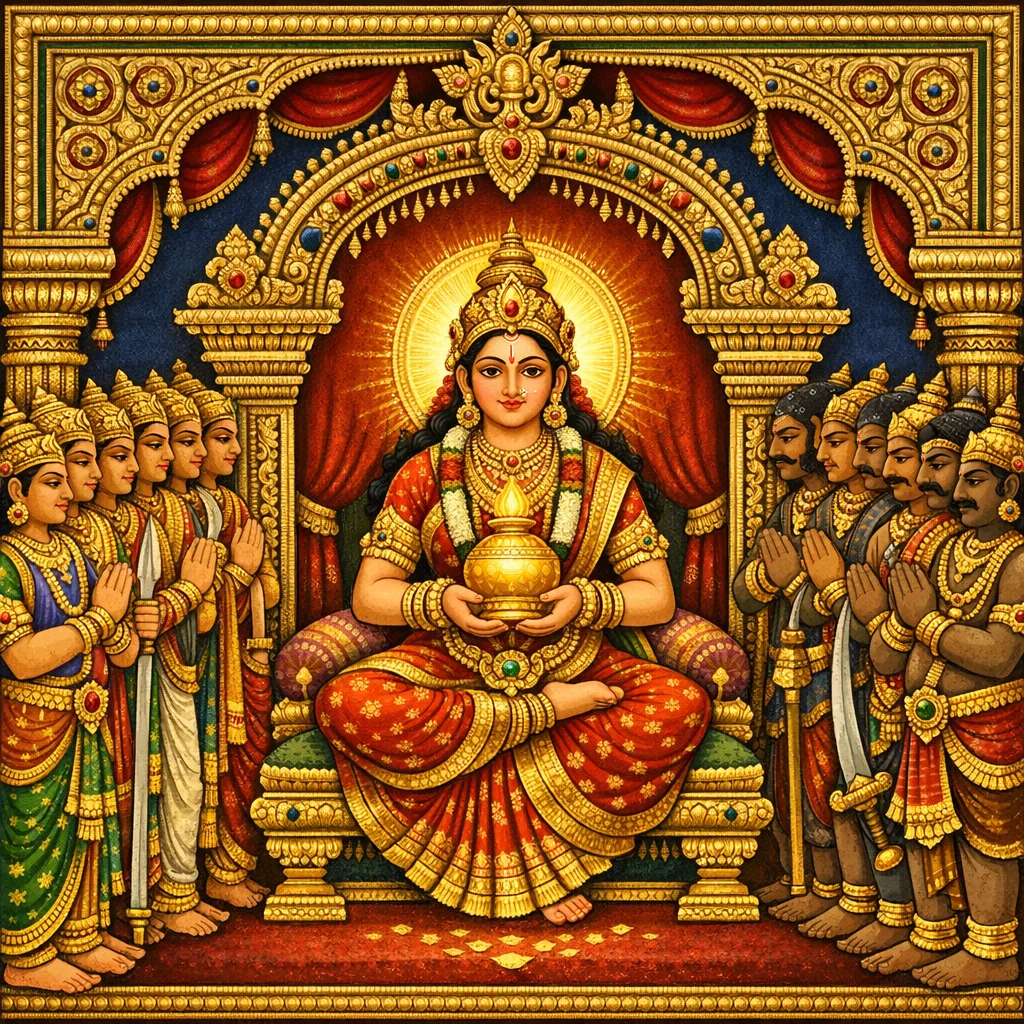
This adhyāya (in the Hayagrīva–Agastya dialogue stream of the Lalitopākhyāna) recounts a crisis when Dhanvantari appears with the amṛta-kalaśa, the nectar vessel. The daityas seize the golden pot, igniting a sura–asura war. Viṣṇu, protector of all worlds, propitiates Lalitā as svaikya-rūpiṇī, one with his own non-dual essence, marking a Śākta turn: victory depends not only on force but on divine māyā/saṃmohana. Lalitā manifests as sarva-saṃmohinī, halts the battle, and persuades the daityas to entrust her with the nectar. She then sets suras and asuras in separate rows and establishes an orderly distribution, governing cosmic conflict through speech, composure, and delusion. Amṛta stands as a symbol of sovereignty, and Śakti as the decisive mediator who ritualizes and reorders the battlefield into rightful allotment.
Shlokas
Verse 1
इति श्रीब्रह्माण्डमहापुराणे उत्तरभागे हयग्रीवागस्त्यसंवादे ललितोपाख्याने अमृतमन्थनं नाम नवमो ऽध्यायः हयग्रीव उवाच अथ देवा महेन्द्राद्या विष्णुना प्रभविष्मुना / अङ्गीकृता महाधीराः प्रमोदं परमं ययुः
Thus, in the Śrī Brahmāṇḍa Mahāpurāṇa, Uttara section, the ninth chapter called “The Churning of Nectar.” Hayagrīva said: then the devas, led by Mahendra, being accepted by mighty Viṣṇu, became steadfast and attained supreme joy.
Verse 2
मलकाद्यास्तु ते सर्वे दैत्या विष्णुपराङ्मुखाः / संत्यक्ताश्च श्रिया देव्या भृशमुद्वेगमागताः
The daityas—Malaka and the rest—turned away from Viṣṇu; forsaken by the Goddess Śrī, they were seized by grievous distress.
Verse 3
ततो जगृहिरे दैत्या धन्वन्तरिकरस्थितम् / परमामृतसाराढ्यं कलशं कनकोद्भवम् / अथासुराणां देवानामन्योन्यं कलहो ऽभवत्
Then the Daityas seized the golden jar held in Dhanvantari’s hand, brimming with the supreme essence of amrita. Thereupon a fierce quarrel arose between the Devas and the Asuras.
Verse 4
एतस्मिन्नन्तरे विष्णुः सर्वलोकैकरक्षकः / सम्यगाराधयामासललितां स्वैक्यरूपिणीम्
Meanwhile Vishnu, the sole guardian of all the worlds, duly worshipped Lalita, who is the very form of His own oneness.
Verse 5
सुराणामसुराणां च रणं वीक्ष्य सुदारुणम् / ब्रह्मा निजपदं प्राप शंभुः कैलासमास्थितः
Beholding the dreadfully fierce battle between the Devas and the Asuras, Brahma returned to his own abode; and Shambhu took his seat upon Kailasa.
Verse 6
मलकं योधयामास दैत्यानामधिपं वृषा / असुरैश्च सुराः सर्वे सांपरायमकुर्वत
Vṛṣā fought Malaka, the lord of the Daityas; and all the Devas waged a life-and-death battle against the Asuras.
Verse 7
भगवानपि योगीन्द्रः समाराध्य महेश्वरीम् / तदेकध्यानयोगेन तद्रूपः समजायत
Even the blessed Lord of yogins, having duly worshipped Maheshvari, by the yoga of single-pointed meditation became of that very form.
Verse 8
सर्वसंमोहिनी सा तु साक्षाच्छृङ्गारनायिका / सर्वशृङ्गारवेषाढ्या सर्वाभरणभूषिता
She was the enchantress of all, truly the very heroine of sacred beauty. Abounding in every graceful attire, she was adorned with all ornaments.
Verse 9
सुराणामसुराणां च निवार्य रणमुल्वणम् / मन्दस्मितेन दैतेयान्मोहयन्ती जगद ह
She checked the dreadful battle of the Devas and Asuras; with a gentle smile she bewildered the Daityas and spoke.
Verse 10
अलं युद्धेन किं शस्त्रेर्मर्मस्थानविभेदिभिः / निष्ठुरैः किं वृथालापैः कण्ठशोषणहेतुभिः
Enough of war; what need is there for weapons that pierce the vital spots? What use are harsh, idle words that only dry the throat?
Verse 11
अहमेवात्र मध्यस्था युष्माकं च दिवौकसाम् / यूयं तथामी नितरामत्र हि क्लेशभागिनः
I alone stand here as mediator between you and the dwellers of heaven. You as well as they—here indeed are sharers in hardship.
Verse 12
सर्वेषां सममेवाद्य दास्याम्यमृतमद्भुतम् / मम हस्ते प्रदातव्यं सुधापात्रमनुत्तमम्
Today I shall give to all, equally, the wondrous Amṛta. Place into my hand the unsurpassed vessel of Sudhā.
Verse 13
इति तस्या वचः श्रुत्वा दैत्यास्तद्वाक्यमोहिताः / पीयूषकलशं तस्यै ददुस्ते मुग्धचेतसः
Hearing her words, the Daityas were deluded by that speech; their minds bewitched, they handed her the jar of amṛta.
Verse 14
सा तत्पात्रं समादाय जगन्मोहनरूपिणी / सुराणामसुराणां च वृथक्पङ्क्तिं चकार ह
She, in a form that enchants the worlds, took that vessel and set the Devas and the Asuras in separate rows.
Verse 15
द्वयोः पङ्क्त्योश्च मध्यस्थास्तानुवाच सुरासुरान् / तूष्णीं भवन्तु सर्वे ऽपि क्रमशो दीयते मया
Standing between the two rows, she addressed Devas and Asuras: “Let all be silent; I shall give to each in due order.”
Verse 16
तद्वाक्यमुररीचक्रुस्ते सर्वे समवायिनः / सा तु संमोहिताश्लेषलोका दातुं प्रचक्रमे
All who had assembled assented to her words; and she, who ensnares the worlds in delusive embrace, began to distribute.
Verse 17
क्वणत्कनकदर्वीका क्वणन्मङ्गलकङ्कणा / कमनीयविभूषाढ्या कला सा परमा बभौ
Her golden ladle rang out, her auspicious bangles chimed; adorned with lovely ornaments, she shone forth as beauty itself, supreme.
Verse 18
वामे वामे करांभोजे सुधाकलशमुज्ज्वलम् / सुधां तां देवतापङ्क्तौ पूर्वं दर्व्या तदादिशत्
In her left lotus-like hand shone the radiant vessel of sudhā, the nectar. She directed that this ambrosia be first ladled out to the ranks of the Devas.
Verse 19
दिशन्ती क्रमशास्तत्र चन्द्रभास्करसूचितम् / दर्वीकरेण चिच्छेद सैंहिकेयं तु मध्यगम् / पीतामृतशिरोमात्रं तस्य व्योम जगाम च
As she dispensed in due order, at the sign shown by Moon and Sun, she severed Saiṃhikeya who stood in the midst with the hand that held the ladle. Only his head, having drunk the amrita, rose into the sky.
Verse 20
तं दृष्ट्वाप्यसुरास्तत्र तूष्णीमासन्विमोहिताः / एवं क्रमेण तत्सर्वं विबुधेभ्यो वितीर्य सा / असुराणां पुरः पात्रं सानिनाय तिरोदधे
Though they saw it, the Asuras there sat in silence, bewildered. Thus, in due order, she bestowed everything upon the Devas; then, taking the vessel before the Asuras, she vanished from sight.
Verse 21
रिक्तपात्रं तु तं दृष्ट्वा सर्वे दैतेयदानवाः / उद्वेलं केवलं क्रोधं प्राप्ता युद्धचिकीर्षया
Seeing the vessel empty, all the Daityas and Dānavas were seized by nothing but surging wrath, eager to wage war.
Verse 22
इन्द्रादयः सुराः सर्वे सुधापानाद्बलोत्तराः / दुर्वलैरसुरैः सार्धं समयुद्ध्यन्त सायुधाः
Indra and all the Devas, strengthened by drinking the sudhā, became mightier. Bearing weapons, they fought against the Asuras, now enfeebled.
Verse 23
ते विध्यमानाः शतशो दानवेन्द्राः सुरोत्तमैः / दिगन्तान्कतिचिज्जग्मुः पातालं कतिचिद्ययुः
Pierced by the foremost of the Suras, hundreds of Dānava kings scattered—some fled to the ends of the horizons, and some went down to Pātāla.
Verse 24
दैत्यं मलकनामानं विजित्य विबुधेश्वरः / आत्मीयां श्रियमाजह्रे श्रीकटाक्ष समीक्षितः
Having conquered the Daitya named Malaka, the Lord of the gods—blessed by Śrī’s gracious glance—reclaimed his own splendor and fortune.
Verse 25
पुनः सिंहासनं प्राप्य महेन्द्रः सुरसेवितः / त्रैलोक्यं पालयामास पूर्ववत्पूर्वदेवजित्
Regaining his throne, Mahendra, attended by the Suras, ruled the three worlds as before—like the former conqueror of the gods.
Verse 26
निर्भया निखिला देवास्त्रैलोक्ये सचराचरे / यथाकामं चरन्ति स्म सर्वदा हृष्टचेतसः
In the three worlds, with all that moves and all that is still, all the gods became fearless; ever joyful at heart, they roamed as they wished.
Verse 27
तदा तदखिलं दृष्ट्वा मोहिनीचरितं मुनिः / विस्मितः कामचारी तु कैलासं नारदो गतः
Then, beholding the whole wondrous conduct of Mohinī, the sage Nārada was astonished; free to roam at will, he went to Kailāsa.
Verse 28
नन्दिना च कृतानुज्ञः प्रणम्य परमेश्वरम् / तेन संभाव्यमानो ऽसौ तुष्टो विष्टरमास्त सः
With Nandin’s permission, he bowed to Parameśvara; honored by His gracious welcome, he was pleased and sat down at ease.
Verse 29
आसनस्थं महादेवो मुनिं स्वेच्छाविहारिणम् / पप्रच्छ पार्वतीजानिः स्वच्छस्फटिकसन्निभः
Mahādeva, Pārvatī’s lord, radiant like pure crystal, questioned the freely wandering sage who sat upon his seat.
Verse 30
भगवन्सर्ववृत्तज्ञ पवित्रीकृतविष्टर / कलहप्रिय देवर्षे किं वृत्तं तत्र नाकिनाम्
O Bhagavan, knower of every affair, who has sanctified this seat; O devarṣi fond of contention, what happened there among the gods?
Verse 31
सुराणामसुराणां वा विजयः समजायत / किं वाप्यमृतवृत्तान्तं विष्णुना वापि किं कृतम्
Was it the devas or the asuras who gained victory? What is the account of the amṛta? And what, too, did Viṣṇu do?
Verse 32
इति पृष्टो महेशेन नारदो मुनिसत्तमः / उवाच विस्मयाविष्टः प्रसन्नवदनेक्षणः
Thus questioned by Maheśa, Nārada, foremost of sages, filled with wonder, spoke with a serene face and shining eyes.
Verse 33
सर्वं जानासि भगवन्सर्वज्ञो ऽसि यतस्ततः / तथापि परिपृष्टेन मया तद्वक्ष्यते ऽधुना
O Bhagavan, you know all things, for you are omniscient. Yet, since I have asked, that shall now be spoken.
Verse 34
तादृशे समरे घोरे सति दैत्यदिवौकसाम् / आदिनारायमः श्रीमान्मोहिनीरूपमादधे
In that dreadful battle between the Daityas and the Devas, the glorious Ādinārāyaṇa assumed the form of Mohinī.
Verse 35
तामुदारविभूषाढ्यां मूर्तां शृङ्गारदेवताम् / सुरासुराः समालोक्य विरताः समरोध्यमात्
Beholding that form adorned with splendid ornaments, like the very deity of allure, both Devas and Asuras ceased from battle and withdrew.
Verse 36
तन्मायामोहिता दैत्याः सुधापात्रं च याचिताः / कृत्वा तामेव मध्यस्थामर्पयामासुरञ्जसा
Deluded by her māyā, the Daityas asked for the vessel of nectar; making her the mediator, they readily handed it over.
Verse 37
तदा देवी तदादाय मन्दस्मितमनोहरा / देवेभ्य एव पीयूषमशेषं विततार सा
Then the Goddess, lovely with a gentle smile, took it and distributed all the nectar solely to the Devas.
Verse 38
तिरोहितामदृष्ट्वा तां दृष्ट्वा शून्यं च पात्रकम् / ज्वलन्मन्युमुखा दैत्या युद्धाय पुनरुत्थिताः
Not seeing her, for she had vanished, and seeing the vessel empty, the Daityas, their faces blazing with wrath, rose again for battle.
Verse 39
अमरैरमृतास्वादादत्युल्वणपराक्रमैः / पराजिता महादैत्या नष्टाः पातालमभ्ययुः
Defeated by the Immortals, whose might had grown exceedingly fierce from tasting the amṛta, the great Daityas, shattered, fled down to Pātāla.
Verse 40
इमं वृत्तान्तमाकर्ण्य भवानीपतिख्ययः / नारदं प्रेषयित्वाशु तदुक्तं सततं स्मरन्
Hearing this account, Bhavānīpati (Śiva) swiftly dispatched Nārada, ever keeping those spoken words in mind.
Verse 41
अज्ञातः प्रमथैः सर्वैः स्कन्दनन्दिविनायकैः / पार्वतीसहितो विष्णुमाजगाम सविस्मयः
Unknown to all the Pramathas—Skanda, Nandī, and Vināyaka—Śiva, accompanied by Pārvatī, came to Viṣṇu in wonder.
Verse 42
क्षीरोदतीरगं दृष्ट्वा सस्त्रीकं वृषवाहनम् / भोगिभोगासनाद्विष्णुः समुत्थाय समागतः
Seeing Vṛṣavāhana (Śiva) with his consort upon the shore of Kṣīroda, Viṣṇu rose from his seat upon the serpent’s coils (Śeṣa) and came forth to greet him.
Verse 43
वाहनादवरुह्येशः पार्वत्या सहितः स्थितम् / तं दृष्ट्वा शीघ्रमागत्य संपूज्यार्घ्यादितो मुदा
The Lord, together with Pārvatī, descended from His mount and stood there. Seeing Him, he hurried forward and, with joy, worshiped Him duly, offering arghya and other sacred gifts.
Verse 44
सस्नेहं गाढमालिङ्ग्य भवानीपतिमच्युतः / तदागमनकार्यं च पृष्टवान्विष्टरश्रवाः
Acyuta, with affection, embraced the Lord of Bhavānī tightly; then Vistaraśravā also asked the purpose of His coming.
Verse 45
तमुवाच महादेवो भगवन्पुरुषोत्तम / महायोगेश्वर श्रीमन्सर्वसौभाग्यसुन्दरम्
Then Mahādeva said: “O Bhagavān, Puruṣottama! O great Lord of Yoga, radiant and auspicious, beautiful with every blessed fortune!”
Verse 46
सर्वसंमोहजनकमवाङ्मनसगोचरम् / यद्रूपं भवतोपात्तं तन्मह्यं संप्रदर्शय
That form which bewilders all and lies beyond speech and mind— the very form You have assumed—show it to me fully and clearly.
Verse 47
द्रष्टुमिच्छामि ते रूपं शृङ्गारस्याधिदैवतम् / अवश्यं दर्शनीयं मे त्वं हि प्रार्थितकामधृक्
I long to behold Your form, the presiding deity of śṛṅgāra. Surely You must grant me this vision, for You fulfill the desires that are earnestly prayed for.
Verse 48
इति संप्रार्थितः शश्वन्महादेवेन तेन सः / यद्ध्यानवैभवाल्लब्धं रूपमद्वैतमद्भुतम्
Thus, continually entreated by that great Mahādeva, he revealed the wondrous, non-dual form obtained through the majesty of meditation.
Verse 49
तदेवानन्यमनसा ध्यात्वा किञ्चिद्विहस्य सः / तथास्त्विति तिरो ऽधत्त महायोगेश्वरो हरिः
Fixing his mind solely upon that, he smiled a little; then Hari, the great Lord of Yoga, said “So be it,” and vanished from sight.
Verse 50
शर्वो ऽपि सर्वतश्चक्षुर्मुहुर्व्यापारयन्क्वचित् / अदृष्टपूर्वमाराममभिरामं व्यलोकयत्
Even Śarva, whose gaze ranges everywhere, kept turning his eyes about and beheld a delightful grove he had never seen before.
Verse 51
विकसत्कुसुमश्रेणीविनोदिमधुपालिकम् / चंपकस्तबकामोदसुरभीकृतदिक्तटम्
The grove was adorned with rows of blossoming flowers where bees sported in delight; the fragrance of campaka clusters perfumed the borders of every quarter.
Verse 52
माकन्दवृन्दमाध्वीकमाद्यदुल्लोलकोकिलम् / अशोकमण्डलीकाण्डसताण्डवशिखण्डिकम्
There was the sweet nectar of mango groves, while restless kokilas poured forth melodious song; upon the branches of clustered aśoka trees, peahens danced in joyous rhythm.
Verse 53
भृङ्गालिनवझङ्कारजितवल्लकिनिस्वनम् / पाटलोदारसौरभ्यपाटलीकुसुमोज्ज्वलम्
The fresh hum of bees seemed to outdo the music of the vallakī (vīṇā); it shone with pāṭalī blossoms and was everywhere suffused with their lavish fragrance.
Verse 54
तमालतालहिन्तालकृतमालाविलासितम् / पर्यन्तदीर्घिकादीर्घपङ्कजश्रीपरिष्कृतम्
It was graced with playful garlands wrought of tamāla, tāla, and hintāla trees, and adorned by the splendor of long-stemmed lotuses in the border ponds.
Verse 55
वातपातचलच्चारुपल्लवोत्फुल्लपुष्पकम् / सन्तानप्रसवामोदसन्तानाधिकवासितम्
Stirred by gusts of wind, lovely shoots swayed and blossoming flowers adorned the grove; and the fragrance of the santāna tree’s flowering made it all the more perfumed.
Verse 56
तत्र सर्वत्र पुष्पाढ्ये सर्वलोकमनोहरे / पारिजाततरोर्मूले कान्ता काचिददृश्यत
There, in that flower-laden grove, enchanting to all the worlds, beneath the pārijāta tree a lovely maiden was seen.
Verse 57
बालार्कपाटलाकारा नवयौवनदर्पिता / आकृष्टपद्मरागाभा चरणाब्जनखच्छदा
She bore the rosy hue of the young sun, radiant with the pride of fresh youth; her luster drew the eye like the padmarāga gem, and even the nails upon her lotus-feet seemed a delicate adornment.
Verse 58
यावकश्रीविनिक्षेपपादलौहित्यवाहिनी / कलनिःस्वनमञ्जीरपदपद्ममनोहरा
Dyed with the splendor of yāvaka, her feet pour forth a rosy radiance; with the sweet chiming of anklets, her lotus-feet appear utterly enchanting.
Verse 59
अनङ्गवीरतूणीरदर्पोन्मदनजङ्घिका / करिशुण्डाकदलिकाकान्तितुल्योरुशोभिनी
Her calves rouse proud delight, like the quiver of Ananga’s hero; and her thighs shine in beauty, equal in luster to an elephant’s trunk and the stem of the plantain.
Verse 60
अरुणेन दुकूलेन सुस्पर्शेन तनीयसा / अलङ्कृतनितंबाढ्या जघनाभोगभासुरा
She is clad in a crimson dukūla, delicate and soft to the touch; adorned with ornaments, full in the hips, she shines with the radiant fullness of her broad loins.
Verse 61
नवमाणिक्यसन्नद्धहेमकाञ्जीविराजिता / नतनाभिमहावर्त्तत्रिवल्यूर्मिप्रभाझरा
She shines with a golden kāñjī girdle set with fresh rubies; her gently hollowed navel is a mighty whirl, and the wavelike radiance of her trivalī pours forth like a shower of light.
Verse 62
स्तनकुड्मलहिन्दोलमुक्तादामशतावृता / अतिपीवरवक्षोजभारभङ्गुरमध्यभूः
She is veiled in hundreds of pearl garlands, swaying like a swing about the budding breasts; and beneath the weight of her exceedingly full bosom, her waist appears tenderly fragile.
Verse 63
शिरीषकोमलभुजा कङ्कणाङ्गदशालिनी / सोर्मिकां गुलिमन्मृष्टशङ्खसुन्दरकन्धरा
Her arms were tender as the śirīṣa blossom, adorned with bangles and armlets; her fingers shone with a ring, and her neck was lovely like the sacred śaṅkha conch.
Verse 64
मुखदर्पणवृत्ताभचुबुकापाटलाघरा / शुचिभिः पङ्क्तिभिः शुद्धैर्विद्यारूपैर्विभास्वरैः
Her face was round like a mirror, her lips pātala-red; and her pure, radiant rows of teeth shone forth like the luminous form of Vidyā.
Verse 65
कुन्दकुड्मलसच्छायैर्दन्तैर्दर्शितचन्द्रिका / स्थूलमौक्तिकसन्नद्धनासाभरणभासुरा
Her teeth, white as kunda buds, revealed a moonlit radiance; and her nose-ornament, set with large pearls, made her shine all the more.
Verse 66
केतकान्तर्द्दलद्रोणिदीर्घदीर्घविलोचना / अर्धेन्दुतुलिताफाले सम्यक्कॢप्तालकच्छटा
Her eyes were long, long like ketakī petals; and upon her brow, likened to a half-moon, the well-arranged cascade of curls spread its charm.
Verse 67
पालीवतंसमाणिक्यकुण्डलामण्डितश्रुतिः / नवकर्पूरकस्तूरीरसामोदितवीटिका
Her ears were adorned with pālī-vataṃsa ornaments and ruby earrings; and she delighted in the vīṭikā, fragrant with fresh camphor and the essence of musk.
Verse 68
शरच्चरुनिशानाथमण्डलीमधुरानना / स्फुरत्कस्तूरितिलका नीलकुन्तलसंहतिः
Her face was sweet like the autumn moon’s full orb; a shining musk-tilaka adorned her brow, and her dark blue-black tresses were thick and gathered.
Verse 69
सीमन्तरेखाविन्यस्तसिंदूरश्रेणिभासुरा
She shone with the line of sindūra set upon the parting of her hair.
Verse 70
स्फरच्चन्द्रकलोत्तंसमदलोलविलोचना / सर्वशृङ्गारवेषाढ्या सर्वाभरणमण्डिता
She gleamed with the crescent-moon ornament; her eyes swayed, languid with rapture; rich in every śṛṅgāra attire, she was adorned with all ornaments.
Verse 71
तामिमां कन्दुकक्रीडालोलामालोलभूषणाम् / दृष्ट्वा क्षिप्रमुमां त्यक्त्वा सो ऽन्वधावदथेश्वरः
Seeing her, absorbed in ball-play, her ornaments swaying, the Lord at once left Umā and ran after her.
Verse 72
उमापि तं समोवेक्ष्य धावन्तं चात्मनः प्रियम् / स्वात्मानं स्वात्मर्सोन्दर्यं निन्दन्ती चातिविस्मिता / तस्थाववाङ्मुखी तूष्णीं लज्जासूयासमन्विता
Umā too beheld her beloved running; utterly astonished, she reproached herself and her own beauty. Then, filled with shame and jealousy, she stood silent, her face cast down.
Verse 73
गृहीत्वा कथमप्येनामालिलिग मुहुर्मुहुः / उद्धूयोद्धूय साप्येवं धावति स्म सुदूरतः
Somehow seizing her, he embraced her again and again; yet she, shaking herself free, ran off to a far distance.
Verse 74
पुनर्गृहीत्वा तामीशः कामं कामवशीसृतः / आश्र्लिष्टं चातिवेगेन तद्वीर्यं प्रच्युतं तदा
Again the Lord, swayed by desire, seized her and clasped her with impetuous speed; then his virile essence was released at that moment.
Verse 75
ततः समुत्थितो देवो महाशास्ता महाबलः / अनेककोटिदैत्येन्द्रगर्वनिर्वापणक्षमः
Then arose the Deva Mahāśāstā, of mighty strength, able to quench the pride of countless crores of Daitya lords.
Verse 76
तद्वीर्यबिन्दुसंस्पर्शात्सा भूमिस्तत्रतत्र च / रजतस्वर्मवर्णाभूल्लक्षणाद्विन्ध्यमर्दन
O Vindhyamardana! By the touch of that drop of virile essence, the earth in various places took on, as a mark, a hue like silver and gold.
Verse 77
तथैवान्तर्दधे सापि देवता विश्वमोहिनी / निवृत्तः स गिरीशो ऽपि गिरिं गौरीसखो ययौ
So too that goddess, the enchantress of the worlds, vanished from sight; and Girīśa, companion of Gaurī, desisted and went to his mountain.
Verse 78
अथाद्भुतमिदं वक्ष्ये लोपामुद्रापते शृणु / यन्न कस्यचिदाख्यातं ममैव त्दृदयेस्थितम्
Now I shall speak this wondrous matter; O husband of Lopāmudrā, listen. What has been told to none abides within my own heart.
Verse 79
पुरा भण्डासुरो नाम सर्वदैत्यशिखामणिः / पूर्वं देवान्बहुविधान्यः शास्ता स्वेच्छया पटुः
In ancient times there was an asura named Bhaṇḍāsura, the crest-jewel of all the daityas. Skilled and acting at his own will, he chastised the gods in many ways.
Verse 80
विशुक्रं नाम दैतेयं वर्गसंरक्षणक्षमम् / शुक्रतुल्यं विचारज्ञं दक्षांसेन ससर्ज सः
From his right side he created a daitya named Viśukra, able to safeguard his host—equal to Śukra and wise in discernment.
Verse 81
वामांसेन विषाङ्गं च सृष्टवान्दुष्टशेखरम् / धूमिनीनामधेयां च भगिनीं भण्डदानवः
From his left side Bhaṇḍa the dānava created Viṣāṅga, the very crest of the wicked; and he also brought forth his sister named Dhūminī.
Verse 82
भ्रातृभ्यामुग्रवीर्याभ्यां सहितो निहताहितः / ब्रह्माण्डं खण्डयामास शौर्यवीर्यसमुच्छ्रितः
Joined with his two brothers of fierce might, slaying his foes, he rose in valor and power and began to rend the Brahmāṇḍa itself into fragments.
Verse 83
ब्रह्मविष्णुमहेशाश्च तं दृष्ट्वा दीप्ततेजसम् / पलायनपराः सद्यः स्वे स्वे धाम्नि सदावसन्
Brahmā, Viṣṇu, and Maheśa, beholding him of blazing splendor, at once turned to flight and withdrew to their own divine abodes.
Verse 84
तदानीमेव तद्बाहुमंमर्द्दन विमूर्च्छिताः / श्वसितुं चापि पटवो नाभवन्नाकिनां गणाः
In that very moment, crushed by the pressure of his arm, the hosts of the gods swooned; they were not even able to draw breath.
Verse 85
केचित्पातालगर्भेषु केचिदंबुधिवारिषु / केचिद्दिगन्तकोणेषु केचित्कुञ्जेषु भूभृताम्
Some hid in the womb of Pātāla, some in the waters of the ocean, some in the farthest corners of the horizons, and some in the thickets of the mountains.
Verse 86
विलीना भृशवित्रस्तास्त्यक्तदारसुतस्त्रियः / भ्रष्टाधिकारा ऋभवो विचेरुश्छन्नवेषकाः
Stricken with great terror, they seemed to melt away; abandoning wife, son, and womenfolk, the Ṛbhus—bereft of their offices—wandered about in hidden disguises.
Verse 87
यक्षान्महोरगान्सिद्धान्साध्यान्समरदुर्मदान् / ब्रह्माणं पद्मनाभं च रुद्रं वज्रिणमेव च / मत्वा तृणायितान्सर्वांल्लोकान्भण्डः शशासह
Counting the Yakṣas, Mahoragas, Siddhas, Sādhyas proud in battle—and even Brahmā, Padmanābha (Viṣṇu), Rudra, and Indra the wielder of the vajra—as mere blades of grass, Bhaṇḍa ruled over all the worlds.
Verse 88
अथ भण्डासुरं हन्तुं त्रैलोक्यं चापि रक्षितुम् / तृतीयमुदभूद्रूपं महायागानलान्मुने
Then, to slay Bhaṇḍāsura and to safeguard the three worlds, O sage, a third divine form arose from the fire of the great sacrifice.
Verse 89
यद्रूपशालिनीमाहुर्ललिता परदेवताम् / पाशाङ्कुशधनुर्वाणपरिष्कृतचतुर्भुजाम्
She whose form is radiant is hailed as Lalitā, the Supreme Goddess—four-armed, adorned with the noose, goad, bow, and arrows.
Verse 90
सा देवी परम शक्तिः परब्रह्मस्वरूपिणी / जघान भण्डदैत्येन्द्रं युद्धे युद्धविशारदा
That Goddess is the Supreme Śakti, the very form of Parabrahman; skilled in battle, she slew Bhaṇḍa, lord of the daityas, in war.
Frequently Asked Questions
The daityas seize Dhanvantari’s amṛta-kalaśa, provoking a deva–asura clash; Viṣṇu invokes Lalitā, who appears as sarva-saṃmohinī, stops the war, receives the nectar, and organizes its controlled distribution by separating the parties into two rows.
This chapter is primarily episodic (Lalitopākhyāna theophany and conflict mediation) rather than a king-list; genealogical utility is indirect—identifying divine agents (devas/daityas) and their factional roles within cosmic time rather than enumerating a royal vamśa.
Lalitā embodies governance through Śakti: her saṃmohana and authoritative speech convert chaotic battle into ordered allocation, presenting cosmic order as maintained by divine power/knowledge (māyā) rather than by violence alone—an interpretive hallmark of the Lalitopākhyāna.