Adhyaya 72
Vṛṣṇivaṃśa–Anukīrtana (Enumeration of the Vṛṣṇi Lineage) — Questions on Viṣṇu’s Human Descent
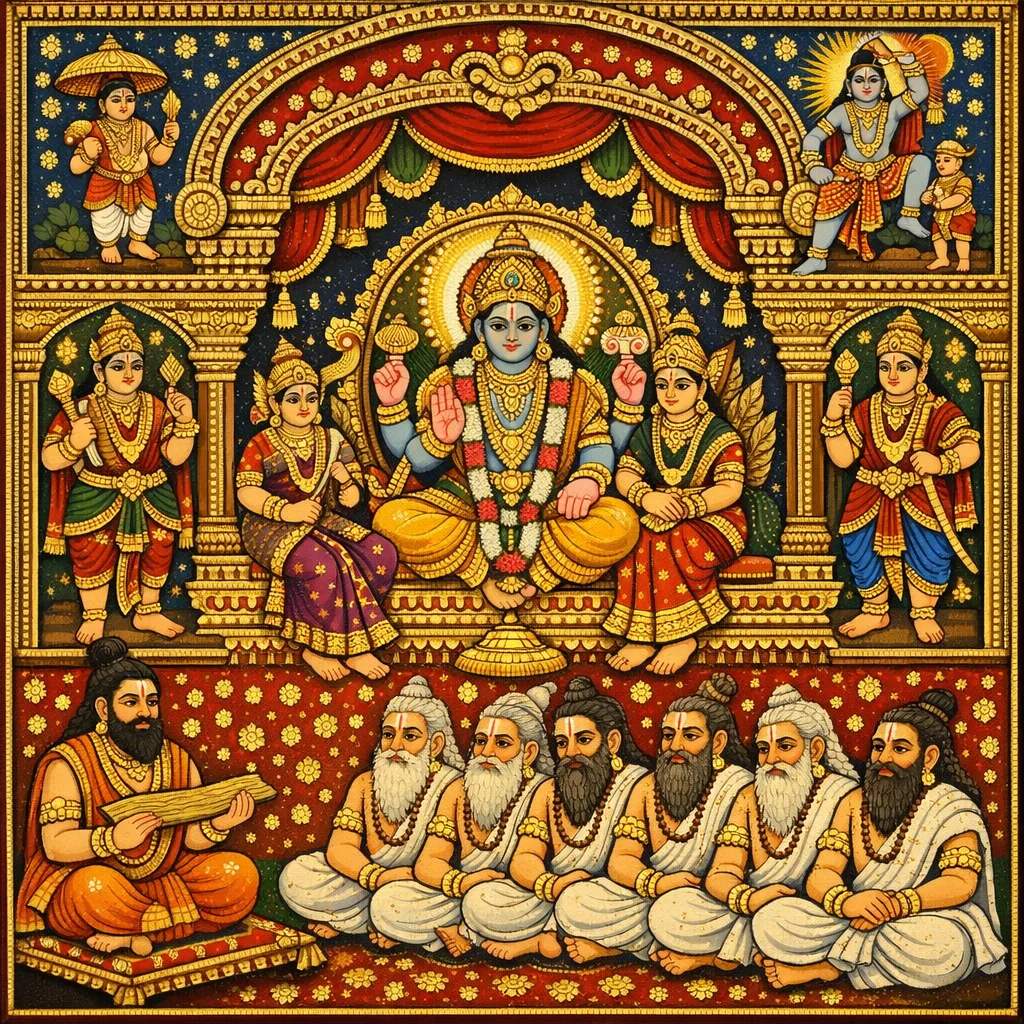
This adhyāya begins as a formal catalogue: Sūta enumerates the human-appearing divine heroes of the Vṛṣṇi line—Saṃkarṣaṇa, Vāsudeva, Pradyumna, Sāṃba, and Aniruddha—explicitly calling them vaṃśa-vīras (heroes of the lineage). The list widens to include revered witnesses and participants (the Saptarṣis, Kubera, Nārada, Dhanvantari, Mahādeva, and Viṣṇu with attendant deities), evoking a sacral assembly in which the genealogy is proclaimed. The narration then turns to theological inquiry: the ṛṣis ask why Viṣṇu repeatedly manifests among humans, why he chooses brahmin–kṣatriya settings, and how the cosmic ruler can become a cowherd (gopatva), enter a womb, and yet remain the establisher of the world’s order, as in the Trivikrama/Vāmana paradigm. Thus the chapter combines structured genealogical enumeration with avatāra-theology questions that interpret the Supreme Deity’s accessible human descents within purāṇic history.
Shlokas
Verse 1
इति श्रीब्रह्माण्डे महापुराणे वायुप्रोक्ते मध्यमभागे तृतीय उपोद्धातपदे वृष्णिवंशानुकीर्त्तनं नामैकसप्ततितमो ऽध्यायः // ७१// सूत उवाच मनुष्यप्रकृतीन्देवान्कीर्त्यमानान्निबोधत / संकर्षणो वासुदेवः प्रद्युम्नः सांब एव च
Thus, in the holy Brahmanda Mahapurana, in the middle section proclaimed by Vayu, the seventy-first chapter is called “The Recitation of the Vrishni Lineage.” Suta said: Hear of the gods of human nature who are being praised—Sankarshana, Vasudeva, Pradyumna, and Samba.
Verse 2
अनिरुद्धश्च पञ्चैते वंशवीराः प्रकीर्त्तिताः / सप्तर्ष्यः कुबेरश्च यज्ञे मणिवरस्तथा
With Aniruddha, these five are proclaimed as heroes of the lineage; and also the Seven Ṛṣis, Kubera, and Maṇivara in the sacred yajña.
Verse 3
शालूकिर्नारदश्चैव विद्वान्धन्वन्तरिश्तथा / नन्दिनश्च महादेवः सालकायन एव च / आदिदेव स्तदा विष्णुरेभिश्च सह दैवतैः
Śālūki, Nārada, and the wise Dhanvantari; Nandin, Mahādeva, and Sālakāyana; and then Ādideva Viṣṇu as well, together with these deities.
Verse 4
ऋषय ऊचुः विष्णुः किमर्थं संभूतः स्मृताः संभूतयः कति / भविष्याः कति चान्ये च प्रादुर्भावा महात्मनः
The Ṛṣis said: “For what purpose did Viṣṇu manifest? How many manifestations are remembered in the smṛtis? How many are yet to come, and what other divine epiphanies of that great-souled One will there be?”
Verse 5
ब्रह्मक्षत्रेषु शस्तेषु किमर्थमिह जायते / पुनः पुनर्मनुष्येषु तन्नः प्रब्रूहि पृच्छताम्
Among the noble brāhmaṇas and kṣatriyas, for what reason is He born here? And why does He come again and again among humankind? Tell us, for we ask.
Verse 6
विस्तरेणैव सर्वाणि कर्माणि रिपुघातिनः
Describe in full detail all the deeds of the Slayer of foes.
Verse 7
श्रोतुमिच्छामहे सम्यग्वद कृष्णस्य धीमतः / कर्मणामानुपूर्वीं च प्रादुर्भावाश्च ये प्रभो
O Lord, we long to hear clearly the true order of the deeds of wise Śrī Kṛṣṇa, and all the manifestations by which He appeared; pray tell us.
Verse 8
या वास्य प्रकृतिस्तात तां चास्मान्वक्तुमर्हसि / कथं स भगवान्विष्णुः सुरेष्वरिनिषूदनः
O revered one, you are fit to tell us also of His nature (prakṛti); and how that Bhagavān Viṣṇu, slayer of the foes of the gods, (came to descend).
Verse 9
वसुदेवकुले धीमान्वासुदेवत्वमागतः / अमरैरावृतं पुण्यं पुण्यकृद्भिरलङ्कृतम्
That wise One appeared in the house of Vasudeva, attaining the state of Vāsudeva; that holy realm was encircled by the Immortals and adorned by doers of merit.
Verse 10
देवलोकं किमुत्सृज्य मर्त्यलोकमिहागतः / देवमानुषयोर्नेता धातुर्यः प्रसवो हरिः
Why did He forsake the world of the gods and come here to the mortal realm? For Hari is the leader of gods and men, the very cause from whom even Dhātā (the Ordainer) arises.
Verse 11
किमर्थं दिव्यमात्मानं मानुष्ये समवेशयत् / यश्चक्रं वर्त्तयत्येको मनुष्याणां मनोमयम्
For what purpose did He place His divine Self within the human state? He alone turns the mind-made wheel within all mankind.
Verse 12
मानुष्ये स कथं बुद्धिं चक्रे चक्रभृतां वरः / गोपायन यः कुरुते जगतः सर्वकालिकम्
In human form, how did the Supreme Lord, best of the bearers of the discus, fashion such resolve—He who guards the world for all time?
Verse 13
स कथं गां गतो विष्णुर्गोपत्वमकरोत्प्रभुः / महाभूतानि भूतात्मा यो दधार चकार ह
How did Vishnu the Lord come to earth and take up the calling of a cowherd—He who, as the Soul of beings, upholds the great elements?
Verse 14
श्रीगर्भः स कथं गर्भे स्त्रिया भूचरया वृतः / येन लोकान्क्रमैर्जित्वा सश्रीकास्त्रिदशाः कृताः
How was the Lord, Sri-garbha, enclosed within the womb of a woman who walks the earth—He who, conquering the worlds in due steps, made the gods radiant with fortune?
Verse 15
स्थापिता जगतो मार्गास्त्रिक्रमं वपुराहृतम् / ददौ जितां वसुमतीं सुराणां सुरसत्तमः
The paths of the world were set in order; the sacred form of Trikrama was revealed. The best of the gods bestowed the conquered earth upon the devas.
Verse 16
येन सैंहं वपुः कृत्वा द्विधाकृत्वा च तत्पुनः / पूर्वदैत्यो महावीर्यो हिरण्यकशिपुर्हतः
By Him who assumed a lion’s form and tore him asunder, the mighty asura of old, Hiranyakashipu, was slain.
Verse 17
यः पुरा ह्यनलो भूत्वा त्वौर्वः संवर्त्तको विभुः / पातालस्थोर्ऽणवगतः पपौ तोयमयं हविः
He who long ago became fire—Aurva, the mighty Saṃvartaka—went to the ocean in Pātāla and drank the oblation made of water.
Verse 18
सहस्रचरणं देवं सहस्रांशुं सहस्रशः / सहस्रशिरसं देवं यमाहुर्वै युगे युगे
The God of a thousand feet, of a thousand rays, of a thousand heads—thus is He proclaimed, age after age.
Verse 19
नाभ्यरण्यां समुद्भूतं यस्य पैतामहं गृहम् / एकार्णवगते लोके तत्पङ्कजमपङ्कजम्
He whose Pitāmaha’s (Brahmā’s) abode arose from the forest of the navel—when the world was sunk in the single ocean, that lotus remained a lotus unstained by mire.
Verse 20
येन ते निहता दैत्याः संग्रामे तारकामये / सर्वदेवमयं कृत्वा सर्वायुधधरं वपुः
In the Tārakāmaya war, by assuming a form made of all the gods and bearing every weapon, He slew those Daityas.
Verse 21
महाबलेन वोत्सिक्तः कालनेमिर्निपातितः / उत्तरांशे समुद्रस्य क्षीरोदस्यामृतोदधेः / यः शेतेशश्वतं योगमाच्छाद्य तिमिरं महत्
Kālanemi, swollen with great might, was cast down; in the northern reach of the Kṣīroda Ocean, the sea of amṛta, He lies in everlasting yoga, veiling the vast darkness.
Verse 22
सुरारणीगर्भमधत्त दिव्यं तपःप्रकर्षाददितिः पुरायम् / शक्रं च यो दैत्यगणं च रूद्धं गर्भावमानेन भृशं चकार ह
In ancient times Aditi, by the height of her austerity, bore the divine womb of Surāraṇī; and because the pregnancy was dishonored, he sternly restrained Śakra (Indra) and the host of Daityas.
Verse 23
पदानि यो लोकपदानि कृत्वा चकार दैत्यान्सलिलेशयांस्तान् / कृत्वा च देवांस्त्रिदिवस्य देवांश्चक्रे सुरेशं पुरुहूतमेव
He established the stations of the world’s order and made those Daityas lie in the waters; and making the gods the deities of Tridiva, he appointed Puruhūta Indra as lord of the Suras.
Verse 24
गार्हपत्येन विधिना अन्वाहार्येण कर्मणा
By the ordinance of the Gārhapatya fire, and by the Anvāhārya rite, in accordance with sacred rule.
Verse 25
अग्निमाहवनीयं च वेदीं चैव कुशं स्रुवम् / प्रोक्षणीयं श्रुतं चैव आवभृथ्यं तथैव च
He also set in order the Āhavanīya fire, the altar, kuśa grass and the sruva ladle; the sprinkling water, the sacred recitation, and the concluding bath-rite (āvabhṛthya) as well.
Verse 26
अथर्षींश्चैव यश्चक्रे हव्यभागप्रदान्मखे / हव्यादांश्च सुरांश्चक्रे कव्यादांश्च पितॄनपि / भोगार्थं यज्ञविधिना यो यज्ञो यज्ञकर्मणि
He who, in the sacrifice, ordered the Ṛṣis by granting them their shares of havya; who made the Suras the receivers of havya and the Pitṛs the receivers of kavya; and the yajña which, by sacrificial law, is performed in the work of sacrifice for the enjoyment of its fruits—he is that very Yajña.
Verse 27
यूपान्समित्स्रुवं सोमं पवित्रं परिधीनपि / यज्ञियानि च द्रव्याणि यज्ञियांश्च तथानलान्
The yūpa posts, the kindling sticks, the ladle, the Soma, the purifier, and the altar-enclosures; and also the sacrificial substances and the sacred fires of the yajña.
Verse 28
सदस्यान्यजमानांश्च ह्यश्वमेधान्क्रतुत्तमान् / विचित्रान्राजसूयदीन्पारमेष्ठ्येन कर्मणा
The sadasyas and the yajamānas; the supreme rites such as the Aśvamedha; and the wondrous Rājasūya and others—these are wrought through the pārameṣṭhya act.
Verse 29
उद्गात्रादींश्च यः कृत्वा यज्ञांल्लोकाननुक्रमम् / क्षणा निमेषाः काष्ठाश्च कलास्त्रैकाल्यमेव च
He who appointed the priests beginning with the Udgātā, and set in due succession the yajñas and the worlds; who also ordained the kṣaṇa, the nimeṣa, the kāṣṭhā, the kalā, and the threefold time.
Verse 30
मुहूर्त्तास्तिथयो मासा दिनं संवत्सरं तथा / ऋतवः कालयोगाश्च प्रमाणं त्रिविधं त्रिषु
Muhurta, tithi, month, day, and year; and the seasons and the conjunctions of time—thus, in the three worlds, measure is threefold.
Verse 31
आयुः क्षेत्राण्यथ बलं क्षणं यद्रूपसौष्ठवम् / मेधावित्वं च शौर्यं च शास्त्रस्येव च पारणम्
Life-span, domains, strength, and the moment in which the beauty of form is perfected; brilliance of intellect and valor, and also the devout recitation of the śāstras.
Verse 32
त्रयो वर्णास्त्रयो लोकास्त्रैविद्यं पावकास्त्रयः / त्रैकाल्यं त्रीणि कर्माणि तिस्रो मात्रा गुणास्त्रयः
Three are the varṇas, three the worlds, the triple sacred knowledge, and three holy fires; threefold is time, three are the rites, three the measures, and three the guṇas.
Verse 33
सृष्टा लोकेश्वराश्चैव येन येन च कर्मणा / सर्वभूतगणाः सृष्टाः सर्वभूतगणात्मना
By whatever acts the lords of the worlds were brought forth, by that very One—who is the Self of all hosts of beings—were all hosts of creatures created.
Verse 34
क्षणं संधाय पूर्वेण योगेन रमते च यः / गतागतानां यो नेता सर्वत्र विविधेश्वरः
He who, by the yoga spoken of before, unites for a moment and abides in delight; the guide of all who come and go, the manifold Lord present everywhere.
Verse 35
यो गतिर्द्धर्मयुक्तानामगतिः पापकर्मणाम् / चातुर्वर्ण्यस्य प्रभवश्चातुर्वर्ण्यस्य रक्षिता
He is the refuge of those devoted to dharma, and the loss of refuge for doers of sinful deeds; he is the source of cāturvarṇya and the protector of cāturvarṇya.
Verse 36
चातुर्विद्यस्य यो वेत्ता चातुराशम्यसंश्रयः / दिगन्तरं नभो भूमिरापो वायुर्विभावसुः
He is the knower of the fourfold sacred learning and the refuge of the four āśramas; he is the expanse of the quarters, the sky, the earth, the waters, the wind, and Vibhāvasu—the radiant fire.
Verse 37
चन्द्रसूर्यद्वयं ज्योतिर्युगेशाः क्षणदाचराः / यः परं श्रुयते देवो यः परं श्रूयते तपः
The twin radiance of moon and sun; Lord of the yugas, moving in a moment. He is heard of as the Supreme Deva, and he is heard of as the Supreme Tapas.
Verse 38
यः परं तमसः प्राहुर्यः परं परमात्मवान् / आदित्यादिस्तु यो देवो यश्च दैत्यान्तको विभुः
He is said to be beyond darkness (tamas), the Supreme, abiding as the Paramātman. He is the primal Deva among the Ādityas, and the mighty slayer of the Daityas.
Verse 39
युगान्तेष्वन्तको यश्च यश्च लोकान्तकान्तकः / सेतुर्यो लोकसेतूनां मेधो यो मध्यकर्मणाम्
At the end of the yugas he is Antaka, and he is the end even of the world-destroyer. He is the bridge of all the world’s bridges, the medhā—keen wisdom—of deeds in the midst.
Verse 40
वेद्यो यो वेदविदुषां प्रभुर्यः प्रभवात्मनाम् / सोमभूतस्तु भूतानामग्निभूतो ऽग्निवर्चसाम्
Knowable to the knowers of the Veda, Lord of all beings of originating power. For creatures he becomes Soma, and for those radiant with fire he becomes Agni.
Verse 41
मनुष्याणां मनुर्भूतस्तपोभूतस्तपस्विनाम् / विनयो नयतृप्तानां तेजस्तेजस्विनामपि
For humankind he becomes Manu; for ascetics he becomes Tapas. For those content in righteous guidance he is humility, and for the radiant he is tejas—splendour as well.
Verse 42
विग्रहो विग्रहाणां यो गतिर्गतिमतामपि / आकाशप्रभवो वायुर्वायुप्राणो हुताशनः
He is the form of all forms and the supreme goal even of the swift; from Ākāśa arises Vāyu, from Vāyu the Prāṇa, and from Prāṇa manifests Hutāśana (Agni).
Verse 43
देवा हुताशनप्राणाः प्राणो ऽग्नेर्मधुसूदनः / रसाच्छोणितसंभूतिः शोणितान्मासमुच्यते
The Devas are the Prāṇa of Hutāśana (Agni), and Agni’s Prāṇa is Madhusūdana (Viṣṇu). From rasa arises śoṇita (blood), and from śoṇita is said to come māṃsa (flesh).
Verse 44
मांसात्त मेदसो जन्म मेदसो ऽस्थि निरुच्यते / अस्य्नो मज्जा समभवन्मज्जातः शुक्रसंभवः
From māṃsa (flesh) is born medas (fat), and from medas is declared asthi (bone). From bone arises majjā (marrow), and from marrow comes śukra (seed).
Verse 45
शुक्राद्गर्भः समाभव द्रसमूलेन कर्मणा / तत्रापां प्रथमावापः स सौम्यो राशिरुच्यते
From śukra the embryo (garbha) comes to be, through action whose root is rasa. There occurs the first infusion of the waters; that is called the Saumya rāśi, of Soma’s nature.
Verse 46
गर्भो ऽश्मसंभवो ज्ञेयो द्वितीयो राशिरुच्यते / शुक्रं सोमात्मकं विद्यादार्त्तवं पावकात्मकम्
Know the embryo (garbha) to arise from aśma, the dense, stone-like principle; this is called the second rāśi. Understand śukra as Soma-natured, and ārtava as Pāvaka-natured (Agni).
Verse 47
भावौ रसानुगावेतौ वीर्ये च शशिपावकौ / कफवर्गे भवेच्छुक्रं पित्तवर्गे च शोणितम्
Bhāva and rasa are said to follow one another; in vīrya abide the natures of moon and fire. In the kapha class arises śukra, and in the pitta class arises śoṇita (blood).
Verse 48
कफस्य त्दृदयं स्थानं नाभ्यां पित्तं प्रतिष्ठितम् / देहस्य मध्ये त्दृदयं स्थानं तु मनसः स्मृतम्
The seat of kapha is the heart, and at the navel pitta is established. The heart in the body’s midst is also remembered as the abode of manas (mind).
Verse 49
नाभिश्चोदर संस्था तु तत्र देवो हुताशनः / मनः प्रजापतिर्ज्ञेयः कफः सोमो विभाव्यते
The navel is set within the belly; there dwells the god Hutāśana (Agni). Manas is to be known as Prajāpati, and kapha is to be contemplated as Soma.
Verse 50
पित्तमग्निः स्मृतो ह्येतदग्नीषोमात्मकं जगत् / एवं प्रवर्त्तिते गर्भे वृत्ते कर्कन्धुसंनिभे
Pitta is remembered as fire; this world is of the nature of Agni and Soma. Thus the embryo proceeds, becoming round like the karkandhu fruit.
Verse 51
वायुः प्रवेशनं चक्रे संगतः परमात्मना / स पञ्चधा शरीरस्थो विद्यते वर्द्धयेत्पुनः
Vāyu entered (the womb), united with the Paramātman. Abiding in the body in fivefold form, it again brings about growth.
Verse 52
प्राणापानौ समानश्च ह्युदानो व्यान एव च / प्राणो ऽस्य परमात्मानं वर्द्धयन्परिवर्त्तते
Prāṇa, apāna, samāna, udāna, and vyāna—all these; prāṇa, increasing within him the essence of the Paramātman, continually moves and circulates.
Verse 53
अपानः पश्चिमं कायमु दानो ऽर्द्धं शरीरिणः / व्यानो व्यानीयते येन समानः सर्वसंधिषु
Apāna abides in the body’s western/back region; udāna in half of the embodied being; vyāna is that by which the movement is carried everywhere; and samāna dwells in all the joints.
Verse 54
भूतावाप्तिस्ततस्तस्य जायतेन्द्रियगोचरा / पृथिवी वायुराकाशमापो ज्योतिश्च पञ्चमम्
Thereafter arises for him the attainment of the sense-perceptible elements: earth, wind, ākāśa (ether), waters, and as the fifth, tejas—radiant fire.
Verse 55
सर्वेद्रियनिविष्टास्ते स्वस्वयोगं प्रचक्रिरे / पार्थिवं देहमाहुस्तु प्राणात्मानं च मारुतम्
All of them, entering into the senses, set their respective functions in motion; the body is called earthly, and the self of prāṇa is called māruta—of the nature of wind.
Verse 56
छिद्राण्याकाशयोनीनि जलात्स्रावः प्रवर्त्तते / ज्योतिश्चक्षुषि कोष्ठो ऽस्मात्तेषां यन्नामतः स्मृतम्
The bodily openings are born of ākāśa; from water the flow of secretions proceeds; and in the eye abides tejas, the light—therefore their names are remembered thus in tradition.
Verse 57
संग्राह्य विषयांश्चैव यस्य वीर्यात्प्रवर्तिताः / इत्येतान्पुरुषः सर्वान्सृजत्येकः सनातनः
By His potency even the graspable objects are set in motion; thus the one eternal Purusha creates them all.
Verse 58
नैधने ऽस्मिन्कथं लोके नरत्वं विष्णुरागतः / एष नः संशयो धीमन्नेष वै विस्मयो महान्
O wise one, how in this perishing world did Vishnu come to humanhood? This is our doubt; truly it is a great wonder.
Verse 59
कथं गतिर्गतिमतामापन्नो मानुषीं तनुम् / श्रोतुमिच्छामहे विष्णोः कर्माणि च यथाक्रमम्
How did Vishnu, the supreme goal of all who move onward, assume a human body? We wish to hear Vishnu’s deeds in due order.
Verse 60
आश्चर्यं परमं विष्णुर्वेदैर्देवश्चै कथ्यते / विष्णोरुत्पत्तिमाश्चय कथयस्व महामते
The Vedas proclaim Vishnu as the supreme wonder and as Deva. O great-minded one, tell of Vishnu’s wondrous manifestation.
Verse 61
एतदाश्चर्यमाख्यातं कथ्यतां वै सुखावहम् / प्रख्यातबलवीर्यस्य प्रादुर्भावन्महात्मनः / कर्मणाश्चर्यभूतस्य विष्णोः सत्त्वमिहोच्यते
Let this wonder be told, for it surely brings joy: here is spoken the manifestation of the great-souled One famed for strength and valor, and the pure nature of Vishnu, wondrous through His deeds.
Verse 62
सूत उवाच अहं वः कीर्त्तयिष्यामि प्रादुर्भावं महात्मनः
Suta said: I shall recount to you the sacred manifestation of that great-souled one.
Verse 63
यथा बभूव भगवान्मानुषेषु महातपाः / भृगुस्त्रीवधदोषेण भृगुशापेन मानुषे
How the Blessed Lord, the great ascetic, came to be among humankind—through the fault of slaying Bhrigu’s wife, and by Bhrigu’s curse, in a human form.
Verse 64
जायते च युगान्तेषु देवकार्यार्थसिद्धये / तस्य दिव्यां तनुं विष्णोर्गदतो मे निबोधत
At the ends of the ages he is born to accomplish the gods’ purpose; hear from me as I speak of Vishnu’s divine form.
Verse 65
युगधर्मे परावृत्ते काले च शिथिले प्रभुः / कर्त्तुं धर्मव्यवस्थानं जायते मानुषेष्विह / भृगोः शापनिमित्तेन देवासुरकृतेन च
When the dharma of the age turns aside and time grows slack, the Lord is born among humans to re-establish the order of dharma—through the occasion of Bhrigu’s curse and also through what was wrought by gods and asuras.
Verse 66
ऋषय ऊचुः कथं देवासुरकृते तद्व्याहारमवाप्तवान् / एतद्वेदितुमिच्छामो वृत्तं देवासुरं कथम्
The sages said: How did that episode come about through the deeds of gods and asuras? We wish to know how that deva–asura account unfolded.
Verse 67
सूत उवाच देवासुरं यथावृत्तं ब्रुवतस्तन्निबोधत
Sūta said: Hear from me the account, exactly as it occurred, of the devas and the asuras.
Verse 68
हिरण्यकशिपुर्दैत्यस्त्रैलोक्यं प्राक्प्रशासति / बलिनाधिष्ठितं राज्यं पुनर्लोकत्रये क्रमात्
Formerly the daitya Hiraṇyakaśipu ruled the three worlds; later, in due course, across the three lokas the kingdom came to be held by Bali.
Verse 69
सख्यमासीत्परं तेषां देवानामसुरैः सह / युगाख्या दश संपूर्णा ह्यासीदव्याहतं जगत्
Then the devas and the asuras shared a supreme friendship; ten periods called yugas were completed, and the world remained unhindered.
Verse 70
निदेशस्थायिनश्चैव तयोर्देवासुराभवन् / बद्धे बलौ विवादो ऽथ संप्रवृत्तः सुदारुणः
The devas and asuras stood by the commands of both sides; but when Bali was bound, a most dreadful dispute arose.
Verse 71
देवासुराणां च तदा घोरः क्षयकरो महान् / तेषां द्वीपनिमित्तं वै संग्रामा बहवो ऽभवेन्
Then there arose between the devas and the asuras a dreadful, great, and ruinous conflict; for the sake of the islands, many battles were fought.
Verse 72
वराहे ऽस्मिन्दश द्वौ च षण्डामर्कान्तगाः स्मृताः / नामतस्तु समासेन शृणुध्वं तान्विवक्षतः
In this Varāha-kalpa, twelve are remembered as the Ṣaṇḍāmārkāntas. Hear, in brief, their names as I am about to declare them.
Verse 73
प्रथमो नारसिंहस्तु द्वितीयश्चापि वामनः / तृतीयः स तु वाराहश्चतुर्थो ऽमृतमन्थनः
The first is Narasiṃha, the second is Vāmana; the third is Varāha, and the fourth is the Churning of Amṛta.
Verse 74
संग्रामः पञ्चमश्चैव सुघोरस्तारकामयः / षष्ठो ह्याडीबकस्तेषां सप्तमस्त्रैपुरः स्मृतः
The fifth is Saṃgrāma, most dreadful and connected with Tārakā; the sixth is Āḍībaka, and the seventh is remembered as Traipura.
Verse 75
अन्धकारो ऽष्टमस्तेषां ध्वजश्च नवमः स्मृतः / वार्त्रश्च दशमो घोरस्ततो हालाहलः स्मृतः
The eighth is Andhakāra, and the ninth is Dhvaja. The tenth is Vārtra, most fearsome; thereafter Hālāhala is remembered.
Verse 76
स्मृतो द्वादशकस्तेषां घोरः कोलाहलो ऽपरः / हिरण्यकशिपुर्दैत्यो नरसिंहेन सूदितः
Thus is this set of twelve remembered; and there is another, dreadful Kolāhala as well. The daitya Hiraṇyakaśipu was slain by Narasiṃha.
Verse 77
वामनेन बलिर्बद्धस्त्रैलोक्याक्रमणे कृते / हिरण्याक्षो हतो द्वन्द्वे प्रतिवादे च दैवते
Vāmana, having spanned the three worlds with His strides, bound Bali; and Hiraṇyākṣa was slain in single combat when he rose in defiance of the gods.
Verse 78
महाबलो महासत्त्वः संग्रामेष्वपराजितः / दंष्ट्रया तु वराहेण स दैत्यस्तु द्विधाकृतः
That daitya, of mighty strength and lofty spirit, undefeated in wars, was cleft in two by Varāha with His tusk.
Verse 79
प्रह्लादो निर्जितो युद्धे इन्द्रेणामृतमन्थने / विरोचनस्तु प्राह्लादिर्नित्यमिन्द्रवधोद्यतः
In the battle at the churning of the nectar, Indra overcame Prahlāda; and Virocana, Prahlāda’s son, was ever intent on slaying Indra.
Verse 80
इन्द्रेणैव स विक्रम्य निहतस्तारकामये / भवादवध्यतां प्राप्य विशेषास्त्रादिभिस्तु यः
In the Tārakāmaya war, Indra himself, with valor, struck him down; and he who had gained from Bhava (Śiva) the boon of inviolability yet perished at last by special weapons.
Verse 81
स जंभो निहतः षष्ठे शक्राविष्टेन विष्णुना / अशक्नुवत्सु देवेषु परं सोढुमदैवतम्
In the sixth encounter, Jambha was slain by Viṣṇu, who had entered into Śakra; for the gods were unable to endure that overwhelming daitya might.
Verse 82
निहता दानवाः सर्वे त्रिपुरे त्र्यंबकेण तु / अथ दैत्याः सुराश्चैव राक्षसास्त्वन्धकारिके
In Tripura, Tryambaka (Śiva) slew all the Dānavas. Then, in the battle of darkness, the Daityas, the Devas, and the Rākṣasas too came forth.
Verse 83
जिता देवमनुष्येस्ते पितृभिश्चैव संगताः / सवृत्रान्दानवांश्चैव संगतान्कृत्स्नशश्च तान्
The Devas and men, joined with the Pitṛs, overcame them; and all the assembled Dānavas, Vṛtra included, were utterly subdued.
Verse 84
जघ्ने विष्णुसहायेन महेन्द्रस्तेन वर्द्धितः / हतो ध्वजे महेन्द्रेण मयाछत्रश्च योगवित्
Aided by Viṣṇu, Mahendra, strengthened by him, struck them down. By Mahendra’s banner-blow, Māyāchhatra too—the knower of Yoga—was slain.
Verse 85
ध्वजलक्षं समाविश्य विप्रचित्तिः महानुजः / दैत्यांश्च दानवांश्चैव संहतान्कृत्स्नशश्च तान्
Entering the very mark of the banner, the mighty Vipracitti utterly overcame all those assembled Daityas and Dānavas.
Verse 86
जयद्धालाहले सर्वैर्देवैः परिवृतो वृषा / रजिः कोलाहले सर्वान्दैत्यान्परिवृतो ऽजयत्
Amid cries of victory and the roaring tumult like halāhala, Vṛṣa, surrounded by all the Devas, prevailed. And in that same uproar, Raji, ringed about by the Daityas, conquered all.
Verse 87
यज्ञस्यावभृथे जित्वा षण्डामकारै तु दैवतैः / एते देवासुरा वृत्ताः संग्रामा द्वादशैव तु
Having won at the avabhṛtha rite of the sacrifice through the deities called Ṣaṇḍāmākāra, these twelve battles between Devas and Asuras came to pass.
Verse 88
सुरासुरक्षयकराः प्रजाना मशिवश्च ह / हिरण्यकशिपू राजा वर्षाणामर्बुदं बभौ
Those wars brought destruction upon Devas and Asuras alike and were inauspicious for the peoples; King Hiraṇyakaśipu shone in sovereignty for an arbuda of years.
Verse 89
तथा शतसहस्राणि ह्यधिकानि द्विसफतिः / अशीतिश्च सहस्राणि त्रैलोक्यस्येश्वरो ऽभवत्
So too, for an additional seventy-two and eighty thousand years, he became the Lord of the three worlds.
Verse 90
पारंपर्येण राजा तु बलिर्वर्षार्बुधं पुनः / षष्टिश्चैव सहस्राणि त्रिंशच्च नियुतानि च
In the line of succession, King Bali too reigned again for an arbuda of years, and further for sixty thousand and thirty niyutas.
Verse 91
बले राज्याधिकारस्तु यावत्कालं बभूव ह / प्रह्लादो निर्जितो ऽभूच्च तावत्कालं सहासुरैः
For as long as Bali held royal authority, for that very span Prahlāda too remained subdued, together with the Asuras.
Verse 92
इन्द्रास्त्रयस्ते विख्याता ह्यसुराणां महौ जसः / दैत्यसंस्थमिदं सर्वमासीद्दशयुगं किल
Your Indra-weapons were renowned, subduing even the mighty Asuras. It is said that all this world remained under Daitya rule for ten yugas.
Verse 93
अशपत्तु ततः शुक्रो राष्ट्रं दशयुगं पुनः / त्रैलोक्यमिदमव्यग्रं महेन्द्रो ह्यभ्ययाद्बलेः
Then Śukra cursed the kingdom again for ten yugas. And Mahendra advanced in might against Bali; the three worlds were then untroubled.
Verse 94
प्रह्लादस्य हृते तस्मिंस्त्रैलोक्ये कालपर्ययात् / पर्यायेणैव संप्राप्तं त्रैलोक्यं पाकशासनम्
For Prahlāda’s sake, as time turned, the sovereignty of the three worlds passed in due succession and came to Pākaśāsana (Indra).
Verse 95
ततो ऽसुरान्परित्यज्य यज्ञो देवानुपागमत् / यज्ञे देवानथ गते काव्यं ते ह्यसुरां ब्रुवन्
Then Yajña, forsaking the Asuras, went over to the Devas. When Yajña had gone to the gods’ side, Kāvya (Śukra) spoke to the Asuras.
Verse 96
किं तन्नो मिषतां राष्ट्रं त्यक्त्वा यज्ञः सुरान्गतः / स्थातुं न शक्रुमो ह्यद्य प्रविशाम रसातलम्
Before our very eyes, Yajña has left our realm and gone to the Suras. We cannot stand here today; let us enter Rasātala.
Verse 97
एवमुक्तो ऽब्रवीदेतान्विषण्णः सांत्वयन्गिरा / माभैष्ट धारयिष्यामि तेजसा स्वेन वः सुराः
Thus addressed, he, though dejected, spoke to them comforting them with words: 'Do not fear, O Suras, I will sustain you with my own brilliance (Tejas).'
Verse 98
वृष्टिरोषधयश्चैव रसा वस्तु च यत्परम् / कृत्स्नानि ह्यपि तिष्ठन्तु पापस्तेषां सुरेषु वै
Let rain, medicinal herbs, vital fluids, and whatever is the supreme substance—let all these remain entirely; let the evil of them be upon the Suras.
Verse 99
युष्मदर्थं प्रदास्यामि तत्सर्व धार्यते मया / ततो देवासुरान्दृष्ट्वा धृतान्काव्येन धीमता
'For your sake, I will bestow all that is held by me.' Then, seeing the Devas and Asuras supported by the wise Kavya...
Verse 100
अमन्त्रयंस्तदा ते वै संविघ्ना विजिगीषया / एष काव्य इदं सर्वं व्यावर्त्तयति नो बलात्
Then they, being obstructed and wishing to conquer, consulted together: 'This Kavya forcibly turns back all this (our effort).'
Verse 101
साधु गच्छामहे तूर्णं यावन्नाप्याययेत्तु तान् / प्रसह्य हत्वा शिष्टांस्तु पातालं प्रापयामहे
'Very well, let us go quickly before he revives them. Having killed the remaining ones by force, let us send them to Patala.'
Verse 102
ततो देवास्तु संरब्धा दानवानभिसृत्य वै / जघ्नुस्तैर्वध्यमानास्ते काव्यमेवाभिदुद्रुवुः
Then the gods, inflamed with wrath, rushed upon the Dānavas and struck them down; and the Dānavas, being slain and harried, fled straight to Kāvya (Śukrācārya).
Verse 103
ततः काव्यस्तु तान्दृष्ट्वा तूर्णं देवैरभिद्रुतान् / समारक्षत संत्रस्तान्देवेभ्यस्तान्दितेः सुतान्
Then Kāvya, seeing them swiftly pursued by the gods, at once protected those frightened sons of Diti from the devas.
Verse 104
काव्यो दृष्ट्वा स्थितान्देवांस्तत्र दैवमचिन्तयत् / तानुवाच ततो ध्यात्वा पूर्ववृत्तमनुस्मरन्
Kāvya, seeing the gods standing there, reflected upon the working of fate; then, meditating and recalling what had happened before, he spoke to them.
Verse 105
त्रैलोक्यं विजितं सर्वं वामनेन त्रिभिःक्रमैः / बलिर्बद्धो हतो जंभो निहतश्च विरोचनः
With three strides Vāmana conquered the entire three worlds; Bali was bound, Jambha was slain, and Virocana too was struck down.
Verse 106
महासुरा द्वादशसु संग्रामेषु सुरैर्हताः / तैस्तैरुपायैर्भूयिष्ठा निहता ये प्रधानतः
In twelve battles the great Asuras were slain by the gods; and chiefly the leaders were, for the most part, destroyed by various stratagems.
Verse 107
किञ्चिच्छिष्टास्तु वै यूयं युद्धे स्वल्पे तु वै स्वयम् / नीतिं वो हि विधास्यामि कालः कश्चित्प्रतीक्ष्यताम्
You have survived only in part after a small battle fought by yourselves. I shall lay down for you the nīti, the righteous strategy; wait for a little while.
Verse 108
यास्याम्यहं महादेवं मन्त्रार्थे विजयाय च / अग्निमाप्याययेद्धोता मेत्रैरेष दहिष्यति
I shall go to Mahādeva for the purpose of the mantras and for victory. Let the hotṛ nourish the sacred fire; by my mantras this fire shall blaze and burn.
Verse 109
ततो यास्याम्यहं देवं मन्त्रार्थे नीललोहितम् / युष्माननुग्रहीष्यामि पुनः पश्चादिहागतः
Then I shall go to the god Nīlalohita for the purpose of the mantras. When I return here afterward, I shall bestow my grace upon you.
Verse 110
यूयं तपश्चरध्वं वै संवृता वल्कलैर्वने / न वै देवा वाधिष्यन्ति यावदागमनं मम
You should practice tapas in the forest, clothed in bark garments. Until my return, the gods shall not hinder you.
Verse 111
अप्रतीपांस्ततो मन्त्रान्देवात्प्राप्य महेश्वरात् / योत्स्यामहे पुनर्देवांस्ततः प्राप्स्यथ वै जयम्
Then, having received from Maheśvara mantras that cannot be withstood, we shall fight the gods again; and then you shall surely attain victory.
Verse 112
ततस्ते कृतसंवादा देवानूचुस्ततो ऽसुराः / न्यस्तशस्त्रा वयं सर्वे लोकान्यूयं क्रमन्तु वै
Then, when their parley was concluded, the Asuras said to the Devas: “We have all laid down our weapons; do you indeed traverse the worlds.”
Verse 113
वयं तपश्चरिष्यामः संवृत्ता वल्कलैर्वने / प्रह्लादस्य वचः श्रुत्वा सत्यानुव्यात्दृतं तु तत्
We shall practice tapas in the forest, clad in bark garments; having heard Prahlāda’s words, we have firmly resolved to follow the truth.
Verse 114
ततो देवा न्यवर्त्तन्त विज्वरा मुदिताश्च ह / न्यस्तशस्त्रेषु दैत्येषु स्वान्वै जग्मुर्यथागतान्
Then the Devas turned back, free from distress and filled with joy; when the Daityas had laid down their weapons, the gods went to their own abodes as they had come.
Verse 115
ततस्तानब्रवीत्काव्यः कञ्चित्कालं प्रतीक्ष्यताम् / निरुत्सुकास्तपोयुक्ताः कालः कार्यार्थसाधकः
Then Kāvya (Śukrācārya) said to them: “Wait for some time; without impatience, remain devoted to tapas—Time is what brings the intended work to fulfillment.”
Verse 116
पितुर्ममाश्रमस्था वै संप्रतीक्षत दानवाः / स संदिश्यसुरान्काव्यो महोदेवं प्रपद्य च
O Dānavas, stay in my father’s āśrama and wait; Kāvya, having sent word to the Devas, sought refuge in Mahādeva.
Verse 117
प्रणम्यैवमुवाचायं जगत्प्रभवमीश्वरम् / मन्त्रानिच्छामि हे देव ये न संति बृहस्पतौ
Having bowed down, he spoke to the Lord, the source of the world: “O Deva, I desire the mantras that are not found even with Bṛhaspati.”
Verse 118
पराभवाय देवानामसुरेष्वभयावहान् / एवमुक्तो ऽब्रवीद्देवो मन्त्रानिच्छसि वै द्विज
For the triumph of the Devas and to cast fear upon the Asuras— thus addressed, the Deva replied: “O dvija, do you indeed seek the mantras?”
Verse 119
व्रतं चर मयोद्दिष्टं ब्रह्मचारी समाहितः / पूर्मं वर्षसहस्रं वै कुण्डधूममवाक्शिराः
Practice the vow I have prescribed; be a brahmacārin, steady and composed. First, for a thousand years, remain with head bowed amid the smoke of the sacred kuṇḍa.
Verse 120
यदि पास्यति भद्रं ते मत्तो मन्त्रमवाप्स्यसि / तथोक्तो देवदेवेन स शुक्रस्तु महातपाः
If you can observe it—may auspiciousness be yours—then you shall obtain the mantra from me. Thus spoke the Deva of Devas; and Śukra, the great ascetic…
Verse 121
पादौ संस्पृश्य देवस्य बाढमित्यभाषत / व्रतं चराम्यहं देव यथोद्दिष्टो ऽस्मि वैप्रभो
Touching the Deva’s feet, he replied: “So be it. O Deva, O Lord, I shall observe the vow exactly as you have prescribed.”
Verse 122
ततो नियुक्तो देवेन कुण्डधारो ऽस्य धूमकृत् / असुराणां हितार्थाय तस्मिञ्छुक्रे गते तदा
Then, appointed by the Deva, Kuṇḍadhāra—the maker of smoke—set to work for the welfare of the Asuras, when Śukra had departed at that time.
Verse 123
मन्त्रार्थं तत्र वसति ब्रह्म चर्यं महेश्वरे / तद्बुद्ध्वा नीतिपूर्वं तु राष्ट्रं न्यस्तं तदासुरैः
For the sake of the mantra’s purpose he dwells there, observing brahmacarya before Maheśvara; knowing this, the Asuras then, in accordance with sound polity, entrusted the realm.
Verse 124
तस्मिञ्छिद्रे तदामर्षाद्देवास्तान्समभिद्रवन् / प्रगृहीतायुधाः सर्वे बृहस्पतिपुरोगमाः
Finding that opening, the Devas, inflamed with wrath, rushed upon them; all had seized their weapons, with Bṛhaspati at their head.
Verse 125
दृष्ट्वासुरगणा देवान्प्रगृहीतायुधान्पुनः / उत्पेतुः सहसा सर्वे संत्रस्तास्ते ततो ऽभवन्
Seeing the Devas again with weapons in hand, the hosts of Asuras suddenly sprang up; then they all became seized with fear.
Verse 126
न्यस्ते शस्त्रे ऽभये दत्ते ह्याचार्ये व्रतमास्थिते / संत्यज्य समयं देवास्ते सपत्नजिघांसवः
Though the weapons had been laid down, fearlessness granted, and the ācārya established in his vow, the Devas—eager to slay their foes—cast aside the agreed covenant.
Verse 127
अनाचार्यास्तु भद्रं वो विश्वस्तास्तपसे स्थिताः / चीरवल्काजिनधरा निष्क्रिया निष्परिग्रहाः
Blessings upon you: though without a preceptor, we stand in trust, established in austerity. Clad in coarse cloth, bark, and hide, we are inactive in worldly deeds and free from possessions.
Verse 128
रणे विजेतुं देवान्वै न शक्ष्यामः कथञ्चन / अयुद्धेन प्रपद्यामः शरणं काव्यमातरम्
In battle we cannot, by any means, conquer the gods. Therefore, without fighting, we surrender and take refuge in the Mother of Poetry, Sarasvatī.
Verse 129
प्रापद्यन्त ततो भीतास्तया चैव तदाभयम् / दत्तं तेषां तु भीतानां दैत्यानामभयार्थिनाम्
Then, frightened, they sought refuge in her; and at that very time she granted fearlessness to those Daityas who pleaded for safety.
Verse 130
तया चाभ्युपपन्नांस्तान्दृष्ट्वा देवास्तदासुरान् / अभिजघ्नुः प्रसह्यैतान्विचार्य च बलाबलम्
Seeing those Asuras who had come under her protection, the gods, weighing strength and weakness, struck them down by force.
Verse 131
तत स्तान्वध्यमानांस्तु देवैर्दृष्ट्वासुरांस्तदा / देवी क्रुद्धाब्रवीदेनाननिन्द्रत्वं करोम्यहम्
Then, seeing those Asuras being slain by the gods, the Goddess grew wrathful and said, “I shall strip them of Indrahood—of Indra’s rank and power.”
Verse 132
संस्तभ्य शीघ्रं संरंभादिन्द्रं साभ्यचरत्ततः / ततः संस्तंभितं दृष्ट्वा शक्रं देवास्तु मूढवत्
Then, in a sudden surge of wrath, she swiftly assailed Indra. Seeing Śakra held fast and stunned, the gods stood as if bewildered.
Verse 133
व्यद्रवन्त ततो भीता दृष्ट्वा शक्रं वशीकृतम् / गतेषु सुरसंघेषु विष्मुरिन्द्रमभाषत
Seeing Śakra brought under control, they fled in fear. When the hosts of gods had departed, Viṣmu spoke to Indra.
Verse 134
मां त्वं प्रविश भद्रं ते नेष्यामि त्वां सुरेश्वर / एवमुक्तस्ततो विष्णुः प्रविवेश पुरन्दरः
He said, “May good be yours; enter into me, O Lord of the gods—I shall bear you away.” Thus addressed, Purandara entered into Viṣṇu.
Verse 135
विष्मुना रक्षितं दृष्ट्वा देवी क्रुद्धा वचो ऽवदत् / एषा त्वां विष्णुना सार्द्ध दहामि मघवन्बलात्
Seeing him guarded by Viṣmu, the Goddess, enraged, declared: “O Maghavan, by sheer force I shall burn you together with Viṣṇu!”
Verse 136
मिषता सर्वभूतानां दृश्यतां मे तपोबलम् / तयाभिभूतौ तौ देवाविन्द्राविष्णू जजल्पतुः
Before the gaze of all beings she proclaimed, “Behold the power of my austerity!” Thus she overpowered them both; then the two gods, Indra and Viṣṇu, spoke to one another.
Verse 137
कथं मुच्येव सहितौ विष्णुरिन्द्रमभाषत / इन्द्रो ऽब्रवीज्जहि ह्येनां यावन्नो न दहे द्विभो
Vishnu asked Indra, 'How can we both be saved?' Indra replied, 'Kill her, O Lord, before she burns us to ashes.'
Verse 138
विशेषेणाभिभूतो ऽहमिमां तज्जहि माचिरम् / ततः समीक्ष्य तां विष्णुः स्त्रीवधं कर्त्तुमास्थितः
'I am completely overwhelmed by her, so kill her without delay.' Then, observing her, Vishnu resolved to commit the act of killing a woman.
Verse 139
अभिध्याय ततश्शक्रमापन्नं सत्वरं प्रभुः / तस्याः संत्वरमाणायाः शीघ्रङ्कारी मुरारिहा
Thinking of Indra who was in danger, the Lord acted quickly. While she was rushing to attack, the Slayer of Mura (Vishnu) acted even faster.
Verse 140
त्रिधा विष्णुस्ततो देवः क्रूरं बुद्ध्वा चिकीर्षितम् / क्रुद्धस्तदस्त्रमाविध्य शिरश्चिच्छेद माधवः
Then Lord Vishnu, realizing her cruel intent, became angry. Madhava hurled his weapon and severed her head.
Verse 141
तं दृष्ट्वा स्त्रीवधं घोरं चुकोप भृगुरीश्वरः / ततो ऽभिशप्तो भृगुणा विष्णुर्भार्यावधे तदा
Seeing that terrible killing of a woman, the powerful Sage Bhrigu became angry. Then Vishnu was cursed by Bhrigu for the killing of his wife.
Verse 142
यस्मात्ते जानता धर्ममवध्या स्त्री निषूदिता / तस्मात्त्वं सप्तकृत्वो वै मनुष्येषु प्रपद्यसे
For though you knew dharma, you slew a woman who should not be slain; therefore you shall take refuge among humankind seven times.
Verse 143
ततस्तेनाभिशापेन नष्टे धर्मे पुनः पुनः / सर्वलोक हितार्थाय जायते मानुषेष्विह
By that curse, dharma is lost again and again; yet for the welfare of all worlds, he is born here among humankind.
Verse 144
अनुव्याहृत्य विष्मुं स तदादाय शिरः स्वयम् / समानीय ततः काये समायोज्येदमब्रवीत्
Uttering the name of Viṣṇu, he himself took up that head; then bringing it to the body and fitting it in place, he spoke thus.
Verse 145
एतां त्वां विष्णुना सत्यं हतां संजीवयाम्यहम् / यदि कृत्स्नो मया धर्मश्चरितो ज्ञायते ऽपि वा
O Goddess, with Viṣṇu as witness, in truth I restore you to life, you who were slain—if indeed I have practiced dharma in its fullness and it be known.
Verse 146
तेन सत्येन जीवस्व यदि सत्यं ब्रवीम्यहम् / सत्याभिव्यहृतात्तस्य देवी संजीविता तदा
Live by the power of that truth, if I speak truly; and when he had uttered that truthful declaration, the Goddess was then restored to life.
Verse 147
तदा तां प्रोक्ष्य शीताभिरद्भिर्जीवेति सो ऽब्रवीत् / ततस्तां सर्वभूतानां दृष्ट्वा सुप्तोत्थितामिव
Then he sprinkled her with cool water and said, “Live.” Thereupon all beings, seeing her as if awakened from sleep, were filled with wonder.
Verse 148
साधुसाध्वित्यदृश्यानां वाचस्ताः सस्वनुर्दिशः / दृष्ट्वा संजीवितामेवं देवीं तां भृगुणा तदा
“Well done, well done!”—so rang the voices of the unseen, and the quarters resounded. Then Bhṛgu beheld that Goddess thus restored to life.
Verse 149
मिषतां सर्वभूतानां तदद्भुतमिवाभवत् / असंभ्रान्तेन भृगुणा पत्नी संजीवितां ततः
Before the eyes of all beings, it seemed a marvel. Then Bhṛgu, unperturbed, brought his wife back to life.
Verse 150
दृष्ट्वा शक्रो न लेभे ऽथ शर्म काव्यभयात्ततः / प्रजागरे ततश्चेन्द्रो जयन्तीमात्मनः सुताम्
Seeing this, Śakra (Indra) found no peace, for fear of Kāvyā. Thereafter Indra kept vigil, anxious for his daughter Jayantī.
Verse 151
प्रोवाच मतिमान्वाक्यं स्वां कन्यां पाकशासनः / एष काव्यो ह्यनिन्द्राय चरते दारुणं तपः
Pākaśāsana (Indra), wise in counsel, said to his daughter: “This Kāvyā is performing a dreadful austerity for the destruction of Indra.”
Verse 152
तेनाहं व्याकुलः पुत्रि कृतो धृतिमना दृढम् / गच्छ संभावयस्वैनं श्रमापनयनैः शुभे
My daughter, because of that I have become greatly distressed, though I hold my resolve firmly. O auspicious one, go and honor him with services that remove his weariness.
Verse 153
तैस्तैर्मनो ऽनुकूलैश्च ह्युपचारैरतद्रिता / देवी सारीन्द्रदुहिता जयन्ती शुभचारिणी
With various attentions pleasing to the heart, and without negligence, the goddess Jayantī—daughter of Sārīndra, of auspicious conduct—devoted herself to service.
Verse 154
सुस्वरूपधरागात्तं दुर्वहं व्रतमास्थितम् / पित्रा यथोक्तं वाक्यं सा काव्ये कृतवती तदा
Assuming a fair form, she undertook that hard-to-bear vow; and her father’s spoken word she then fulfilled, even shaping it into poetic verse.
Verse 155
गीर्भिश्चैवानुकूलाभिः स्तुवन्ती वल्गुभाषिणी / गात्रसंवाहनैः काले सेवमाना त्वचासुखैः
With fitting words she praised him, sweet of speech; and in due time she attended him with massages of the limbs, with touches that brought comfort to the skin.
Verse 156
शुश्रूषन्त्यनुकूला च उवास बहुलाः समाः / पूर्णं धूमव्रते चापि घोरे वर्षसहस्रके
Serving obediently and with goodwill, she dwelt there for many years; and even in the dreadful Dhūma-vrata she completed the full span of a thousand years.
Verse 157
वरेण च्छन्दयामास काव्यं प्रीतो ऽभवस्तदा / एवं व्रतं त्वयैकेन चीर्णं नान्येन केन चित्
By granting a boon he pleased Kāvya, and then he was filled with delight. Such a vow has been observed by you alone, by none other.
Verse 158
तस्मात्त्वं तपसा बुद्ध्या श्रुतेन च बलेन च / तेजसा वापि विबुधान्सर्वानभिभविष्यसि
Therefore, by austerity, intellect, sacred learning, strength, and radiant tejas, you shall surpass all the gods.
Verse 159
यच्च किञ्चिन्ममब्रह्म विद्यते भृगुनन्दन / सांग च सरहस्यं च यज्ञोपनिषदस्तथा
O beloved son of Bhṛgu, whatever Brahma-knowledge abides in me—complete with its limbs, with its inner mysteries, and likewise the Upaniṣadic teaching of sacrifice—
Verse 160
प्रतिभाति ते सर्वं तद्वाच्यं तु न कस्यचित् / सर्वाभिभावी तेन त्वं द्विजश्रेष्ठो भविष्यसि
All of it shines forth clearly within you, yet it is not to be spoken to anyone. By this you will overpower all and become the foremost among the twice-born.
Verse 161
एवं दत्त्वा वरं तस्यै भार्गवाय भवः पुनः / प्रजेशत्वं धनेशत्वमवध्यत्वं च वै ददौ
Thus, having granted him the boon, Bhava (Śiva) again bestowed upon Bhārgava lordship over beings, lordship over wealth, and indeed inviolability.
Verse 162
एतांल्लब्ध्वा वरान्काव्यः संप्रहृष्टतनूरुहः / हर्षात्प्रादुर्बभौ तस्य दिव्यं स्तोत्रं महेशितुः
Having obtained those boons, Kāvya thrilled with joy, his body covered in rapture. Out of that gladness there arose from him a divine hymn to Maheshvara.
Verse 163
तदा तिर्यक्स्थितस्त्वेवं तुष्टुवे नीललोहितम् / नमो ऽस्तु शितिकण्ठाय सुराद्याय सुवर्चसे
Then, standing askew, he praised Nīlalohita: “Homage to Śitikaṇṭha, the First among the gods, the radiant One.”
Verse 164
लेलिहानाय लेह्याय वत्सराय जगत्पते / कपर्दिने ह्यूर्द्ध्वरोम्णे हर्यक्षवरदाय च
Homage to the Licking One and the One to be savored, to the Year itself, Lord of the world; to Kapardin, whose hair stands upward, and to the Giver of boons to Haryakṣa.
Verse 165
संस्तुताय सुतीर्थाय देवदेवाय रंहसे / उष्णीषिणे सुवक्त्राय सहस्राक्षाय मीढुषे
Homage to the One praised, the holy ford itself, the God of gods, the swift; to the Crowned One, the fair-faced, the Thousand-eyed, the Giver of rain.
Verse 166
वसुरेताय रुद्राय तपसे चीरवाससे / निस्वाय मुक्तकेशाय सेनान्ये रोहिताय च
Homage to Rudra, whose seed is the splendor of the Vasus; to Ascetic Power, to the wearer of bark-cloth; to Nisva, the loose-haired, the Commander of hosts, and to Rohita.
Verse 167
कवये राजवृद्धाय तक्षकक्रीडनाय च / गिरिशायार्कनेत्राय यतये चाज्यपाय च
Homage to the sacred Poet, the increaser of royal might, the one who sports with Takṣaka; to Girīśa, the Sun‑eyed, the ascetic, and the drinker of consecrated ghee.
Verse 168
सुवृत्ताय सुहस्ताय धन्विने भार्गवाय च / सहस्रबाहवे चैव सहस्रामलचक्षुषे
Homage to the well‑conducted, the fair‑handed, the bow‑bearing Bhārgava; to the Thousand‑armed One, the One with a thousand spotless eyes.
Verse 169
सहस्रकुक्षये चैव सहस्रचरणाय च / सहस्रशिरसे चैव बहुरूपाय वेधसे
Homage to Vedhas—Thousand‑bellied, Thousand‑footed, Thousand‑headed—who assumes forms without number.
Verse 170
भवाय विश्वरूपाय श्वेताय पुरुषाय च / निषङ्गिणे कवचिने सूक्ष्माय क्षपणाय च
Homage to Bhava, the All‑formed, the White Puruṣa; the weapon‑bearer, the armored One, the Subtle, and the dispeller of night.
Verse 171
ताम्राय चैव भीमाय उग्राय च शिवाय च / महादेवाय सर्वाय विश्वरूपशिवाय च
Homage to the Copper‑hued One, the Terrible, the Fierce, and Śiva the Auspicious; to Mahādeva, the All, and to Śiva whose form is the universe.
Verse 172
हिरण्याय वसिष्ठाय वर्षाय मध्यमाय च / धाम्ने चैव पिशङ्गाय पिङ्गलायारुणाय च
Homage to the Golden One, to Vasiṣṭha, to Varṣa and to the Middle One; homage also to the Abode, to Piśaṅga, to Piṅgala, and to Aruṇa.
Verse 173
पिनाकिने चेषुमते चित्राय रोहिताय च / दुन्दुभ्यायैकपादाय अर्हाय बुद्धये तथा / मृगव्याधाय सर्वाय स्थाणवे भीषणाय च
Homage to the Bearer of Pināka, to the Lord of arrows, to the Wondrous One, and to Rohita; to Dundubhi, the One-footed, the Worthy One, and Wisdom itself; to the Deer-hunter, to the All, to Sthāṇu, and to the Terrible One.
Verse 174
बहुरूपाय चोग्राय त्रिनेत्रायेश्वराय च / कपिलोयैकवीराय मृत्यवे त्र्यंबकाय च
Homage to the Many-formed One, the Fierce One, the Three-eyed Lord; to Kapila, the Sole Hero, to Mṛtyu, and to Tryambaka.
Verse 175
वास्तोष्पते पिनाकाय शङ्कराय शिवाय च / आरण्याय गृहस्थाय यतिने बह्मचारिणे
Homage to Vāstoṣpati, to the Bearer of Pināka, to Śaṅkara and to Śiva; to the Forest-dweller, the Householder, the Yati, and the Brahmacārin.
Verse 176
सांख्याय चैव योगाय ध्यानिने दीक्षिताय च / अन्तर्हिताय सर्वाय तप्याय व्यापिने तथा
Homage to Sāṃkhya and to Yoga, to the Meditative One and the Consecrated One; to the Inwardly Hidden, to the All, to Tapyā, and to the All-pervading One.
Verse 177
बुद्धाय चैव शुद्धाय मुक्ताय केवलाय च / रोधसे चैकितानाय ब्रह्मिष्ठाय महार्षये
Homage to the One who is Wisdom, Purity, Liberation, and the Sole Absolute; and to Rōdhasa, single-minded, the great rishi steadfast in Brahman.
Verse 178
चतुष्पादाय मेध्याय वर्मिणे शीघ्रगाय च / शिखण्डिने कपालाय दण्डिने विश्वमेधसे
Homage to the Four-footed One, the Pure, the Armored, and the Swift-moving; to the Crested One, the Skull-bearer, the Staff-bearer, the All-wise.
Verse 179
अप्रतीताय दीप्ताय भास्कराय सुमेधसे / क्रूराय विकृतायैव बीभत्साय शिवाय च
Homage to the Unfathomable, the Radiant, the Sun-like One of noble wisdom; to the Fierce, the Strange-formed, the Terrifying, and also to Śiva, the Auspicious.
Verse 180
शुचये परिधानाय सद्योजाताय मृत्यवे / पिशिताशाय शर्वाय मेघाय वैद्युताय च
Homage to the Pure One, the Clad One, the Suddenly-born, and Death itself; to Piśitāśa, to Śarva, to the One who is cloud and lightning.
Verse 181
दक्षाय च जघन्याय लोकानामीश्वराय च / अनामयाय चेध्माय हिरण्यायैकचक्षुषे
Homage to the Skillful One, to the Lowest-reaching One, to the Lord of all worlds; to the Unailing One, to the Sacred Fuel, to the Golden One, and to the One-eyed.
Verse 182
श्रेष्ठाय वामदेवाय ईशानाय च धीमते / महाकल्पाय दीप्ताय रोदनाय हसाय च
Salutations to the Supreme Vāmadeva, to Īśāna, the wise Lord; to the radiant One, vast as the Mahākalpa, who is both weeping and laughter.
Verse 183
दृढधन्विने कवचिने रथिने च वरूथिने / भृगुनाथाय शुक्राय गह्वरिष्ठाय धीमते
Salutations to the firm-bowed One, the armored, the charioteer and protector; to Śukra, lord of the Bhṛgus, the wise One who abides in the depths.
Verse 184
अमोघाय प्रशान्ताय सदा विप्रप्रियाय च / दिग्वासः कृत्तिवासाय भगघ्नाय नमो ऽस्तु ते
Salutations to the unfailing One, the tranquil One, ever dear to the brāhmaṇas; to the sky-clad Kṛttivāsa, the destroyer of bhaga—obeisance to You.
Verse 185
पशूनां पतये चैव भूतानां पतये नमः / प्रभवे ऋग्यजुःसाम्ने स्वाहायै च सुधाय च
Obeisance to the Lord of beasts and the Lord of beings; to the Source of Ṛg, Yajus, and Sāma, to Svāhā and to Sudhā as well.
Verse 186
वषट्कारतमायैव तुभ्यं मन्त्रात्मने नमः / स्रष्ट्रे धात्रे तथा कर्त्रे हर्त्रे च क्षपणाय च
Obeisance to You, the very Vaṣaṭkāra, the Soul of mantra; to the Creator, Sustainer, Doer, Withdrawer, and Dissolver as well.
Verse 187
भूतभव्यभवेशाय तुभ्यं कर्मात्मने नमः / वसवे चैव साध्याय रुद्रादित्याश्विनाय च
Salutations to You, Lord of past, future, and present, whose very nature is sacred action. Salutations also to the Vasus, the Sādhyas, the Rudras, the Ādityas, and the Aśvins.
Verse 188
विश्वाय मरुते चैव तुभ्यं देवात्मने नमः / अग्नीषोमविधिज्ञाय पशुमन्त्रौ षधाय च
Salutations to You, the very soul of the Devas, with the Viśvadevas and the Maruts. Salutations to the Knower of the Agni–Soma rites, to the essence of the paśu-mantras and of sacred healing herbs.
Verse 189
दक्षिणावभृथायैव तुभ्यं यज्ञात्मने नमः / तपसे चैव सत्याय त्यागाय च शमाय च
Salutations to You, whose form is the Yajña itself, with the dākṣiṇā and the avabhṛtha bath. Salutations to austerity, to truth, to renunciation, and to serene restraint.
Verse 190
अहिंसायाथ लोभाय सुवेषायानिशाय च / सर्वभूतात्प्रभूताय तुभ्यं योगात्मने नमः
Salutations to You who appear as non-violence, and also as desire and greed, as fair adornment, and as the night. Greater than all beings, O very essence of Yoga—to You, my reverence.
Verse 191
पृथिव्यै चान्तरिक्षाय महासे त्रिदिवाय च / जनस्तपाय सत्याय तुभ्यं लोकात्मने नमः
Salutations to Earth, to the Mid-region, to Mahas, and to the Threefold Heaven. Salutations to You, the Soul of all worlds, abiding as Jana-loka, Tapa-loka, and Satya-loka.
Verse 192
अव्यक्तायाथ महते भूतायैवेन्द्रियाय च / तन्मात्रायाथ महते तुभ्यं तत्त्वात्मने नमः
Salutations to You—the Unmanifest, the Mahat, the beings, the senses, and the subtle essences; to You, whose very self is the Principle of truth.
Verse 193
नित्याय चाप्यलिङ्गाय सूक्ष्माय चेतराय च / शुद्धाय विभवे चैव तुभ्यं नित्यात्मने नमः
Salutations to You—the Eternal, without mark, subtle and transcendent; pure and majestic: to You, the Everlasting Self.
Verse 194
नमस्ते त्रिषु लोकेषु स्वरन्तेषु भुवादिषु / सत्यान्तमहराद्येषु चतुर्षु च नमो ऽस्तु ते
Homage to You in the three worlds, in the realms beginning with Svarga, and in the four planes from Satya down to Maharloka—salutations to You.
Verse 195
नामस्तोत्रे मया ह्यस्मिन्यदसद्व्याहृतं प्रभो / मद्भक्त इतिब्रह्मण्य सर्वं तत्क्षन्तुमर्हसि
O Lord, if in this hymn of names I have uttered anything unworthy, O Protector of the Brahmanas, forgive it all, knowing me as Your devotee.
Frequently Asked Questions
The Vṛṣṇi/Yādava-associated lineage is foregrounded through the named vaṃśa-vīras—Saṃkarṣaṇa, Vāsudeva, Pradyumna, Sāṃba, and Aniruddha—serving as a structured entry into the Kṛṣṇa-centered clan register.
The ṛṣis ask why the supreme Viṣṇu repeatedly assumes human birth—entering a womb, adopting social roles (including cowherd life), and appearing among praised brahmin-kṣatriya contexts—despite being the cosmic regulator.
It supplies a doctrinal contrast: the same deity who establishes cosmic pathways as Trivikrama is also capable of intimate human embodiment, thereby legitimizing Kṛṣṇa’s historical-līlā as continuous with universal sovereignty.