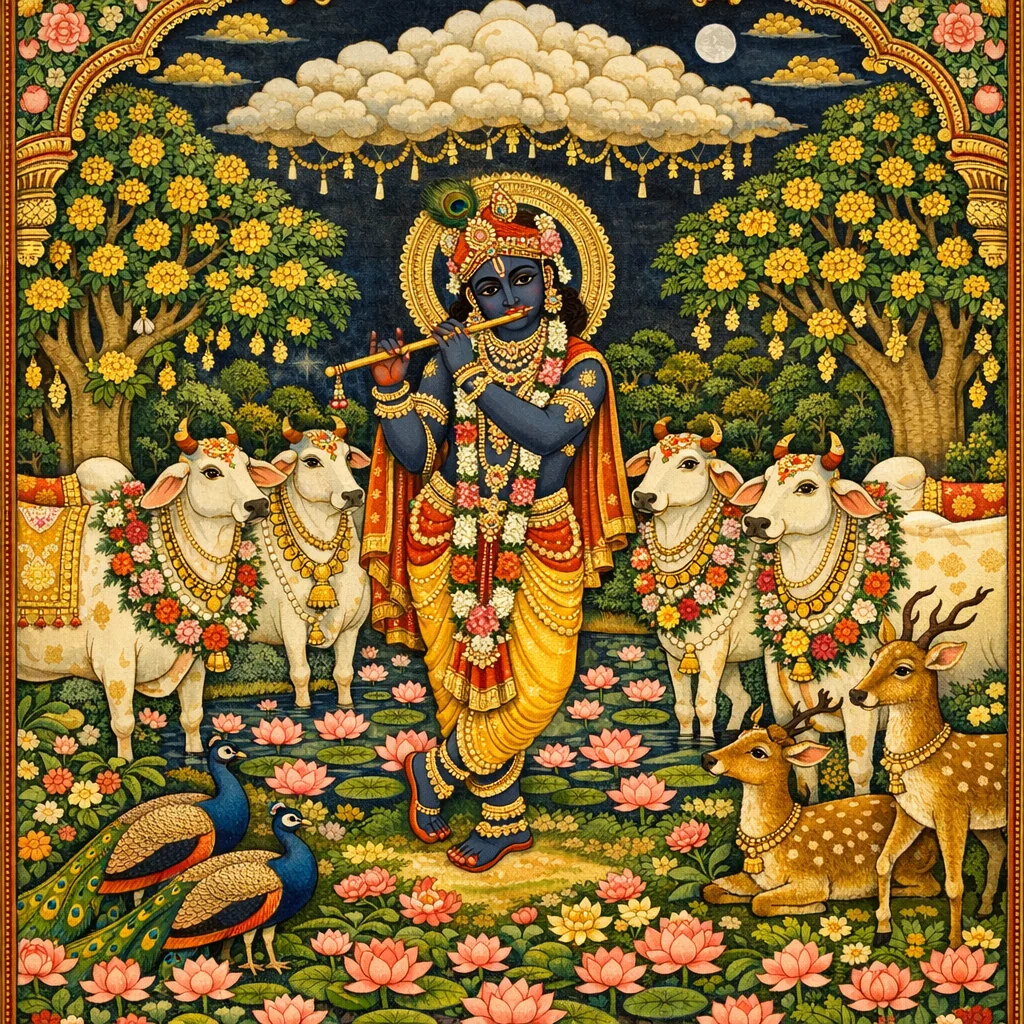
Adhyaya 35
Gopī-gīta in Separation: The Flute’s Call and Vraja’s Ecstatic Response
Śukadeva describes Vraja’s recurring rhythm: when Kṛṣṇa goes to the forest to herd the cows, the gopīs’ minds follow Him, and their day is sustained by kīrtana of His līlās. Speaking together, they portray His flute-playing—His stance, tender fingers, dancing brows—and the astonishing power of that sound, which overwhelms even celestial women traveling with the Siddhas. Their vision widens from human longing to a cosmic ecology of bhakti: bulls, deer, and cows freeze in rapture; rivers halt their currents, yearning for the dust of His lotus feet; trees and creepers burst with fruits, flowers, and dripping sap as if revealing Viṣṇu within their hearts. Clouds offer gentle thunder, flowers, and shade like an umbrella, while great devas (Brahmā, Śiva, Indra) are confounded by the essence of His music. The chapter culminates in the evening return—Kṛṣṇa coming back with the cows, praised by gods and friends—linking daytime separation to Vraja’s nocturnal longing and līlā, where remembrance intensifies toward direct encounter.
Shlokas
Verse 1
श्रीशुक उवाच गोप्य: कृष्णे वनं याते तमनुद्रुतचेतस: । कृष्णलीला: प्रगायन्त्यो निन्युर्दु:खेन वासरान् ॥ १ ॥
Śukadeva Gosvāmī said: Whenever Kṛṣṇa went to the forest, the gopīs’ minds ran after Him, and in sorrow they passed their days singing of Kṛṣṇa’s līlās.
Verse 2
श्रीगोप्य ऊचु: वामबाहुकृतवामकपोलो वल्गितभ्रुरधरार्पितवेणुम् । कोमलाङ्गुलिभिराश्रितमार्गं गोप्य ईरयति यत्र मुकुन्द: ॥ २ ॥ व्योमयानवनिता: सह सिद्धै- र्विस्मितास्तदुपधार्य सलज्जा: । काममार्गणसमर्पितचित्ता: कश्मलं ययुरपस्मृतनीव्य: ॥ ३ ॥
The gopīs said: When Mukunda rests His left cheek upon His left arm, makes His eyebrows dance, places the flute upon His lips, and with tender fingers covers its holes to draw forth a sweet melody—then even the goddesses who travel the sky with their husbands, the Siddhas, listen in amazement and grow shy. Their minds yield to the pursuit of desire, and in their agitation they do not even notice their garments’ belts loosening.
Verse 3
श्रीगोप्य ऊचु: वामबाहुकृतवामकपोलो वल्गितभ्रुरधरार्पितवेणुम् । कोमलाङ्गुलिभिराश्रितमार्गं गोप्य ईरयति यत्र मुकुन्द: ॥ २ ॥ व्योमयानवनिता: सह सिद्धै- र्विस्मितास्तदुपधार्य सलज्जा: । काममार्गणसमर्पितचित्ता: कश्मलं ययुरपस्मृतनीव्य: ॥ ३ ॥
The gopīs said: When Mukunda rests His left cheek upon His left arm, seals the flute’s holes with tender fingers, and makes His eyebrows dance, He pours forth the sacred music of the veṇu. Then the goddesses who travel the sky with the Siddhas stand amazed. Hearing that sound, they grow shy, for their minds yield toward the path of desire; in their distress they do not even notice the girdles of their garments loosening.
Verse 4
हन्त चित्रमबला: शृणुतेदं हारहास उरसि स्थिरविद्युत् । नन्दसूनुरयमार्तजनानां नर्मदो यर्हि कूजितवेणु: ॥ ४ ॥ वृन्दशो व्रजवृषा मृगगावो वेणुवाद्यहृतचेतस आरात् । दन्तदष्टकवला धृतकर्णा निद्रिता लिखितचित्रमिवासन् ॥ ५ ॥
O girls, how wondrous—listen! This son of Nanda, who delights the distressed, bears upon His chest a steady brilliance like lightning and a smile that gleams like a jeweled necklace. When He makes His flute sing, the bulls, deer, and cows of Vraja—standing in groups far away—are captivated by the sound. They stop chewing, hold the mouthful between their teeth, lift their ears, and, stunned, appear as if asleep or like figures painted in a picture.
Verse 5
हन्त चित्रमबला: शृणुतेदं हारहास उरसि स्थिरविद्युत् । नन्दसूनुरयमार्तजनानां नर्मदो यर्हि कूजितवेणु: ॥ ४ ॥ वृन्दशो व्रजवृषा मृगगावो वेणुवाद्यहृतचेतस आरात् । दन्तदष्टकवला धृतकर्णा निद्रिता लिखितचित्रमिवासन् ॥ ५ ॥
O girls, how wondrous—listen! This son of Nanda, who delights the distressed, bears upon His chest a steady brilliance like lightning and a smile that gleams like a jeweled necklace. When He makes His flute sing, the bulls, deer, and cows of Vraja—standing in groups far away—are captivated by the sound. They stop chewing, hold the mouthful between their teeth, lift their ears, and, stunned, appear as if asleep or like figures painted in a picture.
Verse 6
बर्हिणस्तबकधातुपलाशै- र्बद्धमल्लपरिबर्हविडम्ब: । कर्हिचित् सबल आलि स गोपै- र्गा: समाह्वयति यत्र मुकुन्द: ॥ ६ ॥ तर्हि भग्नगतय: सरितो वै तत्पदाम्बुजरजोऽनिलनीतम् । स्पृहयतीर्वयमिवाबहुपुण्या: प्रेमवेपितभुजा: स्तिमिताप: ॥ ७ ॥
My dear gopī, sometimes Mukunda adorns Himself with leaves, peacock feathers, and colored minerals, playfully imitating the look of a wrestler. Then, in the company of Balarāma and the cowherd boys, He sounds His flute to call the cows. At that time the rivers break their flow and stand still; their waters, stunned by love’s ecstasy, yearn for the dust of His lotus feet carried by the wind. Yet, like us, the rivers are of scant merit, and so they only wait, their “arms” trembling with prema.
Verse 7
बर्हिणस्तबकधातुपलाशै- र्बद्धमल्लपरिबर्हविडम्ब: । कर्हिचित् सबल आलि स गोपै- र्गा: समाह्वयति यत्र मुकुन्द: ॥ ६ ॥ तर्हि भग्नगतय: सरितो वै तत्पदाम्बुजरजोऽनिलनीतम् । स्पृहयतीर्वयमिवाबहुपुण्या: प्रेमवेपितभुजा: स्तिमिताप: ॥ ७ ॥
My dear gopī, sometimes Mukunda adorns Himself with leaves, peacock feathers, and colored minerals, playfully imitating the look of a wrestler. Then, in the company of Balarāma and the cowherd boys, He sounds His flute to call the cows. At that time the rivers break their flow and stand still; their waters, stunned by love’s ecstasy, yearn for the dust of His lotus feet carried by the wind. Yet, like us, the rivers are of scant merit, and so they only wait, their “arms” trembling with prema.
Verse 8
अनुचरै: समनुवर्णितवीर्य आदिपूरुष इवाचलभूति: । वनचरो गिरितटेषु चरन्ती- र्वेणुनाह्वयति गा: स यदा हि ॥ ८ ॥ वनलतास्तरव आत्मनि विष्णुं व्यञ्जयन्त्य इव पुष्पफलाढ्या: । प्रणतभारविटपा मधुधारा: प्रेमहृष्टतनवो ववृषु: स्म ॥ ९ ॥ दर्शनीयतिलको वनमाला- दिव्यगन्धतुलसीमधुमत्तै: । अलिकुलैरलघुगीतामभीष्ट- माद्रियन् यर्हि सन्धितवेणु: ॥ १० ॥ सरसि सारसहंसविहङ्गा- श्चारुगीताहृतचेतस एत्य । हरिमुपासत ते यतचित्ता हन्त मीलितदृशो धृतमौना: ॥ ११ ॥
Kṛṣṇa roams the forest with His friends, who sing the glory of His mighty deeds; thus He shines like the Ādi-Puruṣa, displaying inexhaustible majesty. When the cows wander on the mountain slopes, He calls them with the sound of His flute.
Verse 9
अनुचरै: समनुवर्णितवीर्य आदिपूरुष इवाचलभूति: । वनचरो गिरितटेषु चरन्ती- र्वेणुनाह्वयति गा: स यदा हि ॥ ८ ॥ वनलतास्तरव आत्मनि विष्णुं व्यञ्जयन्त्य इव पुष्पफलाढ्या: । प्रणतभारविटपा मधुधारा: प्रेमहृष्टतनवो ववृषु: स्म ॥ ९ ॥ दर्शनीयतिलको वनमाला- दिव्यगन्धतुलसीमधुमत्तै: । अलिकुलैरलघुगीतामभीष्ट- माद्रियन् यर्हि सन्धितवेणु: ॥ १० ॥ सरसि सारसहंसविहङ्गा- श्चारुगीताहृतचेतस एत्य । हरिमुपासत ते यतचित्ता हन्त मीलितदृशो धृतमौना: ॥ ११ ॥
Then the forest creepers and trees, laden with flowers and fruits, seem to reveal Lord Viṣṇu within their hearts. Their branches bow under the weight, their trunks and vines bristle in the ecstasy of bhakti, and they pour down a rain of sweet sap.
Verse 10
अनुचरै: समनुवर्णितवीर्य आदिपूरुष इवाचलभूति: । वनचरो गिरितटेषु चरन्ती- र्वेणुनाह्वयति गा: स यदा हि ॥ ८ ॥ वनलतास्तरव आत्मनि विष्णुं व्यञ्जयन्त्य इव पुष्पफलाढ्या: । प्रणतभारविटपा मधुधारा: प्रेमहृष्टतनवो ववृषु: स्म ॥ ९ ॥ दर्शनीयतिलको वनमाला- दिव्यगन्धतुलसीमधुमत्तै: । अलिकुलैरलघुगीतामभीष्ट- माद्रियन् यर्हि सन्धितवेणु: ॥ १० ॥ सरसि सारसहंसविहङ्गा- श्चारुगीताहृतचेतस एत्य । हरिमुपासत ते यतचित्ता हन्त मीलितदृशो धृतमौना: ॥ ११ ॥
When Kṛṣṇa, adorned with a lovely tilaka and a forest garland, is surrounded by bees intoxicated by honey and the divine fragrance of tulasī, He raises His flute to His lips and plays His cherished gentle song; the swarms of bees seem to honor that melody.
Verse 11
अनुचरै: समनुवर्णितवीर्य आदिपूरुष इवाचलभूति: । वनचरो गिरितटेषु चरन्ती- र्वेणुनाह्वयति गा: स यदा हि ॥ ८ ॥ वनलतास्तरव आत्मनि विष्णुं व्यञ्जयन्त्य इव पुष्पफलाढ्या: । प्रणतभारविटपा मधुधारा: प्रेमहृष्टतनवो ववृषु: स्म ॥ ९ ॥ दर्शनीयतिलको वनमाला- दिव्यगन्धतुलसीमधुमत्तै: । अलिकुलैरलघुगीतामभीष्ट- माद्रियन् यर्हि सन्धितवेणु: ॥ १० ॥ सरसि सारसहंसविहङ्गा- श्चारुगीताहृतचेतस एत्य । हरिमुपासत ते यतचित्ता हन्त मीलितदृशो धृतमौना: ॥ ११ ॥
In the lake, cranes, swans, and other birds, their hearts stolen by that lovely song, draw near. With minds fixed they worship Hari; eyes closed, they keep silence, motionless in meditation.
Verse 12
सहबल: स्रगवतंसविलास: सानुषु क्षितिभृतो व्रजदेव्य: । हर्षयन् यर्हि वेणुरवेण जातहर्ष उपरम्भति विश्वम् ॥ १२ ॥ महदतिक्रमणशङ्कितचेता मन्दमन्दमनुगर्जति मेघ: । सुहृदमभ्यवर्षत् सुमनोभि- श्छायया च विदधत् प्रतपत्रम् ॥ १३ ॥
O goddesses of Vraja, when Kṛṣṇa enjoys with Balarāma upon the mountain slopes, playfully wearing a flower garland upon His head, He gladdens all beings with the resonant call of His flute, and the whole world is filled with joy.
Verse 13
सहबल: स्रगवतंसविलास: सानुषु क्षितिभृतो व्रजदेव्य: । हर्षयन् यर्हि वेणुरवेण जातहर्ष उपरम्भति विश्वम् ॥ १२ ॥ महदतिक्रमणशङ्कितचेता मन्दमन्दमनुगर्जति मेघ: । सुहृदमभ्यवर्षत् सुमनोभि- श्छायया च विदधत् प्रतपत्रम् ॥ १३ ॥
O goddesses of Vraja, when Śrī Kṛṣṇa, sporting with Balarāma upon the mountain slopes, wears a flower garland as an ornament upon His head and gladdens all beings with the resonant music of His flute, the whole world is filled with joy. Then a nearby cloud, fearing to offend so great a Personality, rumbles very softly in accompaniment; it showers flowers upon its dear friend Kṛṣṇa and shades Him from the sun like an umbrella.
Verse 14
विविधगोपचरणेषु विदग्धो वेणुवाद्य उरुधा निजशिक्षा: । तव सुत: सति यदाधरबिम्बे दत्तवेणुरनयत् स्वरजाती: ॥ १४ ॥ सवनशस्तदुपधार्य सुरेशा: शक्रशर्वपरमेष्ठिपुरोगा: । कवय आनतकन्धरचित्ता: कश्मलं ययुरनिश्चिततत्त्वा: ॥ १५ ॥
O pious mother Yaśodā, your son is expert in every art of the cowherd life, and by His own training He has devised many new styles of flute-playing. When He places the flute upon His bimba-red lips and sends forth the notes of the scale in manifold melodies, Brahmā, Śiva, Indra and the other lords of the devas become bewildered on hearing that sound. Though they are the most learned authorities, they cannot determine its essence, and thus they bow their heads and hearts in reverence.
Verse 15
विविधगोपचरणेषु विदग्धो वेणुवाद्य उरुधा निजशिक्षा: । तव सुत: सति यदाधरबिम्बे दत्तवेणुरनयत् स्वरजाती: ॥ १४ ॥ सवनशस्तदुपधार्य सुरेशा: शक्रशर्वपरमेष्ठिपुरोगा: । कवय आनतकन्धरचित्ता: कश्मलं ययुरनिश्चिततत्त्वा: ॥ १५ ॥
O pious mother Yaśodā, your son is expert in every art of the cowherd life, and by His own training He has devised many new styles of flute-playing. When He places the flute upon His bimba-red lips and sends forth the notes of the scale in manifold melodies, Brahmā, Śiva, Indra and the other lords of the devas become bewildered on hearing that sound. Though they are the most learned authorities, they cannot determine its essence, and thus they bow their heads and hearts in reverence.
Verse 16
निजपदाब्जदलैर्ध्वजवज्र- नीरजाङ्कुशविचित्रललामै: । व्रजभुव: शमयन् खुरतोदं वर्ष्मधुर्यगतिरीडितवेणु: ॥ १६ ॥ व्रजति तेन वयं सविलास- वीक्षणार्पितमनोभववेगा: । कुजगतिं गमिता न विदाम: कश्मलेन कवरं वसनं वा ॥ १७ ॥
As Śrī Kṛṣṇa strolls through Vraja with feet soft as lotus petals, bearing the wondrous emblems of flag, thunderbolt, lotus and elephant goad, He soothes the earth’s distress from the cows’ hooves. Playing His celebrated flute, His body moves with the sweet grace of an elephant. Thus we gopīs, stirred by Cupid when He casts playful glances upon us, stand motionless like trees, and in our bewilderment do not even know that our hair and garments are loosening.
Verse 17
निजपदाब्जदलैर्ध्वजवज्र- नीरजाङ्कुशविचित्रललामै: । व्रजभुव: शमयन् खुरतोदं वर्ष्मधुर्यगतिरीडितवेणु: ॥ १६ ॥ व्रजति तेन वयं सविलास- वीक्षणार्पितमनोभववेगा: । कुजगतिं गमिता न विदाम: कश्मलेन कवरं वसनं वा ॥ १७ ॥
As Śrī Kṛṣṇa strolls through Vraja with feet soft as lotus petals, bearing the wondrous emblems of flag, thunderbolt, lotus and elephant goad, He soothes the earth’s distress from the cows’ hooves. Playing His celebrated flute, His body moves with the sweet grace of an elephant. Thus we gopīs, stirred by Cupid when He casts playful glances upon us, stand motionless like trees, and in our bewilderment do not even know that our hair and garments are loosening.
Verse 18
मणिधर: क्वचिदागणयन् गा मालया दयितगन्धतुलस्या: । प्रणयिनोऽनुचरस्य कदांसे प्रक्षिपन् भुजमगायत यत्र ॥ १८ ॥ क्वणितवेणुरववञ्चितचित्ता: कृष्णमन्वसत कृष्णगृहिण्य: । गुणगणार्णमनुगत्य हरिण्यो गोपिका इव विमुक्तगृहाशा: ॥ १९ ॥
Now Kṛṣṇa stands somewhere, counting His cows on a string of gems. Wearing a tulasī garland fragrant with His beloved’s scent, He rests His arm on the shoulder of an affectionate cowherd friend and, playing the flute, sings. Bewildered by that resonant melody, the wives of the black deer come to Kṛṣṇa—the ocean of transcendental qualities—and sit beside Him; like us gopīs, they abandon all hope of happiness in household life.
Verse 19
मणिधर: क्वचिदागणयन् गा मालया दयितगन्धतुलस्या: । प्रणयिनोऽनुचरस्य कदांसे प्रक्षिपन् भुजमगायत यत्र ॥ १८ ॥ क्वणितवेणुरववञ्चितचित्ता: कृष्णमन्वसत कृष्णगृहिण्य: । गुणगणार्णमनुगत्य हरिण्यो गोपिका इव विमुक्तगृहाशा: ॥ १९ ॥
Bewildered by the flute’s vibrating sound, the wives of the black deer followed Kṛṣṇa—the ocean of all virtues—and came to sit beside Him; like the gopīs, they gave up hope for happiness in household life.
Verse 20
कुन्ददामकृतकौतुकवेषो गोपगोधनवृतो यमुनायाम् । नन्दसूनुरनघे तव वत्सो नर्मद: प्रणयिणां विजहार ॥ २० ॥ मन्दवायुरुपवात्यनुकूलं मानयन् मलयजस्पर्शेन । वन्दिनस्तमुपदेवगणा ये वाद्यगीतबलिभि: परिवव्रु: ॥ २१ ॥
O sinless Yaśodā, your darling child, the son of Nanda, has festively adorned Himself with a jasmine garland and now sports along the Yamunā, surrounded by the cowherd boys and the herd, delighting His dear companions.
Verse 21
कुन्ददामकृतकौतुकवेषो गोपगोधनवृतो यमुनायाम् । नन्दसूनुरनघे तव वत्सो नर्मद: प्रणयिणां विजहार ॥ २० ॥ मन्दवायुरुपवात्यनुकूलं मानयन् मलयजस्पर्शेन । वन्दिनस्तमुपदेवगणा ये वाद्यगीतबलिभि: परिवव्रु: ॥ २१ ॥
A gentle breeze blows favorably, as if honoring Him with the cool, fragrant touch of Malaya sandalwood. And the Upadevas, like courtly panegyrists, surround Him on all sides, offering music, song, and tribute gifts.
Verse 22
वत्सलो व्रजगवां यदगध्रो वन्द्यमानचरण: पथि वृद्धै: । कृत्स्नगोधनमुपोह्य दिनान्ते गीतवेणुरनुगेडितकीर्ति: ॥ २२ ॥ उत्सवं श्रमरुचापि दृशीना- मुन्नयन् खुररजश्छुरितस्रक् । दित्सयैति सुहृदासिष एष देवकीजठरभूरुडुराज: ॥ २३ ॥
Out of tender love for the cows of Vraja, Kṛṣṇa became the lifter of Govardhana. At day’s end, having gathered the entire herd, He returns playing a song upon His flute; along the path the elders worship His lotus feet, and the cowherd boys who accompany Him chant His glories. His garland is dusted by the cows’ hoof-raised powder, and His beauty—enhanced by fatigue—becomes a festival for the eyes; eager to fulfill His friends’ desires, Kṛṣṇa is like the moon arisen from Yaśodā’s womb.
Verse 23
वत्सलो व्रजगवां यदगध्रो वन्द्यमानचरण: पथि वृद्धै: । कृत्स्नगोधनमुपोह्य दिनान्ते गीतवेणुरनुगेडितकीर्ति: ॥ २२ ॥ उत्सवं श्रमरुचापि दृशीना- मुन्नयन् खुररजश्छुरितस्रक् । दित्सयैति सुहृदासिष एष देवकीजठरभूरुडुराज: ॥ २३ ॥
Out of deep affection for the cows of Vraja, Śrī Kṛṣṇa became the lifter of Govardhana Hill. At day’s end He gathers all His cows and returns, playing a sacred melody on His flute; along the path elders and the devas worship His lotus feet, while the cowherd boys at His side sing His glories. His flower garland is dusted by the cows’ hoof-raised powder, and His beauty—made brighter by fatigue—becomes a festival for every eye. Eager to fulfill His friends’ desires, He shines like the moon risen from mother Yaśodā’s womb.
Verse 24
मदविघूर्णितलोचन ईषत्- मानद: स्वसुहृदां वनमाली । बदरपाण्डुवदनो मृदुगण्डं मण्डयन् कनककुण्डललक्ष्म्या ॥ २४ ॥ यदुपतिर्द्विरदराजविहारो यामिनीपतिरिवैष दिनान्ते । मुदितवक्त्र उपयाति दुरन्तं मोचयन् व्रजगवां दिनतापम् ॥ २५ ॥
With eyes slightly rolling as if in gentle intoxication, Śrī Kṛṣṇa respectfully greets His well-wishing friends, wearing a forest-flower garland. His bright face, tinted like the badara berry, and the splendor of His golden earrings further adorn His tender cheeks. At day’s end the Lord of the Yadus returns with the majestic grace of a royal elephant, His joyful face like the moon, lord of the night, relieving the cows of Vraja from the day’s burning heat.
Verse 25
मदविघूर्णितलोचन ईषत्- मानद: स्वसुहृदां वनमाली । बदरपाण्डुवदनो मृदुगण्डं मण्डयन् कनककुण्डललक्ष्म्या ॥ २४ ॥ यदुपतिर्द्विरदराजविहारो यामिनीपतिरिवैष दिनान्ते । मुदितवक्त्र उपयाति दुरन्तं मोचयन् व्रजगवां दिनतापम् ॥ २५ ॥
With eyes slightly rolling as if in gentle intoxication, Śrī Kṛṣṇa respectfully greets His well-wishing friends, wearing a forest-flower garland. His bright face, tinted like the badara berry, and the splendor of His golden earrings further adorn His tender cheeks. At day’s end the Lord of the Yadus returns with the majestic grace of a royal elephant, His joyful face like the moon, lord of the night, relieving the cows of Vraja from the day’s burning heat.
Verse 26
श्रीशुक उवाच एवं व्रजस्त्रियो राजन् कृष्णलीलानुगायती: । रेमिरेऽह:सु तच्चित्तास्तन्मनस्का महोदया: ॥ २६ ॥
Śrī Śukadeva Gosvāmī said: O King, in this way, during the daytime the women of Vṛndāvana delighted in continually singing the līlās of Śrī Kṛṣṇa; their hearts and minds were absorbed in Him, and they were filled with great festive joy.
Frequently Asked Questions
The passage magnifies Kṛṣṇa’s veṇu-nāda as transcendental attraction (ākarṣaṇa) that surpasses social and cosmic boundaries. The ‘disturbance’ is not endorsement of mundane lust but a poetic revelation of how Bhagavān’s beauty and sound subdue conditioned propriety and awaken involuntary absorption. Bhāgavata rhetoric uses this to assert Kṛṣṇa’s supremacy: if even celestial beings lose composure, the gopīs’ exclusive fixation is shown as spiritually inevitable and theologically meaningful.
These are Bhāgavata signs (lakṣaṇa) of bhakti’s contagion in Vraja: the environment mirrors the devotees’ inner state. Rivers halting suggests nature’s suspension before the Absolute, yearning for contact with His pāda-raja (foot-dust). Trees and creepers becoming luxuriant and ‘manifesting Viṣṇu’ indicates sattvika transformation—external fertility symbolizing internal revelation—teaching that devotion is not only psychological but cosmically participatory in Kṛṣṇa’s līlā.
Śukadeva Gosvāmī narrates to King Parīkṣit, framing the gopīs’ speech as daytime kīrtana born from separation during Kṛṣṇa’s forest pastimes. This frame is crucial: it presents the gopīs’ words as sādhana (continuous remembrance) and as pramāṇa (authoritative testimony) for the Bhāgavata’s theology of āśraya—Kṛṣṇa as the supreme object of love.
The evening return (go-cāraṇa completion) resolves the day’s vipralambha with a glimpse of reunion: Kṛṣṇa, dusted by cows’ hooves, worshiped along the path, and welcomed by friends. Literarily it provides narrative progression from daytime separation to the intensification of Vraja’s nocturnal affect; theologically it shows poṣaṇa—Kṛṣṇa as the one who protects, gathers, and ‘delivers’ Vraja (including the cows) from hardship while simultaneously nourishing devotees’ longing into deeper bhakti.