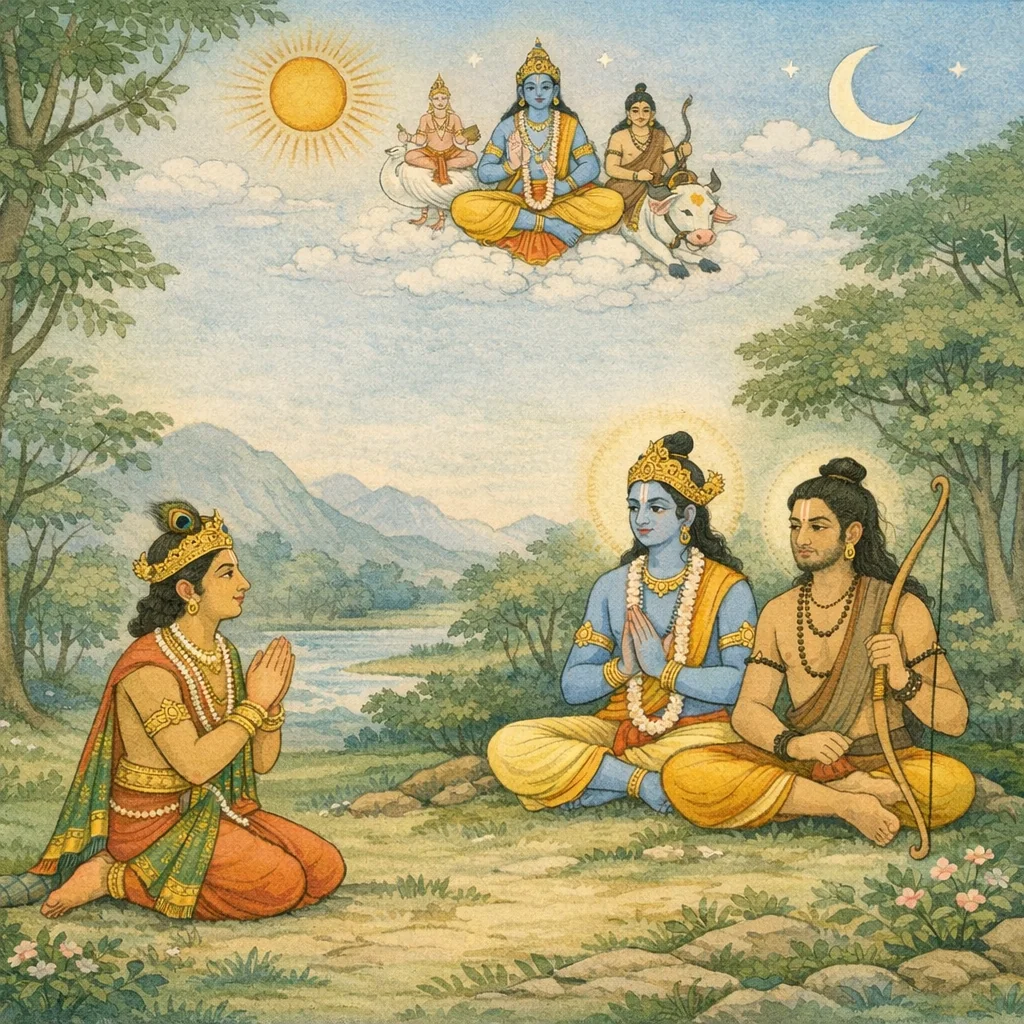
Adhyaya 8: Prahlada’s Defeat in Battle and Victory through Bhakti (Nara-Narayana Episode)
प्रह्लादस्य युद्धपराजयः भक्तिविजयश्च (Prahlādasya Yuddha-Parājayaḥ Bhakti-Vijayaśca)
Battle and Devotion
Pulastya, in dialogue with Nārada, narrates a sustained combat between the dānava-king Prahlāda and the dharma-born Sādhya identified with Nara-Nārāyaṇa/Viṣṇu. The episode foregrounds asura-dharma: Prahlāda’s insistence on keeping his martial vow, his ritual observances (āhnika at Naimiṣāraṇya), and his eventual ethical turn from violence to devotion. Iconographically, Viṣṇu appears as Pītavāsā (yellow-robed), Śārṅgadhara (bearer of the Śārṅga bow), and as the cosmic principle pervading elements and deities—an explicit theological universalism that supports the Purāṇa’s syncretic tendency (the divine as the ground of Brahmā, Rudra/Trinetra, Agni, Vāyu, Sūrya, Soma, etc.). After a thousand divine years of inconclusive warfare, Prahlāda learns that victory over the dharmajā Sādhya is attainable only through bhakti, not arms; his stotra ‘defeats’ the Lord, who grants boons: expiation of bodily, mental, and verbal sin, unwavering devotion, and imperishability, while instructing righteous governance and dharma-propagation among dānavas.
Divine Beings
Sacred Geography
Mortal & Asura Figures
Key Content Points
- Pulastya–Nārada frame: narration of the Prahlāda vs. Nara-Nārāyaṇa/Sādhya conflict, escalating from mace and arrows to successive weapons, repeatedly neutralized by divine skill.
- Asura-dharma and ritual discipline: Prahlāda pauses battle for prātaraḥ-āhnika at Naimiṣāraṇya, reflecting the integration of kṣātra action with Vedic daily rites.
- Syncretic theology via stotra: Prahlāda’s hymn identifies Viṣṇu as the immanent source of multiple deities and cosmic elements; bhakti becomes the superior means of ‘conquest,’ leading to boons and ethical instruction for dharmic rule.
Shlokas in Adhyaya 8
Verse 1
इति श्रीवामनपुराणे सप्तमो ऽध्यायः पुलस्त्य उवाच शार्ङ्गपाणिनमायान्तं दृष्ट्वाग्रे दानवेश्वरः परिभ्राम्य गदां वेगात् मूर्ध्नि साध्यमताडयत्
‘Thus ends the seventh chapter of the Śrī Vāmana Purāṇa.’ Pulastya said: Seeing Śārṅgapāṇi approaching before him, the lord of the Dānavas whirled his mace swiftly and struck (him) on the head.
Verse 2
ताडितस्याथ गदया धर्मपुत्रस्य नारद नेत्राभ्यामपतद् वारि वह्निवर्षनिभं भुवि
O Nārada, when the son of Dharma was struck by the mace, water fell from his eyes onto the earth, resembling a rain of fire.
Verse 3
मूर्ध्नि नारायणस्यापि सा गदा दानवार्पिता जगाम शतधा ब्रह्मञ्शैलशृङ्गे यथाशनिः
Even upon the head of Nārāyaṇa, that mace hurled by the Dānava shattered into a hundred pieces—like a thunderbolt upon a mountain peak, O Brāhmaṇa.
Verse 4
ततो निवृत्य दैत्येन्द्रः समास्थाय रथं द्रुतम् आदाय कार्मुकं वीरस्तूणद् बाणं समाददे
Then the lord of the Daityas turned back, swiftly mounted his chariot, took up his bow, and the hero seized arrows from his quiver.
Verse 5
आनम्य चापं वेगेन गार्द्धूपत्राञ्सिलीमुखान् मुमोच साध्याय तदा क्रोधन्धकारिताननः
Bending his bow with speed, he then released sharp arrows, feathered like a vulture’s pinions, against Sādhya—his face darkened as though by the blindness of wrath.
Verse 6
तानापतत एवाशु बाणांश्चन्द्रार्द्धसन्निभान् चिच्छेद बाणैरपरैर्निर्बिभेद च दानवम्
As those arrows swiftly came flying, he cut them down with other arrows—those resembling the half-moon—and he also pierced the Dānava.
Verse 7
ततो नारायणं दैत्यो दैत्यं नारायणः शरैः आविध्येतां तदान्योन्यं मर्मभिद्भिरजिह्यगैः
Then the Daitya struck Nārāyaṇa, and Nārāyaṇa struck the Daitya with arrows; at that time they wounded one another with unerring shafts that pierced the vital points.
Verse 8
ततो ऽम्बरे संनिपातो देवानामभवन्मुने दिदृक्षूणां तदा युद्धं लघु चित्रं च सुष्ठु च
Then, O sage, there was a gathering of the gods in the sky, eager to behold that battle—swift, wondrous, and splendid.
Verse 9
ततः सुराणां दुन्दुभ्यस् त्ववाद्यन्त महास्वनाः पुष्पवर्षमनौपम्यं मुमुचुः साध्यदैत्ययौः
Then the gods’ kettle-drums resounded with a mighty sound, and the Sādhyas released an incomparable rain of flowers (upon/for the combatants).
Verse 10
ततः पश्यत्सु देवेषु गगनस्थेषु तावुभौ अयुध्येतां महेष्वासौ प्रेक्षकप्रीतिवर्द्धनम्
Then, while the gods watched from the sky, those two mighty bowmen fought, increasing the delight of the spectators.
Verse 11
बबन्धतुस्तदाकाशं तावुभौ शरवृष्टिभिः दिशश्च विदिशश्चैव छादयेतां शरोत्करैः
Then those two, with showers of arrows, seemed to bind up the very sky; and with heaps of arrows they covered the directions and the intermediate quarters as well.
Verse 12
ततो नारायणश्चापं समाकृष्य महामुने बिभेद मार्गणैस्तीक्ष्णैः प्रह्लादं सर्वमर्मसु
Then Nārāyaṇa, drawing his bow, O great sage, pierced Prahlāda with sharp missiles at all his vital spots.
Verse 13
तथा दैत्येश्वरः क्रुद्धश्चापमानम्य वेगवान् बिभेद हृदये बाह्वोर्वदने च नरोत्तमम्
Likewise the lord of the Daityas, enraged and swift, bending his bow, pierced that best of men in the heart, in the arms, and in the face.
Verse 14
ततो ऽस्यतो दैत्यपतेः कार्मुकं मुष्टिबन्धनात् चिच्छेदैकेन बाणेन चन्द्रार्धाकारवर्चसा
Then, as the lord of the Daityas was shooting, (Puruṣottama) cut his bow at the hand-grip with a single arrow, shining like a crescent moon.
Verse 15
अपास्यत धनुश्छिन्नं चापमादाय चापरम् अधिज्यं लाघवात् कृत्वा ववर्ष निशिताञ्शरान्
Casting aside the broken bow, he took up another bow; swiftly stringing it, he rained down sharp arrows.
Verse 16
तानप्यस्य शरान् साध्यश्छित्त्वा बाणैरवारयत् कार्मुकं च क्षुरप्रेण चिच्छेद पुरुषोत्तमः
And those arrows of his too, Puruṣottama quickly cut down and checked with his own arrows; and with a razor-headed (arrow) he severed the bow as well.
Verse 17
छिन्नं छिन्नं धनुर्दैत्यस्त्वन्यदन्यत्समाददे समादत्तं तदा साध्यो मुने चिच्छेद लाघवात्
Each time his bow was cut, the Daitya seized yet another. But as soon as it was taken up, O sage, Sādhya immediately severed it again, by sheer swiftness.
Verse 18
संछिन्नेष्वथ चापेषु जग्राह दितिजेश्वरः परिघं दारुणां दीर्घं सर्वलोहमयं दृढम्
Then, when his bows had been cut to pieces, the lord of the Diti-born seized a parigha—terrible, long, made wholly of iron, and solid.
Verse 19
परिगृह्याथ परिघं भ्रामयामास दानवः भ्राम्यमाणं स चिच्छेद नाराचेन महामुनिः
Having grasped the parigha, the Dānava began to whirl it. As it was being whirled, the great sage cut it down with a nārāca arrow.
Verse 20
छिन्ने तु परिघे श्रीमान् प्रह्लादो दानवेश्वरः मुद्गरं भ्राम्य वेगेन प्रचिक्षेप नराग्रजे
When his iron club (parigha) had been cut, the illustrious Prahlāda, lord of the Dānavas, whirling a mace with force, hurled it at the foremost of men.
Verse 21
तमापतन्तं बलवान् मार्गणैर्दशभिर्मुने चिच्छेद दशधा साध्यः स छिन्नो न्यपतद् भुवि
O sage, as it came flying toward him, the mighty one cut it into ten pieces with ten arrows; thus cut, it fell to the ground.
Verse 22
मुद्गरे वितथे जाते प्रासमाविध्य वेगवान् प्रचिक्षेप नराग्र्याय तं च चिच्छेद धर्मजः
When the mace had proved futile, the swift one seized a spear and hurled it at the foremost of men; and that too Dharma’s son cut down.
Verse 23
प्रासे छिन्ने ततो दैत्यः शक्तिमादाय चिक्षिपे तां च चिच्छेद बलवान् क्षुरप्रेण महातपाः
When his javelin (prāsa) was cut down, the Daitya then took up a spear (śakti) and hurled it. The mighty great ascetic cut that too with a razor-edged arrow (kṣurapra).
Verse 24
छिन्नेषु तेषु शस्त्रेषु दानवो ऽन्यन्महद्धनुः समादाय ततो बाणैरवतस्तार नारद
When those weapons were cut down, the Dānava took up another great bow; then, O Nārada, he showered arrows (upon his opponent).
Verse 25
ततो नारायणो देवो दैत्यनाथं जगद्गुरुः नाराचेन जघानाथ हृदये सुरतापसः
Then Nārāyaṇa, the God—teacher of the world—struck the lord of the Daityas in the heart with a nārāca arrow; he (Nārāyaṇa) is the ascetic power (tapas) of the gods.
Verse 26
संभिन्निहृदयो ब्रह्मन् देवेनाद्भुतकर्मणा निपपात रथोपस्थे तमपोवाह सारथिः
O Brahmin, his heart shattered by the god of wondrous deeds, he collapsed onto the seat of the chariot; the charioteer then carried him away.
Verse 27
स संज्ञां सुचिरेणैव प्रतिलभ्य दितीश्वरः सुदृढं चापमादाय भूयो योद्धमुपागतः
Regaining consciousness after a long time, the lord of Diti’s race took up a very strong bow and again came forward to fight.
Verse 28
तमागतं संनिरीक्ष्य प्रत्युवाच नराग्रजः गच्छ दैत्येन्द्र योत्स्यामः प्रातस्त्वाह्निकमाचर
Seeing him come, the foremost among men replied: “Go, O lord of the Daityas; we shall fight (later). Perform first your morning daily rites.”
Verse 29
एवमुक्तो दितीशस्तु साध्येनाद्भुतकर्मणा जगाम नैमिषारण्यं क्रियां चक्रे तदाऽह्निकीम्
Thus addressed by Sādhya of wondrous deeds, the lord of Diti went to Naimiṣāraṇya and then performed the daily rites (āhnika).
Verse 30
एवं युध्यति देवे च प्रह्लादो ह्यसुरो मुने रात्रौ चिन्तयते युद्धे कथं जेष्यामि दाम्भिकम्
While he thus fought against the Deva, the Asura Prahlāda, O sage, reflected at night about the battle: ‘How shall I defeat the arrogant one?’
Verse 31
एवं नारायणेनासौ सहायुध्यत नारद दिव्यं वर्षसस्रं तु दैत्यो देवं न चाजयत्
Thus he fought along with Nārāyaṇa, O Nārada; yet for a thousand divine years the Daitya did not conquer the Deva.
Verse 32
ततो वर्षसहस्रान्ते ह्यजिते पुरुषोत्तमे पीतवाससमभ्येत्य दानवो वाक्यमब्रवीत्
Then, at the end of a thousand years, a Dānava approached Ajita, the Supreme Person (Puruṣottama), clad in yellow garments (Pītavāsa), and spoke these words.
Verse 33
किमर्थं देवदेवेश साध्यं नारायणं हरिम् विजेतुं नाद्य शक्नोमि एतन्मे कारणं वद
For what reason, O Lord of the lord of gods, am I unable today to conquer Sādhya Nārāyaṇa, Hari? Tell me the cause of this.
Verse 34
पीतवासा उवाच दुर्जयो ऽसौ महाबाहुस्त्वया प्रह्लाद धर्मजः साध्यो विप्रवरो धीमान् मृधे देवासुरैरपि
Pītavāsa said: ‘That mighty-armed one is difficult to conquer by you, O Prahlāda—he is born of dharma. Sādhya, the foremost of brāhmaṇas, wise—he cannot be overcome in battle even by the devas and the asuras.’
Verse 35
प्रह्लाद उवाच यद्यसौ दुर्जयो देव मया साध्यो रणाजिरे तत्कथं यत्प्रतिज्ञातं तदसत्यं भविष्यति
Prahlāda said: “O god, if that unconquerable one can be subdued by me on the battlefield, then how could what has been promised become untrue?”
Verse 36
हीनप्रतिज्ञो देवेश कथं जीवेत मादृशः तस्मात्तवाग्रतो विष्णो करिष्ये कायशोधनम्
“O Lord of gods, how could one like me live if deprived of (or failing) his vow? Therefore, O Viṣṇu, before you I shall perform purification of my body.”
Verse 37
पुल्स्त्य उवाच इत्येवमुक्त्वा वचनं देवाग्रे दानवेश्वरः शिरःस्नातस्तदा तस्थौ गृणन् ब्रह्म सनातनम्
Pulastya said: “Having spoken these words thus, the lord of the Dānavas, in the presence of the gods, then stood after bathing his head, praising (or reciting about) the eternal Brahman.”
Verse 38
ततो दैत्यपतिं विष्णुं पीतवासाब्रवीद्वचः गच्छ जेष्यसि भक्त्या तं न युद्धेन कथञ्चन
Then the Yellow-robed one (Vishnu) spoke these words to the lord of the Daityas: “Go; you will conquer him through devotion, not by battle in any way.”
Verse 39
प्रह्लाद उवाच मया जितं देवदेव त्रैलोक्यमपि सुव्रत जितो ऽयं त्वत्प्रसादेन शक्रः किमुत धर्मजः
Prahlada said: “O God of gods, O you of excellent vow—by me even the three worlds were conquered. Yet this Indra has conquered by your favor; what then of the son of Dharma?”
Verse 40
असौ यद्यजयो देव त्रैलोक्येनापि सुव्रतः न स्थातुं त्वत्प्रसादेव शक्यं किमु करोम्यज
“Even if he is unconquerable, O god—indeed, even by the three worlds, O you of excellent vow—without your grace it is not possible even to stand; what then can I do, O unborn one?”
Verse 41
पीतवासा उवाच सो ऽहं दानवशार्दूल लोकानां हितकाम्यया धर्मं प्रवर्त्तापयितुं तपश्चर्यां समास्थितः
Pītavāsā said: “O tiger among Dānavas, I—desiring the welfare of the worlds—have undertaken austerity in order to set dharma in motion (to establish dharma).”
Verse 42
तस्माद्यदिच्छसि जयं तमाराधय दानव तं पराजेष्यसे भक्त्या तस्माच्छुश्रूष धर्मजम्
“Therefore, if you desire victory, O Dānava, worship him. By devotion you will defeat him; therefore, attend obediently to the dharma-born (rightful) instruction.”
Verse 43
पुलस्त्य उवाच/ इत्युक्तः पीतवासेन दानवेन्द्रो महात्मना अब्रवीद्वचनं हृष्टः समाहूयान्धकं मुनेष
Pulastya said: “Thus addressed by the great-souled Pītavāsā, the lord of the Dānavas, delighted, spoke words—having summoned Andhaka, O sage.”
Verse 44
दैत्याश्च दानवाश्चैव परिपाल्यास्त्वयान्धक मयोत्सृष्टमिदं राज्यं प्रतीच्छस्व महाभुज
“O Andhaka, the Daityas and Danavas are indeed to be protected by you. Accept this kingdom that has been relinquished by me, O mighty-armed one.”
Verse 45
इत्येवमुक्तो जग्राह राज्यं हैरण्यलोचनिः प्रह्लादो ऽपि तदागच्छत् पुण्यं बदरिकाश्रमम्
Thus addressed, Hiraṇyalocana accepted the kingdom. And Prahlada too then came to the holy Badarikāśrama.
Verse 46
दृष्ट्वा नारायणं देवं नरं च दितिजेश्वरः कृताञ्जलिपुटो भूत्वा ववन्दे चरणौ तयोः
Seeing the god Nārāyaṇa and Nara, the lord of the Diti-born (Prahlada) became one with folded hands and bowed to the feet of them both.
Verse 47
तमुवाच महातेजा वाक्यं नारायणो ऽव्ययः किमर्थं प्रणतो ऽसीह मामजित्वा महासुर
The imperishable Nārāyaṇa, of great splendor, addressed him: “O great Asura, for what reason are you bowing here (to me), having not conquered me?”
Verse 48
प्रह्लाद उवाच/ कस्त्वां जेतुं प्रभो शक्तः कस्त्वत्तः पुरुषो ऽधिकः त्वं हि नारायणो ऽनन्तः पीतवासा जनार्दनः
Prahlāda said: “O Lord, who is capable of conquering you? Who is superior to you? For you are Nārāyaṇa, the Endless; you are Janārdana, clad in yellow garments.”
Verse 49
त्वं देवः पुण्डरीकाक्षस्त्वं विष्णुः शार्ङ्गचापधृक् त्वमव्ययो महेशानः शाश्वतः पुरुषोत्तमः
“You are the God, lotus-eyed; you are Viṣṇu, bearer of the Śārṅga bow. You are the imperishable Great Lord (Maheśāna), the eternal Supreme Person (Puruṣottama).”
Verse 50
त्वां योगिनश्चिन्तयन्ति चार्चयन्ति मनीषिणः जपन्ति स्नातकास्त्वां च यजन्ति त्वां च याज्ञिकाः
Yogins meditate upon you, and the wise worship you. The स्नातक-s recite (your name/mantras), and the ritualists (yājñikas) also offer sacrifices to you.
Verse 51
त्वमच्युको हृषीकेशश्चक्रपाणिर्धराधरः महामीनो हयशिरास्त्वमेव वरकच्छपः
You are Acyuta, Hṛṣīkeśa, the bearer of the discus, and the supporter of the earth. You are the great Fish; you are Hayagrīva; you indeed are the excellent Tortoise.
Verse 52
हिरण्याक्षरिपुः श्रीमान् भगवानथ सूकरः मत्पितुर्नाशनकरो भवानपि नृकेसरी
You are the glorious Lord, the enemy of Hiraṇyākṣa—indeed the Boar (Varāha). And you are also the Man-Lion (Nṛkesarī), the destroyer of my father.
Verse 53
ब्रह्म त्रिनेत्रो ऽमरराड् हुताशः प्रेताधिपो नीरपतिः समीरः सूर्यो मृगाङ्को ऽचलजङ्गमाद्यो भवान् विभो नाथ खगेन्द्रकेतो
You are Brahmā; you are the three-eyed one (Śiva); you are the king of the gods (Indra); you are Fire; you are the lord of the departed (Yama); you are the lord of waters (Varuṇa); you are Wind; you are the Sun; you are the Moon; you are the origin of all moving and unmoving beings. O all-pervading Lord, O Master—O you whose banner bears Garuḍa.
Verse 54
त्वं पृथ्वी ज्योतिराकाशं जलं भूत्वा सहस्रशः त्वया व्याप्तं जगत्सर्वं कस्त्वां जेष्यति माधव
Becoming earth, light/fire, space, and water in countless ways, you pervade the entire universe. Who could conquer you, O Mādhava?
Verse 55
भक्त्या यदि हृषीकेश तोषमेषि जगद्गुरो नान्यथा त्वं प्रशक्तो ऽसि जेतुं सर्वगताव्यय
Only through devotion, O Hṛṣīkeśa, are you pleased, O teacher of the world. Not otherwise can one overpower you—O all-pervading, imperishable one.
Verse 56
भगवानुवाच/ परितुष्टो ऽस्मि ते दैत्य स्तवेनानेन सुव्रत भक्त्या त्वनान्यया चाहं त्वया दैत्य पराजितः
The Blessed Lord said: “O Daitya, O you of good vow, I am fully pleased by this hymn of praise. By your exclusive devotion, O Daitya, I have been (as it were) conquered by you.”
Verse 57
पराजितश्च पुरुषो दैत्य दण्डं प्रयच्छति दण्डार्थं ते प्रदास्यामि वरं वृणु यमिच्छसि
“When a person is conquered, O Daitya, he offers a penalty (or recompense). As that penalty, I shall grant you a boon—choose whatever you desire.”
Verse 58
प्रह्लाद उवाच नारायण वरं याचे यं त्वं मे दातुमर्हसि तन्मे पापं लयं यातु शारीरं मानसं तथा
Prahlāda said: “O Nārāyaṇa, I ask for the boon which you are fit to grant me: may my sin be dissolved—both bodily and mental.”
Verse 59
वाचिकं च जगन्नाथ यत्त्वया सह युध्यतः नरेण यद्यप्यभवद् वरमेतत्प्रयच्छ मे
O Jagannātha, even if a mere verbal offense occurred while I was fighting with you, O Lord—grant me this boon.
Verse 60
नारायण उवाच एवं भवतु दैद्येन्द्र पापं ते यातु संक्षयम् द्वितीयं प्रार्थय वरं तं ददामि तवासुर
Nārāyaṇa said: So be it, O lord of the Daityas; may your sin come to an end. Ask for a second boon—I shall grant it to you, O Asura.
Verse 61
प्रह्लाद उवाच या या जायेय मे बुद्धिः सा सा विष्णो त्वदाश्रिता देवार्चने च निरता त्वच्चित्ता त्वत्परायणा
Prahlāda said: Whatever thoughts arise in my intellect—each and every one, O Viṣṇu, is dependent on you; engaged in worship of the Deva, with mind fixed on you, devoted wholly to you.
Verse 62
नारायण उवाच एवं भविष्यत्यसुर वरमन्यं यमिच्छसि तं वृणीष्व महाबाहो प्रदास्याम्यविचारयन्
Nārāyaṇa said: “So shall it be, O Asura. Choose another boon that you desire. Select it, O mighty-armed one; I shall grant it without hesitation.”
Verse 63
प्रह्लाद उवाच/ सर्वमेव मया लब्धं त्वत्प्रसादादधोक्षज त्वत्पादपङ्कजाभ्यां हि ख्यातिरस्तु सदा मम
Prahlāda said: “Everything has indeed been obtained by me through Your grace, O Adhokṣaja. Let my renown always be (connected) with Your lotus feet.”
Verse 64
एवमस्त्वपरं चास्तु नित्यमेवाक्षयो ऽव्ययः अजरश्चामरश्चापि मत्प्रसादाद् भविष्यसि
“So be it; and let there be this also: you shall ever be inexhaustible and imperishable; and, by My grace, you shall also be free from old age and death.”
Verse 65
गच्छस्व दैत्यशार्दूल स्वमावासं क्रियारतः न कर्मबन्धो भवतो मच्चित्त्स्य भविष्यति
“Go, O tiger among Daityas, to your own abode, devoted to righteous action. For you—whose mind is fixed on Me—there will not arise bondage from action.”
Verse 66
प्रशासयदमून् दैत्यान् राज्यं पालय शाश्वतम् स्वजातिसदृशं दैत्य कुरु धर्ममनुत्तमम्
“Govern these Daityas; protect and uphold the kingdom enduringly. O Daitya, practice the unsurpassed dharma appropriate to your own kind (station).”
Verse 67
पुलस्त्य उवाच इत्युक्तो लोकनाथेन प्रह्लादो देवमब्रवीत् कथं राज्यं समादास्ये परित्यक्तं जगद्गुरो
“Pulastya said: Thus addressed by the Lord of the worlds, Prahlada spoke to the God: ‘O Teacher of the world, how can I take up a kingdom that has been renounced (by me)?’”
Verse 68
तमुवाच जगत्स्वामी गच्छ त्वं निजमाश्रयम् हितोपदेष्टा दैत्यानां दानवानां तथा भव
The Lord of the universe said to him: “Go to your own abode. Be likewise a beneficial instructor (counselor) to the Daityas and the Dānavas.”
Verse 69
नारायणेनैवमुक्तः स तदा दैत्यनायकः प्रणिपत्य विभुं तुष्टो जगाम नगरं निजम्
Thus addressed by Nārāyaṇa, he then—the leader among the Daityas—bowed to the Lord, satisfied, and went to his own city.
Verse 70
दृष्टः सभाजितश्चापि दानवैरन्धकेन च निमन्त्रितश्च राज्याय न प्रत्यैच्छत्स नारद
When he was seen, he was honored by the Dānavas—and also by Andhaka. Invited to take up kingship, he did not accept it, O Nārada.
Verse 71
राज्यं परित्यज्य महासुरेन्द्रो नियोजयन् सत्पथि दानवेन्द्रान् ध्यायन् स्मरन् केशवमप्रमेयं तस्थौ तदा योगविशुद्धदेहः
Abandoning his kingdom, the great lord of the Asuras, while directing the chiefs of the Dānavas onto the path of righteousness, stood then—meditating upon and remembering immeasurable Keśava—his body purified by yoga.
Verse 72
एवं पुरा नारद दानवेन्द्रो नारायणेनोत्तमपूरुषेण पराजितश्चापि विमुच्य राज्यं तस्थौ मनो धातरि सन्निवेश्य
Thus, O Nārada, in former times the lord of the Dānavas, though defeated by Nārāyaṇa—the Supreme Person—relinquishing the kingdom, remained with his mind firmly placed in the Sustainer (Dhātṛ).
Frequently Asked Questions
Prahlāda’s stotra presents a syncretic theology in which Viṣṇu is affirmed as the immanent ground of multiple divine forms, explicitly including Rudra/Trinetra alongside Brahmā, Agni, Vāyu, Sūrya, and Soma. This universalizing identification does not erase sectarian deities but subsumes them within a single supreme principle, allowing Śaiva and Vaiṣṇava iconographies to be read as mutually intelligible manifestations.
The chapter’s sacred topography is anchored in Naimiṣāraṇya, where Prahlāda performs his āhnika (daily rite), marking the forest as a ritually authoritative space even for an asura-king. It also culminates at Badarikāśrama, the ascetic landscape associated with Nara-Nārāyaṇa, thereby sanctifying the narrative through a pilgrimage-grade setting tied to tapas, dharma-propagation, and devotional transformation.
Prahlāda’s martial vow fails against the dharmajā Sādhya over a thousand divine years, forcing a shift from kṣātra violence to devotional surrender. The moral center is asura-dharma refined: fidelity to truth and vow, ritual discipline, and finally bhakti as the only efficacious means to ‘defeat’ the Lord—resulting in boons (sin-dissolution, steadfast devotion, imperishability) and a mandate to govern and instruct dānavas on anuttama-dharma.