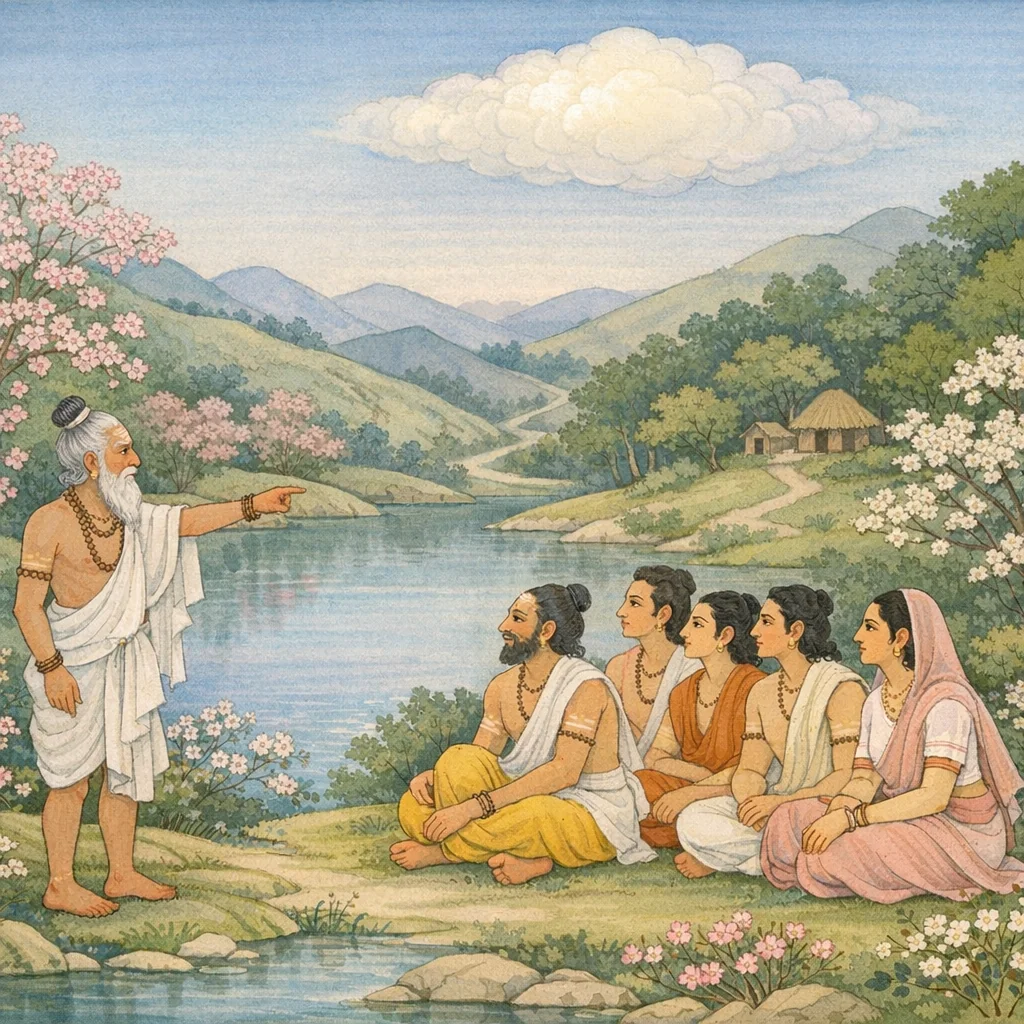
Adhyaya 157
Gandhamādana-nivāsaḥ — Draupadyāḥ prārthanā, Bhīmasenārohaṇaṃ, Maṇimāna-yuddham (Chapter 157: Draupadi’s request, Bhima’s ascent, and the combat with Maniman)
Upa-parva: Gandhamādana-Ārṣṭiṣeṇa-āśrama episode (Bhīmasena’s ascent and encounter near Vaiśravaṇa’s domain)
Janamejaya asks how long the Pāṇḍavas stayed on Gandhamādana, what they consumed there, and for a detailed account of Bhīmasena’s actions, including whether there was contact with Vaiśravaṇa (Kubera). Vaiśaṃpāyana reports that the Pāṇḍavas lived by ascetic-appropriate foods—fruits, pure honey, and meat of game taken with clean arrows—while hearing diverse discourses from Lomāśa; the fifth year of their residence passes. Portents occur: Garuḍa seizes a great nāga from a lake, the mountain trembles, and fragrant garlands and five-colored flowers are blown toward the Pāṇḍavas near the Aśvarathā river. Draupadī, recalling Bhīma’s strength and prior heroic precedents, urges him to show the summit; Bhīma, stirred, arms himself and ascends a difficult peak. He beholds a splendid, jeweled region described as Vaiśravaṇa’s residence, then signals his presence with conch and bowstring sounds. Yakṣa–rākṣasa–gandharva defenders rush in; Bhīma repels their weapons with arrows and drives them back. Maṇimān, identified as a powerful rākṣasa and associate of Vaiśravaṇa, rebukes the retreating troops, attacks Bhīma with mace, spear, and trident; Bhīma counters with expertise in gadā-yuddha, breaks the trident, and finally fells Maṇimān with a decisive mace-throw. The remaining night-stalkers withdraw in distress, marking Bhīma’s localized victory within a guarded divine perimeter.
Chapter Arc: सौगन्धिक सरोवर के तट पर निवास करते हुए युधिष्ठिर ब्राह्मणों, द्रौपदी और भाइयों से अब तक की तीर्थ-यात्रा का स्मरण कराते हैं—कितने पुण्य तीर्थ, वन और सरोवर देखे जा चुके हैं। → युधिष्ठिर क्रमशः उन पवित्र स्थलों का विस्तार से उल्लेख करते हैं जिन्हें देवताओं, महर्षियों और द्विजों ने पूर्वकाल में सेवित किया—पर्वत, सरोवर, समुद्र तथा इला, सरस्वती, सिंधु, यमुना, नर्मदा आदि नदियों के तीर्थ। यात्रा की व्यापकता एक नई दिशा की अपेक्षा जगाती है। → आकाश से दिव्य वाणी सुनाई देती है; ऋषि, ब्राह्मण और राजकुमार—सब विस्मित हो उठते हैं। यह अलौकिक संकेत आगे के पथ और आश्रम-गमन को मानो स्वीकृति/आदेश देता है। → लोमश महात्मा यथाक्रम सभी आयतन/तीर्थ-स्थानों का मार्गदर्शन करते हुए यात्रा को पुनः नर-नारायण आश्रमागमन की ओर प्रवाहित करते हैं; अंत में पाण्डव, द्रौपदी और ब्राह्मणों सहित सुखपूर्वक विश्राम करते हैं। → वृषपर्व के रमणीय, सिद्ध-चारण-सेवित आश्रम की ओर अगला प्रस्थान—जहाँ आगे नई कथा-गाँठें खुलने वाली हैं।
Shlokas
Verse 1
वैशम्पायनजी कहते है--जनमेजय! उस सौगन्धिक सरोवरके तटपर निवास करते हुए धर्मराज युधिष्ठिरने एक दिन ब्राह्मणों तथा द्रौपदीसहित अपने भाइयोंसे इस प्रकार कहा --
Vaiśampāyana said: “O Janamejaya, while dwelling on the bank of that Saugandhika lake, Dharma-rāja Yudhiṣṭhira one day addressed his brothers—together with Draupadī and in the presence of brāhmaṇas—in the following manner.”
Verse 2
दृष्टानि तीर्थान्यस्माभि: पुण्यानि च शिवानि च । मनसो ह्वादनीयानि वनानि च पृथक् पृथक्,“हम लोगोंने अनेक पुण्यदायक एवं कल्याण-स्वरूप तीर्थोंके दर्शन किये। मनको आह्लाद प्रदान करनेवाले भिन्न-भिन्न वनोंका भी अवलोकन किया
Vaiśampāyana said: “We have beheld sacred fords—holy and auspicious—along with many distinct forests, each in its own way delightful to the mind.”
Verse 3
देवै: पूर्व विचीर्णानि मुनिभिश्च महात्मभि: । यथाक्रमविशेषेण द्विजै: सम्पूजितानि च,*वे तीर्थ और वन ऐसे थे, जहाँ पूर्वकालमें देवता और महात्मा, मुनि विचरण कर चुके हैं तथा क्रमश: अनेक द्विजोंने उनका समादर किया है
Vaiśampāyana said: These sacred places had been traversed in ancient times by the gods and by great-souled sages; and, in due order and with fitting distinctions, they were duly honored and worshipfully received by the twice-born.
Verse 4
ऋषीणां पूर्वचरितं तथा कर्म विचेष्टितम् । राजर्षीणां च चरितं कथाश्च विविधा: शुभा:,“हमने ऋषियोंके पूर्वचरित्र, कर्म और चेष्टाओंकी कथा सुनी है। राजर्षियोंके भी चरित्र और भाँति-भाँतिकी शुभ कथाएँ सुनते हुए मंगलमय आश्रमोंमें विशेषत: ब्राह्मणोंके साथ तीर्थस्नान किया है
Verse 5
शृण्वानास्तत्र तत्र सम आश्रमेषु शिवेषु च । अभिषेक द्विजै: सार्थ कृतवन्तो विशेषत:,“हमने ऋषियोंके पूर्वचरित्र, कर्म और चेष्टाओंकी कथा सुनी है। राजर्षियोंके भी चरित्र और भाँति-भाँतिकी शुभ कथाएँ सुनते हुए मंगलमय आश्रमोंमें विशेषत: ब्राह्मणोंके साथ तीर्थस्नान किया है
Vaiśaṃpāyana said: “As we journeyed from place to place, we listened in many sacred hermitages—auspicious and serene—to accounts of the ancient seers: their former lives, their deeds, and their disciplines. Hearing also the varied and wholesome narratives of royal sages, we performed ritual bathing and consecratory ablutions at holy places, especially in the company of Brahmins.”
Verse 6
अर्चिता: सतत देवा: पुष्पैरद्धि: सदा च वः । यथालब्धैर्मूलफलै: पितरश्नापि तर्पिता:,“हमने सदा फूल और जलसे देवताओंकी पूजा की है और यथाप्राप्त फल-मूलसे पितरोंको भी तृप्त किया है
Vaiśampāyana said: “We have continually worshipped the gods with flowers and with water, and we have also satisfied the ancestors with whatever roots and fruits were available. Thus, without excess or harm, we have upheld the duties of reverence and gratitude through simple offerings.”
Verse 7
पर्वतेषु च रम्येषु सर्वेषु च सरस्सु च । उदधौ च महापुण्ये सूपस्पृष्टं महात्मभि:,“रमणीय पर्वतों और समस्त सरोवरोंमें विशेषत: परम पुण्यमय समुद्रके जलमें इन महात्माओंके साथ भलीभाँति स्नान एवं आचमन किया है
Vaiśampāyana said: In delightful mountains, in all the lakes, and especially in the supremely meritorious ocean, they performed thorough ritual bathing and sipping of sanctified water together with those great-souled men—acts that signify purification, reverence for sacred places, and disciplined conduct during their journey.
Verse 8
इला सरस्वती सिन्धुर्यमुना नर्मदा तथा । नानातीर्थेषु रम्येषु सूपस्पृष्ट सह द्विजै:ः,“इला, सरस्वती, सिंधु, यमुना तथा नर्मदा आदि नाना रमणीय तीथोोमें भी ब्राह्मणोंके साथ विधिवत् स्नान और आचमन किया है
Vaiśaṃpāyana said: He duly performed the prescribed purificatory rites—bathing and sipping sanctified water—together with Brahmins at many delightful sacred fords, including the Ilā, Sarasvatī, Sindhu, Yamunā, and Narmadā. The passage underscores the ethic of purification, reverence for holy places, and the merit of acting in accordance with ritual discipline in the company of the learned.
Verse 9
गड्जाद्वारमतिक्रम्प बहव: पर्वता: शुभा: | हिमवान् पर्वतश्नैव नानाद्विजगणायुत:,“गंगाद्वार (हरिद्वार)-को लाँचकर बहुत-से मंगलमय पर्वत देखे तथा बहुसंख्यक ब्राह्मणोंसे युक्त हिमालय पर्वतका भी दर्शन किया
Vaiśampāyana said: Having passed beyond Gaṅgādvāra (Haridvāra), they beheld many auspicious mountains; and they also saw Himavān (the Himalaya), thronged with diverse multitudes of twice-born Brahmins—evoking the sanctity of the region where pilgrimage, learning, and disciplined living converge.
Verse 10
विशाला बदरी दृष्टा नरनारायणाश्रम: । दिव्या पुष्करिणी दृष्टा सिद्धदेवर्षिपूजिता,“विशाल बदरीतीर्थ, भगवान् नर-नारायणके आश्रम तथा सिद्धों और देवर्षियोंसे पूजित इस दिव्य सरोवरका भी दर्शन किया
Vaiśampāyana said: They beheld the vast Badarī sacred region, the hermitage of Bhagavān Nara and Nārāyaṇa, and also saw a divine lotus-lake, revered and worshipped by Siddhas and divine seers. The passage underscores the sanctifying power of pilgrimage—approaching holy places and exemplary sages as a means of inner purification and alignment with dharma.
Verse 11
“विप्रवरो! महात्मा लोमशजीने हमें सभी पुण्य-स्थानोंके क्रमश: दर्शन कराये हैं
Vaiśampāyana said: “O best of brāhmaṇas, the great-souled Lomāśa has led us, in due sequence, to behold all the sacred pilgrimage places.”
Verse 12
इमं॑ वैश्रवणावासं पुण्यं सिद्धनिषेवितम् । कथं भीम गमिष्यामो गतिरन्तरधीयताम्,'भीमसेन! यह सिद्धसेवित पुण्यप्रदेश कुबेरका निवासस्थान है। अब हम कुबेरके भवनमें कैसे प्रवेश करेंगे? इसका उपाय सोचो”
Vaiśampāyana said: “This is the sacred abode of Vaiśravaṇa (Kubera), a holy region frequented by perfected beings. O Bhīma, how are we to proceed and gain entry here? Let a means be devised—think of the right course to take.”
Verse 13
वैशम्पायन उवाच एवं ब्रुवति राजेन्द्रे वागुवाचाशरीरिणी । न शक्यो दुर्गमो गन्तुमितो वैश्रवणाश्रमात्,वैशम्पायनजी कहते हैं--महाराज युधिष्ठिरके ऐसा कहते ही आकाशवाणी बोल उठी --“कुबेरके इस आश्रमसे आगे जाना सम्भव नहीं है। यह मार्ग अत्यन्त दुर्गम है
Vaiśampāyana said: As the lordly king (Yudhiṣṭhira) was speaking thus, a bodiless voice spoke: “From this hermitage of Vaiśravaṇa (Kubera), it is not possible to go further. The way ahead is exceedingly difficult.”
Verse 14
अनेनैव पथा राजन् प्रतिगच्छ यथागतम् | नरनारायणस्थानं बदरीत्यभिविश्रुतम्,“राजन्! जिससे तुम आये हो, उसी मार्गसे विशाला बदरीके नामसे विख्यात भगवान् नर-नारायणके स्थानको लौट जाओ
Vaiśampāyana said: “O King, return by this very path, the same way you came, to the famed hermitage known as Badarī—the sacred abode of Nara and Nārāyaṇa.”
Verse 15
तस्माद् यास्यसि कौन्तेय सिद्धचारणसेवितम् । बहुपुष्पफलं रम्यमाश्रमं वृषपर्वण:,“कुन्तीकुमार! वहाँसे तुम प्रचुर फल-फूलसे सम्पन्न वृषपर्वके रमणीय आश्रमपर जाओ, जहाँ सिद्ध और चारण निवास करते हैं
Vaiśampāyana said: “Therefore, O son of Kuntī, you shall go to the delightful hermitage of Vṛṣaparvan—rich in many flowers and fruits—frequented by Siddhas and Cāraṇas.” The instruction frames the forest journey as a disciplined movement toward a sanctified space, where contact with perfected beings and sacred bards supports right conduct, restraint, and clarity of purpose amid hardship.
Verse 16
अतिक्रम्य च त॑ पार्थ त्वार्शिषेणाश्रमे वसे: | ततो द्रक्ष्यसि कौन्तेय निवेशं धनदस्य च,“उस आश्रमको भी लाँचकर आर्डषषिणके आश्रमपर जाना और वहीं निवास करना। तदनन्तर तुम्हें धनदाता कुबेरके निवासस्थानका दर्शन होगा”
Vaiśampāyana said: “O Pārtha, having passed beyond that (place/āśrama), you should go to the hermitage of Ārṣiṣeṇa and dwell there. Then, O son of Kuntī, you will behold the abode of Dhanada (Kubera).”
Verse 17
एतस्मिन्नन्तरे वायुर्दिव्यगन्धवह: शुचि: । सुखप्रह्नलादन: शीत: पुष्पवर्ष ववर्ष च,इसी समय दिव्य सुगन्धसे परिपूर्ण पवित्र वायु चलने लगी, जो शीतल तथा सुख और आह्लाद देनेवाली थी। साथ ही वहाँ फूलोंकी वर्षा होने लगी
At that very moment, a pure breeze arose, bearing a divine fragrance—cool, soothing, and gladdening to the heart. And there, a shower of flowers also began to fall, as if nature itself were honoring the sanctity of what was unfolding.
Verse 18
श्रुत्वा तु दिव्यामाकाशाद् वाचं सर्वे विसिस्मियु: । ऋषीणां ब्राह्मणानां च पार्थिवानां विशेषत:,वह दिव्य आकाशवाणी सुनकर सबको बड़ा विस्मय हुआ। ऋषियों, ब्राह्मणों और विशेषत: राजर्षियोंको अधिक आश्चर्य हुआ
Vaiśampāyana said: Hearing that celestial voice resounding from the sky, everyone was struck with wonder. The sages and the brāhmaṇas—and most of all the kings present—were filled with an even greater astonishment, sensing a divine intervention that demanded reverent attention and moral seriousness.
Verse 19
श्रुत्वा तन्महदाश्नचर्य द्विजो धौम्यो5ब्रवीत् तदा । न शक्यमुत्तरं वक्तुमेवं भवतु भारत,वह महान् आश्चर्यजनक बात सुनकर वि्रर्षि धौम्यने कहा--“भारत! इसका प्रतिवाद नहीं किया जा सकता। ऐसा ही होना चाहिये”
Hearing that great marvel, the Brahmin Dhaumya then said: “O Bhārata, no rebuttal can be offered to this. Let it be so.”
Verse 20
ततो युधिष्छिरो राजा प्रतिजग्राह तद् वच: । प्रत्यागम्य पुनस्तं तु नरनारायणाश्रमम्,तदनन्तर राजा युधिष्ठिरने वह आकाशवाणी स्वीकार कर ली और पुन: नर-नारायणके आश्रममें लौटकर भीमसेन आदि सब भाइयों और द्रौपदीके साथ वहीं रहने लगे। उस समय साथ आये हुए ब्राह्मण लोग भी वहीं सुखपूर्वक निवास करने लगे
Then King Yudhiṣṭhira accepted those words. Returning once again to the hermitage of Nara and Nārāyaṇa, he stayed there together with Bhīmasena and the other brothers, as well as Draupadī. The brāhmaṇas who had accompanied them also dwelt there happily. The passage underscores Yudhiṣṭhira’s readiness to heed authoritative counsel and to choose disciplined, peaceful residence in a sacred place, sustaining harmony with companions and guests.
Verse 21
तदनन्तर राजा युधिष्ठिरने वह आकाशवाणी स्वीकार कर ली और पुन: नर-नारायणके आश्रममें लौटकर भीमसेन आदि सब भाइयों और द्रौपदीके साथ वहीं रहने लगे। उस समय साथ आये हुए ब्राह्मण लोग भी वहीं सुखपूर्वक निवास करने लगे
Thereafter King Yudhiṣṭhira accepted the heavenly voice. Then, returning again to the hermitage of Nara and Nārāyaṇa, he stayed there with all his brothers—beginning with Bhīmasena—and with Draupadī. The brāhmaṇas who had come along also lived there happily. The episode underscores Yudhiṣṭhira’s readiness to heed divine counsel and to seek refuge in a sanctified place, sustaining the community of dependents through disciplined, dharmic residence.
Verse 131
यथाक्रमविशेषेण सर्वाण्यायतनानि च । दर्शितानि द्विजश्रेष्ठा लोमशेन महात्मना
Vaiśampāyana said: “In due order, with each place distinguished by its proper sequence, all the sacred sites were shown—O best of the twice-born—by the great-souled Lomāśa.”
Verse 156
इति श्रीमहाभारते वनपर्वणि तीर्थयात्रापर्वणि लोमशतीर्थयात्रायां पुनर्नरनारायणाश्रमागमने षट्पज्चाशदधिकशततमो< ध्याय:,इस प्रकार श्रीमह्याभारत वनपर्वके अन्तर्गत तीर्थयात्रापर्वमें लोगशती र्थयात्राके प्रसंगमें पाण्डवोंका पुनः नर-नारायणके आश्रगरमें आयमनविषयक एक सौ छप्पनवाँ अध्याय पूरा हुआ
Thus, in the Śrī Mahābhārata, within the Vana Parva, in the Tīrtha-yātrā Parva—during Lomasa’s pilgrimage narrative—ends the one-hundred-and-fifty-sixth chapter, describing the Pāṇḍavas’ return to the hermitage of Nara and Nārāyaṇa. The colophon signals a transition: after sacred travel and instruction, the heroes are brought back to an archetypal seat of austerity and dharma, where spiritual authority frames and purifies their worldly trials.
Verse 231
भीमसेनादिशि: सर्वैर्भ्नातृभि: परिवारित: । पाज्चाल्या ब्राह्मुणाश्वैव न्यवसन्त सुखं तदा
Vaiśaṃpāyana said: Then, surrounded by all his brothers, Bhīmasena stayed there in comfort, together with Pāñcālī and the brāhmaṇas. The scene underscores the dharmic ideal of fraternal solidarity and the duty to protect and support dependents—especially a shared wife and the learned—during hardship.
Frequently Asked Questions
The tension lies between heroic initiative and the propriety of entering a guarded divine territory: Bhīma’s strength is affirmed, yet the episode frames a conflict triggered by boundary enforcement and the risks of unauthorized approach to a protected domain.
Power is most credible when paired with discipline: the chapter juxtaposes ascetic living and attentive listening to sages with controlled martial competence, suggesting that resilience in exile requires both ethical formation and readiness to act.
No explicit phalaśruti appears in the provided chapter segment; the meta-function is narrative-architectural—positioning Bhīma’s prowess and the Gandhamādana setting as a bridge toward later divine interactions and escalations in the exile cycle.