Adhyaya 25
बलरामस्य वारुणी-प्रसङ्गः, यमुनाकर्षणम्, लक्ष्मी-प्रदत्त-विभूषणम्, रेवती-विवाहः
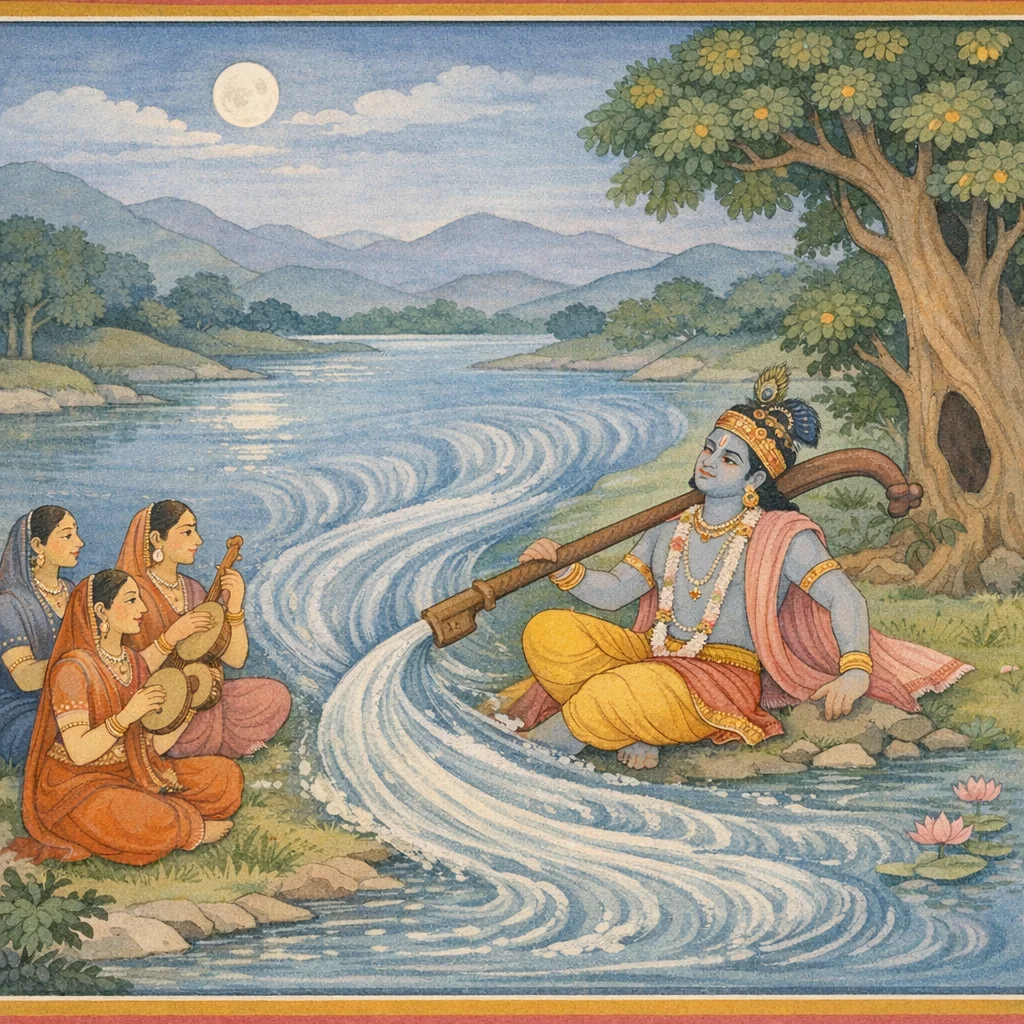
Parāśara tells Maitreya: during a forest outing, Śeṣa (Ananta), veiled in human form, moves about with the Lord. Seeing the purpose fulfilled, Varuṇa sends the sacred Vāruṇī for Ananta’s enjoyment; it abides in a hollow of a kadamba tree in Vṛndāvana. Balarāma, catching the fragrance of wine, drinks with the gopas and gopīs amid songs and instruments of praise. Heated and shining with beads of sweat, he calls, “Yamunā, come!” but the river, taking it as drunken speech, does not come. Enraged, Halāyudha seizes Yamunā at the bank and drags her from her course, flooding the forest; terrified, Yamunā assumes bodily form and begs forgiveness, and Balarāma releases her. After bathing, his splendor increases; he receives a lotus ornament, a single earring, a lotus garland sent by Varuṇa, and blue garments bestowed by Śrī Lakṣmī. After sporting in Vraja for two months, he returns to Dvārakā and weds Revatī; they have two sons, Niṣaṭha and Ulmuka.
Shlokas
Verse 1
वने विचरतस् तस्य सह गोपैर् महात्मनः मानुषछद्मरूपस्य शेषस्य धरणीभृतः
As that great-souled Lord wandered through the forest with the cowherds, Śeṣa—the bearer of the earth—also moved beside Him, concealed in a human guise.
Verse 2
निष्पादितोरुकार्यस्य कार्येणोर्वीविचारिणः उपभोगार्थम् अत्यर्थं वरुणः प्राह वारुणीम्
Seeing that he who ranged across the earth in the course of his duty had accomplished the great undertaking, Varuṇa—wishing to grant him fitting enjoyment—bestowed the divine liquor called Vāruṇī.
Verse 3
अभीष्टा सर्वदा यस्य मदिरे त्वं महौजसः अनन्तस्योपभोगाय तस्य गच्छ मुदे शुभे
O Madirā, ever the cherished delight of that mighty one—auspicious lady, go to Ananta, that he may partake of you in joy and satisfaction.
Verse 4
इत्य् उक्ता वारुणी तेन संनिधानम् अथाकरोत् वृन्दावनवनोत्पन्नकदम्बतरुकोटरे
Thus addressed, Vāruṇī made her presence manifest, taking her station within the hollow of a kadamba tree that had sprung up in the forest of Vṛndāvana.
Verse 5
विचरन् बलदेवो ऽपि मदिरागन्धम् उत्तमम् आघ्राय मदिरातर्षम् अवापाथ पुरातनम्
As Balarāma too wandered about, he caught the finest fragrance of liquor; and merely by inhaling it, an ancient thirst for wine arose within him once again.
Verse 6
ततः कदम्बात् सहसा मद्यधारां स लाङ्गली पतन्तीं वीक्ष्य मैत्रेय प्रययौ परमां मुदम्
Then, O Maitreya, the Plough-bearer (Balarāma), suddenly beholding a stream of intoxicating liquor pouring down from the kadamba tree, was seized by the highest delight.
Verse 7
पपौ च गोपगोपीभिः समवेतो मुदान्वितः प्रगीयमानो ललितं गीतवाद्यविशारदैः
And he drank with them, gathered with the cowherds and cowherd-women, filled with joy, while those skilled in song and instruments sang delicate praises.
Verse 8
स मत्तो ऽत्यन्तघर्माम्भःकणिकामौक्तिकोज्ज्वलः आगच्छ यमुने स्नातुम् इच्छामीत्य् आह विह्वलः
Maddened with longing, his body glittering with pearl-like droplets of sweat from the intense heat, he cried out in agitation: “Come, O Yamunā—I wish to bathe!”
Verse 9
तस्य वाचं नदी सा तु मत्तोक्ताम् अवमन्य वै नाजगाम ततः क्रुद्धो हलं जग्राह लाङ्गली
But that river, slighting his command as though it were the utterance of one intoxicated, did not come. Then the Plough-bearer, angered, seized his plough.
Verse 10
गृहीत्वा तां तटे तेन चकर्ष मदविह्वलः पापे नायासि नायासि गम्यताम् इच्छयान्यतः
Maddened by intoxication, he seized her on the riverbank and dragged her, saying: “Wicked one—do not go, do not go! Go elsewhere only if I permit it.”
Verse 11
साकृष्टा सहसा तेन मार्गं संत्यज्य निम्नगा यत्रास्ते बलभद्रो ऽसौ प्लावयाम् आस तद् वनम्
Dragged at once by him, the river abandoned her former course, turned to where Balabhadra stood, and flooded that woodland on every side.
Verse 12
शरीरिणी तथोपेत्य त्रासविह्वललोचना प्रसीदेत्य् अब्रवीद् रामं मुञ्च मां मुसलायुध
Then, taking on a bodily form, she approached with eyes trembling in fear and pleaded to Rāma (Balarāma): “Be gracious! Release me, O wielder of the plough-weapon!”
Verse 13
सो ऽब्रवीद् अवजानासि मम शौर्यबले नदि सो ऽहं त्वां हलपातेन विनेष्यामि सहस्रधा
He said: “O river, you slight my valor and my strength. Therefore, with the blow of my plough I shall strike you down and shatter you into a thousand pieces.”
Verse 14
इत्य् उक्तयातिसंत्रासात् तया नद्या प्रसादितः भूभागे प्लाविते तस्मिन् मुमोच यमुनां बलः
Thus addressed, the river, overwhelmed by great fear, became appeased. And when that tract of land had been flooded, Bala released the Yamunā, letting her flow again in her proper course.
Verse 15
ततः स्नातस्य वै कान्तिर् आजगाम महात्मनः अवतंसोत्पलं चारु गृहीत्वैकं च कुण्डलम्
Then, when the great-souled one had bathed, a radiant splendor came upon him. Taking a lovely lotus as an ornament and also a single earring, he became adorned with auspicious brilliance.
Verse 16
वरुणप्रहितां चास्मै मालाम् अम्लानपङ्कजाम् समुद्राभे तथा वस्त्रे नीले लक्ष्मीर् अयच्छत
Lakṣmī bestowed upon him a garland of unfading lotuses sent by Varuṇa, and she also granted him two dark-blue garments, ocean-hued, as tokens of sacred majesty.
Verse 17
कृतावतंसः स तदा चारुकुण्डलभूषितः नीलाम्बरधरः स्रग्वी शुशुभे कान्तिसंयुतः
Then he shone in radiant splendor—his head adorned, his ears graced with lovely earrings; clad in blue raiment and wearing a garland, he blazed with enchanting divine brilliance.
Verse 18
इत्थं विभूषितो रेमे तत्र रामस् तदा व्रजे मासद्वयेन यातश् च पुनः स द्वारकां पुरीम्
Thus honored and adorned, Rāma (Balarāma) dwelt joyfully in Vraja; and when two months had passed, he returned again to the city of Dvārakā.
Verse 19
रेवतीं नाम तनयां रैवतस्य महीपतेः उपयेमे बलस् तस्यां जज्ञाते निशठोल्मुकौ
Bala took to wife Revatī, the daughter of King Raivata; and from her were born two sons, Niśaṭha and Ulmuka.
Frequently Asked Questions
The narrative frames it as a divine ‘upabhoga’ offering after the completion of great duties—signaling cosmic offices (Varuṇa) honoring the Lord’s manifestation (Ananta) and showing that even deities act under the higher sovereign order of Vishnu’s lila.
It depicts īśvara-niyantraṇa: nature and its courses are not autonomous against the Lord’s will. The river’s personified surrender (śaraṇāgati) and subsequent release illustrate that divine power is tempered by grace once humility and order are restored.