Adhyaya 2
गर्भ-व्यवस्था, देवकी-गर्भ-स्तुति (गर्भस्तुतिः), जगदन्तर्गत-हरि-प्रतिपादनम्
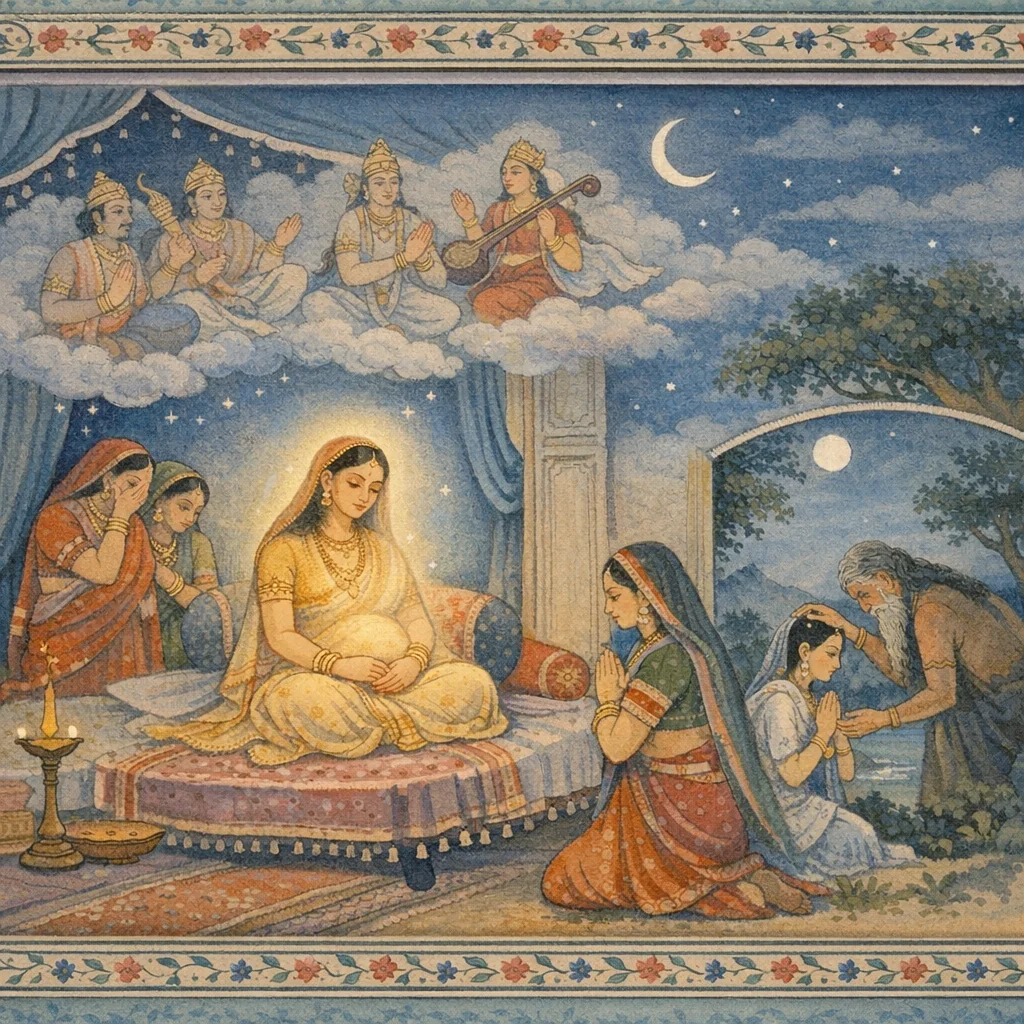
Parāśara recounts the divine ordinance in action: Yogamāyā implants the six embryos and transfers the seventh to Rohiṇī; then, for the welfare of the three worlds, Hari enters Devakī’s womb, while Yoganidrā is conceived in Yaśodā. Cosmic signs arise—planets align and seasons turn auspicious—proclaiming the descent of Viṣṇu’s aṁśa. Devakī blazes with unbearable tejas, and unseen devas continually praise her. The chapter unfolds as a garbha-stuti, extolling Devakī as the womb of prakṛti, vāk, Veda, and yajña, and as the source of both deva and daitya lineages (Aditi/Diti). The hymn expands cosmologically: because Viṣṇu, beyond all measures and limits, has entered her, the earth with oceans, rivers, cities, and the seven lokas are said to abide within her womb. It culminates in a prayer for auspiciousness and protection, asking the Goddess to lovingly uphold the Lord who upholds the entire jagat—affirming Viṣṇu’s non-dual pervasion while preserving the devotional intimacy of the birth narrative.
Shlokas
Verse 1
यथोक्तं सा जगद्धात्री देवदेवेन वै तदा षड्गर्भगर्भविन्यासं चक्रे चान्यस्य कर्षणम्
Just as the God of gods had spoken, then indeed she—the World-Mother—set in order the implantation of six embryos, and also brought about the drawing away of another (embryo) elsewhere.
Verse 2
सप्तमे रोहिणीं प्राप्ते गते गर्भे ततो हरिः लोकत्रयोपकाराय देवक्याः प्रविवेश वै
When the seventh (embryo) had gone to Rohiṇī, then Hari—moved by the purpose of blessing the three worlds—indeed entered the womb of Devakī.
Verse 3
योगनिद्रा यशोदायास् तस्मिन्न् एव ततो दिने संभूता जठरे तद्वद् यथोक्तं परमेष्ठिना
That very day, just as the Supreme Ordainer had declared, Yoga-nidrā was conceived in Yaśodā’s womb, so that the Lord’s sovereign design might unfold without impediment.
Verse 4
ततो ग्रहगणः सम्यक् प्रचचार दिवि द्विज विष्णोर् अंशे भुवं याते ऋतवश् चाभवन् शुभाः
Thereafter, O twice-born, the host of planets moved through the heavens in perfect order; and when an emanated portion of Viṣṇu descended to the earth, the seasons too became auspicious, restored to beneficent harmony.
Verse 5
न सेहे देवकीं द्रष्टुं कश्चिद् अप्य् अतितेजसा जाज्वल्यमानां तां दृष्ट्वा मनांसि क्षोभम् आययुः
None could bear to look upon Devakī, for she blazed with overpowering splendor; seeing her thus aflame with radiance, their minds were shaken and thrown into turmoil.
Verse 6
अदृष्टाः पुरुषैः स्त्रीभिर् देवकीं देवतागणाः बिभ्राणां वपुषा विष्णुं तुष्टुवुस् ताम् अहर्निशम्
Unseen by men and women, the hosts of gods continually praised Devakī—she who bore Viṣṇu Himself within her body—extolling her day and night.
Verse 7
प्रकृतिस् त्वं परा सूक्ष्मा ब्रह्मगर्भाभवः पुरा ततो वाणी जगद्धातुर् वेदगर्भातिशोभने
You are the supreme, subtle Prakṛti—the primordial womb in which Brahmā once lay as an embryo. From you arose the divine Word of the Creator of worlds, by which the Vedas were brought forth—O Radiant One, resplendent as the womb of sacred knowledge.
Verse 8
सृज्यस्वरूपगर्भा च सृष्टिभूता सनातने बीजभूता तु सर्वस्य यज्ञगर्भाभवस् त्रयी
O Eternal One, you are the womb of the very form of creation—creation itself made manifest. You are the seed of all that exists; and from you, as the inner essence of sacrifice, the threefold Veda comes to be.
Verse 9
फलगर्भा त्वम् एवेज्या वह्निगर्भा तथारणिः अदितिर् देवगर्भा त्वं दैत्यगर्भा तथा दितिः
You are Ijyā itself, the sacred rite, holding within you the fruit of every act. You are the araṇi, the fire-stick, womb of the hidden flame. You are Aditi, in whom the gods are conceived; and you are Diti, in whom the Daityas are conceived—thus do both orders of beings arise from you, O Supreme Reality.
Verse 10
ज्योत्स्ना वासरगर्भा त्वं ज्ञानगर्भासि सन्नतिः नयगर्भधरा नीतिर् लज्जा त्वं प्रश्रयोद्वहा
You are moonlight itself, and within you the day is held; you are humility, bearing wisdom within. You are righteous policy, carrying discernment in your womb; you are modesty, the wellspring that gives rise to gentle courtesy.
Verse 11
कामगर्भा तथेच्छा त्वं त्वं तुष्टिस् तोषगर्भिणी मेधा च बोधगर्भासि धैर्यगर्भोद्वहा धृतिः
You are desire itself, bearing desire within; you are will, pregnant with resolve. You are contentment, the womb of satisfaction; you are intelligence, bearing awakening within. You are steadfastness, carrying fortitude in your very core; you are endurance, the bearer of patience and strength.
Verse 12
ग्रहर्क्षतारकागर्भा द्यौर् अस्याखिलहैतुकी एता विभूतयो देवि तथान्याश् च सहस्रशः
The heavens—womb to planets, lunar mansions, and stars—stand as the all-pervading causal ground of this manifest world. These are His manifestations, O Goddess; and countless others besides, by the thousandfold.
Verse 13
तथासंख्या जगद्धात्रि साम्प्रतं जठरे तव समुद्रादिनदीद्वीपवनपत्तनभूषणा ग्रामखर्वटखेटाढ्या समस्ता पृथिवी शुभे
So too, O auspicious one—O sustainer of the worlds—at this very moment the entire Earth abides within your womb: adorned with oceans and rivers, with islands and forests, with cities as her ornaments, and filled with villages, market-towns, and settlements.
Verse 15
भूर्लोको ऽथ भुवर्लोकः स्वर्लोको ऽथ महर् जनः तपश् च ब्रह्मलोकश् च ब्रह्माण्डम् अखिलं शुभे
O auspicious one, Bhūr-loka, Bhuvar-loka, Svarga-loka, and then Maharloka, Janaloka, Tapoloka, and Brahmaloka—these, arrayed in ordered tiers, together form the entire brahmāṇḍa, the complete universe.
Verse 16
तदन्तर् ये स्थिता देवा दैत्यगन्धर्वचारणाः महोरगास् तथा यक्षा राक्षसाः प्रेतगुह्यकाः
In the spaces between those worlds dwell many orders of beings—gods, Daityas, Gandharvas and Cāraṇas; the great serpents, the Yakṣas, the Rākṣasas, and also the hosts of Pretas and Guhyakas.
Verse 17
मनुष्याः पशवश् चान्ये ये च जीवा यशस्विनि तैर् अन्तःस्थैर् अनन्तो ऽसौ सर्वेशः सर्वभावनः
O illustrious one, whether humans, animals, or any other living beings—within all embodied lives abides that Infinite One. He is the Lord of all, the inner source who brings forth and sustains every state of being.
Verse 18
रूपकर्मस्वरूपाणि न परिच्छेदगोचरे यस्याखिलप्रमाणानि स विष्णुर् गर्भगस् तव
He whose form, deeds, and essential nature cannot be circumscribed by any measure—before whom all means of valid knowledge fall silent—that very Viṣṇu has entered your womb.
Verse 19
त्वं स्वाहा त्वं स्वधा विद्या सुधा त्वं ज्योतिरम्बरे त्वं सर्वलोकरक्षार्थम् अवतीर्णा महीतले
You are Svāhā, the sacred utterance that bears offerings to the gods; you are Svadhā, the sanctifying invocation that sustains the ancestors. You are knowledge itself and the nectar of immortality; you are the radiance that shines in the heavens. For the protection of all worlds, you have descended upon the earth.
Verse 20
प्रसीद देवि सर्वस्य जगतः शं शुभे कुरु प्रीत्या तं धारयेशानं धृतं येनाखिलं जगत्
Be gracious, O Goddess; bring peace and auspiciousness to all the world. In loving devotion, uphold that Supreme Lord—the Sovereign—by whom the entire universe is upheld.
Frequently Asked Questions
It is a hymn-like passage praising the womb-bearing Devakī (and the divine feminine principle) as the locus of cosmic origins—because Viṣṇu, the immeasurable Jagat-kāraṇa, has entered her womb; therefore worlds, beings, and sacred knowledge are poetically said to abide within her.
The text treats the avatāra as a cosmic event: when Viṣṇu’s aṁśa descends, dharma’s restoration is mirrored by harmony in graha movements and ṛtu cycles, functioning as narrative markers of divine presence.