शिवमायाप्रभाववर्णनम् (Description of the Power/Effects of Śiva’s Māyā)
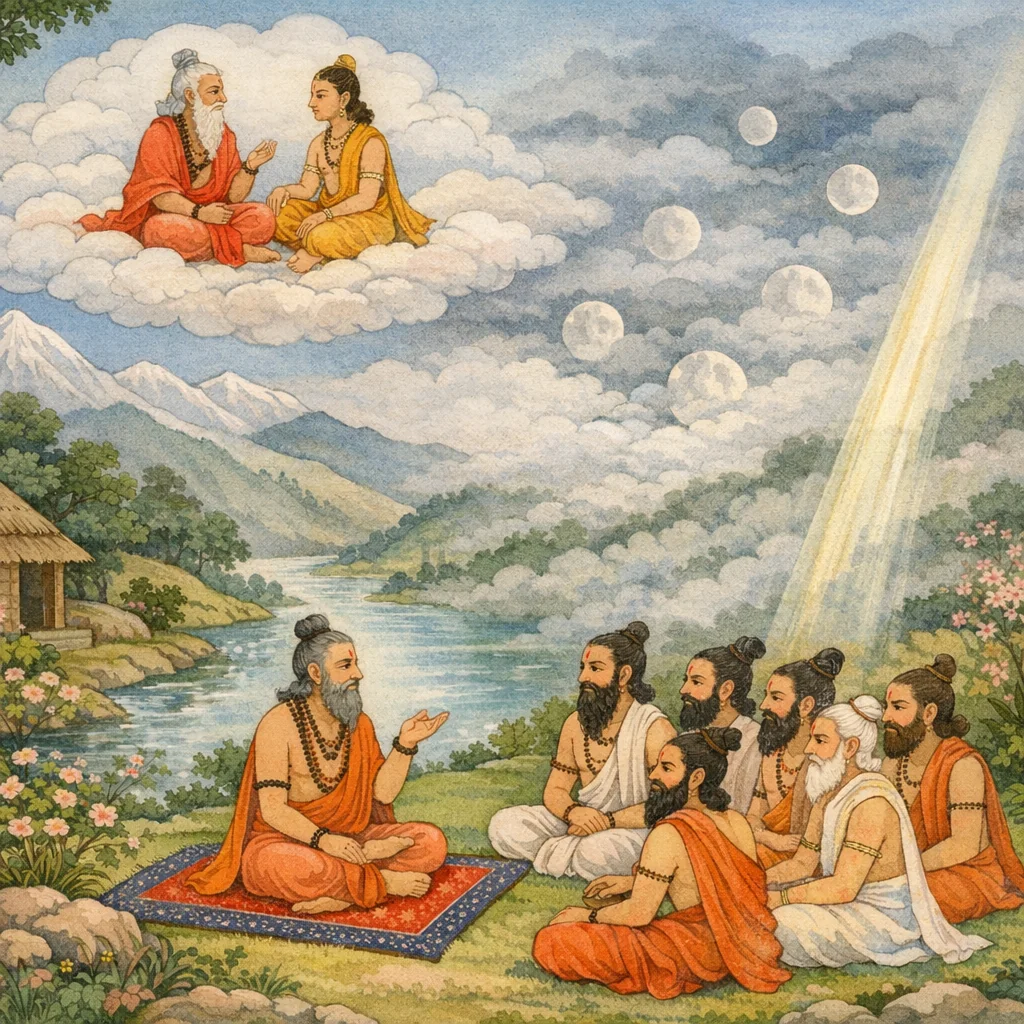
Adhyāya 4 unfolds as a layered transmission of authority: the sages ask for a fresh exposition, and Sūta recounts how his teacher Vyāsa questioned Sanatkumāra, the birthless and omniscient one. The subject is the prabhāva (operative power) of Śiva’s māyā: though Śiva’s mahimā pervades the whole jagat, beings are deluded when māyā “takes away” knowledge, making plurality and the varied play of līlā appear. Sanatkumāra presents the teaching as salvific—mere hearing of the Śāṃkarī narrative awakens bhakti toward Śiva and reverses ignorance. The chapter culminates in a high identification of Śiva as Sarveśvara and Sarvātmā, with His supreme form functioning triadically as Brahmā–Viṣṇu–Īśvara, expressed through liṅga symbolism (triliṅgā, liṅgarūpiṇī) to reveal unity behind apparent multiplicity.
Shlokas
Verse 1
मुनय ऊचुः । ताततात महाभाग धन्यस्त्वं हि महामते । अद्भुतेयं कथा शंभोः श्राविता परभक्तिदा
The sages said: “O revered one, O revered one—fortunate and noble are you, O great-minded one. This wondrous account of Śambhu has been recited to us, and it bestows supreme devotion.”
Verse 2
पुनर्ब्रूहि कथां शंभोर्व्यास प्रश्नानुसारतः । सर्वज्ञस्त्वं व्यासशिष्यः शिवतत्त्वविचक्षणः
O Vyāsa, recount once again the sacred narrative of Śambhu, in accordance with the questions. You are omniscient—Vyāsa’s disciple—and discerning in the tattva, the true principle of Śiva.
Verse 3
सूत उवाच । एवमेव गुरुर्व्यासः पृष्टवान्मेऽजसंभवम् । सनत्कुमारं सर्वज्ञं शिवभक्तं मुनीश्वरम्
Sūta said: “In the same manner, my guru Vyāsa questioned me—(and also) the self-born Brahmā—and (he questioned) Sanatkumāra, the all-knowing lord among sages, a devoted servant of Śiva.”
Verse 4
इति श्रीशिवमहापुराणे पंचम्यामुमासंहितायां शिवमायाप्रभाववर्णनं नाम चतुर्थो ऽध्यायः
Thus, in the Śrī Śiva Mahāpurāṇa, in the Fifth Book—the Umāsaṃhitā—ends the Fourth Chapter, entitled “The Description of the Power and Manifestation of Śiva’s Māyā.”
Verse 5
पुनर्ब्रूहि महादेव महिमानं विशेषतः । श्रद्धा च महती श्रोतुं मम तात प्रवर्द्धते
O Mahādeva, please speak again—especially in detail—about Your glory. Dear father, my great faith to listen keeps increasing.
Verse 6
महिम्ना येन शंभोस्तु येये लोके विमोहिताः । मायया ज्ञानमाहृत्य नानालीलाविहारिणः
By the very greatness of Śambhu, the beings of this world become deluded: through His Māyā their true knowledge is drawn away, and they wander on, sporting in countless and varied worldly play.
Verse 7
सनत्कुमार उवाच । शृणु व्यास महाबुद्धे शांकरीं सुखदां कथाम् । तस्याः श्रवणमात्रेण शिवे भक्तिः प्रजायते
Sanatkumāra said: “Listen, O Vyāsa of great intellect, to this Śāṃkarī narrative that bestows joy. By merely hearing it, devotion to Śiva is born.”
Verse 8
शिवस्सर्वेश्वरो देवस्सर्वात्मा सर्वदर्शनः । महिम्ना तस्य सर्वं हि व्याप्तं च सकलं जगत्
Shiva is the Lord of all, the supreme Deva—the indwelling Self of all beings, and the all-seeing Witness. Indeed, by His majesty, the entire universe is pervaded and sustained everywhere.
Verse 9
शिवस्यैव परा मूर्तिर्ब्रह्मविष्ण्वीश्वरात्मिका । सर्वभूतात्मभूताख्या त्रिलिंगा लिंगरूपिणी
Indeed, Shiva’s supreme Form is that which is the very Self of Brahmā, Viṣṇu, and Īśvara. Known as the Inner Self of all beings, that Supreme Reality is the “threefold-linga” and is manifested as the Linga itself.
Verse 10
देवानां योनयश्चाष्टौ मानुषी नवमी च या । तिरश्चां योनयः पंच भवंत्येवं चतुर्द्दश
Among the Devas there are eight classes born of the womb; the human womb is the ninth; and among animals there are five womb-born classes—thus, in this manner, there are fourteen classes of embodied birth.
Verse 11
भूता वा वर्तमाना वा भविष्याश्चैव सर्वश । शिवात्सर्वे प्रवर्तंते लीयंते वृद्धिमागताः
All beings—of the past, the present, and the future—arise from Śiva alone. Having grown and fulfilled their course, they again merge into Him.
Verse 12
ब्रह्मेन्द्रोपेन्द्रचन्द्राणां देवदानवभोगिनाम् । गंधर्वाणां मनुष्याणामन्येषां वापि सर्वशः
For Brahmā, Indra, Upendra (Viṣṇu), and the Moon; for the Devas, the Asuras, and the serpent-beings (Nāgas); for the Gandharvas and humankind—and indeed for all others everywhere—this truth holds in every way.
Verse 13
बंधुर्मित्रमथाचार्य्यो रक्षन्नेताऽर्थवान्गुरुः । कल्पद्रुमोऽथ वा भ्राता पिता माता शिवो मतः
Śiva is regarded as one’s kinsman and friend, as the teacher and protecting guide, as the gracious Guru who bestows true prosperity. He is also held to be like the wish-fulfilling tree—indeed, as one’s brother, father, and mother.
Verse 14
शिवस्सर्वमयः पुंसां स्वयं वेद्यः परात्परः । वक्तुं न शक्यते यश्च परं चानु परं च यत्
Śiva is all-pervading in all beings; He is to be realized by oneself and is higher than the highest. He cannot truly be expressed in words—He is the Supreme, and yet He is also that which is beyond even the Supreme.
Verse 15
तन्माया परमा दिव्या सर्वत्र व्यापिनी मुने । तदधीनं जगत्सर्वं सदेवासुरमानुषम्
O sage, His Māyā is supreme and divine, pervading everywhere. Dependent upon that power is this entire universe—together with the gods, the asuras, and humankind.
Verse 16
कामेन स्वसहायेन प्रबलेन मनोभुवा । सर्वः प्रधर्षितो वीरो विष्ण्वादिः प्रबलोऽपि हि
By Kāma—assisted by his own powerful ally, the mind-born one—every hero was subdued; indeed, even the mighty ones beginning with Viṣṇu, though strong, were overpowered.
Verse 17
शिवमायाप्रभावेणाभूद्धरिः काममोहितः । परस्त्रीधर्षणं चक्रे बहुवारं मुनीश्वर
O lord of sages, by the overpowering influence of Śiva’s māyā, Hari (Viṣṇu) became deluded by desire and, again and again, committed the outrage of violating another’s wife.
Verse 18
इन्द्रस्त्रिदशपो भूत्वा गौतमस्त्रीविमोहितः । पापं चकार दुष्टात्मा शापं प्राप मुनेस्तदा
Indra, lord of the thirty-three gods, became infatuated with Gautama’s wife. That evil-minded one committed sin and then received a curse from the sage.
Verse 19
पावकोऽपि जगच्छ्रेष्ठो मोहितश्शिवमायया । कामाधीनः कृतो गर्वात्ततस्तेनैव चोद्धृतः
Even Pāvaka (Agni), deemed the foremost among the world’s powers, was deluded by Śiva’s Māyā. Through pride he was made subject to desire; and then, by that very power of the Lord, he was raised up again.
Verse 20
जगत्प्राणोऽपि गर्वेण मोहितश्शिवमायया । कामेन निर्जितो व्यासश्चक्रेऽन्यस्त्रीरतिं पुरा
Even Vyāsa—though a life-breath to the world—was once deluded by pride through Śiva’s Māyā; conquered by desire, he formerly fell into attachment to another woman.
Verse 21
चण्डरश्मिस्तु मार्तण्डो मोहितश्शिवमायया । कामाकुलो बभूवाशु दृष्ट्वाश्वीं हयरूपधृक्
Mārtaṇḍa (the Sun), whose rays are fierce, was deluded by Śiva’s Māyā. On seeing the mare, he at once became agitated with desire and assumed the form of a stallion.
Verse 22
चन्द्रश्च मोहितश्शम्भोर्मायया कामसंकुलः । गुरुपत्नीं जहाराथ युतस्तेनैव चोद्धृतः
Moon (Candra) too—bewildered by Śambhu’s Māyā and agitated by desire—carried off the wife of his own guru; yet, by that very Lord, he was also restored and delivered.
Verse 23
पूर्वं तु मित्रावरुणौ घोरे तपसि संस्थितौ । मोहितौ तावपि मुनी शिवमायाविमोहितौ
In former times, Mitra and Varuṇa were established in fierce austerities; yet even those two sages became deluded, being bewildered by Śiva’s Māyā.
Verse 24
उर्वशीं तरुणीं दृष्ट्वा कामुको संबभूवतुः । मित्रः कुम्भे जहौ रेतो वरुणोऽपि तथा जले
Seeing the youthful Urvaśī, both (Mitra and Varuṇa) became overcome by desire. Mitra discharged his seed into a pot, and Varuṇa likewise into the water.
Verse 25
ततः कुम्भात्समुत्पन्नो वसिष्ठो मित्रसंभवः । अगस्त्यो वरुणाज्जातो वडवाग्निसमद्युतिः
Then Vasiṣṭha arose from the jar, born of Mitra; and Agastya was born from Varuṇa, radiant like the submarine fire (Vaḍavāgni).
Verse 26
दक्षश्च मोहितश्शंभोर्मायया ब्रह्मणस्सुतः । भ्रातृभिस्स भगिन्यां वै भोक्तुकामोऽभवत्पुरा
Daksha, the son of Brahmā, became deluded by Śambhu’s Māyā; and in former times, together with his brothers, he developed the desire to enjoy his own sister.
Verse 27
ब्रह्मा च बहुवारं हि मोहितश्शिवमायया । अभवद्भोक्तुकामश्च स्वसुतायां परासु च
Indeed, Brahmā was many times deluded by Śiva’s Māyā, and he became seized by the desire for enjoyment—even toward his own daughter and toward other women as well.
Verse 28
च्यवनोऽपि महायोगी मोहितश्शिवमायया । सुकन्यया विजह्रे स कामासक्तो बभूव ह
Even Cyavana, though a great yogin, was deluded by Śiva’s Māyā. Sporting with Sukanyā, he indeed became attached to desire.
Verse 29
कश्यपः शिवमायातो मोहितः कामसंकुलः । ययाचे कन्यकां मोहाद्धन्वनो नृपतेः पुरा
Overtaken by Śiva’s māyā, Kaśyapa became deluded and stirred by desire; and in that bewilderment he once begged King Dhanvan for his maiden daughter.
Verse 30
गरुडः शांडिलीं कन्यां नेतुकामस्सुमोहितः । विज्ञातस्तु तया सद्यो दग्धपक्षो बभूव ह
Garuda, utterly deluded and intent on carrying off the maiden Śāṇḍilī, was recognized by her at once; and in that very moment his wings were burned indeed.
Verse 31
विभांडको मुनिर्नारीं दृष्ट्वा कामवशं गतः । ऋष्यशृङ्गः सुतस्तस्य मृग्यां जातश्शिवाज्ञया
Seeing a woman, the sage Vibhaṇḍaka fell under the sway of desire. By Śiva’s command, his son Ṛṣyaśṛṅga was born from a doe.
Verse 32
गौतमश्च मुनिश्शंभोर्मायामोहितमानसः । दृष्ट्वा शारद्वतीं नग्नां रराम क्षुभितस्तया
Gautama, the sage—his mind deluded by Śambhu’s māyā—on seeing Śāradvatī unclothed, was stirred by her and engaged in amorous enjoyment.
Verse 33
रेतः स्कन्नं दधार स्वं द्रोण्यां चैव स तापसः । तस्माच्च कलशाज्जातो द्रोणश्शस्त्रभृतां वरः
That ascetic preserved his own spilled semen in a trough (droṇī). From that very jar (kalaśa) Drona was born—foremost among those who bear weapons.
Verse 34
पराशरो महायोगी मोहितश्शिवमायया । मत्स्योदर्या च चिक्रीडे कुमार्या दाशकन्यया
Parāśara, the great yogin, was deluded by Śiva’s Māyā; and with Matsyodarī—the fisher-maiden—he sported.
Verse 35
विश्वमित्रो बभूवाथ मोहितश्शिवमायया । रेमे मेनकया व्यास वने कामवशं गतः
Then Viśvāmitra too was deluded by Śiva’s Māyā; and, O Vyāsa, swayed by desire, he sported with Menakā in the forest.
Verse 36
वसिष्ठेन विरोधं तु कृतवान्नष्टचेतनः । पुनः शिवप्रासादाच्च ब्राह्मणोऽभूत्स एव वै
Having lost right discernment, he entered into conflict with Vasiṣṭha; yet, by Lord Śiva’s grace, that very man was indeed restored again as a brāhmaṇa.
Verse 37
रावणो वैश्रवाः कामी बभूव शिवमायया । सीतां जह्रे कुबुद्धिस्तु मोहितो मृत्युमाप च
By Lord Śiva’s divine Māyā, Rāvaṇa—of Vaiśravaṇa’s line—was overpowered by lust. With perverted understanding and delusion, he abducted Sītā and thereby met his death as well.
Verse 38
बृहस्पतिर्मुनिवरो मोहितश्शिवमायया । भ्रातृपत्न्या वशी रेमे भरद्वाजस्ततोऽभवत्
Bṛhaspati, foremost of sages, deluded by Śiva’s Māyā, came under the sway of his brother’s wife and consorted with her; from that union Bharadvāja was born.
Verse 39
इति मायाप्रभावो हि शंकरस्य महात्मनः । वर्णितस्ते मया व्यास किमन्यच्छ्रोतुमिच्छसि
Thus, O Vyāsa, I have described to you the wondrous power of Māyā belonging to the great-souled Śaṅkara. What else do you now wish to hear?
Frequently Asked Questions
The chapter’s core argument is theological rather than event-driven: it explains how Śiva’s all-pervading mahimā coexists with worldly delusion by positing Śiva-māyā as the principle that veils jñāna, enabling diverse līlās and the experience of multiplicity.
The liṅga is treated as a unitive symbol encoding plurality-in-unity: terms like triliṅga/liṅgarūpiṇī align the triadic divine functions (Brahmā, Viṣṇu, Īśvara) within a single higher Śaiva reality, implying that differentiated powers are grounded in one transcendent source.
Śiva is highlighted in epithets emphasizing sovereignty and immanence—Śaṃbhu/Śaṅkara/Maheśa as sarveśvara and sarvātmā—while the chapter frames the teaching as Śāṃkarī kathā (linked to Śaṅkarī/Umā) whose hearing is said to directly produce bhakti.