संन्यासाचारवर्णनम् (Description of the Conduct and Daily Discipline of Saṃnyāsa)
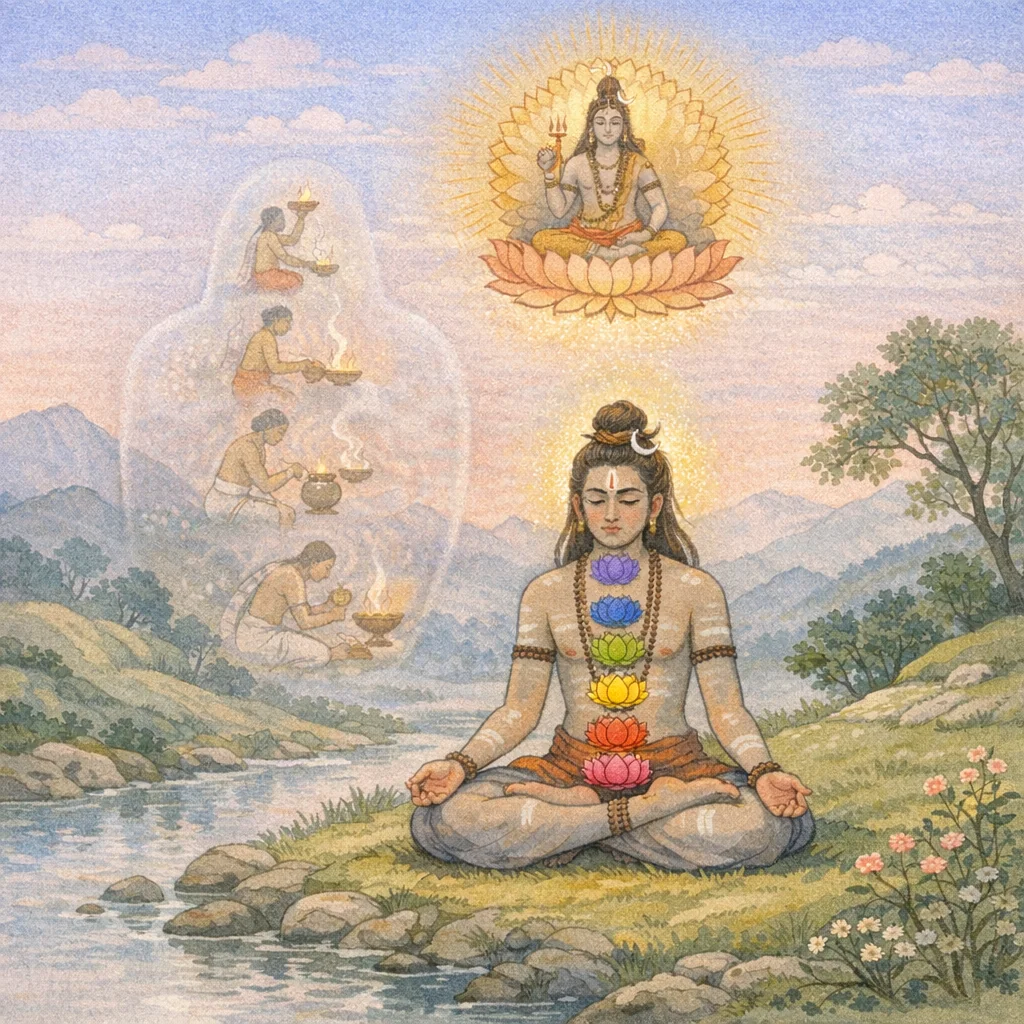
This adhyāya is Īśvara’s direct teaching to Mahādevī, rooted in affection (sneha) and the continuity of sampradāya. It sets out the saṃnyāsin’s daily discipline (āhnika): rising at brāhma-muhūrta, visualizing the guru enthroned in the sahasrāra-lotus with purified, crystal-like radiance and auspicious mudrās. The practitioner performs inward worship with offerings “brought by bhāva” (bhāvopanīta) and then prostrates with folded hands. The central intention is that all actions from morning to evening be offered as worship to Mahādeva. With the guru’s permission, the yogin restrains prāṇa, sits composed, and masters mind and senses. The teaching then turns to subtle-body contemplation: the luminous ṣaṭcakra from mūlādhāra to brahma-randhra, within which Śiva is meditated upon as saccidānanda, nirguṇa, and as Sadāśiva free from affliction, culminating in the realization “so’ham” and non-dual merging. Overall it is a compact practice-map: guru-dhyāna → bhāva-pūjā → offering of action → prāṇāyāma/indriya-jaya → cakra contemplation → Sadāśiva realization.
Shlokas
Verse 1
ईश्वर उवाच । अतः परं प्रवक्ष्यामि संन्यासाह्निककर्म च । तव स्नेहान्महादेवि संप्रदायानुरोधतः
Īśvara said: “Now, from this point onward, O Mahādevī, I shall explain the daily duties and observances of the saṃnyāsin (renunciate)—out of affection for you, and in accordance with the established sampradāya (tradition).”
Verse 2
ब्राह्मे मुहूर्त्त उत्थाय शिरसि श्वेतपंकजे । सहस्रारे समासीनं गुरुं संचितयेद्यतिः
Rising at the brāhma-muhūrta, the renunciate should meditate upon the Guru seated in the thousand-petalled lotus at the crown of the head—radiant like a white lotus.
Verse 3
शुद्धस्फटिकसंकाशं द्विनेत्रं वरदाभये । दधानं शिवसद्भावमेवात्मनि मनोहरम्
He is radiant like pure crystal, two-eyed, bearing the gestures of boon-giving and fearlessness—charming to behold—who holds within His own Self the very essence of Śiva’s auspicious being.
Verse 4
इति श्रीशिवमहापुराणे षष्ठ्यां कैलाससंहितायां संन्यासाचारवर्णनंनाम चतुर्थोऽध्यायः
Thus ends the Fourth Chapter, entitled “Description of the Discipline of Renunciation (Saṃnyāsa),” in the Sixth Book of the Śrī Śiva Mahāpurāṇa, the Kailāsa Saṃhitā.
Verse 5
प्रातःप्रभृति सायान्ते सायादिप्रातरं ततः । यत्करोमि महादेव तदस्तु तव पूजनम्
From morning until evening, and again from evening until the next morning—whatever I do, O Mahādeva, let all of it become Your worship.
Verse 6
प्रतिविज्ञाप्य गुरवे लब्धानुज्ञस्ततो गुरोः । निरुद्धप्राण आसीनो विजितात्मा जितेन्द्रियः
Having duly informed the Guru and obtained his permission, he then sat in posture with the vital breath restrained—self-possessed and master of the senses.
Verse 7
मूलादिब्रह्मरंध्रांतं षट्चक्रं परिचिंतयेत् । विद्युत्कोटिसमप्रख्यं सर्वतेजोमयं परम्
One should contemplate the six cakras extending from the Mūlādhāra up to the Brahma-randhra (the crown aperture), as the Supreme—made wholly of radiant splendor—shining with a brilliance equal to crores of flashes of lightning.
Verse 8
तन्मध्ये चिंतयेन्मां च सच्चिदानन्दविग्रहम् । निर्गुणं परमं ब्रह्म सदाशिवमनामयम्
Within that inner locus, one should contemplate Me—the embodiment of Existence, Consciousness, and Bliss—beyond the guṇas, the Supreme Brahman: Sadāśiva, the flawless and disease-free Lord.
Verse 9
सोहमस्मीति मतिमान्म दैक्यमनुभूय च । बहिर्निर्गत्य च ततो दूरं गच्छेद्यथासुखम्
Having realized through wise insight, “Soham—I am He (Śiva),” one should experience oneness with Me; then, going out from there, he may journey far, moving about in ease and peace.
Verse 10
वस्त्रेणाच्छाद्य मतिमाञ्छिरो नासिकया सह । विशोध्य देहं वि धिवत्तृणमाधाय भूतले
Covering the head and nose with a cloth, the wise should cleanse the body according to the prescribed rite; then he should spread sacred grass (kuśa) upon the ground.
Verse 11
गृहीतशिश्न उत्थाय ततो गच्छेज्जलाशयम् । उद्धृत्य वार्यथान्यायं शौचं कुर्यादतन्द्रितः
Rising while holding his organ, he should then go to a water-reservoir. Taking up water properly according to the prescribed method, he should perform purification (śauca) without negligence.
Verse 12
हस्तौ पादौ च संशोध्य द्विराचम्योमिति स्मरन् । उत्तराभिमुखो मौनी दन्तधावनमाचरेत्
After cleansing the hands and feet, one should perform ācamana twice while remembering the syllable Oṃ; then, facing north and observing silence (maunī), one should proceed to clean the teeth.
Verse 13
तृणपर्णैः सदा कुर्यादमामेकादशी विना । अपां द्वादशगण्डूषैर्मुखं संशोधयेत्ततः
One should regularly perform the cleansing with blades of grass and leaves—except on the new-moon day (amāvāsyā) and on Ekādaśī. Thereafter, one should purify the mouth by rinsing with water twelve times.
Verse 14
द्विराचम्य मृदा तोयैः कटिशौचं विधाय च । अरुणोदयकाले तु स्नानं कुर्यान्मृदा सह
Having sipped water twice for purification (ācamana), and having cleansed the waist-region with earth and water, one should, at arunodaya—the first light of dawn—perform one’s bath, using earth also as a purifying agent.
Verse 15
गुरुं संस्मृत्य मां चैव स्नानसंध्याद्यमाचरेत् । विस्तारभयतो नोक्तमत्र द्रष्टव्यमन्यतः
Remembering the Guru and also Me (Śiva), one should perform the daily disciplines such as ritual bathing and the Sandhyā worship. Out of fear of excessive elaboration, it has not been explained here in detail; it should be understood from other (scriptural) sources.
Verse 16
आबध्य शंखमुद्रां च प्रणवेनाभिषेचयेत् । शिरसि द्वादशावृत्त्या तदर्धं वा तदर्धकम्
Having formed the conch-gesture (śaṅkha-mudrā), one should perform the consecratory sprinkling with the Praṇava (Oṁ). Upon the head, it is to be done with twelve repetitions—or with half of that, or half again, as permitted.
Verse 17
तीरमागत्य कौपीनं प्रक्षाल्याचम्य च द्विधा । प्रोक्षयेत्प्रणवेनैव वस्त्रमंगोपमार्जनम्
Having come to the riverbank, one should wash the loincloth and perform ācamana twice. Then, uttering the Praṇava (Oṁ) alone, one should sprinkle for purification and wipe the body with the cloth, as a cleansing rite before worship.
Verse 18
मुखम्प्रथमतो मृज्य शिर आरभ्य सर्वतः । तेनैव मार्जयेद्देहं स्थित्वा च गुरुसन्निधौ
First, one should cleanse the face; then, beginning from the head, one should wipe and purify everywhere. Standing in the presence of the Guru, one should cleanse the whole body by that same act.
Verse 19
आबध्याद्वामतः शुद्धं कौपीनं च सडोरकम् । ततः संधारयेद्भस्म तद्विधिः प्रोच्यतेऽद्रिजे
“Let him, on the left side, securely tie on the pure loincloth together with its waist-cord. Thereafter, let him properly apply and bear the sacred ash (bhasma). O Daughter of the Mountain, this is the prescribed rule that is being taught.”
Verse 20
द्विराचम्य समादाय भस्म सद्यादिमंत्रतः । अग्निरित्यादिभिर्मंत्रैरभिमंत्र्य स्पृशेत्तनुम्
After sipping water twice for purification (ācamana), one should take up the sacred ash (bhasma) with the “Sadyojāta” mantra; then, consecrating it with mantras beginning with “Agni…”, one should touch and sanctify one’s body with it.
Verse 21
आपोवेत्यभिमंत्र्याथ जलं तेनैव सेचयेत् । ओमापोज्योतिरित्युक्त्वा मानस्तोकेति मंत्रतः
Having first sanctified the water with the mantra “Āpo vā…,” one should sprinkle with that very water. Then, uttering “Oṁ—Āpaḥ; Jyotiḥ (the waters, the divine light),” one should perform the rite in accordance with the mantra beginning “Mā nas toke…,” thus completing the purificatory sprinkling.
Verse 22
समद्य कमलद्वन्द्वं कुर्या केकं तु पंचधा । शिरोवदनहृद्गुह्यपादेषु परमेश्वरि
“Having then assumed the paired lotus-gesture (kamala-dvandva), one should perform the ‘keka’ placement in fivefold manner—upon the head, the face, the heart, the secret region, and the feet, O Supreme Goddess.”
Verse 23
ईशानादिसमारभ्य सद्यान्तं पंचभिः क्रमात् । उद्धूल्य कवलं पश्चात्प्रणवेनाभिषेचयेत्
Beginning with Īśāna and proceeding in due order through the five (mantras/aspects), up to Sadya, one should rub (purify) the mouthful (of water); thereafter, one should consecrate it by sprinkling it with the Praṇava (Oṁ).
Verse 24
सर्वांगं च ततो हस्तौ प्रक्षाल्यान्यत्समाहरेत् । समर्च्य पूर्वत्तत्तु त्रिपुण्ड्रांस्तेन धारयेत्
Then one should wash the entire body and the hands, and gather the remaining requisites. Having worshipped in the same manner as before, one should thereafter apply and wear the three sacred ash-marks (Tripuṇḍra) with that (consecrated ash), in accordance with the prescribed principle.
Verse 26
नाभौ बाह्वौः संधिषु च पृष्ठ चैव यथाक्रमम् । प्रक्षाल्य हस्तौ च ततो द्विराचम्य यथाविधि
In due order, one should wash the navel, the arms, the joints, and also the back. Then, having washed the hands, one should perform ācamana twice according to the prescribed rule, thus becoming fit for the worship of Lord Śiva.
Verse 27
पंचीकरणमुच्चार्य भावयेत्स्वगुरुं बुधः । वक्ष्यमाणप्रकारेण प्राणायामान्षडाचरेत्
Having uttered the pañcīkaraṇa (the fivefold mantric arrangement), the wise aspirant should contemplate his own Guru; then, according to the method that will be explained, he should perform six prāṇāyāmas (regulated breath-retentions).
Verse 28
दक्षहस्तेन संगृह्य जलं वामेन पाणिना । समाच्छाद्य द्विषड्वारं प्रणवे नाभिमंत्रयेत्
Taking water in the right hand and holding it with the left palm, one should cover the two and the six openings (of the body) and then consecrate that water by invoking it with the Pranava, Oṃ.
Verse 29
एवं त्रिवारं संप्रोक्ष्य शिरसि त्रिः पिबेत्ततः । समाहितेन मनसा ध्यायन्नोंकारमीश्वरम्
Thus, having sprinkled the sanctified water three times, one should sprinkle it on the head three times and then sip it three times. With a well-collected mind, one should meditate upon the Lord as Oṃkāra—the sovereign reality signified by the syllable Oṃ.
Verse 30
सौरमण्डलमध्यस्थं सर्वतेजोमयं परम् । अष्टबाहुं चतुर्वक्त्रमर्द्धनारीकमद्भुतम्
He is stationed in the midst of the solar orb—supreme, constituted of the radiance of all lights. Wondrous to behold, He appears with eight arms and four faces, in the marvelous form of Ardhanārīśvara, half male and half female.
Verse 31
सर्वाश्चर्य्यगुणोपेतं सर्वालंकारशोभितम् । एवं ध्यात्वाथ विधिवद्दद्यादर्घ्यत्रयं ततः
Having thus meditated on the Lord—endowed with every wondrous excellence and resplendent with all ornaments—one should then, according to proper ritual procedure, offer the threefold arghya, the respectful water-oblation.
Verse 32
अष्टोत्तरशतं जप्त्वा द्विषड्वारं तु तर्पयेत् । पुनराचम्य विधिवत्प्राणायामत्रयं चरेत्
Having repeated the mantra one hundred and eight times, one should then perform tarpaṇa twelve times. After sipping water again in the proper manner (ācaman), one should practice the threefold prāṇāyāma according to rule.
Verse 33
पूजासदनमागच्छेन्मनसा संस्मरञ्च्छिवम् । द्वारमासाद्य प्रक्षाल्य पादौ मौनी द्विराचमेत्
One should go to the hall of worship, inwardly remembering Śiva. Reaching the doorway, having washed the feet, one should keep silence and perform ācamana twice.
Verse 34
प्रविशेद्विधिना तत्र दक्षपादपुरस्स रम् । मण्डपान्तस्सुधीस्तत्र मण्डलं रचयेत्क्रमात्
Then, according to the prescribed rule, one should enter that excellent sanctuary before the southern pedestal. Inside the pavilion, the wise practitioner should, in due order, construct the ritual maṇḍala.
Frequently Asked Questions
Īśvara prescribes a sequential renunciant regimen: rise at brāhma-muhūrta, visualize and honor the guru in the sahasrāra, offer all daily actions as Mahādeva’s worship, obtain the guru’s consent, restrain prāṇa, and proceed into ṣaṭcakra contemplation culminating in Sadāśiva meditation and so’ham recognition.
The sahasrāra enthronement of the guru encodes lineage as the gateway to highest realization; the ṣaṭcakra map frames liberation as an ascent from embodied bases (mūla) to the brahma-randhra apex; ‘bhāvopanīta’ offerings signal internalized worship where intention substitutes for external materials; ‘so’ham’ marks the non-dual pivot where devotion matures into identity-recognition of Śiva.
Sadāśiva is foregrounded as the meditative object: saccidānanda-vigraha (the form of being-consciousness-bliss), nirguṇa (beyond attributes), parama brahman (supreme absolute), and anāmaya (free from affliction), indicating a theological synthesis of personal Śiva and the impersonal absolute.