Sukta 20
Sukta 6.20
Bharadvāja Bārhaspatya (trad.)
Indra
Triṣṭubh (probable)
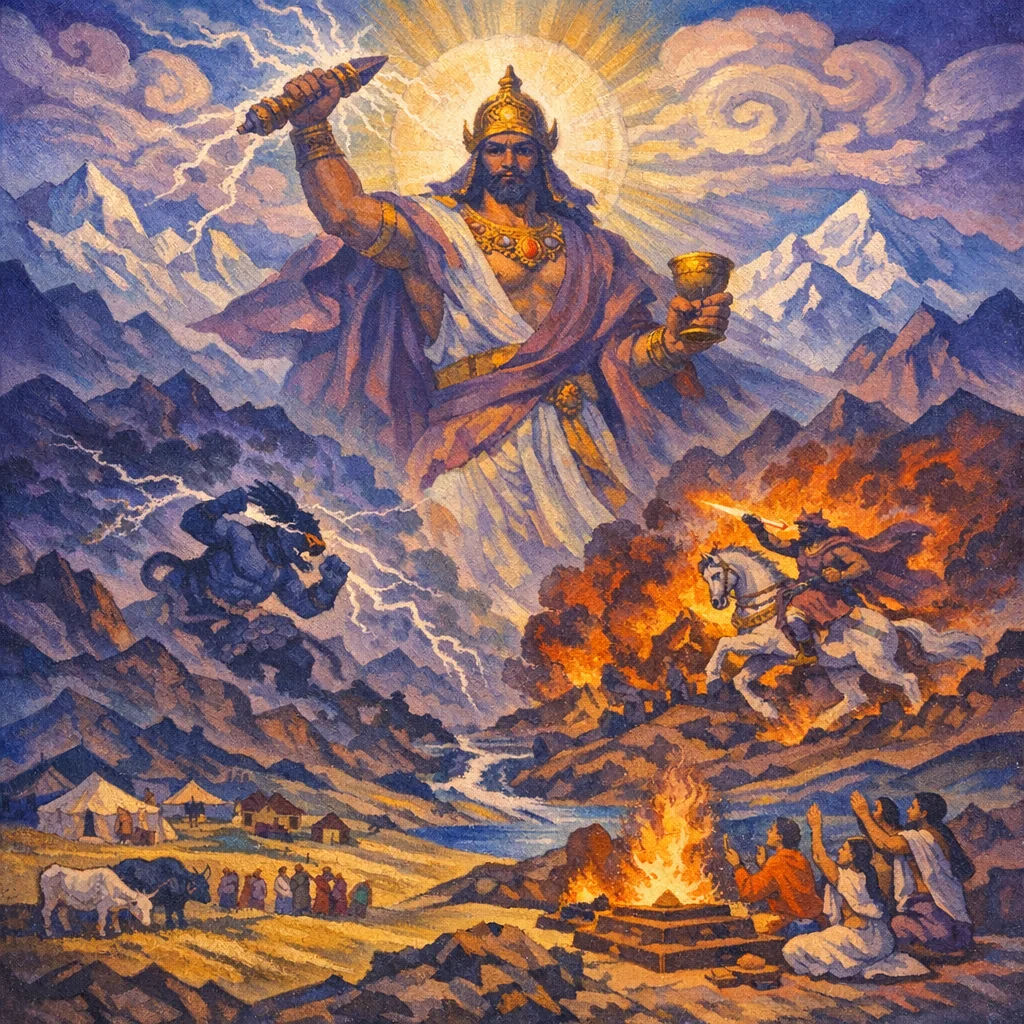
This hymn to Indra praises his irresistible might in battle, recalling his shattering of serpent-like foes and fortified strongholds, and his protection of generous worshippers. It asks Indra to bestow expansive, “heaven-over-earth” abundance—wealth, cattle, and fertile fields—upon the poet’s people. The verses link Indra’s cosmic victories (Vṛtra-slaying and enemy-subduing) with tangible prosperity granted to those who press Soma and offer praise.
Mantras
Mantra 1
द्यौर्न य इन्द्राभि भूमार्यस्तस्थौ रयिः शवसा पृत्सु जनान् । तं नः सहस्रभरमुर्वरासां दद्धि सूनो सहसो वृत्रतुरम् ॥
Like heaven overarching earth, the noble wealth stands up by your force among the battling peoples; grant us that abundance bearing a thousand loads, rich in fruitful fields—O son of might, slayer of the coverer.
Mantra 2
दिवो न तुभ्यमन्विन्द्र सत्रासुर्यं देवेभिर्धायि विश्वम् । अहिं यद्वृत्रमपो वव्रिवांसं हन्नृजीषिन्विष्णुना सचानः ॥
As from heaven, to you, O Indra, the divine world-order was set in place among the gods; when you slew the serpent Vṛtra who had covered the waters, O wielder of the tawny steeds, acting in companionship with Vishnu.
Mantra 3
तूर्वन्नोजीयान्तवसस्तवीयान्कृतब्रह्मेन्द्रो वृद्धमहाः । राजाभवन्मधुनः सोम्यस्य विश्वासां यत्पुरां दर्त्नुमावत् ॥
Overpowering, mightier, more vehement than the vehement, Indra—whose word has been made true by the mantra—grew into a vast greatness; he became king through the honey of Soma when he shattered the strongholds of all the cities.
Mantra 4
शतैरपद्रन्पणय इन्द्रात्र दशोणये कवयेऽर्कसातौ । वधैः शुष्णस्याशुषस्य मायाः पित्वो नारिरेचीत्किं चन प्र ॥
By hundreds the Panis fled away here, O Indra, before the seer of the tenfold power in the winning of the illumined chant. By thy smiting, the deceits of Shushna—of the force that withholds the flow—could not drain away even a little of the soul’s plenitude.
Mantra 5
महो द्रुहो अप विश्वायु धायि वज्रस्य यत्पतने पादि शुष्णः । उरु ष सरथं सारथये करिन्द्रः कुत्साय सूर्यस्य सातौ ॥
The great malice was laid low, the all-devouring harm, when Śuṣṇa fell before the descent of the thunderbolt. Wide then became the path and the chariot-course: Indra became the charioteer for Kutsa in the winning of the Sun (the recovered light).
Mantra 6
प्र श्येनो न मदिरमंशुमस्मै शिरो दासस्य नमुचेर्मथायन् । प्रावन्नमीं साप्यं ससन्तं पृणग्राया समिषा सं स्वस्ति ॥
Like a soaring falcon he brought forth for him the intoxicating Soma-essence, crushing the head of the Dāsa Namuci. He protected Namī, seeking the fit support, and filled him with plenitude of being—wealth, nourishment, and a gathered wholeness of well-being.
Mantra 7
वि पिप्रोरहिमायस्य दृळ्हाः पुरो वज्रिञ्छवसा न दर्दः । सुदामन्तद्रेक्णो अप्रमृष्यमृजिश्वने दात्रं दाशुषे दाः ॥
Thou, the wielder of the thunderbolt, didst shatter by thy force the strongholds firm-set by Pipru of serpent-craft. O good-giver, thou gavest that unassailable wealth as a gift to Ṛjiśvan, the offerer who gives.
Mantra 8
स वेतसुं दशमायं दशोणिं तूतुजिमिन्द्रः स्वभिष्टिसुम्नः । आ तुग्रं शश्वदिभं द्योतनाय मातुर्न सीमुप सृजा इयध्यै ॥
Indra, rich in the joy of perfect help, roused Vetasu—of the tenfold skill, of the tenfold energy—ever impelling him. He set him forward like a mother sets her child near, for shining forth: the strong, enduring, powerful one to grow into his work.
Mantra 9
स ईं स्पृधो वनते अप्रतीतो बिभ्रद्वज्रं वृत्रहणं गभस्तौ । तिष्ठद्धरी अध्यस्तेव गर्ते वचोयुजा वहत इन्द्रमृष्वम् ॥
He conquers the challengers, irresistible, bearing in his grasp the thunderbolt that slays the Coverer. His two tawny powers stand poised like two steeds at the yoke-station; yoked by the Word, they carry Indra, the high and uplifted force.
Mantra 10
सनेम तेऽवसा नव्य इन्द्र प्र पूरवः स्तवन्त एना यज्ञैः । सप्त यत्पुरः शर्म शारदीर्दर्द्धन्दासीः पुरुकुत्साय शिक्षन् ॥
May we win by thy ever-new help, O Indra; the Pūrus praise thee forward with these sacrifices. When thou didst shatter the seven autumnal strongholds that were a false shelter of the Dāsas, thou wast training and empowering Purukutsa for his victory.
Mantra 11
त्वं वृध इन्द्र पूर्व्यो भूर्वरिवस्यन्नुशने काव्याय । परा नववास्त्वमनुदेयं महे पित्रे ददाथ स्वं नपातम् ॥
Thou, O Indra, wast the ancient increaser, making wide room for Uśanā Kāvya. Thou didst give to the great Father the ‘new dwelling’ that must be carried forward—thy own offspring, a rightful continuance of the divine lineage within us.
Mantra 12
त्वं धुनिरिन्द्र धुनिमतीॠणोरपः सीरा न स्रवन्तीः । प्र यत्समुद्रमति शूर पर्षि पारया तुर्वशं यदुं स्वस्ति ॥
Thou art the impeller, O Indra; thou didst set free the surging waters to flow like furrows. And when, O hero, thou carriest beyond the ocean, do thou ferry Turvaśa and Yadu across in a gathered well-being.
Mantra 13
तव ह त्यदिन्द्र विश्वमाजौ सस्तो धुनीचुमुरी या ह सिष्वप् । दीदयदित्तुभ्यं सोमेभिः सुन्वन्दभीतिरिध्मभृतिः पक्थ्यर्कैः ॥
All that power of thine, O Indra, was proclaimed in the battle—when Dhunī and Cumurī were laid low, as thou didst will. Dabhīti of the Pakthas, bringing fuel and pressing Soma, made it blaze for thee with hymns: the fire of aspiration answering the god with light.
Frequently Asked Questions
It praises Indra’s power as a victorious protector who breaks enemy strongholds and removes obstruction, then asks him to grant wealth, cattle, and fertile prosperity to the worshippers.
These are remembered as examples of Indra’s decisive victories. By recalling them, the poet strengthens the claim that Indra can also overcome present dangers and grant secure riches now.
Indra is portrayed as growing in strength through Soma and hymns. The act of pressing and offering Soma, along with praise, is presented as a key way to invoke his help and generosity.