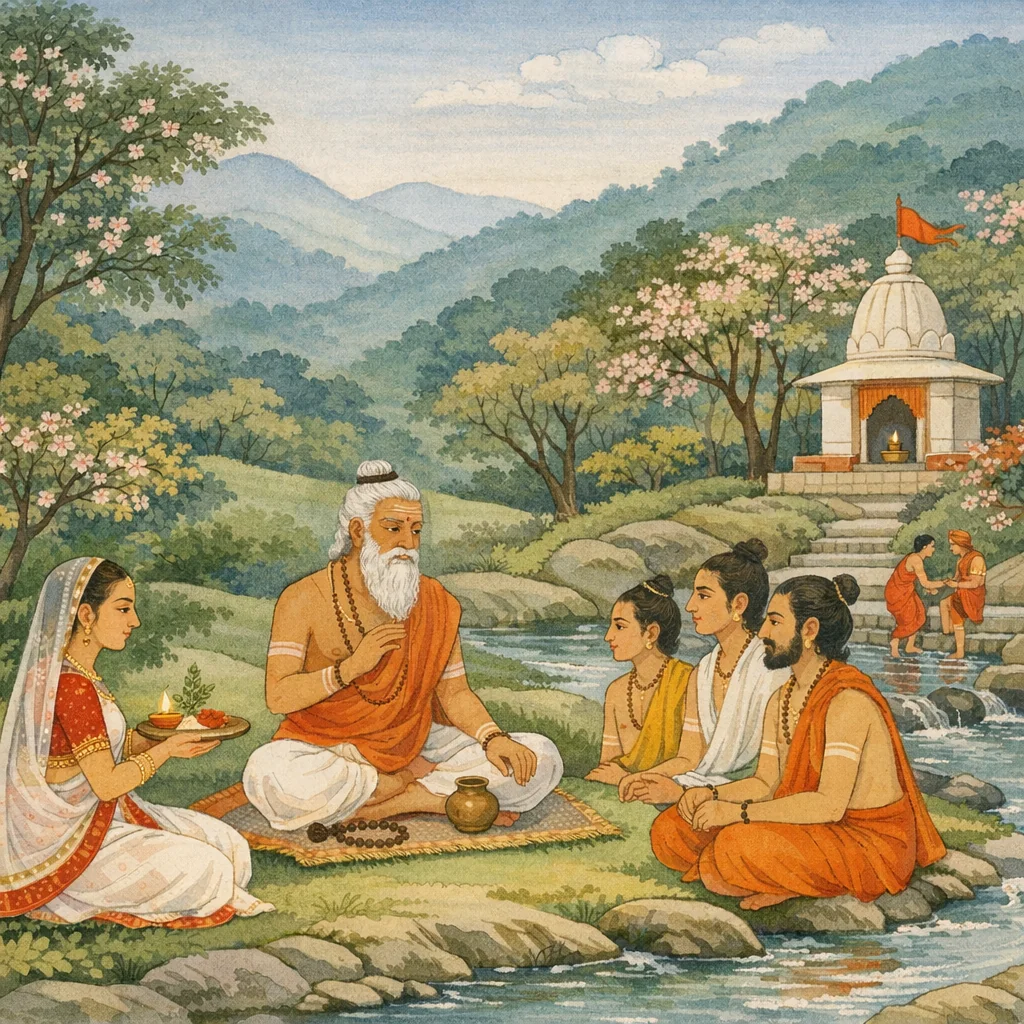
Adhyaya 40
Brahmā’s Lotus-Birth, Puṣkara-Creation Imagery, Madhu–Kaiṭabha, and Early Genealogies
PP.1.40 begins with Brahmā’s act of creation through the cosmic lotus: the Earth is named Rasā-devī, the lotus-filaments are aligned with divine mountains, and Jambūdvīpa is set among them as part of the sacred world-image. Madhu and Kaiṭabha, born of rajas and tamas, then rise and confront Brahmā; yet on recognizing Viṣṇu they bow in submission. Viṣṇu grants them a boon for the future and then crushes them, re-establishing cosmic order. Brahmā performs tapas; Nārāyaṇa appears in another form and Kapila is present, leading into the creation of worlds and mind-born lineages. A long genealogical catalogue follows (Dakṣa’s daughters, Kaśyapa, the Ādityas, Daityas/Dānavas, and more), ending with a phalaśruti on the merit of hearing and reciting the Purāṇa, and turning toward a major war narrative in which the gods seek refuge in Viṣṇu and are assured of victory.
Shlokas
Verse 1401
पुलस्त्य उवाच । अथ योगवतां श्रेष्ठमसृजद्भूरिवर्चसम् । स्रष्टारं सर्वलोकानां ब्रह्माणं सर्वतोमुखम्
Pulastya said: Then he created Brahmā—foremost among yogins, radiant with great splendor—the creator of all the worlds, the many-faced one who looks in every direction.
Verse 1402
तस्मिन्हिरण्मये पद्मे बहुयोजनविस्तृते । सर्वतेजोगुणमये पार्थिवैर्लक्षणैर्वृते
Within that golden lotus, spread across many yojanas, filled with the quality of all radiance and encompassed by earthly marks, it existed there.
Verse 1403
तच्च पद्मं पुराभूतं पृथिवीरूपमुत्तमम् । नारायणसमुद्भूतं प्रवदंति महर्षयः
And that lotus, which in ancient times existed as the exalted form of the Earth, the great sages declare to have arisen from Nārāyaṇa.
Verse 1404
यत्पद्मं सा रसादेवी पृथिवी परिकथ्यते । ये पद्मकेसरा मुख्यास्तान्दिव्यान्पर्वतान्विदुः
That lotus is described as Rasā-devī—namely, the Earth; and its principal filaments are understood to be the divine mountains.
Verse 1405
हिमवंतं च नीलं च मेरुं निषधमेव च । कैलासं शृंगवंतं च तथाद्रिं गंधमादनम्
Himavān and Nīla, Meru and Niṣadha; likewise Kailāsa, Śṛṅgavat, and also the mountain Gandhamādana.
Verse 1406
पुण्यं त्रिशिखरं चैव कांतं मंदरमेव च । उदारं पिंजरं चैव विंध्यमस्तं च पर्वतम्
Also (there are) the sacred Puṇya, Triśikhara, Kānta, and Mandara; likewise Udāra and Piñjara, and the Vindhya and Asta mountains.
Verse 1407
एत एव गणानां च सिद्धानां च महात्मनाम् । आश्रयाः पुण्यशीलानां सर्वकामफलप्रदाः
These very ones are the refuge of the Gaṇas, the Siddhas, and the great-souled; they are the support of the virtuous, and they bestow the fruits of all desired aims.
Verse 1408
एतेषामंतरे द्वीपो जंबूद्वीप इति स्मृतः । जंबुद्वीपस्य संस्थानं याज्ञीया यत्र च क्रियाः
Among these lies the island-continent known as Jambūdvīpa. The arrangement of Jambūdvīpa is the realm where the rites prescribed for sacrifice are performed.
Verse 1409
तेभ्यो यद्द्रवते तोयं दिव्यामृतरसोपमम् । दिव्यतीर्थशताधाराः सरस्यः सर्वतः स्मृताः
From them flows water comparable in taste to divine nectar; and on every side there are said to be lakes that serve as the support and source of hundreds of celestial tīrthas.
Verse 14010
यान्येतानीहपद्मस्य केसराणि समंततः । असंख्येयाः पृथिव्यां ते विविधाश्चैव पर्वताः
As numerous as the filaments of this lotus on every side, so too upon the earth are countless mountains of many kinds.
Verse 14011
यानि पर्णानि पद्मस्य भूरिपूर्वाणि पार्थिव । ते दुर्गमाः शैलचिता म्लेच्छदेशाः प्रकीर्तिताः
O king, those many ancient petals of the lotus are said to be regions hard to reach—lands strewn with mountains, spoken of as mleccha countries.
Verse 14012
यान्यधोभागपत्राणि ता निवासास्तु भागशः । दैत्यानामसुराणां च पन्नगानां च पार्थिव
O king, the leaves on the lower side (of that lotus) became, in their due portions, the dwelling-places of the Daityas, the Asuras, and the serpent-races (Nāgas).
Verse 14013
तेषां मध्येंतरं यत्तु तद्रसातलसंज्ञितम् । महापातककर्माणो मज्जंते यत्र मानवाः
That intervening region in their midst is known as Rasātala, where human beings who commit the gravest sins sink down.
Verse 14014
चतुर्दिशासु संख्याताश्चत्वारः सलिलाकराः । एवं नारायणस्यार्थे मही पुष्कर संभवा
Thus, in the four directions, four oceans—repositories of waters—are reckoned; in this manner the earth, born of Puṣkara, came into being for the purpose of Nārāyaṇa.
Verse 14015
प्रादुर्भावोप्ययं तस्मान्नाम्ना पुष्करसंज्ञितः । एतस्मात्कारणाद्यज्ञे पुराणैः परमर्षिभिः
Therefore, because of his manifestation and dissolution, he is known by the name “Puṣkara.” For this very reason, in the sacrifice (yajña), the supreme sages—through the Purāṇas—declare him so.
Verse 14016
यज्ञियैर्वेददृष्टांतैर्यज्ञैर्यूपचितिः कृता । एवं भगवता तेन विश्वव्याप्यधराचिता
With Vedic precedents and sacrificial rites, the altar—with its sacrificial posts—was duly constructed. Thus, by that Blessed Lord, the earth—pervading the whole universe—was established and set in order.
Verse 14017
पर्वतानां नदीनां च रचना चैव निर्मिता । विश्वस्य यश्चाप्रतिमप्रभावः प्रभाकरा भो वरुणोमितद्युतिः
He fashioned the very ordering of mountains and rivers; and he—of incomparable power in the universe—is the maker of radiance, O Varuṇa, of immeasurable splendour.
Verse 14018
शनैः स्वयंभूर्व्यसृजत्सुषुप्तं जगन्मयः पद्मनिधिं महार्णवे । विघ्नस्तपसि संभूतो मधुर्नाम महासुरः
Gradually, the Self-born (Brahmā), pervading the universe, brought forth in the great ocean the lotus-treasure, as though in deep sleep. From an obstacle arising during the austerity (tapas), there was born a great asura named Madhu.
Verse 14019
तेनैव च सहोद्भूतो ह्यसुरो नाम कैटभः । तौ रजस्तमसोर्भूतौ संभूतौ तामसौ गणौ
And along with him there arose an asura named Kaiṭabha. Those two—born of rajas and tamas—came into being as a pair of tamasic beings.
Verse 14020
एकार्णवं जगत्सर्वं क्षोभयेतां महाबलौ । दिव्यरक्तांबरधरौ श्वेतदीप्तोग्रदंष्ट्रिणौ
Those two of great might churned the entire world into a single ocean; clad in divine red garments, they bore fierce, gleaming white tusks.
Verse 14021
किरीटमकुटोदग्रौ केयूरवलयोज्ज्वलौ । महाविवृतताम्राक्षौ पीनोरस्कौ महाभुजौ
They were adorned with towering diadems and crowns, shining with armlets and bracelets; their reddish eyes were wide and open, their chests full and broad, and their arms mighty.
Verse 14022
महागिरेः संहननौ जंगमाविव पर्वतौ । नवमेघप्रतीकाशावादित्यप्रतिमाननौ
They were powerfully built, like great mountains in motion—dark as fresh rain-clouds, with faces radiant like the sun.
Verse 14023
विपुलाभोगकेयूर कराभ्यामतिभीषणौ । पादसंचारविन्यासैर्विक्षिपंताविवार्णवम्
With hands adorned by broad, massive armlets, they appeared exceedingly fearsome; and by the very placement of their moving steps, they seemed to churn and toss the ocean.
Verse 14024
कंपयंतौ हरिमिव शयानं मधुसूदनम् । तौ तत्र विचरंतौ तु पुष्करे विश्वतोमुखौ
Roaming there at Puṣkara, those two, facing in all directions, shook the place as though it were Hari Mādhusūdana lying in repose.
Verse 14025
योगिनां श्रेष्ठमत्यंतं दीप्तं ददृशतुस्तदा । नारायणसमाज्ञातं सृजंतमखिलाः प्रजाः
Then they beheld the foremost of yogins—exceedingly radiant—who, commanded by Nārāyaṇa, was bringing forth all beings in creation.
Verse 14026
दैवतानि च विश्वानि मानसांश्च सुतानृषीन् । ततस्तावूचतुस्तत्र ब्रह्माणमसुरोत्तमौ
And (he brought forth) the deities and the worlds, and also the mind-born sons—the sages. Then those two, foremost among the asuras, addressed Brahmā there.
Verse 14027
दुष्टौ युयुत्सू संक्रुद्धौ क्रोधव्याकुलितेक्षणौ । कस्त्वं पुष्करमध्यस्थः सितोष्णीषश्चतुर्भुजः
Both were wicked—eager for battle, enraged, their eyes unsettled by wrath. Who are you, standing in the midst of Puṣkara, wearing a white turban and bearing four arms?
Verse 14028
आवामगणयन्मोहादास्से त्वं विगतस्पृहः । एह्यागच्छावयोर्युद्धं देहि त्वं कमलोद्भव
In delusion you have disregarded us; yet you sit here, free from desire. Come—draw near! Grant us battle, O Lotus-born (Brahmā).
Verse 14029
आवाभ्यां परमेशाभ्यामशक्तः स्थातुमर्णवे । तत्र कश्च भवेत्तुभ्यं येन चात्र नियोजितः
By the power of us two, the supreme Lords, you are unable to remain in the ocean. Who, then, could exist there on your behalf, and by whom would you be appointed here?
Verse 14030
कः स्रष्टा कश्च ते गोप्ता केन नाम्नाभिधीयते । ब्रह्मोवाच । ईश्वरः प्रोच्यते लोके विष्णुश्चानंतशक्तिधृत्
“Who is the creator, and who is your protector? By what name is he known?” Brahmā replied: “In the world he is called the Lord (Īśvara), and he is Viṣṇu, the bearer of limitless power.”
Verse 14031
तत्सकाशात्तु जातं मां स्रष्टारमवगच्छतम् । मधुकैटभा ऊचतुः । नावयोः परमं लोके किंचिदस्ति महामुने
Know me as the Creator, born from Him. Madhu and Kaiṭabha said: “O great sage, there is nothing whatsoever in this world that is superior to us.”
Verse 14032
आवाभ्यां च्छाद्यते विश्वं तमसा रजसा च वै । रजस्तमोमयावावामृषीणामतिलंघिनौ
By us the whole universe is veiled—indeed by darkness (tamas) and by passion (rajas). We are made of rajas and tamas, and even the sages (ṛṣis) cannot transgress us.
Verse 14033
धर्म शीलं च्छादयन्तौ नाशकौ सर्वदेहिनाम् । आवाभ्यां युज्यते लोको दुस्तराभ्यां युगे युगे
We are the two who veil dharma and right conduct, the destroyers of all embodied beings. In every age the world becomes bound to us—hard to overcome.
Verse 14034
आवामर्थश्च कामश्च यज्ञस्सर्वपरिग्रहः । सुखं यत्र मदो यत्र यत्र श्रीः कीर्तिरेव च
There are we—prosperity and desire; there are sacrifice (yajña) and every kind of acquisition. Where we are, there are happiness and exhilaration; where we are, there are also Śrī (fortune) and fame.
Verse 14035
येषां यत्कांक्षितं किंचित्तत्तदावां विचिंतय । ब्रह्मोवाच । आवाभ्यां संहतौ दृष्ट्वा युवां पूर्वं पराजितौ
“Whatever they desire—consider it and decide it for the two of us.” Brahmā said: “Seeing you two united, you were formerly defeated by the two of us.”
Verse 14036
तं समाधाय गुणिनं सत्वं चास्मि समाश्रितः । यः परो योगयुक्तात्मा योक्षरः सत्वमेव च
Having fixed my mind upon that virtuous principle, I have taken refuge in sattva as well. He is the Supreme, whose self is yoked to yoga; He who is imperishable is indeed sattva itself.
Verse 14037
रजसस्तमसश्चैव यः स्रष्टा विश्वसंभवः । ततो भूतानि जायंते सात्विकानीतराणि च
From Him who creates through rajas and tamas—the very source of the universe—beings are born: some are sāttvika, and others are of differing natures.
Verse 14038
स एव युवयोर्नाशं वासुदेवः करिष्यति । स्वपन्नेव ततो देवो बहुयोजनविस्तृतौ
That very Vāsudeva will bring about the destruction of you both. Thereupon the God appeared as if in a dream—vast in expanse, stretching over many yojanas.
Verse 14039
बाहू नारायणो ब्रह्म कृतवानात्ममायया । कृष्यमाणौ ततस्तस्य बाहुभ्यां बाहुशालिनौ
By His own divine power (māyā), Nārāyaṇa fashioned the arms of Brahmā. Then, from those arms, two mighty-armed beings were drawn forth.
Verse 14040
चेरतुस्तौ विगलितौ शकुनाविव पीवरौ । ततस्तावाहतुर्गत्वा वासुदेवं सनातनम्
Those two moved about, emaciated like birds though once stout. Then they went and addressed Vāsudeva, the Eternal One.
Verse 14041
पद्मनाभं हृषीकेशं प्रणिपत्य नतावुभौ । जानीवस्त्वां विश्वयोनिं त्वामेकं पुरुषोत्तमम्
Prostrating before Padmanābha, Hṛṣīkeśa, we both, bowed in humility, recognize You as the womb and source of the universe—You alone are Puruṣottama, the Supreme Person.
Verse 14042
आवयोश्चैव हेतुं त्वां जानन्तौ बुद्धिकारणम् । अमोघदर्शनं सत्यं यतस्त्वां विद्वशाश्वतम्
We both know you as the very cause behind us and as the source of intelligence. Your vision is unfailing and true, for you are the eternal, all-knowing one.
Verse 14043
ततस्त्वामभितो देव कांक्षावः प्रसमीक्षितुम् । अमोघदर्शनोसि त्वं नमस्ते समितिंजय
Therefore, O God, we are eager on all sides to behold you clearly. Your sight is unfailing; salutations to you, O conqueror of assemblies (battles).
Verse 14044
श्रीभगवानुवाच । किमर्थं मामनुब्रूथ युवामसुरसत्तमौ । गतायुष्कौ युवां भूयस्त्वहो जीवितुमिच्छथः
The Blessed Lord said: “For what purpose do you two—foremost among the Asuras—address me? Your allotted lifespan is spent; yet, alas, you still wish to live again.”
Verse 14045
मधुकैटभा ऊचतुः । यस्मिन्न कश्चिन्मृतवान्देव तस्मिन्वधं प्रभो । इच्छावः पुत्रतां चैव भवतः सुमहातपः
Madhu and Kaiṭabha said: “O God, O Lord—since in that realm no one has ever died, how could there be our slaying? O you of very great austerity, we desire to become your sons as well.”
Verse 14046
श्रीभगवानुवाच । युवयोर्बाढमेतत्स्याद्भविष्ये कलिसंभवे । भविष्यथो न संदेहः सत्यमेतद्ब्रवीमि वाम्
The Blessed Lord said: “Indeed, this will certainly come to pass for you both in the future, at the arising of the Kali age. You will surely be so—there is no doubt. This truth I speak to you both.”
Verse 14047
वरं प्रदायाथ महासुराभ्यां सनातनो विश्वधरः सुरोत्तमः । रजस्तमोजौ तु तदांजनोपमौ ममर्द तावूरुतलेऽमरप्रभुः
After granting a boon to the two great demons, the eternal, world-supporting, best of the gods—the Lord of the immortals—then crushed those two, Rajas and Tamas, dark as collyrium, beneath his thigh.
Verse 14048
स्थित्वा तस्मिंस्तु कमले ब्रह्मा ब्रह्मविदांवरः । ऊर्ध्वबाहुर्महातेजास्तपोघोरं समाश्रितः
Standing there upon that lotus, Brahmā—foremost among the knowers of Brahman—of great splendor, with arms uplifted, undertook austere and formidable tapas.
Verse 14049
प्रज्वलन्निव तेजोभिर्भाभिः स्वाभिस्तमोनुदः । बभाषे स तु धर्मात्मा सहस्रांशुरिवांशुभिः
Blazing, as it were, with his own lights and energies that dispel darkness, that righteous-souled one spoke—like the sun of a thousand rays with its beams.
Verse 14050
अथान्यद्रूपमास्थाय प्रभुर्नरायणोव्ययः । आजगाम महातेजा योगाचार्यो महायशाः
Then the Lord Nārāyaṇa—imperishable—assuming another form, arrived: greatly radiant, the famed master-teacher of Yoga.
Verse 14051
सांख्याचार्यश्च मतिमान्कपिलो ब्रह्मणां वरः । उभावपि महात्मानौ पूजितौ तत्र तत्परौ
There, the wise Kapila—teacher of Sāṃkhya and foremost among the knowers of Brahman—was present; and both those great souls were honored there, devotedly engaged.
Verse 14052
तौ प्राप्तावूचतुस्तत्र ब्रह्माणममितौजसम् । परावरविशेषज्ञौ पूजितौ च महर्षिभिः
Having arrived there, the two addressed Brahmā of boundless splendor—knowers of the distinction between the higher and the lower—and themselves honored by the great ṛṣis.
Verse 14053
ब्रह्म संपरिवेद्यं ते विशाल जगदास्थितौ । ग्रामणीस्सर्वभूतानां ब्रह्मा त्रैलोक्यपूजितः
Brahmā is fully known to you: He abides in the vast universe; He is the leader of all beings and is worshipped throughout the three worlds.
Verse 14054
तयोस्तद्वचनं श्रुत्वा विबोध्यगतयोः परम् । त्रीनिमान्कृतवान्लोकान्यथेयं ब्रह्मणः श्रुतिः
Having heard their words and discerning the supreme truth concerning the two destinies, he created these three worlds—so declares this sacred teaching of Brahmā.
Verse 14055
पुत्रं स्वसंभवं चैकं समुत्पादितवान्भुवम् । तदाग्रे चागतस्तस्य ब्रह्ममानससंभवः
He brought forth upon the earth a single son, self-born; and then, before him, there arrived one born from Brahmā’s mind.
Verse 14056
उत्पन्नमात्रो ब्रह्माणमुक्तवान्मानसः सुतः । किं कुर्मस्तव साहाय्यं ब्रवीतु भगवानिति
As soon as he was born, the mind-born son spoke to Brahmā: “What shall we do to assist you? Let the Blessed Lord tell us.”
Verse 14057
ब्रह्मोवाच । यदेष कपिलो नाम ब्रह्मनारायणस्तथा । वदतो भवतस्त्वं तु तत्कुरुष्व महामते
Brahmā said: “Since this one is indeed named Kapila, and is also Brahman and Nārāyaṇa, then you—O great-minded one—carry out that task, even as you have spoken.”
Verse 14058
ब्रह्मणा स तथोक्तस्तौ प्राह भूप समुत्थितः । शुश्रूषुरस्मि युवयोः किं करोमि कृतांजलि
Thus addressed by Brahmā, the king rose and said: “I long to serve you both; with folded hands, what shall I do?”
Verse 14059
श्रीभवगवानुवाच । यत्सत्यमक्षरं ब्रह्म अष्टादशविधं च तत् । यत्सत्यममृतं तत्तु परं पदमनुस्मर
The Blessed Lord said: “Remember the supreme abode that is Truth—the imperishable Brahman spoken of in eighteenfold ways; that which is Truth and deathless—remember that highest state.”
Verse 14060
एतद्वचो निशम्यैवं स ययौ दिशमुत्तरां । गत्वा च तत्र स ब्रह्म अगमज्ज्ञानचक्षुषा
Hearing these words, he went toward the northern direction; and having reached there, that Brahmā perceived, with the eye of spiritual knowledge, what was to be known.
Verse 14061
ततो ब्रह्मा भुवर्नाम द्वितीयमसृजत्प्रभुः । संकल्पयित्वा मनसा तमेव च महामनाः
Then Brahmā, the sovereign Lord, created the second realm called Bhuvar; that great-minded one, having first fashioned it by intention within his mind, brought it forth into manifestation.
Verse 14062
ततः सोप्यब्रवीद्वाक्यं किं करोमि पितामह । पितामहसमा ज्ञातो ब्रह्माणं समुपस्थितः
Then he too spoke these words: “O Pitāmaha, what should I do?” Recognizing him as equal to his grandsire, he approached Brahmā.
Verse 14063
ब्राह्मणस्यामृतरसोनुभूतस्तेन वै ततः । प्राप्तः सपरमंस्थानं स तयोः पार्श्वमागतः
Having experienced, through that brāhmaṇa, the nectar-like essence, he then attained the supreme abode and came to the side of those two.
Verse 14064
तस्मिन्नपि गते सोथ तृतीयमसृजत्प्रभुः । मोक्षप्रवृत्तिकुशलं सुवर्नामयुतः प्रभुः
When that one too had passed away, the Lord created a third—skilled in setting beings on the course toward liberation (mokṣa), and endowed with a golden nature and splendour.
Verse 14065
सोपि तंधर्ममास्थाय तयोरेवागमद्गतिं । एवं पुत्रास्त्रयोप्येते गताः शंभोर्महात्मनः
He too, adopting that very dharma, attained the same destination as those two. Thus, these three sons likewise reached the blessed state of the great-souled Śambhu (Śiva).
Verse 14066
तान्गृहीत्वा सुतांस्तस्य तौ गतावूर्जितां गतिं । नारायणश्च भगवान्कपिलश्च यतीश्वरः
Taking his sons with them, the two proceeded on a mighty path—Lord Nārāyaṇa and Kapila, foremost among the yatis, the ascetic lords.
Verse 14067
यं कालं ते गता ब्रह्म ब्रह्मा तं कालमेव च । तपोघोरतरं भूयः संश्रितः परमं पदं
O Brahman, at the very moment when you departed, Brahmā too reached that same time; and again, resorting to even more dreadful austerities, he attained the supreme state.
Verse 14068
न च शक्तस्ततो ब्रह्मा प्रभुरेकस्तपश्चरन् । शरीरार्धात्ततो भार्यामुत्पादयति तच्छुभाम्
Then Brahmā, though the sole Lord, was not able to proceed alone while practicing austerity; therefore, from half of his own body he produced a wife, auspicious in every way.
Verse 14069
आत्मनः सदृशान्पुत्रानसृजद्वै पितामहः । विश्वे प्रजानां पतयो येभ्यो लोका विनिःसृताः
The Grandfather (Brahmā) indeed created sons resembling himself—the Viśvedevas, lords of creatures—from whom the worlds came forth.
Verse 14070
विश्वेशं प्रथमं तावन्महात्मा तपसात्मजम् । सर्वत्रसंहतं पुण्यं नाम्ना धर्मं स सृष्टवान्
First, that great soul created Viśveśa—born of austerity—and then brought forth the all-pervading, consolidated sacred power known by the name Dharma.
Verse 14071
दक्षं मरीचिमत्रिं च पुलस्त्यं पुलहं कतुम् । वसिष्ठं गौतमं चैव भृगुमंगिरसं मुनिं
Dakṣa, Marīci, Atri, Pulastya, Pulaha, Kratu, Vasiṣṭha, Gautama, and also the sages Bhṛgu and Aṅgiras.
Verse 14072
अत्यद्भुतास्स्वकृत्येन ज्ञेयास्ते तु महर्षयः । त्रयोदशगुणारंभा ये वंशास्तु महर्षिणां
Those great seers are to be known by their own wondrous deeds. And the lineages of the great sages are said to commence with thirteen qualities.
Verse 14073
अदितिर्दितिर्दनुः काला अनायुः सिंहिका खसा । प्राची क्रोधा च सुरसा विनता कद्रुरेव च
Aditi, Diti, Danu, Kālā, Anāyu, Siṁhikā, Khasā; and also Prācī, Krodhā, Surasā, Vinatā, and Kadrū.
Verse 14074
दक्षस्यापत्यमेतद्वै कन्या द्वादश पार्थिव । नक्षत्राणि च चंद्रस्य विंशतिस्सप्त चोर्जिताः
O king, these are indeed the offspring of Dakṣa: twelve daughters; and also the Moon’s twenty-seven mighty Nakṣatras, the lunar mansions.
Verse 14075
मरीचेः कश्यपः पुत्रस्तपसा निर्मितः किल । तस्मै द्वादशकन्याश्च दक्षस्ताश्चान्वमन्यत
Kāśyapa, the son of Marīci, was—so it is said—brought forth through austerity; and Dakṣa granted him twelve daughters as wives, consenting to them for him.
Verse 14076
नक्षत्राणि च सोमाय तथैवं दत्तवानृषिः । रोहिण्यादीनि सर्वाणि पुण्यानि कुरुनंदन
Thus the sage bestowed the lunar mansions upon Soma, the Moon—all of them, beginning with Rohiṇī—those sacred constellations, O descendant of the Kurus.
Verse 14077
लक्ष्मीस्सरस्वती संध्या विश्वेशा च महायशाः । देवी सरस्वती चैव ब्रह्मणा निर्मिताः पुरा
Lakṣmī, Sarasvatī, Sandhyā, and Viśveśā—these greatly renowned goddesses—were formerly created by Brahmā; and likewise the goddess Sarasvatī.
Verse 14078
एताः पञ्च वरिष्ठा वै सुरश्रेष्ठाय पार्थिव । दत्ता धर्माय भद्रं ते ब्रह्मणा दृष्टकर्मणा
O king, these five—indeed the foremost—were bestowed by Brahmā upon the best of the gods for the sake of Dharma. May auspiciousness be yours; thus they were given by Brahmā, who beholds the fruits of actions.
Verse 14079
या रूपार्धवती पत्नी ब्रह्मणः कामरूपिणी । सुरभिः सहसा भूत्वा ब्रह्माणं समुपस्थिता
That wife of Brahmā—endowed with a share of beauty and able to assume forms at will—suddenly became Surabhī and presented herself before Brahmā.
Verse 14080
ततस्तामगमद्ब्रह्मा मैथुने लोकपूजितः । लोकसर्जनहेतुज्ञो गवामर्थाय सत्तम
Then Brahmā—revered by the worlds and knowing the cause of the creation of beings—went to her for union, O best of the virtuous, for the sake of bringing forth cattle.
Verse 14081
जज्ञे चैकादशसुतान्विपुलान्धर्मसंज्ञितान् । रक्तसंध्याभ्रसंकाशान्महतस्तिग्मतेजसः
And there were born eleven mighty sons, known collectively as “Dharma,” resembling the red clouds of twilight—great beings of sharp, blazing radiance.
Verse 14082
ते रुदंतो द्रवंतश्च गतवंतः पितामहम् । रोदनाद्द्रवणाच्चैव रुद्रा एवेति ते स्मृताः
Crying and running, they went to Pitāmaha (Brahmā). And because of their weeping and their running, they are indeed remembered as “Rudras”.
Verse 14083
निर्हृतिश्चैव संध्यश्च तृतीयश्चाप्ययोनिजः । मृगव्याधः कपर्दी च महाविश्वेश्वरश्च यः
Nirhṛti, and Sandhyā as well, and the third—Ayonija; also Mṛgavyādha, Kapardī, and he who is Mahāviśveśvara.
Verse 14084
अहिर्बुध्न्यश्च भगवान्कपाली चैव पिंगलः । सेनानीश्च महातेजा रुद्राश्चैकादश स्मृताः
Ahirbudhnya, Bhagavān, Kapālī, and Piṅgala; Senānī and the greatly radiant Mahātejā—these are remembered as the eleven Rudras.
Verse 14085
तस्यामेव सुरभ्यां च गावो जाताः सुराश्च ये । अजश्चैव तु हंसश्च तथैव नृपसत्तम
From that very Surabhī were born the cows and the gods; and likewise the goat and the haṃsa (gander), O best of kings.
Verse 14086
ओषध्यः प्रवरायाश्च सुरभ्यास्तास्समुत्थिताः । धर्माल्लक्ष्मीस्तथाकामं साध्यान्साध्या व्यजायत
From Surabhī arose the medicinal herbs and the excellent cows; from Dharma arose Lakṣmī; and likewise, as desired, Sādhya gave birth to the Sādhyas.
Verse 14087
भवं च प्रभवं चैव कृशाश्वं सुवहं तथा । अरुणं वरुणं चैव विश्वामित्र चल ध्रुवौ
(He mentioned) Bhava and Prabhava; likewise Kṛśāśva and Suvaha; Aruṇa and Varuṇa; and also Viśvāmitra, Cala, and Dhruva.
Verse 14088
हविष्मंतं तनूजं च विधानाभिमतावपि । वत्सरं चैव भूतिं च सर्वासुरनिषूदनम्
Haviṣmant, Tanūja, and also Vidhānābhimata; Vatsara and Bhūti too—(all of them) the slayers of every host of demons.
Verse 14089
सुपर्वाणं बृहत्कांतिं साध्या लोकनमस्कृतम् । वासवानुगता देवी जनयामास वै सुरान्
The goddess, aligned with Vāsava (Indra), indeed gave birth to the gods—Suparvan, Bṛhatkānti, Sādhya, and Lokanamaskṛta.
Verse 14090
धरं वै प्रथमं देवं द्वितीयं ध्रुवमव्ययम् । विश्वावसुं तृतीयं च चतुर्थं सोममीश्वरं
First (is) the deity Dhara; second, the imperishable Dhruva; third, Viśvāvasu; and fourth, Soma, the Lord.
Verse 14091
ततोनुरूपमायं च यमं तस्मादनंतरम् । सप्तमं च तथा वायुमष्टमं निर्हृतिं तथा
Then (he mentions) Anurūpa and Māya; and next after them, Yama. The seventh likewise is Vāyu, and the eighth is Nirhṛti as well.
Verse 14092
धर्मस्यापत्यमेतद्वै सुरभ्यां तदजायत । विश्वेदेवाश्च विश्वायां धर्माज्जाता इति स्मृताः
Truly, this was born as a child of Dharma from Surabhī. And the Viśvedevas, it is remembered, were born from Dharma in the womb of Viśvā.
Verse 14093
दक्षश्चैव महाबाहुः पुष्करस्तम एव च । चाक्षुषश्च ततोत्रिश्च तथा भद्रमहोरगौ
And Dakṣa, the mighty-armed one, and Puṣkara, and Tama as well; and Cākṣuṣa, then Atri too—likewise Bhadra and Mahoraga.
Verse 14094
विश्वांतक वसुर्बालो निकुंभश्च महायशाः । रुरुदश्चातिसिद्धौजा भास्कर प्रमितद्युतिः
Viśvāntaka, Vasur, Bāla, and Nikuṃbha of great renown; also Ruruda, of exceedingly accomplished might; and Bhāskara, whose radiance is measured as that of the Sun.
Verse 14095
विश्वान्देवान्देवमाता विश्वेषां जनयत्सुतान् । मरुत्वती मरुत्वतो देवानजनयत्सुतान्
The Mother of the gods bore the Viśva-deities as sons for the benefit of all. Marutvatī likewise bore the Marutvat gods as sons.
Verse 14096
अग्निश्चक्षू रविर्ज्योतिः सावित्री मित्रमेव च । अमरं शरवृष्टिं च सुकर्षं च महत्तरम्
Agni, the Eye; Ravi, the Light; Sāvitrī and Mitra as well; the Immortal; the shower of arrows; Sukarṣa; and the Most Great.
Verse 14097
विराजं चैव राजं च विश्वायुं सुमतिं तथा । अश्वगं चित्ररश्मिं च तथा च निषधं नृपं
And he also named Virāja and Rāja; likewise Viśvāyu and Sumati; also Aśvaga and Citraraśmi, and Niṣadha, the king.
Verse 14098
भूय एवं चात्मविधिं चारित्रं पादमात्रगं । बृहंतं वै बृहद्रूपं तथा चैव सनाभिगं
Moreover, (he described) the discipline of self-knowledge and sacred conduct—told only in a quarter measure (as a partial account)—and the Vast One of immense form, and likewise the One endowed with a navel, the cosmic source.
Verse 14099
मरुत्वती प्रजा जज्ञे ज्येष्ठां तं मरुतांगणं । अदितिः कश्यपाज्जज्ञे आदित्यान्द्वादशैव हि
From Marutvatī was born the progeny—the eldest among the host of the Maruts. And Aditi, by Kaśyapa, indeed gave birth to the twelve Ādityas.
Verse 140100
इंद्रो विष्णुर्भगस्त्वष्टा वरुणोंशोर्यमारविः । पूषा मित्रश्च वरदो धाता पर्जन्य एव हि
Indra, Viṣṇu, Bhaga, Tvaṣṭṛ, Varuṇa, Aṃśa, Aryaman, and Ravi (the Sun); Pūṣan, Mitra, the boon-giver, Dhātṛ, and indeed Parjanya—these are the divine powers being enumerated.
Verse 140101
इत्येते द्वादशादित्या वरिष्टास्त्रिदिवौकसां । आदित्यस्य सरस्वत्यां जज्ञाते द्वौ सुतौ वरौ
Thus these are the twelve Ādityas, the foremost among the dwellers of heaven. And from Āditya, in Sarasvatī, two excellent sons were born.
Verse 140102
तपःश्रेष्ठौ गुणश्रेष्ठौ त्रिदिवस्यातिसंमतौ । दनुस्तु दानवान्जज्ञे दितिर्दैत्यान्व्यजायत
Two (sons) were foremost in austerity and foremost in virtue, and were highly esteemed in the three worlds. Danu, however, gave birth to the Dānavas, while Diti gave birth to the Daityas.
Verse 140103
काला तु कालकेयांस्तानसुरान्राक्षसांस्तथा । अनायुषायास्तनया व्याधयश्च महाबलाः
Kālā, for her part, bore those Kālakeya demons, and likewise other Asuras and Rākṣasas; and Anāyuṣā gave birth to mighty diseases, great in power.
Verse 140104
सिंहिका ग्रहमाता च गंधर्वजननी मुनिः । प्राची त्वप्सरसां माता पुण्यानां भारतेतरा
Siṃhikā is the mother of the Grahas (celestial seizors); the sage-woman is the mother of the Gandharvas. Prācī, moreover, is the mother of the Apsarases; and Bhāratī is the mother of the Puṇyas (meritorious beings).
Verse 140105
क्रोधा साः सर्वभूतानि पिशाचा सा च पार्थिव । जज्ञे यक्षगणांश्चैव राक्षसांश्च विशांपते
From Krodhā were born all beings; and from Piśācā, O king, were born the hosts of Yakṣas and also the Rākṣasas, O lord of the people.
Verse 140106
चतुष्पदानि सत्वानि एता गाश्चैव सौरभी । पुराणपुरुषश्चैव मायां विष्णुर्हरिः प्रभुः
These are the four-footed beings; these are the cows, and also Saurabhī (the wish-fulfilling cow). Also here is the Primeval Person, and here is Māyā—Vishnu, Hari, the Lord Himself.
Verse 140107
कथितस्तेनुपूर्वेण संस्तुतश्च महर्षिभिः । यश्चेदमग्र्यं शृणुयात्पुराणं सदा नरः पर्वसु चेत्पठेत
This Purāṇa was formerly narrated by him and praised by the great sages. And the man who ever listens to this most excellent Purāṇa—or recites it on sacred festival days—attains its merit.
Verse 140108
अवाप्यलोकं स हि वीतरागः परत्र च स्वर्गफलानि भुंक्ते चक्षुषा मनसा वाचा कर्मणा च चतुर्विधम्
Having attained that realm, the one free from attachment enjoys in the hereafter the fruits of heaven, fourfold—through the eye, the mind, speech, and action.
Verse 140109
प्रसादयति यः कृष्णं तस्य कृष्णः प्रसीदति । राज्यं च लभते राजा निर्धनश्चोत्तमं धनम्
Whoever pleases Kṛṣṇa—upon him Kṛṣṇa becomes pleased. A king gains his kingdom, and the poor obtain excellent wealth.
Verse 140110
क्षीणायुर्लभते चायुः पुत्रकामोथ संततिम् । यज्ञार्थिनस्तथा कामांस्तपांसि विविधानि च
One whose lifespan is waning obtains renewed longevity; one who desires a son obtains progeny. Likewise, those who seek yajña attain their desired aims and gain various forms of tapas (austerity) and their fruits.
Verse 140111
यं यं कामयते कामं तं तं लोकेश्वराल्लभेत् । सर्वं विहाय य इमं पठेद्वै पौष्करं हरेः
Whatever desire a person longs for, that very desire he may obtain from the Lord of the worlds—if, renouncing all else, he recites this Puṣkara-related section of Hari.
Verse 140112
प्रादुर्भावं नरश्रेष्ठ न तस्य ह्यशुभं भवेत् । एष पौष्करकोनाम प्रादुर्भावो महात्मनः
O best of men, for one who beholds this divine manifestation, no inauspiciousness can arise. This is the manifestation called Pauṣkara, belonging to that great-souled One.
Verse 140113
कीर्तितस्तु महाराज व्यासश्रुतिनिदर्शनात् । विष्णुत्वं शृणु मे विष्णोर्हरित्वं च कृतेयुगे
O great king, it has been proclaimed, supported by the testimony of Vyāsa’s tradition. Now hear from me of Viṣṇu’s nature as Viṣṇu, and also of His identity as Hari in the Kṛta Yuga.
Verse 140114
वैकुंठत्वं च देवेषु कृष्णत्वं मानुषेषु च । ईश्वरस्य हितस्यैषा कर्मणां गहना गतिः
Among the gods, He manifests as Vaikuṇṭha; among humans, as Kṛṣṇa. Such is the profound and inscrutable course of deeds that serve the Lord’s benevolent purpose.
Verse 140115
सांप्रतं भूतभव्यं च शृणु राजन्यथातथं । अव्यक्तो व्यक्तलिंगस्थो य एष भगवान्प्रभुः
O King, now hear in due order of the present, the past, and the future—how the Blessed Lord, the Sovereign, though unmanifest, abides within the manifest marks of creation.
Verse 140116
नारायणो ह्यनंतात्मा प्रभवाप्यय एव च । एष नारायणो भूत्वा हरिरासीत्सनातनः
Nārāyaṇa, whose Self is infinite, is indeed both the source of origination and the abode of dissolution. Having become this Nārāyaṇa, Hari existed as the Eternal One.
Verse 140117
ब्रह्मा वायुश्च सोमश्च धर्मः शक्रो बृहस्पतिः । अदितेरपि पुत्रत्वमेत्यजः कुरुनंदन
Brahmā, Vāyu, Soma, Dharma, Śakra, and Bṛhaspati—O descendant of Kuru—all attained the state of being sons of Aditi; and so too did the Unborn, Aja.
Verse 140118
एष विष्णुरिति ख्यात इन्द्रस्यावरजो विभुः । प्रसादनं तस्यविभोरदित्याः पुत्रकारणम्
He is renowned as Viṣṇu—the mighty younger brother of Indra. Winning the favor of that Lord became the cause for Aditi to obtain a son.
Verse 140119
वधार्थं सुरशत्रूणां दैत्यदानवरक्षसाम् । ससर्जाथ सुरान्कल्पे ब्रह्माणं च प्रजापतीन्
For the purpose of slaying the enemies of the gods—namely the Daityas, Dānavas, and Rākṣasas—he then, in that aeon (kalpa), created the gods, and also Brahmā and the Prajāpatis.
Verse 140120
असृजन्मानसांस्तत्र ब्रह्मवंशाननुत्तमान् । तेभ्योभवन्महात्मभ्यः परंब्रह्म सनातनम्
There he created, by his mind, the unsurpassed lineages of Brahmā’s race. From those great-souled ones there came forth the eternal Supreme Brahman.
Verse 140121
एतदाश्चर्यभूतस्य विष्णोः कर्मानुकीर्तितं । कीर्त्तनीयस्य लोकेषु कीर्त्यमानं निबोध मे
Thus are recounted the wondrous deeds of Viṣṇu. Listen as I proclaim those acts worthy of praise, praised throughout all the worlds.
Verse 140122
वृत्ते वृत्रवधे भीष्म वर्तमाने कृतेयुगे । आसीत्त्रैलोक्यविख्यातः संग्रामस्तारकामयः
O Bhīṣma, after Vṛtra was slain—while the Kṛta Yuga was in progress—there arose a battle famed throughout the three worlds, filled with warriors like Tārakā.
Verse 140123
यत्र ते दानवा घोराः सर्वे संग्रामदुर्जयाः । घ्नंति देवासुरान्सर्वान्सयक्षोरगराक्षसान्
There, those dreadful Dānavas—each one invincible in battle—slay all the Devas and Asuras, along with Yakṣas, Nāgas, and Rākṣasas.
Verse 140124
ते वध्यमाना विमुखाश्छिन्नप्रहरणा रणे । त्रातारं मनसा जग्मुर्देवं नारायणं प्रभुम्
As they were being slain—turned away in flight, their weapons shattered on the battlefield—they sought, in their minds, the Lord Nārāyaṇa, the divine Master, as their protector.
Verse 140125
एतस्मिन्नंतरे मेघा निर्वाणांगारवर्चसः । सार्कचंद्रग्रहगणं च्छादयंतो नभस्तलम्
Meanwhile, clouds—glowing like extinguished embers—spread out and covered the sky, along with the sun, the moon, and the host of planets.
Verse 140126
चंडविद्युद्गणोपेता घोरनिर्ह्रादकारिणः । अन्योन्यवेगाभिहताः प्रववुः सप्तमारुताः
Accompanied by fierce clusters of lightning and producing dreadful roaring sounds, the seven winds blew, striking one another with their own opposing force.
Verse 140127
दीप्ततोयाः सनिर्घातैः सह वज्रानलानिलैः । रवैस्सुघोरैरुत्पातैर्दह्यमानमिवाम्बरम्
With blazing torrents and thunderclaps, with lightning, fire, and violent winds—amid most dreadful roars and ominous portents—the sky appeared as though it were burning.
Verse 140128
पेतुरुल्कासहस्राणि निपेतुः खचराण्यपि । दैवानि च विमानानि प्रपतंत्युत्पतंति च
Thousands of meteors fell; even aerial beings fell down. The celestial vimānas, divine chariots, were plunging and then suddenly rising again.
Verse 140129
चतुर्युगांतसमये लोकानां यद्भयं भवेत् । अरूपवति रूपाणि तस्मिन्नुत्पातलक्षणे
At the end of the four-yuga cycle, whatever fear arises among the worlds—amid those ominous portents—even the formless appears in forms.
Verse 140130
तस्माद्दुष्प्रथितं सर्वं न प्राज्ञायत किंचन । तिमिरौघपरिक्षिप्ता न रेजुश्च दिशो दश
Therefore everything became ill-defined; nothing at all could be discerned. Enveloped by masses of darkness, the ten directions did not shine.
Verse 140131
विवेश रूपिणी काली कालमेघावगुंठिता । द्यौर्नभात्यभिभूतार्का घोरेण तमसा वृता
Then entered Kālī in a dark and fearsome form, shrouded like a black rain-cloud. The sky no longer shone; the sun was overwhelmed, and all was wrapped in dreadful darkness.
Verse 140132
तां घनौघां सतिमिरां दोर्भ्यामाछिद्य स प्रभुः । वपुः स्वं दर्शयामास दिव्यं कृष्णवपुर्हरिः
Then the Lord Hari, dark-hued in form, tore apart that dense mass of darkness with His arms and revealed His own divine form.
Verse 140133
बलाहकांजननिभं बलाहकतनूरुहम् । तेजसा वपुषा चैव कृष्णं कृष्णमिवाचलम्
Dark like the collyrium of rain-clouds, with body-hair like a rain-cloud, and by his radiance and form, black like the immovable Mount Kṛṣṇa.
Verse 140134
दीप्तपीतांबरधरं तप्तकांचनभूषणम् । धूम्रांधकारवपुषं युगांताग्निमिवोत्थितम्
Wearing a radiant yellow garment and ornaments of heated gold, his smoky, dark form rose up like the fire at the end of a yuga.
Verse 140135
वृत्तद्विगुणपीनां संकिरीटाच्छन्नमूर्धजम् । बभौ चामीकरप्रख्यैरायुधैरुपशोभितम्
He appeared with a rounded, doubly full body, his hair covered by a crown, and he shone, adorned with weapons gleaming like gold.
Verse 140136
चंद्रार्ककिरणोद्योतं गिरिकूटमिवोच्छ्रितम् । नंदकानंदितकरं कौस्तुभोद्भासितोरसम्
Radiant with the beams of the moon and the sun, towering like a mountain peak—his hand delighting in the sword Nandaka, and his chest shining with the Kaustubha jewel.
Verse 140137
शक्तिचित्रफलोदग्रं शंखचक्रगदाधरम् । विष्णुशैलं क्षमाशीलं श्रीवत्सं शार्ङ्गपाणिनम्
I behold Him—exalted with wondrous powers and manifold fruits, bearing the conch, discus, and mace; firm as a mountain in Viṣṇu’s steadfastness, patient in forbearance; marked with the Śrīvatsa, and holding the Śārṅga bow in His hand.
Verse 140138
त्रिदशोदारफलदं स्वर्गस्त्रीचारुवल्लभम् । सर्वलोकमनःकांतं सर्वसत्वमनोहरम्
It bestows generous rewards even upon the gods; it is beloved of the lovely women of heaven; it captivates the minds of all worlds, and delights the hearts of all beings.
Verse 140139
मायाविशालविटपं तोयदौघसमप्रभम् । विद्याहंकारमानाढ्य महाभूतप्ररोहणम्
Its branches spread wide through māyā, shining like a mass of rain-clouds; rich with knowledge, ego, and pride, and sending forth shoots that become the great elements.
Verse 140140
विशेषपत्रैर्निचितं ग्रहनक्षत्रपुष्पितम् । दैत्यलोकमहास्कंधं मर्त्यलोकप्रकाशितम्
Dense with extraordinary leaves and blossoming with planets and constellations, it is the great trunk of the Daitya-world, made manifest to the world of mortals.
Verse 140141
सागराकारनिर्ह्रादं रसातलगलाश्रयम् । नागेंद्रपाशैर्विततं पक्षिजंतुसमन्वितम्
Resounding like the ocean, resting at the mouth of Rasātala, spread out with the coils of the lord of serpents, and filled with birds and other creatures.
Verse 140142
शीलानाहार्यगंधाढ्यं सर्वलोकमहाद्रुमम् । अव्यक्तानंदसलिलं व्यक्ताहंकारफेनिलम्
Rich with the fragrance of noble conduct and sacred offerings, it stands as a mighty tree for all the worlds. Its waters are the bliss of the Unmanifest, while its foam is the manifest ‘I’—the ego.
Verse 140143
महाभूतकरौघौघं ग्रहनक्षत्रबुद्बुदम् । विमानवाहनैर्व्याप्तं तोयदाडम्बराकुलम्
It teemed with surging hosts of the great elements, its planets and constellations like bubbles. Celestial chariots and mounts filled it, and it roared in tumult like thunderclouds heavy with rain.
Verse 140144
जंतुमत्स्यगणाकीर्णं शैलशंखकुलैर्युतम् । त्रैगुण्यविषयावर्तं सर्वलोकतिमिंगिलम्
Filled with hosts of creatures and fish, and accompanied by mountains and families of conches, it is whirled by the currents of sense-objects born of the three guṇas. This world-ocean is a timiṅgila, a monstrous devourer of all the worlds.
Verse 140145
वीरवृक्षलतागुल्मं भुजगोत्सृष्टशैवलम् । द्वादशार्कमहाद्वीपं रुद्रैकादशपत्तनम्
It is filled with mighty trees, creepers, and shrubs, and with algae cast forth by serpents. It holds the great continents beneath twelve suns, and the eleven cities of Rudra.
Verse 140146
वस्वष्टपर्वतोपेतं त्रैलोक्यांभो महोदधिम् । संध्यासंध्योर्मिसलिलमापूर्णानिलशोभितम्
He beheld the great ocean whose waters span the three worlds, adorned with Mount Vasvaṣṭa; its waves were like the waters of sandhyā at dawn and dusk, and it shone, made splendid by full, surging winds.
Verse 140147
दैत्ययक्षगणग्रामं रक्षोगणझषाकुलम् । पितामहमहावीर्यं स्वर्गस्त्रीरत्नसंकुलम्
It was crowded with hosts of Daityas and Yakṣas, teeming with troops of Rākṣasas like a sea full of fish; it blazed with the mighty power of the Grandfather, Brahmā, and was filled with jewel-like maidens of heaven.
Verse 140148
श्री कीर्ति कांतिलक्ष्मीभिर्नदीभिश्च समाकुलम् । कालयोगमहावर्षप्रलयोत्पत्तिवेगितम्
It was filled with prosperity, fame, radiance, and fortune, and thronged with rivers; driven onward by the forces of time and destiny—by great rains, dissolution, and renewed creation.
Verse 140149
सत्संयोगमहापारं नारायणमहार्णवम् । देवातिदेवं वरदं भक्तानां भक्तवत्सलम्
I take refuge in Nārāyaṇa—the vast ocean of divinity and the great shore of holy association—supreme over the gods, the bestower of boons, and lovingly devoted to His devotees.
Verse 140150
अनुग्रहकरं देवं प्रशांतिकरणं शुभम् । हर्यश्वरथसंयुक्त सुपर्णध्वजशोभिते
I bow to that auspicious God who bestows grace and brings peace—mounted on a chariot drawn by tawny horses, resplendent with the banner bearing Suparṇa (Garuḍa).
Verse 140151
चंद्रार्कचक्ररचित उदाराक्षवृतांतरे । अनंतरश्मिसंयुक्ते दुर्दर्शे मेरुकूबरे
Within that vast sphere fashioned like the circular courses of the moon and the sun—joined with endless rays—stands Meru, splendid yet difficult to behold.
Verse 140152
तारकाचित्रकुसुमे ग्रहनक्षत्रबंधुरे । भयेष्वभयदे व्योम्नि देवदैत्यापराजिते
O sky adorned with starry, variegated blossoms, made splendid by planets and constellations—O giver of fearlessness amid dangers, unconquered by both gods and demons.
Verse 140153
हर्यश्वरथसंयुक्तमुक्ताशोभासमन्वितम् । ददृशुस्ते स्थितं देवं दिव्यलोकमये रथे
They beheld the Lord standing upon a celestial chariot—yoked with tawny horses and adorned with the splendor of pearls—fashioned of the very substance of the divine realms.
Verse 140154
ते कृतांजलयः सर्वे देवा इंद्रपुरोगमाः । जयशब्दं पुरस्कृत्य शरण्यं शरणं गताः
Then all the gods, led by Indra, with palms joined in reverence, crying “Victory!” went for refuge to the Protector—the One worthy of granting shelter.
Verse 140155
एतेषां च गिरः श्रुत्वा स विष्णुर्देवदैवतः । मनश्चक्रे विनाशाय दानवानां महामृधे
Hearing their words, that Viṣṇu—worshipped even by the gods—set his mind on the destruction of the Dānavas in the great battle.
Verse 140156
आकाशे तु स्थितो विष्णुरुत्तमं वपुराश्रितः । उवाच देवताः सर्वाः सप्रतिज्ञमिदं वचः
Then Viṣṇu, stationed in the sky and assuming his most excellent form, addressed all the deities with these words, solemnly pledged.
Verse 140157
शांतिं व्रजत भद्रं वो मा भैष्ट मरुतांगणाः । जिता मे दानवाः सर्वे त्रैलोक्यं परिगृह्यताम्
Go in peace; blessings upon you—do not fear, O hosts of the Maruts. All the Dānavas have been conquered by me; let the three worlds be secured and governed.
Verse 140158
ततोस्य सत्यसंधस्य विष्णोर्वाक्येन तोषिताः । देवाः प्रीतिं पराजग्मुः प्राश्यामृतमिवोत्तमम्
Then, delighted by the words of Viṣṇu—true to his pledge—the gods attained great joy, as if they had drunk the finest nectar.
Verse 140159
ततस्तमश्च संहृत्य विनेशुश्च बलाहकाः । प्रववुश्च शिवा वाताः प्रसन्नाश्च दिशो दश
Then the darkness was gathered up and the rain-clouds disappeared; auspicious winds began to blow, and the ten directions became clear and serene.
Verse 140160
शुद्धप्रायाणि ज्योतींषि सोमं चक्रुः प्रदक्षिणम् । न विग्रहं ग्रहाश्चक्रुः प्रसन्नाश्चापि सिंधवः
The luminaries became mostly purified and made a circumambulation of Soma (the Moon). The planets raised no opposition, and even the rivers were serene and pleased.
Verse 140161
विरजा अभवन्मार्गा लोकाः स्वर्गादयस्त्रयः । यथार्थमूहुस्सरितश्चुक्षुभे न तथार्णवः
The paths became stainless; and the three worlds—beginning with heaven (Svarga)—came into being. The rivers surged in their proper courses, yet the ocean was not disturbed in the same way.
Verse 140162
आसन्छुभानीन्द्रियाणि नराणामंतरात्मसु । महर्षयो वीतशोका वेदानुच्चैरधीयत
The radiant senses became established within the inner selves of humankind; and the great sages, free from sorrow, recited the Vedas aloud.
Verse 140163
यज्ञेषु च हविः पाकं शिवमाप च पावकः । प्रवृत्तधर्मसंवृत्ता लोका मुदितमानसाः
In the sacrifices, the cooking of the oblations proceeded auspiciously, and the sacred fire attained a śiva—beneficent—state; the worlds, established in active righteousness, were filled with joy in their hearts.
Verse 140164
विष्णोः सत्यप्रतिज्ञस्य श्रुत्वारिनिधना गिरः । ततो भयं विष्णुमुखाच्छ्रुत्वा दैतेयदानवाः
Hearing the unfailing words of Viṣṇu, whose vow is ever true, the Daityas and Dānavas grew afraid, having heard that fearsome declaration from the mouth of Viṣṇu.
Verse 140165
उद्योगं विपुलं चक्रुर्युद्धाय विजयाय च । मयस्तु कांचनमयं त्रिनल्वांतरमव्ययम्
They undertook vast preparations for war and for victory; and Maya (built) an imperishable structure of gold, spanning the interval of three nalvas.
Verse 140166
चतुश्चक्रं सुविपुलं सुकल्पितमहायुधम् । किंकिणीजालनिर्घोषं द्वीपिचर्मपरिष्कृतम्
A vast, four-wheeled, excellently fashioned great weapon—resounding with the clamor of a net of little bells, and adorned with leopard-skin covering.
Verse 140167
रुचिरं रश्मिजालैश्च हैमजालैश्च शोभितम् । ईहामृगगणाकीर्णं पक्षिसंघविराजितम्
Beautiful, adorned with nets of radiance and golden lattices; filled with herds of īhāmṛgas and made splendid by flocks of birds.
Verse 140168
दिव्यास्त्रशस्त्ररुचिरं पयोधरनिनादितम् । स्वक्षं रथवरोदारं सूपस्थं गगनोपमम्
Splendid with celestial weapons and arms, it resounded like thunderclouds—faultless, noble and spacious, with an excellent seat, comparable to the sky.
Verse 140169
गदापरिघसंपूर्णं मूर्तिमंतमिवार्णवम् । हेमकेयूरवलयं चंद्रमंडलकूबरम्
Filled with maces and iron clubs, it looked like the ocean made manifest in bodily form; adorned with golden armlets and bracelets, with shoulders broad like the orb of the moon.
Verse 140170
सपताकध्वजोपेतं सादित्यमिव मंदरम् । गजेंद्राभोगवपुषं क्वचित्केसरवर्चसम्
Adorned with banners and flags, it appeared like Mandara mountain lit by the sun; in form it was broad and massive like the great lord of elephants, and at places it shone with the radiance of saffron.
Verse 140171
युक्तमृक्षसहस्रेण सुधारांबुदनादितम् । दीप्तमाकाशगं दिव्यं रथं पररथारुजम्
A divine chariot, moving through the sky and blazing with splendor, was yoked to a thousand stars; it resounded like a nectar-bearing cloud and outshone the chariots of others.
Verse 140172
अध्यतिष्ठद्रणाकांक्षी मेरुं दीप्तमिवांशुमान् । तारस्तु क्रोशविस्तारमायामे च तथाविधम्
Eager for battle, Aṁśumān took his stand upon blazing Mount Meru. Tārā, too, extended a krośa in breadth, and likewise in length.
Verse 140173
शैलकूबरसंकाशं नीलांजनचयोपमम् । काललोहस्य रत्नानां समूहाबद्धकूबरम्
It appeared like a mountain-peak; it resembled a heap of blue collyrium. It was a massed, compacted hump-like formation of black iron and gems.
Verse 140174
तिमिरोद्गारकिरणं गर्जंतमिव तोयदम् । लोहजालेन महता सगवाक्षेण दंशितम्
It was like a rain-cloud roaring, sending forth rays that seemed to vomit darkness—yet it was struck and enclosed by a great iron net with openings like ox-eyes.
Verse 140175
आयसैः परिघैः पूर्णं क्षेपणीयैश्च मुद्गरैः । प्रासैः पाशैश्च विततैरसंयुक्तैश्च कण्टकैः
It was filled with iron bars, with throwable mallets, with spears and spread-out nooses, and with sharp spikes set all around.
Verse 140176
शोभितं त्रासनीयैश्च तोमरैः सपरश्वधैः । उद्यतं द्विषतां हेतोर्द्वितीयमिव मंदरम्
Adorned with fearsome weapons—javelins and axes—and raised up for the sake of destroying enemies, it stood like a second Mount Mandara.
Verse 140177
युक्तं खरसहस्रेण सोऽध्यारोहद्रथोत्तमम् । विरोचनस्तु संक्रुद्धो गदापाणिरवस्थितः
Harnessed to a thousand donkeys, he mounted the finest chariot; and Virocana, enraged, stood ready, mace in hand.
Verse 140178
प्रमुखे तस्य सैन्यस्य दीप्तशृंग इवाचलः । युक्तं हयसहस्रेण हयग्रीवस्तु दानवः
At the head of that army stood the demon Hayagrīva—like a mountain with blazing peaks—commanding a thousand horses.
Verse 140179
व्यूहितं दानवव्यूहं परिचक्राम वीर्यवान् । विप्रचित्तिसुतः श्वेतः श्वेतकुंडलभूषणः
The mighty one circled the demon array set in formation—Śveta, son of Vipracitti, adorned with white earrings.
Verse 140180
स्यंदनं वाहयामास परानीकस्य मर्दनः । व्यायतं किष्कुसाहस्रं धनुर्विस्फारयन्महत्
The crusher of the enemy host drove his chariot on, powerfully drawing and twanging his great bow—stretched to a thousand kiṣkus.
Verse 140181
स चाहवमुखे तस्थौ सप्ररोह इवाचलः । खरस्तु विष्किरिन्क्रोधान्नेत्राभ्यां रोपजं जलम्
And he stood at the very front of the battle, unmoving like a mountain with its crags. But Khara, scattering his rage, poured forth from his eyes the water born of passion.
Verse 140182
स्फुरद्दंतौष्ठनयनः संग्रामं सोभ्यकांक्षत । त्वष्टा त्वष्टादशहयं यानमास्थाय दानवः
With flashing teeth, lips, and eyes, the Dānava yearned for battle; and Tvaṣṭā, mounting a chariot drawn by eighteen horses, set forth.
Verse 140183
दिव्यव्यूहप्रतीकाशा युद्धायाभिमुखः स्थितः । अरिष्टो बलिपुत्रश्च वरिष्ठो दुर्धरायुधः
Standing ready, facing the battle-front, they appeared like a divine battle-formation. There were Ariṣṭa, Bali’s son, and also Variṣṭha, bearing weapons hard to withstand.
Verse 140184
युद्धायाभिमुखस्तस्थौ धराधरविकंपनः । किशोरस्त्वतिसंहर्षात्किशोर इव चोदितः
Facing the battle, the mountain-shaking hero stood ready; and the young warrior, thrilled with great excitement, was spurred on like a young lion.
Verse 140185
अभवद्दैत्यमध्ये स ग्रहमध्ये यथा रविः । लंबस्तु नवमेघाभः प्रलंबांबरभूषणः
He shone among the Daityas like the sun among the planets. And Lamba—dark as a fresh rain-cloud—was adorned, with Pralamba as his garment and ornaments.
Verse 140186
दैत्यव्यूहगतो भाति सनीहार इवांशुमान् । वसुंधराभस्तदनु दशनौष्ठेक्षणायुधः
Amid the Daityas’ battle-formation he shone like the sun veiled in mist. After him came one with the radiance of the earth, whose weapons were his teeth, lips, eyes, and the rest.
Verse 140187
हसंस्तिष्ठति दैत्यानाम्मध्ये क्रूर महाग्रहः । अन्ये हयगतास्तत्र मत्तेभेंद्रगताः परे
Laughing, the cruel and mighty captor stood in the midst of the Daityas. There, some were mounted on horses, while others rode upon rutting, lordly elephants.
Verse 140188
सिंहव्याघ्रगताश्चान्ये वराहर्क्षेषु चापरे । केचित्खरोष्ट्रयातारः केचित्तोयदवाहनाः
Some rode on lions and tigers; others on boars and bears. Some traveled on donkeys and camels, and some had the clouds as their vehicles.
Verse 140189
पत्तयश्चापरे दैत्या भीषणा विकृताननाः । एकपादास्त्वपादाश्च ननृतुर्युद्धकांक्षिणः
And other Daityas—terrifying, with distorted faces—some with only one foot and some with no feet at all, danced about, eager for battle.
Verse 140190
आस्फोटयंतो बहवः स्वनंतश्च तथापरे । दृप्तशार्दूलनिर्घोषा नेदुर्दानवपुङ्गवाः
Many of them snapped their fingers and bellowed; others likewise roared—those foremost among the Dānavas cried out with the resounding clamour of proud tigers.
Verse 140191
ते गदापरिघैर्घोरैः शिलामुद्गरपाणयः । बाहुभिः परिघाकारैस्तर्जयंति स्म देवताः
Wielding fearsome maces and iron clubs, with stone-hammers in their hands, and with arms shaped like bars, they threatened the gods.
Verse 140192
प्रासैः खड्गैश्च पाशैश्च तोमरांकुशपट्टिशैः । चिक्रीडुस्ते शतघ्नीभिः शतधारैश्च मुद्गरैः
They sported in combat with spears, swords, and nooses—with javelins, goads, and battle-axes—playing as well with śataghnīs and with spiked maces of a hundred blades.
Verse 140193
खड्गशैलैश्च शैलैश्च परिघैश्चोद्यतायुधैः । युक्तं बलाहकगणैः सर्वतः संवृतं नभः
The sky was completely covered on all sides, filled with masses of clouds, with sword-like rocks, boulders, and iron clubs—like weapons—raised aloft.
Verse 140194
एवं तद्दानवं सैन्यं सर्वसत्वमदोत्कटम् । देवताभिमुखं तस्थौ मेघानीकमिवोदितम्
Thus that Daitya host—fierce with the intoxication of its own might—stood facing the gods, like a mass of clouds risen up.
Verse 140195
रेजे च तद्दैत्यसहस्रगाढं वाय्वग्निशैलांबुदतोयकल्पम् । बलं बलौघाकुलमभ्युदीर्णं युयुत्सयोन्मत्तमिवा बभासे
And that army—dense with thousands of Daityas—shone forth, resembling wind, fire, mountains, clouds, and surging waters; a host crowded with battalions, it appeared like one maddened with the desire to fight.
Verse 140196
श्रुतस्ते दैत्यसैन्यस्य विस्तारः कुरुनंदन । सुराणामपि सैन्यस्य विस्तरं वैष्णवं शृणु
O son of the Kurus, you have heard the full account of the Daitya army; now hear the detailed, Vaiṣṇava account of the army of the gods as well.