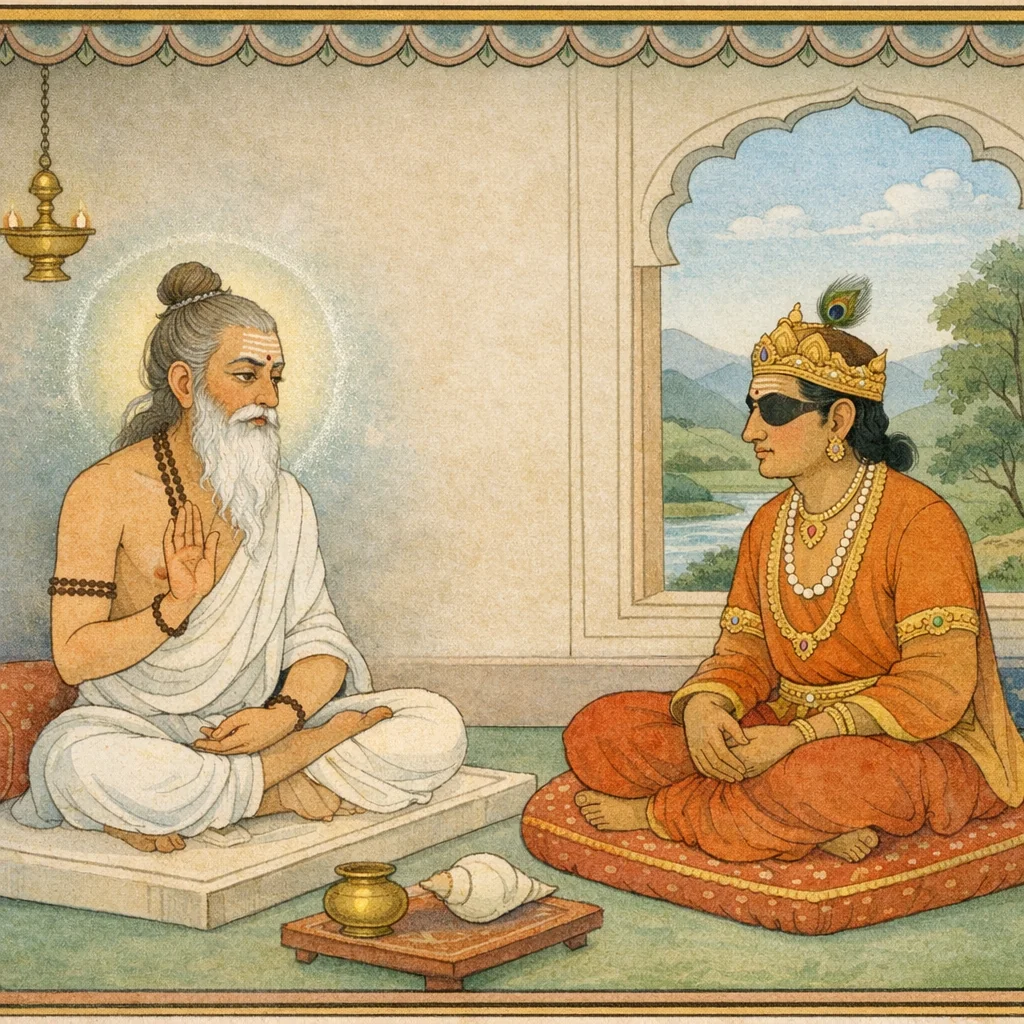
Adhyaya 43
Sanatsujāta on Vedic Learning, Truth (Satya), and the Discipline of Dama–Tyāga–Apramāda
Upa-parva: Sanatsujātīya (Discourse of Sanatsujāta)
Chapter 43 is a sustained ethical-philosophical exchange between Dhṛtarāṣṭra and Sanatsujāta. Dhṛtarāṣṭra first asks whether Vedic study protects a twice-born person who commits wrongdoing; Sanatsujāta rejects the notion that hymns or ritual formulae automatically ‘save’ one who persists in deceitful conduct, likening such supports to birds abandoning a nest at the end. When Dhṛtarāṣṭra questions why brahmins still extol Vedic learning, Sanatsujāta reframes the issue: ascetic effort bears fruit, yet the decisive ‘tapas’ is an interior refinement—freedom from enumerated faults and cultivation of virtues. He lists twelve avoidable human defects (including anger, desire, greed, delusion, envy, malice, sorrow, and craving) and contrasts them with twelve brahminical virtues (dharma, truth, self-restraint, austerity, non-envy, modesty, forbearance, non-malice, sacrifice, generosity, steadiness, and learning). He then defines three key disciplines—dama, tyāga, and apramāda—by specifying the faults they exclude and the emotional equanimity they produce. Dhṛtarāṣṭra next asks how to identify a true ‘brāhmaṇa’ among claims of one-, two-, three-, or four-Veda learning; Sanatsujāta answers that truth is the single Veda’s essence, and that one established in satya knows the ‘knowable’ more than one who merely knows texts. The chapter closes by praising silence and inward orientation as marks of the highest sage, culminating in the assertion that the brahmin established in truth ‘sees Brahman’.
Chapter Arc: धृतराष्ट्र, युद्ध की छाया में, सनत्सुजात से ‘अत्यन्तविद्या’—ब्रह्मचर्य से सिद्ध होने वाली अमृतत्व-विद्या—का रहस्य पूछते हैं; वेद-वचनों का संकेत देकर संवाद को परम-तत्त्व की ओर मोड़ दिया जाता है। → सनत्सुजात स्पष्ट करते हैं कि ब्रह्म ‘त्वरमाण’ (अधीर) मन से नहीं मिलता; बुद्धि का मन में लय और गहन चिन्तन चाहिए। धृतराष्ट्र व्यावहारिक आपत्ति उठाते हैं—गृहस्थ/राजकर्म में रहते हुए, ‘अनारभ्यां वसती’ (निष्काम/अकर्म-सा) कैसे संभव है, और ब्राह्मण्य/अमृतत्व कैसे मिले? → सनत्सुजात ब्रह्म के स्वरूप को नकारात्मक-निर्देश (नेति-नेति) से उभारते हैं—वह न ताराओं में, न विद्युत् में, न वायु/देवताओं/चन्द्र-सूर्य में दृश्य है; वही प्रतिष्ठा, अमृत, लोक और यश है; उसी से भूत उत्पन्न होते हैं और उसी में प्रलय को जाते हैं। → ब्रह्मचर्य को देवत्व और ऋषित्व का साधन बताकर (देवों ने देवत्व, ऋषियों ने ब्रह्मलोक) साधना-मार्ग की प्रतिष्ठा की जाती है; सत्य-आधारित आचरण और परमार्थ-तत्त्व के उपदेश की महिमा से ‘अमृतत्व’ को ज्ञान-निष्ठा के फल के रूप में स्थापित किया जाता है। → धृतराष्ट्र के प्रश्नों की धारा बनी रहती है—अदृश्य, अक्षर पद को ‘विद्वान’ कैसे देखता/जानता है—यह जिज्ञासा अगले उपदेश-खंड की ओर संकेत करती है।
Shlokas
Verse 1
- “ऋग्यजु:सामश्रि: पूतो ब्रह्मलोके महीयते ।” (ऋग्वेद, यजुर्वेद और सामवेदसे पवित्र होकर ब्राह्मण ब्रह्मलोकमें प्रतिष्ठित होता है;) इत्यादि वेदवचन वेदवेत्ता ब्राह्मणोंके पवित्र एवं निष्पाप होनेकी बात कहते हैं। - जिन्होंने ऋगादि वेदोंका अध्ययन नहीं किया है, वे अनूच कहलाते हैं। चतुश्नत्वारिशो< ध्याय: ब्रह्मचर्य तथा ब्रह्मका निरूपण धृतराष्ट्र रवाच सनत्सुजात यामिमां परां त्वं ब्राह्मीं वाचं वदसे विश्वरूपाम् । परां हि कामेन सुदुर्लभां कथां प्रब्रूहि मे वाक्यमिदं कुमार,धृतराष्ट्रने कहा--सनत्सुजातजी! आप जिस सर्वोत्तम और सर्वरूपा ब्रह्मसम्बन्धिनी विद्याका उपदेश कर रहे हैं, कामी पुरुषोंके लिये वह अत्यन्त दुर्लभ है। कुमार! मेरा तो यह कहना है कि आप इस उत्कृष्ट विषयका पुनः प्रतिपादन करें
Sanatsujāta said: “Vedic sayings such as, ‘Purified by the glory of the Ṛg, Yajus, and Sāman, one is honored in the world of Brahman,’ and others like them, declare that Brahmins who truly know the Veda are pure and free from sin. Those who have not studied the Ṛg and the other Vedas are called anūca (unlearned in Vedic recitation).” Dhṛtarāṣṭra said: “Sanatsujāta, the supreme, all-formed Brahman-teaching you are uttering is exceedingly hard for desire-driven people to attain. O youthful sage, I ask you: please expound again this highest discourse for me.”
Verse 2
सनत्युजात उवाच नैतद् ब्रह्म त्वरमाणेन लभ्यं यन्मां पृच्छन्नतिहृष्यतीव । बुद्धी विलीने मनसि प्रचिन्त्या विद्या हि सा ब्रह्म॒चर्येण लभ्या,सनत्सुजातने कहा--राजन्! तुम जो मुझसे बारंबार प्रश्न करते समय अत्यन्त हर्षित हो उठते हो, सो इस प्रकार जल्दबाजी करनेसे ब्रह्मकी उपलब्धि नहीं होती। बुद्धिमें मनके लय हो जानेपर सब वृत्तियोंका विरोध करनेवाली जो स्थिति है, उसका नाम है ब्रह्मविद्या और वह ब्रह्मचर्यका पालन करनेसे ही उपलब्ध होती है
Sanatsujāta said: “O king, the Brahman you seek is not attained by haste, even though you question me again and again with great excitement. When the mind is dissolved into the intellect—through deep contemplation—there arises that knowledge which restrains all mental movements; this is Brahma-knowledge, and it is attained only through the discipline of brahmacarya.”
Verse 3
ध्ृतराष्टर उवाच अत्यन्तविद्यामिति यत् सनातनीं ब्रवीषि त्वं ब्रह्मचर्येण सिद्धाम् । अनारभ्यां वसतीह कार्यकाले कथं ब्राह्मुण्यममृतत्वं लभेत,धृतराष्ट्रने कहा--जो कर्मोंद्वारा आरम्भ होनेयोग्य नहीं है तथा कार्यके समयमें भी जो इस आत्मामें ही रहती है, उस अनन्त ब्रह्मसे सम्बन्ध रखनेवाली इस सनातन विद्याको यदि आप ब्रह्मचर्यसे ही प्राप्त होनेयोग्य बता रहे हैं तो मुझ-जैसे लोग ब्रह्मसम्बन्धी अमृतत्व (मोक्ष)-को कैसे पा सकते हैं?
Dhṛtarāṣṭra said: “You speak of a timeless, highest knowledge—perfected through brahmacarya. Yet it is said to be ‘not initiated by action’ and to abide here within the Self even amid the time of duties. If so, how can people like me attain the brahman-state and the deathless freedom (mokṣa) connected with Brahman?”
Verse 4
सनत्युजात उवाच अव्यक्तविद्यामभिधास्ये पुराणीं बुद्धया च तेषां ब्रह्मचर्येण सिद्धाम् । यां प्राप्यैनं मर्त्यलोक॑ त्यजन्ति या वै विद्या गुरुवृद्धेषु नित्या,सनत्सुजातजी बोले--अब मैं (सच्चिदानन्दघन) अव्यक्त ब्रह्मसे सम्बन्ध रखनेवाली उस पुरातन विद्याका वर्णन करूँगा, जो मनुष्योंको बुद्धि और ब्रह्मचर्यके द्वारा प्राप्त होती है, जिसे पाकर विद्वान् पुरुष इस मरणधर्मा शरीरको सदाके लिये त्याग देते हैं तथा जो वृद्ध गुरुजनोंमें नित्य विद्यमान रहती है
Sanatsujāta said: I shall declare that ancient knowledge of the Unmanifest, perfected through understanding and through the discipline of brahmacarya. Having attained it, the wise abandon this mortal condition; for this is the knowledge that ever abides among venerable elders and true teachers.
Verse 5
ध्तराष्ट्र रवाच ब्रह्मचर्येण या विद्या शक््या वेदितुमज्जसा । तत् कथं ब्रह्मचर्य स्यादेतद् ब्रह्मन् ब्रवीहि मे,धृतराष्ट्रने कहा--ब्रह्मन! यदि वह ब्रह्मविद्या ब्रह्मचर्यके द्वारा ही सुगमतासे जानी जा सकती है तो पहले मुझे यही बताइये कि ब्रह्मचर्यका पालन कैसे होता है?
Dhṛtarāṣṭra said: “O Brahman, if that sacred knowledge is readily knowable through the practice of brahmacarya, then tell me first how brahmacarya is to be observed. Explain this to me.”
Verse 6
सनत्सुजात उवाच आचार्ययोनिमिह ये प्रविश्य भूत्वा गर्भे ब्रह्मचर्य चरन्ति । इहैव ते शास्त्रकारा भवन्ति प्रहाय देहं परमं यान्ति योगम्,सनत्सुजातजी बोले--जो लोग आचार्यके आश्रममें प्रवेश कर अपनी सेवासे उनके अन्तरंग भक्त हो ब्रह्मचर्यका पालन करते हैं, वे यहीं शास्त्रकार हो जाते हैं और देहत्यागके पश्चात् परम योगरूप परमात्माको प्राप्त होते हैं
Sanatsujāta said: Those who enter here into the lineage and shelter of a true teacher, becoming as it were ‘within the womb’ of disciplined training, and who live the vow of brahmacarya—such people, even in this very life, become authoritative formulators and transmitters of sacred teaching. Having cast off the body, they attain the supreme Yoga, union with the Highest Self.
Verse 7
अस्मिल्लोके वै जयन्तीह कामान् ब्राह्मीं स्थितिं हानुतितिक्षमाणा: । त आत्मान निर्हरन्तीह देहा- न्मुज्जादिषीकामिव सत्त्वसंस्था:,इस जगतमें जो लोग वर्तमान स्थितिमें रहते हुए ही सम्पूर्ण कामनाओंको जीत लेते हैं और ब्राह्मी स्थिति प्राप्त करनेके लिये ही नाना प्रकारके द्वन्ोंको सहन करते हैं, वे सत्त्वगुणमें स्थित हो यहाँ ही मूँजसे सींककी भाँति इस देहसे आत्माको (विवेकद्वारा) पृथक् कर लेते हैं
In this very world, those who conquer their desires while remaining in their present station, and who endure the many pairs of opposites in order to attain the Brahmic state, become established in sattva and, here itself, draw out the Self from the body—as one draws a reed-fiber from a stalk of muñja grass—separating it by discernment.
Verse 8
शरीरमेतौ कुरुत: पिता माता च भारत । आचार्यशास्ता या जाति: सा पुण्या साजरामरा,भारत! यद्यपि माता और पिता-ये ही दोनों इस शरीरको जन्म देते हैं, तथापि आचार्यके उपदेशसे जो जन्म प्राप्त होता है, वह परम पवित्र और अजर-अमर है
Sanatsujāta said: “O Bhārata, father and mother together bring about this physical body. Yet the ‘birth’ that arises through the teacher’s instruction and discipline is supremely purifying—indeed, it is a birth that does not age or die.”
Verse 9
य: प्रावृणोत्यवितथेन वर्णा- नृतं कुर्वन्नमृतं सम्प्रयच्छन् । त॑ मन्येत पितरं मातरं च तस्मै न द्रहोत् कृतमस्य जानन्,जो परमार्थतत्त्वके उपदेशसे सत्यको प्रकट करके अमरत्व प्रदान करते हुए ब्राह्मणादि वर्णोकी रक्षा करते हैं, उन आचार्यको पिता-माता ही समझना चाहिये तथा उनके किये हुए उपकारका स्मरण करके कभी उनसे द्रोह नहीं करना चाहिये
Sanatsujāta teaches that the teacher who truly protects the social orders (varṇas) without deceit, who upholds truth and bestows the way to immortality, should be regarded as both father and mother. Remembering the benefit received from such a guide, one should never commit treachery against him.
Verse 10
गुरु शिष्यो नित्यमभिवादयीत स्वाध्यायमिच्छेच्छुचिरप्रमत्त: । मान॑ न कुर्यान्नादधीत रोष- मेष प्रथमो ब्रह्मचर्यस्थ पाद:,ब्रह्मचारी शिष्यको चाहिये कि वह नित्य गुरुको प्रणाम करे, बाहर-भीतरसे पवित्र हो प्रमाद छोड़कर स्वाध्यायमें मन लगावे, अभिमान न करे, मनमें क्रोधको स्थान न दे। यह ब्रह्मबचर्यका पहला चरण है
Sanatsujāta teaches that a student living the discipline of brahmacarya should daily salute and attend upon the teacher, remain pure in conduct and mind, and—free from negligence—apply himself to sacred study. He should not cultivate pride, nor allow anger to take root within. This, he says, is the first step of brahmacarya: humility, vigilance, and self-controlled learning as the foundation of ethical life.
Verse 11
शिष्यवृत्तिक्रमेणैव विद्यामाप्रोति यः शुचि: । ब्रह्मचर्यव्रतस्यास्य प्रथम: पाद उच्यते
Sanatsujāta said: “That pure-minded person who attains true knowledge by following, step by step, the disciplined conduct expected of a student—this is declared to be the first ‘quarter’ (pāda), the foundation, of this vow of brahmacarya.”
Verse 12
जो शिष्यकी वृत्तिके क्रमसे ही जीवन-निर्वाह करता हुआ पवित्र हो विद्या प्राप्त करता है, उसका यह नियम भी ब्रह्मचर्यव्रतका पहला ही पाद कहलाता है ।। आचार्यस्य प्रियं कुर्यात् प्राणैरपि धनैरपि । कर्मणा मनसा वाचा द्वितीय: पाद उच्यते,अपने प्राण और धन लगाकर भी मन, वाणी तथा कर्मसे आचार्यका प्रिय करे, यह दूसरा पाद कहलाता है
Sanatsujāta explains the discipline of brahmacarya in its practical, ethical form. First, a student who sustains his life in an orderly and restrained way, remaining pure while pursuing learning, is said to be fulfilling the first ‘quarter’ (pāda) of the brahmacarya vow. Second, even at the cost of one’s life or wealth, to act so as to please the teacher—through deed, thought, and speech—is declared the second quarter. The teaching frames education as a sacred apprenticeship grounded in self-control, purity, and wholehearted service to the guru.
Verse 13
समा गुरौ यथा वृत्तिर्गुरुपत्न्यां तथा55चरेत् । तत्युत्रे च तथा कुर्वन् द्वितीय: पाद उच्यते
One should conduct oneself toward the teacher’s wife exactly as one behaves toward the teacher himself. Acting in the same manner toward the teacher’s son as well—this is declared to be the second ‘foot’ (pāda), the second step, of right conduct. The teaching emphasizes disciplined reverence and moral restraint within the guru’s household as a foundation of dharma.
Verse 14
गुरुके प्रति शिष्यका जैसा श्रद्धा और सम्मानपूर्ण बर्ताव हो, वैसा ही गुरुकी पत्नी और पुत्रके साथ भी होना चाहिये। यह भी ब्रह्मचर्यका द्वितीय पाद ही कहलाता है ।। आचार्येणात्मकृतं विजानन् ज्ञात्वा चार्थ भावितोडस्मीत्यनेन | यन्मन्यते त॑ प्रति हृष्टबुद्धिः स वै तृतीयो ब्रह्मचर्यस्य पाद:,आचार्यने जो अपना उपकार किया, उसे ध्यानमें रखकर तथा उससे जो प्रयोजन सिद्ध हुआ, उसका भी विचार करके मन-ही-मन प्रसन्न होकर शिष्य आचार्यके प्रति जो ऐसा भाव रखता है कि इन्होंने मुझे बड़ी उन्नत अवस्थामें पहुँचा दिया--यह ब्रह्मचर्यका तीसरा पाद है
Sanatsujāta said: Knowing the personal kindness done by the teacher, and reflecting that one’s purpose has been fulfilled—thinking, “By him I have been nurtured and refined”—when a student holds a glad and grateful mind toward that teacher, this is called the third ‘foot’ (stage) of brahmacarya.
Verse 15
नाचार्यस्यानपाकृत्य प्रवासं प्राज्ञ: कुर्वीत नैतदहं करोमि । इतीव मन्येत न भाषयेत स वै चतुर्थो ब्रह्मचर्यस्य पाद:,आचार्यके उपकारका बदला चुकाये बिना अर्थात् गुरुदक्षिणा आदिके द्वारा उन्हें संतुष्ट किये बिना विद्वान् शिष्य वहाँसे अन्यत्र न जाय। [दक्षिणा देकर या गुरुकी सेवा करके] कभी मनमें ऐसा विचार न लावे कि मैं गुरुका उपकार कर रहा हूँ तथा मुँहसे भी कभी ऐसी बात न निकाले। यह ब्रह्मचर्यका चौथा पाद है
Sanatsujāta said: A wise student should not depart to live elsewhere without first discharging what is due to his teacher—without satisfying him through service, fees, or other proper acts of gratitude. Even then, he should not entertain the thought, “I am doing my teacher a favor,” nor should he ever speak in that manner. This is declared to be the fourth quarter of brahmacarya: humility and gratitude toward the teacher, free from pride.
Verse 16
कालेन पादं लभते तथार्थ ततश्न पादं गुरुयोगतश्न । उत्साहयोगेन च पादमृच्छे- च्छास्त्रेण पादं च ततोडभियाति,सनातनी विद्याके कुछ अंशको तथा उसके मर्मको तो मनुष्य समयके योगसे प्राप्त करता है, कुछ अंशको गुरुके सम्बन्धसे तथा कुछ अंशको अपने उत्साहके सम्बन्धसे और कुछ अंशको परस्पर शास्त्रके विचारसे प्राप्त करता है
Sanatsujāta explains that a person gains the timeless knowledge only in parts: one portion comes with the ripening of time and lived experience; another through association with a true teacher; another through one’s own disciplined effort and zeal; and yet another through careful reflection on the scriptures. Thus, understanding is not sudden or single-sourced—it is gradually completed by time, guidance, personal striving, and reasoned study.
Verse 17
धर्मादयो द्वादश यस्य रूप- मन्यानि चाड्रानि तथा बलं च । आचार्ययोगे फलतीति चाहु- ब्रह्मार्थयोगेन च ब्रह्म॒चर्यम्
Sanatsujāta said: “Dharma and the rest—twelve in all—constitute His very form; and other mighty masses, like mountains, as well as strength, are also His. They declare that through disciplined union with the true Teacher this bears fruit; and that through yoga directed to Brahman, brahmacarya (the vow of chastity and self-restraint) is fulfilled and perfected.”
Verse 18
पूर्वोक्त धर्मादे बारह गुण जिसके स्वरूप हैं तथा और भी जो धर्मके अंग एवं सामर्थ्य हैं, वे भी जिसके स्वरूप हैं, वह ब्रह्मचर्य आचार्यके सम्बन्धसे प्राप्त वेदार्थके ज्ञाससे सफल होता है, ऐसा कहा जाता है ।। एवं प्रवृत्तो यदुपालभेत वै धनमाचार्याय तदनुप्रयच्छेत् । सतां वृत्ति बहुगुणामेवमेति गुरो: पुत्रे भवति च वृत्तिरेषा,इस तरह ब्रह्मचर्यपालनमें प्रवृत्त हुए ब्रह्मबचारीको चाहिये कि जो कुछ भी धन (जीवननिर्वाहयोग्य वस्तुएँ) भिक्षामें प्राप्त हो, उसे आचार्यको अर्पण कर दे। ऐसा करनेसे वह शिष्य सत्पुरुषोंके अनेक गुणोंसे युक्त आचारको प्राप्त होता है। गुरुपुत्रके प्रति भी उसकी यही भावना रहनी चाहिये
Sanatsujāta explains that brahmacarya is not merely bodily restraint but a disciplined way of life whose very form is constituted by the previously described dharmic qualities and by other limbs and strengths of dharma. Such brahmacarya becomes fruitful when it is joined to the teacher and to the inquiry into the meaning of the Veda received through that relationship. Therefore, a student devoted to brahmacarya should offer to the ācārya whatever sustenance or wealth he obtains by alms. By doing so, the disciple attains the refined conduct of the virtuous, rich in many good qualities; and he should maintain the same respectful disposition toward the teacher’s son as well.
Verse 19
एवं वसन् सर्वतो वर्धतीह बहून् पुत्रॉल्लभते च प्रतिष्ठाम् । वर्षन्ति चास्मै प्रदिशो दिशश्न वसन्त्यस्मिन् ब्रह्मचर्ये जनाश्न,ऐसी वृत्तिसे गुरुगृहमें रहनेवाले शिष्यकी इस संसारमें सब प्रकारसे उन्नति होती है। वह (गृहस्थाश्रममें प्रवेश करके) बहुत-से पुत्र और प्रतिष्ठा प्राप्त करता है। सम्पूर्ण दिशा- विदिशाएँ उसके लिये सुखकी वर्षा करती हैं तथा उसके निकट बहुत-से दूसरे लोग ब्रह्मचर्यपालनके लिये निवास करते हैं
Sanatsujāta said: Living in this way—dwelling in the teacher’s house with disciplined conduct—the student prospers in every respect in this world. Later, entering household life, he gains many sons and also social standing. The quarters and sub-quarters seem to “rain” blessings upon him, and many others come to live near him in order to practice brahmacarya.
Verse 20
एतेन ब्रह्मचर्येण देवा देवत्वमाप्नुवन् । ऋषयश्चन महाभागा ब्रह्मलोक॑ मनीषिण:,इस ब्रह्मचर्यके पालनसे ही देवताओंने देवत्व प्राप्त किया और महान् सौभाग्यशाली मनीषी ऋषियोंने ब्रह्मलोकको प्राप्त किया
Sanatsujāta teaches that it is through the discipline of brahmacarya—self-restraint and consecrated conduct—that the gods attained their divine status, and that the great, fortunate seer-sages, endowed with insight, reached Brahmaloka.
Verse 21
गन्धर्वाणामनेनैव रूपमप्सरसामभूत् । एतेन ब्रह्मचर्येण सूर्योउप्यह्लाय जायते
Sanatsujāta said: “By this very discipline, the Gandharvas attained their splendid form, and the Apsarases as well. Through this practice of brahmacarya, even the Sun becomes a source of delight.”
Verse 22
इसीके प्रभावसे गन्धर्वों और अप्सराओंको दिव्य रूप प्राप्त हुआ। इस ब्रह्मचर्यके ही प्रतापसे सूर्यदेव समस्त लोकोंको प्रकाशित करनेमें समर्थ होते हैं ।। आकाडकभक्ष्यार्थस्य संयोगाद् रसभेदार्थिनामिव । एवं होते समाज्ञाय तादृग्भावं गता इमे,रसभेदरूप चिन्तामणिसे याचना करनेवालोंको जैसे उनके अभीष्ट अर्थकी प्राप्ति होती है, उसी प्रकार ब्रह्मचर्य भी मनोवांछित वस्तु प्रदान करनेवाला है। ऐसा समझकर ये ऋषि- देवता आदि ब्रह्मचर्यके पालनसे वैसे भावको प्राप्त हुए
Sanatsujāta explains that by the power of brahmacarya (disciplined continence and sacred self-restraint), Gandharvas and Apsarases attained divine beauty and form; by that very austerity the Sun-god is able to illumine all the worlds. Just as those who seek a particular taste obtain the desired result through the proper means—like petitioners approaching a wish-fulfilling jewel—so too brahmacarya grants what the mind longs for. Understanding this, sages, gods, and other beings practiced brahmacarya and thereby reached that exalted state.
Verse 23
य आश्रयेत् पावयेच्चापि राजन् सर्व शरीरं तपसा तप्यमान: । एतेन वै बाल्यमभ्येति विद्वान् मृत्युंतथा स जयत्यन्तकाले,राजन! जो इस ब्रह्मचर्यका आश्रय लेता है, वह ब्रह्मबचारी यम-नियमादि तपका आचरण करता हुआ अपने सम्पूर्ण शरीरको भी पवित्र बना लेता है तथा इससे विद्वान् पुरुष निश्चय ही अबोध बालककी भाँति राग-द्वेषसे शून्य हो जाता है और अन्त समयमें वह मृत्युको भी जीत लेता है
Sanatsujāta said: “O King, one who takes refuge in this discipline of brahmacarya and, while practicing austerity through self-restraint, purifies even the whole body—by this very means the wise person attains a childlike state, free from attachment and aversion. And at the final hour, such a one conquers death itself.”
Verse 24
अन्तवतः: क्षत्रिय ते जयन्ति लोकान् जना: कर्मणा निर्मलेन । ब्रह्मैव विद्वांस्तेन चाभ्येति सर्व नान्य: पन्था अयनाय विद्यते,राजन्! सकाम पुरुष अपने पुण्यकर्मोंके द्वारा नाशवान् लोकोंको ही प्राप्त करते हैं; किंतु जो ब्रह्मको जाननेवाला विद्वान् है, वही उस ज्ञानके द्वारा सर्वरूप परमात्माको प्राप्त होता है। मोक्षके लिये ज्ञानके सिवा दूसरा कोई मार्ग नहीं है
Sanatsujāta said: “O King, men—especially kṣatriyas—by pure and blameless action win only those worlds that have an end. But the wise knower of Brahman, through that very knowledge, attains the all-pervading Supreme Reality. For liberation, there is no other path to the Goal besides knowledge.”
Verse 25
ध्तराष्ट्र रवाच आभाति शुक्लमिव लोहितमिवाथो कृष्णमथाज्जनं काद्रवं वा । सद्ब्रह्मण: पश्यति योअत्र विद्वान् कथं रूप॑ं तदमृतमक्षरं पदम्,धृतराष्ट्र बोले--विद्वान् पुरुष यहाँ सत्यस्वरूप परमात्माके जिस अमृत एवं अविनाशी परमपदका साक्षात्कार करते हैं, उसका रूप कैसा है? क्या वह सफेद-सा, लाल-सा, काजल-सा काला या सुवर्ण-जैसे पीले रंगका प्रतीत होता है?
Dhṛtarāṣṭra said: “When a wise person here directly beholds the true Brahman, what form does that immortal, imperishable supreme state appear to have? Does it seem white, or red, or black like collyrium, or golden-yellow?”
Verse 26
सनत्युजात उवाच आभाति शुक्लमिव लोहितमिवाथो कृष्णमायसमर्कवर्णम् । न पृथिव्यां तिष्ठति नान्तरिक्षे नैतत् समुद्रे सलिलं बिभर्ति,सनत्सुजातने कहा--यद्यपि श्वेत, लाल, काले, लोहेके सदृश अथवा सूर्यके समान प्रकाशमान अनेकों प्रकारके रूप प्रतीत होते हैं, तथापि ब्रह्मका वास्तविक रूप न पृथ्वीमें है, न आकाशमें। समुद्रका जल भी उस रूपको नहीं धारण करता
Sanatsujāta said: “It appears—now as white, now as red, now as black; sometimes like iron, sometimes radiant like the sun. Yet that Reality does not stand fixed on the earth, nor does it abide in the mid-air; even the ocean’s waters do not bear or contain it.”
Verse 27
न तारकासु न च विद्युदाश्रितं नचाश्रेषु दृश्यते रूपमस्य । न चापि वायौ न च देवतासु नैतच्चन्द्रे दृश्यते नोत सूर्ये
Sanatsujāta teaches that the Supreme Reality cannot be grasped as a visible form within the familiar phenomena of the world. It is not seen among the stars, nor lodged in lightning; it is not perceived in the sky. It is not found in the wind, nor among the gods as an object of sight; it is not seen in the moon, nor even in the sun.
Verse 28
इस ब्रह्मका वह रूप न तारोंमें है, न बिजलीके आश्रित है और न बादलोंमें ही दिखायी देता है। इसी प्रकार वायु, देवगण, चन्द्रमा और सूर्यमें भी वह नहीं देखा जाता ।। नैवर्क्षु तन्न यजुष्षु नाप्यथर्वसु न दृश्यते वै विमलेषु सामसु । रथन्तरे बार्हद्रथे वापि राजन् महाव्ते नैव दृश्येद् ध्रुवं तत्,राजन! ऋग्वेदकी ऋचाओंमें, यजुर्वेदके मन्त्रोंमें, अथर्ववेदके सूक्तोंमें तथा विशुद्ध सामवेदमें भी वह नहीं दृष्टिगोचर होता। रथन्तर और बार्हद्रथ नामक साममें तथा महान् व्रतमें भी उसका दर्शन नहीं होता; क्योंकि वह ब्रह्म नित्य है
Sanatsujāta said: “O King, that steadfast Reality (Brahman) is not an object of sight within the hymns of the Ṛgveda, nor within the formulas of the Yajurveda, nor within the chants of the Atharvaveda, nor even within the pure melodies of the Sāmaveda. It is not ‘seen’ even in the celebrated Sāman-s such as Rathantara and Bārhadratha, nor in the great vow-rite (Mahāvrata). For Brahman is eternal and not grasped as a visible thing—its realization lies beyond mere ritual recitation and liturgical performance.”
Verse 29
अपारणीयं तमस: परस्तात् तदन्तको<प्येति विनाशकाले । अणीयो रूपं क्षुरधारया सम॑ महच्च रूप॑ तद् वै पर्वतेभ्य:,ब्रह्मके उस स्वरूपका कोई पार नहीं पा सकता। वह अज्ञानरूप अन्धकारसे सर्वथा अतीत है। महाप्रलयमें सबका अन्त करनेवाला काल भी उसीमें लीन हो जाता है। वह रूप अस्तुरेकी धारके समान अत्यन्त सूक्ष्म और पर्वतोंसे भी महान् है (अर्थात् वह सूक्ष्मसे भी सूक्ष्मतर और महानसे भी महान् है)
Sanatsujāta declares that Brahman is beyond all measure, wholly on the far side of darkness (ignorance). At the time of cosmic dissolution, even Death—the ender of all—enters into That and is absorbed. That Reality is subtler than a razor’s edge, yet greater than mountains: it points to an ultimate ground that transcends the dread power of time and the limits of human grasp.
Verse 30
सा प्रतिष्ठा तदमृतं लोकास्तद् ब्रह्म तद् यश: । भूतानि जज्ञिरे तस्मात् प्रलयं यान्ति तत्र हि,वही सबका आधार है, वही अमृत है, वही लोक, वही यश तथा वही ब्रह्म है। सम्पूर्ण भूत उसीसे प्रकट हुए और उसीमें लीन होते हैं
Sanatsujāta declares that the ultimate Ground is the true support of all existence: it is immortality itself, the very worlds, the supreme Brahman, and the source of all glory. From That all beings arise, and into That alone they inevitably dissolve at the time of dissolution.
Verse 31
अनामयं तनन््महदुद्यतं यशो वाचो विकारं कवयो वदन्ति । यस्मिन् जगत् सर्वमिदं प्रतिछितं ये तद् विदुरमृतास्ते भवन्ति,विद्वान् कहते हैं, कार्यरूप जगत् वाणीका विकारमात्र है; किंतु जिसमें यह सम्पूर्ण जगत् प्रतिष्ठित है, वह ब्रह्म रोग, शोक और पापसे रहित है और उसका महान् यश सर्वत्र फैला हुआ है। उस नित्य कारण-स्वरूप ब्रह्मको जो जानते हैं, वे अमर हो जाते हैं अर्थात् मुक्त हो जाते हैं
Sanatsujāta said: The sages declare that this manifested world is only a modification of speech—an effect expressed through names and descriptions. But that Reality in which the whole universe stands established is free from affliction, sorrow, and sin, and its vast glory is ever exalted. Those who truly know That become deathless—released.
Verse 44
इति श्रीमहाभारते उद्योगपर्वणि सनत्सुजातपर्वणि सनत्सुजातवाक्ये चतुश्नत्वारिंशो5ध्याय:
Thus, in the Śrī Mahābhārata, within the Udyoga Parva, in the section concerning Sanatsujāta, in the discourse spoken by Sanatsujāta, ends the forty-third chapter.
Frequently Asked Questions
Whether scriptural learning (ṛc/yajus/sāman recitation) can offset unethical action; the chapter answers that persistent wrongdoing is not neutralized by textual mastery without truth-oriented conduct.
Truth (satya) is presented as the decisive criterion of knowledge and spiritual authority; self-control, disciplined non-attachment, and vigilance are the operative means by which ‘tapas’ becomes ethically effective.
Yes: the chapter explicitly links establishment in satya with ‘seeing Brahman’ and elevates silence and inward realization over external marks, situating ethical discipline as a direct pathway toward liberative insight.