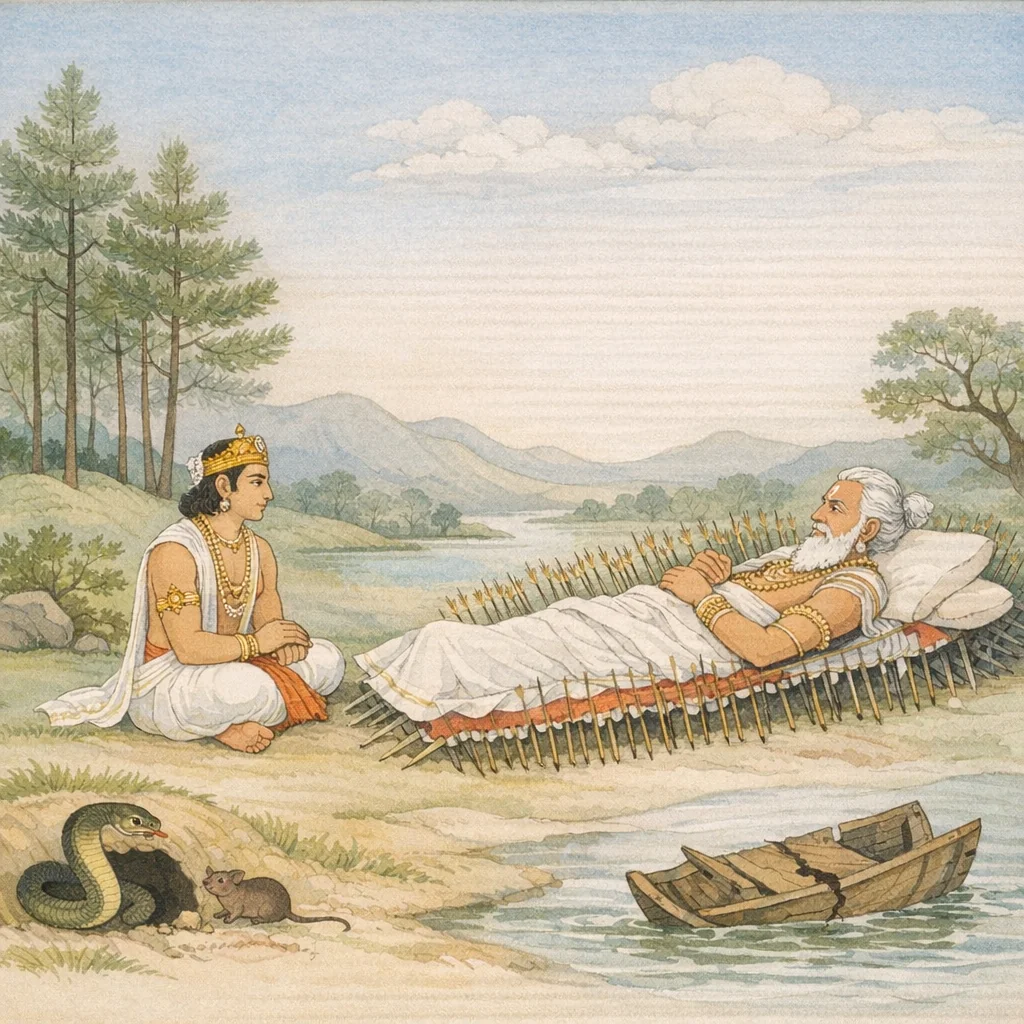
Adhyaya 57
अध्याय ५७ — राज्ञः नित्यप्रयत्नः, रक्षा-प्रधानता, तथा त्याग-नीतिः (Chapter 57: Constant Royal Vigilance, Primacy of Protection, and Principles of Dismissal)
Upa-parva: Rājadharmānuśāsana Upa-Parva (Instruction on Royal Duty)
Bhīṣma instructs Yudhiṣṭhira that a ruler must remain perpetually diligent; a king who abandons effort declines in authority and effectiveness. He cites authoritative verses associated with Uśanā (Śukra) and other traditional lawgivers to emphasize that the earth metaphorically ‘consumes’ two figures: a non-protecting king and a non-migrating (socially non-contributing) brāhmaṇa—an admonition framed as a warning against neglect of role-duty. The chapter urges pragmatic statecraft: reconcile those fit for alliance, oppose those requiring resistance, and act decisively against any person who harms the state’s constituent limbs (saptāṅga), even if that person is a teacher or friend. Illustrative precedents are offered (e.g., Sagara’s abandonment of Asamañjā; Uddālaka’s rejection of Śvetaketu for improper conduct) to justify disciplined governance over familial affection. Positive royal traits are enumerated: public-pleasing justice, truth-protection, straightforward dealings, non-appropriation of others’ wealth, timely giving and enforcement, secrecy in counsel, anger-control, and continuous engagement with dharma, artha, kāma, and mokṣa. The king should be measured in trust—neither credulous nor excessively suspicious—use oversight and intelligence, cultivate capable associates, and maintain ethical conduct. The text culminates in the principle that protection (rakṣā) is the foundational royal duty: without a king, household and wealth lack security. Finally, it quotes Manu-like counsel to abandon dysfunctional role-bearers (e.g., ineffective teacher, non-studying priest, non-protecting king), using vivid analogies to convey administrative accountability.
Chapter Arc: शरशय्या पर लेटे भीष्म युधिष्ठिर से कहते हैं—राजा का प्रथम धर्म है निरन्तर उद्योग; जो स्त्री की भाँति निष्क्रिय बैठता है, उसकी कीर्ति और राज्य दोनों क्षीण होते हैं। → भीष्म शुक्राचार्य (उशना) के वचन का स्मरण कराते हैं और चेतावनी देते हैं कि पृथ्वी दो प्रकार के लोगों को वैसे ही ‘ग्रस’ लेती है जैसे बिल में रहने वाले चूहों को सर्प—(1) जो राजा विरोध/उपद्रव का निवारण नहीं करता, (2) जो ब्राह्मण प्रवास/कर्तव्य-त्याग में पड़ा रहता है। फिर वे बताते हैं कि अहंकारी, कर्तव्य-अकर्तव्य न जानने वाला और कुमार्गगामी गुरु भी दण्डनीय हो जाता है—अर्थात् पद नहीं, आचरण मान्य है। → राजधर्म का तीखा निष्कर्ष उभरता है: राज्य-रक्षा और व्यवस्था के बिना लोक-जीवन का कोई आधार नहीं—‘पहले राजा, फिर पत्नी, फिर धन’; और जो राजा गुप्तचर-तंत्र, मंत्र-परामर्श तथा कृत-अकृत्य का विवेक इस प्रकार रखे कि शत्रु उसे न जान सकें, वही राज्य के योग्य है। → भीष्म आदर्श राजा के गुण गिनाते हैं—बुद्धिमान, त्यागी, शत्रु-दुर्बलता जानने में तत्पर, शीघ्र-कार्यकारी, सभी वर्णों के न्याय-अन्याय को समझने वाला; साथ ही व्यवहारिक नीति देते हैं कि समुद्र-यात्रा की टूटी नाव की तरह अनुपयोगी साधनों/व्यक्तियों का त्याग कर देना चाहिए—अप्रवक्ता आचार्य, अनध्यायी ऋत्विज, अरक्षितार राजा, अप्रियवादिनी पत्नी, ग्रामकाम गोपाल, वनकाम नापित आदि।
Shlokas
Verse 1
भीष्मजी कहते हैं--युधिष्ठिर! राजाको सदा ही उद्योगशील होना चाहिये। जो उद्योग छोड़कर स्त्रीकी भाँति बेकार बैठा रहता है, उस राजाकी प्रशंसा नहीं होती है
Bhishma said: “Yudhishthira, a king must always be energetic and diligent in action. A ruler who abandons effort and sits idle—like one withdrawn from duty—does not earn praise.”
Verse 2
भगवानुशना चाह शलोकमत्र विशाम्पते । तदिहैकमना राजन् गदतस्तं निबोध मे,प्रजानाथ! इस विषयमें भगवान् शुक्राचार्यने एक श्लोक कहा है, उसे मैं बता रहा हूँ। तुम यहाँ एकाग्रचित्त होकर मुझसे उस श्लोकको सुनो
Bhishma said: “O lord of the people, the venerable Ushanas (Shukracharya) once spoke a verse on this very matter. Now, O king, with your mind gathered into one-pointed attention, listen here as I recite it to you.”
Verse 3
द्वाविमौ ग्रसते भूमि: सर्पो बिलशयानिव । राजानं चाविरोद्धारं ब्राह्मणं चाप्रवासिनम्,जैसे साँप बिलमें रहनेवाले चूहोंको निगल जाता है, उसी प्रकार दूसरोंसे लड़ाई न करनेवाले राजा तथा विद्याध्ययन आदिके लिये घर छोड़कर अन्यत्र न जानेवाले ब्राह्मणको पृथ्वी निगल जाती है (अर्थात् वे पुरुषार्थ-साधन किये बिना ही मर जाते हैं)”
Bhishma said: “The earth swallows up these two, just as a serpent swallows creatures that dwell in holes: a king who does not oppose aggressors, and a Brahmin who does not go forth from home for higher study and disciplined pursuit. Such men, failing to exert themselves in their proper duties, perish without attaining the means of human fulfillment.”
Verse 4
तदेतन्नरशार्दूल हृदि त्वं कर्तुमहसि । संधेयानभिसंधत्स्व विरोध्यांश्व विरोधय,अतः नरश्रेष्ठ! तुम इस बातको अपने हृदयमें धारण कर लो, जो संधि करनेके योग्य हों, उनसे संधि करो और जो विरोधके पात्र हों, उनका डटकर विरोध करो
Bhishma said: “O tiger among men, you should firmly hold this in your heart: make alliances with those fit for reconciliation, and resolutely oppose those who deserve opposition.”
Verse 5
सप्ताड्ुस्य च राज्यस्य विपरीतं य आचरेत् । गुरुर्वा यदि वा मित्र प्रतिहन्तव्य एव सः,राज्यके सात अड़ हैं--राजा, मन्त्री, मित्र, खजाना, देश, दुर्ग और सेना। जो इन सात अड़ोंसे युक्त राज्यके विपरीत आचरण करे, वह गुरु हो या मित्र, मार डालनेके ही योग्य है
Bhishma said: “Whoever acts contrary to the proper functioning of a kingdom endowed with its seven constituent limbs—whether he be a teacher or even a friend—must be treated as an enemy to be struck down. For the safety of the realm and the protection of dharma, personal ties cannot excuse conduct that undermines the state.”
Verse 6
मरुत्तेन हि राज्ञा वै गीत: श्लोक: पुरातन: । राजाधिकारे राजेन्द्र बृहस्पतिमते पुरा,राजेन्द्र! पूर्वकालमें राजा मरुत्तने एक प्राचीन श्लोकका गान किया था, जो बृहस्पतिके मतानुसार राजाके अधिकारके विषयमें प्रकाश डालता है
Bhīṣma said: “O king, in former times King Marutta sang an ancient verse—one that, in accordance with Bṛhaspati’s counsel, illuminates the rightful scope and limits of royal authority.”
Verse 7
गुरोरप्यवलिप्तस्य कार्याकार्यमजानत: । उत्पथप्रतिपन्नस्य दण्डो भवति शाश्वत:,“घमंडमें भरकर कर्तव्य और अकर्तव्यका ज्ञान न रखनेवाला तथा कुमार्गपर चलनेवाला मुनष्य यदि अपना गुरु हो तो उसे भी दण्ड देनेका सनातन विधान है'
Bhishma teaches that even a guru is not beyond accountability: if, swollen with arrogance, he cannot discern what ought to be done and what ought not to be done, and has strayed onto a wrongful path, then the timeless rule is that punishment may rightly be applied even to him. Dharma stands higher than status; authority without right conduct forfeits its immunity.
Verse 8
बाहो: पुत्रेण राज्ञा च सगरेण च धीमता । असमज्जा: सुतो ज्येष्ठस्त्यक्त: पौरहितैषिणा,बाहुके पुत्र बुद्धिमान् राजा सगरने तो पुरवासियोंके हितकी इच्छासे अपने ज्येष्ठ पुत्र असमंजाका भी त्याग कर दिया था
Bhishma said: The wise king Sagara, son of Bāhu, seeking the welfare of the citizens, even abandoned his eldest son Asamañjā. The episode shows that a ruler’s foremost duty is the public good, and that kinship cannot excuse conduct harmful to society.
Verse 9
असमज्जा: सरय्वां स पौराणां बालकान् नृप । न््यमज्जयदत: पित्रा निर्भत्स्य स विवासित:,नरेश्वर! असमंजा पुरवासियोंके बालकोंको पकड़कर सरयूनदीमें डुबा दिया करता था; अतः उसके पिताने उसे दुत्कारकर घरसे बाहर निकाल दिया
Bhishma said: O king, Asamanja used to seize the townsmen’s young children and drown them in the river Sarayū. Therefore his father, after sternly reproaching him for this cruelty, expelled him from the household. The episode shows that a ruler’s family must restrain violence and protect the innocent, and that paternal authority is exercised to uphold social dharma.
Verse 10
ऋषिणोद्दालकेनापि श्वेतकेतुर्महातपा: । मिथ्या विप्रानुपचरन् संत्यक्तो दयित: सुत:,उद्दालक ऋषिने अपने प्रिय पुत्र महातपस्वी श्वेतकेतुको केवल इस अपराधसे त्याग दिया कि वह ब्राह्मणोंके साथ मिथ्या एवं कपटपूर्ण व्यवहार करता था
Bhīṣma said: Even the sage Uddālaka cast off his beloved son Śvetaketu—though a great ascetic—solely for this fault: that he dealt with brāhmaṇas in a false and deceitful manner. The episode shows that integrity and truthfulness toward the worthy are non-negotiable, even when the offender is one’s own dear child.
Verse 11
लोकरज्जनमेवात्र राज्ञां धर्म: सनातन: । सत्यस्य रक्षणं चैव व्यवहारस्य चार्जवम्,अत: इस लोकमें प्रजावर्गको प्रसन्न रखना ही राजाओंका सनातन धर्म है। सत्यकी रक्षा और व्यवहारकी सरलता ही राजोचित कर्तव्य है
Bhishma said: In this world, the eternal duty of kings is nothing other than keeping the people content. Protecting truth, and maintaining straightforwardness and integrity in public dealings—these are the kingly obligations.
Verse 12
न हिंस्यात् परवित्तानि देयं काले च दापयेत् । विक्रान्त: सत्यवाक् क्षान्तो नृपो न चलते पथ:,दूसरोंके धनका नाश न करे। जिसको जो कुछ देना हो, उसे वह समयपर दिलानेकी व्यवस्था करे। पराक्रमी, सत्यवादी और क्षमाशील बना रहे--ऐसा करनेवाला राजा कभी पथभ्रष्ट नहीं होता
Bhīṣma teaches that a king should not harm or destroy the wealth of others, and should ensure that whatever is due to anyone is paid at the proper time. A ruler who is courageous, truthful in speech, and patient-forbearing does not stray from the right path of kingship and dharma.
Verse 13
आत्मवांश्व जितक्रोध: शास्त्रार्थकृतनि श्चय: । धर्मे चार्थे च कामे च मोक्षे च सततं रत:,जिसने अपने मनको वशमें कर लिया है, क्रोधको जीत लिया है तथा शास््त्रोंके सिद्धान्तका निश्चयात्मक ज्ञान प्राप्त कर लिया है, जो धर्म, अर्थ, काम और मोक्षके प्रयत्नमें निरन्तर लगा रहता है, जिसे तीनों वेदोंका ज्ञान है तथा जो अपने गुप्त विचारोंको दूसरोंपर प्रकट नहीं होने देता है, वही राजा होने योग्य है, प्रजाकी रक्षा न करनेसे बढ़कर राजाओंके लिये दूसरा कोई पाप नहीं है
Bhishma said: “He alone is fit to be king who has mastered himself, conquered anger, and arrived at firm, reasoned certainty regarding the meaning of the scriptures; who remains continually engaged in the proper pursuit of dharma, material prosperity, rightful pleasure, and liberation. Such a ruler should be learned in the Vedas and restrained in speech, not exposing private counsels. For kings, there is no sin greater than failing to protect their subjects.”
Verse 14
त्रय्यां संवृतमन्त्रश्न॒ राजा भवितुम्ति । वृजिनं च नरेन्द्राणां नान्यच्चारक्षणात् परम्,जिसने अपने मनको वशमें कर लिया है, क्रोधको जीत लिया है तथा शास््त्रोंके सिद्धान्तका निश्चयात्मक ज्ञान प्राप्त कर लिया है, जो धर्म, अर्थ, काम और मोक्षके प्रयत्नमें निरन्तर लगा रहता है, जिसे तीनों वेदोंका ज्ञान है तथा जो अपने गुप्त विचारोंको दूसरोंपर प्रकट नहीं होने देता है, वही राजा होने योग्य है, प्रजाकी रक्षा न करनेसे बढ़कर राजाओंके लिये दूसरा कोई पाप नहीं है
Bhishma said: He alone is fit to be a king who is learned in the three Vedas and who keeps his counsel well concealed. For rulers, there is no wrongdoing greater than failing to protect their subjects.
Verse 15
चातुर्वर्ण्यस्य धर्माश्च रक्षितव्या महीक्षिता | धर्मसंकररक्षा च राज्ञां धर्म: सनातन:,राजाको चारों वर्णोंके धर्मोकी रक्षा करनी चाहिये, प्रजाको धर्मसंकरतासे बचाना राजाओंका सनातन धर्म है
Bhīṣma said: “O king, the duties of the four social orders must be safeguarded by the ruler. To protect the people from the confusion and intermixture of duties (dharma-saṅkara) is the eternal obligation of kings.”
Verse 16
न विश्वसेच्च नृपतिर्न चात्यर्थ च विश्वसेत् । षाड्गुण्यगुणदोषांश्न नित्यं बुद्धघावलोकयेत्,राजा किसीपर भी विश्वास न करे। विश्वसनीय व्यक्तिका भी अत्यन्त विश्वास न करे। राजनीतिके छः: गुण होते हैं--सन्धि, विग्रह, यान, आसन, द्वैधीभाव और समाश्रय-। इन सबके गुण-दोषोंका अपनी बुद्धिद्वारा सदा निरीक्षण करे
Bhishma said: A king should neither be wholly distrustful nor place excessive trust. He should continually examine, with clear intelligence, the merits and faults involved in the six measures of statecraft—making peace, waging war, marching forth, remaining stationed, pursuing a double policy, and seeking shelter or alliance—so that his rule is guided by prudent discernment rather than impulse.
Verse 17
द्विट्छिद्रदर्शी नृपतिर्नित्यमेव प्रशस्यते । त्रिवर्ग विदितार्थश्न युक्तचारोपधिश्व॒ यः:,शत्रुओंके छिद्र देखनेवाले राजाकी सदा ही प्रशंसा की जाती है। जिसे धर्म, अर्थ और कामके तत्त्वका ज्ञान है तथा जिसने शत्रुओंकी गुप्त बातोंको जानने और उनके मन्त्री आदिको फोड़नेके लिये गुप्तचर लगा रखा है, वह भी प्रशंसाके ही योग्य है
Bhishma said: A king who constantly keeps watch over the enemy’s vulnerabilities is ever praised. Likewise, the ruler who understands the three aims of human life—dharma, artha, and kāma—and who maintains a well-ordered system of spies and counter-spies to uncover the enemy’s secrets and shatter the designs of his ministers, is also worthy of commendation. The ethical teaching is that prudent rule joins moral discernment with vigilant statecraft, so the realm is guarded without negligence.
Verse 18
कोशस्योपार्जनरतिर्यमवैश्रवणोपम: । वेत्ता च दशवर्गस्य स्थानवृद्धिक्षयात्मन:,राजाको उचित है कि वह सदा अपने कोषागारको भरा-पूरा रखनेका प्रयत्न करता रहे, उसे न्याय करनेमें यमराज और धन-संग्रह करनेमें कुबेरके समान होना चाहिये। वह स्थान, वृद्धि तथा क्षयके हेतुभूत दस- वर्गोंका सदा ज्ञान रखे
Bhishma said: A king should be ever intent on acquiring and keeping a full treasury—like Yama in the administration of justice, and like Vaiśravaṇa (Kubera) in the gathering of wealth. He should also understand the tenfold set of factors that govern a realm’s proper establishment, its growth, and its decline.
Verse 19
अभृतानां भवेद् भर्ता भूतानामन्ववेक्षक: । नृपति: सुमुखश्न स्यात् स्मितपूर्वाभिभाषिता,जिनके भरण-पोषणका प्रबन्ध न हो उनका पोषण राजा स्वयं करे और उसके द्वारा जिनका भरण-पोषण चल रहा हो, उन सबकी देखभाल रखे। राजाको सदा प्रसन्नमुख रहना और मुसकराते हुए वार्तालाप करना चाहिये
Bhishma said: The king should be the supporter of those who have no one to maintain them, and he should carefully oversee the welfare of all beings who live under his protection. A ruler should remain pleasant-faced and speak first with a gentle smile—so that governance is felt as care rather than fear.
Verse 20
उपासिता च वृद्धानां जिततन्द्रिरलोलुप: । सतां वृत्ते स्थितमति: संतोष्यश्चारुदर्शन:,राजाको वृद्ध पुरुषोंकी उपासना (सेवा या संग) करनी चाहिये, वह आलस्यको जीते और लोलुपताका परित्याग करे। सत्पुरुषोंके व्यवहारमें मन लगावे। संतुष्ट होने योग्य स्वभाव बनाये रखे। वेश-भूषा ऐसी रखे, जिससे वह देखनेमें अत्यन्त मनोहर जान पड़े
Bhishma said: A king should keep the company of elders and serve them. He should conquer sloth and abandon greed. Let his mind be firmly set in the conduct of the virtuous; let him be easily contented by nature; and let his appearance and bearing be pleasing to behold—so that his rule is grounded in discipline, good example, and public trust.
Verse 21
न चाददीत वित्तानि सतां हस्तात् कदाचन । असदभ्यश्न॒ समादद्यात् सद्भधयस्तु प्रतिपादयेत्,साधुपुरुषोंके हाथसे कभी धन न छीने। असाधु पुरुषोंसे दण्डके रूपमें धन लेना चाहिये; साधु पुरुषोंको तो धन देना चाहिये
Bhishma said: One should never seize wealth from the hands of the virtuous. From the wicked, however, one may take wealth as a punitive exaction; but to the virtuous, one should rather give—supporting them instead of harming them. The ethical point is that punishment and coercive taking are meant for restraining wrongdoing, not for exploiting the good.
Verse 22
स्वयं प्रहर्ता दाता च वश्यात्मा रम्यसाधन: । काले दाता च भोक्ता च शुद्धाचारस्तथैव च,स्वयं दुष्टोपर प्रहार करे, दानशील बने, मनको वशमें रखे, सुरम्य साधनसे युक्त रहे, समय-समयपर धनका दान और उपभोग भी करे तथा निरन्तर शुद्ध एवं सदाचारी बना रहे
Bhīṣma said: “A person should be self-reliant and capable of decisive action, yet also generous; he should keep his mind under control and be equipped with worthy, pleasing means of living. At the proper time he should both give and enjoy, and he should remain continually pure in conduct and steadfast in good behavior.”
Verse 23
शूरान् भक्तानसंहार्यान् कुले जातानरोगिण: । शिष्टान् शिष्टाभिसम्बन्धान्मानिनो$नवमानिन:,जो शूरवीर एवं भक्त हों, जिन्हें विपक्षी फोड़ न सकें, जो कुलीन, नीरोग एवं शिष्ट हों तथा शिष्ट पुरुषोंसे सम्बन्ध रखते हों, जो आत्मसम्मानकी रक्षा करते हुए दूसरोंका कभी अपमान न करते हों, धर्मपरायण, विद्वान, लोकव्यवहारके ज्ञाता और शत्रुओंकी गतिविधिपर दृष्टि रखनेवाले हों, जिनमें साधुता भरी हो तथा जो पर्वतोंके समान अटल रहनेवाले हों, ऐसे लोगोंको ही राजा सदा अपना सहायक बनावे और उन्हें ऐश्वर्यका पुरस्कार दे। उन्हें अपने समान ही सुखभोगकी सुविधा प्रदान करे, केवल राजोचित छत्र धारण करना और सबको आज्ञा प्रदान करना--इन दो बातोंमें ही वह उन सहायकोंकी अपेक्षा अधिक रहे
Bhishma said: “A king should choose as his constant helpers those who are brave and devoted, whom adversaries cannot break; who are born in good families and are healthy; who are cultured and connected with other cultured people; who possess self-respect yet never demean others. Such men—steadfast in righteousness, learned, skilled in the ways of the world, watchful of an enemy’s movements, inwardly noble, and firm as mountains—should be rewarded with prosperity and granted comforts comparable to the king’s own. Only two marks should set the king above them: the royal parasol and the authority to command.”
Verse 24
विद्याविदो लोकविद: परलोकान्ववेक्षकान् | धर्मे च निरतान् साधूनचलानचलानिव,जो शूरवीर एवं भक्त हों, जिन्हें विपक्षी फोड़ न सकें, जो कुलीन, नीरोग एवं शिष्ट हों तथा शिष्ट पुरुषोंसे सम्बन्ध रखते हों, जो आत्मसम्मानकी रक्षा करते हुए दूसरोंका कभी अपमान न करते हों, धर्मपरायण, विद्वान, लोकव्यवहारके ज्ञाता और शत्रुओंकी गतिविधिपर दृष्टि रखनेवाले हों, जिनमें साधुता भरी हो तथा जो पर्वतोंके समान अटल रहनेवाले हों, ऐसे लोगोंको ही राजा सदा अपना सहायक बनावे और उन्हें ऐश्वर्यका पुरस्कार दे। उन्हें अपने समान ही सुखभोगकी सुविधा प्रदान करे, केवल राजोचित छत्र धारण करना और सबको आज्ञा प्रदान करना--इन दो बातोंमें ही वह उन सहायकोंकी अपेक्षा अधिक रहे
Bhishma said: “A king should always choose as his helpers those who are learned in true knowledge, skilled in the ways of the world, and watchful regarding the next world (the moral consequences of actions). They should be steadfast in dharma, genuinely good, and unshakable like mountains. Such men—brave and devoted, not easily split by opponents, noble, healthy, and well-mannered, connected with refined people, protecting their self-respect without ever humiliating others—should be rewarded with prosperity. The king should grant them comforts comparable to his own; only in two matters should he stand above them: bearing the royal parasol and issuing commands.”
Verse 25
सहायान् सतत कुर्याद् राजा भूतिपुरष्कृत: । तैश्व तुल्यो भवेद् भोगैश्छत्रमात्राज्याधिक:,जो शूरवीर एवं भक्त हों, जिन्हें विपक्षी फोड़ न सकें, जो कुलीन, नीरोग एवं शिष्ट हों तथा शिष्ट पुरुषोंसे सम्बन्ध रखते हों, जो आत्मसम्मानकी रक्षा करते हुए दूसरोंका कभी अपमान न करते हों, धर्मपरायण, विद्वान, लोकव्यवहारके ज्ञाता और शत्रुओंकी गतिविधिपर दृष्टि रखनेवाले हों, जिनमें साधुता भरी हो तथा जो पर्वतोंके समान अटल रहनेवाले हों, ऐसे लोगोंको ही राजा सदा अपना सहायक बनावे और उन्हें ऐश्वर्यका पुरस्कार दे। उन्हें अपने समान ही सुखभोगकी सुविधा प्रदान करे, केवल राजोचित छत्र धारण करना और सबको आज्ञा प्रदान करना--इन दो बातोंमें ही वह उन सहायकोंकी अपेक्षा अधिक रहे
Bhishma said: “A king, intent on prosperity, should always appoint and maintain capable helpers. With them he should be equal in the enjoyment of comforts and rewards; he should surpass them only in the royal insignia of sovereignty—bearing the umbrella of kingship and exercising command. The ethical point is that stable rule rests on honoring worthy allies with dignity and shared prosperity, not on humiliating subordinates or hoarding privilege.”
Verse 26
प्रत्यक्षा च परोक्षा च वृत्तिश्चास्य भवेत् समा | एवं कुर्वन् नरेन्द्रोडपि न खेदमिह विन्दति,प्रत्यक्ष और परोक्षमें भी उनके साथ राजाका एक-सा ही बर्ताव होना चाहिये। ऐसा करनेवाला नरेश इस जगत्में कभी कष्ट नहीं उठाता
Bhīṣma said: “Whether dealing with matters that are directly seen or only known indirectly, a king should maintain the same even-handed conduct toward them. A ruler who acts in this balanced way does not come to grief or distress in this world.”
Verse 27
सर्वाभिशड्की नृपतिर्यश्व सर्वहरो भवेत् । स क्षिप्रमनजुर्लुब्ध: स्वजनेनैव बध्यते,जो राजा सबपर संदेह करता और सबका सर्वस्व हर लेता है, वह लोभी और कुटिल राजा एक दिन अपने ही लोगोंके हाथसे शीघ्र मारा जाता है
Bhishma said: A king who suspects everyone and becomes a plunderer of all—seizing the wealth and rights of his subjects—such a greedy and crooked ruler is swiftly checked and brought down by his own people. The teaching is that rule rooted in distrust and confiscation destroys legitimacy, and the ruler’s fall arises from the very community he wronged.
Verse 28
शुचिस्तु पृथिवीपालो लोकचित्तग्रहे रत: । न पतत्यरिभिरग्र॑स्त: पतितश्षावतिष्ठते,जो भूपाल बाहर-भीतरसे शुद्ध रहकर प्रजाके हृदयको अपनानेका प्रयत्न करता है, वह शत्रुओंका आक्रमण होनेपर भी उनके वशमें नहीं पड़ता, यदि उसका पतन हुआ भी तो वह सहायकोंको पाकर शीघ्र ही उठ खड़ा होता है
Bhishma said: A king who remains personally pure and is devoted to winning the confidence and affection of his people does not collapse even when enemies assail him; and even if he suffers a setback, he does not remain fallen—supported by allies and the strength of public goodwill, he rises again quickly.
Verse 29
अक्रोधनो हाृव्यसनी मृदुदण्डो जितेन्द्रिय: । राजा भवति भूतानां विश्वास्यो हिमवानिव,जिसमें क्रोधका अभाव होता है, जो दुर्व्यसनोंसे दूर रहता है, जिसका दण्ड भी कठोर नहीं होता तथा जो अपनी इन्द्रियोंपर विजय पा लेता है, वह राजा हिमालयके समान सम्पूर्ण प्राणियोंका विश्वासपात्र बन जाता है
Bhishma said: A king who is free from anger, who keeps away from ruinous vices, whose punishment is gentle rather than harsh, and who has mastered his senses becomes, like the Himalaya, a steadfast object of trust for all living beings.
Verse 30
प्राज्ञस्त्यागगुणोपेत: पररन्ध्रेषु तत्पर: । सुदर्श: सर्ववर्णानां नयापनयवित् तथा
Bhīṣma said: “A truly wise man is endowed with the virtue of renunciation. He is keenly attentive to the hidden weaknesses (and vulnerable points) of others, and he is discerning in his judgment of all social orders. Likewise, he understands both proper policy and improper policy—what should be adopted and what should be avoided.”
Verse 31
क्षिप्रकारी जितक्रोध: सुप्रसादो महामना: । अरोषप्रकृतिर्युक्त: क्रियावानविकत्थन:
Bhīṣma said: “He should be one who acts promptly, has conquered anger, is gracious and easily pleased, and is great-souled. His very nature should be free from resentment; he should be disciplined and capable in action, and he should be without boastfulness.”
Verse 32
आरब्धान्येव कार्याणि सुपर्यवसितानि च । यस्य सज्ञः प्रदृश्यन्ति स राजा राजसत्तम:
Bhīṣma said: He is the best of kings in whom one clearly sees both the undertaking of necessary works and their excellent completion—whose conduct shows resolve at the start and steadiness through to the end.
Verse 33
जो बुद्धिमान, त्यागी, शत्रुओंकी दुर्बलता जाननेके प्रयत्नमें तत्पर, देखनेमें सुन्दर, सभी वर्णोंके न्याय और अन्यायको समझनेवाला, शीघ्र कार्य करनेमें समर्थ, क्रोधपर विजय पानेवाला, आश्रितोंपर कृपा करनेवाला, महामनस्वी, कोमल स्वभावसे युक्त, उद्योगी, कर्मठ तथा आत्मप्रशंसासे दूर रहनेवाला है, जिस राजाके आरम्भ किये हुए सभी कार्य सुन्दर रूपसे समाप्त होते दिखायी देते हैं, वह समस्त राजाओंमें श्रेष्ठ है ।। पुत्रा इव पितुर्गेहे विषये यस्य मानवा: । निर्भया विचरिष्यन्ति स राजा राजसत्तम:,जैसे पुत्र अपने पिताके घरमें निर्भीक होकर रहते हैं, उसी प्रकार जिस राजाके राज्यमें मनुष्य निर्भय होकर विचरते हैं, वह सब राजाओंमें श्रेष्ठ है
Bhishma said: That king is the best among rulers in whose realm people move about without fear—just as sons live fearlessly in their father’s house. Such fearlessness arises when the ruler is wise, self-controlled, compassionate to dependents, swift and capable in action, free from anger and self-praise, and able to bring undertakings to a good completion; then the kingdom becomes a place of secure, dharmic order rather than coercion.
Verse 34
अगूढविभवा यस्य पौरा राष्ट्रनिवासिन: । नयापनयतवेत्तार: स राजा राजसत्तम:,जिसके राज्य अथवा नगरमें निवास करनेवाले लोग (चोरोंसे भय न होनेके कारण) अपने धनको छिपाकर न रखते हों तथा न्याय और अन्यायको समझते हों, वह राजा समस्त राजाओंमें श्रेष्ठ है
Bhīṣma said: That king is the best among rulers in whose realm the townsmen and country-dwellers do not feel compelled to hide their wealth, and who understand what is right policy and what is wrongful conduct. Such fearlessness among subjects and such discernment in governance mark the highest standard of kingship.
Verse 35
स्वकर्मनिरता यस्य जना विषयवासिन: । असंघातरता दान्ता: पाल्यमाना यथाविधि,जिसके राज्यमें निवास करनेवाले लोग विधिपूर्वक सुरक्षित एवं पालित होकर अपने- अपने कर्ममें संलग्न, शरीरमें आसक्ति न रखनेवाले और जितेन्द्रिय हों, अपने वशमें रहते हों, शिक्षा देने और ग्रहण करने योग्य हों, आज्ञा पालन करते हों, कलह और विवादसे दूर रहते हों और दान देनेकी रुचि रखते हों, वह राजा श्रेष्ठ है
Bhishma said: That king is truly excellent in whose realm the people, dwelling amid worldly concerns, are properly protected and cared for according to rule; they remain devoted to their own duties, are free from clinging to the body and its pleasures, and are self-controlled—living within discipline and order.
Verse 36
वश्या नेया विधेयाश्ष न च संघर्षशीलिन: । विषये दानरुचयो नरा यस्य स पार्थिव:,जिसके राज्यमें निवास करनेवाले लोग विधिपूर्वक सुरक्षित एवं पालित होकर अपने- अपने कर्ममें संलग्न, शरीरमें आसक्ति न रखनेवाले और जितेन्द्रिय हों, अपने वशमें रहते हों, शिक्षा देने और ग्रहण करने योग्य हों, आज्ञा पालन करते हों, कलह और विवादसे दूर रहते हों और दान देनेकी रुचि रखते हों, वह राजा श्रेष्ठ है
Bhishma said: That king is truly excellent in whose realm the people are governable and amenable to guidance, obedient and disciplined, not given to quarrel or contention, and inclined to charity. Such subjects, being properly protected and nurtured according to rule, remain engaged in their rightful duties with self-control and without clinging to bodily indulgence—thereby reflecting the king’s righteous governance.
Verse 37
न यस्य कूटं कपटं न माया न च मत्सर: | विषये भूमिपालस्य तस्य धर्म: सनातन:,जिस भूपालके राज्यमें कूटनीति, कपट, माया तथा ईर्ष्याका सर्वथा अभाव हो उसीके द्वारा सनातन धर्मका पालन होता है
Bhīṣma said: In that king’s realm where there is absolutely no crooked policy, no deceit, no delusion, and no envy, there alone the eternal order of dharma is truly upheld. Such a kingdom becomes a moral ground where justice can stand without being undermined by hidden motives.
Verse 38
यः सत्करोति ज्ञानानि ज्ञेये परहिते रत: । सतां वर्त्मनिगस्त्यागी स राजा राज्यमहति,जो ज्ञान एवं ज्ञानियोंका सत्कार करता है, शास्त्रके ज्ञातव्य विषयको समझने तथा परहित-साधन करनेमें संलग्न रहता है, सत्पुरुषोंके मार्गपर चलनेवाला और स्वार्थत्यागी है, वही राजा राज्य चलानेके योग्य समझा जाता है
Bhishma said: The king who honors learning and the learned, who is devoted to understanding what the scriptures declare as worth knowing, and who is engaged in promoting the welfare of others—who follows the path of the virtuous and renounces selfish interest—such a ruler alone is fit to govern a kingdom.
Verse 39
यस्य चाराश्न मन्त्राश्न नित्यं चैव कृताकृता: । न ज्ञायन्ते हि रिपुभि: स राजा राज्यमहति
Bhishma said: The king whose spies and counsellors—those who constantly attend to what should be done and what should not be done—remain unknown to his enemies, that king is truly fit to hold and govern a kingdom.
Verse 40
जिसके गुप्तचर, गुप्त विचार, निश्चय किए हुए करने योग्य कर्म और किये हुए कर्म शत्रुओंद्वारा कभी जाने न जा सकें, वही राजा राज्य पानेका अधिकारी है ।। श्लोकश्चायं पुरा गीतो भार्गवेण महात्मना । आखूयाते राजचरिते नृपतिं प्रति भारत,भारत! महात्मा भार्गवने पूर्वकालमें किसी राजाके प्रति राजोचित कर्तव्यका वर्णन करते समय इस श्लोकका गान किया था
Bhishma said: The king alone is fit to obtain and hold sovereignty whose spies remain concealed, whose counsel is secret, and whose resolved duties and completed actions can never be discovered by enemies. This very verse, O Bharata, was sung long ago by the great Bhargava, when he was expounding the conduct and duties of kings to a ruler.
Verse 41
राजानं प्रथम विन्देत् ततो भार्या ततो धनम् | राजन्यसति लोकस्य कुतो भार्या कुतो धनम्,“मनुष्य पहले राजाको प्राप्त करे। उसके बाद पत्नीका परिग्रह और धनका संग्रह करे। लोकरक्षक राजाके न होनेपर कैसे भार्या सुरक्षित रहेगी और किस तरह धनकी रक्षा हो सकेगी?”
Bhishma said: “First, one should secure a king (rightful governance); only thereafter should one take a wife and then accumulate wealth. For when there is no king to protect the people, how can a wife remain safe, and how can wealth be guarded?”
Verse 42
तद्राज्ये राज्यकामानां नान्यो धर्म: सनातन: । ऋते रक्षां तु विस्पष्टां रक्षा लोकस्य धारिणी,राज्य चाहनेवाले राजाओंके लिये राज्यमें प्रजाओंकी भलीभाँति रक्षाको छोड़कर और कोई सनातन धर्म नहीं है, रक्षा ही जगत्को धारण करनेवाली है
Bhishma said: For kings who desire and hold sovereignty, within their realm there is no other eternal duty than the clear and effective protection of their subjects. Protection alone upholds the world; by safeguarding the people, a king sustains order, justice, and the very stability of society.
Verse 43
प्राचेतसेन मनुना श्लोकौ चेमावुदाहतौ । राजधर्मेषु राजेन्द्र ताविहैकमना: शृणु,राजेन्द्र! प्राचेतस मनुने राजधर्मके विषयमें ये दो श्लोक कहे हैं। तुम एकचित होकर उन दोनों श्लोकोंको यहाँ सुनो
Bhīṣma said: “O king, in the context of the duties of kings, these two verses were formerly uttered by Manu, the son of Pracetā. Now listen here to those two verses with a single, undistracted mind.”
Verse 44
षडेतान् पुरुषो जह्याद् भिन्नां नावमिवार्णवे । अप्रवक्तारमाचार्यमनधीयानमृत्विजम्,'जैसे समुद्रकी यात्रामें टूटी हुई नौकाका त्याग कर दिया जाता है, उसी प्रकार प्रत्येक मनुष्यको चाहिये कि वह उपदेश न देनेवाले आचार्य, वेदमन्त्रोंका उच्चारण न करनेवाले ऋत्विज्, रक्षा न कर सकने-वाले राजा, कटु वचन बोलनेवाली स्त्री, गाँवमें रहनेकी इच्छा रखनेवाले ग्वाले और जंगलमें रहनेकी कामना करनेवाले नाई--इन छ: व्यक्तियोंका त्याग कर दे”
Bhīṣma said: Just as one abandons a boat that has broken apart in the ocean, so should a person abandon these six: a teacher who does not instruct, and a priest who does not recite (or study) the Vedic mantras. The ethical point is pragmatic dharma: roles that exist to protect, guide, and sustain society become liabilities when they fail in their essential function, and clinging to them leads to harm—like trusting a shattered vessel at sea.
Verse 45
अरक्षितारं राजानं भार्या चाप्रियवादिनीम् | ग्रामकामं च गोपालं वनकामं॑ च नापितम्,'जैसे समुद्रकी यात्रामें टूटी हुई नौकाका त्याग कर दिया जाता है, उसी प्रकार प्रत्येक मनुष्यको चाहिये कि वह उपदेश न देनेवाले आचार्य, वेदमन्त्रोंका उच्चारण न करनेवाले ऋत्विज्, रक्षा न कर सकने-वाले राजा, कटु वचन बोलनेवाली स्त्री, गाँवमें रहनेकी इच्छा रखनेवाले ग्वाले और जंगलमें रहनेकी कामना करनेवाले नाई--इन छ: व्यक्तियोंका त्याग कर दे”
Bhīṣma said: “One should abandon a king who cannot provide protection, a wife who speaks harshly, a cowherd who longs only for village-life, and a barber who yearns for the forest. Such persons, being unfit for their proper roles, should be given up—just as one discards a broken boat when undertaking an ocean voyage.”
Verse 57
इति श्रीमहाभारते शान्तिपर्वणि राजधर्मानुशासनपर्वणि सप्तपञ्चाशत्तमो<5ध्याय: ।। ५७ || इस प्रकार श्रीमह्याभारत शान्तिपर्वके अन्तर्गत राजधर्मानुशासनपर्वमें सत्तावनवाँ अध्याय पूरा हुआ
Thus ends the fifty-seventh chapter of the Rājadharmānuśāsana section within the Śānti Parva of the sacred Mahābhārata. (Colophon indicating the completion of the chapter.)
Frequently Asked Questions
The tension between personal attachment (to teachers, friends, or family) and the ruler’s obligation to protect the kingdom’s systemic welfare; the chapter argues that public duty can require firm corrective action against even revered individuals who harm the state.
Legitimate kingship is defined by sustained effort, protection, and integrity in procedure: secrecy in counsel, restraint of anger, truthful and straightforward administration, and welfare-centered enforcement are treated as the stable basis of authority.
No explicit phalāśruti is stated; the meta-claim is functional and ethical: without protective rulership, social life and prosperity become structurally insecure, making rakṣā the indispensable condition for dharma and ordered living.