Adhyaya 326
Nārada’s Darśana of Viśvarūpa Nārāyaṇa and the Caturmūrti Doctrine (नारदस्य नारायणदर्शनं चतुर्मूर्तिविचारश्च)
Upa-parva: Mokṣa-dharma (Liberation Teachings) — Nārada’s Vision of Nārāyaṇa and the Fourfold Manifestation (Caturmūrti)
Bhīṣma narrates how, after being praised with “hidden and factual names,” the deity of universal form reveals Nārada to himself in a shifting spectrum of colors and luminous textures, signaling a theophany that exceeds stable description. The deity is depicted with multiple heads, eyes, and limbs, uttering Oṃkāra and Vedic material, while holding ritual emblems (vedī, kamaṇḍalu, darbha, ajina, staff, and fire), thereby merging contemplative metaphysics with ritual semiotics. Nārada venerates the deity and requests no external boon beyond the immediate fruition of austerity: direct vision of the eternal. The discourse then pivots to metaphysics—asserting the supreme as imperceptible to senses, untouched by sattva-rajas-tamas, the all-pervading witness, and the non-decaying principle amid perishing bodies. A sāṃkhya-style account appears (puruṣa as the “twenty-fifth”), followed by a dissolution sequence (earth → water → fire/light → wind → space → mind → avyakta → puruṣa) to establish ultimacy. The text articulates the fourfold manifestation (Vāsudeva as supreme; Saṃkarṣaṇa as jīva/Śeṣa; Pradyumna as mind; Aniruddha as ahaṃkāra), while warning that the visible form is māyā-crafted and not the final comprehension. The deity enumerates cosmic constituents and deities within himself, then outlines recurring incarnational interventions for restoring order across ages, culminating in an explicit transmission note: this “great upaniṣad,” aligned with four Vedas and named within Pañcarātra discourse, is recited by Nārada in Brahmā’s assembly. Yudhiṣṭhira queries why Brahmā needed to hear it; Bhīṣma answers via deep-time cycles and a lineage chain of hearing and re-teaching, ending with phalaśruti-like results for recitation/hearing and an injunction to worship the supreme.
Chapter Arc: भीष्म युधिष्ठिर से कहते हैं कि राजा जनक मंत्रियों सहित अंतःपुर की ओर बढ़ते हैं—जहाँ वे गुरु-पुत्र शुकदेव का सत्कार करने को उद्यत हैं, मानो राजसत्ता स्वयं ज्ञान के चरणों में झुकने चली हो। → जनक बहुरत्नजटित ‘सर्वतोभद्र’ आसन, अर्घ्य और विविध रत्नों सहित शुकदेव के पास पहुँचते हैं; फिर प्रश्न उठता है—ब्राह्मण का कर्तव्य क्या है, मोक्ष का स्वरूप क्या है, और मोक्ष ज्ञान से मिलता है या तप से? → उत्तर में साधना का सार उभरता है: तप, गुरु-सेवा, ब्रह्मचर्य के साथ वेदाध्ययन; और अंततः मन को संयोजित कर ईर्ष्या, काम और मोह का त्याग—यही वह निर्णायक मोड़ है जहाँ साधक ‘ब्रह्मत्व’ की ओर अग्रसर होता है। → जनक शुकदेव में वैराग्य की पराकाष्ठा देखते हैं—न बंधुओं में आसक्ति, न भय में भय; लोष्ट, अश्म और कांचन समान। वे स्वीकार करते हैं कि शुकदेव अक्षय, अनामय परम मार्ग में स्थित हैं और कहते हैं: जिस फल के लिए ब्राह्मणत्व और मोक्षार्थ साधना है, उसमें तुम पहले से ही वर्तते हो—अब और क्या पूछना शेष है?
Shlokas
Verse 1
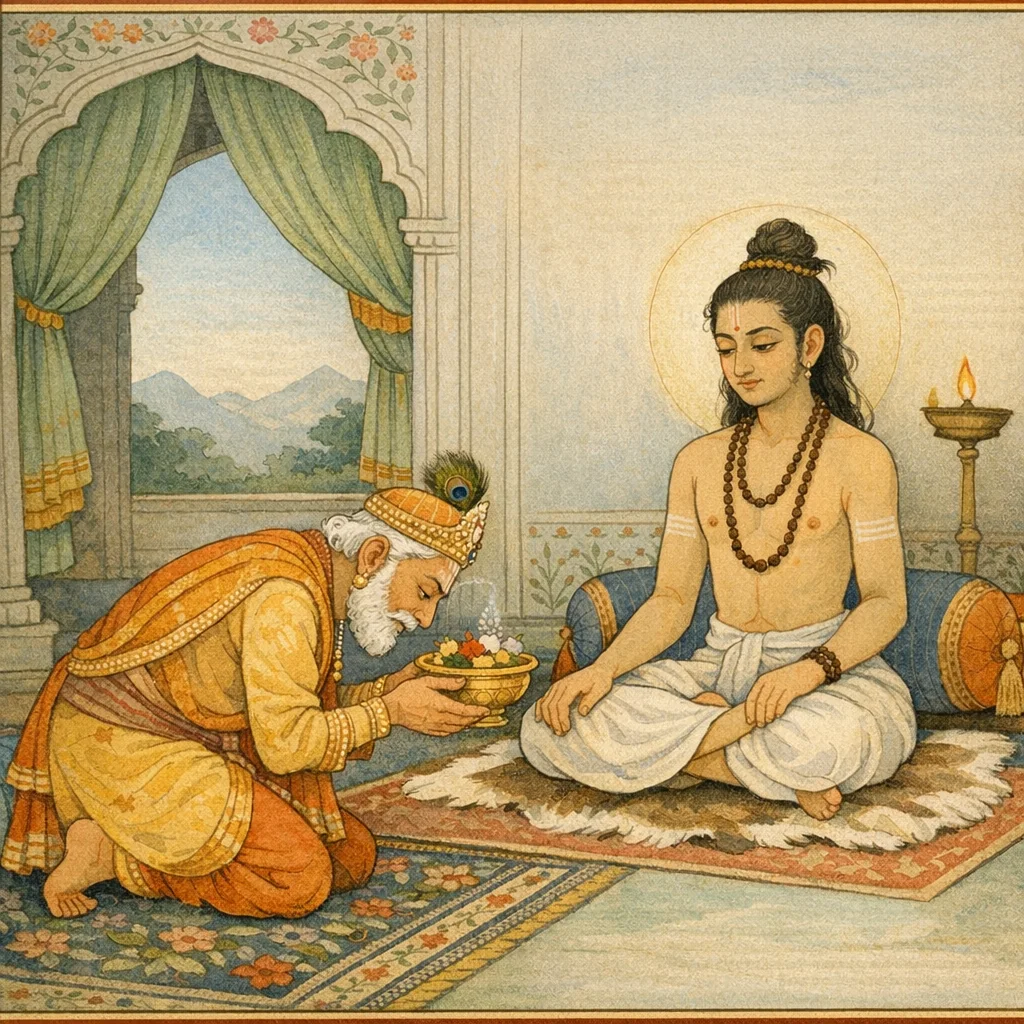
2:८-औह०:९-४ 75 #:- षड्विशर्त्याधेकत्रिशततमो< ध्याय: राजा जनकके द्वारा शुकदेवजीका पूजन तथा उनके प्रश्वका समाधान करते हुए ब्रह्म॒चर्याश्रममें परमात्माकी प्राप्ति होनेके बाद अन्य तीनों आश्रमोंकी अनावश्यकताका प्रतिपादन करना तथा मुक्त पुरुषके लक्षणोंका वर्णन भीष्म उवाच तत:ः स राजा जनको मन्त्रिभि: सह भारत । पुर: पुरोहितं कृत्वा सर्वाण्यन्त:पुराणि च,भीष्मजी कहते हैं--भारत! तदनन्तर मन्त्रियोंसहित राजा जनक अन्तःपुरकी सम्पूर्ण स्त्रियों और पुरोहितको आगे करके आसन तथा नाना प्रकारके रत्नोंकी भेंट लिये मस्तकपर अर्घ्यपात्र रखकर गुरुपुत्र शुकदेवजीके पास आये
Bhishma said: Then King Janaka, O Bharata, accompanied by his ministers, placed his household priest in the forefront and brought along all the women of the inner apartments as well. In formal reverence he carried seats and various jewels as offerings, bearing the arghya vessel upon his head, and approached Śukadeva, the teacher’s son, to honor him with worship.
Verse 2
आसन च पुरस्कृत्य रत्नानि विविधानि च । शिरसा चार्घ्यमादाय गुरुपुत्रं समभ्यगात्,भीष्मजी कहते हैं--भारत! तदनन्तर मन्त्रियोंसहित राजा जनक अन्तःपुरकी सम्पूर्ण स्त्रियों और पुरोहितको आगे करके आसन तथा नाना प्रकारके रत्नोंकी भेंट लिये मस्तकपर अर्घ्यपात्र रखकर गुरुपुत्र शुकदेवजीके पास आये
Bhishma said: “O Bharata, thereafter King Janaka, accompanied by his ministers and preceded by the women of the inner apartments and the family priest, went to the teacher’s son. Bearing a seat of honor and various precious gifts, and carrying the arghya-vessel upon his head, he approached him with reverence.”
Verse 3
स तदा55सनमादाय बहुरत्नविभूषितम् | स्पर्द्धयास्तरणसंस्तीर्ण सर्वतो भद्रमृद्धिमत्,उस समय जिसे पुरोहितने ले रखा था, वह सर्वतोभद्र नामक बहुरत्नजटित आसन, जिसपर मूल्यवान् बिछौने बिछे हुए थे, उनके हाथसे अपने हाथमें लेकर राजा जनकने गुरुपुत्र शुकदेवको समर्पित किया। वह आसन समृद्धिसे सम्पन्न था
Bhishma said: “Then, taking up that seat adorned with many gems—spread with costly coverings and known as the ‘Sarvatobhadra,’ rich in splendor—King Janaka received it into his own hands and presented it to Śukadeva, the son of the preceptor.”
Verse 4
पुरोधसा संगृहीतं हस्तेनालभ्य पार्थिव: । प्रददौ गुरुपुत्राय शुकाय परमार्चितम्,उस समय जिसे पुरोहितने ले रखा था, वह सर्वतोभद्र नामक बहुरत्नजटित आसन, जिसपर मूल्यवान् बिछौने बिछे हुए थे, उनके हाथसे अपने हाथमें लेकर राजा जनकने गुरुपुत्र शुकदेवको समर्पित किया। वह आसन समृद्धिसे सम्पन्न था
Bhishma said: “The king, taking with his own hand the richly honored seat that had been held by the royal priest, presented it to Śuka, the son of the guru, with highest respect.”
Verse 5
तत्रोपविष्टं तं कार्ष्णि शास्त्रत: प्रत्यपूजयत् । पाद्य॑ निवेद्य प्रथममर्घ्य गां च न्यवेदयत्,व्यासपुत्र शुकदेव जब उस आसनपर विराजमान हुए, तब राजा जनकने शास्त्रके अनुसार उनका पूजन आरम्भ किया। पहले पाद्य और अर्घ्य आदि निवेदन करके राजाने उन्हें एक गौ प्रदान की
Bhishma said: “When Śukadeva, Vyāsa’s son, had taken his seat there, King Janaka began to honor him according to the injunctions of the śāstras. First he offered pādya and arghya, and then presented him with a cow.”
Verse 6
सचवतां मन्त्रवत्पूजां प्रत्यगृह्लाद् यथाविधि । प्रतिगृहा तु तां पूजां जनकाद् द्विजसत्तम:,द्विजश्रेष्ठ शुकदेवजीने राजा जनककी ओरसे प्राप्त हुई वह मन्त्रयुक्त सविधि पूजा स्वीकार की। पूजा ग्रहण करनेके पश्चात् गोदान स्वीकार करके राजाको आदर देते हुए महातेजस्वी शुकने उनका सदा बना रहनेवाला कुशल-समाचार पूछा
Bhishma said: “The foremost of Brahmins duly accepted from King Janaka the proper, mantra-accompanied worship offered according to rule. Having received that worship and accepted the gift of a cow, the radiant sage honored the king and inquired after his enduring welfare.”
Verse 7
गां चैव समनुज्ञाय राजानमनुमान्य च । पर्यपृच्छन्महातेजा राज्ञ: कुशलमव्ययम्,द्विजश्रेष्ठ शुकदेवजीने राजा जनककी ओरसे प्राप्त हुई वह मन्त्रयुक्त सविधि पूजा स्वीकार की। पूजा ग्रहण करनेके पश्चात् गोदान स्वीकार करके राजाको आदर देते हुए महातेजस्वी शुकने उनका सदा बना रहनेवाला कुशल-समाचार पूछा
Bhīṣma said: Having duly taken leave regarding the cow-gift and having shown proper honor to the king, the radiant sage then inquired of the king’s enduring welfare—asking after his well-being in a manner befitting dharma and royal decorum.
Verse 8
अनामयं च राजेन्द्र शुक: सानुचरस्य ह | अनुशिष्टस्तु तेनासौ निषसाद सहानुग:,राजेन्द्र! सेवकोंसहित राजाके आरोग्यका समाचार भी उन्होंने पूछा। फिर उनकी आज्ञा ले राजा अपने अनुचरवर्गके साथ वहाँ हाथ जोड़े हुए भूमिपर ही बैठ गये। राजाका हृदय तो उदार था ही, उनका कुल भी परम उदार था। उन पृथ्वीपति नरेशने व्यासनन्दन शुकसे उनके कुशल-मंगलकी जिज्ञासा करके पूछा--'ब्रह्मम! किस निमित्तसे यहाँ आपका शुभागमन हुआ है?”
Bhishma said: “O best of kings, Śuka also inquired about the well-being of the king together with his attendants. Having been duly instructed by him, the king—along with his followers—sat down there with joined palms, in a posture of respectful submission. The ruler, noble in heart and of an illustrious lineage, then asked Śuka, the son of Vyāsa, about his welfare and auspicious condition: ‘O Brahman, for what purpose has your blessed arrival here taken place?’”
Verse 9
उदारसत्त्वाभिजनो भूमौ राजा कृताज्जलि: । कुशल चाव्ययं चैव पृष्टवा वैयासकिं नृप: । किमागमनमित्येवं पर्यपृच्छत पार्थिव:,राजेन्द्र! सेवकोंसहित राजाके आरोग्यका समाचार भी उन्होंने पूछा। फिर उनकी आज्ञा ले राजा अपने अनुचरवर्गके साथ वहाँ हाथ जोड़े हुए भूमिपर ही बैठ गये। राजाका हृदय तो उदार था ही, उनका कुल भी परम उदार था। उन पृथ्वीपति नरेशने व्यासनन्दन शुकसे उनके कुशल-मंगलकी जिज्ञासा करके पूछा--'ब्रह्मम! किस निमित्तसे यहाँ आपका शुभागमन हुआ है?”
Bhishma said: The king—noble in spirit and of an illustrious lineage—sat down on the ground with folded hands. After inquiring of Vaiyāsaki (Śuka) about his welfare and freedom from harm, the ruler respectfully asked, “For what purpose have you come here?” The scene underscores royal humility and the ethical duty of honoring a spiritually eminent guest through courteous inquiry and reverent posture.
Verse 10
शुक उवाच पित्राहमुक्तो भद्रें ते मोक्षधर्मार्थकोविद: । विदेहराजो याज्यो मे जनको नाम विश्रुत:,शुकदेवजीने कहा--राजन्! आपका कल्याण हो। मेरे पिताजीने मुझसे कहा है कि मेरे यजमान लोकप्रसिद्ध विदेहगाज जनक मोक्षधर्मके विशेषज्ञ हैं। यदि प्रवृत्ति या निवृत्ति- धर्मके विषयमें तुम्हारे हृदयमें कोई संदेह हो तो तुरंत ही उनके पास चले जाओ। वे तुम्हारी सारी शंकाओंका समाधान कर देंगे
Shuka said: “Blessings upon you. My father has instructed me: ‘My patron, the renowned King Janaka of Videha, is deeply learned in the principles and aims of mokṣa-dharma. If any doubt arises in your heart regarding the path of worldly engagement (pravṛtti) or renunciation (nivṛtti), go at once to him—he will resolve all your questions.’”
Verse 11
तत्र गच्छस्व वै तूर्ण यदि ते हृदि संशय: । प्रवृत्ती वा निवृत्तौ वा स ते च्छेत्स्यति संशयम्,शुकदेवजीने कहा--राजन्! आपका कल्याण हो। मेरे पिताजीने मुझसे कहा है कि मेरे यजमान लोकप्रसिद्ध विदेहगाज जनक मोक्षधर्मके विशेषज्ञ हैं। यदि प्रवृत्ति या निवृत्ति- धर्मके विषयमें तुम्हारे हृदयमें कोई संदेह हो तो तुरंत ही उनके पास चले जाओ। वे तुम्हारी सारी शंकाओंका समाधान कर देंगे
Śuka said: “Go there at once, if doubt has arisen in your heart. Whether your uncertainty concerns the path of engagement in action (pravṛtti) or the path of withdrawal (nivṛtti), he will cut through your doubt.”
Verse 12
राजा जनकके द्वारा शुकदेवजीका पूजन सो हं पितुर्नियोगात् त्वामुपप्रष्टमिहागत: । तन्मे धर्मभृतां श्रेष्ठ यथावद् वक्तुमहसि,धर्मात्माओंमें श्रेष्ठ नरेश! पिताकी इस आज्ञासे ही मैं यहाँ आपके पास कुछ पूछनेके लिये आया हूँ। आप मेरे प्रश्नोंका यथावत् उत्तर दें
Therefore, acting under my father’s command, I have come here to question you. O best among the upholders of dharma, you ought to answer my questions properly and in due order—so that the truth of righteous conduct may be clearly understood.
Verse 13
कि कार्य ब्राह्मणेनेह मोक्षार्थक्ष किमात्मक: । कथं च मोक्ष: प्राप्तव्यो ज्ञानेन तपसाथवा,ब्राह्मणका कर्तव्य कया है? मोक्ष नामक पुरुषार्थका क्या स्वरूप है? उस मोक्षको ज्ञानसे अथवा तपस्यासे किस साधनसे प्राप्त किया जा सकता है?
Śuka said: “What, in this world, is the proper duty of a brāhmaṇa who seeks liberation? What is the essential nature of mokṣa as a human goal? And by what means is that liberation to be attained—through knowledge, or through austerity?”
Verse 14
जनक उवाच यत् कार्य ब्राह्मणेनेह जन्मप्रभृति तच्छृणु । कृतोपनयनस्तात भवेद् वेदपरायण:,जनकने कहा--तात! ब्राह्मणको जन्मसे लेकर जो-जो कर्म करने चाहिये, उनको सुनिये--यज्ञोपवीत संस्कार हो जानेके बाद ब्राह्मण-बालकको वेदाध्ययनमें तत्पर होना चाहिये
Janaka said: “Listen, dear one, to the duties that a brāhmaṇa should undertake here from birth onward. Once his upanayana (initiation with the sacred thread) has been performed, the young brāhmaṇa should devote himself wholeheartedly to the study and recitation of the Veda.”
Verse 15
तपसा गुरुवृत्त्या च ब्रह्म॒चर्येण वा विभो । देवतानां 230 ६५034 हानसूयक:
Janaka said: “O mighty one, whether by austerity, by devoted service and proper conduct toward one’s teacher, or by the discipline of celibate studentship—one who is free from envy and does not begrudge the gods (or the divine order) attains the right disposition for spiritual progress.”
Verse 16
वेदानधीत्य दक्षिणामपवर्ज्य च । अभ्यनुज्ञामथ प्राप्य समावर्तेत वै द्विज:
Janaka said: “Having studied the Vedas, and having duly offered the teacher’s fee, and then having obtained permission (from the preceptor), the twice-born student should formally return from his period of studentship.”
Verse 17
प्रभो! तपस्या, गुरुकी सेवा तथा ब्रह्मचर्यका पालन--इन तीन कर्मोके साथ-साथ वेदाध्ययनका कार्य सम्पन्न करना चाहिये। हवनकर्मद्वारा देवताओंके और तर्पणद्वारा वह पितरोंके ऋणसे मुक्त होनेका यत्न करे। किसीके दोष न देखे और संयमपूर्वक रहकर वेदाध्ययन समाप्त करनेके पश्चात् गुरुको दक्षिणा दे और उनकी आज्ञा लेकर समावर्तन- संस्कारके पश्चात् घरको लौटे ।। समावृत्तश्न गार्हस्थ्ये स्वदारनिरतो वसेत् । अनसूयुर्यथान्यायमाहिताग्निस्तथैव च,घर आनेपर विवाह करके गार्हस्थ्य धर्मका पालन करे और अपनी ही स्त्रीके प्रति अनुराग रखे। दूसरोंके दोष न देखकर सबके साथ यथोचित बर्ताव करे और अग्निकी स्थापनाके पश्चात् प्रतिदिन अग्निहोत्र करता रहे
Janaka said: “O Lord, one should complete Vedic study while simultaneously practicing three disciplines—ascetic effort, service to one’s teacher, and the observance of brahmacarya. By the rite of offering (homa) one strives to be freed from the debt owed to the gods, and by libations (tarpaṇa) from the debt owed to the ancestors. One should not look for faults in others; living with restraint, after finishing Vedic study one should offer the teacher the due honorarium (dakṣiṇā), take the teacher’s permission, and—after the samāvartana (graduation) rite—return home. Having returned, one should enter the householder stage (gārhasthya), be devoted to one’s own wife, behave appropriately toward all without malice or fault-finding, establish the sacred fires, and continue the daily agnihotra.”
Verse 18
उत्पाद्य पुत्रपौत्रं तु वन्याश्रमपदे वसेत् । तानेवाग्नीन् यथाशास्त्रमर्चयन्नतिथिप्रिय:,वहाँ पुत्र-पौत्र उत्पन्न करके पुत्रको गार्हस्थ्य धर्मका भार सौंपकर वनमें जा वानप्रस्थ- आश्रममें रहे। उस समय भी शास्त्रविधिके अनुसार उन्हीं गार्हपत्य आदि अग्नियोंकी आराधना करते हुए अतिथियोंका प्रेमपूर्वक सत्कार करे
Janaka said: “After begetting sons and grandsons, one should dwell in the stage of life belonging to the forest-dweller (vānaprastha). Even then, in accordance with scriptural rule, he should continue to honor those very household fires (such as the gārhapatya), and, being devoted to guests, receive and serve them with affectionate hospitality.”
Verse 19
स वनेः5ग्नीन् यथान्यायमात्मन्यारोप्य धर्मवित् | निर्दधन्दो वीतरागात्मा ब्रह्माश्रमपदे वसेत्,इसके बाद धर्मज्ञ पुरुष शास्त्रीय विधिके अनुसार अग्निहोत्रकी अग्नियोंका आत्मामें आरोप करके निर्दधन्द्ध एवं वीतराग होकर ब्रह्मचिन्तनसे सम्बन्ध रखनेवाले संन्यास-आश्रममें प्रवेश करे
Janaka said: “A knower of dharma should, according to the scriptural rule, withdraw the sacred fires into the Self; and, having ‘burned up’ worldly ties and ritual dependence and become free from attachment, he should dwell in the renunciant stage (saṃnyāsa) that is devoted to contemplation of Brahman.”
Verse 20
शुक उवाच उत्पन्ने ज्ञानविज्ञाने निर्दच्धे हदि शाश्वते । किमवश्यं निवस्तव्यमाश्रमेषु भवेत् त्रिषु,शुकदेवजीने पूछा--राजन्! यदि किसीके हृदयमें ब्रह्मचर्य-आश्रममें ही सनातन ज्ञान-विज्ञान प्रकट हो जाय और हृदयके राग-द्वेष आदि द्वन्द्ध दूर हो जायँ तो भी क्या उसके लिये शेष तीन आश्रमोंमें रहना आवश्यक है?
Śuka said: “O King, if in the very stage of brahmacarya one’s eternal knowledge and realized wisdom (jñāna-vijñāna) have arisen, and the heart’s impurities have been burned away, is it still compulsory for such a person to live through the remaining three āśramas?”
Verse 21
एतद् भवन्तं पृच्छामि तद् भवान् वक्तुम्हति । यथा वेदार्थततच्त्वेन ब्रूहि मे त्वं जनाधिप,नरेश्वर! मैं यही बात आपसे पूछता हूँ। आप मुझे यह बतानेकी कृपा करें। वेदके वास्तविक सिद्धान्तके अनुसार क्या करना उचित है? यह आप मुझे बताइये
I ask you this, O revered one; you are fit to answer it. O lord of the people, O king of men, tell me—according to the true purport and principle of the Veda—what ought rightly to be done.
Verse 22
जनक उवाच न विना ज्ञानविज्ञाने मोक्षस्याधिगमो भवेत् | न विना गुरुसम्बन्ध॑ ज्ञानस्याधिगम: स्मृत:,जनकने कहा--्रह्मन! जैसे ज्ञान-विज्ञानके बिना मोक्षकी प्राप्ति नहीं होती, उसी प्रकार सदगुरुसे सम्बन्ध हुए बिना ज्ञानकी प्राप्ति नहीं हो सकती
Janaka said: “Without knowledge and realized understanding, attainment of liberation cannot occur. In the same way, it is taught that knowledge is not truly gained without a living connection to a genuine teacher.”
Verse 23
गुरु: प्लावयिता तस्य ज्ञानं प्लव इहोच्यते । विज्ञाय कृतकृत्यस्तु तीर्णस्तदुभयं त्यजेत्,गुरु इस संसारसागरसे पार उतारनेवाले हैं और उनका दिया हुआ ज्ञान यहाँ नौकाके समान बताया जाता है। मनुष्य उस ज्ञानको पाकर भवसागरसे पार और कृतकृत्य हो जाता है। जैसे नदीको पार कर लेनेपर मनुष्य नाव और नाविक दोनोंको छोड़ देता है, उसी प्रकार मुक्त हुआ पुरुष गुरु और ज्ञान दोनोंको छोड़ दे
Janaka says: The guru is the one who ferries a person across; and the knowledge bestowed by him is described here as the boat. Having realized that knowledge, one becomes fulfilled in purpose and crosses beyond worldly becoming. Just as, after crossing a river, a person leaves behind both the boat and the boatman, so too the liberated person lets go of both the guru (as an external support) and the knowledge (as a means), resting in freedom itself.
Verse 24
अनुच्छेदाय लोकानामनुच्छेदाय कर्मणाम् | पूर्वराचरितो धर्मश्नातुराश्रम्यसंकट:,पहलेके विद्वान् लोकमर्यादाकी तथा कर्मपरम्पराकी रक्षा करनेके लिये चारों आश्रमोंसहित वर्णधर्मोका पालन करते थे
Janaka said: For the sake of preventing disruption among people, and for the sake of preventing a break in the continuity of righteous action, the ancients practiced a dharma that had been followed from old—one that, after completing the student’s discipline, entered the demanding course of life through the stages of āśrama. Thus they upheld social order and the inherited stream of duties.
Verse 25
अनेन क्रमयोगेन बहुजातिषु कर्मणाम् । हित्वा शुभाशुभं॑ कर्म मोक्षो नामेह लभ्यते,इस तरह क्रमशः नाना प्रकारके कर्मोका अनुष्ठान करते हुए शुभाशुभ कर्मोंकी आसक्तिका परित्याग करनेसे यहाँ मोक्षकी प्राप्ति होती है
Janaka said: “By this disciplined path of gradual practice—carried out through many kinds of actions across many births—one attains what is called liberation here, by abandoning attachment to both ‘good’ and ‘bad’ deeds.”
Verse 26
भावितै: करणैश्वायं बहुसंसारयोनिषु । आसादयति शुद्धात्मा मोक्ष वै प्रथमाश्रमे,अनेक जन्मोंसे कर्म करते-करते जब सम्पूर्ण इन्द्रियाँ पवित्र हो जाती हैं, तब शुद्ध अन्तःकरणवाला मनुष्य पहले ही आश्रममें अर्थात् ब्रह्मचर्याश्रममें मोक्षरूप ज्ञान प्राप्त कर सकता है
Through faculties and instruments of action refined across many births within saṃsāra, a person of purified inner being can attain the liberating knowledge called mokṣa even in the first āśrama—namely, the brahmacarya stage.
Verse 27
तमासाद्य तु मुक्तस्य दृष्टार्थस्य विपश्चित: । त्रिष्वाश्रमेषु को न्वर्थो भवेत् परमभीप्सत:,उसे पाकर जब ब्रह्मचर्य-आश्रममें ही तत्त्वका साक्षात्कार हो जाय तो परमात्माको चाहनेवाले जीवन्मुक्त विद्वानके लिये शेष तीन आश्रमोंमें जानेकी क्या आवश्यकता है? अर्थात् कोई आवश्यकता नहीं है
Janaka said: When a wise one has already attained liberation—having directly realized the highest end—what need remains for him, who longs for the Supreme, to pass through the other three stages of life? For one who has realized Truth even in brahmacarya, the later āśramas are not obligatory as means to fulfillment.
Verse 28
राजसांस्तामसांश्वैव नित्यं दोषान् विवर्जयेत् । साच््विकं मार्गमास्थाय पश्येदात्मानमात्मना
Janaka said: One should constantly abandon the faults born of passion and darkness. Taking refuge in the sāttvika path, one should behold the Self by the Self—through inner clarity and disciplined discernment.
Verse 29
विद्वानुको चाहिये कि वह राजस और तामस दोषोंका सदा ही परित्याग कर दे और सात्विक मार्गका आश्रय लेकर बुद्धिके द्वारा आत्माका साक्षात्कार करे ।। सर्वभूतेषु चात्मानं सर्वभूतानि चात्मनि । सम्पश्यन्नोपलिप्येत जले वारिचरो यथा,जो सम्पूर्ण भूतोंमें आत्माको और आत्मामें सम्पूर्ण भूतोंको देखता है, वह संसारमें उसी तरह कहीं भी आसक्त नहीं होता जैसे जलचर पक्षी जलमें रहकर भी उससे लिप्त नहीं होता
Janaka teaches that a wise person should continually abandon the defects born of passion (rajas) and darkness (tamas), take refuge in the sāttvika path, and by disciplined understanding realize the Self directly. One who clearly beholds the Self in all beings and all beings within the Self remains untainted by worldly life—like a water-bird that moves within water yet is not smeared by it.
Verse 30
पक्षिवत् प्रवणादूर्ध्वममुत्रानन्त्यमश्षुते । विहाय देहान्निर्मुक्तो निर्दन्द्ः प्रशमं गत:,वह तो घोंसलेको छोड़कर उड़ जानेवाले पक्षीकी भाँति इस देहसे पृथक हो निर्द्धन्द्व एवं शान्त होकर परलोकमें अक्षयपद (मोक्ष)-को प्राप्त हो जाता है
Janaka said: “Like a bird that rises up from its sloping perch and flies away, so too does one, having cast off the body and become free, attain serenity beyond all pairs of opposites; and in the other world he reaches the imperishable state—liberation.”
Verse 31
अत्र गाथा: पुरा गीता: शृणु राज्ञा ययातिना । धार्यन्ते या द्विजैस्तात मोक्षशास्त्रविशारदै:,तात! इस विषयमें पूर्वकालमें राजा ययातिके द्वारा गायी हुई गाथाएँ सुनिये, जिन्हें मोक्षशास्त्रके ज्ञाता द्विज सदा याद रखते हैं
Janaka said: “Now listen, dear one, to the ancient verses once sung by King Yayāti—verses that learned Brahmins, well-versed in the teachings of liberation, preserve and keep in memory.”
Verse 32
ज्योतिरात्मनि नान्यत्र सर्वजन्तुषु तत् समम् । स्वयं च शक््यते द्रष्टं सुसमाहितचेतसा,अपने भीतर ही आत्मज्योतिका प्रकाश है, अन्यत्र नहीं। वह ज्योति सम्पूर्ण प्राणियोंके भीतर समानरूपसे स्थित है। अपने चित्तको भलीभाँति एकाग्र करनेवाला उसको स्वयं देख सकता है
The light of the ātman is within oneself, nowhere else. That light abides equally in all beings. One whose mind is well-collected and deeply composed can behold it for oneself.
Verse 33
न बिभेति परो यस्मान्न बिभेति पराच्च यः । यश्न नेच्छति न दवेष्टि ब्रह्म सम्पद्यते तदा,जिससे दूसरा कोई प्राणी नहीं डरता, जो स्वयं दूसरे किसी प्राणीसे भयभीत नहीं होता तथा जो न तो किसी वस्तुकी इच्छा करता है और न किसीसे द्वेष ही रखता है, वह तत्काल ब्रह्मभावको प्राप्त हो जाता है
One whom no being fears, who himself fears no being, and who neither craves nor hates—such a person at once attains the state of Brahman.
Verse 34
यदा भावं न कुरुते सर्वभूतेषु पापकम् । कर्मणा मनसा वाचा ब्रह्म सम्पद्यते तदा,जब मनुष्य मन, वाणी तथा क्रियाके द्वारा किसी भी प्राणीके प्रति पापभाव नहीं करता अर्थात् समस्त प्राणियोंमें द्वेषपहित हो जाता है, उस समय वह ब्रह्मभावको प्राप्त हो जाता है
When a person generates no sinful intention toward any living being—by deed, by mind, or by speech—becoming free from hatred toward all creatures, then he attains the state of Brahman.
Verse 35
संयोज्य मनसा55त्मानमीर्य[मुत्सूज्य मोहनीम् । त्यक्त्वा काम॑ च मोहं च तदा ब्रह्मृत्वमश्ुते,जब मोहमें डालनेवाली ईर्ष्या, काम एवं मोहका त्याग करके साधक अपने मनको आत्मामें लगा देता है, उस समय वह ब्रह्मको प्राप्त हो जाता है
When a seeker yokes the mind to the Self, casting away jealousy that deludes, and abandoning both desire and delusion, then he attains the state of Brahman.
Verse 36
यदा श्राव्ये च दृश्ये च सर्वभूतेषु चाप्पययम् । समो भवति निर्दन्द्धो ब्रह्म सम्पद्यते तदा,जब यह साधक सुनने और देखने योग्य पदार्थोमें तथा सम्पूर्ण प्राणियोंमें समान भाववाला हो जाता है एवं सुख-दुःख आदि द्वल्धोंसे रहित हो जाता है, उस समय वह ब्रह्मभावको प्राप्त हो जाता है
When this seeker becomes even-minded toward what is heard and what is seen, and toward all beings as well—free from the pairs of opposites such as pleasure and pain—then he attains the state of Brahman.
Verse 37
यदा स्तुतिं च निनन््दां च समत्वेनैव पश्यति । काज्चनं चायसं चैव सुखं दुःखं तथैव च,जिस समय मनुष्य निनन््दा और स्तुतिको समान भावसे समझता है, सोना-लोहा, सुख- दुःख, सर्दी-गर्मी, अर्थ-अनर्थ, प्रिय-अप्रिय तथा जीवन-मरणमें भी उसकी समान दृष्टि हो जाती है, उस समय वह साक्षात् ब्रह्मभावको प्राप्त हो जाता है
Janaka said: When a person regards praise and blame with perfect equanimity—seeing gold and iron alike, and likewise pleasure and pain—then he rises to the direct state of Brahman, established in inner sameness rather than shaken by the world’s opposites.
Verse 38
शीतमुष्णं तथैवार्थमनर्थ प्रियमप्रियम् । जीवितं मरणं चैव ब्रह्म सम्पद्यते तदा,जिस समय मनुष्य निनन््दा और स्तुतिको समान भावसे समझता है, सोना-लोहा, सुख- दुःख, सर्दी-गर्मी, अर्थ-अनर्थ, प्रिय-अप्रिय तथा जीवन-मरणमें भी उसकी समान दृष्टि हो जाती है, उस समय वह साक्षात् ब्रह्मभावको प्राप्त हो जाता है
Janaka said: When a person comes to regard cold and heat alike, gain and loss alike, the pleasant and the unpleasant alike, and even life and death with the same steady vision, then he attains the state of Brahman itself—freedom grounded in inner equanimity rather than in changing outer conditions.
Verse 39
प्रसार्येह यथाड्रानि कूर्म: संहरते पुनः । तथेन्द्रियाणि मनसा संयन्तव्यानि भिक्षुणा,जैसे कछुआ अपने अंगोंको फैलाकर फिर समेट लेता है, उसी प्रकार संन्यासीको मनके द्वारा इन्द्रियोंपर नियन्त्रण रखना चाहिये
Janaka said: “Just as a tortoise extends its limbs and then draws them back again, so should a mendicant restrain the senses by means of the mind.”
Verse 40
तम: परिगतं वेश्म यथा दीपेन दृश्यते । तथा बुद्धिप्रदीपेन शक््य आत्मा निरीक्षितुम्,जैसे अन्धकारसे आच्छादित हुआ घर दीपकके प्रकाशसे देखा जाता है, उसी प्रकार अज्ञानान्धकारसे आवृत हुए आत्माका विशुद्ध बुद्धिरूपी दीपकके द्वारा साक्षात्कार किया जा सकता है
Janaka teaches that just as a house covered in darkness becomes visible by the light of a lamp, so too the Self—veiled by the darkness of ignorance—can be directly discerned through the lamp of purified intellect.
Verse 41
एतत् सर्व च पश्यामि त्वयि बुद्धिमतां वर । यच्चान्यदपि वेत्तव्यं तत्त्वतो वेद तद् भवान्,बुद्धिमानोंमें श्रेष्ठ शुकदेवजी! उपर्युक्त सारी बातें मुझे आपके भीतर दिखायी देती हैं। इनके अतिरिक्त भी जो कुछ जानने योग्य तत्त्व है, उसे आप ठीक-ठीक जानते हैं
Janaka said: “O best among the wise, I see all these qualities and truths embodied in you. And whatever else remains truly worth knowing, you understand it precisely as it is.”
Verse 42
ब्रह्मर्षे विदितश्वासि विषयान्तमुपागत: । गुरोस्तव प्रसादेन तव चैवोपशिक्षया,ब्रह्मर्ष! मैं आपको अच्छी तरह जान गया। आप अपने पिताजीकी कृपा और उन्हींसे मिली हुई शिक्षाद्वारा विषयोंसे परे हो चुके हैं
Janaka said: “O brahmarṣi, I have now clearly understood you. By the grace of your guru and by the instruction you have received from him, you have reached the end of sense-objects—standing beyond worldly enjoyments.”
Verse 43
तस्यैव च प्रसादेन प्रादुर्भूत॑ महामुने । ज्ञानं दिव्यं ममापीदं तेनासि विदितो मम,महामुने! उन्हीं गुरुदेवकी कृपासे मुझे भी यह दिव्य ज्ञान प्राप्त हुआ है, जिससे मैं आपकी स्थितिको ठीक-ठीक समझ गया हूँ
Janaka said: “By the grace of that very revered teacher, O great sage, this divine knowledge has arisen in me as well. Through it I have come to understand your true state clearly, O great sage.”
Verse 44
अधिकं तव विज्ञानमधिका च गतिस्तव । अधिकं तव चैश्वर्य तच्च त्वं नावबुध्यसे,आपका विज्ञान, आपकी गति और आपका एऐश्वर्य--ये सभी अधिक हैं; परंतु आपको इस बातका पता नहीं है
Janaka said: “Your discernment is greater, and your course—your spiritual progress and way of moving through life—is also greater. Your lordly power and capacity are greater as well—yet you do not recognize that truth about yourself.”
Verse 45
बाल्याद् वा संशयाद् वापि भयादू वाप्यविमोक्षजात् | उत्पन्ने चापि विज्ञाने नाधिगच्छति तां गतिम्,बालस्वभावके कारण, संशयसे अथवा मोक्ष न मिलनेके काल्पनिक भयसे मनुष्यको विज्ञान प्राप्त हो जानेपर भी मोक्षकी प्राप्ति नहीं होती
Janaka said: “Whether from childish immaturity, or from doubt, or from fear born of imagining that liberation will not be attained—even when true knowledge has arisen, a person still does not reach that highest state. For such inner weaknesses obstruct the fruit of wisdom and keep one from liberation.”
Verse 46
व्यवसायेन शुद्धेन मद्विधैश्छिन्नसंशय: । विमुच्य हृदयग्रन्थीनासादयति तां गतिम्,मेरे-जैसे लोगों द्वारा जिसका संशय नष्ट हो गया है, वह साधक विशुद्ध निश्चयके द्वारा हृदयकी गाँठें खोलकर उस परमगतिको प्राप्त कर लेता है
Janaka says: “One whose doubts have been cut away by people like me attains that supreme state—by a pure, unwavering resolve, he loosens the knots of the heart and becomes free.”
Verse 47
भवांश्षोत्पन्नविज्ञान: स्थिरबुद्धिरलोलुप: । व्यवसायादूते ब्रह्मुन्नासादयति तत्परम्,ब्रह्म! आपको ज्ञान प्राप्त हो चुका है। आपकी बुद्धि भी स्थिर है तथा आपमें विषयलोलुपताका भी सर्वथा अभाव हो गया है, परंतु विशुद्ध निश्चयके बिना कोई परमात्मभावको नहीं प्राप्त होता है
O Brahmin! True knowledge has arisen in you; your understanding is steady and unshaken, and all craving for sense-objects has wholly fallen away. Yet without a pure and firm resolve, none attains the supreme state—the condition of the Paramātman.
Verse 48
नास्ति ते सुखदु:खेषु विशेषो नासि लोलुप: । नौत्सुक्यं नृत्यगीतेषु न राग उपजायते,आप सुख-दुःखमें कोई अन्तर नहीं समझते। आपके मनमें लोभ नहीं है। आपको न तो नाच देखनेकी उत्कण्ठा होती है और न गीत सुननेकी। किसी विषयके प्रति आपके मनमें रण नहीं उत्पन्न होता है
Janaka said: “In your eyes there is no distinction between pleasure and pain. You are not driven by greed. You feel no craving for dance or song, and no attachment arises in your mind toward any object of enjoyment.”
Verse 49
न बन्धुष्वनुबन्धस्ते न भयेष्वस्ति ते भयम् । पश्यामि त्वां महाभाग तुल्यलोष्टाश्मकाज्चनम्,महाभाग! न तो भाई-बन्धुओंमें आपकी आसक्ति है, न भयदायक पदार्थोंसे आपको भय ही होता है। मैं देखता हूँ, आपके लिये मिट्टीके ढेले, पत्थर और सुवर्ण एक-से हैं
Janaka said: “You have no clinging attachment to kinsmen, nor do fearful things awaken fear in you. I see, O greatly fortunate one, that for you a clod of earth, a stone, and gold are all the same.”
Verse 50
अहं त्वामनुपश्यामि ये चाप्यन्ये मनीषिण: । आस्थितं परमं मार्गमक्षयं तमनामयम्,मैं तथा दूसरे मनीषी पुरुष भी आपको अक्षय एवं अनामय परम मार्ग (मोक्ष) में स्थित मानते हैं
Janaka said: “I clearly perceive you—and so do other discerning sages—as one established in the supreme path: imperishable and free from affliction, the way that leads to liberation.”
Verse 51
यत् फल ब्राह्मणस्येह मोक्षार्थश्ष॒ यदात्मक: । तस्मिन् वै वर्तसे ब्रह्मन् किमन्यत् परिपृच्छसि,ब्रह्म! इस जगत्में ब्राह्मण होनेका जो फल है और मोक्षका जो स्वरूप है, उसीमें आपकी स्थिति है। अब और क्या पूछना चाहते हैं?
Janaka said: “That very fruit which belongs here to a Brahmin, and that very nature of liberation sought for mokṣa—abide in you. O Brahmin, what else do you wish to ask?”
Verse 326
इति श्रीमहाभारते शान्तिपर्वणि मोक्षधर्मपर्वणि शुकोत्पत्तौ षड्विंशत्यधिकत्रिशततमो<ध्याय:
Thus, in the Śrī Mahābhārata, within the Śānti Parvan—specifically in the Mokṣa-dharma section—ends the chapter concerning the origin (birth narrative) of Śuka, the three-hundred-and-twenty-sixth chapter. This is the colophon marking the close of the discourse and situating it within the liberation-teachings of the Mokṣa-dharma.
Frequently Asked Questions
The implied tension is between reliance on sensory-form (rūpa) and commitment to a transcendental principle: the text permits visionary form for instruction while insisting the ultimate is beyond perception and guṇa-conditioned cognition.
The supreme is the all-pervading witness, unaffected by qualities and actions; liberation is framed as entering/realizing that principle, supported by disciplined focus and a clarified ontology linking mind and ego to cosmogenesis.
Yes: it provides a lineage account of how the teaching is heard and re-taught, restricts disclosure to Vāsudeva-devotees, and states benefits for those who recite or hear it with concentrated, single-point orientation.