Adhyaya 28
Aśmagīta: Janaka’s Inquiry on Loss, Kāla, and the Limits of Control (अश्मगीता)
Upa-parva: Rājadharmānushāsana Upa-parva (Kingship and Governance Instructions)
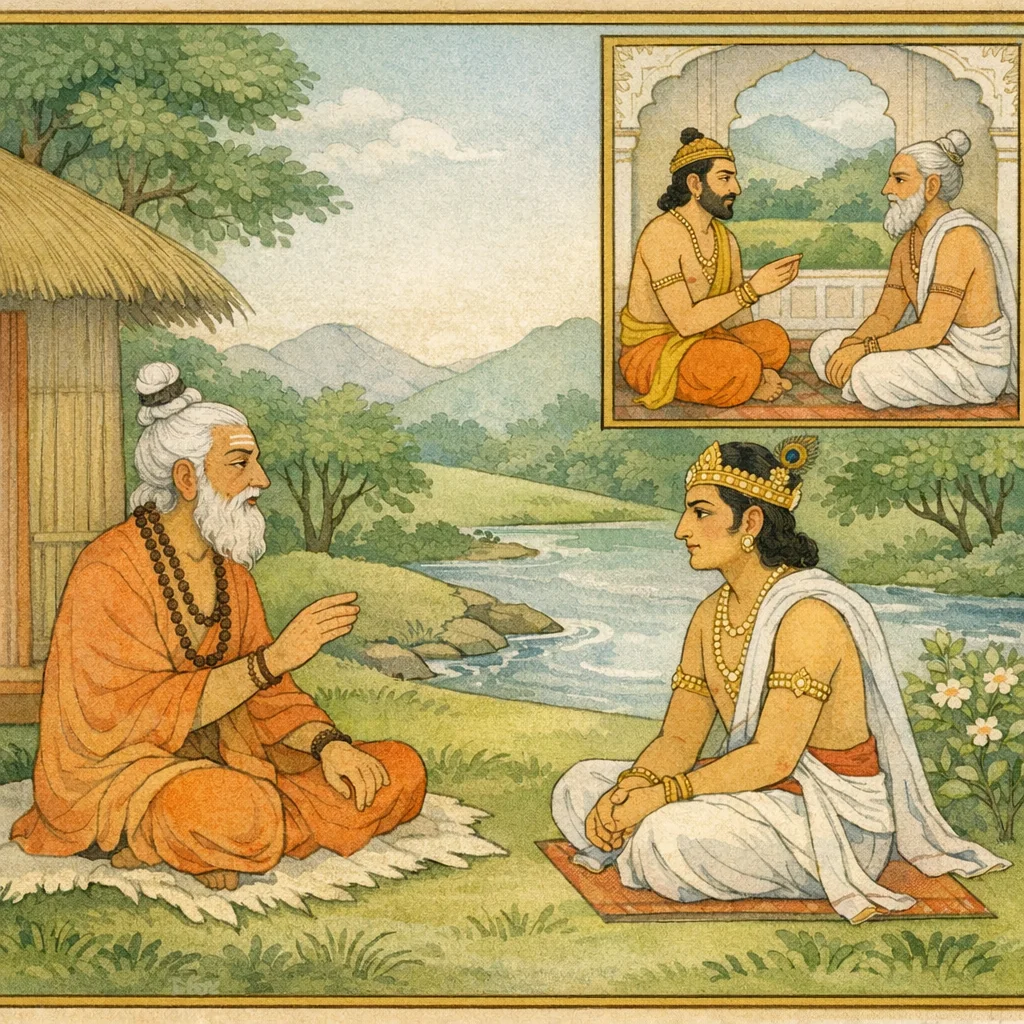
Vaiśaṃpāyana frames Yudhiṣṭhira as overwhelmed by kin-sorrow and inclined toward self-abandonment, whereupon Vyāsa dispels despair by introducing an ancient exemplum, the Aśmagīta. Vyāsa recounts how King Janaka, distressed by the possible gain or loss of relatives and wealth, questions the sage-brāhmaṇa Aśman regarding the proper orientation for one who seeks well-being. Aśman answers with a structured reflection on the human condition: pleasures and pains recur after birth; fixation on any one condition can carry the mind away, producing delusion and unethical drift. The teaching emphasizes kāla (time) as the regulating horizon: aging and death are inescapable; outcomes such as health, vigor, fortune, and even family continuities appear contingent and unstable. The chapter catalogues ordinary vulnerabilities (disease, accident, hunger, violence, hazards) to demonstrate that neither ritual, medicine, learning, nor austerity can fully override mortality. It recommends disciplined reflection—questioning identity, attachment, and the premise of permanent possession—while still endorsing socially stabilizing duties: honoring ancestors, practicing dharma, and pursuing the triad of aims (trivarga) within lawful bounds. The exemplum concludes with Janaka returning home with pacified grief, and Vyāsa applying the lesson to Yudhiṣṭhira: relinquish sorrow, stand up, and rule the earth won through kṣātra-dharma without despondency.
Chapter Arc: वैशम्पायन के वचन से शोकाकुल युधिष्ठिर के सामने व्यास एक ‘पुरातन इतिहास’ खोलते हैं—अश्मगीत—जिसमें प्रारब्ध की अटलता का रहस्य छिपा है। → व्यास जनक और एक प्राज्ञ ब्राह्मण ‘अश्मा’ का संवाद सुनाते हैं। दुःख-शोक से ग्रस्त जनक पूछते हैं: जब कुटुम्ब, धन, और राज्य का आगमन-विनाश अनिश्चित है, तब कल्याण चाहने वाला मनुष्य किस आधार पर आचरण करे? उत्तर में जीवन की क्षणभंगुरता, युवावस्था में भी पतन, और परलोक की प्रत्यक्ष-अप्रत्यक्षता पर तीखे तर्क आते हैं—और यह तनाव बढ़ता है कि यदि सब कुछ प्रारब्ध-नियत है तो पुरुषार्थ का स्थान कहाँ है। → अश्मगीत का निर्णायक स्वर उभरता है: कोई भी ‘सेतु’—नियत विधान—का उल्लंघन करता दिखाई नहीं देता; रोग, अग्नि, जल, शस्त्र, भूख-प्यास, विष, ज्वर, गिरना आदि मृत्यु-निमित्त भी उसी दिष्ट मार्ग से जीव को ले जाते हैं। इसी के साथ यह भी कहा जाता है कि तप, स्वाध्याय, दान, यज्ञशीलता भी जरा-मृत्यु को नहीं लाँघती—अर्थात् देह-धर्म पर प्रारब्ध की प्रबलता अटल है। → व्यास इस दृष्टान्त को युधिष्ठिर पर लागू करते हैं: शोक छोड़ो, उठो; क्षात्रधर्म से जीती हुई पृथ्वी तुम्हारी है—उसे तुच्छ न समझो। प्रारब्ध को जानकर भी कर्तव्य-पालन ही राजधर्म है; शोक से नहीं, धर्मयुक्त कर्म से स्थैर्य आता है। → प्रारब्ध की अटलता स्वीकार कर भी मनुष्य के ‘उचित कर्म’ की सीमा क्या है—और शोक से मुक्त होकर युधिष्ठिर किस प्रकार राजधर्म में प्रवृत्त होंगे—यह प्रश्न अगले उपदेश की ओर संकेत करता है।
Shlokas
Verse 1
#<3८६>-> ह्नु # अष्टाविशोश् ध्याय: अश्मा ऋषि और जनकके संवादद्वारा प्रारब्धकी प्रबलता बतलाते हुए व्यासजीका युधिष्ठिरको समझाना वैशम्पायन उवाच ज्ञातिशोकाभितप्तस्य प्राणानभ्युत्सिसृक्षत: । ज्येष्ठस्य पाण्डुपुत्रस्य व्यास: शोकमपानुदत्,वैशम्पायनजी कहते हैं--जनमेजय! भाई-बन्धुओं के शोकसे संतप्त हो अपने प्राणोंको त्याग देनेकी इच्छावाले ज्येष्ठ पाण्डव युधिष्ठिरके शोकको महर्षि व्यासने इस प्रकार दूर किया
Vaiśampāyana said: “O Janamejaya, when the eldest son of Pāṇḍu, Yudhiṣṭhira, was scorched by grief for his kinsmen and longed to cast away his very life, the sage Vyāsa dispelled his sorrow.”
Verse 2
व्यास उवाच अत्राप्युदाहरन्तीममितिहासं पुरातनम् । अश्मगीतं नरव्याप्र तन्निबोध युधिष्ठिर,व्यासजी बोले--पुरुषसिंह युधिष्ठिर! इस प्रसंगमें जानकार लोग अभ्मा ब्राह्मणके गीतसम्बन्धी इस प्राचीन इतिहासका उदाहरण दिया करते हैं, इसे सुनो
Vyāsa said: “Here too, O tiger among men, Yudhiṣṭhira, the learned cite an ancient precedent. Listen as I recount the old account known as the ‘Song of Aśmā’.”
Verse 3
अश्मानं ब्राद्माण्ं प्राज्ञ वेदेहो जनको नृपः । संशयं परिपप्रच्छ दुः:खशोकसमन्वित:,एक समयकी बात है, दुःख-शोकमें डूबे हुए विदेहगाज जनककने ज्ञानी ब्राह्मण अश्मासे अपने मनका संदेह इस प्रकार पूछा
Vyāsa said: Once, King Janaka of Videha, overwhelmed by grief and sorrow, approached the wise brāhmaṇa Aśman and questioned him closely, seeking clarity to resolve the doubt that troubled his mind.
Verse 4
जनक उवाच आगमे यदि वापाये ज्ञातीनां द्रविणस्य च । नरेण प्रतिपत्तव्यं कल्याणं कथमिच्छता,जनक बोले--ब्रह्मन्! कुटुम्बीजन और धनकी उत्पत्ति या विनाश होनेपर कल्याण चाहनेवाले पुरुषको कैसा निश्चय करना चाहिये?
Janaka said: “O Brahmin, when one’s kinsmen and one’s wealth either increase or decline, what settled course of conduct should a man adopt if he seeks what is truly auspicious and beneficial?”
Verse 5
अश्मोवाच उत्पन्नमिममात्मानं नरस्यानन्तरं ततः । तानि तान्यनुवर्तन्ते दु:खानि च सुखानि च,अश्माने कहा--राजन्! मनुष्यका यह शरीर जब जन्म ग्रहण करता है, तब उसके साथ ही सुख और दुःख भी उसके पीछे लग जाते हैं
Aśma said: “O King, when this embodied self of a human being comes into birth, then immediately thereafter joys and sorrows follow close behind—each in its turn—attaching themselves to him as companions of embodied life.”
Verse 6
तेषामन्यतरापत्ताौ यद् यदेवोपपद्यते । तदस्य चेतनामाशु हरत्यभ्रमिवानिल:,इन दोनोंमेंसे एक-न-एककी प्राप्ति तो होती ही है; अतः जो भी सुख या दुःख उपस्थित होता है, वही मनुष्यके ज्ञानको उसी प्रकार हर लेता है, जैसे हवा बादलको उड़ा ले जाती है
Janaka said: “When one of the two inevitably befalls a person, whatever experience presents itself—be it pleasure or pain—swiftly carries away his clarity of awareness, just as the wind drives off a cloud.”
Verse 7
अभिजातो<स्मि सिद्धो5स्मि नास्मि केवलमानुष: । इत्येभिहेतुभिस्तस्य त्रिभिक्षित्तं प्रसिच्यते,इसीसे “मैं कुलीन हूँ, सिद्ध हूँ और कोई साधारण मनुष्य नहीं हूँ” ये अहंकारकी तीन धाराएँ मनुष्यके चित्तको सींचने लगती हैं
Janaka said: “I am well-born; I am accomplished; I am not merely an ordinary human.” With such reasons—these three—his mind is watered and nourished, meaning that the streams of pride begin to irrigate the inner consciousness and make ego grow.
Verse 8
सम्प्रसक्तमना भोगान् विसृज्य पितृसंचितान् । परिक्षीण: परस्वानामादानं साधु मन्यते,फिर वह मनुष्य भोगोंमें आसक्तचित्त होकर क्रमश: बाप-दादोंकी रखी हुई कमाईको उड़ाकर कंगाल हो जाता है और दूसरोंके धनको हड़प लेना अच्छा मानने लगता है
Janaka said: When a man’s mind becomes entangled in pleasures, he squanders the wealth amassed by his forefathers. Once reduced to ruin, he begins to regard the taking of others’ property as something acceptable—thus desire leads him from wastefulness into outright wrongdoing.
Verse 9
तमतिक्रान्तमर्यादमाददानमसाम्प्रतम् । प्रतिषेधन्ति राजानो लुब्धा मृगमिवेषुभि:,जैसे व्याधे अपने बाणोंद्वारा मृगोंको आगे बढ़नेसे रोकते हैं, उसी प्रकार मर्यादा लाँघकर अनुचितरूपसे दूसरोंके धनका अपहरण करनेवाले उस मनुष्यको राजालोग दण्डद्वारा वैसे कुमार्गपर चलनेसे रोकते हैं
Janaka said: Kings restrain—by punishment—one who has overstepped the bounds of rightful conduct and who, in an improper and untimely way, seizes the wealth of others; just as hunters stop a deer from running onward with their arrows. The point is that greed-driven transgression of social and moral limits invites the corrective force of royal authority, meant to keep people from straying onto wrongful paths.
Verse 10
ये च विंशतिवर्षा वा त्रिंशद्वर्षाश्न मानवा: । परेण ते वर्षशतान्न भविष्यन्ति पार्थिव,राजन! जो बीस या तीस वर्षकी उम्रवाले मनुष्य चोरी आदि कुकर्मोमें लग जाते हैं, वे सौ वर्षतक जीवित नहीं रह पाते
Janaka said: “O king, those men who, even while only twenty or thirty years of age, take to theft and other wrongful deeds will not live on to complete a hundred years.”
Verse 11
तेषां परमदु:खानां बुद्धा भैषज्यमाचरेत् । सर्वप्राणभृतां वृत्तं प्रेक्षमाणस्ततस्तत:,जहाँ-तहाँ समस्त प्राणियोंके दुःखद बर्तावसे उनपर जो कुछ बीतता है उसे देखता हुआ मनुष्य दरिद्रतासे प्राप्त होनेवाले उन महान् दुःखोंका निवारण करनेके लिये बुद्धिके द्वारा औषध करे (अर्थात् विचारद्वारा अपने-आपको कुमार्गपर जानेसे रोके)
Janaka said: “For those extreme sufferings, one should apply the remedy through awakened understanding. Observing, here and there, the conduct of all living beings and how their painful ways of life bring consequences upon them, a person should use discernment as medicine—restraining oneself from slipping onto a wrong path.”
Verse 12
मानसानां पुनर्योनिर्दु:खानां चित्तविभ्रम: | अनिष्टोपनिपातो वा तृतीयं नोपपद्यते,मनुष्योंको बार-बार मानसिक दुःखोंकी प्राप्तिके कारण दो ही हैं--चित्तका भ्रम और अनिष्टकी प्राप्ति। तीसरा कोई कारण सम्भव नहीं है
Janaka said: “For human beings, the recurring source of mental suffering is only twofold: delusion and disturbance of the mind, or the befalling of what is undesirable. A third cause does not reasonably stand.”
Verse 13
एवमेतानि दु:ःखानि तानि तानीह मानवम् | विविधान्युपवर्तन्ते तथा संस्पर्शजान्यपि,इस प्रकार मनुष्यको इन्हीं दो कारणोंसे ये भिन्न-भिन्न प्रकारके दु:ख प्राप्त होते हैं। विषयोंकी आसक्तिसे भी ये दु:ख प्राप्त होते हैं
Janaka said: “Thus, in this world, these very sufferings come upon a human being again and again in many forms; and sufferings born of contact with sense-objects also arise in the same way.”
Verse 14
जरामृत्यू हि भूतानां खादितारी वृकाविव । बलिनां दुर्बलानां च हस्वानां महतामपि,बुढ़ापा और मृत्यु--ये दोनों दो भेड़ियोंके समान हैं, जो बलवान् दुर्बल, छोटे और बड़े सभी प्राणियोंको खा जाते हैं
Janaka said: “Old age and death are indeed like two wolves that devour living beings—whether strong or weak, whether small or great.”
Verse 15
न कश्रिज्जात्वतिक्रामेज्जरामृत्यू हि मानव: । अपि सागरपर्यन्तां विजित्येमां वसुन्धराम्,कोई भी मनुष्य कभी बुढ़ापे और मौतको लाँघ नहीं सकता। भले ही वह समुद्रपर्यन्त इस सारी पृथ्वीपर विजय पा चुका हो
Janaka said: “No human being can ever overstep old age and death. Even if one were to conquer this entire earth up to the encircling ocean, the inevitability of aging and mortality would still remain.”
Verse 16
सुखं वा यदि वा दु:खं भूतानां पर्युपस्थितम् । प्राप्तव्यमवशै: सर्व परिहारो न विद्यते,प्राणियोंके निकट जो सुख या दुःख उपस्थित होता है, वह सब उन्हें विवश होकर सहना ही पड़ता है, क्योंकि उसके टालनेका कोई उपाय नहीं है
Janaka said: “Whether happiness or sorrow comes to living beings, all of it must be undergone by them under the force of circumstance; there is no means of wholly avoiding what has arrived.”
Verse 17
पूर्वे वयसि मध्ये वाप्युत्तरे वा नराधिप । अवर्जनीयास्ते<र्था वै कांक्षिता ये ततो5न्यथा,नरेश्वर! पूर्वावस्था, मध्यावस्था अथवा उत्तरावस्थामें कभी-न-कभी वे क्लेश अनिवार्यरूपसे प्राप्त होते ही हैं, जिन्हें मनुष्य उनके विपरीतरूपमें चाहता है (अर्थात् सुख- ही-सुखकी इच्छा करता है; परंतु उसे कष्ट भी प्राप्त होते ही हैं)
Janaka said: “O ruler of men, whether in youth, in middle age, or in old age, certain outcomes are unavoidable. Those very things that one longs to be otherwise—wishing only for comfort—still arrive in the form of hardship, for suffering too is an inescapable part of human life.”
Verse 18
अप्रियैः सह संयोगो विप्रयोगश्न सुप्रियै: । अर्थानर्थो सुखं दुःखं विधानमनुवर्तते,अप्रिय वस्तुओंके साथ संयोग, अत्यन्त प्रिय वस्तुओंका वियोग, अर्थ, अनर्थ, सुख और दुःख--इन सबकी प्राप्ति प्रारब्धके विधानके अनुसार होती है
Janaka says: “Union with what is disagreeable and separation from what is most dear—likewise gain and loss, pleasure and pain—these all come to beings in accordance with the ordinance of what has been set in motion (prārabdha).”
Verse 19
प्रादुर्भावश्व भूतानां देहत्यागस्तथैव च । प्राप्तिव्यायामयोगश्च सर्वमेतत् प्रतिष्ठितम्,प्राणियोंकी उत्पत्ति, देहावसान, लाभ” और हानि--ये सब प्रारब्धके ही आधारपर स्थित हैं
Janaka said: The coming into manifestation of living beings, and likewise the casting off of the body; gain and loss; and the exertion connected with attaining results—everything of this kind stands established upon what has already been set in motion by past deeds (prārabdha).
Verse 20
गन्धवर्णरसस्पर्शा निवर्तन्ते स्वभावत: । तथैव सुखदुःखानि विधानमनुवर्तते,जैसे शब्द, स्पर्श, रूप, रस और गन्ध स्वभावत: आते-जाते रहते हैं, उसी प्रकार मनुष्य सुख और दु:खोंको प्रारब्धानुसार पाता रहता है
Janaka said: “Smell, color, taste, and touch arise and subside by their own nature. In the same way, pleasures and pains come to a person in accordance with the ordained course (one’s destiny).”
Verse 21
आसन शयनं यानमुत्थानं पानभोजनम् । नियतं सर्वभूतानां कालेनैव भवत्युत,सभी प्राणियोंके लिये बैठना, सोना, चलना-फिरना, उठना और खाना-पीना--ये सभी कार्य समयके अनुसार ही नियत रूपसे होते रहते हैं
Janaka says: For all living beings, sitting, lying down, moving about, rising up, and eating and drinking occur in a fixed manner—governed solely by Time.
Verse 22
वैद्याश्नाप्पातुरा: सन्ति बलवन्तश्न दुर्बला: | श्रीमन्तक्षापरे षण्ढा विचित्र: कालपर्यय:,कभी-कभी वैद्य भी रोगी, बलवान् भी दुर्बल और श्रीमान् भी असमर्थ हो जाते हैं, यह समयका उलट-फेर बड़ा अदभुत है
Janaka said: “At times even physicians fall ill; even the strong become weak; and even the prosperous become powerless. Such is the astonishing reversal wrought by Time.”
Verse 23
कुले जन्म तथा वीर्यमारोग्यं रूपमेव च । सौभाग्यमुपभोगश्व भवितव्येन लभ्यते,उत्तम कुलमें जन्म, बल-पराक्रम, आरोग्य, रूप, सौभाग्य और उपभोग-सामग्री--ये सब होनहारके अनुसार ही प्राप्त होते हैं
Janaka said: Birth in a noble lineage, strength and valor, good health, beauty, good fortune, and the means of enjoyment—these are all obtained in accordance with what is destined.
Verse 24
सन्ति पुत्रा: सुबहवो दरिद्राणामनिच्छताम् । नास्ति पुत्र: समृद्धानां विचित्र विधिचेष्टितम्,जो दरिद्र हैं और संतानकी इच्छा नहीं रखते हैं, उनके तो बहुत-से पुत्र हो जाते हैं और जो धनवान हैं, उनमेंसे किसी-किसीको एक पुत्र भी नहीं प्राप्त होता। विधाताकी चेष्टा बड़ी विचित्र है
Janaka observed that fate distributes worldly goods in unexpected ways: the poor, though they do not even desire children, often come to have many sons; while among the prosperous, some obtain not even a single son. Thus the workings of the Ordainer are indeed strange—warning us not to measure merit or happiness by outward fortune alone.
Verse 25
व्याधिरग्निर्जलं शस्त्र बुभुक्षाश्नापदो विषम् ज्वरश्ष मरणं जन्तोरुच्चाच्च पतनं तथा
Janaka said: “For a living being, danger comes from many quarters—disease, fire, water, weapons, hunger, wild beasts, poison, fever, and death itself; likewise there is the peril of falling from a great height. Seeing that life is continually exposed to such threats, one should not be intoxicated by security or delay what is right; one should live with vigilance, restraint, and readiness for dharma.”
Verse 26
दृश्यते नाप्यतिक्रामन्न निष्क्रान्तो5थवा पुनः
Janaka said: “It is seen that he neither oversteps the proper bounds nor withdraws; and again, he does not depart from his station.”
Verse 27
इस प्रकार श्रीमह्या भारत शान्तिपर्वके अन्तर्गत राजधर्मानुशासनपर्वमें व्यासवाक्यविषयक सत्ताईसवाँ अध्याय पूरा हुआ,दृश्यते हि युवैवेह विनश्यन् वसुमान् नरः । दरिद्रश्न॒ परिक्लिष्ट: शतवर्षो जरान्वित: इस जगतमें धनवान् मनुष्य भी जवानीमें ही नष्ट होता दिखायी देता है और क्लेशमें पड़ा हुआ दरिद्र भी सौ वर्षोतक जीवित रहकर अत्यन्त वृद्धावस्थामें मरता देखा जाता है
For it is seen in this world that even a wealthy man may perish while still young; while a poor man, worn down by hardship, may live on for a hundred years and die only after reaching extreme old age. The teaching underscores the unpredictability of lifespan and the futility of measuring fortune or merit merely by wealth or longevity.
Verse 28
अकिज्चनाश्र दृश्यन्ते पुरुषाश्चिरजीविन: । समृद्धे च कुले जाता विनश्यन्ति पतंगवत्,इति श्रीमहाभारते शान्तिपर्वणि राजधर्मानुशासनपर्वणि व्यासवाक्येडष्टाविंशोडध्याय:
Janaka said: “Those who are without possessions and free from worldly dependence are seen to live long. But those born into wealthy and flourishing families often perish quickly—like moths rushing into a flame.”
Verse 29
जिनके पास कुछ नहीं है, ऐसे दरिद्र भी दीर्घजीवी देखे जाते हैं और धनवान् कुलमें उत्पन्न हुए मनुष्य भी कीट-पतंगोंके समान नष्ट होते रहते हैं ।। प्रायेण श्रीमतां लोके भोक्तुं शक्तिर्न विद्यते । काष्ठान्यपि हि जीर्यन्ते दरिद्राणां च सर्वश:,जगतमें प्रायः धनवानोंको खाने और पचानेकी शक्ति ही नहीं रहती है और दरिद्रोंके पेटमें काठ भी पच जाते हैं
Janaka said: Even those who possess nothing—poor as they are—are seen to live long, while men born in wealthy families perish like insects. In this world, the rich often lack the strength to truly enjoy and digest what they consume; whereas for the poor, even wood seems to be digested in every way. Thus, prosperity does not guarantee vitality, and hardship does not always prevent endurance.
Verse 30
अहमेतत् करोमीति मन्यते कालनोदित: । यद् यदिष्टमसंतोषाद् दुरात्मा पापमाचरेत्,दुरात्मा मनुष्य कालसे प्रेरित होकर यह अभिमान करने लगता है कि मैं यह करूँगा। तत्पश्चात् असंतोषवश उसे जो-जो अभीष्ट होता है, उस पापपूर्ण कृत्यको भी वह करने लगता है
Janaka said: Driven on by Time, a man imagines, “I am the doer of this.” Then, out of discontent, whatever he desires—though it be sinful—his corrupted mind proceeds to commit it.
Verse 31
मृगयाक्षा: स्त्रिय: पान॑ प्रसंगा निन्दिता बुधैः । दृश्यन्ते पुरुषाश्चात्र सम्प्रयुक्ता बहुश्ुता:
Janaka said: “Women with the ‘hunter’s gaze’ and the entanglement of drinking are condemned by the wise. Yet here one sees men as well—indeed, even those reputed to be learned—caught up and bound to these pursuits.”
Verse 32
विद्वान् पुरुष शिकार करने, जूआ खेलने, स्त्रियोंके संसर्गमें रहने और मदिरा पीनेके प्रसंगोंकी बड़ी निन््दा करते हैं, परंतु इन पापकर्मोमें अनेक शास्त्रोंके श्रवण और अध्ययनसे सम्पन्न पुरुष भी संलग्न देखे जाते हैं ।। इति कालेन सर्वार्थनीप्सितानीप्सितानिह । स्पृशन्ति सर्वभूतानि निमित्तं नोपलभ्यते,इस प्रकार कालके प्रभावसे समस्त प्राणी इष्ट और अनिष्ट पदार्थोंको प्राप्त करते रहते हैं, इस इष्ट और अनिष्टकी प्राप्तिका अदृष्टके सिवा दूसरा कोई कारण नहीं दिखायी देता
Janaka said: “The wise strongly condemn occasions such as hunting, gambling, consorting with women, and drinking liquor. Yet we still see even men accomplished in hearing and studying many scriptures becoming entangled in these very sinful acts. Thus, under the pressure of Time, all beings continually come into contact with what they desire and what they do not desire. No clear, visible cause is found for these gains and losses; apart from the unseen force of destiny (adṛṣṭa), nothing else appears as the reason.”
Verse 33
वायुमाकाशमनग्निं च चन्द्रादित्यावह:क्षपे । ज्योतींषि सरित: शैलान् क: करोति बिभर्ति च,वायु, आकाश, अग्नि, चन्द्रमा, सूर्य, दिन, रात, नक्षत्र, नदी और पर्वतोंको कालके सिवा कौन बनाता और धारण करता है?
Janaka said: “Who, other than Time, creates and sustains the wind, the sky, fire, the moon and the sun, the alternation of day and night, the stars, the rivers, and the mountains?”
Verse 34
शीतमुष्णं तथा वर्ष कालेन परिवर्तते | एवमेव मनुष्याणां सुखदु:खे नरर्षभ,सर्दी, गर्मी और वर्षाका चक्र भी कालसे ही चलता है। नरश्रेष्ठ! इसी प्रकार मनुष्योंके सुख-दुःख भी कालसे ही प्राप्त होते हैं
Janaka said: “Cold, heat, and the rains revolve according to Time. In the same way, O best of men, the happiness and sorrow of human beings also come about through Time.”
Verse 35
नौषधानि न मन्त्राश्न न होमा न पुनर्जपा: | त्रायन्ते मृत्युनोपेतं जरया चापि मानवम्
Janaka said: “Neither medicines, nor mantras, nor sacrificial fire-offerings, nor repeated recitations can truly save a human being who has been overtaken by death—and likewise by old age.”
Verse 36
वृद्धावस्था और मृत्युके वशमें पड़े हुए मनुष्यको औषध, मन्त्र, होम और जप भी नहीं बचा पाते हैं ।। यथा काष्ठ च काष्ठ॑ च समेयातां महोदधौ । समेत्य च व्यपेयातां तद्गधद् भूतसमागम:,जैसे महासागरमें एक काठ एक ओरसे और दूसरा दूसरी ओरसे आकर दोनों थोड़ी देरके लिये मिल जाते हैं तथा मिलकर फिर बिछुड़ भी जाते हैं, इसी प्रकार यहाँ प्राणियोंके संयोग-वियोग होते रहते हैं
Janaka said: “A person who has fallen under the dominion of old age and death cannot be saved even by medicines, mantras, sacrificial offerings, or repeated prayers. Just as one piece of wood from one side and another from the other side drift together in the great ocean, meet for a short while, and then separate again, so too in this world the coming-together and parting of living beings continually occurs.”
Verse 37
ये चैव पुरुषा: स्त्रीभिर्गीतवाद्यैरुपस्थिता: । ये चानाथा: परान्नादा: कालस्तेषु समक्रिय:,जगत्में जिन धनवान पुरुषोंकी सेवामें बहुत-सी सुन्दरियाँ गीत और वाद्योंके साथ उपस्थित हुआ करती हैं और जो अनाथ मनुष्य दूसरोंके अन्नपर जीवन-निर्वाह करते हैं, उन सबके प्रति कालकी समान चेष्टा होती है
Janaka said: “Whether they are wealthy men attended by many women with songs and musical instruments, or helpless people who survive on food given by others, Time acts upon them all in the same way.”
Verse 38
मातापितृसहस्राणि पुत्रदारशतानि च । संसारेष्वनुभूतानि कस्य ते कस्य वा वयम्,हमने संसारमें अनेक बार जन्म लेकर सहस्रों माता-पिता और सैकड़ों स्त्री-पुत्रोंके सुखका अनुभव किया है; परंतु अब वे किसके हैं अथवा हम उनमेंसे किसके हैं?
Janaka said: “In the long course of transmigratory existence, we have been born again and again and have experienced thousands of mothers and fathers, and hundreds of sons and wives. But now—whose are they, and whose are we? To whom do these relationships truly belong?”
Verse 39
नैवास्य कश्चिद् भविता नायं भवति कस्यचित् । पथि संगतमेवेदं दारबन्धुसुह्ृज्जनै:,इस जीवका न तो कोई सम्बन्धी होगा और न यह किसीका सम्बन्धी है। जैसे मार्ममें चलनेवालोंको दूसरे राहगीरोंका साथ मिल जाता है, उसी प्रकार यहाँ भाई-बन्धु, स्त्री-पुत्र और सुहृदोंका समागम होता है
No one will ever truly be his kinsman, nor is he truly the kinsman of anyone. As travelers on a road meet by chance and keep company for a while, so in this world the coming together of brothers, wife and children, and dear friends is only a meeting along the way.
Verse 40
क्वासे क्व च गमिष्यामि को न्वहं किमिहास्थित: । कस्मात् किमनुशोचेयमित्येवं स्थापयेन्मन:
Janaka said: “Where indeed am I, and where shall I go? Who truly am I, and why do I stand here in this condition? For what reason, and over what, should I grieve?” Thus should one steady the mind by returning it again and again to such inquiry, so that sorrow born of confusion is cut off and discernment is established.
Verse 41
अतः विवेकी पुरुषको अपने मनमें यह विचार करना चाहिये कि “मैं कहाँ हूँ, कहाँ जाऊँगा, कौन हूँ, यहाँ किसलिये आया हूँ और किसलिये किसका शोक करूँ?” ।। अनित्ये प्रियसंवासे संसारे चक्रवद्गतौ । पथि संगतमेवैतद् भ्राता माता पिता सखा,यह संसार चक्रके समान घूमता रहता है। इसमें प्रियजनोंका सहवास अनित्य है। यहाँ भ्राता, मित्र, पिता और माता आदिका साथ रास्तेमें मिले हुए बटोहियोंके समान ही है
Therefore a discerning person should reflect within: “Where am I? Where will I go? Who am I? Why have I come here—and for whom, and why, should I grieve?” For this world turns like a wheel, and the company of those we love is impermanent. Brother, mother, father, and friend are like fellow travelers met along the road.
Verse 42
न दृष्टपूर्व प्रत्यक्ष परलोकं विदुर्बुधा: । आगरमांस्त्वनतिक्रम्य श्रद्धातव्यं बुभूषता,यद्यपि विद्वान पुरुष कहते हैं कि परलोक न तो आँखोंके सामने है और न पहलेका ही देखा हुआ है, तथापि अपने कल्याणकी इच्छा रखनेवाले पुरुषको शास्त्रोंकी आज्ञाका उल्लंघन न करके उसकी बातोंपर विश्वास करना चाहिये
Janaka said: The wise know that the other world is neither directly visible to the senses nor something previously seen. Even so, one who seeks one’s own highest good should not transgress the injunctions of the sacred teachings; rather, one should place trust in what they enjoin.
Verse 43
कुर्वीत पितृदैवत्यं धर्माणि च समाचरेत् । यजेच्च विद्वान् विधिवत त्रिवर्ग चाप्युपाचरेत्,विज्ञ पुरुष पितरोंका श्राद्ध और देवताओंका यजन करे। धर्मानुकूल कार्योंका अनुष्ठान और यज्ञ करे तथा विधिपूर्वक धर्म, अर्थ और कामका भी सेवन करे
Janaka said: “Let a wise person perform the rites owed to the ancestors and the gods. Let him practice righteous duties, and offer sacrifice according to proper rule. And let him also pursue the three aims of life—dharma, artha, and kāma—in a disciplined and lawful way.”
Verse 44
संनिमज्जेज्जगदिदं गम्भीरे कालसागरे | जरामृत्युमहाग्राहे न कश्चिदवबुध्यते,जिसमें जरा और मृत्युरूपी बड़े-बड़े ग्राह पड़े हुए हैं, उस गम्भीर कालसमुद्रमें यह सारा संसार डूब रहा है, किंतु कोई इस बातको समझ नहीं पाता है
King Janaka said: “This entire world is sinking into the deep ocean of Time, where the great crocodiles of old age and death lie in wait; yet no one truly awakens to this fact.”
Verse 45
आयुर्वेदमधीयाना: केवलं सपरिग्रहा: | दृश्यन्ते बहवो वैद्या व्याधिभि: समभिप्लुता:
Janaka said: “Many physicians are seen who have studied Ayurveda, yet remain merely acquisitive and possessive; and they themselves are overwhelmed by diseases.”
Verse 46
केवल आयुर्वेदका अध्ययन करनेवाले बहुत-से वैद्य भी परिवारसहित रोगोंके शिकार हुए देखे जाते हैं ।। ते पिबन्त: कषायांश्र सर्पीषि विविधानि च । न मृत्युमतिवर्तन्ते वेलामिव महोदधि:
Janaka said: “Even many physicians who have studied only Ayurveda are seen to fall prey to disease, along with their families. Though they drink medicinal decoctions and take various kinds of ghee-preparations, they still do not pass beyond Death—just as the great ocean does not cross its own shoreline.”
Verse 47
वे कड़वे-कड़वे काढ़े और नाना प्रकारके घृत पीते रहते हैं तो भी जैसे महासागर अपनी तट-भूमिसे आगे नहीं बढ़ता, उसी प्रकार वे मौतको लाँघ नहीं पाते हैं ।। रसायनविदश्चैव सुप्रयुक्तरसायना: । दृश्यन्ते जरया भग्ना नगा नागैरिवोत्तमै:,रसायन जाननेवाले वैद्य अपने लिये रसायनोंका अच्छी तरह प्रयोग करके भी वृद्धावस्थाद्वारा वैसे ही जर्जर हुए दिखायी देते हैं, जैसे श्रेष्ठ हाथियोंके आघातसे टूटे हुए वृक्ष दृष्टिगोचर होते हैं
Janaka said: “Even if people drink bitter decoctions and consume many kinds of ghee, they still cannot overstep death—just as the great ocean never crosses beyond its own shoreline. Likewise, physicians skilled in rejuvenative elixirs, though applying such rasāyana treatments expertly for themselves, are seen broken by old age, like trees shattered by the blows of mighty elephants.”
Verse 48
तथैव तपसोपेता: स्वाध्यायाभ्यसने रता: । दातारो यज्ञशीलाश्न न तरन्ति जरान्तकौ,इसी प्रकार शास्त्रोंके स्वाध्याय और अभ्यासमें लगे हुए विद्वान, तपस्वी, दानी और यज्ञशील पुरुष भी जरा और मृत्युको पार नहीं कर पाते हैं
Janaka said: “In the same way, even those endowed with austerity—those devoted to the study and disciplined practice of the scriptures, the learned ascetics, generous givers, and men devoted to sacrifice—still do not cross beyond old age and death.”
Verse 49
न हाहानि निवर्तन्ते न मासा न पुन: समा: | जातानां सर्वभूतानां न पक्षा न पुन: क्षपा:,संसारमें जन्म लेनेवाले सभी प्राणियोंके दिन-रात, वर्ष, मास और पक्ष एक बार बीतकर फिर वापस नहीं लौटते हैं
Janaka said: For all beings born into saṃsāra, time does not turn back. Days do not return once they have passed; nor do months, nor years. Likewise, fortnights and nights, once gone, do not come again. Therefore, since life is steadily consumed by irreversible time, one should not postpone dharma, self-discipline, and the pursuit of liberation.
Verse 50
सो<यं विपुलमध्वानं कालेन ध्रुवमश्चुव: । नरोडवश: समभ्येति सर्वभूतनिषेवितम्,मृत्युके इस विशाल मार्गका सेवन सभी प्राणियोंको करना पड़ता है। इस अनित्य मानवको भी कालसे विवश होकर कभी न टलनेवाले मृत्युके मार्गपर आना ही पड़ता है
Janaka said: “This man, compelled by Time, surely traverses the vast road—fixed and unavoidable. Helpless, a person comes to that death which is trodden by all beings.”
Verse 51
देहो वा जीवतो<भ्येति जीवो वाभ्येति देहत: । पथि संगममभ्येति दारैरन्यैश्व बन्धुभि:,(आस्तिक मतके अनुसार) जीव (चेतन) से शरीरकी उत्पत्ति हो या (नास्तिकोंकी मान्यताके अनुसार) शरीरसे जीवकी। सर्वथा स्त्री-पुत्र आदि या अन्य बन्धुओंके साथ जो समागम होता है, वह रास्तेमें मिलनेवाले राहगीरोंके समान ही है
Janaka said: Whether one holds that the body arises from the living self, or that the living self arises from the body, in any case the meeting with wife, children, and other relatives is like the chance encounter of travelers on a road—brief and contingent, not to be clung to as permanent possession.
Verse 52
नायमत्यन्तसंवासो लभ्यते जातु केनचित् । अपि स्वेन शरीरेण किमुतान्येन केनचित्,किसी भी पुरुषको कभी किसीके साथ भी सदा एक स्थानमें रहनेका सुयोग नहीं मिलता। जब अपने शरीरके साथ भी बहुत दिनोंतक सम्बन्ध नहीं रहता, तब दूसरे किसीके साथ कैसे रह सकता है?
Janaka said: One never truly obtains perpetual co-residence or unbroken companionship with anyone. If even with one’s own body the association does not endure for long, how could it possibly endure with any other person?
Verse 53
क्व नु तेडद्य पिता राजन् क्व नु तेडद्य पितामहा: । न त्वं पश्यसि तानद्य न त्वां पश्यन्ति तेडनघ,राजन्! आज तुम्हारे पिता कहाँ हैं? आज तुम्हारे पितामह कहाँ गये? निष्पाप नरेश! आज न तो तुम उन्हें देख रहे हो और न वे तुम्हें देखते हैं
Janaka said: “O king, where is your father today, and where are your grandfathers today? Today you do not see them, and they do not see you, O sinless ruler.”
Verse 54
न चैव पुरुषो द्रष्टा स्वर्गस्य नरकस्य च । आगमस्तु सतां चक्षुर्न॒पते तमिहाचर,कोई भी मनुष्य यहींसे इन स्थूल नेत्रोंद्वारा स्वर्ग और नरकको नहीं देख सकता। उन्हें देखनेके लिये सत्पुरुषोंके पास शास्त्र ही एकमात्र नेत्र हैं, अतः नरेश्वर! तुम यहाँ उस शास्त्रके अनुसार ही आचरण करो
Janaka said: No human being can directly see heaven or hell with these ordinary eyes while living here. For the virtuous, the authoritative teachings of scripture are the only true “eyes” by which such unseen results are known. Therefore, O king, conduct yourself here in accordance with that scriptural guidance.
Verse 55
चरितत्रह्मचर्यों हि प्रजायेत यजेत च । पितृदेवमनुष्याणानृण्यादनसूयक:,मनुष्य पहले ब्रह्मचर्यका पूर्णरूपसे पालन करके गृहस्थ-आश्रम स्वीकार करे और पितरों, देवताओं तथा मनुष्यों (अतिथियों) के ऋणसे मुक्त होनेके लिये संतानोत्पादन तथा यज्ञ करे, किसीके प्रति दोषदृष्टि न रखे
Janaka teaches that a person should first complete the discipline of brahmacarya in full, then enter the householder stage. To become free from the debts owed to ancestors, gods, and human beings (especially guests), one should beget offspring and perform sacrifices, while remaining free from fault-finding and envy toward others.
Verse 56
स यज्ञशील: प्रजने निविष्ट: प्राग् ब्रह्मचारी प्रविविक्तचक्षु: । आराधयेत् स्वर्गमिमं च लोक॑ परं च मुक्त्वा हृदयव्यलीकम्,मनुष्य पहले ब्रह्मचर्यका पालन करके संतानोत्पादनके लिये विवाह करे, नेत्र आदि इन्द्रियोंको पवित्र रखे और स्वर्गलोक तथा इहलोकके सुखकी आशा छोड़कर हृदयके शोक-संतापको दूर करके यज्ञपरायण हो परमात्माकी आराधना करता रहे
Janaka said: “Let a man be devoted to sacrifice and settled in household life for the sake of progeny, having first lived as a brahmacārin with senses kept pure and restrained. Casting off the heart’s crookedness—its grief, agitation, and inner deceit—let him worship the Supreme, abandoning expectation of pleasures in this world and even in heaven.”
Verse 57
समं हि धर्म चरतो नृपस्य द्रव्याणि चाभ्याहरतो यथावत् । प्रवृत्तधर्मस्य यशो 5भिवर्धते सर्वेषु लोकेषु चराचरेषु,राजा यदि नियमपूर्वक प्रजाके निकटसे करके रूपमें द्रव्य ग्रहण करे और राग-द्वेषसे रहित हो राजधर्मका पालन करता रहे तो उस धर्मपरायण नरेशका सुयश सम्पूर्ण चराचर लोकोंमें फैल जाता है
Janaka said: “When a king practices dharma with impartiality and collects revenues and goods from his subjects in the proper, lawful manner, his fame increases. For the ruler who remains steadily engaged in righteous governance, good renown spreads through all worlds—among all beings, moving and unmoving.”
Verse 58
इत्येवमाज्ञाय विदेहराजो वाक््यं समग्रं परिपूर्णहेतु: । अश्मानमामन्त्रय विशुद्धबुद्धि- ययौ गृहं स्वं प्रति शान्तशोक:,निर्मल बुद्धिवाले विदेहहाज जनक अश्माका यह युक्तिपूर्ण सम्पूर्ण उपदेश सुनकर शोकरहित हो गये और उनकी आज्ञा ले अपने घरको लौट गये
Thus, having understood the entire statement—complete and grounded in sound reasoning—the king of Videha, Janaka, became clear-minded and free from grief. After respectfully taking leave of Aśmaka, he returned to his own home, his sorrow stilled by the teaching he had received.
Verse 59
तथा त्वमप्यच्युत मुड्च शोक- मुत्तिष्ठ शक्रोपम हर्षमेहि । क्षात्रेण धर्मेण मही जिता ते तां भुड़क्षय कुन्तीसुत मावमंस्था:,अपने धर्मसे कभी च्युत न होनेवाले इन्द्रतुल्य पराक्रमी कुन्तीकुमार युधिष्ठिर! तुम भी शोक छोड़कर उठो और हृदयमें हर्ष धारण करो। तुमने क्षत्रियधर्मके अनुसार इस पृथ्वीपर विजय पायी है; अत: इसे भोगो। इसकी अवहेलना न करो
So you too, O Acyuta, unwavering in dharma, cast off grief and rise. O hero like Indra, take joy into your heart. By the kṣatriya’s dharma you have won this earth; therefore rule it and enjoy it. Do not hold it in contempt, O son of Kuntī.
Verse 253
निर्माणे यस्य यद् दिष्टं तेन गच्छति सेतुना । रोग, अग्नि, जल, शस्त्र, भूख, प्यास, विपत्ति, विष, ज्वर और ऊँचे स्थानसे गिरना--ये सब जीवकी मृत्युके निमित्त हैं। जन्मके समय जिसके लिये प्रारब्धवश जो निमित्त नियत कर दिया गया है, वही उसका सेतु है, अतः उसीके द्वारा वह जाता है अर्थात् परलोकमें गमन करता है
Janaka said: For each being, whatever end is ordained at the time of its coming into existence—by that very “bridge” it departs. Disease, fire, water, weapons, hunger, thirst, calamity, poison, fever, and falling from a height are all merely occasions that can become the cause of death. Yet the particular occasion fixed by one’s prārabdha at birth is the bridge appointed for that person; by that alone one passes on—meaning, one goes to the next world.
Verse 266
दृश्यते चाप्यतिक्रामन्ननिग्राह्मो5थवा पुनः । कोई इस सेतुका उल्लंघन करता दिखायी नहीं देता अथवा पहले भी किसीने इसका उल्लंघन किया हो, ऐसा देखनेमें नहीं आया। कोई-कोई पुरुष जो (तपस्या आदि प्रबल पुरुषार्थके द्वारा) दैवके नियन्त्रणमें रहनेयोग्य नहीं है, वह पूर्वोक्त सेतुका उल्लंघन करता भी दिखायी देता है
Janaka says: “One does not ordinarily see anyone transgressing that established boundary (setu)—nor is it commonly observed that anyone in the past has violated it. Yet, on occasion, a man who is not amenable to restraint—one who, by powerful self-effort such as austerity, is no longer held under the control of fate—may be seen to overstep that boundary.”
Frequently Asked Questions
How a ruler should remain ethically stable when confronted with the potential gain or loss of kin and wealth—whether grief or fear should determine conduct, or whether duty should be pursued with reflective restraint.
Recognize impermanence and the governance of kāla: attachment-driven fixation leads to mental disturbance and unethical action, while disciplined reflection enables fulfillment of social duties without being ruled by sorrow.
Yes: the exemplum ends with Janaka’s grief pacified, and Vyāsa explicitly applies the instruction to Yudhiṣṭhira—abandon despondency and administer the kingdom in accordance with kṣātra-dharma.