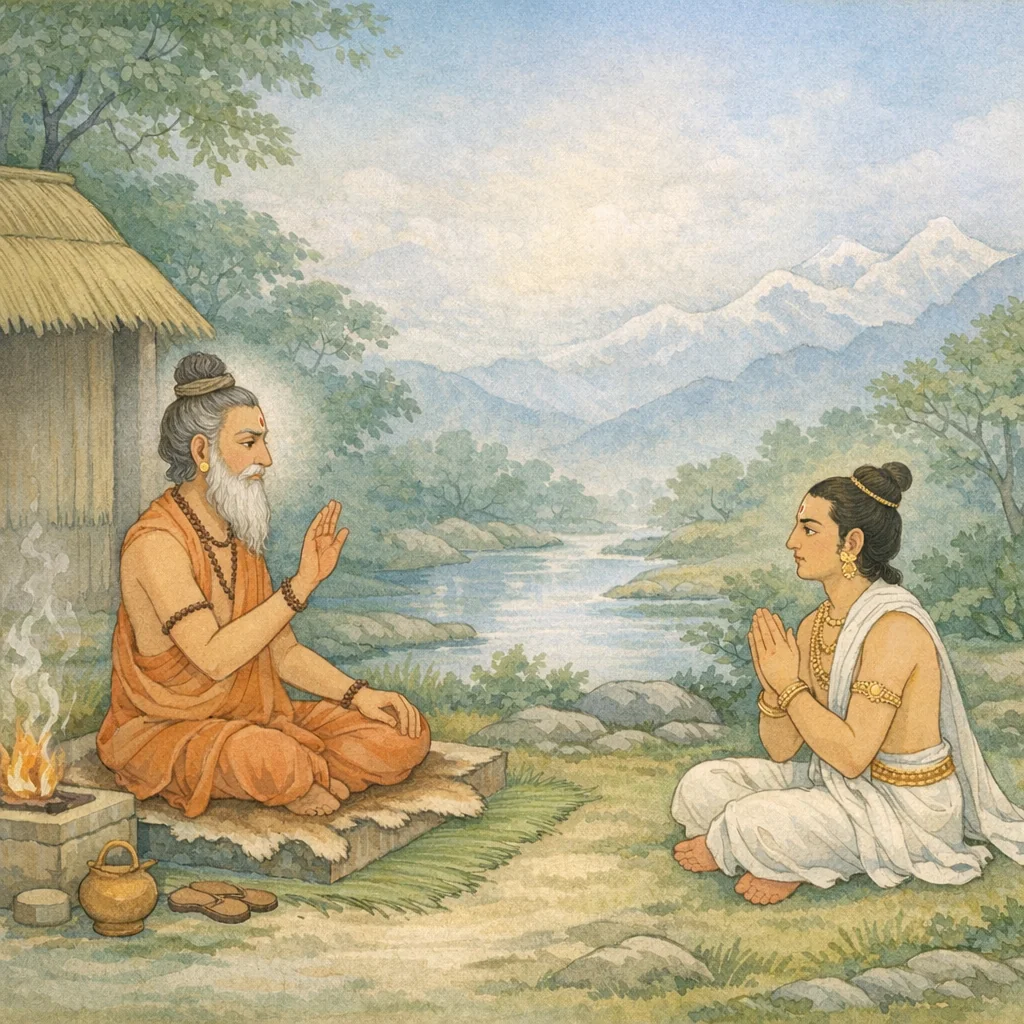
Adhyaya 269
परिव्राजक-आचारः (Conduct of the Wandering Renunciant) — Mahābhārata, Śānti-parva 269
Upa-parva: Mokṣa-dharma (Liberation-Oriented Instruction) — Parivrājaka-Āśrama Conduct Unit
Yudhiṣṭhira asks which character, conduct, learning, and ultimate orientation enable attainment of Brahman’s ‘station’ described as supreme, stable, and beyond prakṛti. Bhīṣma answers by listing operational disciplines associated with mokṣa-dharma: light eating and sense-control; leaving home with detachment; equanimity in gain/loss; abstaining from fault-finding in thought, sight, and speech; non-harm and friendliness toward all beings; patience under harsh words; gentle and non-retaliatory speech even when provoked; discreet village behavior and regulated alms-seeking; avoidance of elation or despair at outcomes; refusal of honor-seeking or preferential gains; preference for solitude and unknown residence; steadiness amid approval/disapproval; restraint of impulses (speech, mind, anger, curiosity, hunger/sexuality); neutrality toward praise/blame; and non-entanglement with householder or forest-dweller networks. The chapter concludes by presenting fearlessness-giving (abhaya-dāna) and home-leaving as leading to luminous worlds and an orientation toward the infinite.
Chapter Arc: कपिल का उद्घोष—वेद प्रमाण हैं, पर उनका सार-मार्ग वही है जो शब्द-ब्रह्म से परे परब्रह्म तक ले जाए; साधक को यह समझना है कि कर्म, देह और वाणी की शुद्धि किस हेतु है। → संवाद में सूक्ष्म तनाव यह उठता है कि क्या केवल वैदिक कर्मकाण्ड, प्रायश्चित्त और आश्रम-धर्म पर्याप्त हैं, या वे केवल दुर्बल आत्मा के लिए सहारा हैं; कपिल चारों आश्रमों के ‘उत्तम साधन’ बताते हुए शुद्धि, संयम, संतोष-त्याग और उपनिषद्-विद्या की अनिवार्यता पर जोर देते हैं। → निर्णायक कथन—‘शब्द-ब्रह्म में निष्णात’ साधक परब्रह्म को प्राप्त करता है; शुद्ध शरीर-चित्त वाला ब्राह्मण पात्र बनता है, और जो ‘तुरीय’ उपनिषद्-धर्म (ब्रह्म-संबन्धी विद्या) में स्थित है, उसके लिए प्रायश्चित्त का प्रश्न नहीं—क्योंकि वह विधि में प्रतिष्ठित होकर सत्य-ऋत-आत्मा-स्वरूप ब्रह्म को बुद्धि-नेत्रों से देखता है। → कपिल ब्रह्म के लक्षणों का स्तवनात्मक निरूपण करते हैं—ऋत, सत्य, सर्वात्मा, अव्यक्त, अव्यय; तथा तेज, क्षमा, शान्ति, शुभ, आकाशवत् असंग, सनातन-ध्रुव—इन गुणों से बुद्धि द्वारा गम्य ब्रह्म को नमस्कार कर अध्याय का उपसंहार करते हैं।
Shlokas
Verse 1
अकाल सप्तर्त्याधिकद्विशततमो< ध्याय: स्यूमरश्मि-कपिल-संवाद--चारों आश्रमोंमें उत्तम साधनोंके द्वारा ब्रह्मकी प्राप्तिका कथन कपिल उवाच वेदा: प्रमाणं लोकानां न वेदा: पृष्ठतः कृता: । दे ब्रह्मणी वेदितव्ये शब्दब्रह्म परं च यत्,कपिलने कहा--स्यूमरश्मे! सम्पूर्ण लोकोंके लिये वेद ही प्रमाण हैं। अतः वेदोंकी अवहेलना नहीं की गयी है। ब्रह्मके दो रूप समझने चाहिये--शब्दब्रह्म (वेद) और परब्रह्म (सच्चिदानन्दघन परमात्मा)
Kapila said: “For all people, the Vedas are the authoritative standard; they were not composed as an afterthought or secondary support. Yet one should understand that ‘Brahman’ is to be known in two ways: as Śabda-brahman—the Brahman in the form of sacred word and Vedic revelation—and as the Supreme Brahman beyond words, the highest reality. Thus, reverence for scripture is upheld, while the teaching points beyond scripture to direct realization.”
Verse 2
शब्दब्रद्माणि निष्णात: परं ब्रह्माधिगच्छति । शरीरमेतत् कुरुते यद् वेदे कुरुते तनुम्
Kapila says: One who has become fully proficient in the ‘Brahman as sound’—the Vedic word and its disciplined study—can thereby attain the Supreme Brahman. For this very body is fashioned by what one fashions in the Veda: as one forms one’s inner self through Vedic discipline, so one’s embodied condition is shaped accordingly.
Verse 3
कृतशुद्धशरीरो हि पात्र भवति ब्राह्मण: । आनन्त्यमत्र बुद्धयेदं कर्मणां तद् ब्रवीमि ते
Kapila said: “Indeed, a brāhmaṇa whose body has been purified through disciplined conduct becomes a worthy vessel (fit recipient). In this matter one should understand the limitless reach of actions and their consequences; therefore I declare this teaching to you.”
Verse 4
जो पुरुष शब्दब्रह्ममें पारंगत (वेदोक्त कर्मोके अनुष्ठानसे शुद्धचित्त हो चुका) है, वह परब्रह्मको प्राप्त कर लेता है। पिता और माता वेदोक्त गर्भाधानकी विधिसे बालकके जिस शरीरको जन्म देते हैं, वे उस बालकके उस शरीरका ही संस्कार करते हैं। इस प्रकार जिसका शरीर वैदिक संस्कारसे शुद्ध हो जाता है, वही ब्रह्मज्ञानका पात्र होता है। अब मैं अपनी बुद्धिके अनुसार तुम्हें यह बता रहा हूँ कि कर्म किस प्रकार अक्षय मोक्ष-सुखकी प्राप्ति करानेमें कारण होते हैं ।। अनागममनैतिहां प्रत्यक्ष लोकसाक्षिकम् । धर्म इत्येव ये यज्ञान् वितन्वन्ति निराशिष:,जो अपना धर्म (कर्तव्य) समझकर बिना किसी प्रकारकी भोगेच्छाके यज्ञोंका अनुष्ठान करते हैं, उनके उस यज्ञका फल वेद या इतिहासद्दारा नहीं जाना जाता है। वह प्रत्यक्ष है और उसे सब लोग अपनी आँखों देखते हैं
Kapila says: The person who has mastered the ‘Brahman of sound’—the Veda—and whose mind has been purified through the performance of Vedic duties, attains the Supreme Brahman. A father and mother, having brought forth a child’s body through the Vedic rite of conception, perform the consecratory refinements for that very body. Thus, only one whose body and life have been purified by Vedic sacraments becomes a fit vessel for knowledge of Brahman. Now, according to my understanding, I shall explain to you how action becomes a cause for the attainment of imperishable liberation and bliss. For those who spread and perform sacrifices solely as ‘dharma’—without desire for enjoyment—the fruit of that sacrifice is not something to be known from Veda or from historical report; it is immediate, publicly witnessed, and seen directly by people.
Verse 5
उत्पन्नत्यागिनो<लुब्धा: कृपासूयाविवर्जिता: । धनानामेष वै पन्थास्तीर्थेषु प्रतिपादनम्,जो प्राप्त हुए पदार्थोका त्याग सब प्रकारके लालचको छोड़कर करते हैं, जो कृपणता और असूयासे रहित हैं और “धनके उपयोगका यही सर्वोत्तम मार्ग है” ऐसा समझकर सत्पात्रोंको दान करते हैं, कभी पापकर्मका आश्रय नहीं लेते तथा सदा कर्मयोगके साधनमें ही लगे रहते हैं, उनके मानसिक संकल्पकी सिद्धि होने लगती है और उन्हें विशुद्ध ज्ञानस्वरूप परब्रह्मके विषयमें दृढ़ निश्चय हो जाता है
Kapila said: Those who renounce what has come to them, free from greed and devoid of miserliness and envy—understanding that this indeed is the proper course regarding wealth—dedicate it at sacred occasions and places by giving to worthy recipients. Such people do not resort to sinful acts and remain steadily engaged in the discipline of right action; thus their inner resolve begins to bear fruit, and they gain firm conviction in the pure, knowledge-natured Supreme Reality.
Verse 6
अनश्रिता: पापकर्म कदाचित् कर्मयोगिन: । मन: संकल्पसंसिद्धा विशुद्धज्ञाननिश्चया:,जो प्राप्त हुए पदार्थोका त्याग सब प्रकारके लालचको छोड़कर करते हैं, जो कृपणता और असूयासे रहित हैं और “धनके उपयोगका यही सर्वोत्तम मार्ग है” ऐसा समझकर सत्पात्रोंको दान करते हैं, कभी पापकर्मका आश्रय नहीं लेते तथा सदा कर्मयोगके साधनमें ही लगे रहते हैं, उनके मानसिक संकल्पकी सिद्धि होने लगती है और उन्हें विशुद्ध ज्ञानस्वरूप परब्रह्मके विषयमें दृढ़ निश्चय हो जाता है
Kapila said: Those who are karma-yogins never resort to sinful action. As their mind’s resolve becomes steadily fulfilled and perfected, they gain a firm conviction in pure knowledge—clarity about the highest reality—through a life anchored in disciplined action and ethical restraint.
Verse 7
अक्रुध्यन्तोडनसूयन्तो निरहडकारमत्सरा: । ज्ञाननिष्ठास्त्रिशुक्लाश्व सर्वभूतहिते रता:,वे किसीपर क्रोध नहीं करते, कहीं दोषदृष्टि नहीं रखते, अहंकार तथा मात्सर्यसे दूर रहते हैं, ज्ञानके साधनोंमें उनकी निष्ठा होती है, उनके जन्म, कर्म और विद्या--तीनों ही शुद्ध होते हैं तथा वे समस्त प्राणियोंके हितमें तत्पर रहते हैं
Kapila said: “They do not give way to anger, nor do they indulge in fault-finding or envy. Free from egoism and jealousy, they remain firmly devoted to the pursuit of knowledge. Pure in the three respects—birth, conduct, and learning—they are ever engaged in the welfare of all living beings.”
Verse 8
आसन गृहस्था भूयिष्ठा अव्युत्क्रान्ता: स्वकर्मसु । राजानश्न तथा युक्ता ब्राह्मणाश्न यथाविधि,पूर्वकालमें बहुत-से ब्राह्मण और राजा ऐसे हो गये हैं, जो गृहस्थ आश्रममें ही रहते हुए अपने-अपने कर्मोका त्याग न करके उनमें निष्काम भावसे विधिपूर्वक लगे रहे
Kapila said: “In former times, many people—especially householders—remained steadfast in their own prescribed duties without falling away from them. Kings, disciplined in their responsibilities, and Brahmins as well, performed their ordained acts in the proper manner, with a spirit of selfless commitment.”
Verse 9
समा हार्जवसम्पन्ना: संतुष्टा ज्ञाननिश्चया: । प्रत्यक्षधर्मा: शुचय: श्रद्दधाना: परावरे,वे सब प्राणियोंपर समान दृष्टि रखते थे। सरल, संतुष्ट, ज्ञाननिष्ठ, प्रत्यक्ष फल देनेवाले धर्मके अनुष्ठाता और शुद्धचित्त होते थे तथा शब्दब्रह्म एवं परब्रह्म-दोनोंमें ही श्रद्धा रखते थे
Kapila said: They looked upon all beings with an equal eye. Endowed with straightforwardness, contentment, and firm conviction in true knowledge, they practiced a dharma whose fruits are directly evident in lived experience. Pure in mind and conduct, they placed their faith in both the lower and the higher—both the discipline of sacred sound (śabda-brahman) and the supreme reality (para-brahman).
Verse 10
पुरस्ताद् भावितात्मानो यथावच्चरितव्रता: । चरन्ति धर्म कृच्छेडपि दुर्गे चैवापि संहता:,वे आवश्यक नियमोंका यथावत् पालन करके पहले अपने चित्तको शुद्ध करते थे और कठिनाई तथा दुर्गम स्थानोंमें पड़ जानेपर भी परस्पर मिलकर धर्मानुष्ठानमें तत्पर रहते थे। संघ-बद्ध होकर धर्मानुष्ठान करनेवाले उन पूर्ववर्ती पुरुषोंको इसमें सुखका ही अनुभव होता था। उन्हें किसी प्रकारका प्रायक्षित्त करनेकी आवश्यकता नहीं पड़ती थी
Kapila said: “In earlier times, men of disciplined conduct first purified their inner selves by observing the required restraints correctly. Even when faced with hardship or forced to pass through difficult, perilous places, they remained united and continued their practice of dharma together. For those former people who performed dharma in a bonded community, the very act was experienced as happiness; they did not fall into the kind of fault that would require expiation (prāyaścitta).”
Verse 11
संहत्य धर्म चरतां पुरा55सीत् सुखमेव तत् | तेषां नासीद् विधातवयं प्रायश्षित्तं कथंचन,वे आवश्यक नियमोंका यथावत् पालन करके पहले अपने चित्तको शुद्ध करते थे और कठिनाई तथा दुर्गम स्थानोंमें पड़ जानेपर भी परस्पर मिलकर धर्मानुष्ठानमें तत्पर रहते थे। संघ-बद्ध होकर धर्मानुष्ठान करनेवाले उन पूर्ववर्ती पुरुषोंको इसमें सुखका ही अनुभव होता था। उन्हें किसी प्रकारका प्रायक्षित्त करनेकी आवश्यकता नहीं पड़ती थी
Kapila said: “In former times, when people practiced dharma in unity, that very way of life was experienced as happiness. For those who lived and acted together in righteousness, there was no need whatsoever to prescribe any expiation (prāyaścitta).”
Verse 12
सत्यं हि धर्ममास्थाय दुराधर्षतमा मता: । न मात्रामनुरुध्यन्ते न धर्मच्छलमन्ततः,वे सत्यधर्मका आश्रय लेकर ही अत्यन्त दुर्धर्ष माने जाते थे। लेशमात्र भी पाप नहीं करते थे और प्राणान्तका अवसर उपस्थित होनेपर भी धर्मके विषयमें छलसे काम नहीं लेते थे
For, grounded in truth as their very dharma, they were regarded as utterly unassailable. They would not yield even by the smallest measure, and even at the final extremity they would not resort to deceit in the name of dharma.
Verse 13
य एव प्रथम: कल्पस्तमेवाभ्याचरन् सह । तेषां नासीद् विधातव्यं प्रायश्षित्तं कदाचन,जो प्रथम श्रेणीका धर्म माना जाता था, उसीका वे सब लोग साथ रहकर आचरण करते थे, अतः उनके सामने कभी प्रायश्चित्त करनेका अवसर नहीं आता था
Kapila said: “They lived together practicing only that very first and original order of conduct. Therefore, for them there never arose any occasion to prescribe or perform expiation (prāyaścitta), since no lapse requiring atonement occurred.”
Verse 14
तस्मिन् विधौ स्थितानां हि प्रायश्षित्तं न विद्यते । दुर्बलात्मन उत्पन्न प्रायश्षित्तमिति श्रुति:,धर्मकी उस उत्तम श्रेणीमें स्थित हुए उन शुद्धचित्त पुरुषोंके लिये प्रायश्ित्त हैं ही नहीं। जिनका हृदय दुर्बल है, उन्हींसे पाप होता है और उन्हींके लिये प्रायश्चित्तका विधान किया गया है--ऐसा सुननेमें आता है
Kapila said: “For those who remain established in that discipline, there is in truth no need for expiation. Expiation (prāyaścitta) is spoken of in the tradition as something that arises only for the weak-minded—because it is they who fall into wrongdoing, and for them alone the rule of atonement is prescribed.”
Verse 15
एवं बहुविधा विप्रा: पुराणा यज्ञवाहना: । त्रैविद्यवृद्धा: शुचयो वृत्तवन्तो यशस्विन:,इस प्रकार बहुत-से ब्राह्मण पूर्वकालमें यज्ञका निर्वाह करते थे। वे वेदविद्याके ज्ञानमें बढ़े-चढ़े, पवित्र, सदाचारी और यशस्वी थे
Kapila said: “Thus, in ancient times there were many kinds of brāhmaṇas who sustained and carried forward the sacrificial tradition. They were advanced in the threefold Vedic learning, pure in conduct, steadfast in right livelihood and discipline, and renowned for their virtue.”
Verse 16
यजन्तो5हरहर्यज्जैर्निराशीर्बन्धना बुधा: । तेषां यज्ञाश्न वेदाश्न॒ कर्माणि च यथागमम्,वे विद्वान् पुरुष प्रतिदिन कामनाओंके बन्धनसे मुक्त हो यज्ञोंद्वारा भगवानूका यजन करते थे। उनके वे यज्ञ, वेदाध्ययन तथा अन्यान्य कर्म शास्त्रविधिके अनुसार सम्पन्न होते थे
Kapila said: “Those wise men performed sacrifices day after day, without craving for reward, freed from the bonds of desire. Their sacrifices, their study of the Vedas, and their other rites and works were all carried out in accordance with scriptural ordinance.”
Verse 17
आगमाश्च यथाकाले संकल्पाश्न यथाक्रमम् । अपेतकामक्रोधानां दुश्चराचारकर्मणाम्,उन्होंने काम और क्रोधको त्याग दिया था। उनके आचार-कर्म दूसरोंके लिये आचरणमें लाने अत्यन्त कठिन थे। उनके हृदयमें यथासमय शास्त्र-ज्ञान और सत्यंकल्पका क्रमश: उदय होता था
Kapila said: “In due season, scriptural insight arose in them, and in due order their true resolve matured. Having cast off desire and anger, their conduct and disciplines were so exacting that others found them exceedingly hard to emulate.”
Verse 18
स्वकर्मभि: शंसितानां प्रकृत्या शंसितात्मनाम् । ऋजूनां शमनित्यानां स्वेषु कर्मसु वर्तताम्,अपने उत्तम कर्मोंके कारण उनकी बड़ी प्रशंसा होती थी। वे स्वभावसे ही पवित्रचित्त, सरल, शान्तिपरायण और स्वधर्मनिष्ठ होते थे
Kapila said: “They were highly praised because of their own excellent deeds. By nature their minds were pure and well-regulated; they were straightforward, ever devoted to peace, and steadfast in performing their respective duties.”
Verse 19
सर्वमानन्त्यमेवासीदिति नः शाश्वती श्रुति: । तेषामदीनसत्त्वानां दुश्चराचारकर्मणाम्
“Our eternal sacred tradition declares: ‘All this was indeed boundless.’ Yet for those whose inner strength does not sink—who persist through harsh disciplines and difficult modes of conduct—this truth is approached through arduous practice and demanding deeds.”
Verse 20
उनके हृदय बड़े उदार थे, उनके आचार और कर्म दूसरोंके लिये आचरणमें लानेमें अत्यन्त कठिन थे, अतः उनका सारा शुभ कर्म ही अक्षय मोक्षरूप फल देनेवाला था। यह बात सदा हमारे सुननेमें आयी है ।। स्वकर्मभि: सम्भूतानां तपो घोरत्वमागतम् । त॑ सदाचारमाश्चर्य पुराणं शाश्व॒तं ध्रुवम्
Kapila said: “From their own rightful works there arose an austerity (tapas) that became formidable in its intensity. That wondrous discipline of good conduct is ancient, everlasting, and unshakably established.”
Verse 21
वे अपने-अपने कर्मोसे ही परिपुष्ट थे। उनकी तपस्या घोर रूप धारण कर चुकी थी। वे आश्चर्यजनक सदाचारका पालन करते थे और उसका उन्हें पुरातन, शाश्वत एवं अविनाशी ब्रह्मरूप फल प्राप्त होता था ।। अशवनुवद्धिश्नरितुं किंचिद् धर्मेषु सूक्ष्मताम् । निरापद्धर्म आचारो ह्ुप्रमादोडपराभव:,धर्मोमें जो किंचित् सूक्ष्मता है, उसका आचरण करनेमें कितने ही लोग असमर्थ हो जाते हैं। वास्तवमें वेदोक्त आचार और धर्म आपत्तिसे रहित है। उसमें न तो प्रमाद है और न पराभव ही है
Kapila said: “They were sustained and strengthened by their own respective duties (dharma). Their austerity had assumed a formidable intensity. They practiced a wondrous discipline of good conduct, and from it they attained an ancient, eternal, imperishable fruit—Brahman itself. Yet the subtlety that exists within dharma is something many people are unable to put into practice. In truth, the conduct and dharma taught by the Veda are free from peril: there is neither negligence in them nor any defeat.”
Verse 22
सर्ववर्णेषु जातेषु नासीत् कश्रनिद् व्यतिक्रम: । व्यस्तमेकं चतुर्धा हि ब्राह्मणा आश्रमं विदु:,पूर्वकालमें सब वर्णोंकी उत्पत्ति हो जानेपर आश्रमके विषयमें कोई वैषम्य नहीं था। तदनन्तर एक ही आश्रमको अवस्था-भेदसे चार भागोंमें विभक्त किया गया। इस बातको सभी ब्राह्मण जानते रहे
Kapila said: “When all the social orders (varṇa) had come into being, there was at first no deviation or inequality regarding the discipline of life (āśrama). Later, what was originally a single way of life was differentiated into four stages; this is a matter known to the Brahmanas.”
Verse 23
तं॑ सन््तो विधिवत प्राप्य गच्छन्ति परमां गतिम् | गृहेभ्य एव निष्क्रम्य वनमन्ये समाश्रिता:,श्रेष्ठ पुरुष विधिपूर्वक उन सब आश्रमोंमें प्रवेश करके उनके धर्मका पालन करते हुए परम-गतिको प्राप्त होते हैं। उनमेंसे कुछ लोग तो घरसे निकलकर (अर्थात् संन्यासी होकर), कुछ लोग वानप्रस्थका आश्रय लेकर, कुछ मानव गृहस्थ ही रहकर और कोई ब्रह्मचर्य आश्रमका सेवन करते हुए ही उस आश्रमधर्मका पालन करके परमपदको प्राप्त होते हैं। उस समय वे ही द्विजगण आकाशमें ज्योति-मयरूपसे दिखायी देते हैं, जो कि नक्षत्रोंके समान ही आकाशके विभिन्न स्थानोंमें अनेक तारागण हैं--इन सबने संतोषके द्वारा ही यह अनन्त पद प्राप्त किया है, ऐसा वैदिक सिद्धान्त है
Kapila said: “Having duly attained that discipline, the wise reach the highest goal. Some depart from the household and go forth to the forest; others take refuge in the forest-dweller’s life. In this way, by entering the stages of life in the proper manner and faithfully observing their respective duties, they attain the supreme state.”
Verse 24
गृहमेवाभिसंश्रित्य ततो<चन्ये ब्रह्मचारिण: । त एते दिवि दृश्यन्ते ज्योतिर्भूता द्विजातय:,श्रेष्ठ पुरुष विधिपूर्वक उन सब आश्रमोंमें प्रवेश करके उनके धर्मका पालन करते हुए परम-गतिको प्राप्त होते हैं। उनमेंसे कुछ लोग तो घरसे निकलकर (अर्थात् संन्यासी होकर), कुछ लोग वानप्रस्थका आश्रय लेकर, कुछ मानव गृहस्थ ही रहकर और कोई ब्रह्मचर्य आश्रमका सेवन करते हुए ही उस आश्रमधर्मका पालन करके परमपदको प्राप्त होते हैं। उस समय वे ही द्विजगण आकाशमें ज्योति-मयरूपसे दिखायी देते हैं, जो कि नक्षत्रोंके समान ही आकाशके विभिन्न स्थानोंमें अनेक तारागण हैं--इन सबने संतोषके द्वारा ही यह अनन्त पद प्राप्त किया है, ऐसा वैदिक सिद्धान्त है
Kapila said: “Some, taking refuge in the household life itself, and others living as brahmacārins, follow their respective disciplines. Having fulfilled the duties of their chosen āśrama in the proper way, they attain the highest goal; and then those twice-born are seen in the sky as beings of light—like stars set in different regions—showing that liberation is reached not by mere outward form, but by faithful practice of one’s ordained way of life.”
Verse 25
नक्षत्राणीव धिष्ण्येषु बहवस्तारकागणा: । आनन्त्यमुपसम्प्राप्ता: संतोषादिति वैदिकम्,श्रेष्ठ पुरुष विधिपूर्वक उन सब आश्रमोंमें प्रवेश करके उनके धर्मका पालन करते हुए परम-गतिको प्राप्त होते हैं। उनमेंसे कुछ लोग तो घरसे निकलकर (अर्थात् संन्यासी होकर), कुछ लोग वानप्रस्थका आश्रय लेकर, कुछ मानव गृहस्थ ही रहकर और कोई ब्रह्मचर्य आश्रमका सेवन करते हुए ही उस आश्रमधर्मका पालन करके परमपदको प्राप्त होते हैं। उस समय वे ही द्विजगण आकाशमें ज्योति-मयरूपसे दिखायी देते हैं, जो कि नक्षत्रोंके समान ही आकाशके विभिन्न स्थानोंमें अनेक तारागण हैं--इन सबने संतोषके द्वारा ही यह अनन्त पद प्राप्त किया है, ऐसा वैदिक सिद्धान्त है
Kapila said: “Just as many clusters of stars appear in the various regions of the sky like constellations, so too many twice-born attain the endless state. They reach that infinite goal through contentment—this is the Vedic conclusion.”
Verse 26
यद्यागच्छन्ति संसारं पु$नर्योनिषु तादृशा: । न लिप्यन्ते पापकृत्यै:ः कदाचित् कर्मयोनित:,ऐसे पुण्यात्मा पुरुष यदि कभी पुनः संसारकी कर्माधिकार युक्त योनियोंमें आते या जन्म ग्रहण करते हैं तो वे उस योनिके सम्बन्धसे पापकर्मोद्वारा लिप्त नहीं होते हैं
Even if such pure-souled persons return again to worldly existence and take birth in wombs where action and obligation operate, they are never stained by sinful deeds merely because of that embodied condition. Their inner purity and knowledge keep them unattached, so the faults of the field of action do not cling to them.
Verse 27
एवमेव ब्रह्माचारी शुश्रूषुर्घोरनिश्वय: । एवं युक्तो ब्राह्मण: स्यादन्यो ब्राह्मणको भवेत्,इसी प्रकार गुरुकी सेवामें तत्पर रहनेवाला, ब्रह्मचर्य-परायण, दृढ़ निश्चयवाला तथा योगयुक्त ब्रह्मचारी ही उत्तम ब्राह्मण हो सकता है। उससे भिन्न अन्य प्रकारका ब्राह्मण निम्न कोटिका अथवा नाममात्रका ब्राह्मण समझा जाता है
So too, only that brahmacārin who is devoted to serving the teacher, steadfast in strict resolve, and disciplined in yoga becomes a true brāhmaṇa. One who is otherwise is to be regarded as an inferior brāhmaṇa—or merely a brāhmaṇa in name.
Verse 28
कर्मवं पुरुषस्याह शुभं वा यदि वाशुभम् | एवं पक््वकषायाणामानन्त्येन श्रुतेन च,इस प्रकार शुभ अथवा अशुभ कर्म ही पुरुषका तदनु-रूप नाम नियत करता है। जिनके राग-द्वेष आदि कषाय पक गये हैं, जिनके मनसे तृष्णा निकल गयी है, जो बाहर- भीतरसे शुद्ध हैं तथा जिनकी बुद्धि कल्याणस्वरूप मोक्षमें लगी हुई है, उन तत्त्वज्ञानी पुरुषोंकी दृष्टिमें अनन्त ब्रह्मज्ञान तथा शास्त्रज्ञानके प्रभावसे सब कुछ ब्रह्मस्वरूप हो गया था; यह बात सदा ही हमारे सुननेमें आयी है
Kapila said: A person’s name and standing are determined in accordance with his deeds—whether auspicious or inauspicious. But for those whose inner impurities (such as passion and aversion) have fully ripened and been exhausted, whose craving has fallen away, who are pure within and without, and whose intellect is fixed on liberation, everything is seen as Brahman itself—through the power of boundless Brahma-knowledge and scriptural hearing. This, we have always heard, is the testimony of the wise.
Verse 29
सर्वमानन्त्यमासीद् वै एवं नः शाश्वती श्रुति: । तेषामपेततृष्णानां निर्णिक्तानां शुभात्मनाम्,इस प्रकार शुभ अथवा अशुभ कर्म ही पुरुषका तदनु-रूप नाम नियत करता है। जिनके राग-द्वेष आदि कषाय पक गये हैं, जिनके मनसे तृष्णा निकल गयी है, जो बाहर- भीतरसे शुद्ध हैं तथा जिनकी बुद्धि कल्याणस्वरूप मोक्षमें लगी हुई है, उन तत्त्वज्ञानी पुरुषोंकी दृष्टिमें अनन्त ब्रह्मज्ञान तथा शास्त्रज्ञानके प्रभावसे सब कुछ ब्रह्मस्वरूप हो गया था; यह बात सदा ही हमारे सुननेमें आयी है
Kapila said: “Indeed, everything had become boundless (infinite); thus runs the eternal teaching we have heard. For those noble-souled ones whose thirst (craving) had fallen away, who were cleansed and purified, all experience was seen as pervaded by the Infinite.”
Verse 30
चतुर्थोपनिषद् धर्म: साधारण इति स्मृति: । संसिद्धै: साध्यते नित्यं ब्राह्मणैर्नियतात्मभि:,तुरीय ब्रह्मसे सम्बन्ध रखनेवाली जो उपनिषद्-विद्या है, उसकी प्राप्ति करानेवाले शम, दम, उपरति, तिततिक्षा, श्रद्धा तथा समाधानरूप जो धर्म हैं, वह सभी वर्ण और आश्रमके लोगोंके लिये साधारण हैं--ऐसा स्मृतिका कथन है। परंतु जो संयतचित्त और तपःसिद्ध ब्रह्मनिष्ठ पुरुष हैं, वे ही सदा उस धर्मका साधन कर पाते हैं
Kapila said: “The discipline connected with the ‘fourth’ (turiya) Upaniṣadic realization is, according to Smṛti, a common (universal) dharma. Yet it is steadily accomplished only by those Brahmanas who are self-restrained and perfected through austerity—men firmly established in Brahman—who alone can continually practice and fulfill that path.”
Verse 31
संतोषमूलस्त्यागात्मा ज्ञानाधिष्ठानमुच्यते । अपवर्गमतिर्नित्यो यतिधर्म: सनातन:
Kapila said: “That discipline is said to be grounded in knowledge, whose root is contentment and whose very nature is renunciation. With the mind ever set on liberation, this is the eternal, timeless dharma of the ascetic.”
Verse 32
संतोष ही जिसके सुखका मूल है, त्याग ही जिसका स्वरूप है, जो ज्ञानका आश्रय कहा जाता है, जिसमें मोक्षदायिनी बुद्धि--ब्रह्मसाक्षात्काररूप वृत्ति नित्य आवश्यक है, वह संन्यास-आश्रमरूप धर्म सनातन है ।। साधारण: केवलो वा यथाबलमुपासते । गच्छतां गच्छतां क्षेमं दुर्बलो5त्रावसीदति । ब्रह्मण: पदमन्विच्छन् संसारान्मुच्यते शुचि:,यह यतिधर्म अन्य आश्रमके धर्मोंसे मिला हुआ हो या स्वतन्त्र हो, जो अपने वैराग्य- बलके अनुसार इसका आश्रय लेते हैं, वे कल्याणके भागी होते हैं। इस मार्गसे जानेवाले सभी पथिकोंका परम कल्याण होता है; परंतु जो दुर्बल है--मन और इन्द्रियोंको वशमें न रखनेके कारण जो इसके साधनमें असमर्थ है, वही यहाँ शिथिल होकर बैठ रहता है। जो बाहर और भीतरसे पवित्र है, वह ब्रह्मपदका अनुसंधान करता हुआ संसार-बन्धनसे मुक्त हो जाता है
Contentment is the root of whose happiness, renunciation is whose very nature, and who is said to be the support of true knowledge—within whom the liberating intellect, the constant inner movement that realizes Brahman, is always necessary: that dharma, taking the form of the renunciant order (saṃnyāsa-āśrama), is eternal. Whether practiced in a general way alongside other disciplines or pursued alone as an independent path, people take it up according to their strength and thereby attain well-being. For all who proceed on this road, there is supreme welfare; only the weak—those unable to restrain mind and senses and thus incapable of its means—sink down and remain stalled here. One who is pure outwardly and inwardly, seeking the state of Brahman, is released from the bondage of worldly existence.
Verse 33
स्यूमराश्मिर्वाच ये भुज्जते ये ददते यजन्तेडधीयते च ये । मात्राभिरुपलब्धाभिरयें वा त्यागं समाश्रिता:,स्यूमरश्मिने पूछा--ब्रह्मन! जो लोग प्राप्त हुए धनके द्वारा केवल भोग भोगते हैं, जो दान करते हैं, जो उस धनको यज्ञमें लगाते हैं, जो स्वाध्याय करते हैं अथवा जो त्यागका आश्रय लेते हैं, इनमेंसे कौन पुरुष मृत्युके पश्चात् प्रधानरूपसे स्वर्गलोकपर विजय पाता है? मैं जिज्ञासुभावसे पूछ रहा हूँ; आप मुझे यह सब यथार्थरूपसे बताइये
Syūmarāśmi said: “O Brahmin, among those who, with whatever limited means they have obtained, (1) merely enjoy, (2) give in charity, (3) employ their wealth in sacrifice, (4) pursue sacred study, or (5) take refuge in renunciation—who, after death, wins pre-eminently the conquest of heaven? I ask with a sincere desire to know; tell me this truthfully and in full.”
Verse 34
एतेषां प्रेत्यभावे तु कतम: स्वर्गजित्तम: । एतदाचक्ष्व मे ब्रह्मन् यथातत्त्वेन पृच्छत:,स्यूमरश्मिने पूछा--ब्रह्मन! जो लोग प्राप्त हुए धनके द्वारा केवल भोग भोगते हैं, जो दान करते हैं, जो उस धनको यज्ञमें लगाते हैं, जो स्वाध्याय करते हैं अथवा जो त्यागका आश्रय लेते हैं, इनमेंसे कौन पुरुष मृत्युके पश्चात् प्रधानरूपसे स्वर्गलोकपर विजय पाता है? मैं जिज्ञासुभावसे पूछ रहा हूँ; आप मुझे यह सब यथार्थरूपसे बताइये
Kapila asks: “Among these ways of using wealth—mere enjoyment, giving gifts, offering it in sacrifice, pursuing Vedic study, or taking refuge in renunciation—which person, after death, most decisively wins heaven? O Brahman, since I ask with a sincere desire to know, tell me this exactly as it truly is.”
Verse 35
कपिल उवाच परिग्रहा: शुभा: सर्वे गुणतो<5भ्युदयाश्व ये । नतु त्यागसुखं प्राप्ता एतत् त्वमपि पश्यसि,कपिलजीने कहा--जिनका सात्त्विक गुणसे प्राकट्य हुआ है, ऐसे सभी परिग्रह शुभ हैं; परंतु त्यागमें जो सुख है, उसे इनमेंसे कोई भी नहीं पा सके हैं। इस बातको तुम भी देखते ही हो
Kapila said: “All forms of acquisition that arise from the sattvic quality are, in their own way, auspicious. Yet none of them attains the happiness found in renunciation. You too can see this.”
Verse 36
स्यूमरश्मिरु्वाच भवन्तो ज्ञाननिष्ठा वै गृहस्था: कर्मनिश्चया: । आश्रमाणां च सर्वेषां निष्ठायामैक्यमुच्यते,स्यूमरश्मिने पूछा--भगवन्! आप तो ज्ञाननिष्ठ हैं और गृहस्थलोग कर्मनिष्ठ होते हैं; परंतु आप इस समय निष्ठामें सभी आश्रमोंकी एकताका प्रतिपादन कर रहे हैं। इस प्रकार ज्ञान और कर्मकी एकता और पृथकृता-दोनोंका भ्रम होनेसे इनका ठीक-ठीक अन्तर समझमें नहीं आता है। इसलिये आप मुझे उसे यथोचित एवं यथार्थरीतिसे बतानेकी कृपा करें
Syūmarśmi said: “You are firmly established in knowledge, while householders are committed to action. Yet you now declare that, in the matter of spiritual steadfastness, all the āśramas share a single unity. Because this creates confusion—whether knowledge and action are one or different—I cannot clearly grasp their true distinction. Therefore, O venerable one, please explain it to me appropriately and truthfully.”
Verse 37
एकत्वेन पृथक्त्वेन विशेषो नात्र दृश्यते । तद् यथावद् यथान्यायं भगवान् प्रब्रवीतु मे,स्यूमरश्मिने पूछा--भगवन्! आप तो ज्ञाननिष्ठ हैं और गृहस्थलोग कर्मनिष्ठ होते हैं; परंतु आप इस समय निष्ठामें सभी आश्रमोंकी एकताका प्रतिपादन कर रहे हैं। इस प्रकार ज्ञान और कर्मकी एकता और पृथकृता-दोनोंका भ्रम होनेसे इनका ठीक-ठीक अन्तर समझमें नहीं आता है। इसलिये आप मुझे उसे यथोचित एवं यथार्थरीतिसे बतानेकी कृपा करें
“Whether viewed as unity or as separateness, no real distinction is seen here. Therefore, let the Blessed One explain it to me correctly and in accordance with reason and propriety.”
Verse 38
कपिल उवाच शरीरपक्ति: कर्माणि ज्ञानं तु परमा गति: । कषाये कर्मभि: पक्वे रसज्ञाने च तिष्ठति,कपिलजीने कहा--कर्म स्थूल और सूक्ष्म शरीरकी शुद्धि करनेवाले हैं, किंतु ज्ञान परम गतिरूप है। जब कर्मोंद्वारा चित्तके रागादि दोष जल जाते हैं, तब मनुष्य रस-स्वरूप ज्ञानमें स्थित हो जाता है
Kapila said: “Actions serve to ‘cook’ or mature the body—purifying it at both the gross and subtle levels—yet true knowledge is the highest destination. When, through disciplined action, the mind’s stains such as passion and attachment are burnt away, a person becomes established in the savor of realized knowledge.”
Verse 39
आनृशंस्यं क्षमा शान्तिरहिंसा सत्यमार्जवम् | अद्रोहो5नभिमान श्र ह्वीस्तितिक्षा शमस्तथा,समस्त प्राणियोंपर दया, क्षमा, शान्ति, अहिंसा, सत्य, सरलता, अद्रोह, निरभिमानता, लज्जा, तितिक्षा और शम--ये परब्रह्म परमात्माकी प्राप्तिके मार्ग हैं। इनके द्वारा पुरुष परब्रह्मको प्राप्त कर लेता है। इस प्रकार विद्वान् पुरुषको मनके द्वारा कर्मके वास्तविक परिणामका निश्चय समझना चाहिये
Kapila said: “Compassion, forgiveness, peace, non-violence, truthfulness, straightforwardness, freedom from malice, absence of pride, modesty, forbearance, and inner restraint—these are the paths leading to the attainment of the Supreme Brahman. By cultivating these, a person reaches the Supreme. Therefore, a learned man should, through the mind’s discernment, determine the true outcome of actions.”
Verse 40
पन्थानो ब्रह्मणस्त्वेते एतै: प्राप्नोति यत्परम् तद् विद्वाननुबुद्धयेत मनसा कर्मनिश्चयम्,समस्त प्राणियोंपर दया, क्षमा, शान्ति, अहिंसा, सत्य, सरलता, अद्रोह, निरभिमानता, लज्जा, तितिक्षा और शम--ये परब्रह्म परमात्माकी प्राप्तिके मार्ग हैं। इनके द्वारा पुरुष परब्रह्मको प्राप्त कर लेता है। इस प्रकार विद्वान् पुरुषको मनके द्वारा कर्मके वास्तविक परिणामका निश्चय समझना चाहिये
Kapila said: “These are the paths that lead to Brahman. By these one attains the Supreme. Therefore, a wise person should clearly discern with the mind the true determination and consequence of action.” Here, the “paths” are the ethical disciplines that purify conduct—compassion toward all beings, forgiveness, peace, non-violence, truthfulness, straightforwardness, non-malice, humility, modesty, forbearance, and self-restraint—set forth as the practical means to realize the highest Reality.
Verse 41
यां विप्रा: सर्वतः शान्ता विशुद्धा ज्ञाननिश्चया: । गतिं गच्छन्ति संतुष्टास्तामाहु: परमां गतिम्,सब ओरसे शान्त, संतुष्ट, विशुद्धचित्त और ज्ञाननिष्ठ विप्र जिस गतिको प्राप्त होते हैं, उसीको परमगति कहते हैं
Kapila said: “The state which brahmin sages—peaceful in every way, inwardly purified, firm in the certainty of true knowledge, and content—attain, that very state is declared to be the highest goal.”
Verse 42
वेदांश्व॒ वेदितव्यं च विदित्वा च यथास्थितिम् । एवं वेदविदित्याहुरतो5न्यो वातरेचक:,जो वेदों और उनके द्वारा जानने योग्य परब्रह्यको ठीक-ठीक जानता है, उसीको वेदवेत्ता कहते हैं। उससे भिन्न जो दूसरे लोग हैं, वे मुँहसे वेद नहीं पढ़ते, धौंकनीके समान केवल हवा छोड़ते हैं
One who knows the Vedas and what is to be known through the Vedas, and who knows it as it truly stands—he alone is called a knower of the Veda. Others, different from him, merely make sounds with the mouth; like a bellows, they only blow out air.
Verse 43
सर्व विदुर्वेदविदो वेदे सर्व प्रतिष्ठितम् । वेदे हि निष्ठा सर्वस्य यद् यदस्ति च नास्ति च,वेदज्ञ पुरुष सभी विषयोंको जानते हैं; क्योंकि वेदमें सब कुछ प्रतिष्ठित है। जो-जो वस्तु है और जो नहीं है, उन सबकी स्थिति वेदमें बतायी गयी है
Kapila said: “Those who truly know the Veda know everything, for in the Veda all things are grounded and established. Indeed, the Veda is the final resort for all understanding: it sets forth the standing of whatever exists and whatever does not exist.”
Verse 44
एषैव निष्ठा सर्वत्र यत् तदस्ति च नास्ति च । एतदन्त च मध्यं च सच्चासच्च विजानतः,सम्पूर्ण शास्त्रोंकी एकमात्र निष्ठा यही है कि जो-जो दृश्य पदार्थ है वह प्रतीतिकालमें तो विद्यमान है, परंतु परमार्थ ज्ञानकी स्थितिमें बाधित हो जानेपर वह नहीं है। ज्ञानी पुरुषकी दृष्टिमें सदसत् स्वरूप ब्रह्म ही इस जगत्का आदि, मध्य और अन्त है
Kapila said: “This alone is the settled conclusion everywhere in the teaching: whatever appears is, during the time of appearance, taken as existent, yet in the standpoint of highest knowledge it is negated and thus is not. For the knower who discerns reality and unreality, Brahman—of the nature of both being and non-being (as spoken of in relation to appearance)—is the beginning, the middle, and the end of this entire world.”
Verse 45
समाप्तं त्याग इत्येव सर्ववेदेषु निष्ठितम् । संतोष इत्यनुगतमपवर्गे प्रतेष्ठितम्,सब कुछ त्याग देनेपर ही उस ब्रह्मकी प्राप्ति होती है। यही बात सम्पूर्ण वेदोंमें निश्चित की गयी है। वह अपने आनन्दस्वरूपसे सबमें अनुगत तथा अपवर्ग (मोक्ष) में प्रतिष्ठित है
Kapila said: “The conclusion is this alone: renunciation (tyāga). This is established as the settled teaching throughout all the Vedas. That Reality—present within all as contentment (santoṣa)—stands firmly in apavarga, liberation (mokṣa).”
Verse 46
ऋतं सत्यं विदितं वेदितव्यं सर्वस्यात्मा स्थावरं जड़मं च । सर्व सुखं यच्छिवमुत्तरं च ब्रह्माव्यक्त प्रभवश्चवाव्ययं च,अतः वह ब्रह्म ऋत, सत्य, ज्ञात, ज्ञातव्य, सबका आत्मा, स्थावर-जंगमरूप, सम्पूर्ण सुखरूप, कल्याणमय, सर्वोत्कृष्ट, अव्यक्त, सबकी उत्पत्तिका कारण और अविनाशी है
Kapila declares that Brahman is the very principle of cosmic order (ṛta) and truth (satya)—both what is already known and what remains to be known. It is the inner Self of all beings, encompassing the immobile and the insentient as well. It is the fullness of happiness, auspiciousness, and the highest good; unmanifest (avyakta), the source from which all arises, and imperishable. The ethical thrust is that ultimate reality is not partial or sectarian: it pervades all, grounds truthfulness, and stands as the highest aim beyond transient pleasures.
Verse 47
तेज: क्षमा शान्तिरनामयं शुभं तथाविध॑ व्योम सनातन ध्रुवम् एतै: सर्वर्गम्यते बुद्धिनेत्रै- स्तस्मै नमो ब्रह्मणे ब्राह्मणाय,उस आकाशके समान असंग, अविनाशी और सदा एकरस तत्त्वका ज्ञान-नेत्रोंवाले सभी पुरुष तेज, क्षमा और शान्तिरूप शुभ साथधनोंके द्वारा साक्षात्कार करते हैं। जो वास्तवमें ब्रह्मवेत्तासे अभिन्न है, उस परब्रह्म परमात्माको नमस्कार है
Kapila teaches that the supreme Reality—like space, unattached, imperishable, eternally ancient and unshifting—is realized by those whose inner eye is purified by wisdom. Such seers reach it through auspicious disciplines embodied as spiritual radiance (tejas), forbearance (kṣamā), and peace (śānti), and therefore he offers reverence to that Brahman, the highest principle known by the true knower of Brahman.
Verse 270
इति श्रीमहाभारते शान्तिपर्वणि मोक्षधर्मपर्वणि गोकपिलीये सप्तत्यधिकद्धिशततमो<ध्याय:
Thus ends the two-hundred-and-seventieth chapter in the Mokṣadharma section of the Śānti Parva of the Śrī Mahābhārata, in the episode concerning the Cow and Kapila.
Frequently Asked Questions
The dilemma is definitional: whether ‘attaining Brahman’s station’ depends on identity and learning alone or on enacted discipline. The chapter resolves this by prioritizing observable conduct—restraint, non-harm, and equanimity—as the decisive criteria.
Liberation-oriented life is cultivated through regulated impulses (speech, mind, anger, appetite), non-injury, and emotional steadiness; social friction is minimized by gentle speech, anonymity, and non-dependence, making inner freedom compatible with public order.
Yes in functional form: the closing claim links granting fearlessness to all beings and departing the household to attainment of ‘luminous worlds’ and an orientation toward the infinite, marking ethical non-threat (abhaya) as a soteriological prerequisite.