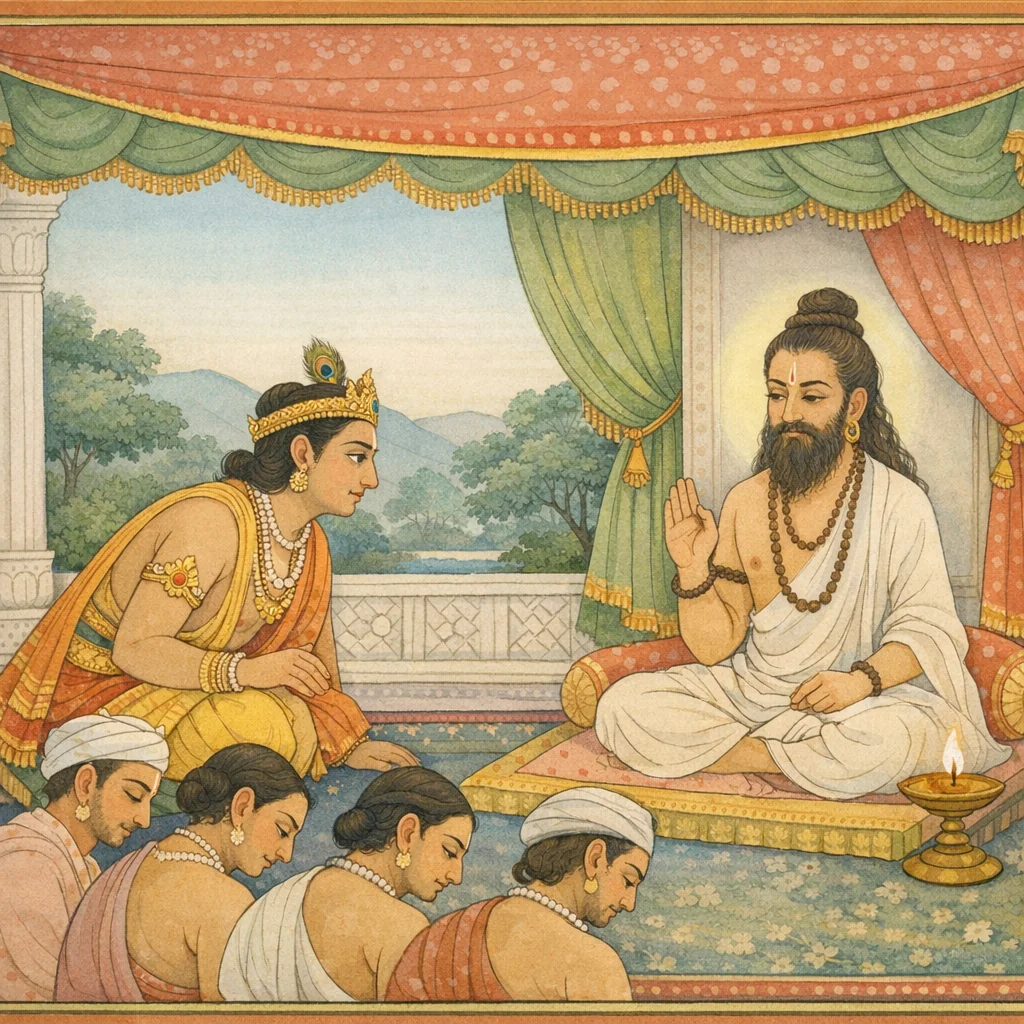
Adhyaya 218
Śrī–Indra–Bali Saṃvāda: The Departure and Fourfold Placement of Lakṣmī
Upa-parva: Dāna-dharma / Śrī–Indra–Bali Saṃvāda (Prosperity and the Ethics of Fortune)
Bhīṣma narrates that Indra observes a radiant feminine presence—Śrī/Lakṣmī—emerging from Bali’s body, signaling the withdrawal of prosperity. Indra questions Bali and then addresses Śrī directly, asking her identity and motive. Śrī states that neither Bali nor the gods truly ‘know’ her; she is called Bhūti, Lakṣmī, and Śrī, and her movements are governed not by a creator’s arbitrary assignment but by kāla’s cycles. She explains her departure from Bali as consequence of ethical slippage: despite earlier virtues (truth, gifts, vows, austerity, valor, dharma), Bali becomes compromised by contempt toward brāhmaṇas and ritual impropriety, and by a deluded claim of exclusive worship. Indra requests a method for her permanent residence; Śrī prescribes a Veda-aligned fourfold division. Indra installs her quarters upon (1) earth, (2) waters, (3) fire/yajña as a sustaining locus, and (4) the virtuous truthful community. Indra warns against harming beings in whom Śrī is installed. The chapter closes with Bali’s proud counter-claim about future victory tied to cosmic irregularities, which Indra rejects by citing the fixed order of the sun’s course and seasons established by Svayaṃbhū, reaffirming cosmic regularity over hubristic prediction.
Chapter Arc: भीष्म युधिष्ठिर को एक प्राचीन आख्यान की ओर ले जाते हैं—मिथिला के जनकवंशी राजा जनदेव, जो मृत्यु के बाद ‘जीव रहता है या नहीं’ जैसे प्रश्नों पर टिके हुए हैं और आत्मतत्त्व में तृप्त नहीं होते। → राजा जनदेव शास्त्र-आगम और तर्क के बीच झूलते हैं; ‘अव्यक्त’ जैसे शब्दों के अर्थ (कहीं परमात्मा, कहीं प्रकृति) को लेकर सूक्ष्म भ्रम उभरता है। पंचशिख का ज्ञान-प्रवाह प्रवेश करता है और वह अनेक आचार्यों/मतवादियों को तर्कों से निरुत्तर कर देता है—मत-मतांतरों की भीड़ में सत्य का चयन कठिन हो जाता है। → पंचशिख का निर्णायक प्रहार: ‘अनात्मा’ (देह-आधारित अहं) ही आत्मा का ‘मृत्यु’ बनता है—मृत्यु, जरा, रोग और क्लेश को आत्मा मान लेना मोह है; देह-नाश को आत्म-नाश समझना असम्यक् मत है। इसी के साथ कर्म-फल, दृश्य-अदृश्य, सुख-दुःख की आपत्तियों का तर्क-शोधन होता है। → उपदेश ‘अनुपधि’ (निर्लेप), ‘अच्छल’ (अवंचक), ‘परमनिरामय’ (निर्विकार) और ‘आत्मसाक्षिक’ (स्वानुभव-सिद्ध) रूप में प्रतिष्ठित होता है। राजा जनदेव विस्मित होकर फिर प्रश्न उठाने को प्रवृत्त होते हैं—अर्थात् मत-खंडन के बाद भी जिज्ञासा जीवित रहती है और सत्य की ओर झुकाव दृढ़ होता है। → राजा जनदेव का विस्मय और पुनः अनुयोग—अगले प्रसंग में वे इसी आत्मसाक्षिक वचन की और गहरी परीक्षा/व्याख्या चाहेंगे।
Shlokas
Verse 1
# 53८5 (9) शीला $. इससे पूर्व पहले, दूसरे और तीसरे श्लोकोंमें “अव्यक्त*” शब्द परमात्माका वाचक है और यहाँ “अव्यक्त' शब्द प्रकृतिका वाचक समझना चाहिये। २. प्रकृति प्रवाहरूपसे अनादि और अनन्त है तथा पुरुष (जीवात्मा) स्वरूपसे। - “पुराणान्तरमें बताया गया है कि इन्द्रियोंका आत्मभावसे चिन्तन करनेवाले योगी दस मन्वन्तरोंतक ब्रह्मलोकमें निवास करते हैं। यथा-- “दशमन्वन्तराणीह तिष्ठन्तीन्द्रियचिन्तका:।' अष्टादर्शाधिकद्विशततमो< ध्याय: राजा जनकके दरबारमें पज्चशिखका आगमन और उनके द्वारा नास्तिक मतोंके निराकरणपूर्वक शरीरसे भिन्न आत्माकी नित्य सत्ताका प्रतिपादन युधिषछिर उवाच केन वृत्तेन वृत्तज्ष जनको मिथिलाधिप: । जगाम मोक्ष मोक्षज्ञो भोगानुत्सृज्य मानुषान्,युधिष्ठिरने पूछा--सदाचारके ज्ञाता पितामह! मोक्षधर्मको जाननेवाले मिथिलानरेश जनकने मानवभोगोंका परित्याग करके किस प्रकारके आचरणसे मोक्ष प्राप्त किया?
Yudhiṣṭhira said: “By what mode of conduct did Janaka, lord of Mithilā—knower of right conduct and well-versed in the path of liberation—attain mokṣa, having set aside ordinary human enjoyments?”
Verse 2
भीष्म उवाच अत्राप्युदाहरन्तीममितिहासं पुरातनम् । येन वृत्तेन धर्मज्ञ: स जगाम महत्सुखम्,भीष्मजीने कहा--राजन्! इस विषयमें विज्ञ पुरुष इस प्राचीन इतिहासका उदाहरण दिया करते हैं, जिसके आचरणसे धर्मज्ञ राजा जनक महान् सुख (मोक्ष) को प्राप्त हुए थे
Bhishma said: “Here too, O king, the learned cite an ancient historical example. By following that course of conduct, the dharma-knowing king Janaka attained great bliss—liberation.”
Verse 3
जनको जनदेवस्तु मिथिलायां जनाधिप: । ऑर्ध्वदेहिकधर्माणामासीद् युक्तो विचिन्तने,प्राचीन कालकी बात है, मिथिलामें जनकवंशी राजा जनदेव राज्य करते थे। वे सदा देह-त्यागके पश्चात् आत्माके अस्तित्वरूप धर्मोंके ही चिन्तनमें लगे रहते थे
Bhishma said: In ancient times, in Mithilā, there ruled a king of Janaka’s line named Janadeva, a sovereign among men. He was constantly devoted to reflecting on the dharmas that pertain to what lies beyond the body—those duties and truths connected with the soul’s existence after death.
Verse 4
तस्य सम शतमाचार्या वसन्ति सतत गृहे । दर्शयन्त: पृथग्धर्मान् नानाश्रमनिवासिन:,उनके दरबारमें सौ आचार्य बराबर रहा करते थे, जो विभिन्न आश्रमोंके निवासी थे और उन्हें भिन्न-भिन्न धर्मोंका उपदेश देते रहते थे
Bhīṣma said: “In his household there constantly lived a full hundred teachers. Belonging to different āśramas, they would expound distinct forms of dharma, each according to his own discipline—so that the ruler’s court remained continually instructed in varied ethical and religious duties.”
Verse 5
स तेषां प्रेत्यभावे च प्रेत्यजातौ विनिश्षये । आगमस्थ: स भूयिष्ठमात्मतत्त्वे न तुष्यति,“इस शरीरको त्याग देनेके पश्चात् जीवकी सत्ता रहती है या नहीं, अथवा देह-त्यागके बाद उसका पुनर्जन्म होता है या नहीं", इस विषयमें उन आचार्योंका जो सुनिश्चित सिद्धान्त था, वे लोग आत्मतत्त्वके विषयमें जैसा विचार उपस्थित करते थे, उससे शास्त्रानुयायी राजा जनदेवको विशेष संतोष नहीं होता था
Bhishma said: Though those teachers, resting on the authority of scripture, had reached a settled conclusion on whether the Self endures after death and whether it is born again after leaving the body, King Janadeva found little satisfaction in their accounts of the truth of the Self. His dissatisfaction reveals an ethical and philosophical urgency: doctrinal certainty is not enough unless it yields clear insight into the soul’s nature and the moral meaning of life and death.
Verse 6
तत्र पज्चशिखो नाम कापिलेयो महामुनि: । परिधावन् महीं कृत्स्नां जगाम मिथिलामथ,एक बार कपिलाके पुत्र महामुनि पंचशिख सारी पृथ्वीकी परिक्रमा करते हुए मिथिलामें जा पहुँचे
Bhishma said: There, the great sage Pañcaśikha, the son of Kapila, roaming over the whole earth, at last arrived at Mithilā—bringing the discourse into the very setting where kings and seers examine dharma through disciplined inquiry and renunciation.
Verse 7
सर्वसंन्यासधर्माणां तत्त्वज्ञानविनिश्चये । सुपर्यवसितार्थश्न निर्दधन्द्रो नष्टसंशय:,वे सम्पूर्ण संन्यास-धर्मोंके ज्ञाता और तत्त्वज्ञानके निर्णयमें एक सुनिश्चित सिद्धान्तके पोषक थे। उनके मनमें किसी प्रकारका संदेह नहीं था। वे निर्द्धनद्ध होकर विचरा करते थे
He was a knower of all the dharmas of renunciation, and in determining true knowledge (tattva-jñāna) he upheld a well-settled doctrine. No doubt remained in his mind. Possessionless, he wandered in voluntary poverty.
Verse 8
ऋषीणामाहुरेकं तं यं कामानावृतं नृषु । शाश्वतं सुखमत्यन्तमन्विच्छन्तं सुदुर्लभम्,उन्हें ऋषियोंमें अद्वितीय बताया जाता है। वे कामनासे सर्वथा शून्य थे। वे मनुष्योंके हृदयमें अपने उपदेशद्वारा अत्यन्त दुर्लभ सनातन सुखकी प्रतिष्ठा करना चाहते थे
Bhishma said: “Among the sages they speak of that one as unrivalled—one who, among men, is not veiled by desire. Seeking the supremely rare, eternal happiness, he strives to establish it in human hearts through instruction.”
Verse 9
यमाहु: कपिल सांख्या: परमर्षि प्रजापतिम् । स मन्ये तेन रूपेण विस्मापयति हि स्वयम्,सांख्यके विद्वान तो उन्हें साक्षात् प्रजापति महर्षि कपिलका ही स्वरूप बताते हैं। उन्हें देखकर ऐसा जान पड़ता था, मानो सांख्यशास्त्रके प्रवर्तक भगवान् कपिल स्वयं पंचशिखके रूपमें आकर लोगोंको आश्रर्यमें डाल रहे हैं
Bhishma said: “The knowers of Sāṅkhya declare Kapila to be the supreme seer, Prajāpati himself. I think that, appearing in that very form, he indeed astonishes people—as though Kapila, the promulgator of Sāṅkhya, has himself come in person (in that guise) to inspire wonder.”
Verse 10
आसुरे: प्रथमं शिष्यं यमाहुश्चिरजीविनम् । पजञ्चस्रोतसि य: सत्रमास्ते वर्षमहस्रिकम्,उन्हें आसुरि मुनिका प्रथम शिष्य और चिरंजीवी बताया जाता है। उन्होंने एक हजार वर्षोतक मानस यज्ञका अनुष्ठान किया था
Bhīṣma said: “They describe him as the first disciple of the sage Āsuri and as one who is long-lived. At Pañcasrotas he undertook a sacrificial session (satra) that continued for a thousand years.”
Verse 11
त॑ं समासीनमागम्य कापिलं मण्डलं महत् | पञ्चस्रोतसि निष्णात: पज्चरात्रविशारद:,एक समय आसूुरि मुनि अपने आश्रममें बैठे हुए थे। इसी समय कपिलमतावलम्बी मुनियोंका महान् समुदाय वहाँ आया और प्रत्येक पुरुषके भीतर स्थित, अव्यक्त एवं परमार्थतत्त्वके विषयमें उनसे कुछ कहनेका अनुरोध करने लगा। उन्हींमें पंचशिख भी थे, जो पाँच स्रोतों (इन्द्रियों) वाले मनके व्यापार (ऊहापोह) में कुशल थे, पंचरात्र आगमके विशेषज्ञ थे, पाँच कोशोंके ज्ञाता और तद्विषयक पाँच प्रकारकी उपासनाओंके जानकार थे। शाम, दम, उपरति, तितिक्षा और समाधान--इन पाँच गुणोंसे भी युक्त थे। उन पाँचों कोशोंसे भिन्न होनेके कारण उनके शिखास्थानीय जो ब्रह्म है, वह पंचशिख कहा गया है। उसके ज्ञाता होनेसे ऋषिको भी “पंचशिख' माना गया है
Bhishma said: Approaching him as he sat in his hermitage, a great assembly of sages devoted to Kapila’s doctrine arrived. Among them was Pañcaśikha—deeply trained in the fivefold currents (the operations of the senses and mind) and highly accomplished in the Pañcarātra tradition. They sought instruction concerning the unmanifest reality that abides within each person and the highest truth that leads beyond mere appearance to genuine liberation.
Verse 12
पञ्चज्ञ: पञज्चकृत्पज्चगुण: पञजचशिख: स्मृतः । पुरुषावस्थमव्यक्तं परमार्थ न्यवेदयत्,एक समय आसूुरि मुनि अपने आश्रममें बैठे हुए थे। इसी समय कपिलमतावलम्बी मुनियोंका महान् समुदाय वहाँ आया और प्रत्येक पुरुषके भीतर स्थित, अव्यक्त एवं परमार्थतत्त्वके विषयमें उनसे कुछ कहनेका अनुरोध करने लगा। उन्हींमें पंचशिख भी थे, जो पाँच स्रोतों (इन्द्रियों) वाले मनके व्यापार (ऊहापोह) में कुशल थे, पंचरात्र आगमके विशेषज्ञ थे, पाँच कोशोंके ज्ञाता और तद्विषयक पाँच प्रकारकी उपासनाओंके जानकार थे। शाम, दम, उपरति, तितिक्षा और समाधान--इन पाँच गुणोंसे भी युक्त थे। उन पाँचों कोशोंसे भिन्न होनेके कारण उनके शिखास्थानीय जो ब्रह्म है, वह पंचशिख कहा गया है। उसके ज्ञाता होनेसे ऋषिको भी “पंचशिख' माना गया है
Bhishma said: He is remembered as Pañcaśikha—one who knows the five, acts through the five, and is endowed with five qualities. He expounded the supreme truth: the unmanifest principle abiding within the state of the person (puruṣa).
Verse 13
इष्टसत्रेण संसिद्धों भूयश्व॒ तपसा55सुरि: । क्षेत्रक्षेत्रज्ञयोव्र्यक्ति बुबुधे देवदर्शन:,आसुरि तपोबलसे दिव्य दृष्टि प्राप्त कर चुके थे। ज्ञानयजञ्ञके द्वारा सिद्धि प्राप्त करके उन्होंने क्षेत्र और क्षेत्रज्मक भेदको स्पष्टरूपसे समझ लिया था
Bhishma said: By attaining perfection through the sacrifice of true knowledge, and again through austere discipline, the sage Asuri—endowed with divine vision—clearly awakened to the distinctness between the ‘field’ (kṣetra, the embodied realm of experience) and the ‘knower of the field’ (kṣetrajña, the conscious self).
Verse 14
यत् तदेकाक्षरं ब्रह्म नानारूपं प्रदृश्यते । आसुरिर्मण्डले तस्मिन् प्रतिपेदे तदव्ययम्,जो एकमात्र अक्षर और अविनाशी ब्रह्म नाना रूपोंमें दिखायी देता है, उसका ज्ञान आसुरिने उस मुनिमण्डलीमें प्रतिपादित किया
Bhīṣma said: That imperishable Brahman—one and indivisible, spoken of as the ‘single syllable’—is nevertheless seen as assuming many forms. In that circle of sages, Āsuri expounded and established the understanding of that undecaying Reality.
Verse 15
तस्य पञ्चशिख: शिष्यो मानुष्या पयसा भृतः । ब्राह्मणी कपिला नाम काचिदासीत् कुटुम्बिनी,उन्हींके शिष्य पंचशिख थे, जो मानवी स्त्रीके दूधसे पले थे। कपिला नामवाली कोई कुटुम्बिनी ब्राह्मणी थी। उसी स्त्रीके पुत्रभावको प्राप्त होकर वे उसके स्तनोंका दूध पीते थे; अतः कपिलाका पुत्र कहलानेके कारण कापिलेय नामसे उनकी प्रसिद्धि हुई। उन्होंने नैप्ठिक (ब्रह्ममें निष्ठा रखनेवाली) बुद्धि प्राप्त की थी
Bhishma said: “He had a disciple named Pañcaśikha, who was reared on the milk of a human woman. There was a Brahmin householder woman named Kapilā. Having come to be regarded as her son, he drank from her breasts; therefore, being known as Kapilā’s son, he became famous by the name Kāpileya. He had attained a steadfast, renunciant intellect—fixed in Brahman.”
Verse 16
तस्या: पुत्रत्वमागम्य स्त्रिया: स पिबति स्तनौ । ततः स कापिलेयत्वं लेभे बुद्धिं च नैषछ्लेकीम्,उन्हींके शिष्य पंचशिख थे, जो मानवी स्त्रीके दूधसे पले थे। कपिला नामवाली कोई कुटुम्बिनी ब्राह्मणी थी। उसी स्त्रीके पुत्रभावको प्राप्त होकर वे उसके स्तनोंका दूध पीते थे; अतः कपिलाका पुत्र कहलानेके कारण कापिलेय नामसे उनकी प्रसिद्धि हुई। उन्होंने नैप्ठिक (ब्रह्ममें निष्ठा रखनेवाली) बुद्धि प्राप्त की थी
“Having come to be regarded as that woman’s son, he drank from her breasts; therefore he gained the name Kāpileya, and he also attained a steadfast naiṣṭhikī intellect.”
Verse 17
एतन्मे भगवानाह कापिलेयस्य सम्भवम् | तस्य तत् कापिलेयत्वं सर्ववित्त्वमनुत्तमम्,कापिलेयके जन्मका यह वृतान्त मुझे भगवानने बताया था। उनके कपिलापुत्र कहलाने और सर्वज्ञ होनेका यही परम उत्तम वृत्तान्त है
Bhishma said: “This account of Kapileya’s origin was told to me by the Blessed Lord. That very narrative is the highest explanation of why he is called ‘the son of Kapila’ and how he came to possess unsurpassed omniscience.”
Verse 18
सामान्यं जनक ज्ञात्वा धर्मज्ञो ज्ञानमुत्तमम् | उपेत्य शतमाचार्यान् मोहयामास हेतुभि:,धर्मज्ञ पंचशिखने उत्तम ज्ञान प्राप्त किया था। वे राजा जनकको सौ आचार्योंपर समानभावसे अनुरक्त जान उनके दरबारमें गये और वहाँ जाकर उन्होंने अपने युक्तियुक्त वचनोंद्वारा उन सब आचार्योंको मोहित कर दिया
Bhishma said: Having understood King Janaka’s even-mindedness, the knower of dharma attained the highest knowledge. Approaching a hundred teachers, he then, by means of well-reasoned arguments, captivated and confounded them.
Verse 19
जनकस्त्वभिसंरक्त: कापिलेयानुदर्शनात् । उत्सृज्य शतमाचार्यान् पृष्ठतोडनुजगाम तम्,उस समय महाराज जनक कपिलानन्दन पंच-शिखका ज्ञान देखकर उनके प्रति आकृष्ट हो गये और अपने सौ आचार्योंको छोड़कर उन्हींके पीछे चलने लगे
Bhishma said: King Janaka, becoming deeply drawn by the insight he perceived in Kapila’s son, followed after him—leaving behind his hundred teachers.
Verse 20
तस्मै परमकल्याय प्रणताय च धर्मत: । अब्रवीत् परम॑ मोक्ष यत् तत् सांख्येडभिधीयते,तब मुनिवर पंचशिखने राजाको धर्मानुसार चरणोंमें पड़ा देख उन्हें योग्य अधिकारी मानकर परम मोक्षका उपदेश दिया, जिसका सांख्यशास्त्रमें वर्णन है
Bhishma said: Seeing him—most auspicious in disposition—bowed down in accordance with dharma, the sage spoke to him of the supreme liberation, that highest release which is taught in the Sāṅkhya tradition.
Verse 21
जातिनिर्वेदमुक्त्वा स कर्मनिर्वेदमब्रवीत् | कर्मनिर्वेदमुक्त्वा च सर्वनिर्वेदमब्रवीत्,उन्होंने 'जातिनिर्वेद'* का वर्णन करके “कर्मनिर्वेद'* का उपदेश किया। तत्पश्चात् 'सर्वनिर्वेद'* की बात बतायी
Bhishma said: Having first explained dispassion arising from one’s social condition or birth (jāti-nirveda), he then taught dispassion toward action itself (karma-nirveda). And after setting forth dispassion toward action, he went on to speak of complete, all-encompassing dispassion (sarva-nirveda).
Verse 22
यदर्थ धर्मसंसर्ग: कर्मणां च फलोदय: । तमनाश्चवासिकं मोहं विनाशि चलमशध्चुवम्,उन्होंने कहा--'“जिसके लिये धर्मका आचरण किया जाता है, जो कर्मोके फलका उदय होनेपर प्राप्त होता है, वह इहलोक या परलोकका भोग नश्चर है। उसपर आस्था करना उचित नहीं। वह मोहरूप, चंचल और अस्थिर है”
He said: “That for which one practices dharma, and that which is obtained when the fruits of action arise—the enjoyments of this world or the next—are not lasting. One should not place one’s faith in them. They are delusive, shifting, and unstable.”
Verse 23
दृश्यमाने विनाशे च प्रत्यक्षे लोकसाक्षिके । आगमात् परमस्तीति ब्रुवन्नपि पराजित:,कुछ नास्तिक ऐसा कहा करते हैं कि देहरूपी आत्माका विनाश प्रत्यक्ष देखा जा रहा है। सम्पूर्ण लोक इसका साक्षी है। फिर भी यदि कोई शास्त्रप्रमाणकी ओट लेकर देहसे भिन्न आत्माकी सत्ताका प्रतिपादन करता है तो वह परास्त है; क्योंकि उसका कथन लोकानुभवके विरुद्ध है
Bhīṣma said: “When destruction is seen directly and the whole world stands as witness to it, one who still argues—taking refuge in scriptural authority—that there exists a supreme reality (or self) beyond what is evident, is deemed defeated by the skeptic, for his claim appears to run against common experience.”
Verse 24
अनात्मा ह्ात्मनो मृत्यु: क्लेशो मृत्युर्जरामय: । आत्मानं मन्यते मोहात् तदसम्यक् परं मतम्,आत्माके स्वरूपभूत शरीरका अभाव होना ही उसकी मृत्यु है। इस दृष्टिसे दुःख, वृद्धावस्था तथा नाना प्रकारके रोग--ये सभी आत्माकी मृत्यु ही हैं (क्योंकि इनके द्वारा शरीरका आंशिक विनाश होता रहता है)। फिर भी जो लोग आत्माको देहसे भिन्न मानते हैं, उनकी यह मान्यता बहुत ही असंगत है
Bhīṣma said: “That which is not the Self becomes, as it were, the ‘death’ of the Self. Affliction, and likewise old age and disease, are called ‘death’ because they bring about the wasting and destruction of the body. Yet, through delusion, people take the body to be the Self; that view is profoundly mistaken.”
Verse 25
अथ चेदेवमप्यस्ति यल्लोके नोपपद्यते । अजरोथ<यममृत्युश्व राजासौ मन्यते यथा,यदि ऐसी वस्तुका भी अस्तित्व मान लिया जाय, जो लोकमें सम्भव नहीं है अर्थात् यदि शास्त्रके आधारपर यह स्वीकार कर लिया जाय कि शरीरसे भिन्न कोई अजर-अमर आत्मा है, जो स्वर्गादि लोकोंमें दिव्य सुख भोगता है, तब तो बन्दीजन जो राजाको अजर-अमर कहते हैं, उनकी वह बात भी ठीक माननी पड़ेगी (सारांश यह है कि जैसे बन्दीजन आशीर्वादमें उपचारत: राजाको अजर-अमर कहते हैं, उसी प्रकार यह शास्त्रका वचन भी औपचारिक ही है। नीरोग शरीरको ही अजर-अमर और यहाँके प्रत्यक्ष सुख-भोगको ही स्वर्गीय सुख कहा गया है)
Bhishma said: Even if one concedes—on the authority of scripture—that there is something beyond ordinary worldly experience, namely a self distinct from the body, unaging and deathless, enjoying divine pleasures in heaven and other realms, then one must also accept as literally true the courtly praise of bards who call a king “unaging” and “immortal.” The point is that such statements are often conventional and figurative: “unaging” may mean a healthy body, and “heavenly pleasure” may mean pleasures directly experienced here, rather than a separate metaphysical realm.
Verse 26
अस्ति नास्तीति चाप्येतत् तस्मिन्नसति लक्षणे । किमधिष्ठाय तद् ब्रूयाल्लोकयात्राविनिश्चवयम्,यदि आत्मा है या नहीं--यह संशय उपस्थित होनेपर अनुमानसे उसके अस्तित्वका साधन किया जाय तो इसके लिये कोई ऐसा ज्ञापक हेतु नहीं उपलब्ध होता, जो कहीं दोषयुक्त न होता हो; फिर किस अनुमानका आश्रय लेकर लोकव्यवहारका निश्चय किया जा सकता है
Bhīṣma said: When there is no defining mark by which it can be ascertained, even the claim “it exists” or “it does not exist” becomes groundless. On what basis, then, could one assert it and thereby arrive at a settled rule for the conduct of worldly life?
Verse 27
प्रत्यक्ष होतयोमूलं कृतान्तौतिहयोरपि । प्रत्यक्षेणागमो भिन्न: कृतान्तो वा न किउड्चन,अनुमान और आगम--इन दोनों प्रमाणोंका मूल प्रत्यक्ष प्रमाण है। आगम या अनुमान यदि प्रत्यक्ष अनुभवके विरुद्ध है तो वह कुछ भी नहीं है--उसकी प्रामाणिकता नहीं स्वीकार की जा सकती
Bhīṣma said: Direct perception is the root basis even of inference and scriptural testimony. If a received teaching or an inference stands opposed to what is directly experienced, it amounts to nothing—its claim to authority cannot be accepted.
Verse 28
यत्र यत्रानुमाने5स्मिन् कृतं भावयतो5डपि च | नान्यो जीव: शरीरस्य नास्तिकानां मते स्थित:,जहाँ-कहीं भी ईश्वर, अदृष्ट अथवा नित्य आत्माकी सिद्धिके लिये अनुमान किया जाता है, वहाँ साध्य-साधनके लिये की हुई भावना भी व्यर्थ है, अतः नास्तिकोंके मतमें जीवात्माकी शरीरसे भिन्न कोई सत्ता नहीं है--यह बात स्थिर हुई
Bhishma said: Wherever, in this line of reasoning, one tries to establish God, the unseen (adṛṣṭa), or an eternal Self by inference, even the mental construction of means and ends becomes futile. Therefore, in the doctrine of the unbelievers, it is concluded as settled that there is no living self distinct from the body.
Verse 29
रेतो वटकणीकायां घृतपाकाधिवासनम् | जाति: स्मृतिरयस्कान्त: सूर्यकान्तो<म्बुभक्षणम्,जैसे वटवृक्षके बीजमें पत्र, पुष्प, फल, मूल तथा त्वचा आदि छिपे होते हैं, जैसे गायके द्वारा खायी हुई घासमेंसे घी, दूध आदि प्रकट होते हैं तथा जिस प्रकार अनेक औषध द्रव्योंका पाक एवं अधिवासन करनेसे उसमें नशा पैदा करनेवाली शक्ति आ जाती है, उसी प्रकार वीर्यसे ही शरीर आदिके साथ चेतनता भी प्रकट होती है। इसके सिवा जाति, स्मृति, अयस्कान्तमणि, सूर्यकानामणि और बड़वानलके द्वारा समुद्रके जलका पान आदि दृष्टन्तोंसे भी देहातिरिक्त चैतन्यकी सिद्धि नहीं होती-
Bhishma said: “Just as the vast banyan tree lies hidden in a tiny seed, just as ghee (and other essences) emerge from what a cow has eaten, and just as certain herbs, when cooked and steeped, acquire an intoxicating potency—so too from semen the body and even the appearance of sentience manifest. Yet examples such as birth-species (jāti), memory, the magnet-stone, the sun-stone, or the ocean’s ‘drinking’ (by the submarine fire) do not, by themselves, establish a consciousness existing apart from the body.”
Verse 30
प्रेतीभूते5त्ययश्वैव देवताद्युपपाचनम् । मृते कर्मनिवृत्तिश्न प्रमाणमिति निश्चय:,(इस नास्तिक मतका खण्डन इस प्रकार समझना चाहिये) मरे हुए शरीरमें जो चेतनताका अभाव देखा जाता है, वही देहातिरिक्त आत्माके अस्तित्वमें प्रमाण है (यदि चेतनता देहका ही धर्म हो तो मृतक शरीरमें भी उसकी उपलब्धि होनी चाहिये; परंतु मृत्युके पश्चात् कुछ कालतक शरीर तो रहता है, पर उसमें चेतनता नहीं रहती; अतः यह सिद्ध हो जाता है कि चेतन आत्मा शरीरसे भिन्न है)। नास्तिक भी रोग आदिकी निवृत्तिके लिये मन्त्र, जप तथा तान्त्रिक पद्धतिसे देवता आदिकी आराधना करते हैं। (वह देवता क्या है? यदि पाज्चभौतिक है तो घट आदिकी भाँति उसका दर्शन होना चाहिये और यदि वह भौतिक पदार्थोंसे भिन्न है तो चेतनकी सत्ता स्वतः सिद्ध हो गयी; अतः देहसे भिन्न आत्मा है, यह प्रत्यक्ष अनुभवसे सिद्ध हो जाता है और देह ही आत्मा है, यह प्रत्यक्ष अनुभवके विरुद्ध जान पड़ता है)। यदि शरीरकी मृत्युके साथ आत्माकी भी मृत्यु मान ली जाय, तब तो उसके किये हुए कर्मोका भी नाश मानना पड़ेगा; फिर तो उसके शुभाशुभ कर्मोंका फल भोगनेवाला कोई नहीं रह जायगा और देहकी उत्पत्तिमें अकृताभ्यागम (बिना किये हुए कर्मका ही भोग प्राप्त हुआ ऐसा) माननेका प्रसंग उपस्थित होगा। ये सब प्रमाण यह सिद्ध करते हैं कि देहातिरिक्त चेतन आत्माकी सत्ता अवश्य है
Bhīṣma said: “The transition after death, and also the very practice of propitiating deities and the like, and the cessation of karma when one is dead—these are decisive evidences. From the fact that consciousness is not found in a dead body, it is inferred that there is a conscious self distinct from the body; for if consciousness were merely a property of the body, it should remain present even when the body persists for some time after death. Moreover, even those who deny the unseen still resort to mantra, japa, and ritual means to ward off illness and misfortune by invoking divine powers—thereby implicitly admitting a reality beyond gross matter. And if one were to claim that the self perishes with the body, then one would also have to accept the destruction of one’s deeds, leaving no experiencer of the fruits of virtue and vice, and forcing the unacceptable conclusion that beings undergo results of actions never performed. Therefore, the existence of a conscious self beyond the body is established.”
Verse 31
नन्वेते हेतवः सन्ति ये केचिन्मूर्तिसंस्थिता: । अमूर्तस्य हि मूर्तेन सामान्यं नोपपद्यते,नास्तिकोंकी ओरसे जो कोई हेतुभूत दृष्टान्त दिये गये हैं, वे सब मूर्त पदार्थ हैं। मूर्त जड पदार्थसे मूर्त जड पदार्थकी ही उत्पत्ति होती है। यही उन दृष्टन्तोंद्वारा सिद्ध होता है। जैसे काष्ठसे अग्निकी उत्पत्ति (यदि पजञ्चभूतोंसे आत्माकी अथवा मूर्तसे अमूर्तकी उत्पत्ति स्वीकार की जाय तब तो पृथ्वी आदि मूर्त पदार्थोसे आकाशकी भी उत्पत्ति माननी पड़ेगी, जो असम्भव है)। आत्मा अमूर्त पदार्थ है और देह मूर्त; अतः अमूर्तकी मूर्तके साथ समानता अथवा मूर्त भूतोंके संयोगसे अमूर्त चेतन आत्माकी उत्पत्ति नहीं हो सकती
Bhīṣma said: “Indeed, whatever reasons and examples are offered (by the skeptics) are all grounded in things that have form. But between what is formless and what has form, no true sameness can be established. Therefore, one cannot legitimately argue that the formless Self arises from, or is explained by, the combination of formed material elements.”
Verse 32
अविद्या कर्म तृष्णा च केचिदाहु: पुनर्भवे । कारणं लोभमोहौ तु दोषाणां तु निषेवणम्,कुछ लोग अविद्या, कर्म, तृष्णा, लोभ, मोह तथा दोषोंके सेवनको पुनर्जन्ममें कारण बताते हैं
Bhīṣma said: Some declare that ignorance, action (driven by attachment), and craving are the causes of rebirth; others point to greed and delusion, and to the indulgence in faults. In this way, rebirth is traced not to fate, but to inner defilements and the habits that nourish them.
Verse 33
अविद्यां क्षेत्रमाहुरहि कर्म बीज॑ तथा कृतम् । तृष्णा संजननं स्नेह एष तेषां पुनर्भव:,अविद्याको वे क्षेत्र कहते हैं। पूर्व-जन्मोंका किया हुआ कर्म बीज है और तृष्णा अंकुरकी उत्पत्ति करानेवाला स्नेह या जल है। यही उनके मतमें पुनर्जन्मका प्रकार है
Bhishma said: “They declare ignorance to be the field; the deeds performed (in former lives) are the seed. Craving is the moisture—attachment—that makes the sprout arise. Such, in their view, is the mechanism by which beings are born again.”
Verse 34
तस्मिन् गूढे च दग्धे च भिन्ने मरणधर्मिणि । अन्योअस्माज्जायते देहस्तमाहु: सत्त्वसंक्षयम्,वे अविद्या आदि कारणसमूह सुषुप्ति और प्रलयमें भी संस्काररूपमें गूढ़भावसे स्थित रहते हैं। उनके रहते हुए जब एक मरणधर्मा शरीर नष्ट हो जाता है, तब उसीसे पूर्वाक्त अविद्या आदिके कारण दूसरा शरीर उत्पन्न हो जाता है। जब ज्ञानके द्वारा अविद्या आदि निमित्त दग्ध हो जाते हैं, तब शरीर-नाशके पश्चात् सत्त्व (बुद्धि) का क्षयरूप मोक्ष होता है, ऐसा उनका कथन है
Bhishma said: When that causal complex remains hidden, and when the perishable body is broken and destroyed, another body is born from it—this is what they call the ‘diminution of sattva (the inner instrument).’ But when ignorance and its causal conditions are burned away by knowledge, then after the body’s fall there is the exhaustion of the mind-intellect (sattva/buddhi) itself—this, they say, is liberation.
Verse 35
यदा स्वरूपतश्चान्यो जातित: शुभतो<र्थत: । कथमस्मिन् स इत्येवं सर्व वा स्यादसंहितम्,(उपर्युक्त नास्तिक मतमें आस्तिकलोग इस प्रकार दोष देते हैं--) क्षणिक विज्ञानवादीकी मान्यताके अनुसार शरीर और जीव जब क्षणिक हैं, तब पूर्व-क्षणवर्ती शरीरसे परक्षणवर्ती शरीर रूप, जाति, धर्म और प्रयोजन सभी दृष्टियोंसे भिन्न हैं। ऐसी अवस्थामें यह वही है, इस प्रकार प्रत्यभिज्ञा (स्मृति) नहीं हो सकती। अथवा भोग, मोक्ष आदि सब कुछ बिना इच्छा किये ही अकस्मात् प्राप्त हो जाता है, ऐसा मानना पड़ेगा (उस दशामें यह भी कहा जा सकता है कि मोक्षकी इच्छा करनेवाला दूसरा है, साधन करनेवाला दूसरा है और उससे मुक्त होनेवाला भी दूसरा ही है)
Bhīṣma said: “If, from one moment to the next, a being is different in its very nature—different in kind, in auspicious character, and in purpose—then how could one ever say of this, ‘This is that same one’? In that case, all coherence in experience and conduct would collapse.”
Verse 36
एवं सति च का प्रीतिर्दानविद्यातपोबलै: । यदस्याचरितं कर्म सर्वमन्यत् प्रपद्यते,यदि ऐसी ही बात है, तब दान, विद्या, तपस्या और बलसे किसीको क्या प्रसन्नता होगी? क्योंकि उसका किया हुआ सारा कर्म दूसरेको ही अपना फल प्रदान करेगा (अर्थात् दान करते समय जो दाता है, वह क्षणिक विज्ञानवादके अनुसार फल-भोगकालमें नहीं रह जाता, अतः पुण्य या पाप एक करता है और उसका फल दूसरा भोगता है)
Bhishma said: “If this is so, what satisfaction could anyone find in charity, learning, austerity, or strength? For if all the deeds a person performs end up yielding their results to someone else, then the very basis of moral effort collapses—one acts, yet another would reap the fruit.”
Verse 37
अपि हायमिहैवान्यै: प्राक् कृतैर्द:खितो भवेत् । सुखितो दुःखितो वापि दृश्यादृश्यविनिर्णय:,(यदि कहें, यह आपत्ति तो अभीष्ट ही है कि कर्म करते समय जो कर्ता है, वह फल- भोग-कालनमें नहीं है। एक विज्ञानसे उत्पन्न हुआ दूसरा विज्ञान ही फल भोगता है, तब तो) इस जगतमें यह देवदत्त नामक पुरुष यज्ञदत्त आदि दूसरोंके किये हुए अशुभ कर्मोंसे दुखी एवं परकृत शुभ कर्मोंसे सुखी हो सकता है (क्योंकि जब कर्ता दूसरा और भोक्ता दूसरा है, तब तो किसीका भी कर्म किसीको भी सुख-दुःख दे सकता है)। उस दशामें दृश्य और अदृश्यका निर्णय भी यही होगा कि जो पूर्वक्षणमें दृश्य था, वह वर्तमान क्षणमें अदृश्य हो गया तथा जो पहले अदृश्य था, वही इस समय दृश्य हो रहा है
Bhīṣma said: “If this were so—namely, that the agent who performs an act is not the one who later experiences its result—then here in this very world a man could be made miserable by the past deeds done by others, or made happy or unhappy by others’ actions. In that case, the very distinction between what is ‘seen’ and ‘unseen’ would collapse: what was seen in a prior moment would become unseen in the present, and what was previously unseen would appear as seen now.”
Verse 38
तथा हि मुसलैह्हन्यु: शरीरं तत् पुनर्भवेत् । पृथग्ज्ञानं यदन्यच्च येनैतन्नोपपद्यते,यदि कहें, देवदत्तके ज्ञानसे यज्ञदत्तका ज्ञान पृथक् एवं विजातीय है, सजातीय विज्ञानधारामें ही कर्म और उसके फलका भोग प्राप्त होता है; अतः देवदत्तके किये हुए कर्मका भोग यज्ञदत्तको नहीं प्राप्त हो सकता, उस कारण पूर्वाक्त दोषकी आपत्ति सम्भव नहीं है, तब हम यह पूछते हैं कि आपके मतमें जो यह सादृश्य या सजातीय विज्ञान उत्पन्न होता है, उसका उपादान क्या है? यदि पूर्वक्षणवर्ती विज्ञानको ही उपादान बताया जाय तो यह ठीक नहीं है; क्योंकि वह विज्ञान नष्ट हो चुका और यदि पूर्वक्षणवर्ती विज्ञानका नाश ही उत्तरक्षणवर्ती सजातीय विज्ञानकी उत्पत्तिमें कारण है, तब तो यदि कुछ लोग किसीके शरीरको मूसलोंसे मार डालें तो उस मरे हुए शरीरसे भी दूसरे शरीरकी पुनः उत्पत्ति हो सकती है (अत: यह मत ठीक नहीं है)
Bhishma said: “For, on that reasoning, if a body were struck down with clubs, that very body could arise again. And if one insists that there is a separate, distinct cognition—something other—by which this does not follow, then we ask: what is the material basis (upādāna) for the ‘similar’ stream of consciousness you posit? If you claim the immediately preceding moment of consciousness is the basis, it cannot be so, since it has already perished. And if you say that the mere destruction of the prior moment is the cause of the next similar cognition, then even a body destroyed by clubs would, by mere destruction, become the cause of another body’s re-arising—an unacceptable consequence.”
Verse 39
ऋतुसंवत्सरौ तिष्य: शीतोष्णे5थ प्रियाप्रिये । यथातीतानि पश्यन्ति तादृश: सत्त्वसंक्षय:,ऋतु, संवत्सर, युग, सर्दी, गर्मी तथा प्रिय और अप्रिय--ये सब वस्तुएँ आकर चली जाती हैं और जाकर फिर आ जाती हैं, यह सब लोग प्रत्यक्ष देखते हैं। उसी प्रकार सत्त्वसंक्षयरूप मोक्ष भी फिर आकर निवृत्त हो सकता है (क्योंकि विज्ञानधाराका कहीं अन्त नहीं है)
Bhishma said: “Seasons and years, the (cycle marked by) Tiṣya, cold and heat, the pleasant and the unpleasant—people plainly see that all these come, pass away, and return again. In the same way, the ‘dissolution of being’ (sattva-saṃkṣaya), spoken of as liberation, is also of such a kind—liable to recur and cease again—since the stream of consciousness/knowledge is said to have no final termination.”
Verse 40
जरयाभिपरीतस्य मृत्युना च विनाशिना । दुर्बल॑ दुर्बलं पूर्व गृहस्पेव विनश्यति,जैसे मकानके दुर्बल-दुर्बल अंग पहले नष्ट होने लगते हैं और फिर क्रमश: सारा मकान ही गिर जाता है, उसी प्रकार वृद्धावस्था और विनाशकारी मृत्युसे आक्रान्त हुए शरीरके दुर्बल-दुर्बल अंग क्षीण होते-होते एक दिन सम्पूर्ण शरीरका नाश हो जाता है
Bhīṣma said: “When a body is overtaken by old age and by death, the destroyer, its weaker parts fail first—just as in a house the frail sections collapse before the whole structure finally falls. In the same way, as the limbs grow feebler and feebler, one day the entire body comes to ruin.”
Verse 41
इन्द्रियाणि मनो वायु: शोणितं मांसमस्थि च । आनुपूर्व्या विनश्यन्ति स्वं धातुमुपयान्ति च,इन्द्रिय, मन, प्राण, रक्त, मांस और हड्डी--ये सब क्रमशः नष्ट होते और अपने कारणमें मिल जाते हैं
Bhīṣma said: The senses, the mind, the vital wind, blood, flesh, and bone—these, in due sequence, perish and finally merge back into their own underlying constituents. Thus the embodied being is seen as a compound that dissolves according to its nature, urging one to cultivate detachment and right understanding rather than clinging to what must inevitably break apart.
Verse 42
लोकयात्राविघातश्न दानधर्मफलागमे । तदर्थ वेदशब्दाशक्ष व्यवहाराक्ष लौकिका:,यदि आत्माकी सत्ता न मानी जाय तो लोकयात्राका निर्वाह नहीं होगा। दान और दूसरे धर्मोंके फलकी प्राप्तिके लिये कोई आस्था नहीं रहेगी; क्योंकि वैदिक शब्द और लौकिक व्यवहार सब आत्माको ही सुख देनेके लिये हैं
Bhīṣma said: If the existence of the Self is not accepted, the very continuance of worldly life would be obstructed, and there would be no ground for confidence in attaining the fruits of charity and other duties. For the Vedic utterances and the ordinary practices of the world are all directed toward the welfare and fulfillment of the Self.
Verse 43
इति सम्यड्मनस्येते बहव: सन्ति हेतव: । एतदस्तीदमस्तीति न किज्वचित्प्रतिदृश्यते,इस प्रकार मनमें अनेक प्रकारके तर्क उठते हैं और उन तर्कों तथा युक्तियोंसे आत्माकी सत्ता या असत्ताका निर्धारण कुछ भी होता नहीं दिखायी देता
Bhishma said: “Thus, when the mind is set to examine, many lines of reasoning arise. Yet from those arguments and counter-arguments, nothing is clearly seen anywhere that decisively establishes, ‘this exists’ or ‘this does not exist’—especially regarding the self. Therefore one should not mistake mere debate for true discernment.”
Verse 44
तेषां विमृशतामेव तत् तत्समभिधावताम् | क्वचिन्निविशते बुद्धिस्तत्र जीर्यति वृक्षवत्,इस तरह विचार करते हुए भिन्न-भिन्न मतोंकी ओर दौड़नेवाले लोगोंकी बुद्धि कहीं एक जगह प्रवेश करती है और वहीं वृक्षकी भाँति जड़ जमाये जीर्ण हो जाती है
Bhishma said: “For those who keep deliberating yet keep rushing from one doctrine to another, the intellect at times settles in some single position; and once it settles there, it grows old and rigid in that very place—like a tree taking root.”
Verse 45
एवमर्थरनर्थश्व दु:खिता: सर्वजन्तव: । आगमैरपकृष्यन्ते हस्तिपैहस्तिनो यथा,इस प्रकार अर्थ और अनर्थसे सभी प्राणी दुखी रहते हैं। केवल शास्त्रके वचन ही उन्हें खींचकर राहपर लाते हैं। ठीक उसी तरह, जैसे महावत हाथीपर अंकुश रखकर उन्हें काबूमें किये रहते हैं
Thus all living beings are distressed by both gain and loss. It is the authoritative teachings of the scriptures that draw them back onto the right path—just as elephant-drivers restrain and guide elephants with the goad.
Verse 46
अर्थास्तथात्यन्तसुखावहांश्न लिप्सन्त एते बहवो विशुष्का: । महत्तरं दुःखमनुप्रपन्ना हित्वा55मिषं मृत्युवशं प्रयान्ति,बहुत-से शुष्क हृदयवाले लोग ऐसे विषयोंकी लिप्सा रखते हैं, जो अत्यन्त सुखदायक हों; किंतु इस लिप्सामें उन्हें भारी-से-भारी दुःखोंका ही सामना करना पड़ता है और अन्तमें वे भोगोंको छोड़कर मृत्युके ग्रास बन जाते हैं
Bhishma said: Many people, their hearts dried up (devoid of discernment), crave objects of enjoyment that seem to promise the highest happiness. Yet in pursuing that craving they fall into ever greater suffering, and in the end—abandoning those pleasures—they pass helplessly under the dominion of death.
Verse 47
विनाशिनो हाध्रुवजीवितस्य कि बन्धुभिभभिन्नपरिग्रहै श्व । विहाय यो गच्छति सर्वमेव क्षणेन गत्वा न निवर्तते च,जो एक दिन नष्ट होनेवाला है, जिसके जीवनका कुछ ठिकाना नहीं, ऐसे अनित्य शरीरको पाकर इन बन्धु-बान्धवों तथा स्त्री-पुत्र आदिसे क्या लाभ है? यह सोचकर जो मनुष्य इन सबको क्षणभरमें वैराग्यपूर्वक त्यागकर चल देता है, उसे मृत्युके पश्चात् फिर इस संसारमें जन्म नहीं लेना पड़ता
Bhishma said: “Alas, for one whose life is perishable and whose span is uncertain, what real gain is there in relatives and in possessions that are scattered and unstable? Reflecting thus, the person who, in a moment, renounces all with dispassion and departs—having gone on—does not return again (to worldly birth).”
Verse 48
भूव्योमतोयानलवायवो5पि सदा शरीरं प्रतिपालयन्ति । इतीदमालक्ष्य रति: कुतो भवेद् विनाशिनो&प्यस्य न शर्म विद्यते,पृथ्वी, आकाश, जल, अग्नि और वायु--ये सदा शरीरकी रक्षा करते रहते हैं। इस बातको अच्छी तरह समझ लेनेपर इसके प्रति आसक्ति कैसे हो सकती है? जो एक दिन मृत्युके मुखमें पड़नेवाला है, ऐसे शरीरसे सुख कहाँ है
Bhishma said: “Earth, space, water, fire, and wind continually sustain and protect the body. When one clearly recognizes this, how could attachment to the body arise? For this body is perishable and destined to fall into death; in it there is no lasting comfort or true happiness.”
Verse 49
इदमनुपधिवाक्यमच्छलं परमनिरामयमात्मसाक्षिकम् | नरपतिरभिवीक्ष्य विस्मित: पुनरनुयोक्तुमिदं प्रचक्रमे,पंचशिखका यह उपदेश जो भ्रम और वंचनासे रहित, सर्वथा निर्दोष तथा आत्माका साक्षात्कार करानेवाला था, सुनकर राजा जनकको बड़ा विस्मय हुआ; अतः उन्होंने पुनः प्रश्न करनेका विचार किया
Bhishma said: Hearing this statement of Pañcaśikha—free from ulterior motive, without deceit, utterly faultless, and verifiable in one’s own direct realization of the Self—King Janaka looked on in amazement and then resolved to question him further.
Verse 217
इस प्रकार श्रीमह्ोाभारत शान्तिपर्वके अन्तर्गत गोक्षधर्मपर्वमें श्रीकृष्णसम्बन अध्यात्मका वर्णनविषयक दो सौ सत्रहवाँ अध्याय पूरा हुआ
Thus ends the two-hundred-and-seventeenth chapter of the Śānti Parva of the Śrī Mahābhārata, within the Go-kṣa-dharma section, treating of spiritual knowledge in connection with Śrī Kṛṣṇa. This is the concluding colophon marking the completion of the chapter’s teaching.
Verse 218
इति श्रीमहाभारते शान्तिपर्वणि मोक्षधर्मपर्वणि पठडचशिखवाक्ये पाषण्डखण्डनं नामाष्टादशाधिकद्धिशततमो< ध्याय:,इस प्रकार श्रीमहाभारत शान्तिपर्वके अन्तर्गत मोक्षधर्मपर्वमें पंचशिखके उपदेशके प्रसंगमें पाखण्डखण्डन नामक दो सौ अठारहवाँ अध्याय पूरा हुआ
Thus, in the Śrī Mahābhārata, in the Śānti Parva, within the Mokṣa-dharma section, on the occasion of Pañcaśikha’s instruction, the two-hundred-and-eighteenth chapter, entitled “Pāṣaṇḍa-khaṇḍana” (The Refutation of Heretical Doctrines), is completed.
Frequently Asked Questions
The dilemma is whether prosperity is an entitlement of power or a conditional trust: Bali’s sovereignty persists, yet Śrī withdraws when ethical discipline and respect-based conduct deteriorate, implying that rule without restraint is unstable.
Prosperity is governed by kāla and sustained by conduct; to stabilize fortune, a ruler must distribute its supports across ecology (earth, water), public ritual order (fire/yajña), and moral community (the truthful and virtuous).
No explicit phalaśruti is stated; the meta-commentary operates through exemplum: understanding the conditions of Śrī’s residence functions as practical guidance for governance and self-regulation within the broader mokṣa-oriented frame of impermanence.