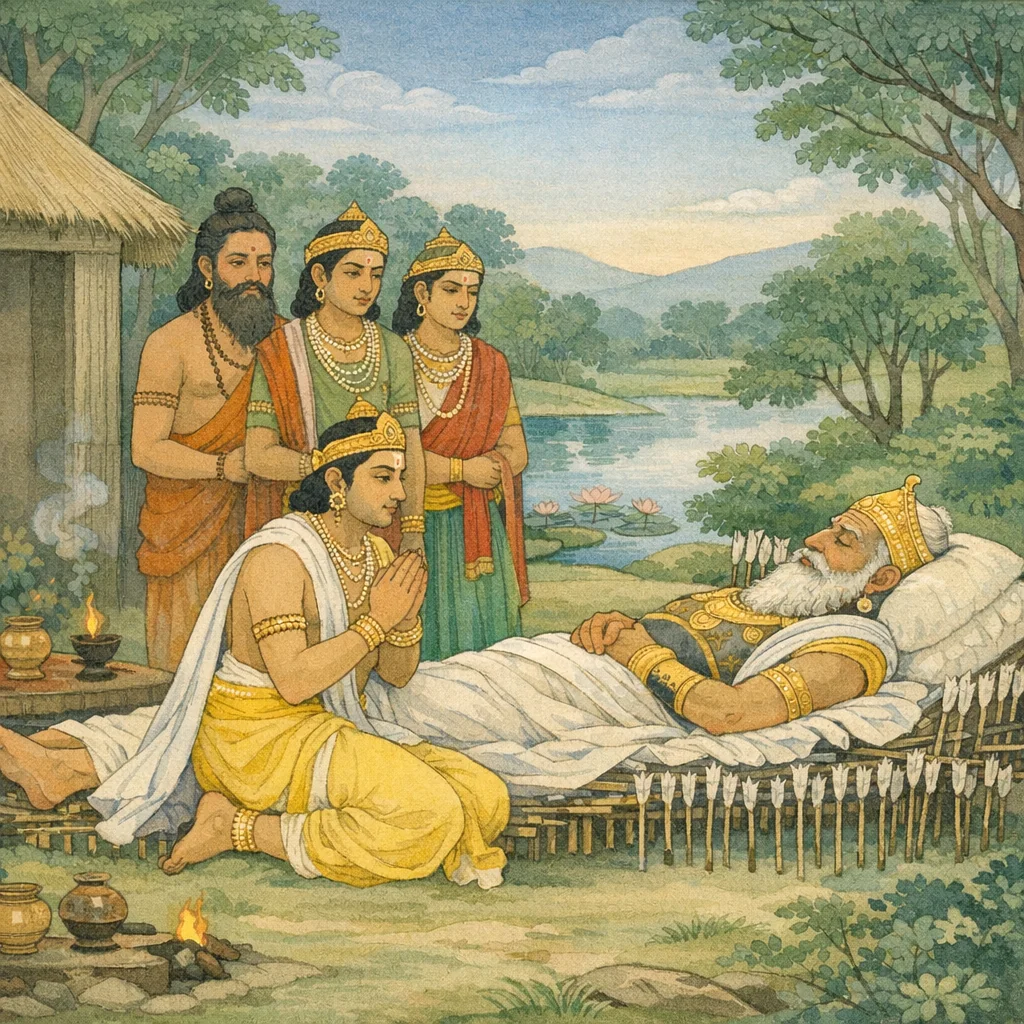
Adhyaya 212
Vimokṣa-niścaya: Pañcaśikha’s Analysis of Aggregates, Guṇas, and Tyāga (मोक्षनिर्णयः)
Upa-parva: Mokṣa-dharma (Liberation Teachings) — Pañcaśikha–Janaka Discourse Unit
Bhīṣma reports that King Janaka, though instructed by a great sage, again inquires about “bhavābhava” at death—whether personal awareness persists and what the practical value of knowledge is if all ends in dissolution. Pañcaśikha responds by rejecting both an uccheda-fixed view (absolute annihilation) and a bhāva-fixed view (simple permanence). He models the person as a functional aggregation of body, senses, and mind operating through mutual support in action, composed of five elements (ākāśa, vāyu, tejas/uṣmā, āpa/sneha, pṛthivī). He enumerates sense faculties and objects, describes feeling as threefold (pleasant, painful, neutral), and identifies buddhi as decisive cognition regarding all categories. Misidentifying the aggregate as self yields unending distress; correct orientation requires “samyaṅ-manas” framed as an unsurpassed tyāga-śāstra. Tyāga is mapped in graded forms (relinquishing goods, enjoyments, pleasure-seeking, and finally all appropriation). The chapter systematizes the eleven instruments (five jñānendriyas, five karmendriyas, and mind), explains tri-guṇa dispositions with diagnostic markers, and argues that causal functioning under svabhāva does not entail either total extinction or crude eternality. Liberation is depicted via non-adhesion metaphors (lotus-leaf, spider-thread, shedding skin, bird leaving a falling tree). A concluding phala-style statement credits sustained study of this vimokṣa-niścaya with resilience and release, aligning Janaka’s certainty with freedom from sorrow.
Chapter Arc: भीष्म युधिष्ठिर के सामने दुर्लभ वेदविद्वानों और वेदोक्त कर्म में स्थित जनों की चर्चा से आरम्भ करते हैं—परन्तु बताते हैं कि केवल कर्म-मार्ग नहीं, प्रशस्त ‘मार्ग’ की खोज ही मनुष्य को ऊँचा उठाती है। → युधिष्ठिर के भीतर संशय उभरता है: विषयों से घिरे मन को शान्ति कैसे मिले? गुणों (सत्त्व-रज-तम) के कार्य-परिणाम क्या हैं, और निषिद्ध आचरण का त्याग किस प्रकार साध्य है? इन्द्रियों को संयमित करने और अहंकार को कर्म-प्रवर्तक कारण मानने की बात से प्रश्न और तीखा होता है। → भीष्म निर्णायक उपदेश देते हैं: जो शान्ति चाहता है वह विषयात्मक भावों का आलोचनात्मक निरीक्षण करे, इन्द्रियों को बाँधे, और समझे कि काल-ऋतु की तरह गुण अपने-अपने समय पर उभरते हैं—पर कर्म को चलाने वाला ‘अहंकार’ है। सत्त्व में स्थित देही शुद्ध सात्त्विक भावों को देखता है; श्रद्धा-विद्या से युक्त होकर निर्मलता की ओर बढ़ता है। → अध्याय का निष्कर्ष यह है कि निषिद्ध आचरण का त्याग, सत्य-शौच-सरलता-त्याग-क्षमा-धैर्य-तप आदि सद्गुणों का आश्रय, तथा सत्त्वगुण का सेवन—ये मिलकर मन को शान्ति और परा-गति की ओर ले जाते हैं। → युधिष्ठिर का प्रश्न-क्रम आगे भी चलता है—गुणों के बलाबल और दोषों के विवेचन की सूक्ष्मता अगले उपदेशों की ओर संकेत करती है।
Shlokas
Verse 1
ऑपन-मा_ज बक। अं कऋाा-ज द्वादर्शाधिकद्विशततमो< ध्याय: निषिद्ध आचरणके त्याग, सत्त्व, रज और तमके कार्य एवं परिणामका तथा सत्त्वगुणके सेवनका उपदेश भीष्म उवाच प्रवृत्तिलक्षणो धर्मो यथा समुपलभ्यते । तेषां विज्ञाननिष्ठानामन्यत्तत्त्वं न रोचते,भीष्मजी कहते हैं--राजन्! कर्मनिष्ठ पुरुषोंको जिस प्रकार प्रवृत्तिधर्मकी उपलब्धि होती है--वही उन्हें अच्छा लगता है, उसी प्रकार जो ज्ञानमें निष्ठा रखनेवाले हैं, उन्हें ज्ञानके सिवा दूसरी कोई वस्तु अच्छी नहीं लगती
Bhīṣma said: O King, just as men devoted to action find fulfillment in the dharma marked by worldly engagement, so too those firmly established in true knowledge find nothing else pleasing apart from that knowledge.
Verse 2
दुर्लभा वेदविद्वांसो वेदोक्तेषु व्यवस्थिता: । प्रयोजन महत्त्वात्तु मार्गमिच्छन्ति संस्तुतम्,वेदोंके विद्वान् और वेदोक्त कर्मोमें निष्ठा रखनेवाले पुरुष प्राय: दुर्लभ हैं। जो अत्यन्त बुद्धिमान हैं, वे पुरुष वेदोक्त दोनों मार्गोमेंसे जो अधिक महत्त्वपूर्ण होनेके कारण सबके द्वारा प्रशंसित है, उस मोक्षमार्गको ही चाहते हैं
Bhishma said: Those who truly know the Veda and remain firmly established in the Veda-enjoined disciplines are rare. But the supremely discerning, seeing the greater purpose, seek the path that is most praised by all—the path leading to liberation.
Verse 3
सद्ध्विराचरितत्वात्तु वृत्तमेतदगर्हितम् । इयं सा बुद्धिरभ्येत्य यया याति परां गतिम्
Bhīṣma said: “Because this conduct has been practiced by the virtuous, this way of life is blameless. This is that very understanding which, once attained, leads a person to the highest goal.”
Verse 4
सत्पुरुषोंने सदा इसी मार्गको ग्रहण किया है; अतः यही अनिन््द्य एवं निर्दोष है। यह वह बुद्धि है जिसके द्वारा चलकर मनुष्य परम गतिको प्राप्त कर लेता है ।। शरीरवानुपादत्ते मोहात् सर्वान् परिग्रहान् | क्रोधलोभादिभिभर्भावैर्युक्तो राजसतामसै:,जो देहाभिमानी है, वह मोहवश क्रोध, लोभ आदि राजस, तामस भावोंसे युक्त होकर सब प्रकारकी वस्तुओंके संग्रहमें लग जाता है
Bhishma said: This path has always been adopted by the truly good; therefore it is blameless and free from fault. It is that discerning wisdom by following which a person attains the highest goal. But one who identifies with the body, deluded by ignorance, takes up every kind of possession; driven by states such as anger and greed—colored by passion and darkness—he becomes absorbed in accumulating and clinging to things.
Verse 5
नाशुद्धमाचरेत् तस्मादभीप्सन् देहयापनम् | कर्मणा विवरं कुर्वन्न लोकानाप्नुयाच्छुभान्,अतः जो देह-बन्धनसे मुक्त होना चाहता हो, उसे कभी अशुद्ध (अवैध) आचरण नहीं करना चाहिये। वह निष्काम कर्मद्वारा मोक्षका द्वार खोले और स्वर्ग आदि पुण्यलोक पानेकी कदापि इच्छा न करे
Therefore, one who longs to be freed from the bondage of the body should never engage in impure or unlawful conduct. By desireless action (niṣkāma karma) he should open the gate to liberation, and he should not at all yearn for meritorious realms such as heaven.
Verse 6
लोहयुक्तं यथा हेम विपक्वं न विराजते । तथापक््वकषायाख्यं विज्ञानं न प्रकाशते,जैसे लोहयुक्त सुवर्ण आगमें पकाकर शुद्ध किये बिना अपने स्वरूपसे प्रकाशित नहीं होता, उसी प्रकार चित्तके राग आदि दोषोंका नाश हुए बिना उसमें ज्ञानस्वरूप आत्मा प्रकाशित नहीं होता है
As gold alloyed with iron does not shine until it is purified in fire, so too knowledge (vijñāna) does not illumine while the mind’s stains—called kaṣāya, such as attachment (rāga) and the like—have not been destroyed.
Verse 7
यश्चाधर्म चरेललोभात् कामक्रोधावनुप्लवन् । धर्म्य पन्थानमाक्रम्य सानुबन्धो विनश्यति
Bhīṣma said: Whoever, driven by greed, practices unrighteousness—swept along by desire and anger—though he may step onto a path that appears righteous, is ruined along with all that is bound up with him: his ties, his consequences, and those who depend on him.
Verse 8
जो लोभवश काम-क्रोधका अनुसरण करते हुए धर्ममार्गका उल्लंघन करके अधर्मका आचरण करने लगता है, वह सगे-सम्बन्धियोंसहित नष्ट हो जाता है ।। शब्दादीन् विषयांस्तस्मान्न संरागादयं व्रजेत् । क्रोधो हर्षो विषादश्च॒ जायन्तेह परस्परात्,अपने कल्याणकी इच्छा रखनेवाले पुरुषको कभी रागके वशमें होकर शब्द आदि विषयोंका सेवन नहीं करना चाहिये; क्योंकि वैसा करनेपर हर्ष, क्रोध और विषाद--इन सात्विक, राजस और तामस भावोंकी एक-दूसरेसे उत्पत्ति होती है
Bhīṣma said: Therefore, a man who seeks his own welfare should not, under the sway of attachment, pursue sense-objects such as sound and the rest. For when one indulges in them through craving, joy, anger, and dejection arise here, each giving rise to the other in turn—thus disturbing discernment and leading one away from the path of dharma.
Verse 9
पञ्चभूतात्मके देहे सत्त्वे राजसतामसे । कमभिष्ट्वते चायं क॑ वा55क्रोशति कि वदन्,यह शरीर पाँच भूतोंका विकार है और सत्त्व, रज एवं तम--तीन गुणोंसे युक्त है। इसमें रहकर यह निर्विकार आत्मा क्या कहकर किसकी निन्दा और किसकी स्तुति करे
Bhīṣma said: “This body is a modification of the five great elements and is conditioned by the three qualities—sattva, rajas, and tamas. Dwelling within it, what could the changeless Self meaningfully say—whom could it blame or praise, and on what grounds?”
Verse 10
स्पर्शरूपरसाद्येषु सड़ं गच्छन्ति बालिशा: । नावगच्छन्त्यविज्ञानादात्मानं पार्थिवं गुणम्,अज्ञानी पुरुष स्पर्श, रूप और रस आदि विषयोंमें आसक्त होते हैं। वे विशिष्ट ज्ञानसे रहित होनेके कारण यह नहीं जानते हैं कि यह शरीर पृथ्वीका विकार है
Bhīṣma said: The foolish run after the sixfold field of sense-objects—touch, form, taste, and the rest. Lacking discriminative knowledge, they do not recognize the self as conditioned by the earthly (material) quality, mistaking what is merely a transformation of the elements for their true nature.
Verse 11
मृन्मयं शरणं यद्वधन्मृदैव परिलिप्यते । पार्थिवो5यं तथा देहो मृद्विकारान्न नश्यति,जैसे मिट॒टीका घर मिट्टीसे ही लीपा जाता है तो सुरक्षित रहता है, उसी प्रकार यह पार्थिव शरीर पृथ्वीके ही विकारभूत अन्न और जलके सेवनसे ही नष्ट नहीं होता है
Bhīṣma said: “Just as a shelter made of clay is kept safe when it is plastered again with clay, so too this earthly body is not destroyed merely by taking in what is itself a modification of earth—food and water. What is of the same element sustains it rather than ruining it.”
Verse 12
मधु तैलं पय: सर्पिर्मासानि लवणं गुड: । धान्यानि फलमूलानि मृद्विकारा: सहाम्भसा,मधु, तेल, दूध, घी, मांस, लवण, गुड़, धान्य, फल-मूल और जल--ये सभी पृथ्वीके ही विकार हैं
Bhīṣma said: “Honey, oil, milk, ghee, meats, salt, jaggery, grains, fruits and roots, and water as well—these are all transformations of the earth. The teaching reminds us that what people prize as nourishment and wealth is materially grounded, and thus calls for discernment and restraint rather than attachment to the pleasures of the senses.”
Verse 13
यद्वत् कान्तारमातिष्ठ न्नौत्सुक्यं समनुव्रजेत् । ग्राम्यमाहारमादद्यादस्वाद्गपि हि यापनम्,जैसे वनमें रहनेवाला संन्यासी स्वादिष्ट अन्न (मिठाई आदि)-के लिये उत्सुक नहीं होता। वह शरीर-निर्वाहके लिये स्वाधीन रूखा-सूखा ग्रामीण आहार भी ग्रहण कर लेता है, उसी प्रकार संसाररूपी वनमें रहनेवाला गृहस्थ परिश्रममें संलग्न हो जीवन-निर्वाहमात्रके लिये शुद्ध सात््विक आहार ग्रहण करे। ठीक उसी तरह, जैसे रोगी जीवनरक्षाके लिये औषध सेवन करता है
Bhīṣma said: “Just as one who dwells in the wilderness does not chase cravings, but accepts even plain, rustic food—though tasteless—simply to keep the body going, so too should a householder living in the forest-like world, engaged in honest effort, take pure and sāttvika food only for bare maintenance, as a sick person takes medicine solely to preserve life.”
Verse 14
तद्धत् संसारकान्तारमातिष्ठ न् श्रमतत्पर: । यात्रार्थमद्यादाहारं व्याधितो भेषजं यथा,जैसे वनमें रहनेवाला संन्यासी स्वादिष्ट अन्न (मिठाई आदि)-के लिये उत्सुक नहीं होता। वह शरीर-निर्वाहके लिये स्वाधीन रूखा-सूखा ग्रामीण आहार भी ग्रहण कर लेता है, उसी प्रकार संसाररूपी वनमें रहनेवाला गृहस्थ परिश्रममें संलग्न हो जीवन-निर्वाहमात्रके लिये शुद्ध सात््विक आहार ग्रहण करे। ठीक उसी तरह, जैसे रोगी जीवनरक्षाके लिये औषध सेवन करता है
So too, dwelling in the wilderness of worldly life and devoted to honest effort, one should take food only for the sake of sustaining the journey of life—just as a sick man takes medicine, not for pleasure but for preservation.
Verse 15
सत्यशौचार्जवत्यागैर्वर्चसा विक्रमेण च | क्षान्त्या धृत्या च बुद्धथा च मनसा तपसैव च
Bhīṣma said: “By truthfulness, purity, straightforwardness, and generosity; by spiritual radiance and valor; and also by forbearance, steadfastness, right understanding, disciplined mind, and austerity—(a person is strengthened and made fit for the highest good).”
Verse 16
भावान् सर्वनुपावृत्तान् समीक्ष्य विषयात्मकान् | शान्तिमिच्छन्नदीनात्मा संयच्छेदिन्द्रियाणि च
Having carefully examined all mental states that arise in connection with sense-objects, a steadfast person who seeks inner peace should restrain the senses as well.
Verse 17
उदारचित्त पुरुष सत्य, शौच, सरलता, त्याग, तेज, पराक्रम, क्षमा, धैर्य, बुद्धि, मन और तपके प्रभावसे समस्त विषयात्मक भावोंपर आलोचनात्मक दृष्टि रखते हुए शान्तिकी इच्छासे अपनी इन्द्रियोंको संयममें रखे ।। सत्त्वेन रजसा चैव तमसा चैव मोहिता: । चक्रवत् परिवर्तन्ते हृज्ञानाज्जन्तवो भूशम्
Bhishma said: A noble-minded person, empowered by truthfulness, purity, straightforwardness, renunciation, vigor, valor, forgiveness, steadiness, intelligence, a disciplined mind, and austerity, should look critically upon all sense-born impulses and, desiring peace, keep the senses under restraint. For beings, deluded by sattva, rajas, and tamas, keep revolving like a wheel, greatly driven by the mind’s inner cognition and its confusions.
Verse 18
अजितेन्द्रिय जीव अज्ञानवश सत्त्व, रज और तमसे मोहित हो निरन्तर चक्रकी तरह घूमते रहते हैं ।। तस्मात् सम्यक् परीक्षेत दोषानज्ञानसम्भवान् | अज्ञानप्रभवं दुःखमहंकारं परित्यजेत्,अतः विवेकी पुरुषको चाहिये कि वह अज्ञानजनित दोषोंकी भलीभाँति परीक्षा करे तथा उस अज्ञानसे उत्पन्न हुए दुःख और अहंकारको त्याग दे
Bhishma said: A living being who has not conquered the senses, driven by ignorance and deluded by the qualities of sattva, rajas, and tamas, keeps revolving ceaselessly like a wheel. Therefore one should carefully examine the faults that arise from ignorance, and renounce the suffering and the ego-sense that are born of that ignorance.
Verse 19
महाभूतानीन्द्रियाणि गुणा: सत्त्वं रजस्तम: । त्रैलोक्यं सेश्वरं सर्वमहंकारे प्रतिष्ठितम्,पजञ्चमहाभूत, इन्द्रियाँ, शब्द आदि गुण, सत्त्व, रज और तम तथा लोकपालोंसहित तीनों लोक--यह सब कुछ अहंकारमें ही प्रतिष्ठित है
Bhishma said: The great elements, the senses, the sense-qualities, and the three strands of nature—sattva, rajas, and tamas—together with the three worlds and their presiding lords: all of this stands established in egoity (ahaṃkāra).
Verse 20
यथेह नियत: कालो दर्शयत्यार्तवान् गुणान् | तद्धद्धूतेष्वहंकारं विद्यात् कर्मप्रवर्तकम्,जैसे इस जगत्में नियत काल यथासमय ऋतु-सम्बन्धी गुणोंको प्रकट कर दिखाता है, उसी प्रकार समस्त प्राणियोंमें अहंकारको ही उनके कर्मोंका प्रवर्तक जानना चाहिये
Bhishma said: Just as, in this world, fixed Time reveals the qualities of the seasons at their proper moment, so too one should understand that in all beings it is ego-sense (the ‘I’-notion) that sets their actions in motion.
Verse 21
सम्मोहकं तमो विद्यात् कृष्णमज्ञानसम्भवम् | प्रीतिदुःखनिबद्धांश्व समस्तांस्त्रीनथो गुणान्,अहंकार सात्त्विक, राजस और तामस तीन प्रकारका होता है। तमोगुण मोहमें डालनेवाला तथा अन्धकारके समान काला है। उसे अज्ञानसे उत्पन्न हुआ समझना चाहिये। प्रीति उत्पन्न करनेवाले भाव सात्त्विक हैं और दुःख देनेवाले राजस। इस प्रकार इन समस्त त्रिविध गुणोंका स्वरूप जानना चाहिये
Bhishma said: One should understand tamas as the power that bewilders—dark like blackness—and born of ignorance. Among the three qualities (guṇas) that bind all beings, those dispositions that give rise to contentment and affection are sāttvika, while those that generate suffering are rājasa. Thus should the nature of the threefold guṇas be discerned.
Verse 22
सत्त्वस्यथ रजसश्वैव तमसश्न निबोध तान् । प्रसादो हर्षजा प्रीतिरसंदेहो धृति: स्मृति: । एतान् सत्त्वगुणान् विद्यादिमान् राजसतामसान्,अब मैं तुम्हें सत््वगुण, रजोगुण और तमोगुणके कार्य बताता हूँ, सुनो। प्रसन्नता, हर्षजनित प्रीति, संदेहका अभाव, धैर्य और स्मृति--इन सबको सत्त्वगुणके कार्य समझो। काम, क्रोध, प्रमाद, लोभ, मोह, भय, क्लान्ति, विषाद, शोक, अप्रसन्नता, मान, दर्प और अनार्यता--इन्हें रजोगुण और तमोगुणके कार्य समझना चाहिये
Bhishma said: “Now understand the effects of the three qualities—sattva, rajas, and tamas. Serenity of mind, joy-born affection, freedom from doubt, steadiness, and memory—these are to be known as the workings of sattva. By contrast, impulses such as desire and anger, along with heedlessness, greed, delusion, fear, fatigue, dejection, grief, displeasure, pride, arrogance, and uncivil conduct are to be recognized as the workings of rajas and tamas.”
Verse 23
कामक्रोधौ प्रमादक्ष॒ लोभमोहौ भयं कलम: । विषादशोकावरतिर्मानदर्पावनार्यता,अब मैं तुम्हें सत््वगुण, रजोगुण और तमोगुणके कार्य बताता हूँ, सुनो। प्रसन्नता, हर्षजनित प्रीति, संदेहका अभाव, धैर्य और स्मृति--इन सबको सत्त्वगुणके कार्य समझो। काम, क्रोध, प्रमाद, लोभ, मोह, भय, क्लान्ति, विषाद, शोक, अप्रसन्नता, मान, दर्प और अनार्यता--इन्हें रजोगुण और तमोगुणके कार्य समझना चाहिये
Bhīṣma said: Desire and anger, heedlessness, greed and delusion, fear and exhaustion; dejection, grief, lack of delight (discontent), pride, arrogance, and uncouthness—these are to be understood as the effects that arise from rajas and tamas. In ethical terms, they are the inner forces that disturb clarity, weaken self-restraint, and pull a person away from steady discernment and dharmic conduct.
Verse 24
दोषाणामेवमादीनां परीक्ष्य गुरुलाघवम् । विमृशेदात्मसंस्थानमेकैकमनुसंततम्,इनके तथा ऐसे ही दूसरे दोषोंके बड़े-छोटेका विचार करके फिर इस बातकी परीक्षा करे कि इनमेंसे एक-एक दोष मुझमें है या नहीं। यदि है तो कितनी मात्रामें है (इस तरह विचार करते हुए सभी दोषोंसे छूटनेका प्रयत्न करे)
Bhishma said: Having thus examined the weight and lightness—i.e., the gravity and relative insignificance—of these faults and others like them, one should then reflect continuously upon one’s own inner condition, considering each fault one by one: whether it is present in oneself, and if so, to what extent. In this way, through sustained self-scrutiny, one should strive to become free from all such defects.
Verse 25
युधिछिर उवाच के दोषा मनसा त्यक्ता: के बुद्धया शिथिलीकृता: । के पुन: पुनरायान्ति के मोहादफला इव,युधिष्ठिरने पूछा--पितामह! पूर्वकालके मुमुक्षुओंने किन-किन दोषोंका मनके द्वारा त्याग किया है और किन्हें बुद्धिके द्वारा शिथिल किया है? कौन दोष बारंबार आते हैं और कौन मोहवश फल देनेमें असमर्थ-से प्रतीत होते हैं?
Yudhiṣṭhira said: “Which faults have the seekers of liberation in former times abandoned by mastering the mind, and which have they weakened through discernment? Which faults return again and again, and which—through delusion—seem as though they cannot yield any result?”
Verse 26
केषां बलाबल बुद्धया हेतुभिर्विमृशेद् बुध: । एष मे संशयस्तात तनमे ब्रूहि पितामह,विद्वान् पुरुष अपनी बुद्धि तथा युक्तियोंद्वारा किन दोषोंके बलाबलका विचार करे। तात! पितामह! यह मेरा संशय है। आप मुझसे इसका विवेचन कीजिये
Yudhiṣṭhira said: “O dear grandsire, a wise man, using discernment of what is strong and what is weak and examining the reasons behind it, should evaluate the relative force of which faults? This is my doubt. O Pitāmaha, please explain it to me.”
Verse 27
भीष्म उवाच दोषैर्मूलादवच्चिन्नैरविंशुद्धात्मा विमुच्यते । विनाशयति सम्भूतमयस्मयमयो यथा । तथा कृतात्मा सहजैदररषि्नश्यति तामसै:,भीष्मजीने कहा--राजन्! इन दोषोंका मूल कारण है अज्ञान। अत: मूलसहित इन दोषोंका नाश हो जानेपर मनुष्यका अन्त:ः:करण विशुद्ध होता है और वह संसार-बन्धनसे मुक्त हो जाता है। जैसे लोहेकी बनी हुई छेनीकी धार लोहमयी साँकलको काटकर स्वयं भी नष्ट हो जाती है, उसी प्रकार शुद्ध हुई बुद्धि तमोगुणजनित सहज दोषोंको नष्ट करके उनके साथ ही स्वयं भी शान्त हो जाती है
Bhishma said: O King, when faults are cut off together with their root, the inner self—formerly impure—becomes purified and is released from worldly bondage. Just as an iron tool, itself made of iron, can sever an iron chain and in the process wear away, so too a disciplined and purified intellect destroys the innate, tamas-born defects; and having accomplished that destruction, it too becomes quieted and comes to rest.
Verse 28
राजसं तामसं चैव शुद्धात्मकममकल्मषम् । तत् सर्व देहिनां बीज॑ सत्त्वमात्मवत: समम्,यद्यपि रजोगुण, तमोगुण तथा काम, मोह आदि दोषोंसे रहित शुद्ध सत्त्वमुण--ये तीनों ही देहधारियोंकी देहकी उत्पत्तिके मूल कारण हैं, तथापि जिसने अपने मनको वशमें कर लिया है, उस पुरुषके लिये सत्त्वगुण ही समताका साधन है
Bhishma said: ‘Rajas, tamas, and also the pure, stainless sattva—these are all the seed-causes for embodied beings (the basis from which embodied life and its conditions arise). Yet for the self-controlled person, sattva alone becomes the means to evenness of mind and balance.’
Verse 29
तस्मादात्मवता वर्ज्य रजश्न॒ तम एव च । रजस्तमोभ्यां निर्मुक्त सत्त्वं निर्मलतामियात्,अतः जितात्मा पुरुषको रजोगुण और तमोगुणका त्याग ही करना चाहिये। इन दोनोंसे छूट जानेपर बुद्धि निर्मल हो जाती है
Bhīṣma said: Therefore, a self-controlled person should renounce rajas and also tamas. When freed from rajas and tamas, sattva attains purity; and with that purity, the mind and understanding become clear—fit for right discernment and righteous conduct.
Verse 30
अथवा मन्त्रवद्ब्रूयुरात्मादानाय दुष्कृतम् । स वै हेतुरनादाने शुद्धरर्मानुपालने
Or, they may declare—solemnly, as if reciting a sacred formula—that a misdeed is to be ‘taken upon oneself’ (confessed and owned). For such acceptance becomes the very cause for not repeating the fault and for faithfully maintaining pure dharma.
Verse 31
अथवा बुद्धिको वशमें करनेके लिये शास्त्रविहित मन्त्रयुक्त यज्ञादि कर्मको कुछ लोग दोषयुक्त बताते हैं; परंतु वह मन्त्रयुक्त यज्ञादि धर्म भी निष्कामभावसे किये जानेपर वैराग्यका हेतु है। तथा शुद्ध धर्म--शम, दम आदिके निरन्तर पालनमें भी वही निमित्त बनता है ।। रजसाथधर्मयुक्तानि कार्याण्यपि समाप्रुते । अर्थयुक्तानि चात्यर्थ कामान् सर्वाश्व सेवते,मनुष्य रजोगुणके अधीन होनेपर उसके द्वारा भाँति-भाँतिके अधर्मयुक्त एवं अर्थयुक्त कर्म करने लगता है, तथा वह सम्पूर्ण भोगोंका अत्यन्त आसक्तिपूर्वक सेवन करता है
Bhishma explains that some people criticize the scripturally prescribed, mantra-accompanied rites—such as sacrifices—as flawed, especially when they are used to bring the intellect under control. Yet, when these ritual duties are performed without desire for personal gain, they themselves become a cause of dispassion and help one turn away from attachment. In the same way, they support the steady practice of pure dharma—self-restraint and sense-control (śama, dama, and the like). By contrast, when a person falls under the sway of rajas, even his undertakings become entangled with unrighteousness and self-interested aims, and he indulges in pleasures with intense attachment.
Verse 32
तमसा लोभयुक्तानि क्रोधजानि च सेवते । हिंसाविहाराभिरतस्तन्द्रीनिद्रासमन्वित:,तमोगुणद्वारा मनुष्य लोभ और क्रोधजनित कर्मोंका सेवन करता है, हिंसात्मक कर्मामें उसकी विशेष आसक्ति हो जाती है, तथा वह हर समय निद्रा-तन्द्रासे घिरा रहता है
Bhishma said: Under the sway of the quality of darkness (tamas), a person indulges in actions driven by greed and born of anger. He becomes especially attached to violent pursuits, and remains continually enveloped by lethargy and sleep.
Verse 33
सत्त्वस्थ: सात्त्विकान् भावान् शुद्धान् पश्यति संश्रित: । स देही विमल: श्रीमान् श्रद्धाविद्यासमन्वित:,सत्त्वगुणमें स्थित हुआ पुरुष शुद्ध सात््विक भावोंको ही देखता और उन्हींका आश्रय लेता है। वह अत्यन्त निर्मल और कान्तिमान् होता है। उसमें श्रद्धा और विद्याकी प्रधानता होती है
Bhīṣma said: “A person established in the quality of sattva perceives only pure, sāttvika dispositions and takes refuge in them. Such an embodied being becomes spotless and radiant, marked above all by faith and true understanding.”
Verse 211
इस प्रकार श्रीमह्याभारत शान्तिपर्वके अन्तर्गत गोक्षधर्मपर्वमें श्रीकृष्णसम्बन्धी अध्यात्मका कथनविषयक दो सौ ग्यारहवाँ अध्याय पूरा हुआ
Thus ends the two-hundred-and-eleventh chapter of the Śānti Parva of the Śrī Mahābhārata, within the section known as the Gokṣa-dharma sub-parva, dealing with the exposition of spiritual doctrine in relation to Śrī Kṛṣṇa.
Verse 212
इति श्रीमहाभारते शान्तिपर्वणि मोक्षधर्मपर्वणि वार्ष्णेया ध्यात्मक थने दादशाधिकद्विशततमो<ध्याय:
Thus ends, in the Śrī Mahābhārata, within the Śānti Parva—specifically in the Mokṣa-dharma section—the chapter set in the context of the Vārṣṇeyas and concerned with spiritual doctrine: the two-hundred-and-twelfth chapter. This is a formal colophon marking the close of the discourse attributed to Bhīṣma, situating it within the ethical and liberative teachings of the Śānti Parva.
Frequently Asked Questions
Janaka questions whether knowledge and careful conduct have any practical meaning if post-mortem identity does not persist and all beings dissolve; the dilemma tests the basis of ethical effort under uncertainty about after-death continuity.
The person is a causally functioning aggregate governed by guṇas; suffering persists through misidentification and appropriation. Liberation is operationalized as tyāga—systematic non-attachment to objects, experiences, and outcomes—so karmic results do not “stick.”
Yes. The closing verses state that one who studies and contemplates this “vimokṣa-niścaya” is not diminished by adversity, does not accrue distress, and is released—illustrated through Janaka’s sorrowless certainty.