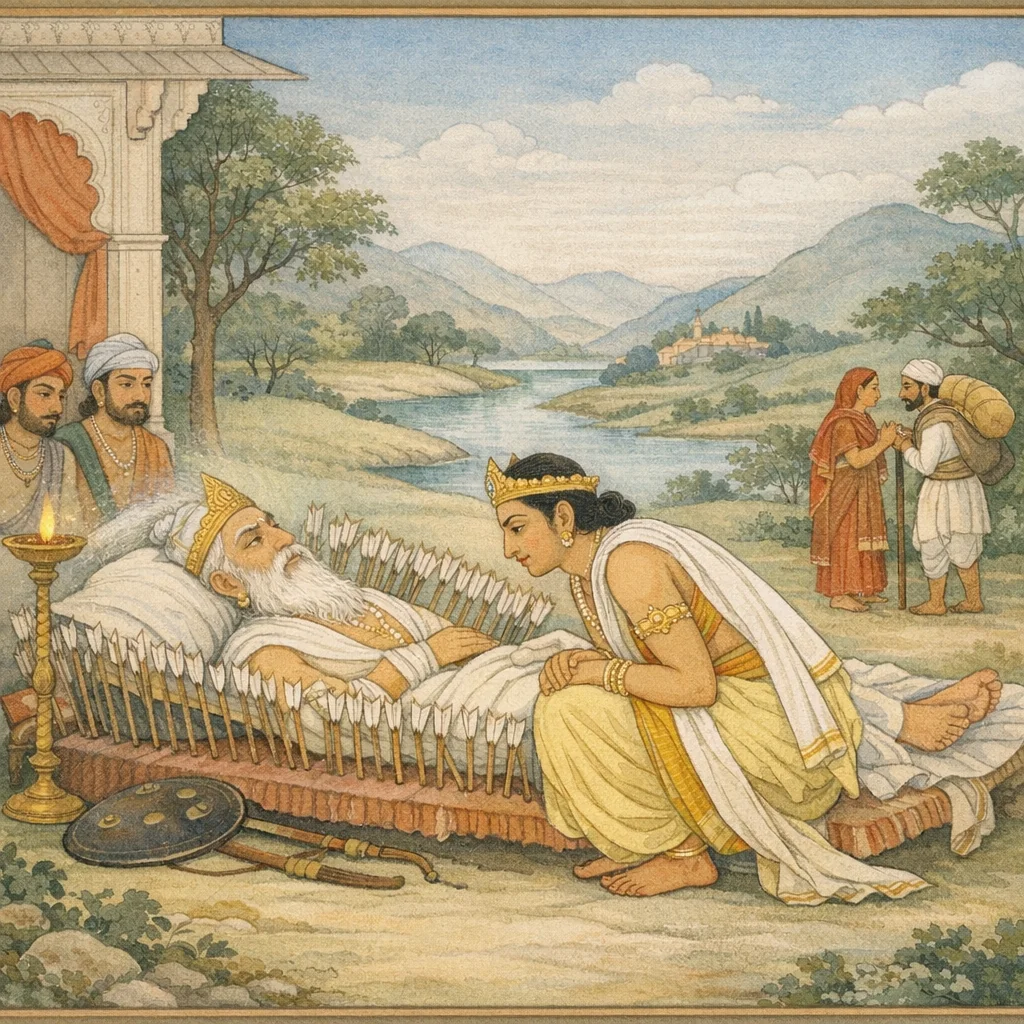
Adhyaya 131
Kośa, Bala, and Maryādā: Treasury, Capacity, and Enforceable Limits (कोश-बल-मर्यादा)
Upa-parva: Rājadharmānuśāsana Upa-Parva (राजधर्मानुशासन उपपर्व)
Bhīṣma instructs Yudhiṣṭhira that a ruler must generate and maintain the treasury (kośa) from both internal and external sources, because dharma in governance operationally proceeds from the fiscal root of the state (rājyamūla). He recommends disciplined accumulation followed by careful protection and welfare-oriented deployment, characterizing this as an enduring norm. He cautions that treasury-building cannot arise from either extreme purity (that avoids hard choices) or extreme cruelty; instead, one should adopt a calibrated middle course. Bhīṣma links fiscal weakness to loss of force, loss of sovereignty, and loss of prosperity, noting that people disregard a king with depleted resources and remain unsatisfied by minimal provision. He then turns to the role of boundaries (maryādā): unregulated predation produces fear even among predatory groups, whereas stable limits—even minimal—are socially honored and can secure cooperation. He enumerates condemned acts (e.g., harming non-combatants, violating protected persons, total dispossession, and abuses against women) and argues that restraint and leaving ‘a remainder’ (saśeṣa) reduces backlash and long-term risk, while total annihilative extraction (niḥśeṣa) generates persistent fear and resistance.
Chapter Arc: युधिष्ठिर का तीखा प्रश्न उठता है—आपत्तिकाल में जब राजा मित्रों से छूट रहा हो, कोष क्षीण हो, बल घट गया हो और दुष्ट मंत्रियों के कारण राज्य डगमगा रहा हो, तब उसकी ‘गति’ क्या है? → भीष्म संकट-धर्म की कठोर भूमि पर राजा को उतारते हैं: दुष्ट अमात्य, भ्रष्ट मंत्र, गिरता हुआ राज्य, और प्रजा-परदेशियों तक की आजीविका का संकट—इन सबके बीच निर्णय-शक्ति ही राजा की अंतिम ढाल है। वे बताते हैं कि अर्थ के साधन अनेक हैं, पर आपत्तिकाल में अर्थ-नीति का उलट-पुलट (जो एक हेतु से किया जाए वह विपरीत फल दे) राजा को सतर्क विवेक से कार्य-निश्चय करने को बाध्य करता है। → भीष्म का निर्णायक प्रतिपादन—‘निर्धन दुर्बल है; धन से बल आता है; कोष वाला संकट पार करता है’—और साथ ही राजा के लिए धिक्कार-सा वाक्य: जिस राज्य में प्रजा और आगंतुक परदेशी भी जीविका से वंचित हों, उस राजा का जीवन ही निंद्य है। यहाँ राजधर्म का केंद्र ‘कोष’ नहीं, ‘प्रजा-धारण’ बन जाता है। → अध्याय धन-उपार्जन के विविध मार्गों (दान, यज्ञ, तप, बुद्धि, कार्य-कौशल) का संकेत देकर यह निष्कर्ष स्थिर करता है कि आपत्तिकाल में मेधावी राजा को साधन-चयन, समयोचित नीति और कोष-संरक्षण द्वारा राज्य-धर्म की रक्षा करनी चाहिए—क्योंकि कोष ही धर्म-पालन और संकट-निवारण का उपकरण है।
Shlokas
Verse 1
अत---#क्र+ त्रिशर्दाधिकशततमो<्ध्याय: आप त्तिके समय राजाका धर्म युधिछिर उवाच मित्रै: प्रहीयमाणस्य बह्नमित्रस्य का गति: । राज्ञ: संक्षीणकोशस्य बलहीनस्य भारत,यधिष्ठिरने पूछा--भारत! यदि राजाके शत्रु अधिक हो जाय॑ँ, मित्र उसका साथ छोड़ने लगें और सेना तथा खजाना भी नष्ट हो जाय तो उसके लिये कौन-सा मार्ग हितकर है?
Yudhiṣṭhira said: O Bhārata, what course remains for a king who, though once rich in allies, is being abandoned by his friends, whose treasury has been exhausted, and who has become bereft of military strength? In a time of calamity, which path is truly beneficial for such a ruler?
Verse 2
दुष्टामात्यसहायस्य च्युतमन्त्रस्य सर्वतः । राज्यात् प्रच्यवमानस्य गतिमग्ग्रामपश्यत:
Yudhiṣṭhira said: “When a king is backed by wicked ministers, when his counsel and policy have fallen into disarray on every side, and when he is slipping away from his kingdom, he no longer sees the path forward—he cannot discern the way to safety or a rightful course of action.”
Verse 3
दुष्ट मन््त्री ही जिसका सहायक हो, इसीलिये जो श्रेष्ठ परामर्शसे भ्रष्ट हो गया हो एवं राज्यसे जिसके भ्रष्ट हो जानेकी सम्भावना हो और जिसे अपनी उन्नतिका कोई श्रेष्ठ उपाय न दिखायी देता हो, उसके लिये क्या कर्तव्य है? ।। परचक्राभियातस्य परराष्ट्राणि मृदूनतः । विग्रहे वर्तमानस्य दुर्बलस्य बलीयसा,जो शत्रुसेनापर आक्रमण करके शत्रुके राज्यको रौंद रहा हो; इतनेहीमें कोई बलवान् राजा उसपर भी चढ़ाई कर दे तो उसके साथ युद्धमें लगे हुए उस दुर्बल राजाके लिये क्या आश्रय है?
Yudhiṣṭhira said: If a king is supported by a wicked counsellor, and therefore has fallen away from sound counsel—so that the loss of his kingdom is likely, and he sees no noble means for his own advancement—what should such a man do? And again: when a ruler has marched against an enemy host and is trampling the enemy’s realm, but in the midst of that campaign a stronger king attacks him as well—what refuge is there for that weaker king who is already engaged in war?
Verse 4
असंविहितराष्ट्स्य देशकालावजानत: । अप्राप्यं च भवेत् सान्त्वं भेदो वाप्पतिपीडनात् । जीवित त्वर्थहेतुर्वा तत्र कि सुकृतं भवेत्,जिसने अपने राज्यकी रक्षा नहीं की हो, जिसे देश और कालका ज्ञान नहीं हो, अत्यन्त पीड़ा देनेके कारण जिसके लिये साम अथवा भेदनीतिका प्रयोग असम्भव हो जाय, उसके लिये क्या करना उचित है वह जीवनकी रक्षा करे या धनके साधनकी? उसके लिये क्या करनेमें भलाई है?
Yudhiṣṭhira said: “For one who has failed to safeguard his kingdom, who does not understand the proper place and time, and who—because of extreme oppression—can no longer make use of conciliation or even division as policy, what course is truly right? Should he strive to preserve life, or to secure the means of wealth? In such a situation, what action counts as the better, the more righteous choice?”
Verse 5
भीष्म उवाच गुहां धर्मज मा प्राक्षीरतीव भरतर्षभ । अपृष्टो नोत्सहे वक्तुं धर्ममेतं युधिष्ठिर
Bhīṣma said: “O Dharmarāja, O best of the Bharatas, do not press me too insistently about this subtle matter. Unless I am asked, I do not feel able to speak of this teaching on dharma, O Yudhiṣṭhira.”
Verse 6
भीष्मजीने कहा--धर्मनन्दन! भरतश्रेष्ठ युधिष्ठिर! यह तो तुमने मुझसे बड़ा गोपनीय विषय पूछा है। यदि तुम्हारे द्वारा प्रश्न न किया गया होता तो मैं इस समय इस संकटकालिक धर्मके विषयमें कुछ भी नहीं कह सकता था ।। धर्मो हणीयान् वचनाद् बुद्धिश्व भरतर्षभ | श्रुत्वोपास्यथ सदाचारै: साधुर्भवति स क्वचित्,भरतभूषण! धर्मका विषय बड़ा सूक्ष्म है, शास्त्र-वचनोंके अनुशीलनसे उसका बोध होता है। शास्त्रश्रवण करनेके पश्चात् अपने सदाचरणोंद्वारा उसका सेवन करके साधुजीवन व्यतीत करनेवाला पुरुष कहीं कोई बिरला ही होता है
Bhishma said: “O bull among the Bharatas, O Yudhishthira, ornament of the Bharata line—Dharma is subtle and can even be diminished when reduced to mere words; and understanding, too, may fail. Only rarely does a person, after hearing the teachings of the scriptures, truly practice them through disciplined good conduct and thereby become genuinely virtuous. You have asked me a deeply confidential matter; had you not questioned me, I could not have spoken of this dharma meant for times of crisis.”
Verse 7
कर्मणा बुद्धिपूर्वेण भवत्याढ्यो न वा पुनः । तादृशो<यमनुप्रश्न: संव्यवस्य: स्वया धिया,बुद्धिपूर्वक किये हुए कर्म (प्रयत्न)-से मनुष्य धनाढ्य हो भी सकता है और नहीं भी हो सकता है। तुम्हें ऐसे प्रश्नपर स्वयं अपनी ही बुद्धिसे विचार करके किसी निश्चयपर पहुँचना चाहिये
By actions undertaken with forethought and intelligence, a man may become wealthy—or he may not. Therefore, on a question such as this, you should reflect with your own understanding and arrive at a firm conclusion.
Verse 8
उपायं धर्मबहुलं यात्रार्थ शूणु भारत । नाहमेतादृशं धर्म बुभूषे धर्मकारणात्,भारत! उपर्युक्त संकटके समय राजाओंके जीवनकी रक्षाके लिये मैं ऐसा उपाय बताता हूँ जिसमें धर्मकी अधिकता है, उसे ध्यान देकर सुनो। परंतु मैं धर्माचरणके उद्देश्यसे ऐसे धर्मको नहीं अपनाना चाहता
O Bharata, listen attentively to a measure for the journey, one in which dharma is predominant. In the distress spoken of above, to safeguard the lives of kings, I shall set forth such a means. Yet I do not wish to adopt a dharma of this kind merely for the sake of practicing dharma.
Verse 9
दुःखादान इह होष स्यात् तु पश्चात् क्षयोपम: । अभिगम्यमतीनां हि सर्वासामेव निश्चय:,आपत्तिके समय भी यदि प्रजाको दुःख देकर धन वसूल किया जाता है तो पीछे वह राजाके लिये विनाशके तुल्य सिद्ध होता है। आश्रय लेने योग्य जितनी बुद्धियाँ हैं, उन सबका यही निश्चय है
Bhishma said: “If, in a time of distress, a king extracts revenue by causing suffering to his subjects, it may seem advantageous at the moment; but later it proves ruinous, like destruction itself. This is the settled judgment of all prudent minds worthy of being consulted.”
Verse 10
यथा यथा हि पुरुषो नित्यं शास्त्रमवेक्षते । तथा तथा विजानाति विज्ञानमथ रोचते,पुरुष प्रतिदिन जैसे-जैसे शास्त्रका स्वाध्याय करता है वैसे-वैसे उसका ज्ञान बढ़ता जाता है फिर तो विशेष ज्ञान प्राप्त करनेमें ही उसकी रुचि हो जाती है
Bhishma said: As a person, day after day, keeps examining and studying the śāstras, so too does his understanding steadily grow; and then his mind comes to delight especially in higher, discriminative knowledge.
Verse 11
अविज्ञानादयोगो हि पुरुषस्पोपजायते । विज्ञानादपि योगश्व योगो भूतिकर: पर:,ज्ञान न होनेसे मनुष्यको संकटकालमें उससे बचनेके लिये कोई योग्य उपाय नहीं सूझता; परंतु ज्ञानसे वह उपाय ज्ञात हो जाता है। उचित उपाय ही ऐश्वर्यकी वृद्धि करनेका श्रेष्ठ साधन है
Bhishma said: From lack of true understanding, a person falls into non-application—he cannot discern the fitting course of action when difficulty arises. But from understanding, the appropriate means becomes known; and that well-chosen means, put into practice, is the highest cause of prosperity and well-being.
Verse 12
अशंकमानो वचनमनसूयुरिदं शृणु । राज्ञ: कोशक्षयादेव जायते बलसंक्षय:,तुम मेरी बातपर संदेह न करते हुए दोषदृष्टिका परित्याग करके यह उपदेश सुनो। खजानेके नष्ट होनेसे ही राजाके बलका नाश होता है
Bhīṣma said: “Listen to this instruction without doubt and without fault-finding. It is from the depletion of the king’s treasury that the weakening of his power inevitably arises.”
Verse 13
कोशं च जनयेद् राजा निर्जलेभ्यो यथा जलम् | काल प्राप्यानुगृह्लीयादेष धर्म: सनातन: । उपायधर्म प्राप्येमं पूर्वराचरितं जनै:,जैसे मनुष्य निर्जल स्थानोंसे भी खोदकर जल निकाल लेता है उसी प्रकार राजा संकटकालमें निर्धन प्रजासे भी यथासाध्य धन लेकर अपना खजाना बढ़ावे; फिर अच्छा समय आनेपर उस धनके द्वारा प्रजापर अनुग्रह करे, यही सनातनकालसे चला आनेवाला धर्म है। पूर्ववर्ती राजाओंने भी आपत्तिकालमें इस उपायधर्मको पाकर इसका आचरण किया है
Bhīṣma said: “A king should build up his treasury, just as one draws out water even from places that seem waterless. When the proper time returns, he should then show favor to the people by means of that wealth—this is the eternal, time-honored dharma. Earlier rulers too, when they encountered calamity, adopted this pragmatic ‘dharma of expedients’ and acted accordingly.”
Verse 14
अन्यो धर्म: समर्थानामापत्स्वन्यक्षु भारत । प्राकुकोशात् प्राप्यते धर्मो वृत्तिर्धर्मादू गरीयसी,भारत! सार्म्थ्यशाली पुरुषोंका धर्म दूसरा है और आपत्तिग्रस्त मनुष्योंका दूसरा। अतः पहले कोशसंग्रह कर लेनेपर राजाके लिये धर्मपालनका अवसर प्राप्त होता है; क्योंकि जीवन-निर्वाहका साधन प्राप्त करना धर्मसे भी बड़ा है
Bhīṣma said: “O Bharata, the rule of dharma for those who are capable is one thing, and for those struck by calamity it is another. Therefore, only after first securing the treasury does a king truly gain the occasion to uphold dharma; for the means of sustaining life and the realm’s functioning can, in urgent necessity, outweigh dharma in priority.”
Verse 15
धर्म प्राप्य न्यायवृत्ति न बलीयान् न विन्दति । यस्माद् बलस्योपपत्तिरेकान्तेन न विद्यते,दुर्बल मनुष्य धर्मको पाकर भी न्यायोचित्त जीविका नहीं उपलब्ध कर पाता है। धर्मांचरण करनेसे बलकी प्राप्ति अवश्य हो जायगी, यह निश्चितरूपसे नहीं कहा जा सकता; इसलिये आपत्तिकालमें अधर्म भी धर्मरूप सुना जाता है। परंतु विद्वान् पुरुष ऐसा मानते हैं कि आपत्तिकालमें भी धर्मके विरुद्ध आचरण करनेसे अधर्म होता ही है
Bhīṣma said: “Even after attaining dharma, a weak person does not necessarily obtain a livelihood that is fully in accord with justice. For the acquisition of strength is not guaranteed in an absolute way merely by practicing dharma. Therefore, in times of distress, conduct that is ordinarily adharma is sometimes spoken of as ‘dharma’ (as an emergency allowance). Yet the wise maintain that even in calamity, acting against dharma still remains adharma.”
Verse 16
तस्मादापत्स्वधर्मोडपि श्रूयते धर्मलक्षण: । अधर्मो जायते तस्मिन्निति वै कवयो विदु:,दुर्बल मनुष्य धर्मको पाकर भी न्यायोचित्त जीविका नहीं उपलब्ध कर पाता है। धर्मांचरण करनेसे बलकी प्राप्ति अवश्य हो जायगी, यह निश्चितरूपसे नहीं कहा जा सकता; इसलिये आपत्तिकालमें अधर्म भी धर्मरूप सुना जाता है। परंतु विद्वान् पुरुष ऐसा मानते हैं कि आपत्तिकालमें भी धर्मके विरुद्ध आचरण करनेसे अधर्म होता ही है
Bhishma said: Therefore, in times of calamity even what is called “dharma” may be spoken of as bearing the marks of dharma. Yet the wise know this for certain: when one acts contrary to dharma—even under distress—adharma is indeed produced. The teaching is that necessity may blur labels, but moral consequence remains; hardship does not automatically sanctify wrongdoing.
Verse 17
अनन्तरं क्षत्रियस्य तत्र कि विचिकित्स्यते | यथास्य धर्मों न ग्लायेन्नेयाच्छत्रुवशं यथा । तत् कर्तव्यमिहेत्याहुर्नात्मानवसादयेत्,आपत्ति दूर होनेके बाद क्षत्रियको क्या करना चाहिये? वह प्रायश्नित्त करे या प्रजासे कर लेना छोड़ दे; यह संशय उपस्थित होता है। इसका समाधान यह है कि वह ऐसा बर्ताव करे जिससे उसके धर्मको हानि न पहुँचे तथा उसे शत्रुके अधीन न होना पड़े। विद्वानोंने उसके लिये यही कर्तव्य बतलाया है, वह किसी तरह अपने-आपको संकटमें न डाले
Bhishma said: “After a crisis has passed, what should a kshatriya still be uncertain about? He should act so that his dharma does not decline and so that he does not fall under an enemy’s control. The wise declare this to be his duty here: he should not cast himself down or bring himself again into distress.”
Verse 18
सर्वात्मनैव धर्मस्य न परस्य न चात्मन: । सर्वोपायैरुज्जिहीर्षेदात्मानमिति निश्चय:,संकटकालमें मनुष्य अपने या दूसरेके धर्मकी ओर न देखे; अपितु सम्पूर्ण हृदयसे सभी उपायोंद्वारा अपने आपके ही उद्धारकी अभिलाषा करे, यही सबका निश्चय है
Bhishma said: “In a time of crisis, one should not fix one’s gaze on the duties of another, nor even cling to one’s own customary duty as such. With one’s whole being, employing every available means, one should seek to rescue oneself—this is the settled conclusion.”
Verse 19
तत्र धर्मविदां तात निश्चयो धर्मनैपुणम् उद्यमो नैपुणं क्षात्रे बाहुवीर्यादिति श्रुति:,तात! धर्मज्ञ पुरुषोंका निश्चय जैसे उनकी धर्म-विषयक निपुणताको सूचित करता है, उसी प्रकार बाहुबलसे अपनी उन्नतिके लिये उद्योग करना क्षत्रियकी निपुणताका सूचक है; यह श्रुतिका निर्णय है
“My son! Just as the resolve of those who know dharma reveals their mastery of dharma, so too striving for one’s advancement through strength of arm and warrior’s valor reveals the kshatriya’s mastery—such is the verdict of the Shruti.”
Verse 20
क्षत्रियो वृत्तिसंरोधे कस्य नादातुमर्हति । अन्यत्र तापसस्वाच्च ब्राह्मणस्वाच्च भारत,भरतनन्दन! क्षत्रिय यदि आजीविकासे रहित हो जाय तो वह तपस्वी और ब्राह्मणका धन छोड़कर और किसका धन नहीं ले सकता है (अर्थात् सभीका ले सकता है)
Bhīṣma said: “When a kṣatriya’s means of livelihood are cut off, from whom is he not permitted to take wealth? From anyone—except from an ascetic and from a brāhmaṇa, O Bhārata, delight of the Bharatas. In such distress, he may take from others, but he must not violate the protected property of those devoted to austerity and Vedic life.”
Verse 21
यथा वै ब्राह्मण: सीदन्नयाज्यमपि याजयेत् । अभोज्यान्नानि चाश्रीयात् तथेदं नात्र संशय:,जैसे ब्राह्मण यदि जीविकाके अभावमें कष्ट पा रहा हो तो वह यज्ञके अनधिकारीसे भी यज्ञ करा सकता है तथा प्राण बचानेके लिये न खाने योग्य अन्नको भी खा सकता है, उसी प्रकार यह (पूर्वश्लोकमें) क्षत्रियके लिये भी कर्तव्यका निर्देश किया गया है। इसमें संशय नहीं है
Bhīṣma said: “Just as a brāhmaṇa, when sinking into distress for lack of livelihood, may even officiate a sacrifice for one who is ordinarily unfit to sponsor it, and may even resort to food that is normally forbidden in order to preserve life—so too, in the same way, the duty prescribed in the previous verse for a kṣatriya is to be understood. There is no doubt about this.”
Verse 22
पीडितस्य किमद्वारमुत्पथो विधृतस्य च । अद्वारत: प्रद्रवति यदा भवति पीडित:,आपदग्रस्त मनुष्यके लिये कौन-सा द्वार नहीं है? (वह जिस ओरसे निकल भागे, वही उसके लिये द्वार है)। कैदीके लिये कौन-सा बुरा मार्ग है (वह बिना मार्गके भी भागकर आत्मरक्षा कर सके तो ऐसा प्रयत्न कर सकता है)। मनुष्य जब आपकत्तिमें घिरा होता है तब वह बिना दरवाजेके भी भाग निकलता है
Bhīṣma said: “For a man crushed by calamity, what place is ‘without an exit’? And for one held in confinement, what path is truly ‘forbidden’? When a person is driven to extremity, he will flee even through what is no door at all.”
Verse 23
यस्य कोशबलग्लान्या सर्वलोकपरा भव: । भैक्ष्यचर्या न विहिता न च विट् शूद्रजीविका,खजाना और सेना न रहनेसे जिस क्षत्रियको सब लोगोंकी ओरसे पराभव प्राप्त होनेकी सम्भावना हो, उसीके लिये उपर्युक्त बातें बतायी गयी हैं। भीख माँगने और वैश्य या शूद्रकी जीविका अपनानेका क्षत्रियके लिये विधान नहीं है
Bhishma said: “For a kshatriya whose treasury and military strength have declined, and who therefore faces the likelihood of being overcome by all people, the foregoing counsel is intended. For a kshatriya, living by begging is not prescribed, nor is adopting the livelihood proper to a vaishya or a shudra.”
Verse 24
स्वधर्मानन्तरा वृत्तिर्जात्याननुपजीवत: । जहत: प्रथमं कल्पमनुकल्पेन जीवनम्,परंतु जब अपनी जातिके लिये प्रतिपादित धर्मका अवलम्बन करके जीवन-निर्वाह न कर सके तब उसके लिये स्वधर्मसे विपरीत वृत्ति भी बतायी गयी है। क्योंकि आपत्तिकालमें प्रथम कल्प अर्थात् स्वधर्मानुकूल वृत्तिका त्याग करनेवाले पुरुषके लिये अपनेसे नीचे वर्णकी वृत्तिसे जीविका चलानेका विधान है
Bhishma said: “When a person cannot sustain life by relying on the duties prescribed for his own birth and station, an alternative mode of livelihood is also taught. For in times of distress, one who must abandon the first and primary course—living in accordance with one’s own dharma—is permitted to live by a secondary course, even by adopting the occupation of a lower social order, so that life may be preserved without collapsing into lawlessness.”
Verse 25
आपदगतेन धर्माणामन्यायेनोपजीवनम् । अपि होतद् ब्राह्माणेषु दृष्ट॑ वृत्तिपरिक्षये,जो आपत्तिमें पड़ा हो वह धर्मके विपरीत आचरणद्वारा जीवन-निर्वाह कर सकता है। जीविका क्षीण होनेपर ब्राह्मणोंमें ऐसा व्यवहार देखा गया है
Bhīṣma said: “When a person has fallen into calamity, sustaining life even by means that run contrary to ordinary standards of dharma is permitted. Indeed, when livelihood has withered away, such emergency conduct has been observed even among brāhmaṇas.”
Verse 26
क्षत्रिये संशय: कस्मादित्येवं॑ निश्चितं सदा । आददीत विशिष्टेभ्यो नावसीदेत् कथंचन,फिर क्षत्रियके लिये कैसे संदेह किया जा सकता है? उसके लिये भी सदा यही निश्चित है कि वह आपत्तिकालमें विशिष्ट अर्थात् धनवान् पुरुषोंसे बलपूर्वक धन ग्रहण करे। धनके अभावमें वह किसी तरह कष्ट न भोगे
Bhishma said: “How can there be any doubt in the case of a Kshatriya? For him this is always settled: in times of calamity he should forcibly take wealth from the ‘distinguished’—that is, the affluent—so that, for lack of resources, he does not fall into distress in any way.”
Verse 27
हन्तारं रक्षितारं च प्रजानां क्षत्रियं विदु: । तस्मात् संरक्षता कार्यमादान क्षत्रबन्धुना,विद्वान् पुरुष क्षत्रियको प्रजाका रक्षक और विनाशक भी मानते हैं। अतः क्षत्रियबन्धुको प्रजाकी रक्षा करते हुए ही धन ग्रहण करना चाहिये
Bhishma said: “The wise know the kṣatriya, in relation to the people, to be both slayer and protector. Therefore a kṣatriya—especially one who is only a ‘kinsman of kṣatriyas’ in name—should accept revenues only while he is actively safeguarding the subjects.”
Verse 28
अन्यत्र राजन् हिंसाया वृत्तिर्नेहास्ति कस्यचित् । अप्यरण्यसमुत्थस्य एकस्य चरतो मुने:,राजन! इस संसारमें किसीकी भी ऐसी वृत्ति नहीं है, जो हिंसासे शून्य हो। औरोंकी तो बात ही क्या है, वनमें रहकर एकाकी विचरनेवाले तपस्वी मुनिकी भी वृत्ति सर्व था हिंसारहित नहीं है
Bhishma said: “O king, in this world there is no one whose way of living is wholly free from violence. What then of others? Even the ascetic muni, born of the forest and wandering alone, cannot be entirely without harm.”
Verse 29
न शंखलिखितां वृत्ति शक््यमास्थाय जीवितुम् । विशेषत: कुरुश्रेष्ठ प्रजापालनमीप्सया,कुरुश्रेष्ठ! कोई भी ललाटमें लिखी हुई वृत्तिका ही भरोसा करके जीवन-निर्वाह नहीं कर सकता; अतः प्रजापालनकी इच्छा रखनेवाले राजाका भाग्यके भरोसे निर्वाह चलाना तो सर्वथा अशक्य है
Bhishma said: “O best of the Kurus, no one can live by relying only on what fate has ‘written on the brow’. Therefore a king who seeks to protect the people cannot possibly carry on by trusting to fortune alone.”
Verse 30
परस्पर हि संरक्षा राज्ञा राष्ट्रेण चापदि | नित्यमेव हि कर्तव्या एष धर्म: सनातन:,इसलिये आपत्तिकालमें राजा और राज्यकी प्रजा दोनोंको निरन्तर एक-दूसरेकी रक्षा करनी चाहिये। यही सदाका धर्म है
Bhishma said: “In times of calamity, the king and the realm (the people of the kingdom) must continually protect one another. This mutual safeguarding is to be practiced always; it is the eternal dharma.”
Verse 31
राजा राष्ट्र यथा55पत्सु द्रव्यौघैरपि रक्षति । राष्ट्रेण राजा व्यसने रक्षितव्यस्तथा भवेत्,जैसे राजा प्रजापर संकट आ जाय तो राशि-राशि धन लुटाकर भी उसकी रक्षा करता है, उसी तरह राजाके ऊपर संकट पड़नेपर राष्ट्रकी प्रजाको भी उसकी रक्षा करनी चाहिये
Bhishma said: “Just as a king protects his realm in times of calamity—even by expending torrents of wealth—so too, when misfortune befalls the king, the realm (its people) should likewise protect him.”
Verse 32
कोशं दण्डं बलं॑ मित्र यदन््यदपि संचितम् | न कुर्वीतान्तरं राष्ट्रे राजा परिगत: क्षुधा,राजा भूखसे पीड़ित होने--जीविकाके लिये कष्ट पानेपर भी खजाना, राजदण्ड, सेना, मित्र तथा अन्य संचित साधनोंको कभी राज्यसे दूर न करे
Bhishma said: Even when a king is overcome by hunger—pressed by hardship for his own livelihood—he should not remove from the kingdom, nor allow any deficiency within it, of the treasury (kośa), the power of punishment and governance (daṇḍa), the army, allies, or any other resources that have been accumulated. A ruler’s personal distress must not be allowed to weaken the state’s foundations, for that endangers the people and undermines righteous kingship in accord with dharma.
Verse 33
बीजं भक्तेन सम्पाद्यमिति धर्मविदो विदु: । अन्रैतच्छम्बरस्याहुर्महामायस्य दर्शनम्,धर्मज्ञ पुरुषोंका कहना है कि मनुष्यको अपने भोजनके लिये संचित अन्नमेंसे भी बीजको बचाकर रखना चाहिये। इस विषयमें महामायावी शम्बरासुरका विचार भी ऐसा ही बताया गया है
Bhishma said: Those who know dharma hold that one should secure seed-grain with devoted care—saving it even from one’s stored food. In this matter, the famed view attributed to Śambara, the great wielder of illusion among the asuras, is also said to be the same: preserve the seed, for it safeguards future sustenance and continuity.
Verse 34
धिक् तस्य जीवित राज्ञो राष्ट्र यस्यावसीदति । अवृत्त्यान्यमनुष्योडपि यो वैदेशिक इत्यपि,जिसके राज्यकी प्रजा तथा वहाँ आये हुए परदेशी मनुष्य भी जीविकाके बिना कष्ट पा रहे हों उस राजाके जीवनको धिक्कार है
Bhishma said: “Shame upon the life of that king whose realm falls into misery—when, for lack of livelihood, even ordinary people, and even foreigners who have come to his country, suffer distress. A ruler’s right to live is condemned if he cannot secure sustenance and stability for those under his protection.”
Verse 35
राज्ञ: कोशबलं मूलं कोशमूलं पुनर्बलम् । तन्मूलं सर्वधर्माणां धर्ममूला: पुनः प्रजा:,राजाकी जड़ है सेना और खजाना। इनमें भी खजाना ही सेनाकी जड़ है। सेना सम्पूर्ण धर्मोकी रक्षाका मूल कारण है और धर्म ही प्रजाकी जड़ है
Bhishma said: “For a king, the root of power is the treasury (kośa) and the army; and the army itself is rooted in the treasury. Upon that strength rests the protection of all dharmas; and upon dharma, in turn, the very stability and flourishing of the people depend.”
Verse 36
नान्यानपीडयित्वेह कोश: शक््य: कुतो बलम् । तदर्थ पीडयित्वा च दोषं प्राप्तुंन सो5हीति,दूसरोंको पीड़ा दिये बिना धनका संग्रह नहीं किया जा सकता; और धन-संग्रहके बिना सेनाका संग्रह कैसे हो सकता है? अतः आपत्तिकालमें कोश या धन-संग्रहके लिये प्रजाको पीड़ा देकर भी राजा दोषका भागी नहीं हो सकता
Bhishma said: “In this world, a treasury (kośa) cannot be built without placing some pressure upon others; and without a treasury, how could there be an army? Therefore, in a time of calamity, when the aim is to secure the royal treasury, a king who imposes burdens upon his subjects for that purpose is not thereby fit to be branded as blameworthy.”
Verse 37
अकार्यमपि यज्ञार्थ क्रियते यज्ञकर्मसु । एतस्मात् कारणादू राजा न दोषं प्राप्तमर्ति,जैसे यज्ञकर्मोमें यज्ञके लिये वह कार्य भी किया जाता है जो करनेयोग्य नहीं है (किंतु वह दोषयुक्त नहीं माना जाता)। उसी प्रकार आपत्तिकालमें प्रजापीडनसे राजाको दोष नहीं लगता है
Even what ought not to be done is done in sacrificial rites for the sake of the yajña. For this reason, in a time of calamity the king incurs no fault even if he must press the people hard in order to preserve the realm.
Verse 38
अर्थार्थमन्यद् भवति विपरीतमथापरम् । अनर्थार्थमथाप्यन्यत् तत् सर्व हार्थकारणम् । एवं बुद्धया सम्प्रपश्येन्मेधावी कार्यनिश्चयम्,आपत्तिकालमें प्रजापीडन अर्थसंग्रहरूप प्रयोजनका साधक होनेके कारण अर्थकारक होता है, इसके विपरीत उसे पीड़ा न देना ही अनर्थकारक हो जाता है। इसी प्रकार जो दूसरे अनर्थकारी (व्यय बढ़ानेवाले सैन्य-संग्रह आदि) कार्य हैं, वे भी युद्धका संकट उपस्थित होनेपर अर्थकारी (विजय साधक) सिद्ध होते हैं। बुद्धिमान् पुरुष इस प्रकार बुद्धिसे विचार करके कर्तव्यका निश्चय करे
One course of action yields gain, another turns out to be its opposite; and yet another, though it seems to bring loss, becomes the very cause of accomplishing all aims. Therefore the wise should examine matters with discernment and, especially in times of crisis, decide what must be done.
Verse 39
यज्ञार्थमन्यद् भवति यज्ञो<न्यार्थस्तथा पर: | यज्ञस्यार्थार्थमेवान्यत् तत् सर्व यज्ञसाधनम्,जैसे अन्यान्य सामग्रियाँ यज्ञकी सिद्धिके लिये होती हैं, उत्तम यज्ञ किसी और ही प्रयोजनके लिये होता है, यज्ञ-सम्बन्धी अन्यान्य बातें भी किसी-न-किसी विशेष उद्देश्यकी सिद्धिके लिये ही होती हैं, तथा यह सब कुछ यज्ञका साधन ही है
Some things exist for the sake of the yajña, and the yajña itself may be undertaken for an end beyond itself. Likewise, whatever is connected with sacrifice is directed toward achieving some specific purpose; in truth, all of it serves as the means by which the yajña is accomplished.
Verse 40
उपमामत्र वक्ष्यामि धर्मतत्त्वप्रकाशिनीम् । यूपं छिन्दन्ति यज्ञार्थ तत्र ये परिपन्थिन:,अब मैं यहाँ धर्मके तत्त्वको प्रकाशित करनेवाली एक उपमा बता रहा हूँ। ब्राह्मणलोग यज्ञके लिये यूप निर्माण करनेके उद्देश्यसे वृक्षका छेदन करते हैं। उस वृक्षको काटकर बाहर निकालनेमें जो-जो पार्श्ववर्ती वृक्ष बाधक होते हैं उन्हें भी निश्चय ही वे काट डालते हैं। वे वृक्ष भी गिरते समय दूसरे-दूसरे वनस्पतियोंको भी प्राय: तोड़ ही डालते हैं
Bhīṣma said: “Here I shall state an analogy that illuminates the true principle of dharma. When people cut wood for a sacrifice in order to make the yūpa (sacrificial post), they fell the chosen tree; and in dragging it out, whatever neighboring trees obstruct the way are also cut down. Those trees, as they fall, often break other plants as well.”
Verse 41
द्रुमा: केचन सामन्ता ध्रुवं छिन्दन्ति तानपि । ते चापि निपतन्तो<न्यान् निधघ्नन्त्येव वनस्पतीन्,अब मैं यहाँ धर्मके तत्त्वको प्रकाशित करनेवाली एक उपमा बता रहा हूँ। ब्राह्मणलोग यज्ञके लिये यूप निर्माण करनेके उद्देश्यसे वृक्षका छेदन करते हैं। उस वृक्षको काटकर बाहर निकालनेमें जो-जो पार्श्ववर्ती वृक्ष बाधक होते हैं उन्हें भी निश्चय ही वे काट डालते हैं। वे वृक्ष भी गिरते समय दूसरे-दूसरे वनस्पतियोंको भी प्राय: तोड़ ही डालते हैं
“Some trees standing nearby are certainly cut down as well. And those trees too, as they fall, inevitably strike down other plants. By this simile I make the principle of dharma clear: when Brahmins fell a tree for a sacrificial post, the act does not remain confined to a single trunk—collateral harm spreads outward, affecting even those that were not the original target.”
Verse 42
एवं कोशस्य महतो ये नरा: परिपन्थिन: । तानहत्वा न पश्यामि सिद्धिमत्र परंतप,परंतप! इस प्रकार जो मनुष्य (प्रजारक्षाके लिये किये जानेवाले) महान् कोशके संग्रहमें बाधा उपस्थित करते हैं, उनका वध किये बिना इस कार्यमें मुझे सफलता होती नहीं दिखायी देती
Bhishma said: “Those men who obstruct the gathering of this great treasury—raised for the protection and welfare of the people—are enemies on the path. Without slaying them, O scorcher of foes, I do not see how success in this undertaking can be achieved.”
Verse 43
धनेन जयते लोकावुभौ परमिमं तथा । सत्यं च धर्मवचनं यथा नास्त्यधनस्तथा,धनसे मनुष्य इहलोक और परलोक दोनोंपर विजय पाता है तथा सत्य और धर्मका भी सम्पादन कर लेता है, परंतु निर्धनको इस कार्यमें वैसी सफलता नहीं मिलती। उसका अस्तित्व नहीं के बराबर होता है
Bhishma said: “By wealth a person gains mastery over both worlds—this one and the next. With wealth one is also able to uphold truth and to act and speak in accordance with dharma; but the one without wealth does not attain the same success in these aims, and his standing in society becomes almost as if he did not exist.”
Verse 44
सर्वोपायैराददीत धन यज्ञप्रयोजनम् । न तुल्यदोष: स्यादेवं कार्याकार्येषु भारत,भरतनन्दन! यज्ञ करनेके उद्देश्यको लेकर सभी उपायोंसे धनका संग्रह करे; इस प्रकार करने और न करने योग्य कर्म बन जानेपर भी कर्ताको अन्य अवसरोंके समान दोष नहीं लगता
Bhishma said: “For the sake of a sacrifice, one should gather wealth by every available means. O Bharata, delight of the Bharatas, when action and inaction become entangled in this way, the agent does not incur the same kind of blame as on other occasions.”
Verse 45
नैतौ सम्भवतो राजन् कथंचिदपि पार्थिव । न हारण्येषु पश्यामि धनवृद्धानहं क्वचित्,राजन! पृथ्वीनाथ! धनका संग्रह और उसका त्याग--ये दोनों एक व्यक्तिमें एक ही साथ किसी तरह नहीं रह सकते; क्योंकि मैं वनमें रहनेवाले त्यागी महात्माओंको कहीं भी धनमें बढ़ा-चढ़ा नहीं देखता
Bhishma said: “O king, lord of the earth, the gathering of wealth and the renunciation of wealth—these two cannot, in any way, abide together in the same person at the same time; for nowhere do I see the great renunciants who dwell in the forest becoming increased in riches.”
Verse 46
यदिदं दृश्यते वित्त पृथिव्यामिह किंचन । ममेदं स्यान्ममेदं स्यादित्येवं कांक्षते जन:,यहाँ इस पृथ्वीपर यह जो कुछ भी धन देखा जाता है, “यह मेरा हो जाय, यह मेरा हो जाय', ऐसी ही अभिलाषा सभी लोगोंको रहती है
Bhishma said: “Whatever wealth is seen here on this earth—anything at all—people keep longing in the same way: ‘May this become mine, may this become mine.’”
Verse 47
न च राज्यसमो धर्म: कश्चिदस्ति परंतप । धर्म: संशब्दितो राज्ञामापदर्थमतोडन्यथा,परंतप! राजाके लिये राज्यकी रक्षाके समान दूसरा कोई धर्म नहीं है। अभी जिस धर्मकी चर्चा की गयी है, वह केवल राजाओंके लिये आपत्तिकालमें ही आचरणमें लाने योग्य है; अन्यथा नहीं
Bhīṣma said: “O scorcher of foes, there is no duty equal to the protection and maintenance of kingship. The ‘dharma’ spoken of here is prescribed for rulers only as an emergency measure in times of calamity; it is not to be treated as the normal rule in ordinary circumstances.”
Verse 48
दानेन कर्मणा चान्ये तपसान्ये तपस्विन: । बुद्धया दाक्ष्येण चैवान्ये विन्दन्ति धनसंचयान्
Bhīṣma said: Some people accumulate wealth through generosity and righteous action; others, being ascetics, do so through austerity. Yet others obtain stores of wealth through intelligence and practical skill. The teaching is that prosperity arises from different disciplines—moral conduct, self-restraint, and discerning competence—each carrying its own ethical weight.
Verse 49
कुछ लोग दानसे, कुछ लोग यज्ञकर्म करनेसे, कुछ तपस्वी तपस्या करनेसे, कुछ लोग बुद्धिसे और अन्य बहुत-से मनुष्य कार्यकौशलसे धनराशि प्राप्त कर लेते हैं ।। अभधनं दुर्बलं प्राहुर्धनेन बलवान् भवेत् । सर्व धनवता प्राप्यं सर्व तरति कोशवान्
Bhīṣma said: Some acquire wealth through giving, some through the performance of sacrificial rites, some ascetics through austerity, some through intelligence, and many others through skill in action and practical competence. People say that one without wealth is weak, while with wealth one becomes strong. For the wealthy, everything is attainable; the one who has a treasury crosses over every difficulty.
Verse 50
निर्धनको दुर्बल कहा जाता है। धनसे मनुष्य बलवान् होता है। धनवान्को सब कुछ सुलभ है। जिसके पास खजाना है, वह सारे संकटोंसे पार हो जाता है ।। कोशेन धर्म: कामश्न परलोकस्तथा हायम् । तं च धर्मेण लिप्सेत नाधर्मेण कदाचन,धन-संचयसे ही धर्म, काम, लोक तथा परलोककी सिद्धि होती है। उस धनको धर्मसे ही पानेकी इच्छा करे, अधर्मसे कभी नहीं
Bhīṣma said: “The poor are called weak; with wealth a man becomes strong. For the wealthy, everything is easily attainable. One who possesses a treasury crosses beyond every crisis. By means of wealth are achieved dharma and desire, and both this world and the next. Therefore one should seek that wealth through dharma—never through adharma.”
Verse 130
इति श्रीमहाभारते शान्तिपर्वणि राजधर्मानुशासनपर्वणि त्रिंशवाधिकशततमो< ध्याय:,इस प्रकार श्रीमह्याभारत शान्तिपर्वके अन्तर्गत राजधरमानुशासनपर्वरमें एक सौ तीसवाँ अध्याय पूरा हुआ
Thus, in the Śrī Mahābhārata, within the Śānti Parva—specifically in the section on the instruction of royal duties (Rājadharmānuśāsana)—the one-hundred-and-thirtieth chapter concludes. This is a formal colophon marking the end of a unit of Bhīṣma’s counsel on kingship and dharma, rather than introducing new narrative action.
Frequently Asked Questions
The dilemma is how to secure adequate revenue for protection and welfare without collapsing into either impractical moral absolutism or harmful overreach; Bhīṣma prescribes a regulated middle course that sustains capacity while limiting abuse.
A state’s ethical functioning depends on material capacity: treasury enables protection and administration, but legitimacy requires maryādā—clear, enforceable limits that restrain coercion and prevent destabilizing fear.
No explicit phalaśruti appears in these verses; the chapter’s meta-claim is structural rather than devotional—understanding kośa, bala, and maryādā is presented as necessary for stable rule and the practical realization of rājadharma.