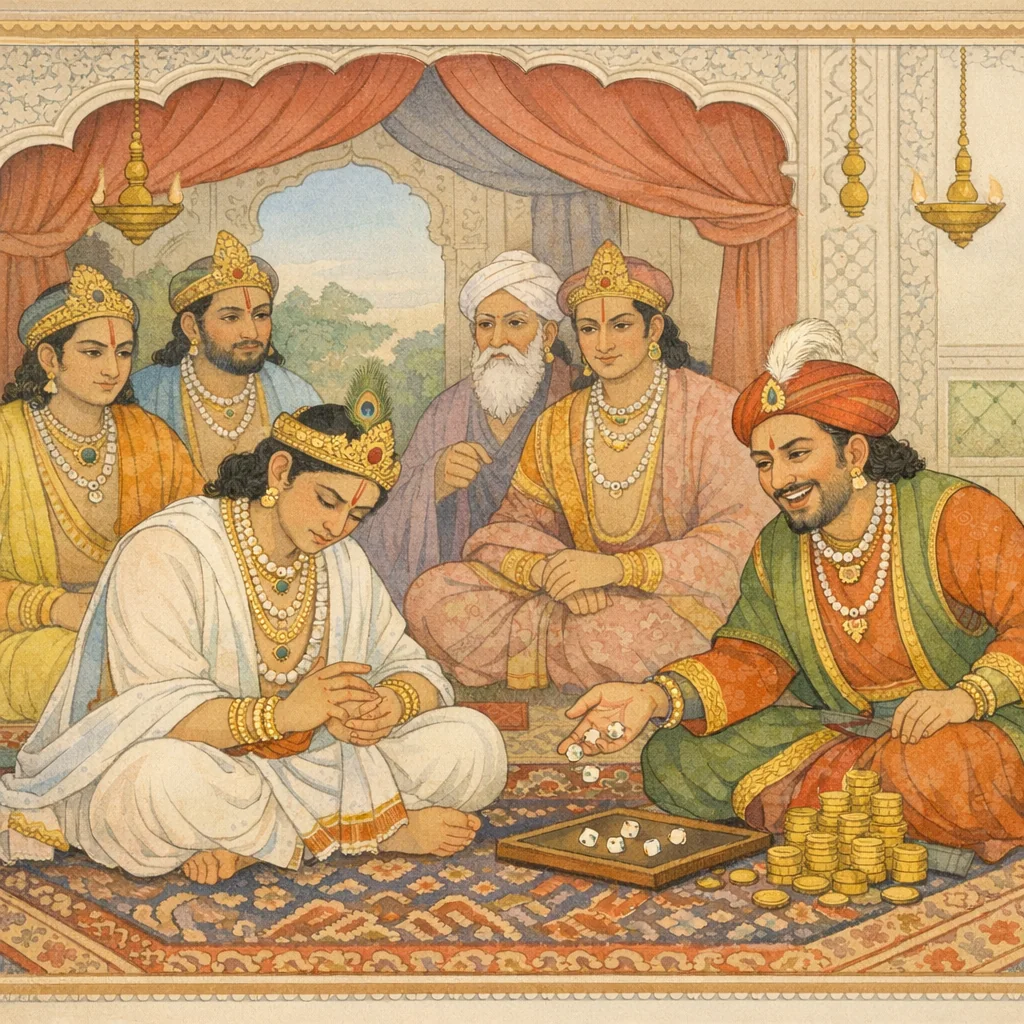
Adhyaya 61
सभा-पर्व, अध्याय ६१ — द्रौपदी-प्रश्नः, सभाधर्मः, सत्यवचन-नियमः
Upa-parva: Dyūta-Parva (Dice Game Episode) — Draupadī-Dharma-Praśna Context
Chapter 61 stages an escalating ethical-legal crisis in the Kuru assembly. Bhīma addresses Yudhiṣṭhira, accepting material losses as subordinate to the deeper transgression of treating Draupadī as a stake; his speech frames the issue as an excess beyond acceptable contest. Arjuna counters by emphasizing restraint, elder-brother hierarchy, and a kṣātra-dharma rationale: the king was invited and participated under a code of honor, so the brothers should not violate order even under provocation. The narrative then shifts to Vikarṇa, who urges the assembled kings and elders to answer Draupadī’s question, warning that unexamined speech and non-judgment lead to collective moral ruin. Vikarṇa outlines royal vices (hunting, drinking, gambling, and over-attachment) and argues that a wager made after prior loss and involving a shared spouse is not valid, concluding that Draupadī was not legitimately won. Karṇa rebuts, asserting the wager’s validity and reclassifying Draupadī’s status to justify coercive treatment; Duḥśāsana then attempts to strip her garment, but an endless manifestation of cloth appears, producing public astonishment and shame. Bhīma makes a public vow of retribution, while Vidura condemns the assembly’s failure to respond and introduces an illustrative ancient dialogue (Prahlāda–Aṅgiras–Kaśyapa) on the duty to answer truthfully in a court: silence and falsehood incur moral consequences. Despite this, the kings remain largely mute, and Draupadī is forcibly dragged, underscoring institutional collapse.
Chapter Arc: सभा में द्यूत की अग्नि भड़क चुकी है; युधिष्ठिर स्वयं स्वीकार करते हैं कि वे शकुनि के कैतव से दुरोदरे में पराजित हो रहे हैं, फिर भी दाँव पर दाँव रखने को उद्यत हैं। → हार की शृंखला टूटती नहीं—युधिष्ठिर अपने अपार वैभव का उद्घोष करते हैं: निष्क-सहस्रों से भरी पेटियाँ, अक्षय कोष, अनेक प्रकार का सुवर्ण, और असंख्य दासियाँ-सेविकाएँ; पर हर घोषणा के उत्तर में शकुनि का एक ही ठंडा वाक्य गूँजता है—“जितम्।” → युधिष्ठिर के धन-वैभव की अंतिम परतें भी दाँव पर चढ़ती जाती हैं और शकुनि, छल का आश्रय लेकर, हँसते-हँसते प्रत्येक दाँव को अपनी जीत घोषित करता है—सभा के सामने धर्मराज की विवशता सार्वजनिक अपमान बन जाती है। → अध्याय का अंत किसी न्याय-स्थापन में नहीं, बल्कि पराजय की निरंतरता के ‘स्थापन’ में होता है—शकुनि की जीतें क्रमशः पक्की होती जाती हैं और युधिष्ठिर का आत्म-स्वीकार (कैतव से हारा) भी उन्हें रुकने की शक्ति नहीं देता। → धन के बाद अब दाँव किस पर जाएगा—और धर्मराज की सीमा कहाँ टूटेगी?
Shlokas
Verse 1
/ भीकम (2 अमान एकषेष्टितमो< ध्याय: जूएमें शकुनिके छलसे प्रत्येक दाँवपर युधिष्ठिरकी हार युधिछिर उवाच मत्त: कैतवकेनैव यज्जितो<5स्मि दुरोदरे । शकुने हन्त दीव्यामो ग्लहमाना: परस्परम्,युधिष्ठिरने कहा--शकुने! तुमने छलसे इस दाँवमें मुझे हरा दिया, इसीपर तुम गर्वित हो उठे हो; आओ, हमलोग पुन: परस्पर पासे फेंककर जूआ खेलें
Yudhiṣṭhira said: “It is by sheer cheating that you have defeated me in this perilous game of dice. O Śakuni, come—let us play again, staking against one another.”
Verse 2
सन्ति निष्कसहस्रस्थ भाण्डिन्यो भरिता: शुभा: । कोशो हिरण्यमक्षय्यं जातरूपमनेकश: । एतदू राजन् मम धन तेन दीव्याम्यहं त्वया
Yudhiṣṭhira said: “There are auspicious chests filled with thousands of gold ornaments, and an inexhaustible treasury of gold—many kinds of refined gold besides. This, O king, is my wealth; with it I will play the dice with you.”
Verse 3
मेरे पास हजारों निष्कोंसे- भरी हुई बहुत-सी सुन्दर पेटियाँ रखी हैं। इसके सिवा खजाना है, अक्षय धन है और अनेक प्रकारके सुवर्ण हैं। राजन! मेरा यह सब धन दाँवपर लगा दिया गया। मैं इसीके द्वारा तुम्हारे साथ खेलता हूँ ।। वैशम्पायन उवाच कौरवाणां कुलकरं ज्येष्ठं पाण्डवमच्युतम् । इत्युक्त: शकुनि: प्राह जितमित्येव त॑ नृपम्,वैशम्पायनजी कहते हैं--जनमेजय! यह सुनकर मर्यादासे कभी च्युत न होनेवाले कौरवोंके वंशधर एवं पाण्डुके ज्येष्ठ पुत्र राजा युधिष्ठिससे शकुनिने फिर कहा--'लो, यह दाँव भी मैंने ही जीता”
Vaiśampāyana said: When the king—Yudhiṣṭhira, the eldest of the Pāṇḍavas, a foremost scion of the Kuru line, one who does not swerve from propriety—had spoken thus, Śakuni replied to that ruler with only this: “Won—this too is won by me.”
Verse 4
युधिछिर उवाच अयं सहस्रसमितो वैयाघ्र: सुप्रतिषछ्ित: । सुचक्रोपस्कर: श्रीमान् किडुकिणीजालमण्डित:
Yudhiṣṭhira said: “Here is a splendid chariot, firmly set and well-appointed—equipped with a full complement of a thousand (components/men), furnished with excellent wheels and fittings, and adorned with a net of small bells.”
Verse 5
संह्ादनो राजरथो य इहास्मानुपावहत् । जैत्रो रथवर: पुण्यो मेघसागरनि:स्वन: ।। अष्टौ यं कुररच्छाया: सदश्वा राष्ट्रसम्मता:
Yudhiṣṭhira said: “This royal chariot named Saṁhādana, which has brought us here, is the victorious, foremost of chariots—auspicious and sacred—its rumble like the roar of clouds and the sea. It is drawn by eight excellent horses, dark as the shadow of a kurara-bird, renowned and approved throughout the realm.”
Verse 6
वहन्ति नैषां मुच्येत पदाद् भूमिमुपस्पृशन् । एतद् राजन् धन महां तेन दीव्याम्यहं त्वया
Yudhiṣṭhira said: “They are borne along in such a way that none who falls before them can escape by setting foot upon the ground. This, O King, is great wealth; therefore I will play at dice with you for it.”
Verse 7
युधिष्ठिरने कहा--यह जो परमानन्ददायक राजरथ है, जो हमलोगोंको यहाँतक ले आया है, रथोंमें श्रेष्ठ जैत्र नामक पुण्यमय श्रेष्ठ रथ है। चलते समय इससे मेघ और समुद्रकी गर्जनाके समान गम्भीर ध्वनि होती रहती है। यह अकेला ही एक हजार रथोंके समान है। इसके ऊपर बाघका चमड़ा लगा हुआ है। यह अत्यन्त सुदृढ़ है। इसके पहिये तथा अन्य आवश्यक सामग्री बहुत सुन्दर है। यह परम शोभायमान रथ क्षुद्र घण्टिकाओंसे सजाया गया है। कुरर पक्षीकी-सी कान्तिवाले आठ अच्छे घोड़े, जो समूचे राष्ट्रमें सम्मानित हैं, इस रथको वहन करते हैं। भूमिका स्पर्श करनेवाला कोई भी प्राणी इन घोड़ोंके सामने पड़ जानेपर बच नहीं सकता। राजन! इन घोड़ोंसहित यह रथ मेरा धन है, जिसे दाँवपर रखकर मैं तुम्हारे साथ जूआ खेलता हूँ ।। वैशम्पायन उवाच एवं श्रुत्वा व्यवसितो निकृतिं समुपाश्रित: । जितमित्येव शकुनिर्युधिष्ठिरमभाषत,वैशम्पायनजी कहते हैं--जनमेजय! यह सुनकर छलका आश्रय लेनेवाले शकुनिने पुनः पासे फेंके और जीतका निश्चय करके युधिष्ठिस्से कहा--'लो, यह भी जीत लिया”
Yudhiṣṭhira said: “This royal chariot, a source of highest delight, which has brought us here, is the victorious chariot named Jaitra, foremost and filled with sacred merit. As it moves it gives forth a deep sound like the roar of clouds and the sea. It alone is equal to a thousand chariots. Tiger-skin is set upon it; it is exceedingly firm; its wheels and all its fittings are beautiful; and it is adorned with small bells. Eight fine horses, dark as the shadow of the kurara-bird and honored throughout the realm, bear this chariot. Whoever falls before these horses cannot escape even by setting foot upon the ground. O King, this chariot with its horses is my wealth; I stake it and play at dice with you.” Vaiśampāyana said: Hearing this, Śakuni—firm in resolve and taking refuge in deceit—cast the dice again. Certain of victory, he spoke to Yudhiṣṭhira: “It is won—this too.”
Verse 8
युधिछिर उवाच शतं दासीसहस््राणि तरुण्यो हेमभद्रिका: । कम्बुकेयूरधारिण्यो निष्ककण्ठ्यः स्वलंकृता:,युधिष्ठिरने कहा--मेरे पास एक लाख तरुणी दासियाँ हैं, जो सुवर्णमय मांगलिक आभूषण धारण करती हैं। जिनके हाथोंमें शंखकी चूड़ियाँ, बाँहोंमें भुजबंद, कण्ठमें निष्कोंका हार तथा अन्य अंगोंमें भी सुन्दर आभूषण हैं। बहुमूल्य हार उनकी शोभा बढ़ाते हैं। उनके वस्त्र बहुत ही सुन्दर हैं। वे अपने शरीरमें चन्दनका लेप लगाती हैं, मणि और सुवर्ण धारण करती हैं तथा चौसठ कलाओंमें निपुण हैं। नृत्य और गानमें भी वे कुशल हैं। ये सब-की-सब मेरे आदेशसे स्नातकों, मन्त्रियों तथा राजाओंकी सेवा-परिचर्या करती हैं। राजन! यह मेरा धन है, जिसे दाँवपर लगाकर मैं तुम्हारे साथ खेलता हूँ
Yudhiṣṭhira said: “I have hundreds of thousands of young maidservants, richly adorned with auspicious ornaments of gold—wearing conch-shell bangles and armlets, with necklaces of niṣkas at their throats, beautifully decorated in every way. This is my wealth, and I stake it in play against you.”
Verse 9
महाहमाल्याभरणा: सुवस्त्रा श्न्दनो क्षिता: । मणीन् हेम च बिश्रत्यश्षतुःषष्टिविशारदा:,युधिष्ठिरने कहा--मेरे पास एक लाख तरुणी दासियाँ हैं, जो सुवर्णमय मांगलिक आभूषण धारण करती हैं। जिनके हाथोंमें शंखकी चूड़ियाँ, बाँहोंमें भुजबंद, कण्ठमें निष्कोंका हार तथा अन्य अंगोंमें भी सुन्दर आभूषण हैं। बहुमूल्य हार उनकी शोभा बढ़ाते हैं। उनके वस्त्र बहुत ही सुन्दर हैं। वे अपने शरीरमें चन्दनका लेप लगाती हैं, मणि और सुवर्ण धारण करती हैं तथा चौसठ कलाओंमें निपुण हैं। नृत्य और गानमें भी वे कुशल हैं। ये सब-की-सब मेरे आदेशसे स्नातकों, मन्त्रियों तथा राजाओंकी सेवा-परिचर्या करती हैं। राजन! यह मेरा धन है, जिसे दाँवपर लगाकर मैं तुम्हारे साथ खेलता हूँ
Yudhiṣṭhira said: “I possess a vast retinue of young maidservants, adorned with splendid garlands and auspicious ornaments, clothed in fine garments, and anointed with sandal paste. They wear jewels and gold and are accomplished in the sixty-four arts, skilled in song and dance. At my command they attend upon the graduates (snātakas), ministers, and kings. O King, this is my wealth—this I stake as a wager as I play with you.”
Verse 10
अनुसेवां चरन्तीमा: कुशला नृत्यसामसु । स्नातकानाममात्यानां राज्ञां च मम शासनात् | एतद् राजन् मम धन तेन दीव्याम्यहं त्वया,युधिष्ठिरने कहा--मेरे पास एक लाख तरुणी दासियाँ हैं, जो सुवर्णमय मांगलिक आभूषण धारण करती हैं। जिनके हाथोंमें शंखकी चूड़ियाँ, बाँहोंमें भुजबंद, कण्ठमें निष्कोंका हार तथा अन्य अंगोंमें भी सुन्दर आभूषण हैं। बहुमूल्य हार उनकी शोभा बढ़ाते हैं। उनके वस्त्र बहुत ही सुन्दर हैं। वे अपने शरीरमें चन्दनका लेप लगाती हैं, मणि और सुवर्ण धारण करती हैं तथा चौसठ कलाओंमें निपुण हैं। नृत्य और गानमें भी वे कुशल हैं। ये सब-की-सब मेरे आदेशसे स्नातकों, मन्त्रियों तथा राजाओंकी सेवा-परिचर्या करती हैं। राजन! यह मेरा धन है, जिसे दाँवपर लगाकर मैं तुम्हारे साथ खेलता हूँ
Yudhiṣṭhira said: “These women, engaged in attendance and service, are skilled in dance and in song. By my command they wait upon the graduates (snātakas), my ministers, and even kings. O King, this is my wealth; staking it, I gamble with you.”
Verse 11
वैशम्पायन उवाच एतच्छुत्वा व्यवसितो निकृतिं समुपाश्रित: । जितमित्येव शकुनिर्युधिष्ठिरमभाषत,वैशम्पायनजी कहते हैं--जनमेजय! यह सुनकर कपटी शकुनिने पुनः जीतका निश्चय करके पासे फेंके और युधिष्ठिरसे कहा--“यह दाँव भी मैंने ही जीता”
Vaiśampāyana said: Hearing this, Śakuni—resolved and resorting to deceit—cast the dice again and addressed Yudhiṣṭhira, declaring, “I have won this stake as well.”
Verse 12
युधिछिर उवाच एतावन्ति च दासानां सहस्राण्युत सन्ति मे । प्रदक्षिणानुलोमाश्न प्रावारवसना: सदा,युधिष्ठिरने कहा--दासियोंकी तरह ही मेरे यहाँ एक लाख दास हैं। वे कार्यकुशल तथा अनुकूल रहनेवाले हैं। उनके शरीरपर सदा सुन्दर उत्तरीय वस्त्र सुशोभित होते हैं
Yudhiṣṭhira said: “So many thousands of male servants, too, are in my household. They are efficient in their duties and compliant in conduct, and they are always adorned with fine upper garments.”
Verse 13
प्राज्ञा मेधाविनो दान्ता युवानो मृष्टकुण्डला: । पात्रीहस्ता दिवारात्रमतिथीन् भोजयन्त्युत । एतद्ू राजन् मम धन तेन दीव्याम्यहं त्वया,वे चतुर, बुद्धिमान, संयमी और तरुण अवस्थावाले हैं। उनके कानोंमें कुण्डल झिलमिलाते रहते हैं। वे हाथोंमें भोजनपात्र लिये दिन-रात अतिथियोंको भोजन परोसते रहते हैं। राजन्! यह मेरा धन है, जिसे दाँवपर लगाकर मैं तुम्हारे साथ खेलता हूँ
Yudhiṣṭhira said: “Wise, intelligent, and self-restrained young men—wearing bright, well-adorned earrings—stand with serving vessels in their hands and, day and night, feed guests. O King, this is my wealth; staking this, I gamble with you.”
Verse 14
वैशम्पायन उवाच एतच्छुत्वा व्यवसितो निकृतिं समुपाश्रित: । जितमित्येव शकुनिर्युधिष्ठिरमभाषत,वैशम्पायनजी कहते हैं--जनमेजय! यह सुनकर पुनः शठताका आश्रय लेनेवाले शकुनिने अपनी ही जीतका निश्चय करके युधिष्ठिस्से कहा--“लो, यह दाँव भी मैंने जीत लिया”
Vaiśampāyana said: Hearing this, Śakuni—resolved and once again resorting to deceit—addressed Yudhiṣṭhira, declaring, “I have won,” as if the outcome were already settled.
Verse 15
युधिछिर उवाच सहस्रसंख्या नागा मे मत्तास्तिष्ठन्ति सौबल । हेमकक्षा: कृतापीडा: पद्मिनो हेममालिन:,युधिष्ठिरने कहा--सुबलकुमार! मेरे यहाँ एक हजार मतवाले हाथी हैं, जिनके बाँधनेके रस्से सुवर्णमय हैं। वे सदा आभूषणोंसे विभूषित रहते हैं। उनके कपोल और मस्तक आदि अंगोंपर कमलके चिह्न बने हुए हैं। उनके गलेमें सोनेके हार सुशोभित होते हैं
Yudhiṣṭhira said: “O Saubala (son of Subala), I have a thousand elephants, all in musth and standing ready. Their tethering-ropes are of gold; they are adorned with crafted head-ornaments; they bear lotus-like marks upon their temples and foreheads; and golden garlands shine upon their necks.”
Verse 16
वे अच्छी तरह वशमें किये हुए हैं और राजाओंकी सवारीके काममें आते हैं। युद्धमें वे सब प्रकारके शब्द सहन करनेवाले हैं। उनके दाँत हलदण्डके समान लंबे हैं और शरीर विशाल है। उनमेंसे प्रत्येकके आठ-आठ हथिनियाँ हैं
Yudhiṣṭhira said: “They are thoroughly tamed and fit for the service of kings as mounts. In battle they can endure every kind of noise and tumult. Their tusks are long like stout plough-handles, and their bodies are massive. Each of them is attended by eight she-elephants.”
Verse 17
सर्वे च पुरभेत्तारो नवमेघनिभा गजा: । एतद् राजन् मम धन तेन दीव्याम्यहं त्वया,उनकी कान्ति नूतन मेघोंकी घटाके समान है। वे सब-के-सब बड़े-बड़े नगरोंको भी नाश कर देनेकी शक्ति रखते हैं। राजन! यह मेरा धन है, जिसे दाँवपर लगाकर मैं तुम्हारे साथ खेलता हूँ
Yudhiṣṭhira said: “All these elephants are city-breakers, their radiance like a mass of fresh rain-clouds. O King, this is my wealth; staking it, I gamble with you.”
Verse 18
वैशम्पायन उवाच इत्येवंवादिनं पार्थ प्रहसन्निव सौबल: । जितमित्येव शकुनिर्युधिष्ठिरमभाषत,वैशम्पायनजी कहते हैं-जनमेजय! ऐसी बातें कहते हुए कुन्तीपुत्र युधिष्ठिरसे शकुनिने हँसकर कहा--“इस दाँवको भी मैंने ही जीता”
Vaiśampāyana said: As the son of Pṛthā (Yudhiṣṭhira) spoke thus, Saubala (Śakuni), as if laughing in mockery, addressed Yudhiṣṭhira: “Won—indeed! This throw too I have won.”
Verse 19
युधिछिर उवाच रथास्तावन्त एवेमे हेमदण्डा: पताकिन: । हयैर्विनीतै: सम्पन्ना रथिभिश्ित्रयोधिभि:,युधिष्ठिरने कहा--मेरे पास उतने ही अर्थात् एक हजार रथ हैं, जिनकी ध्वजाओंमें सोनेके डंडे लगे हैं। उन रथोंपर पताकाएँ फहराती रहती हैं। उनमें सधे हुए घोड़े जोते जाते हैं और विचित्र युद्ध करनेवाले रथी उनमें बैठते हैं। उन रथियोंमेंसे प्रत्येकको अधिक-से- अधिक एक सहस््र स्वर्णमुद्राएँतक वेतनमें मिलती हैं। वे युद्ध कर रहे हों या न कर रहे हों, प्रत्येक मासमें उन्हें यह वेतन प्राप्त होता रहता है। राजन! यह मेरा धन है, इसे दाँवपर लगाकर मैं तुम्हारे साथ खेलता हूँ
Yudhiṣṭhira said: “I have just so many chariots—indeed, a thousand—each bearing a banner with a golden staff. They are furnished with well-trained horses, and in them sit chariot-warriors skilled in varied modes of fighting. This is my wealth; staking it, O king, I play with you.”
Verse 20
एकैको ह्वात्र लभते सहस्रपरमां भृतिम् । युध्यतो<्युध्यतो वापि वेतनं मासकालिकम् । एतद् राजन् मम धन तेन दीव्याम्यहं त्वया,युधिष्ठिरने कहा--मेरे पास उतने ही अर्थात् एक हजार रथ हैं, जिनकी ध्वजाओंमें सोनेके डंडे लगे हैं। उन रथोंपर पताकाएँ फहराती रहती हैं। उनमें सधे हुए घोड़े जोते जाते हैं और विचित्र युद्ध करनेवाले रथी उनमें बैठते हैं। उन रथियोंमेंसे प्रत्येकको अधिक-से- अधिक एक सहस््र स्वर्णमुद्राएँतक वेतनमें मिलती हैं। वे युद्ध कर रहे हों या न कर रहे हों, प्रत्येक मासमें उन्हें यह वेतन प्राप्त होता रहता है। राजन! यह मेरा धन है, इसे दाँवपर लगाकर मैं तुम्हारे साथ खेलता हूँ
Yudhiṣṭhira said: “Here, each man receives a stipend whose maximum is a thousand. Whether he is fighting or not, his wages are paid monthly. O King, this is my wealth; staking it, I will gamble with you.”
Verse 21
वैशग्पायन उवाच इत्येवमुक्ते वचने कृतवैरो दुरात्मवान् | जितमित्येव शकुनिर्युधिष्ठिरमभाषत,वैशम्पायनजी कहते हैं--जनमेजय! उनके ऐसा कहनेपर वैरी दुरात्मा शकुनिने युधिष्ठिरसे कहा--'लो, यह भी जीत लिया”
Vaiśampāyana said: When those words had thus been spoken, Śakuni—harboring enmity and of wicked intent—addressed Yudhiṣṭhira, saying, “Won—this too has been won.”
Verse 22
युधिछिर उवाच अध्चांस्तित्तिरिकल्माषान् गान्धर्वान् हेममालिन: । ददौ चित्ररथस्तुष्टो यांस्तान् गाण्डीवधन्चने
Yudhiṣṭhira said: “Pleased at heart, the Gandharva Citraratha bestowed upon the wielder of the Gāṇḍīva those very horses—tittiri- and kalmāṣa-marked—adorned with garlands of gold.”
Verse 23
युद्धे जित: पराभूत: प्रीतिपूर्वमरिंदम: । एतद् राजन् मम धन तेन दीव्याम्यहं त्वया
Yudhiṣṭhira said: “In battle I was conquered and brought low—yet the foe, a subduer of enemies, treated me with goodwill. O King, this is my wealth; with that very stake I will play with you.”
Verse 24
युधिष्ठिरने कहा--मेरे यहाँ तीतर पक्षीके समान विचित्र वर्णवाले गन्धर्वदेशके घोड़े हैं, जो सोनेके हारसे विभूषित हैं। शत्रुदमन चित्ररथ गन्धर्वने युद्धमें पराजित एवं तिरस्कृत होनेके पश्चात् संतुष्ट हो गाण्डीवधारी अर्जुनको प्रेमपूर्वक वे घोड़े भेंट किये थे। राजन्! यह मेरा धन है जिसे दाँवपर लगाकर मैं तुम्हारे साथ खेलता हूँ ।। वैशम्पायन उवाच 48 अल निकृतिं समुपाश्रित: । शकुनिर्युधिष्ठटिरमभाषत
Yudhiṣṭhira said: “I possess horses from the land of the Gandharvas, of variegated colours like partridges, adorned with golden garlands. After being defeated and humiliated in battle, the Gandharva Citraratha—subduer of foes—became satisfied and, out of affection, presented those horses to Arjuna, the bearer of the Gāṇḍīva. O king, this is my wealth, which I stake and play with you in this game.”
Verse 25
वैशम्पायनजी कहते हैं--जनमेजय! यह सुनकर छलका आश्रय लेनेवाले शकुनिने पुनः अपनी ही जीतका निश्चय करके युधिष्ठिरसे कहा--“यह दाँव भी मैंने ही जीता है” ।। युधिछिर उवाच रथानां शकटानां च श्रेष्ठानां चायुतानि मे । युक्तान्येव हि तिष्ठन्ति वाहैरुच्चावचैस्तथा
Yudhiṣṭhira said: “I have tens of thousands of excellent chariots and carts; they stand ready, already yoked, with horses of various kinds.”
Verse 26
सुदान्ता राजवहना: सर्वशब्दक्षमा युधि । ईषादन्ता महाकाया: सर्वे चाष्टकरेणव:,युधिष्ठिरने कहा--मेरे पास दस हजार श्रेष्ठ रथ और छकड़े हैं। जिनमें छोटे-बड़े वाहन सदा जुटे ही रहते हैं ।। एवं वर्णस्य वर्णस्य समुच्चीय सहस्रश: । यथा समुदिता वीरा: सर्वे वीरपराक्रमा: इसी प्रकार प्रत्येक वर्णके हजारों चुने हुए योद्धा मेरे यहाँ एक साथ रहते हैं। वे सब-के- सब वीरोचित पराक्रमसे सम्पन्न एवं शूरवीर हैं
Yudhiṣṭhira said: “I have well-trained royal conveyances—chariots and wagons—able to endure every command amid the press of battle; their yokes are firm and their frames are massive, all fit for the eightfold teams. Likewise, from each social order, thousands of chosen warriors are gathered and maintained together in my service—men of proven valor, all endowed with heroic prowess.”
Verse 27
क्षीर॑ पिबन्तस्तिष्ठन्ति भुज्जाना: शालितण्डुलान् | षष्टिस्तानि सहस््राणि सर्वे विपुलवक्षस: । एतद् राजन् मम धन तेन दीव्याम्यहं त्वया,उनकी संख्या साठ हजार है। वे दूध पीते और शालिके चावलका भात खाकर रहते हैं। उन सबकी छाती बहुत चौड़ी है। राजन! यह मेरा धन है, जिसे दाँवपर रखकर मैं तुम्हारे साथ खेलता हूँ
Yudhiṣṭhira said: “They live on, drinking milk and eating boiled rice made from fine śāli grains. Their number is sixty thousand, and all are broad-chested. O King, this is my wealth; staking it, I gamble with you.”
Verse 28
वैशम्पायन उवाच पी आर ९ निकृतिं समुपाश्रित: । शकुनिर्युधिष्ठटिरमभाषत,वैशम्पायनजी कहते हैं--जनमेजय! यह सुनकर शठताके उपासक शकुनिने पुनः युधिष्ठिरसे पूर्ण निश्चयके साथ कहा--“यह दाँव भी मैंने ही जीता है”
Vaiśampāyana said: Taking refuge in deceit, Śakuni addressed Yudhiṣṭhira with firm assurance, declaring, “This throw of the dice too has been won by me alone.”
Verse 29
युधिछिर उवाच ताम्रलोहै: परिवृता निधयो ये चतु:शता: । पज्चद्रौणिक एकैक: सुवर्णस्याहतस्य वै,युधिष्ठिरने कहा--मेरे पास ताँबे और लोहेकी चार सौ निधियाँ यानी खजानेसे भरी हुई पेटियाँ हैं। प्रत्येकमें पाँच-पाँच द्रोण विशुद्ध सोना भरा हुआ है, वह सारा सोना तपाकर शुद्ध किया हुआ है, उसकी कीमत आँकी नहीं जा सकती। भारत! यह मेरा धन है, जिसे दाँवपर रखकर मैं तुम्हारे साथ खेलता हूँ
Yudhiṣṭhira said: “I have four hundred treasure-chests, bound with copper and iron. In each there are five droṇas of refined gold—gold that has been smelted and purified. This is my wealth, Bhārata; I stake it and play with you.”
Verse 30
जातरूपस्य मुख्यस्य अनर्घेयस्थ भारत । एतद् राजन् मम धन तेन दीव्याम्यहं त्वया,युधिष्ठिरने कहा--मेरे पास ताँबे और लोहेकी चार सौ निधियाँ यानी खजानेसे भरी हुई पेटियाँ हैं। प्रत्येकमें पाँच-पाँच द्रोण विशुद्ध सोना भरा हुआ है, वह सारा सोना तपाकर शुद्ध किया हुआ है, उसकी कीमत आँकी नहीं जा सकती। भारत! यह मेरा धन है, जिसे दाँवपर रखकर मैं तुम्हारे साथ खेलता हूँ
Yudhiṣṭhira said: “O Bhārata, I possess foremost gold—priceless beyond valuation. O King, this is my wealth; staking it, I will gamble with you.”
Verse 31
वैशम्पायन उवाच ४: 4 आट निकृतिं समुपाश्रित: । शकुनिर्युधिष्टिमभाषत,वैशम्पायनजी कहते हैं--जनमेजय! ऐसा सुनकर छलका आश्रय लेनेवाले शकुनिने पूर्ववत् पूर्ण निश्चयके साथ युधिष्ठिससे कहा--“यह दाँव भी मैंने ही जीता”
Vaiśampāyana said: Hearing this, Śakuni—having taken refuge in deceit—spoke to Yudhiṣṭhira again, as before, with firm resolve: “This stake too has been won by me.”
Verse 60
इस प्रकार श्रीमहाभारत सभापवव॑के अन्तर्गत झ्टूतपर्वमें झूतारम्भविषयक साठवाँ अध्याय पूरा हुआ
Thus ends the sixtieth chapter of the Dyūta section within the Sabha Parva of the Mahābhārata, dealing with the commencement of the gambling match.
Verse 61
इति श्रीमहा भारते सभापर्वणि द्यूतपर्वणि देवने एकषष्टितमो5ध्याय:
Thus ends the sixty-first chapter in the Dice-Game section (Devana) of the Sabha Parva of the sacred Mahābhārata. This closing colophon marks the completion of a narrative unit centered on gambling—an arena where desire, pride, and political calculation eclipse restraint, foreshadowing grave ethical collapse and its consequences.
Frequently Asked Questions
The dilemma is whether a public wager and its outcomes can be treated as binding when the bettor has already lost autonomy and when the stake involves another person’s status—raising the question of consent, authority, and the assembly’s duty to invalidate an ethically defective procedure.
The chapter teaches that dharma in institutions depends on truthful speech and timely adjudication: silence in the face of wrongdoing is not neutral, and rule-following without ethical scrutiny can become a vehicle for adharma.
There is no conventional phalaśruti; instead, the chapter offers meta-commentary through Vidura’s exemplum, asserting that failing to answer a dharma-question or answering falsely produces moral consequences, while truthful testimony preserves both dharma and social legitimacy.