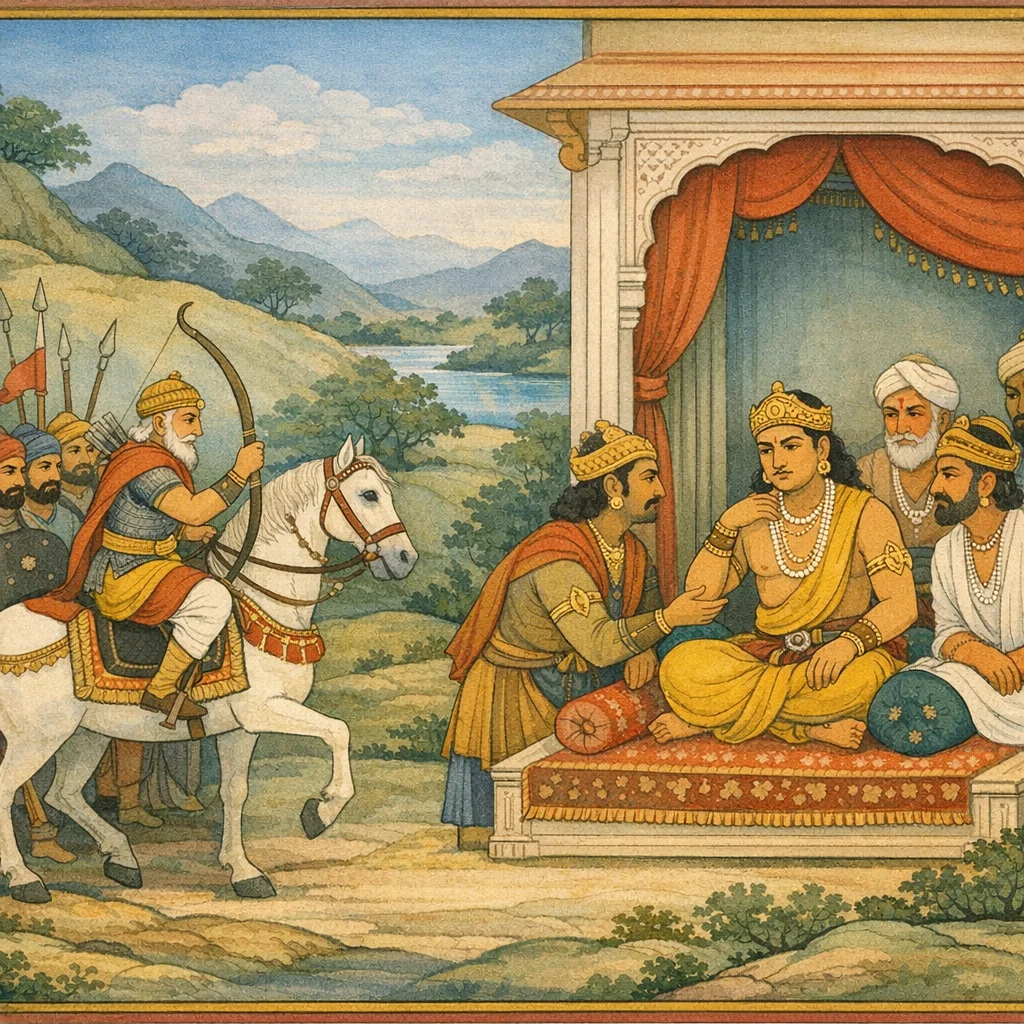
Adhyaya 153
Ghaṭotkaca Slays Alāyudha (Night Battle and Māyā Countermeasures) / घटोत्कचेन अलायुधवधः
Upa-parva: Ghaṭotkaca–Alāyudha Yuddha Episode (Night Engagement) within Droṇa Parva
Sañjaya reports that Krishna, observing Bhīma seized and endangered by a nearby rākṣasa, instructs Ghaṭotkaca to suspend his pursuit of Karṇa and immediately eliminate Alāyudha, promising that Karṇa can be addressed afterward. Complying, Ghaṭotkaca engages Alāyudha (identified with Baka’s kin), while other fronts continue: Arjuna disperses hostile kṣatriya forces with arrows, and Karṇa pressures Pāñcāla leaders as Bhīma moves toward him. The rākṣasa duel intensifies when Alāyudha strikes Ghaṭotkaca with a massive iron club, briefly stunning him; Ghaṭotkaca retaliates by hurling a gold-adorned mace that destroys Alāyudha’s chariot, horses, and charioteer. Alāyudha adopts rākṣasa māyā, generating blood-rain, lightning, darkness, and thunderous impacts; Ghaṭotkaca counters by neutralizing the illusion and withstands a storm of stones with a dense arrow-shower. The fight expands into reciprocal barrages using weapons, iron clubs, blades, and uprooted trees and rock masses, likened to the ancient Vāli–Sugrīva contest in ferocity. After close-quarters grappling, Ghaṭotkaca overpowers Alāyudha and severs his head, then roars and triggers celebration among Pāṇḍava and Pāñcāla forces with drums and conches. He throws Alāyudha’s head before Duryodhana, who becomes visibly alarmed, recalling Alāyudha’s vow to kill Bhīmasena; Dhṛtarāṣṭra’s side recognizes Bhīma’s vow as effectively fulfilled through his son’s act.
Chapter Arc: धृतराष्ट्र, जयद्रथ और भूरिश्रवा के वध का समाचार सुनकर संजय से पूछते हैं—उस घड़ी कौरव-सेना और दुर्योधन के मन में कैसी उथल-पुथल उठी? → संजय बताता है कि जयद्रथ-वध ने कौरव-सैन्य का धैर्य तोड़ दिया; साथ ही विदुर के पूर्व उपदेश और दुर्योधन द्वारा किए गए अपमान का स्मरण होकर ‘वैशसं’ (भयानक अनर्थ) का बोध गहराता है। दुर्योधन अपने पक्ष के बचे हुए स्तंभों—विशेषतः कृप—की ओर आशा से देखता है, पर भीष्म-पतन और दुःशासन के दुष्कर कर्मों की स्मृति उसे और दहला देती है। → द्रोण का कठोर, ब्राह्मण-धर्म और क्षत्रिय-तेज से दीप्त वचन-प्रवाह—जहाँ वह मर्यादा, ब्राह्मण-पूजा और नीति की बात कहकर भी युद्ध के लिए प्रस्थान करता है—और फिर ‘सूर्य की भाँति नक्षत्रों का तेज हरते हुए’ पाण्डव-सेना पर टूट पड़ता है। → अध्याय का अंत द्रोण के प्रस्थान और उसके द्वारा पाण्डवों के क्षात्र-तेज को दबाने वाले आक्रमण के वर्णन पर टिकता है—कौरव पक्ष को क्षणिक संबल मिलता है कि सेनापति अभी भी रण में प्रचंड है। → द्रोण के इस घोर प्रहार के सामने पाण्डव-सेना कैसे टिकेगी, और कौन-सा नया संहार-चक्र खुलेगा?
Shlokas
Verse 1
/ भीकम (2 अमान एकपज्चाशर्दाधकशततमो< ध्याय: द्रोणाचार्यका दुर्योधनको उत्तर और युद्धके लिये प्रस्थान धृतराष्ट उवाच सिन्धुराजे हते तात समरे सव्यसाचिना । तथैव भूरिश्रवसि किमासीद् वो मनस्तदा
Dhṛtarāṣṭra said: “My son, when the king of Sindhu, Jayadratha, was slain in battle by Savyasācī Arjuna, and likewise when Bhūriśravas fell, what was the state of your mind at that time?”
Verse 2
धृतराष्ट्रने कहा--तात! समरांगणमें सव्यसाची अर्जुनके द्वारा सिंधुराज जयद्रथके तथा सात्यविद्दारा भूरिश्रवाके मारे जानेपर उस समय तुमलोगोंके मनकी कैसी अवस्था हुई? ।। दुर्योधनेन च द्रोणस्तथोक्त: कुरुसंसदि | किमुक्तवान् परं तस्मै तन््ममाचक्ष्व संजय,संजय! दुर्योधनने जब कौरव-सभामें द्रोणाचार्यसे वैसी बातें कहीं, तब उन्होंने उसे क्या उत्तर दिया? यह मुझे बताओ
Dhṛtarāṣṭra said: “And when Duryodhana spoke to Droṇa in the assembly of the Kurus in that manner, what further reply did Droṇa give him? Tell me that, Sañjaya.”
Verse 3
संजय उवाच निष्टानको महानासीत् सैन्यानां तव भारत । सैन्धवं निहतं दृष्टवा भूरिश्रवसमेव च,संजयने कहा--भारत! सिंधुराज जयद्रथ तथा भूरिश्रवाको मारा गया देखकर आपकी सेनाओंमें महान् आर्तनाद होने लगा
Sañjaya said: “O Bharata (Dhṛtarāṣṭra), a great wail of anguish arose among your troops when they saw Jayadratha of Sindhu slain, and Bhūriśravas as well.”
Verse 4
मन्त्रितं तव पुत्रस्य ते सर्वमवमेनिरे । येन मन्त्रेण निहता: शतश: क्षत्रियर्षभा:,वे सब लोग आपके पुत्र दुर्योधनकी उस सारी मन्त्रणाका अनादर करने लगे, जिससे सैकड़ों क्षत्रिय-शिरोमणि कालके गालमें चले गये
Sañjaya said: “They all came to disregard the entire counsel of your son, for by that very stratagem hundreds of bull-like warriors among the Kshatriyas had been slain.”
Verse 5
द्रोणस्तु तद् वच: श्रुत्वा पुत्रस्य तव दुर्मना: । मुहूर्तमिव तद् ध्यात्वा भृशमार्तोडभ्यभाषत
Sañjaya said: “Hearing those words of your son, Droṇa became heavy-hearted. After reflecting on them for a brief moment, he—deeply distressed—spoke out in reply.”
Verse 6
आपके पुत्रका पूर्वोक्त वचन सुनकर द्रोणाचार्य मन-ही-मन दुःखी हो उठे। उन्होंने दो घड़ीतक कुछ सोच-विचारकर अत्यन्त आर्तभावसे इस प्रकार कहा ।। द्रोण उदाच दुर्योधन किमेवं मां वाकृुशरैरपि कृन्तसि । अजय्यं सततं संख्ये ब्रुवाणं सव्यसाचिनम्,द्रोणाचार्य बोले--दुर्योधन! तुम क्यों इस प्रकार अपने वचनरूपी बाणोंसे मुझे छेद रहे हो? मैं तो सदासे ही कहता आया हूँ कि सव्यसाची अर्जुन युद्धमें अजेय हैं
Sanjaya said: Hearing the earlier words spoken by your son, Drona was stricken with grief within. After reflecting for a short while, he spoke in deep anguish. Drona said: “Duryodhana, why do you wound me like this with arrows made of words? I have always maintained that Arjuna, the ambidextrous archer, is unconquerable in battle.”
Verse 7
एतेनैवार्जुनं ज्ञातुमलं कौरव संयुगे । यच्छिखण्ड्यवधीदू भीष्मं पाल्यमान: किरीटिना,कुरुनन्दन! अर्जुनको तो केवल इसी बातसे समझ लेना चाहिये था कि उनके द्वारा सुरक्षित होकर शिखण्डीने भी युद्धके मैदानमें भीष्मको मार डाला
Sañjaya said: “This alone should have been enough to make Arjuna understand, O descendant of Kuru, in the battle with the Kauravas: that Śikhaṇḍī was able to strike down Bhīṣma on the battlefield only while being protected by the diadem-wearing Arjuna. The event itself shows how decisive Arjuna’s guardianship and strategic restraint were in bringing down the grandsire.”
Verse 8
अवध्यं निहतं दृष्टवा संयुगे देवदानवै: । तदैवाज्ञासिषमहं नेयमस्तीति भारती,जो देवताओं और दानवोंके लिये भी अवध्य थे, उन्हें युद्धमें मारा गया देख मैंने उसी समय यह जान लिया कि यह कौरव-सेना अब नहीं रह सकेगी
Sañjaya said: Seeing in battle that one who was deemed invulnerable even to the gods and the Dānavas had been slain, I understood at that very moment that this Kaurava host would not endure—its downfall had become inevitable.
Verse 9
य॑ पुंसां त्रिषु लोकेषु सर्वशूरममंस्महि । तस्मिन् निपतिते शूरे कि शेषं पर्युपास्महे,हमलोग जिन्हें तीनों लोकोंके पुरुषोंमें सबसे अधिक शूरवीर मानते थे, उन शौर्यसम्पन्न भीष्मके मारे जानेपर हम दूसरोंका क्या भरोसा करें?
Sanjaya said: “He whom we deemed the most heroic of all men in the three worlds—when that mighty warrior has fallen, what reliance can we place on anyone else who remains?”
Verse 10
यान् सम तान् ग्लहते तात शकुनि: कुरुसंसदि । अक्षान् न ते$क्षा निशिता बाणास्ते शत्रुतापना:,द्यूतक्रीड़ाके समय विदुरजीने तुमसे कहा था कि “तात! कौरव-सभामें शकुनि जिन पासोंको फेंक रहा है, उन्हें पासे न समझो, वे किसी दिन शत्रुओंको संताप देनेवाले तीखे बाण बन सकते हैं!
Sanjaya said: During the game of dice, Vidura warned you: “My child! In the Kuru assembly, do not take the dice that Shakuni casts to be mere dice; one day they may turn into sharp arrows that bring torment upon your enemies.”
Verse 11
त एते घ्नन्ति नस्तात विशिखा: पार्थचोदिता: । तांस्तदा55ख्यायमानस्त्वं विदुरेण न बुद्धवान्
Sañjaya said: “O dear father, these arrows—impelled by Pārtha (Arjuna)—are striking down our men. Yet even as Vidura clearly pointed this out to you at that time, you did not understand.”
Verse 12
परंतु वत्स! उस समय विदुरजीकी कही हुई बातोंको तुमने कुछ नहीं समझा। तात! वे ही पासे ये अर्जुनके चलाये हुए बाण बनकर हमें मार रहे हैं ।। यास्ता विजयतश्चलापि विदुरस्य महात्मन: । धीरस्य वाचो नाश्रौषी: क्षेमाय वदत: शिवा:,दुर्योधन! विदुरजी धीर हैं, महात्मा पुरुष हैं। उन्होंने तुम्हारे कल्याणके लिये जो मंगलकारक वचन कहे थे और जिन्हें तुमने विजयके उल्लासमें अनसुना कर दिया था, उनके उन वचनोंके अनादरसे ही तुम्हारे लिये यह घोर महासंहार प्राप्त हुआ है
Sañjaya said: “But, my child, at that time you understood nothing of what Vidura had told you. Dear one—those very dice now strike us as the arrows loosed by Arjuna. O Duryodhana, Vidura is steadfast and great-souled. The auspicious words he spoke for your welfare—words you ignored in the intoxication of victory—have returned upon you; by scorning that counsel, you have brought this dreadful, vast destruction upon yourself.”
Verse 13
तदिदं वर्तते घोरमागतं वैशसं महत् । तस्यावमानाद्ू वाक्यस्य दुर्योधन कृते तव,दुर्योधन! विदुरजी धीर हैं, महात्मा पुरुष हैं। उन्होंने तुम्हारे कल्याणके लिये जो मंगलकारक वचन कहे थे और जिन्हें तुमने विजयके उल्लासमें अनसुना कर दिया था, उनके उन वचनोंके अनादरसे ही तुम्हारे लिये यह घोर महासंहार प्राप्त हुआ है
Sañjaya said: “This dreadful calamity—this great and brutal destruction—has now come to pass for you, O Duryodhana, because you once scorned that counsel. By disregarding the salutary words spoken for your welfare, in the intoxication of anticipated victory, you have brought this terrible slaughter upon yourself.”
Verse 14
यो5वमन्य वच: पथ्यं सुहृदामाप्तकारिणाम् | स्वमतं कुरुते मूढ: स शोच्यो नचिरादिव,जो मूर्ख अपने हितैषी मित्रोंके हितकर वचनकी अवहेलना करके मनमाना बर्ताव करता है, वह थोड़े ही समयमें शोचनीय दशाको प्राप्त हो जाता है
Sañjaya said: The fool who scorns the wholesome counsel of well-wishing friends and trusted well-doers, and instead acts according to his own whim, soon becomes a fit object of lamentation.
Verse 15
यच्च न: प्रेक्षमाणानां कृष्णामानाय्य तत्सभाम् | अनर्हन्तीं कुले जातां सर्वधर्मानुचारिणीम्,इसके सिवा तुमने हमलोगोंके सामने ही जो द्रौपदीको सभामें बुलाकर अपमानित किया, वह अपमान उसके योग्य नहीं था। वह उत्तम कुलमें उत्पन्न हुई है और सम्पूर्ण धर्मोका निरन्तर पालन करती है। गान्धारीनन्दन! द्रौपदीके अपमानरूपी तुम्हारे अधर्मका ही यह महान् फल प्राप्त हुआ है कि तुम्हारे दलका विनाश हो रहा है। यदि यहाँ यह फल नहीं मिलता तो परलोकमें तुम्हें उस पापका इससे भी अधिक दण्ड भोगना पड़ता
Sañjaya said: “And moreover, in our very presence you had Kṛṣṇā (Draupadī) brought into that assembly—she who did not deserve such treatment, born in a noble lineage and steadfast in the practice of all dharmic duties. O son of Gāndhārī, it is precisely the fruit of that unrighteous act—your humiliation of Draupadī—that has ripened into this great consequence: the destruction of your forces. If its result were not met here, you would have had to endure an even harsher punishment for that sin in the world beyond.”
Verse 16
तस्याधर्मस्य गान्धारे फल प्राप्तमिदं महत् । नो चेत् पापं परे लोके त्वमर्च्छेथास्ततो5घिकम्,इसके सिवा तुमने हमलोगोंके सामने ही जो द्रौपदीको सभामें बुलाकर अपमानित किया, वह अपमान उसके योग्य नहीं था। वह उत्तम कुलमें उत्पन्न हुई है और सम्पूर्ण धर्मोका निरन्तर पालन करती है। गान्धारीनन्दन! द्रौपदीके अपमानरूपी तुम्हारे अधर्मका ही यह महान् फल प्राप्त हुआ है कि तुम्हारे दलका विनाश हो रहा है। यदि यहाँ यह फल नहीं मिलता तो परलोकमें तुम्हें उस पापका इससे भी अधिक दण्ड भोगना पड़ता
O son of Gāndhārī, the great consequence of that unrighteous act of yours has now come to fruition. Had that sin not borne its result here, you would have had to suffer an even harsher punishment for it in the world beyond.
Verse 17
यच्च तान् पाण्डवान् द्यूते विषमेण विजित्य ह । प्राव्राजयस्तदारण्ये रौरवाजिनवासस:,इतना ही नहीं, तुमने पाण्डवोंको जूएमें बेईमानीसे जीतकर और मृगचर्ममय वस्त्र पहनाकर उन्हें वनवास दे दिया (इस अधर्मका भी फल तुम्हें भोगना पड़ता है)
Sañjaya said: “And you, having defeated the Pāṇḍavas in the dice-game by unfair means, then drove them into exile in the forest, making them wear garments of deer-skin. The burden of that unrighteous act, too, now ripens into its consequence for you.”
Verse 18
पुत्राणामिव चैतेषां धर्ममाचरतां सदा । द्रहोत् को नु नरो लोके मदन्यो ब्राह्मणब्रुव:,पाण्डव मेरे पुत्रके समान हैं और वे सदा धर्मका आचरण करते रहते हैं। संसारमें मेरे सिवा दूसरा कौन मनुष्य है, जो ब्राह्मण कहलाकर भी उनसे द्रोह करे
Sañjaya said: “The Pāṇḍavas are to me like my own sons, and they ever conduct themselves according to dharma. In this world, who—other than I—would be so base as to bear the name of a brāhmaṇa and yet commit treachery against them?”
Verse 19
पाण्डवानामयं कोपस्त्वया शकुनिना सह | आह्तो धृतराष्ट्रस्य सम्मते कुरुसंसदि,तुमने राजा धृतराष्ट्रकी सम्मतिसे कौरवोंकी सभामें शकुनिके साथ बैठकर पाण्डवोंका यह क्रोध मोल लिया है
Sañjaya said: “This wrath of the Pāṇḍavas has been brought upon you—together with Śakuni—when, with Dhṛtarāṣṭra’s approval, you sat in the Kuru assembly and chose the course that provoked them. Thus, by consenting to that counsel and that courtly wrongdoing, you purchased a hatred that now ripens into war.”
Verse 20
दुःशासनेन संयुक्त: कर्णेन परिवर्धित: । क्षत्तर्वाक्यमनादृत्य त्वयाभ्यस्त: पुनः पुन:,इस कार्यमें दुःशासनने तुम्हारा साथ दिया है, कर्णसे भी उस क्रोधको बढ़ावा मिला है और विदुरजीके उपदेशकी अवहेलना करके तुमने बारंबार पाण्डवोंके उस क्रोधको बढ़नेका अवसर दिया है
Sañjaya said: “With Duḥśāsana as your accomplice, and with Karṇa inflaming it further, you repeatedly disregarded the counsel of Vidura (the kṣattṛ) and again and again gave occasion for the Pāṇḍavas’ wrath to grow. Thus the anger that now bears fruit in war was not sudden—it was cultivated by your own choices.”
Verse 21
यत्ता: सर्वे पराभूता: पर्यवारयतार्डर्जुनम् । सिन्धुराजानमश्रित्य स वो मध्ये कथं हतः,तुम सब लोगोंने बड़ी सावधानीसे अर्जुनको घेर लिया था। फिर सब-के-सब पराजित कैसे हो गये? तुमने सिंधुराजको आश्रय दिया था। फिर तुम्हारे बीचमें वह कैसे मारा गया?
Sanjaya said: “Though all of you were fully alert and had surrounded Arjuna on every side, how did you still end up defeated? And having taken refuge behind the king of Sindhu, how was he slain right in your midst?”
Verse 22
कथं त्वयि च कर्णे च कृपे शल्ये च जीवति । अश्वत्थाम्नि च कौरव्य निधनं सैन्धवो5गमत्,कुरुनन्दन! तुम और कर्ण तो नहीं मर गये थे, कृपाचार्य, शल्य और अश्वत्थामा तो जीवित थे; फिर तुम्हारे रहते सिंधुराजकी मृत्यु क्यों हुई?
Sañjaya said: “How did the king of Sindhu meet his death, O Kuru-delighter, while you and Karṇa were still alive, while Kṛpa and Śalya were alive, and while Aśvatthāman too lived? With such warriors present, why did Jayadratha fall?”
Verse 23
युध्यन्त: सर्वराजानस्तेजस्तिग्ममुपासते । सिन्धुराजं परित्रातुं स वो मध्ये कथं हत:,युद्ध करते हुए समस्त राजा सिंधुराजकी रक्षाके लिये प्रचण्ड तेजका आश्रय लिये हुए थे। फिर वह आपलोगोंके बीचमें कैसे मारा गया?
Sañjaya said: “All the kings, fighting fiercely, had taken refuge in sharp and blazing prowess in order to protect the king of Sindhu. How, then, was he slain in your very midst?”
Verse 24
मय्येव हि विशेषेण तथा दुर्योधन त्वयि । आशंसत परित्राणमर्जुनातू स महीपति:
Sañjaya said: “That king (Duryodhana) looked for deliverance especially in me—and likewise in you, O Duryodhana—hoping for rescue from Arjuna.”
Verse 25
दुर्योधन! राजा जयद्रथ विशेषतः मुझपर और तुमपर ही अर्जुनसे अपनी जीवन- रक्षाका भरोसा किये बैठा था ।। ततस्तस्मिन् परित्राणमलब्धवति फाल्गुनात् न किंचिदनुपश्यामि जीवितस्थानमात्मन:,तो भी जब अर्जुनसे उसकी रक्षा न की जा सकी, तब मुझे अब अपने जीवनकी रक्षाके लिये भी कोई स्थान दिखायी नहीं देता
Sanjaya said: “Duryodhana, King Jayadratha had placed his confidence for the protection of his very life—especially upon me and upon you—against Arjuna. But when, in his case, protection could not be obtained from Phalguna (Arjuna), I now see no refuge at all even for my own survival.”
Verse 26
मज्जन्तमिव चात्मानं धृष्टद्युम्नस्य किल्बिषे | पश्याम्यहत्वा पज्चालान् सह तेन शिखण्डिना,मैं धृष्टद्यमम और शिखण्डीसहित समस्त पांचालोंका वध न करके अपने-आपको धृष्टद्युम्नके पापपूर्ण संकल्पमें डूबता-सा देख रहा हूँ
Sañjaya said: “I see myself as though sinking into the sinful resolve of Dhṛṣṭadyumna—because I have not slain the Pāñcālas, along with him and Śikhaṇḍin.”
Verse 27
तन्मां किमभितप्यन्तं वाकृशरैरेव कृन्तसि । अशक्त: सिन्धुराजस्य भूत्वा त्राणाय भारत,भारत! ऐसी दशामें तुम स्वयं सिंधुराजकी रक्षामें असमर्थ होकर मुझे अपने वाग्बाणोंसे क्यों छेद रहे हो? मै तो स्वयं ही संतप्त हो रहा हूँ
Sañjaya said: “Why do you pierce me with nothing but verbal arrows while I am already burning with grief? Having proved unable, O Bhārata, to protect the king of Sindhu, why do you now cut me down with harsh words?”
Verse 28
सौवर्ण सत्यसंधस्य ध्वजमक्लिष्टकर्मण: । अपश्यन् युधि भीष्मस्य कथमाशंससे जयम्,अनायास ही महान् कर्म करनेवाले सत्यप्रतिज्ञ भीष्मके सुवर्णमय ध्वजको अब युद्धस्थलमें फहराता न देखकर भी तुम विजयकी आशा कैसे करते हो?
Sañjaya said: “When you no longer see, on the battlefield, the golden banner of Bhīṣma—steadfast in truth and tireless in action—how can you still hope for victory so easily?”
Verse 29
मध्ये महारथानां च यत्राहन्यत सैन्धव: । हतो भूरिश्रवाश्वैव कि शेषं तत्र मन्यसे,जहाँ बड़े-बड़े महारथियोंके बीच सिंधुराज जयद्रथ और भूरिश्रवा मारे गये, वहाँ तुम किसके बचनेकी आशा करते हो?
Sañjaya said: “In the very midst of the great chariot-warriors—where Saindhava (Jayadratha) was struck down, and Bhūriśravā too was slain—whom do you imagine could still remain?”
Verse 30
कृप एव च दुर्धर्षो यदि जीवति पार्थिव । यो नागात् सिन्धुराजस्य वर्त्म तं पूजयाम्यहम्,पृथ्वीपते! दुर्धर्ष वीर कृपाचार्य यदि जीवित हैं, यदि सिंधुराजके पथपर नहीं गये हैं तो मैं उनके बल और सौभाग्यकी प्रशंसा करता हूँ
Sañjaya said: “O king, if the invincible Kṛpa still lives—if he has not gone along the path taken by the king of Sindhu—then I honor him. I praise his might and his good fortune, O lord of the earth.”
Verse 31
यत्रापश्यं हतं भीष्म॑ पश्यतस्ते5नुजस्य वै । दुःशासनस्य कौरव्य कुर्वाणं कर्म दुष्करम्,कुरुनन्दन! नरेश! जिन्हें इन्द्रसहित सम्पूर्ण देवता भी युद्धमें नहीं मार सकते थे, दुष्कर कर्म करनेवाले उन्हीं भीष्मको जबसे मैंने तुम्हारे छोटे भाई दुःशासनके देखते-देखते मारा गया देखा है, तबसे मैं यही सोचता हूँ कि अब यह पृथ्वी तुम्हारे अधिकारमें नहीं रह सकती
Sañjaya said: “O Kauravya, when I saw Bhīṣma slain—while your younger brother Duḥśāsana looked on—Bhīṣma who was performing deeds of extreme difficulty, one whom even all the gods together with Indra could not have killed in battle, from that moment I have been thinking: now this earth cannot remain under your dominion.”
Verse 32
अवध्यकल्पं संग्रामे देवेरपि सवासवै: । न ते वसुन्धरास्तीति तदाहं चिन्तये नूप,कुरुनन्दन! नरेश! जिन्हें इन्द्रसहित सम्पूर्ण देवता भी युद्धमें नहीं मार सकते थे, दुष्कर कर्म करनेवाले उन्हीं भीष्मको जबसे मैंने तुम्हारे छोटे भाई दुःशासनके देखते-देखते मारा गया देखा है, तबसे मैं यही सोचता हूँ कि अब यह पृथ्वी तुम्हारे अधिकारमें नहीं रह सकती
Sañjaya said: “O king, O delight of the Kurus, O ruler of men—since I have seen Bhīṣma, the doer of dreadful deeds, slain in battle before the very eyes of your younger brother Duḥśāsana—Bhīṣma whom even the gods, Indra included, could scarcely have killed in war—I have been thinking this: the earth (your sovereignty) can no longer remain under your control.”
Verse 33
इमानि पाण्डवानां च सृज्जयानां च भारत । अनीकान्याद्रवन्ते मां सहितान्यद्य भारत,भारत! वह देखो, पाण्डवों और सूंजयोंकी सेनाएँ एक साथ मिलकर इस समय मुझपर चढ़ी आ रही हैं
Sañjaya said: “O Bhārata, behold—these battle-formations of the Pāṇḍavas and the Sṛñjayas, united together today, are rushing straight toward me.”
Verse 34
नाहत्वा सर्वपञ्चालान् कवचस्य विमोक्षणम् | कर्तास्मि समरे कर्म धार्तराष्ट्र हितं तव,दुर्योधन! अब मैं समस्त पांचालोंको मारे बिना अपना कवच नहीं उतारूँगा। मैं समरांगणमें वही कार्य करूँगा, जिससे तुम्हारा हित हो
Sañjaya said: “Without first slaying all the Pāñcālas, I will not cast off my armor. In the battle I shall perform only that deed which serves your welfare, O Duryodhana—binding my conduct to the cause of the Dhṛtarāṣṭras even at the cost of relentless violence.”
Verse 35
राजन ब्रूया: सुतं मे त्वमश्व॒त्थामानमाहवे । न सोमकाः: प्रमोक्तव्या जीवितं परिरक्षता,राजन! तुम मेरे पुत्र अश्वत्थामासे जाकर कहना कि “वह युद्धमें अपने जीवनकी रक्षा करते हुए जैसे भी हो, सोमकोंको जीवित न छोड़े”
Sañjaya said: “O King, go and convey to my son Aśvatthāmā on the battlefield: ‘Even while safeguarding your own life, do not let the Somakas escape alive.’”
Verse 36
यच्च पित्रानुशिष्टोडसि तद् वच: परिपालय । आनृशंस्ये दमे सत्ये चार्जवे च स्थिरो भव,यह भी कहना कि पिताने जो तुम्हें उपदेश दिया है, उसका पालन करो। दया, दम, सत्य और सरलता आदि सदगुणोंमें स्थिर रहो
And whatever instruction you have received from your father—guard that word and live by it. Stand firm in compassion and non-cruelty, in self-restraint, in truthfulness, and in straightforward integrity.
Verse 37
धर्मार्थकामकुशलो धर्मार्थावप्यपीडयन् । धर्मप्रधानकार्याणि कुर्यश्विति पुनः पुन:,“तुम धर्म, अर्थ और कामके साधनमें कुशल हो। अतः धर्म और अर्थको पीड़ा न देते हुए बारंबार धर्मप्रधान कर्मोंका ही अनुष्ठान करो
Sañjaya said: “You are skilled in the pursuits of dharma, artha, and kāma. Therefore, without causing harm to dharma and artha, again and again undertake only those actions in which dharma is foremost.”
Verse 38
चक्षुर्मनो भ्यां संतोष्या विप्रा: पूज्याश्न॒ शक्तित: । नचैषां विप्रियं कार्य ते हि वल्लेशिखोपमा:,“विनयपूर्ण दृष्टि और श्रद्धायुत्ह हृदयसे ब्राह्मणोंको संतुष्ट रखना, यथाशक्ति उनका आदर-सत्कार करते रहना। कभी उनका अप्रिय न करना; क्योंकि वे अग्निकी ज्वालाके समान तेजस्वी होते हैं!
Sañjaya said: “With reverent eyes and a faithful mind, keep the brāhmaṇas content, and honor them to the best of your ability. Do nothing that displeases them, for they are radiant and formidable—like the very flames of fire.”
Verse 39
एष त्वहमनीकानि प्रविशाम्यरिसूदन । रणाय महते राजंस्त्वया वाकुशरपीडित:,राजन! शत्रुसूदन! अब मैं तुम्हारे वाग्बाणोंसे पीड़ित हो महान् युद्धके लिये शत्रुओंकी सेनामें प्रवेश करता हूँ
Sañjaya said: “O slayer of foes, O King—pierced and tormented by your sharp arrows of speech—I now enter the enemy battle-formations, ready for the great combat.”
Verse 40
त्वं च दुर्योधन बल॑ यदि शक्तोडसि पालय । रात्रावपि च योत्स्यन्ते संरब्धा: कुरुसृञज्जया:,दुर्योधन! यदि तुममें शक्ति हो तो सेनाकी रक्षा करना; क्योंकि इस समय क्रोधमें भरे हुए कौरव और सूंजय रात्रिमें भी युद्ध करेंगे
Sañjaya said: “And you too, Duryodhana—if you have the strength—protect the army. For the Kurus and the Sṛñjayas, inflamed with wrath, will fight even through the night.”
Verse 41
एवमुक्त्वा ततः प्रायाद् द्रोण: पाण्डवसृज्जयान् | मुष्णन् क्षत्रियतेजांसि नक्षत्राणामिवांशुमान्,जैसे सूर्य नक्षत्रोंके तेज हर लेते हैं, उसी प्रकार क्षत्रियोंक तेजका अपहरण करते हुए आचार्य द्रोण दुर्योधनसे पूर्वोक्त बातें कहकर पाण्डवों और सूंजयोंसे युद्ध करनेके लिये चल दिये
Sañjaya said: Having spoken thus, Droṇa then set out against the Pāṇḍavas and the Sṛñjayas. As the sun outshines the stars, so did he, by his blazing prowess, seem to strip away the martial splendor of the kṣatriyas as he advanced to battle.
Verse 150
इस प्रकार श्रीमहाभारत द्रोणपर्वके अन्तर्गत जयद्रथवधपर्वमें दुर्योधनका अनुतापविषयक एक सौ पचासवाँ अध्याय पूरा हुआ
Thus, in the revered Mahābhārata, within the Droṇa Parva—specifically in the Jayadratha-slaying section—the one hundred and fiftieth chapter, dealing with Duryodhana’s remorse, is concluded.
Verse 151
इति श्रीमहा भारते द्रोणपर्वणि जयद्रथवधपर्वणि द्रोणवाक्ये एकपज्चाशदधिकशततमो<ध्याय:
Thus, in the revered Mahābhārata, within the Droṇa Parva—specifically the section concerning the slaying of Jayadratha—this concludes the one-hundred-and-fifty-first chapter, known as “Droṇa’s discourse.”
Frequently Asked Questions
The dilemma is whether to pursue a high-status adversary (Karṇa) or to address an immediate life-threatening situation (Bhīma seized by Alāyudha). Krishna’s instruction frames the ethical choice as a duty of protection and proportional response under time constraint.
The chapter models dharma as context-sensitive: right action may require reprioritizing goals, resisting distraction by prestige, and using appropriate means to neutralize imminent harm—especially when collective welfare and ally-protection are at stake.
No explicit phalaśruti appears here; the meta-significance is conveyed narratively through consequences—public validation of vows, morale shifts marked by instruments and acclamation, and strategic psychological impact on opposing leadership.