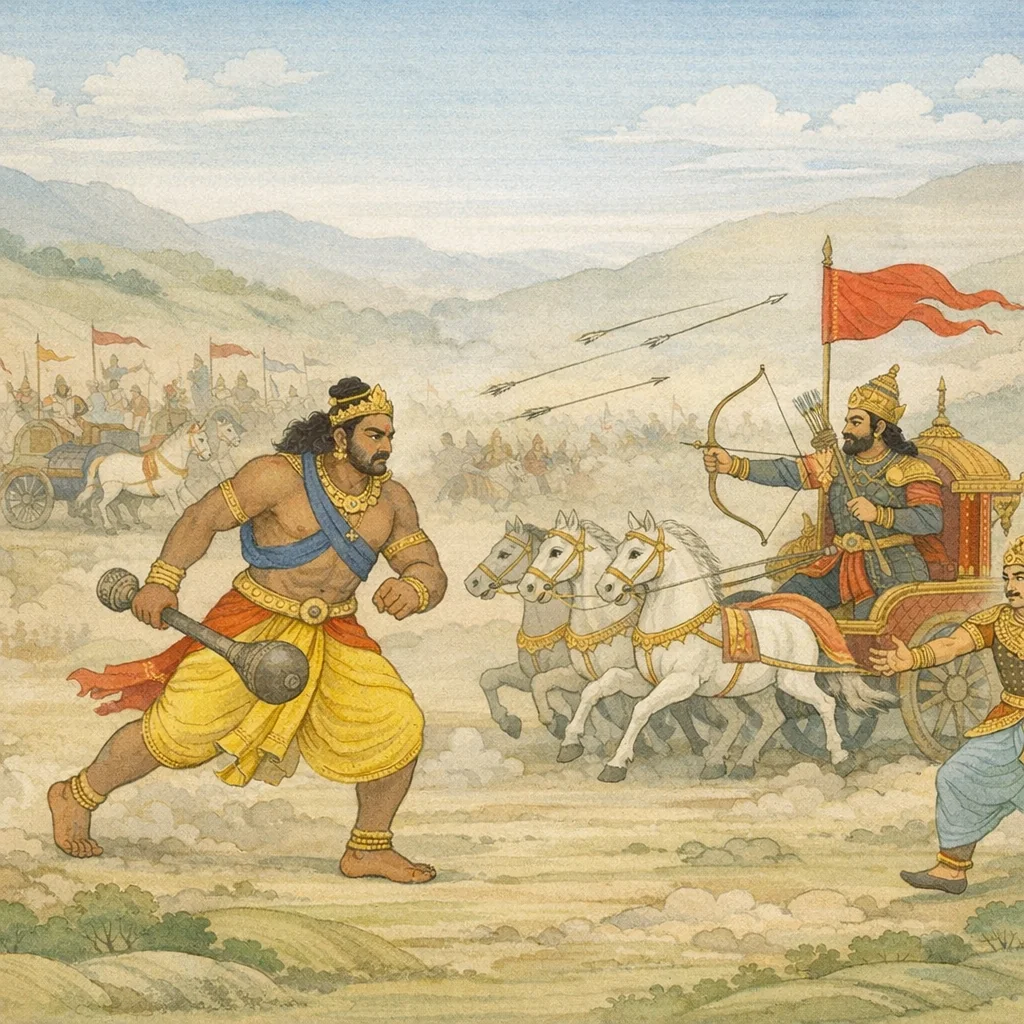
Adhyaya 88
अध्याय ८८ — घटोत्कच-दुर्योधनयुद्धवर्णनम् (Ghaṭotkaca–Duryodhana Engagement)
Upa-parva: Bhīṣma-parva — Ghaṭotkaca–Duryodhana Saṅgrāma (battle episode cluster)
Saṃjaya reports an intense exchange in which Ghaṭotkaca, enraged and employing rākṣasa-like ferocity, withstands and responds to heavy projectile volleys. A Vaṅga ruler advances a mountain-like elephant to obstruct the approach toward Duryodhana’s chariot; Ghaṭotkaca hurls a massive śakti, killing the Vaṅga king and bringing down the elephant, producing visible distress in Duryodhana’s ranks. Duryodhana, upholding kṣātra honor, resists retreat and releases a blazing arrow that Ghaṭotkaca evades with agility, then amplifies terror through a thunderous roar. Hearing this, Bhīṣma assesses the threat as exceptionally difficult to defeat and directs leading Kaurava warriors (including Droṇa and others) to rush to Duryodhana’s protection. A tumulous battle follows; Ghaṭotkaca’s archery disables weapons, standards, drivers, and mounts across multiple opponents, demonstrating both tactical disruption and the narrative motif of asymmetric battlefield dominance.
Chapter Arc: संजय धृतराष्ट्र को रणभूमि का दृश्य सुनाते हैं—अर्जुन बिजली-सी गति से राजाओं के धनुष काटते, रथों को छिन्न-भिन्न करते, और क्षणभर में अनेक महारथियों का गर्व चूर कर देते हैं। → अर्जुन के प्रचण्ड प्रहार से कौरव-पक्ष की पंक्तियाँ डगमगाती हैं; उसी उथल-पुथल में जयद्रथ अत्युग्रबल होकर आगे बढ़ता है और अपने श्रेष्ठ धनुष से कई महारथियों के धनुष बलपूर्वक काटकर प्रतिरोध खड़ा करता है। क्रोध से भरा वृकोदर (भीम) बिना अधिक विचार किए शत्रु-समूह पर टूट पड़ता है। → भीम का उग्र पुरुषार्थ जयद्रथ के सामने भड़क उठता है—जयद्रथ यमदण्ड-तुल्य तीक्ष्ण बाणों की वर्षा करता है, पर भीम बाणों की परवाह किए बिना उसके रथ-घोड़ों पर प्रहार कर उसे विचलित करता है; तभी दुर्योधन स्वयं देवराज-सम प्रभाव के साथ अस्त्र उठाकर भीम-वध हेतु तेजी से बढ़ता है। → अध्याय का अंत निर्णायक वध पर नहीं, बल्कि युद्ध की दिशा बदल देने वाले हस्तक्षेप पर टिकता है—दुर्योधन का आगे आना संकेत देता है कि भीम-जयद्रथ का संघर्ष अब राजकीय प्रतिष्ठा और सेनापति-स्तरीय टकराव में बदलने वाला है। → दुर्योधन हथियार उठाए भीम को मारने दौड़ता है—अगले क्षणों में यह मुठभेड़ किसका मान तोड़ेगी?
Shlokas
Verse 1
अपन क्रात बछ। अं पञ्चाशीतितमोब<् ध्याय: अर्जुनका पराक्रम, पाण्डवोंका भीष्मपर आक्रमण, युधिष्ठिरका शिखण्डीको उपालम्भ और भीमका पुरुषार्थ संजय उवाच स ताड्यमानस्तु शरैर्धनंजय: पदा हतो नाग इव श्वसन् बली । बाणेन बाणेन महारथानां चिच्छेद चापानि रणे प्रसह[,संजय कहते हैं--राजन्! इस प्रकार शत्रुओंके बाणोंसे आहत होकर बलवान् अर्जुन पैरसे कुचले हुए सर्पकी भाँति क्रोधसे लंबी साँस खींचने लगे। उन्होंने बलपूर्वक पृथक्- पृथक् बाण मारकर युद्धमें सभी महारथियोंके धनुष काट डाले
Sañjaya said: O King, though struck by the enemies’ arrows, the mighty Arjuna (Dhanañjaya) began to breathe long, wrathful breaths like a serpent crushed underfoot. Then, forcing the issue in battle, he severed the bows of the great chariot-warriors—arrow after arrow—breaking their power to fight.
Verse 2
संछिद्य चापानि च तानि राज्ञां तेषां रणे वीर्यवतां क्षणेन | विव्याध बाणैर्युगपन्महात्मा निःशेषतां तेष्वथ मन्यमान:,रणक्षेत्रमें उन पराक्रमी नरेशोंके धनुषोंको क्षणभरमें काटकर महामना अर्जुनने उनका पूर्णतः संहार कर देनेकी इच्छासे एक ही साथ सबको अपने बाणोंसे घायल कर दिया
Sañjaya said: In the midst of battle, that great-souled Arjuna, in an instant, cut down the bows of those kings—mighty in valor—and, intent on utterly finishing them, pierced them all at once with his arrows.
Verse 3
निपेतुराजौ रुधिरप्रदिग्धा- स्ते ताडिता: शक्रसुतेन राजन् | विभिन्नगात्रा: पतितोत्तमाड़ा गतासवश्शकछिन्नतनुत्रकाया:,राजन! इन्द्रपुत्र अर्जुनके द्वारा ताड़ित होकर वे सभी नरेश खूनसे लथपथ हो युद्धभूमिमें गिर पड़े। उनके अंग छिन्न-भिन्न हो गये थे, मस्तक कटकर दूर जा गिरे थे, कवच और शरीरके टुकड़े-टुकड़े हो गये थे और इस अवस्थामें पहुँचकर उन्हें अपने प्राण खो देने पड़े थे
Sañjaya said: O King, struck down by Śakra’s son, those rulers—smeared with blood—fell upon the battlefield. Their limbs were shattered, their heads severed and cast away; their armor and bodies were torn to pieces, and in that condition they gave up their lives. The verse starkly underscores the terrible cost of war, where royal valor and worldly status collapse before the impartial violence of battle.
Verse 4
महीं गता: पार्थबलाभि भूता विचित्ररूपा युगपद् विनेशु: । दृष्टवा हतांस्तात् युधि राजपुत्रां- स्त्रिगर्तराज: प्रययौ रथेन,पार्थंके बलसे अभिभूत होकर वे विचित्ररूपधारी राजकुमार एक साथ ही पृथ्वीपर गिरकर नष्ट हो गये। उन राजपुत्रोंको युद्धमें मारा गया देख त्रिगर्तराज सुशर्माने रथके द्वारा अर्जुनपर आक्रमण किया
Sañjaya said: Overpowered by Arjuna’s forces, those princes of varied appearance fell to the earth all at once and perished. Seeing the royal sons slain in battle, the Trigarta king Suśarmā advanced in his chariot to assail Arjuna—an escalation driven by kṣatriya pride and the relentless momentum of war, where grief and vengeance quickly harden into renewed violence.
Verse 5
तेषां रथानामथ पृष्ठगोपा द्वात्रिंशवन्ये3भ्यपतन्त पार्थम् तथैव ते तं परिवार्य पार्थ विकृष्य चापानि महारवाणि,उन राजपुत्रोंके रथोंके जो दूसरे-दूसरे बत्तीस पृष्ठरक्षक थे, वे भी (सुशर्माके साथ ही) अर्जुनपर टूट पड़े। इसी प्रकार उन सबने अर्जुनको चारों ओरसे घेरकर महान् टंकारध्वनि करनेवाले अपने धनुष खींचे और जैसे मेघ पर्वतपर जलराशिकी वर्षा करते हैं, उसी प्रकार अर्जुनपर बाणसमूहोंकी वृष्टि करने लगे। उनके बाणसमूहोंकी वर्षासे पीड़ित होकर युद्धस्थलमें अर्जुनके हृदयमें बड़ा भारी रोष हुआ
Sañjaya said: The rear-guards of those princes’ chariots—thirty-two in number—also rushed upon Pārtha (Arjuna). Surrounding him on all sides, they drew their bows that thundered with a great twang, and began to shower volleys of arrows upon Arjuna like rain-clouds pouring down on a mountain. Struck by that rain of shafts, Arjuna’s heart on the battlefield blazed with fierce wrath.
Verse 6
अवीवृषन् बाणमहौघवृष्ट्या यथा गिरिं तोयधरा जलौघै: । सम्पीड्यमानस्तु शरौघवृष्ट्या धनंजयस्तान् युधि जातरोष:,उन राजपुत्रोंके रथोंके जो दूसरे-दूसरे बत्तीस पृष्ठरक्षक थे, वे भी (सुशर्माके साथ ही) अर्जुनपर टूट पड़े। इसी प्रकार उन सबने अर्जुनको चारों ओरसे घेरकर महान् टंकारध्वनि करनेवाले अपने धनुष खींचे और जैसे मेघ पर्वतपर जलराशिकी वर्षा करते हैं, उसी प्रकार अर्जुनपर बाणसमूहोंकी वृष्टि करने लगे। उनके बाणसमूहोंकी वर्षासे पीड़ित होकर युद्धस्थलमें अर्जुनके हृदयमें बड़ा भारी रोष हुआ
Sañjaya said: Like rain-bearing clouds drenching a mountain with torrents of water, they showered Arjuna with a dense downpour of arrows. Pressed hard by that rain of shafts, Dhanañjaya, in the midst of battle, was stirred to fierce wrath—his resolve sharpening under assault as the struggle intensified.
Verse 7
षष्ट्या शरै: संयति तैलधौतै- जघान तानप्यथ पृष्ठगोपान् । रथांक्ष॒ तांस्तानवजित्य संख्ये धनंजय: प्रीतमना यशस्वी
Sañjaya said: In the press of battle, Dhanaṃjaya (Arjuna) struck them down with sixty arrows, their shafts polished with oil. Then he also overcame those who were guarding the rear; and, having defeated each of them in the fight, the glorious Arjuna became glad at heart—his success adding to his renown amid the demands and moral weight of war.
Verse 8
अथात्वरद् भीष्मवधाय जिष्णु- बलानि राजन् समरे निहत्य । उन्होंने रणक्षेत्रमें तेलके धोये हुए साठ बाण मारकर उन पृष्ठरक्षकोंका भी संहार कर दिया। इस प्रकार युद्धभूमिमें उन सभी रथियोंको जीतकर और कौरव-सेनाओंका समरमें संहार करके प्रसन्नचित्त हुए यशस्वी विजयी अर्जुनने भीष्मके वधके लिये शीघ्रता की ।। ७ - त्रिगर्तराजो निहतान् समीक्ष्य महात्मना तानथ बन्धुवर्गान्
Sañjaya said: Then, O King, Jishnu (Arjuna), intent on Bhishma’s fall, pressed swiftly on after striking down the enemy forces in battle. The king of the Trigartas, seeing his own kinsmen slain by that great-souled warrior, could only look on. Arjuna, having overcome the chariot-fighters and cut down the Kaurava host upon the field, advanced with a steadfast mind, hastening toward the work of bringing Bhishma down.
Verse 9
अभिद्रुतं चास्त्र भृतां वरिष्ठ धनंजयं वीक्ष्य शिखण्डिमुख्या:
Sañjaya said: Seeing Dhanañjaya (Arjuna)—foremost among those who bear weapons—being fiercely charged at, the warriors led by Śikhaṇḍin took note and moved to respond.
Verse 10
पार्थोडपि तानापतत: समीक्ष्य त्रिगर्तराज्ञा सहितान् नृवीरान्,इधर धनुर्धर अर्जुन भी त्रिगर्ततमजके साथ उन नरवीरोंको आते देख संग्रामशूमिमें गाण्डीव धनुषसे छोड़े हुए तीखे बाणोंद्वारा उन्हें नष्ट करके भीष्मजीके पास जाना चाहते थे, इतनेहीमें उन्होंने युद्धस्थलमें राजा दुर्योधन और सिन्धुराज जयद्रथ आदिको देखा
Sañjaya said: Arjuna, seeing those heroic warriors rushing forward together with the king of Trigarta, wished to destroy them on the battlefield with the sharp arrows released from his Gāṇḍīva bow and then move toward Bhīṣma. Just then, amid the clash of arms, he also caught sight of King Duryodhana and the Sindhu king Jayadratha, among others.
Verse 11
विध्वंसयित्वा समरे धनुष्मान् गाण्डीवमुक्तिर्निशितै: पृषत्कै: । भीष्म यियासुर्युधि संददर्श दुर्योधन सैन्धवादीं श्व राज्ञ:,इधर धनुर्धर अर्जुन भी त्रिगर्ततमजके साथ उन नरवीरोंको आते देख संग्रामशूमिमें गाण्डीव धनुषसे छोड़े हुए तीखे बाणोंद्वारा उन्हें नष्ट करके भीष्मजीके पास जाना चाहते थे, इतनेहीमें उन्होंने युद्धस्थलमें राजा दुर्योधन और सिन्धुराज जयद्रथ आदिको देखा
Sañjaya said: Having destroyed in battle those bowmen with sharp arrows released from the Gāṇḍīva, Arjuna—intending to go toward Bhīṣma on the field—then caught sight, in the midst of the fight, of King Duryodhana and the Sindhu king (Jayadratha) and others.
Verse 12
संवारयिष्णूनभिवारयित्वा मुहूर्तमायोध्य बलेन वीर: । उत्सृज्य राजानमनन्तवीर्यों जयद्रथादींश्व नृपान्ू महौजा:
Sañjaya said: After checking those who sought to hold him back, the heroic warrior fought for a short while with sheer strength. Then, releasing the king, that mighty one of endless valor went on to confront the princes, beginning with Jayadratha.
Verse 13
(भीष्मो5पि दृष्टवा समरे कृतास्त्रान् स पाण्डवानां रथिनो हरुदारान् | विहाय संग्राममुखे धनंजयं जवेन पार्थ पुनराजगाम ।।) भीष्म भी अस्त्र-विद्याके विद्वान् एवं उदार पाण्डवरथियोंको युद्धस्थलमें अपने सामने देखते हुए भी उन सबको वहीं छोड़कर बड़े वेगसे पुनः अर्जुनके पास आये। युधिष्ठिरश्न प्रबलो महात्मा समाययौ त्वरितो जातकोप:,उस समय उत्कृष्ट बलशाली अनन्तकीर्ति महात्मा युधिष्ठिर भी युद्धमें अपने भागके रूपमें प्राप्त हुए मद्रराज शल्यको छोड़कर नकुल, सहदेव और भीमसेनके साथ क्रोधपूर्वक तुरंत वहाँसे चल दिये और युद्धके लिये शान्तनुनन्दन भीष्मके पास जा पहुँचे
Sañjaya said: Even Bhīṣma—though he saw before him on the battlefield the noble-hearted Pāṇḍava chariot-warriors, fully armed and ready—left them at the very front of the fight and, with great speed, returned again to Dhanañjaya (Arjuna). The moment reveals Bhīṣma’s tactical urgency and his fixed engagement with Arjuna, the pivotal warrior whose presence could decisively shape both the battle’s outcome and its moral weight.
Verse 14
मद्राधिपं समभित्यज्य संख्ये स्वभागमाप्तं तमनन्तकीर्ति: । सार्थ स माद्रीसुतभीमसे नै- भीष्म ययौ शान्तनवं रणाय,उस समय उत्कृष्ट बलशाली अनन्तकीर्ति महात्मा युधिष्ठिर भी युद्धमें अपने भागके रूपमें प्राप्त हुए मद्रराज शल्यको छोड़कर नकुल, सहदेव और भीमसेनके साथ क्रोधपूर्वक तुरंत वहाँसे चल दिये और युद्धके लिये शान्तनुनन्दन भीष्मके पास जा पहुँचे
Sañjaya said: In the thick of battle, the mighty and illustrious Yudhiṣṭhira—renowned for unending fame—set aside Śalya, the king of Madra who had fallen to him as his allotted opponent, and, accompanied by the sons of Mādrī (Nakula and Sahadeva) and by Bhīmasena, moved at once in wrath to confront Bhīṣma, the son of Śāntanu, for combat. The moment lays bare the war’s ethical strain: even when an adversary is ‘assigned’ by circumstance, urgent duty and strategic necessity can draw a warrior toward the greater threat on the field.
Verse 15
तैः सम्प्रयुक्तै: स महारथाग्र्यै- गज्भासुत: समरे चित्रयोधी । न विव्यथे शान्तनवो महात्मा समागतै: पाण्डुसुतै: समस्तै:,महारथियोंमें श्रेष्ठ समस्त पाण्डव संगठित होकर वहाँ आ पहुँचे थे तो भी उनसे समरांगणमें विचित्र युद्ध करनेवाले गंगापुत्र शान्तनुनन्दन महात्मा भीष्मको व्यथा नहीं हुई
Sañjaya said: Though the foremost of great chariot-warriors—the sons of Pāṇḍu—had come together and engaged him, the great-souled Bhīṣma, son of Śāntanu and born of the Gaṅgā, a wondrous fighter in battle, did not waver or feel distress. The verse exalts steadfastness and disciplined resolve amid overwhelming opposition, a warrior’s composure grounded in duty rather than fear.
Verse 16
अथैत्य राजा युधि सत्यसंधो जयद्रथो>त्युग्रबलो मनस्वी । चिच्छेद चापानि महारथानां प्रसहा तेषां धनुषा वरेण,तत्पश्चात् सत्यप्रतिज्ञ अत्यन्त भयंकर शक्तिशाली मनस्वी राजा जयद्रथने रणमें सामने आकर उत्तम धनुषद्वारा बलपूर्वक उन महारथियोंके धनुष काट डाले
Sañjaya said: Then, in the thick of battle, King Jayadratha—true to his resolve, exceedingly powerful, and high-spirited—advanced to the front and, with his excellent bow, forcibly cut down the bows of those great chariot-warriors. The scene shows how, in war, steadfast vows and superior skill can abruptly shift the balance through disabling blows rather than direct killing.
Verse 17
युधिष्ठिरें भीमसेनं यमौ च पार्थ कृष्णं युधि संजातकोप: । दुर्योधन: क्रोधविषो महात्मा जघान बाणैरनलप्रकाशै:,क्रोधरूपी विष उगलनेवाले महामनस्वी दुर्योधनने युधिष्ठिर, भीमसेन, नकुल, सहदेव, अर्जुन तथा श्रीकृष्णपर युद्धमें कुपित हो अग्निके समान तेजस्वी बाणोंका प्रहार किया
Sañjaya said: In the battle, Duryodhana—his anger like a venom—rose in wrath and struck Yudhiṣṭhira, Bhīmasena, the twin sons (Nakula and Sahadeva), Pārtha (Arjuna), and Kṛṣṇa with arrows blazing like fire. The scene shows how unchecked rage, though formidable in war, becomes a moral poison that drives indiscriminate violence even against the foremost foes.
Verse 18
कृपेण शल्येन शलेन चैव तथा विभो चित्रसेनेन चाजौ । विद्धा: शरैस्तेडतिविवृद्धको पै- देवा यथा दैत्यगणै: समेतै:,प्रभो! जैसे क्रोधमें भरे हुए दैत्यगण एकत्र हो देवताओंपर प्रहार करते हैं, उसी प्रकार कृपाचार्य, शल्य, शल तथा चित्रसेनने युद्धस्थलमें अत्यन्त क्रोधमें भरकर समस्त पाण्डवोंको अपने बाणोंसे घायल कर दिया
Sañjaya said: O lord, on the battlefield the Pāṇḍavas were wounded by volleys of arrows loosed by Kṛpa, Śalya, Śala, and Citrasena—warriors aflame with fierce wrath—just as the gods are assailed when the gathered hosts of the Dānavas attack in anger.
Verse 19
छिन्नायुधं शान्तनवेन राजा शिखण्डिन प्रेक्ष्य च जातकोप: । अजातशगत्रुः समरे महात्मा शिखण्डिनं क्रुद्ध उवाच वाक्यम्,शान्तनुनन्दन भीष्मने जब शिखण्डीका धनुष काट दिया,- तब समरांगणमें अजातशत्रु महात्मा युधिष्ठिर शिखण्डीकी ओर देखकर कुपित हो उठे और उससे क्रोधपूर्वक इस प्रकार बोले--
Seeing that the Śāntanava (Bhīṣma) had cut down Śikhaṇḍin’s weapon, King Ajātaśatru—high-souled Yudhiṣṭhira—was seized by anger on the battlefield. Fixing his gaze upon Śikhaṇḍin, he addressed him in wrathful words.
Verse 20
उक्त्वा तथा त्वं पितुरग्रतो मा- महं हनिष्यामि महाव्रतं तम् । भीष्मं शरौघैर्विमलार्कवर्ण: सत्यं वदामीति कृता प्रतिज्ञा,“वीर! तुमने अपने पिताके सामने प्रतिज्ञापूर्वक मुझसे यह कहा था कि “मैं महान् व्रतधारी भीष्मको निर्मल सूर्यके समान तेजस्वी बाणसमूहोंद्वारा अवश्य मार डालूँगा, यह बात मैं सत्य कहता हूँ।' ऐसी प्रतिज्ञा तुमने की थी; परंतु तुम इस प्रतिज्ञाको सफल नहीं करते हो। कारण कि युद्धमें देवव्रत भीष्मका वध नहीं कर रहे हो। झूठी प्रतिज्ञा करनेवाला न बनो। अपने धर्म, कुल और यशकी रक्षा करो
Sañjaya said: “Before your father you once vowed to me, ‘I will surely slay Bhīṣma, that great keeper of vows, with volleys of arrows radiant as the spotless sun; I speak the truth.’ Such was your pledge. Yet you do not fulfill it, for in battle you do not kill Devavrata Bhīṣma. Do not become one of false vows; protect your dharma, your lineage, and your honor.”
Verse 21
त्वया च नैनां सफलां करोषि देवव्रतं यन्न निहंसि युद्धे । मिथ्याप्रतिज्ञो भव मात्र वीर रक्ष स्वधर्म स्वकुलं यशश्नल,“वीर! तुमने अपने पिताके सामने प्रतिज्ञापूर्वक मुझसे यह कहा था कि “मैं महान् व्रतधारी भीष्मको निर्मल सूर्यके समान तेजस्वी बाणसमूहोंद्वारा अवश्य मार डालूँगा, यह बात मैं सत्य कहता हूँ।' ऐसी प्रतिज्ञा तुमने की थी; परंतु तुम इस प्रतिज्ञाको सफल नहीं करते हो। कारण कि युद्धमें देवव्रत भीष्मका वध नहीं कर रहे हो। झूठी प्रतिज्ञा करनेवाला न बनो। अपने धर्म, कुल और यशकी रक्षा करो
“Yet you do not bring your vow to fruition, since you do not strike down Devavrata (Bhīṣma) in battle. Do not become one whose pledge proves false, O hero. Protect your dharma, your lineage, and your honor.”
Verse 22
प्रेक्षस्व भीष्म॑ युधि भीमवेगं सर्वास्तपन्तं मम सैन्यसंघान् । शरौघजालैरतितिग्मवेगै: काल॑ यथा कालकृतं क्षणेन,“देखो! जैसे यमराज समयानुसार उपस्थित होकर क्षणभरमें देहधारीका विनाश कर देते हैं, उसी प्रकार ये युद्धमें भयंकर वेगशाली भीष्म अत्यन्त प्रचण्ड वेगवाले बाणसमूहोंके द्वारा मेरी समस्त सेनाओंको कितना संताप दे रहे हैं
Sañjaya said: “Behold, in battle, the terrible momentum of Bhīma—how he scorches all the divisions of my army. With nets of arrow-showers, driven with razor-sharp speed, he is like Kāla (Time, Death) itself, which, when the destined hour arrives, destroys embodied beings in an instant.”
Verse 23
निकृत्तचाप: समरेडनपेक्ष: पराजित: शान्तनवेन चाजौ । विहाय बन्धूनथ सोदरांश्न क्व यास्यसे नानुरूपं तवेदम्,'युद्धमें शान्तनुनन्दन भीष्मने तुम्हारा धनुष काटकर तुम्हें पराजित कर दिया; फिर भी तुम उनकी ओरसे निरपेक्ष हो रहे हो। अपने सगे भाइयोंको छोड़कर कहाँ जाओगे? यह कायदा तुम्हारे अनुरूप नहीं है
Sañjaya said: “In the battle, the son of Śantanu (Bhīṣma) has cut down your bow and defeated you in combat; yet you now act as though indifferent toward him. Abandoning your kinsmen—indeed, even your own brothers—where will you go? Such conduct is not fitting for you.”
Verse 24
दृष्टवा हि भीष्म॑ तमनन्तवीर्य भग्नं च सैन्यं द्रवमाणमेवम् । भीतो<सि नून॑ द्रुपदस्य पुत्र तथा हि ते मुखवर्णो<प्रहृष्ट:,“ट्रपदकुमार! अनन्त पराक्रमी भीष्मको तथा उनके डरसे इस प्रकार हतोत्साह होकर भागती हुई मेरी इस सेनाको देखकर निश्चय ही तुम डर गये हो; क्योंकि तुम्हारे मुखकी कान्ति कुछ ऐसी ही अप्रसन्न दिखायी देती है
Sañjaya said: “Seeing Bhīṣma—of boundless might—and seeing the army shattered and fleeing in this manner, you, O son of Drupada, must surely be afraid; for the color of your face is clearly not bright with confidence.”
Verse 25
अज्ञायमाने च धनंजयेडपि महाहवे सम्प्रसक्ते नृवीरे । कथं हि भीष्मात् प्रथित: पृथिव्यां भयं त्वमद्य प्रकरोषि वीर,“वीर! नरवीर अर्जुन कहीं महायुद्धमें फँसे हुए हैं। उनका इस समय पता नहीं है। ऐसे समयमें तुम आज भूमण्डलके विख्यात वीर होकर भीष्मसे भय कैसे कर रहे हो?”
“O warrior! Dhanañjaya—Arjuna—is caught up somewhere in this great battle, and his whereabouts are not known at this moment. At such a time, how can you, though famed across the earth as a hero, be afraid of Bhīṣma today?”
Verse 26
स धर्मराजस्य वचो निशम्य रूक्षाक्षरं विप्रलापानुबद्धम् । प्रत्यादेशं मन्यमानो महात्मा प्रतत्वरे भीष्मवधाय राजन्,राजन! धर्मराजके इस वचनमें प्रत्येक अक्षर रूखेपनसे भरा हुआ था। उसके द्वारा उन्होंने कितनी ही मनके विपरीत बातें कही थीं, तथापि उस वचनको सुनकर महामना शिखण्डीने इसे अपने लिये आदेश माना और तुरंत ही भीष्मका वध करनेके लिये सचेष्ट हो गया
Sañjaya said: Hearing the words of Dharmarāja—harsh in every syllable and entangled with bitter, contrary remarks—the high-souled Śikhaṇḍin took them as a direct command. Interpreting the rebuke as an instruction, he at once hastened, O King, to set about the slaying of Bhīṣma.
Verse 27
तमापतन्तं महता जवेन शिखण्डिनं भीष्ममभिद्रवन्तम् । निवारयामास हि शल्य एन- मस्त्रेण घोरेण सुदुर्जयेन,शिखण्डीको बड़े वेगसे आते और भीष्मपर धावा करते देख शल्यने अत्यन्त दुर्जय एवं भयंकर अस्त्रसे उसे रोक दिया!
Sañjaya said: Seeing Śikhaṇḍin rushing forward at great speed and charging toward Bhīṣma, Śalya checked him, restraining him with a dreadful weapon that was exceedingly hard to overcome.
Verse 28
स चापि दृष्टवा समुदीर्यमाण- मस्त्रं युगान्ताग्निसमप्रकाशम् । न सम्मुमोह द्रुपदस्य पुत्रो राजन महेन्द्रप्रतिमप्रभाव:,राजन्! प्रलयकालकी अग्निके समान तेजस्वी उस अस्त्रको प्रकट हुआ देखकर देवराज इन्द्रके समान प्रभावशाली द्रपदकुमार शिखण्डी घबराया नहीं
Sañjaya said: Seeing that weapon being unleashed—blazing like the fire at the end of an age—Drupada’s son, Śikhaṇḍin, whose might was comparable to Indra’s, did not lose his composure, O King. In the midst of terrifying violence, steadfastness and clarity of purpose are shown as a warrior’s ethical strength, not mere aggression.
Verse 29
तस्थौ च तत्रैव महाधनुष्मान्- शरैस्तदस्त्रं प्रतिबाधमान: । अथाददे वारुणमन्यदस्त्रं शिखण्ड्यथोग्रं प्रतिघातमस्य,वह महाधनुर्धर वीर अपने बाणोंद्वारा शल्यके अस्त्रका निवारण करता हुआ वहीं डटा रहा। फिर शिखण्डीने शल्यके अस्त्रका प्रतिघात करनेवाले अन्य भयंकर वारुणास्त्रको हाथमें लिया
Sañjaya said: The mighty archer stood his ground right there, checking that weapon with his arrows. Then Śikhaṇḍī took up another dreadful missile—the Vāruṇa weapon—meant to counter and strike back against that attack. The scene underscores the war’s relentless logic of measure and countermeasure, where skill and restraint in the use of astras becomes a moral pressure-point amid escalating violence.
Verse 30
तदस्त्रमस्त्रेण विदार्यमाणं खस्था: सुरा ददृशुः पार्थिवाश्व । भीष्मस्तु राजन् समरे महात्मा धनुश्न चित्रं ध्वजमेव चापि
Sanjaya said: The gods stationed in the sky beheld that missile being torn apart by a counter-missile. But Bhishma, O King, that great-souled warrior in the thick of battle, also struck down the wondrous bow and even the banner as well—showing how, in war, prowess is measured not only by meeting force with force, but by swiftly disabling the opponent’s means and symbols of power.
Verse 31
छित्त्वानदत् पाण्डुसुतस्य वीरो युधिष्ठटिरस्याजमीढस्य राज्ञ: । आकाशमें खड़े हुए देवताओं तथा रणक्षेत्रमें आये हुए राजाओंने देखा, शिखण्डीके दिव्यास्त्रसे शल्यका अस्त्र विदीर्ण हो रहा है। राजन! महात्मा एवं वीर भीष्म युद्धस्थलमें अजमीढ़कुलनन्दन पाण्बुपुत्र राजा युधिष्ठिरके विचित्र धनुष और ध्वजको काटकर गर्जना करने लगे ।। ३० है ।। ततः समुत्सृज्य धनु: सबाणं युधिष्ठिरं वीक्ष्य भयाभिभूतम्
Sañjaya said: The hero cut down the bow and banner of King Yudhiṣṭhira, the son of Pāṇḍu and descendant of Ājamīḍha. The gods standing in the sky and the kings gathered on the battlefield witnessed Śalya’s weapon being shattered by Śikhaṇḍī’s divine missile. O King, the great-souled and valiant Bhīṣma, having severed Yudhiṣṭhira’s splendid bow and standard in the midst of battle, roared aloud—displaying the terrible momentum of war even against one renowned for righteousness.
Verse 32
तमापतन्तं सहसा जवेन जयद्रथ: सगदं भीमसेनम्
Sañjaya said: Then Jayadratha, with sudden speed, charged at Bhīmasena as he came rushing on—Bhīma still wielding his mace—driving the battle forward through sheer force and resolve.
Verse 33
अचिन्तयित्वा स शरांस्तरस्वी वृकोदर: क्रोधपरीतचेता:
Sañjaya said: Without pausing to reflect, the mighty Vṛkodara—his mind overwhelmed by anger—at once loosed his arrows, driven by impetuous wrath rather than measured deliberation, showing how fury can eclipse restraint amid the pressures of war.
Verse 34
ततो<भिवीक्ष्याप्रतिमप्र भाव- स्तवात्मजस्त्वरमाणो रथेन
Sañjaya said: Then, having looked upon that warrior of incomparable might, your son—hastening in his chariot—moved to respond, driven by urgency amid the moral pressure of battle and reputation.
Verse 35
भीमो5प्यथैनं सहसा विनद्य प्रत्युद्ययौ गदया तर्जयान:,तब भीमसेन भी सहसा सिंहनाद करके गदाद्वारा गर्जन-तर्जन करते हुए जयद्रथकी ओर बढ़े
Sañjaya said: Then Bhīma too, roaring suddenly, advanced to meet him—brandishing his mace and hurling fierce threats. In the charged ethics of battle, his lion-like cry and direct challenge signal a warrior’s resolve to confront an adversary openly, face to face, without concealment.
Verse 36
(जयद्रथो भग्नवाहो रथं तं त्यक्त्वा ययौ यत्र राजा कुरूणाम् | स सौबल: सानुगः सानुजश्न दृष्टवा भीम॑ मूढचेता भयार्त: ।। घोड़ोंके मारे जानेपर जयद्रथ उस रथको छोड़कर जहाँ शकुनि, सेवकवृन्द तथा छोटे भाइयोंसहित कुरुराज दुर्योधन था, वहीं चला गया। भीमसेनको देखकर जयद्रथका मन किंकर्तव्यविमूढ़ हो गया था। वह भयसे पीड़ित हो रहा था। भीमो5प्यथैनं सहसा विनद्य प्रत्युद्ययौं गदया हन्तुकाम: । स सौबलं तव पुत्र निरीक्ष्य दुर्योधनं सानुजं रोषयुक्तः ।।) भीमसेन भी शकुनि और भाइयोंसहित आपके पुत्र दुर्योधनको देखकर रोषमें भर गये और सहसा गर्जना करके गदाद्वारा जयद्रथको मार डालनेकी इच्छासे आगे बढ़े। समुद्यतां तां यमदण्डकल्पां दृष्टवा गदां ते कुरव: समन्तात् । विहाय सर्वे तव पुत्रमुग्रं पातं गदाया: परिहर्तुकामा:,यमदण्डके समान भयंकर उस गदाको उठी हुई देख समस्त कौरव आपके पुत्रको वहीं छोड़कर गदाके उग्र आघातसे बचनेके लिये चारों ओर भाग गये। भारत! मोहमें डालनेवाले उस अत्यन्त दारुण एवं भयंकर जनसंहारमें उस महागदाको आती देख केवल चित्रसेनका चित्त किंकर्तव्यविमूढ़ नहीं हुआ था
Sañjaya said: When his horses had been slain, Jayadratha abandoned that chariot and went to where the Kuru king (Duryodhana) was, together with Śakuni, his attendants, and his younger brothers. Seeing Bhīma, Jayadratha’s mind became bewildered and unsure of what to do; he was afflicted with fear. The scene underscores how, in the chaos of war, courage collapses when one’s support is broken and one confronts a superior force—fear and confusion replacing resolve.
Verse 37
अफक्रान्तास्तुमुले सम्प्रमर्दे सुदारुणे भारत मोहनीये । अमूढचेतास्त्वथ चित्रसेनो महागदामापतत्तीं निरीक्ष्य,यमदण्डके समान भयंकर उस गदाको उठी हुई देख समस्त कौरव आपके पुत्रको वहीं छोड़कर गदाके उग्र आघातसे बचनेके लिये चारों ओर भाग गये। भारत! मोहमें डालनेवाले उस अत्यन्त दारुण एवं भयंकर जनसंहारमें उस महागदाको आती देख केवल चित्रसेनका चित्त किंकर्तव्यविमूढ़ नहीं हुआ था
Sañjaya said: In that bewildering slaughter of the Bhāratas—fierce, tumultuous, and exceedingly dreadful—when the great mace came rushing in, terrible as Yama’s staff, all the Kauravas, abandoning your son on the spot, scattered in every direction to escape its violent blow. Only Citrasena’s mind did not fall into confusion at the sight of that onrushing mighty mace.
Verse 38
रथ॑ स्वमुत्सूज्य पदातिराजौ प्रगृह्ा खड्गं विपुलं च चर्म । अवषप्लुत: सिंह इवाचलाग्रा- ज्जगामान्यं भूमिप भूमिदेशम्,राजन्! वह अपने रथको छोड़कर हाथमें बहुत बड़ी ढाल और तलवार ले पर्वतके शिखरसे सिंहकी भाँति कूद पड़ा और पैदल ही विचरता हुआ युद्धस्थलके दूसरे प्रदेशमें चला गया
Sañjaya said: Leaving his own chariot behind, the king—now fighting on foot—grasped a broad shield and a sword. Like a lion leaping down from a mountain peak, he sprang forward and, O king, moved on foot into another sector of the battlefield.
Verse 39
गदापि सा प्राप्य रथं सुचित्रं साश्वं ससूतं विनिहत्य संख्ये । जगाम भूमिं ज्वलिता महोल्का भ्रष्टाम्बराद् गामिव सम्पतन्ती,वह गदा भी चित्रसेनके विचित्र रथपर पहुँचकर उसे घोड़े और सारथिसहित चूर-चूर करके आकाशसे टूटकर पृथ्वीपर गिरनेवाली जलती हुई विशाल उल्काके समान रणभूमिमें जा गिरी
Sañjaya said: That mace, having reached the splendidly adorned chariot with its horses and charioteer, smashed it to pieces in the thick of battle. Then it plunged to the earth like a great blazing meteor, falling down from the sky.
Verse 40
आश्चर्यभूतं समहत् त्वदीया दृष्टवैव तद् भारत सम्प्रह्ृष्टा: । सर्वे विनेदु:ः सहिता: समन्तात् पुपूजिरे तव पुत्रस्य शौर्यम्,भारत! इस समय आपके समस्त सैनिक चित्रसेनका वह महान् आश्वर्यमय कार्य देखकर बड़े प्रसन्न हुए। वे सभी सब ओरसे एक साथ आपके पुत्रके शौर्यकी प्रशंसा और गर्जना करने लगे
Sañjaya said: O Bhārata, seeing that great and wondrous feat, all your troops were at once filled with delight. From every side, gathered together, they raised a loud acclaim and celebrated the valor of your son.
Verse 84
इस प्रकार श्रीमह्याभारत भीष्मपर्वके अन्तर्गत भीष्मवधपर्वमें सातवें दिनके युद्धर्ें सुशर्मा और अर्जुनकी भिड़ंतसे सम्बन्ध रखनेवाला चौरासीवाँ अध्याय पूरा हुआ
Sañjaya said: Thus, in the Śrī Mahābhārata, within the Bhīṣma Parva—specifically in the section concerning Bhīṣma’s slaying—the eighty-fourth chapter, connected with the clash between Suśarmā and Arjuna on the seventh day of the war, is concluded.
Verse 85
इति श्रीमहाभारते भीष्मपर्वणि भीष्मवधपर्वणि सप्तमयुद्धदिवसे पज्चाशीतितमो<ध्याय:
Thus, in the revered Mahābhārata, within the Bhīṣma Parva—specifically in the section concerning the slaying of Bhīṣma—on the seventh day of the great war, ends the eighty-fifth chapter.
Verse 86
रणे पुरस्कृत्य नराधिपांस्तान् जगाम पार्थ त्वरितो वधाय । महामना अर्जुनके द्वारा अपने बन्धुसमूहोंको मारा गया देख त्रिगर्तराज सुप्रसिद्ध नरपतियोंको युद्धके लिये आगे करके तुरंत ही अर्जुनका वध करनेके लिये उनके सामने आया
Sañjaya said: In the midst of battle, the Trigarta king—seeing his own kinsmen cut down by high-souled Arjuna—pushed those renowned rulers to the fore and, in haste, advanced to confront Arjuna with the intent to kill him.
Verse 96
अभ्युद्ययुस्ते शितशस्त्रहस्ता रिरक्षिषन्तो रथमर्जुनस्थ । अस्त्रधारियोंमें श्रेष्ठ वीर अर्जुनपर आक्रमण होता देख शिखण्डी आदि महारथी उनके रथकी रक्षा करनेके लिये तीखे अस्त्र-शस्त्र हाथमें लिये आगे बढ़े
Sañjaya said: Seeing the assault directed at the heroic Arjuna, the foremost weapon-bearers—Śikhaṇḍī and other great chariot-warriors—advanced with keen weapons in hand, intent on guarding the chariot where Arjuna stood.
Verse 126
ययौ ततो भीमबलो मनस्वी गाज़्ेयमाजी शरचापपाणि: । दुर्योधन और जयद्रथ आदि योद्धा अर्जुनको रोकनेके प्रयत्नमें लगे थे; अत: उस समय अनन्त पराक्रमी एवं महातेजस्वी वीर अर्जुनने दो घड़ीतक बलपूर्वक युद्ध करके उन सबको रोक दिया। तत्पश्चात् राजा दुर्योधन और जयद्रथ आदि नरेशोंको वहीं छोड़कर भयंकर बलसे सम्पन्न एवं मनस्वी अर्जुन हाथमें धनुष-बाण ले युद्धस्थलमें गंगानन्दन भीष्मकी ओर चल दिये
Sañjaya said: Then the mighty and resolute Arjuna, bow and arrows in hand, advanced on the battlefield toward Bhīṣma, the son of the Gaṅgā. Having held back Duryodhana, Jayadratha, and the other kings who strove to obstruct him for a time, he left them there and moved on with fierce martial purpose to confront Bhīṣma.
Verse 316
गदां प्रगृह्मा भिषपपात संख्ये जयद्रथं भीमसेन: पदाति: । तब धनुष-बाण फेंककर भयसे दबे हुए युधिष्ठिरको देखकर भीमसेन गदा लेकर युद्धमें पैदल ही राजा जयद्रथपर टूट पड़े
Sañjaya said: Grasping his mace, Bhīmasena—fighting on foot—charged into the thick of battle and fell upon King Jayadratha, for he saw Yudhiṣṭhira shaken with fear and having cast aside his bow and arrows.
Verse 326
विव्याध घोरैर्यमदण्डकल्पै: शितै:शरै: पञचशतै: समन्तात् । इस प्रकार सहसा हाथमें गदा लिये भीमसेनको वेगपूर्वक आते देख जयद्रथने यमदण्डके समान भयंकर पाँच सौ तीखे बाणोंद्वारा सब ओरसे उन्हें घायल कर दिया
Sañjaya said: Seeing Bhīmasena rushing forward with a mace in hand, Jayadratha swiftly struck him from all sides with five hundred sharp arrows—terrible as Yama’s rod—wounding him severely.
Verse 336
जघान वाहान् समरे समन्तात् पारावतान् सिन्धुराजस्य संख्ये । वेगशाली भीमसेन उसके बाणोंकी कोई परवा न करते हुए मन-ही-मन क्रोधसे जल उठे। तत्पश्चात् उन्होंने समरभूमिमें सिन्धुराजके कबूतरके समान रंगवाले घोड़ोंको मार डाला
Sanjaya said: In the thick of battle, swift Bhimasena, heedless of the enemy’s arrows and burning with inward wrath, struck down on every side the Sindhu king’s horses—pigeon-grey in color—thus crippling his movement in war.
Verse 343
अभ्याययौ भीमसेन निहन्तुं समुद्यतास्त्र: सुरराजकल्प: । यह देखकर आपका अनुपम प्रभावशाली पुत्र देवराजसदृश दुर्योधन भीमसेनको मारनेके लिये हथियार उठाये बड़ी उतावलीके साथ रथके द्वारा वहाँ आ पहुँचा
Sanjaya said: Weapon raised and eager to strike down Bhimasena, the king-like hero advanced, like the lord of the gods. Seeing this, your incomparable and powerful son Duryodhana—resembling Indra—lifted his arms to kill Bhima and, in great haste, drove his chariot to that spot.
Frequently Asked Questions
The dilemma centers on leadership under crisis: whether a ruler should prioritize tactical withdrawal to preserve forces or maintain a public stance of kṣātra honor; the narrative shows Duryodhana’s resolve amid mounting risk and counsel-driven reinforcement.
Capability and intent must be evaluated realistically: when an adversary’s methods produce disproportionate disruption, prudent command emphasizes collective coordination and protection of critical leadership, rather than relying solely on individual prestige.
No explicit phalaśruti is presented in the supplied passage; the chapter functions primarily as operational narration and ethical illustration through consequence-driven action rather than a concluding salvific or ritual commendation.