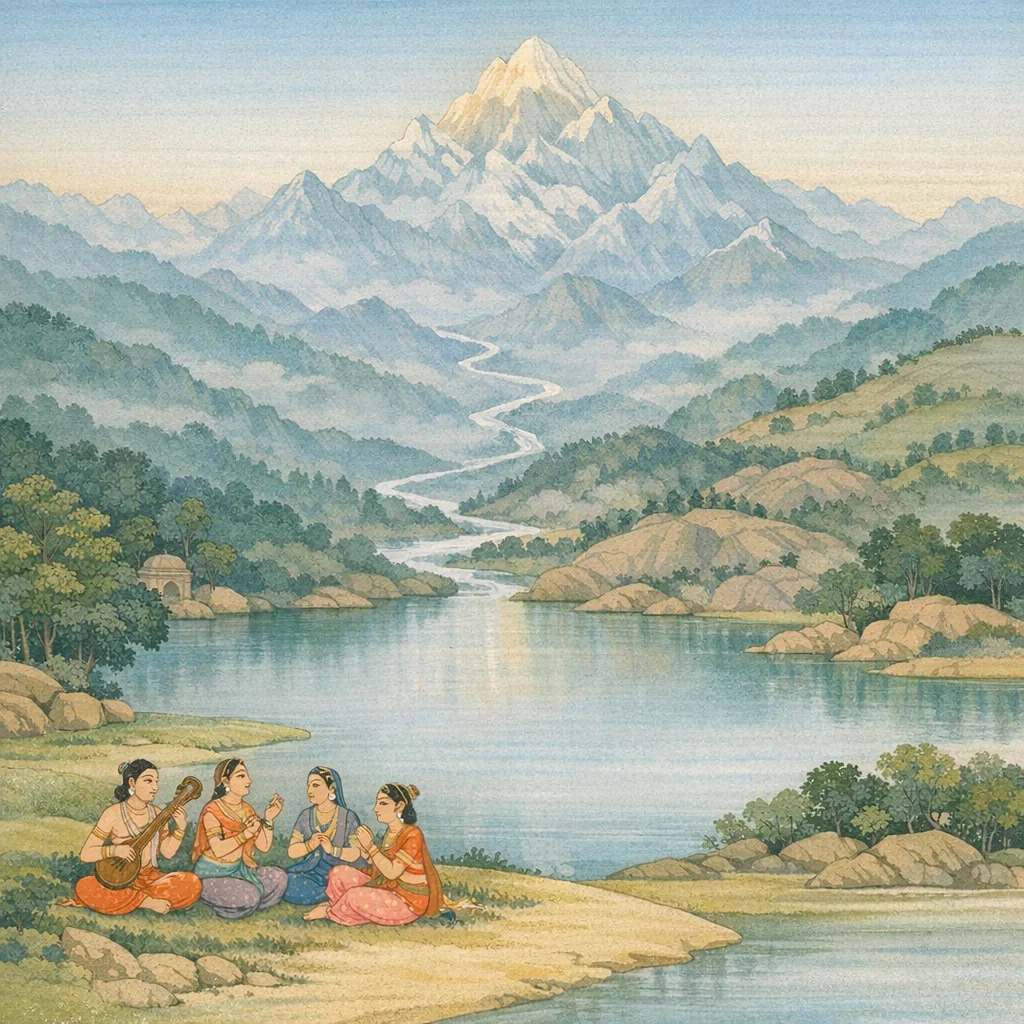
Adhyaya 6
Adhyāya 6: Pañca-mahābhūta–guṇa-nirdeśa and Sudarśana-dvīpa (Five Elements, Sensory Qualities, and a Cosmographic Island)
Upa-parva: Bhūmi–Pramāṇa–Varnana (Cosmographic and Geophysical Description Episode)
Dhṛtarāṣṭra requests that Saṃjaya report the names and measures of rivers, mountains, regions, and forests. Saṃjaya responds by establishing an ontological and epistemological framework: the world rests upon five mahābhūtas—earth, water, wind, fire, and space—each characterized by a descending set of sensory qualities (śabda, sparśa, rūpa, rasa, gandha), with earth presented as principal due to possessing all five. He specifies the reduction of qualities across elements (water lacking smell; fire with three; wind with two; space with sound alone), and notes that embodied differentiation arises when these elements enter imbalance, while processes of arising and dissolution occur in sequence. Saṃjaya then cautions that certain realities are acintya and not to be established by mere reasoning, especially what lies beyond prakṛti. Having framed the limits of measurement and inference, he begins a cosmographic description of Sudarśana-dvīpa: circular and wheel-like, covered with rivers, bounded by cloud-like mountains, adorned with varied cities and pleasing regions, rich in trees, flowers, fruits, wealth, and grain, encircled by a salt ocean, and said to be visible in the lunar orb like a face reflected in a mirror; brief details (pippala and a great hare motif) conclude the summary.
Chapter Arc: धृतराष्ट्र, संजय से पूछते हैं—चन्द्रमण्डल में दिखने वाले ‘शश-चिह्न’ जितना जो भूम्यवकाश दृष्टिगोचर है, उसका प्रमाण क्या है? और फिर पिप्पल, द्वीप-वर्ष-पर्वतों का विस्तार कैसे है? → संजय क्रमशः भूगोल-पुराण का विराट मानचित्र खोलते हैं—पूर्व से पश्चिम तक फैले ‘छः वर्ष-पर्वत’, दोनों ओर समुद्रों की सीमा, और मेरु का ऐसा स्तम्भ-स्वरूप जो ऊर्ध्व, अधः और तिर्यक् दिशाओं में लोकों को आच्छादित करता है; उसके पार्श्वों में चार द्वीपों की स्थापना। फिर दिव्य लोकों के गायक गन्धर्वों का आगमन और स्तुति, तथा पर्वतों द्वारा धारण किए गए समुद्र-सदृश पुण्य-ह्रदों का वर्णन—मानव-कल्पना को साधारण धरती से उठाकर ब्रह्माण्डीय व्यवस्था तक ले जाता है। → मेरु के चारों ओर लोक-आवरण और उसके पार्श्वों में स्थित द्वीपों का निर्णायक उद्घाटन—जहाँ गन्धर्व (तुम्बुरु, नारद, विश्वावसु, हाहा, हुहू) देवश्रेष्ठों के समीप जाकर विविध स्तवों से स्तुति करते हैं, और गंगा-प्राकट्य तथा समुद्र-सम ह्रद की पवित्रता का संकेत (पिनाकधृक्/शिव-संबद्धता) इस भूगोल को तीर्थ-धर्म के शिखर पर पहुँचा देता है। → अध्याय हिमालय, हेमकूट, निषध आदि पर्वतों पर निवास करने वाले राक्षस, गुह्यक, सर्प-नागों का उल्लेख करते हुए, तपोवनों (जैसे गोकर्ण) और दीर्घायु जनसमुदायों (गन्धमादन-प्रदेश में 11,000 वर्ष की आयु) का विधान बताता है; अंततः बिन्दुसरोवर के निकट भागीरथी गंगा का दर्शन करने हेतु भगीरथ के दीर्घ निवास का स्मरण कराकर तीर्थ-परम्परा को स्थिर करता है। → धृतराष्ट्र की जिज्ञासा अभी शेष है—इस विराट भूगोल के बाद संजय आगे किन-किन लोकों, नदियों और दिव्य-नियमों का क्रमबद्ध विस्तार करेंगे?
Shlokas
Verse 1
/ अपन बक। हक २ >> - एक समान। षष्ठो5 ध्याय: सुदर्शनके वर्ष, पर्वत, 8 तथा शशाकृतिका व धृतराष्ट उवाच उक्तो द्वीपस्य संक्षेपो विधिवद् बुद्धिमंस्त्वया । तत्त्वज्ञश्नासि सर्वस्य विस्तरं ब्रूहि संजय,धृतराष्ट्र बोले--बुद्धिमान् संजय! तुमने सुदर्शन-द्वीपका विधिपूर्वक थोड़ेमें ही वर्णन कर दिया, परंतु तुम तो तत्त्वोंके ज्ञाता हो; अतः इस सम्पूर्ण द्वीपका विस्तारके साथ वर्णन करो
Dhṛtarāṣṭra said: “Wise Sañjaya, you have duly given a brief account of the island. But you are a knower of realities in all matters—therefore describe this entire island to me in full detail.”
Verse 2
यावान् भूम्यवकाशो<यं दृश्यते शशलक्षणे । तस्य प्रमाण प्रब्रूहि ततो वक्ष्यसि पिप्पलम्,चन्द्रमाके शश-चिह्ममें भूमिका जितना अवकाश दृष्टिगोचर होता है, उसका प्रमाण बताओ। तत्पश्चात् पिप्पलस्थानका वर्णन करना
Dhṛtarāṣṭra said: “O you marked by the hare (i.e., O Moon), tell me the measure of this expanse of space above the earth that is visible to the eye. After stating its extent, then describe to me the pippala (sacred fig) location.”
Verse 3
संजय उवाच प्रागायता महाराज षडेते वर्षपर्वता: । अवगाढा हाुभयत: समुद्रौ पूर्वपश्चिमौ,संजय बोले--महाराज! पूर्वदिशासे पश्चिम दिशाकी ओर फैले हुए ये छ: वर्ष पर्वत हैं, जो दोनों ओर पूर्व तथा पश्चिम समुद्रमें घुसे हुए हैं
Sañjaya said: “O great king, these six Varṣa-mountains extend from the east toward the west. On both sides they plunge into the oceans—the eastern and the western—marking the great natural boundaries of the lands.”
Verse 4
हिमवान् हेमकूटश्व निषधश्च नगोत्तम: । नीलश्न वैदूर्यमय: श्वेतश्न शशिसंनिभ:,उनके नाम इस प्रकार हैं--हिमवान, हेमकूट, पर्वतश्रेष्ठ निषध, वैदूर्यमणिमय नीलगिरि, चन्द्रमाके समान उज्ज्वल श्वेतगिरि तथा सब धातुओंसे सम्पन्न होकर विचित्र शोभा धारण करनेवाला शुंगवान् पर्वत। राजन! ये छः: पर्वत सिद्धों तथा चारणोंके निवास स्थान हैं
Sañjaya said: “Himavān, Hemakūṭa, and Niṣadha—the foremost of mountains—together with Nīla, made of vaidūrya (a lapis-like gem), and Śveta, radiant like the moon.” Thus are these mountains praised as exalted, luminous abodes, fit dwelling-places for perfected beings.
Verse 5
इस प्रकार श्रीमहाभारत भीष्मपर्वके अन्तर्गत जग्बूखण्डविनिर्माणपर्वमें युदर्शनद्वीपवर्णनविषयक पाँचवाँ अध्याय पूरा हुआ,सर्वधातुविचित्रश्न शुद्भधवान् नाम पर्वत: | एते वै पर्वता राजन् सिद्धचारणसेविता: उनके नाम इस प्रकार हैं--हिमवान, हेमकूट, पर्वतश्रेष्ठ निषध, वैदूर्यमणिमय नीलगिरि, चन्द्रमाके समान उज्ज्वल श्वेतगिरि तथा सब धातुओंसे सम्पन्न होकर विचित्र शोभा धारण करनेवाला शुंगवान् पर्वत। राजन! ये छः: पर्वत सिद्धों तथा चारणोंके निवास स्थान हैं
Sañjaya said: “There is also a mountain named Śuddhadhāvān, resplendent with the varied brilliance of all minerals. O King, these mountains are frequented and inhabited by Siddhas and Cāraṇas. Their names are: Himavān, Hemakūṭa, the foremost mountain Niṣadha, the Nīlagiri made of vaidūrya-gems, the bright Śvetagiri shining like the moon, and the mountain Śuṅgavān, rich in every mineral and adorned with manifold beauty.”
Verse 6
एषामन्तरविष्कम्भो योजनानि सहस्रश: । तत्र पुण्या जनपदास्तानि वर्षाणि भारत,भरतनन्दन! इनके बीचका विस्तार सहस्रों योजन है। वहाँ भिन्न-भिन्न वर्ष (खण्ड) हैं और उनमें बहुत-से पवित्र जनपद हैं इति श्रीमहाभारते भीष्मपर्वणि जम्बूखण्डविनिर्माणपर्वणि भूम्यादिपरिमाणविवरणे षष्ठो5ध्याय:
Sañjaya said: “The intervening breadth between these regions extends for thousands of yojanas. Within that expanse, O Bhārata, lie the various varṣas (territorial divisions), and in them are many sacred provinces and settlements.”
Verse 7
वसन्ति तेषु सत्त्वानि नानाजातीनि सर्वश: । इदं तु भारतं वर्ष ततो हैमवतं परम्,उनमें सब ओर नाना जातियोंके प्राणी निवास करते हैं, उनमेंसे यह भारतवर्ष है। इसके बाद हिमालयसे उत्तर हैमवतवर्ष है
Sañjaya said: “In those regions dwell living beings of many kinds, in every direction. Among them is this land called Bhārata-varṣa; beyond it, to the north of the Himālaya, lies the region known as Haimavata.”
Verse 8
हेमकूटात् परं चैव हरिवर्ष प्रचक्षते । दक्षिणेन तु नीलस्य निषधस्योत्तरेण तु,हेमकूट पर्वतसे आगे हरिवर्षकी स्थिति बतायी जाती है। महाभाग! नीलगिरिके दक्षिण और निषधपर्वतके उत्तर पूर्वसे पश्चिमकी ओर फैला हुआ माल्यवान् नामक पर्वत है। माल्यवानसे आगे गन्धमादन पर्वत है
Sañjaya said: “Beyond the Hemakūṭa mountain, they describe the region called Harivarṣa. It lies to the south of Nīla and to the north of Niṣadha—thus marking, in the sacred geography, the ordered boundaries of the world as understood by the tradition.”
Verse 9
प्रागायतो महाभाग माल्यवान् नाम पर्वत: । ततः परं माल्यवत: पर्वतो गन्धमादन:,हेमकूट पर्वतसे आगे हरिवर्षकी स्थिति बतायी जाती है। महाभाग! नीलगिरिके दक्षिण और निषधपर्वतके उत्तर पूर्वसे पश्चिमकी ओर फैला हुआ माल्यवान् नामक पर्वत है। माल्यवानसे आगे गन्धमादन पर्वत है
O greatly fortunate one! To the east first lies the mountain called Mālyavān, stretching from east to west, south of Nīlagiri and north of Niṣadha. Beyond Mālyavān stands Mount Gandhamādana.
Verse 10
परिमण्डलस्तयोर्मध्ये मेरः कनकपर्वत: । आदित्यतरुणाभासो विधूम इव पावक:,इन दोनोंके बीचमें मण्डलाकार सुवर्णमय मेरुपर्वत है, जो प्रातः:कालके सूर्यके समान प्रकाशमान तथा धूमरहित अग्निके समान कान्तिमान् है
Sañjaya said: “Between those two stood Mount Meru, a circular mountain of gold—radiant like the young morning sun and brilliant like a smokeless fire.”
Verse 11
योजनानां सहस््राणि चतुरशीतिरुच्छित: । अधस्ताच्चतुरशीतिर्योजनानां महीपते,उसकी ऊँचाई चौरासी हजार योजन है। राजन! वह नीचे भी चौरासी हजार योजनतक पृथ्वीके भीतर घुसा हुआ है
Sañjaya said: “O King, it rises to a height of eighty-four thousand yojanas; and, O lord of the earth, it extends downward as well for eighty-four thousand yojanas into the ground.”
Verse 12
ऊर्ध्वमधश्च तिर्यक् च लोकानावृत्य तिष्ठति । तस्य पार्श्चैंष्वमी द्वीपाश्षत्वार: संस्थिता विभो,प्रभो! मेरुपर्वत ऊपर-नीचे तथा अगल-बगल सम्पूर्ण लोकोंको आवृत करके खड़ा है। उसके पार्श्चभागमें ये चार द्वीप बसे हुए हैं
Sañjaya said: “Mount Meru stands firm, veiling the worlds above, below, and across. On its flanks, O mighty lord, O master, these four great continents (dvīpas) are situated.”
Verse 13
भद्राश्वः केतुमालश्न जम्बूद्वीपश्च भारत । उत्तराश्वैव कुरव: कृतपुण्यप्रतिश्रया:,भारत! उनके नाम ये हैं--भद्राश्व, केतुमाल, जम्बूद्वीप तथा उत्तरकुरु। उत्तरकुरु द्वीपमें पुण्यात्मा पुरुषोंका निवास है
O Bhārata! Their names are Bhadrāśva, Ketumāla, Jambūdvīpa, and Uttarakuru. In Uttarakuru dwell men of virtue, established in merit.
Verse 14
विहग: सुमुखो यस्तु सुपर्णस्यथात्मज: किल । स वै विचिन्तयामास सौवर्णान् वीक्ष्य वायसान्,एक समय पक्षिराज गरुड़के पुत्र सुमुखने मेरु-पर्वतपर सुनहरे शरीरवाले कौवोंको देखकर सोचा कि यह सुमेरुपर्वत उत्तम, मध्यम तथा अधम पक्षियोंमें कुछ भी अन्तर नहीं रहने देता है। इसलिये मैं इसको त्याग दूँगा। ऐसा विचार करके वे वहाँसे अन्यत्र चले गये
Sañjaya said: “Sumukha, a bird and indeed the son of Suparṇa (Garuḍa), on seeing crows with golden bodies, began to reflect. He thought: ‘This Sumeru makes no distinction between superior, middling, and inferior birds; therefore I shall abandon it.’ Having thus resolved, he departed from that place to elsewhere.”
Verse 15
मेरुरुत्तममध्यानामधमानां च पक्षिणाम् | अविशेषकरो यस्मात् तस्मादेनं त्यजाम्यहम्,एक समय पक्षिराज गरुड़के पुत्र सुमुखने मेरु-पर्वतपर सुनहरे शरीरवाले कौवोंको देखकर सोचा कि यह सुमेरुपर्वत उत्तम, मध्यम तथा अधम पक्षियोंमें कुछ भी अन्तर नहीं रहने देता है। इसलिये मैं इसको त्याग दूँगा। ऐसा विचार करके वे वहाँसे अन्यत्र चले गये
Sañjaya said: “Because Mount Meru makes no distinction between birds that are superior, middling, or inferior, I shall abandon it.” With this thought, the bird-king Garuḍa’s son Sumukha, having seen golden-bodied crows upon Mount Meru, departed from that place to elsewhere—rejecting a realm where merit and baseness appear to be treated alike.
Verse 16
तमादित्यो<नुपर्येति सततं ज्योतिषां वर: । चन्द्रमाश्न॒ सनक्षत्रो वायुश्नैव प्रदक्षिण:,ज्योतिर्मय ग्रहोंमें सर्वश्रेष्ठ सूर्यदेव, नक्षत्रोंसहित चन्द्रमा तथा वायुदेव भी प्रदक्षिणक्रमसे सदा मेरुगिरिकी परिक्रमा करते रहते हैं
Sañjaya said: The Sun—foremost among the luminaries—unceasingly moves in its course; likewise the Moon together with the constellations, and also the Wind, continually perform their rightward circuit.
Verse 17
स पर्वतो महाराज दिव्यपुष्पफलान्वित: । भवनैरावृत: सर्वैर्जाम्बूनदपरिष्कृतै:,महाराज! वह पर्वत दिव्य पुष्पों और फलोंसे सम्पन्न है। वहाँके सभी भवन जाम्बूनद नामक सुवर्णसे विभूषित हैं। उनसे घिरे हुए उस पर्वतकी बड़ी शोभा होती है
Sañjaya said: “O King, that mountain is endowed with celestial flowers and fruits. It is encircled on all sides by mansions adorned with Jāmbūnada gold, and thus the mountain shines with extraordinary splendor.”
Verse 18
तत्र देवगणा राजन् गन्धर्वासुरराक्षसा: | अप्सरोगणसंयुक्ता: शैले क्रीडन्ति सर्वदा,राजन्! उस पर्वतपर देवता, गन्धर्व, असुर, राक्षस तथा अप्सराएँ सदा क्रीड़ा करती रहती हैं
Sañjaya said: “O King, there on that mountain the hosts of gods—together with Gandharvas, Asuras, and Rākṣasas—accompanied by companies of Apsarases, continually engage in sport.”
Verse 19
तत्र ब्रह्मा च रुद्रश्न शक्रश्नापि सुरेश्वर: । समेत्य विविधैर्यज्नैर्यजन्तेडनेकदक्षिणै:,वहाँ ब्रह्मा, रुद्र तथा देवराज इन्द्र एकत्र हो पर्याप्त दक्षिणावाले नाना प्रकारके यज्ञोंका अनुष्ठान करते हैं
There, Brahmā and Rudra, and also Śakra—the lord of the gods—assemble together and perform many kinds of sacrifices, richly endowed with abundant sacrificial gifts.
Verse 20
तुम्बुरुनरिदश्चैव विश्वावसुर्हहा हुहू: । अभिगम्यामरश्रेष्ठांस्तुष्टवुर्विविधै: स्तवैः,उस समय तुम्बुरु, नारद, विश्वावसु, हाहा और हुह्टू नामक गन्धर्व उन देवेश्वरोंके पास जाकर भाँति-भाँतिके स्तोत्रोंद्वारा उनकी स्तुति करते हैं
Sañjaya said: Then Tumburu, Nārada, Viśvāvasu, and the Gandharvas Hahā and Huhū approached the foremost of the gods and praised those divine lords with hymns of many kinds.
Verse 21
सप्तर्षयो महात्मान: कश्यपश्च प्रजापति: । तत्र गच्छन्ति भद्रंं ते सदा पर्वणि पर्वणि,राजन्! आपका कल्याण हो। वहाँ महात्मा सप्तर्षिगण तथा प्रजापति कश्यप प्रत्येक पर्वपर सदा पधारते हैं
Sañjaya said: “O King, may welfare be yours. There, at every sacred occasion and season, the great-souled Seven Ṛṣis and Prajāpati Kaśyapa regularly come.”
Verse 22
तस्यैव मूर्धन्युशना: काव्यो दैत्यैर्महीपते । इमानि तस्य रत्नानि तस्येमे रत्नपर्वता:,भूपाल! उस मेरुपर्वतके ही शिखरपर दैत्योंके साथ शुक्राचार्य निवास करते हैं। ये सब रत्न तथा ये रत्नमय पर्वत शुक्राचार्यके ही अधिकारमें हैं
Sañjaya said: “O king, upon the very summit of that Meru stands Uśanā Kāvya (Śukrācārya) dwelling together with the Daityas. These jewels, and these mountains made of jewels, are under his authority.”
Verse 23
तस्मात् कुबेरो भगवांश्षतुर्थ भागमश्चुते ततः कलांशं वित्तस्य मनुष्येभ्य: प्रयच्छति,भगवान् कुबेर उन्हींसे धनका चतुर्थ भाग प्राप्त करके उसका उपभोग करते हैं और उस धनका सोलहवाँ भाग मनुष्योंको देते हैं
Sañjaya said: Therefore the venerable Kubera, having received a fourth share from Acyuta, enjoys it; and from that wealth he grants a fractional portion to human beings.
Verse 24
पाश्वें तस्योत्तरे दिव्यं सर्वर्तुकुसुमैश्चितम् । कर्णिकारवनं रम्यं शिलाजालसमुद्गतम्,सुमेरुपर्वतके उत्तर भागमें समस्त ऋतुओंके फूलोंसे भरा हुआ दिव्य एवं रमणीय कर्णिकार (कनेर वृक्षोंका) वन है, जहाँ शिलाओंके समूह संचित हैं
Sañjaya said: “On its northern flank lies a divine and delightful grove of karṇikāra trees, richly adorned with flowers of every season, rising amid clustered masses of rock.”
Verse 25
तत्र साक्षात् पशुपतिर्दिव्यैर्भूती: समावृत: । उमासहायो भगवान् रमते भूतभावन:,वहाँ दिव्य भूतोंसे घिरे हुए साक्षात् भूतभावन भगवान् पशुपति पैरोंतक लटकनेवाली कनेरके फूलोंकी दिव्य माला धारण किये भगवती उमाके साथ विहार करते हैं। वे अपने तीनों नेत्रोंद्वारा ऐसा प्रकाश फैलाते हैं, मानो तीन सूर्य उदित हुए हों
Sañjaya said: “There, the Lord Paśupati himself—Bhūtabhāvana, the source and sustainer of all beings—abides, surrounded by divine manifestations. Accompanied by Goddess Umā, the Blessed One delights in his divine sport, radiating an awe-inspiring presence that signals protection, sovereignty, and sanctifying power beyond the violence of war.”
Verse 26
वैशम्पायन उवाच एवं राज्ञा स पृष्टस्तु संजयो वाक्यमब्रवीत् | वैशम्पायनजी कहते हैं--जनमेजय! राजा धृतराष्ट्रके इस प्रकार पूछनेपर संजयने कहना आरम्भ किया,कर्णिकारमयीं मालां बिश्रत्पादावलम्बिनीम् । त्रिभिनेत्रै: कृतोद्योतस्त्रिभि: सूर्यरिवोदितै: वहाँ दिव्य भूतोंसे घिरे हुए साक्षात् भूतभावन भगवान् पशुपति पैरोंतक लटकनेवाली कनेरके फूलोंकी दिव्य माला धारण किये भगवती उमाके साथ विहार करते हैं। वे अपने तीनों नेत्रोंद्वारा ऐसा प्रकाश फैलाते हैं, मानो तीन सूर्य उदित हुए हों
Vaiśampāyana said: Thus questioned by the king, Saṃjaya began to speak. He described the Lord Paśupati—surrounded by divine beings—wearing a radiant garland of karṇikāra blossoms that hung down to His feet. With His three eyes He cast forth such brilliance, as though three suns had risen.
Verse 27
तमुग्रतपस: सिद्धा: सुव्रता: सत्यवादिन: । पश्यन्ति न हि दुर्वत्तै: शक््यो द्रष्टूं महेश्वर:,उग्र तपस्वी एवं उत्तम व्रतोंका पालन करनेवाले सत्यवादी सिद्ध पुरुष ही वहाँ उनका दर्शन करते हैं। दुराचारी लोगोंको भगवान् महेश्वरका दर्शन नहीं हो सकता
Only those perfected ones—of fierce austerity, steadfast in noble vows, and devoted to truth—behold Him there. For the Great Lord (Maheśvara) cannot be seen by people of corrupt conduct.
Verse 28
तस्य शैलस्य शिखरात् क्षीरधारा नरेश्वर । विश्वरूपापरिमिता भीमनिर्घातनि:स्वना,नरेश्वर! उस मेरुपर्वतके शिखरसे दुग्धके समान श्वेतधारवाली, विश्वरूपा, अपरिमित शक्तिशालिनी, भयंकर वज्रपातके समान शब्द करनेवाली, परम पुण्यात्मा पुरुषों-द्वारा सेवित, शुभस्वरूपा पुण्यमयी भागीरथी गंगा बड़े प्रबल वेगसे सुन्दर चन्द्रकुण्डमें गिरती हैं
Sañjaya said: “O king, from the summit of that mountain there pours a milk-white stream—vast in form and beyond measure—whose roar is like a terrifying thunderclap.”
Verse 29
पुण्या पुण्यतमैर्जुष्टा गड़ा भागीरथी शुभा । प्लवन्तीव प्रवेगेन हृदे चन्द्रमस: शुभे,नरेश्वर! उस मेरुपर्वतके शिखरसे दुग्धके समान श्वेतधारवाली, विश्वरूपा, अपरिमित शक्तिशालिनी, भयंकर वज्रपातके समान शब्द करनेवाली, परम पुण्यात्मा पुरुषों-द्वारा सेवित, शुभस्वरूपा पुण्यमयी भागीरथी गंगा बड़े प्रबल वेगसे सुन्दर चन्द्रकुण्डमें गिरती हैं
Sanjaya said: O king, the auspicious Bhagirathi—holy, and cherished by the most virtuous—rushes onward as if borne upon the flood’s own force. From the summit of Mount Meru she pours down in milk-white streams, vast in form and immeasurable in power, her roar like a dreadful thunderbolt. Served and revered by supremely righteous men, that sacred Ganga, of beneficent nature, plunges with tremendous speed into the beautiful lake called Chandrakunda.
Verse 30
तया ह्युत्पादित: पुण्य: स हद: सागरोपम: । तां धारयामास तदा दुर्धरां पर्वतैरपि
Sanjaya said: By her, a sacred lake was brought forth, vast like the ocean. And then he bore and contained that force, though it was so difficult to sustain that even mountains could scarcely have held it.
Verse 31
मेरोस्तु पश्चिमे पाश्वे केतुमालो महीपते,राजन! मेरुके पश्चिम भागमें केतुमाल द्वीप है, वहीं अत्यन्त विशाल जम्बूखण्ड नामक प्रदेश है, जो नन्दन-वनके समान मनोहर जान पड़ता है। भारत! वहाँके निवासियोंकी आयु दस हजार वर्षोकी होती है
Sanjaya said: “O lord of the earth, on the western flank of Mount Meru lies Ketumāla. In the western region of Meru there is the island-continent called Ketumāla; there too is an exceedingly vast tract known as Jambūkhaṇḍa, delightful like Nandana-grove. O Bhārata, the inhabitants there are said to live for ten thousand years.”
Verse 32
जम्बूखण्डस्तु तत्रैव सुमहान् नन्दनोपम: । आयुर्दश सहस््राणि वर्षाणां तत्र भारत,राजन! मेरुके पश्चिम भागमें केतुमाल द्वीप है, वहीं अत्यन्त विशाल जम्बूखण्ड नामक प्रदेश है, जो नन्दन-वनके समान मनोहर जान पड़ता है। भारत! वहाँके निवासियोंकी आयु दस हजार वर्षोकी होती है
There too lies Jambūkhaṇḍa, exceedingly vast and lovely like Nandana-grove. O Bhārata, the lifespan of those who dwell there is ten thousand years.
Verse 33
सुवर्णवर्णाश्व नरा: स्त्रियश्चाप्सरसोपमा: । अनामया वीतशोका नित्यं मुदितमानसा:,वहाँके पुरुष सुवर्णके समान कान्तिमान् और स्त्रियाँ अप्सराओंके समान सुन्दरी होती हैं। उन्हें कभी रोग और शोक नहीं होते। उनका चित्त सदा प्रसन्न रहता है
Sanjaya said: There, the men are radiant like gold, and the women are beautiful like apsarases. They are free from illness and untouched by sorrow; their minds remain ever cheerful.
Verse 34
जायन्ते मानवास्तत्र निष्टप्तकनकप्रभा: । गन्धमादनशज्ञेषु कुबेर: सह राक्षसै:
Sañjaya said: There, human beings are born with the radiance of heated, refined gold. Upon the peaks of Gandhamādana dwells Kubera, accompanied by his rākṣasa attendants—an image of a realm where splendor and formidable guardianship coexist, as though prosperity were guarded by power and discipline.
Verse 35
संवृतो5प्सरसां सड्घैमोंदते गुह्यकाधिप: । वहाँ तपाये हुए सुवर्णके समान गौर कान्तिवाले मनुष्य उत्पन्न होते हैं। गन्धमादन पर्वतके शिखरोंपर गुह्मकोंके स्वामी कुबेर राक्षसोंके साथ रहते और अप्सराओं-के समुदायोंके साथ आमोद-प्रमोद करते हैं ।। ३४ ई ।। गन्धमादनपादेषु परेष्वपरगण्डिका:
Sañjaya said: Surrounded by companies of Apsarases, Kubera—the lord of the Guhyakas—sports in delight. At the lofty slopes and heights of Mount Gandhamādana, those other marvellous beings are found as well. The passage evokes a celestial realm of pleasure and abundance, yet implicitly reminds that such delights remain within saṃsāra and are not the final aim upheld by dharma.
Verse 36
तत्र हृष्टा नरा राजंस्तेजोयुक्ता महाबला: । स्त्रियश्लोत्पलवर्णा भा: सर्वा: सुप्रियदर्शना:,राजन! वहाँके पुरुष हृष्ट-पुष्ट, तेजस्वी और महाबली होते हैं तथा सभी स्त्रियाँ कमलके समान कान्तिमती और देखनेमें अत्यन्त मनोरम होती हैं
Sañjaya said: “There, O King, the men are joyful and well-nourished, endowed with radiance and great strength; and all the women are lotus-hued in complexion, exceedingly pleasing to behold.” The description underscores a realm marked by prosperity, vitality, and auspicious beauty—signs traditionally associated with righteous order and well-being.
Verse 37
नीलात् परतरं श्रैतं श्वेताद्धैरण्यकं परम् | वर्षमैरावतं राजन् नानाजनपदावृतम्,नील पर्वतसे उत्तर श्वेतवर्ष और श्वेतवर्षसे उत्तर हिरण्यकवर्ष है। तत्पश्चात् शृंगवान् पर्ववसे आगे ऐरावत नामक वर्ष है। राजन! वह अनेकानेक जनपदोंसे भरा हुआ है
Sañjaya said: “Beyond Nīla lies Śvaita; beyond Śveta is the region called Hairaṇyaka. And then, O King, comes the land known as Airāvata, covered with many and varied provinces and settlements.” In this cosmographic narration, Sañjaya maps successive northern realms, emphasizing the ordered expanse of the world and the diversity of peoples within it.
Verse 38
धनु:संस्थे महाराज द्रे वर्षे दक्षिणोत्तरे । इलावृतं मध्यमं तु पञच वर्षाणि चैव हि,महाराज! दक्षिण और उत्तरके क्रमश: भारत और ऐरावत नामक दो वर्ष धनुषकी दो कोटियोंके समान स्थित हैं और बीचमें पाँच वर्ष (श्वेत, हिरण्यक, इलावृत, हरिवर्ष तथा हैमवत) हैं। इन सबके बीचमें इलावृतवर्ष है
Sañjaya said: “O King, on the two ‘ends’ like the two tips of a bow lie two regions, the southern and the northern. In the middle is Ilāvṛta; and indeed there are five regions in between.” In context, the verse maps the cosmic geography to a clear, ordered structure—suggesting a moral subtext of harmony and proper arrangement (dharma) even within vast diversity.
Verse 39
उत्तरोत्तरमेते भ्यो वर्षमुद्रिच्यते गुणै: । आयु:प्रमाणमारोग्यं धर्मतः कामतो<र्थत:,भारतसे आरम्भ करके ये सभी वर्ष आयुके प्रमाण, आरोग्य, धर्म, अर्थ और काम-- इन सभी दृष्टियोंसे गुणोंमें उत्तरोत्तर बढ़ते गये हैं
Sañjaya said: “From those earlier years onward, each succeeding year rose higher in excellence—measured by length of life, by health, and by the gains of dharma, artha, and kāma. Thus, O Bhārata, the course of time advanced with increasing auspicious qualities.”
Verse 40
समन्वितानि भूतानि तेषु वर्षेषु भारत । एवमेषा महाराज पर्वतैः पृथिवी चिता,भारत! इन सब वर्षोमें निवास करनेवाले प्राणी परस्पर मिल-जुलकर रहते हैं। महाराज! इस प्रकार यह सारी पृथ्वी पर्वतोंद्वारा स्थिर की गयी है
Sañjaya said: “O Bhārata, the living beings dwelling in those regions live in mutual association and harmony. O great king, thus this entire earth is, as it were, firmly set and structured by the mountains.”
Verse 41
हेमकूटस्तु सुमहान् कैलासो नाम पर्वत: । यत्र वैश्रवणो राजन् गुहाकैः सह मोदते,राजन! विशाल पर्वत हेमकूट ही कैलास नामसे प्रसिद्ध है। जहाँ कुबेर गुह्कोंके साथ सानन्द निवास करते हैं
Sañjaya said: “O King, there is a very great mountain called Kailāsa—also known as Hemakūṭa—where Vaiśravaṇa (Kubera) dwells joyfully in the company of the Guhyakas.”
Verse 42
अस्त्युत्तरेण कैलासं मैनाकं पर्वत प्रति । हिरण्यशूज्रः सुमहान् दिव्यो मणिमयो गिरि:,कैलाससे उत्तर मैनाक है और उससे भी उत्तर दिव्य तथा महान् मणिमय पर्वत हिरण्यशुंग है
Sañjaya said: “North of Mount Kailāsa lies the mountain Maināka; and still farther to the north stands the great, divine, jewel-like peak called Hiraṇyaśṛṅga.”
Verse 43
तस्य पाश्चे महद् दिव्यं शुभ्रं काउ्चनवालुकम् । रम्यं बिन्दुसरो नाम यत्र राजा भगीरथ:
To the west of that mountain lies a vast, divine lake—bright white, with golden sands, fair to behold—named Bindusara, where King Bhagīratha once dwelt.
Verse 44
यूपा मणिमयास्तत्र चैत्याश्वापि हिरण्मया:
Sañjaya said: There, the sacrificial posts (yūpa) were fashioned of gems, and even the ceremonial horses were made of gold—an image of dazzling royal splendor, proclaiming immense wealth and the outward grandeur of ritual power.
Verse 45
तत्रेष्टवा तु गतः सिद्धि सहस्राक्षो महायशा: । वहाँ बहुत-से मणिमय यूप तथा सुवर्णमय चैत्य (महल) शोभा पाते हैं। वहीं यज्ञ करके महायशस्वी इन्द्रने सिद्धि प्राप्त की थी ।। ४४ ई ।। स्रष्टा भूतपतिर्यत्र सर्वलोकैः सनातन:,उसी स्थानपर सब ओर सम्पूर्ण जगत्के लोग लोकस्रष्टा प्रचण्ड तेजस्वी सनातन भगवान् भूतनाथकी उपासना करते हैं। नर, नारायण, ब्रह्मा, मनु और पाँचवें भगवान् शिव वहाँ सदा स्थित रहते हैं
Sañjaya said: “Having performed sacrifice there, the thousand-eyed Indra—of great renown—attained siddhi (spiritual accomplishment).” The verse presents a sacred locale whose holiness is affirmed by Indra’s successful rite: disciplined worship and right ritual action, in a consecrated place, are shown as leading to attainment and divine favor.
Verse 46
उपास्यते तिग्मतेजा यत्र भूत: समन्तत: । नरनारायणो ब्रह्मा मनु: स्थाणुश्व पजचम:,उसी स्थानपर सब ओर सम्पूर्ण जगत्के लोग लोकस्रष्टा प्रचण्ड तेजस्वी सनातन भगवान् भूतनाथकी उपासना करते हैं। नर, नारायण, ब्रह्मा, मनु और पाँचवें भगवान् शिव वहाँ सदा स्थित रहते हैं
Sañjaya said: In that sacred region, on every side, all beings worship the eternally radiant Lord, fierce in splendor, the sovereign of creatures. There abide Nara and Nārāyaṇa, Brahmā, Manu, and also Sthāṇu (Śiva), reckoned as the fifth—showing that the world’s highest refuge is devotion to the divine, beyond the turmoil of war.
Verse 47
तत्र दिव्या त्रिपथगा प्रथम तु प्रतिषछ्ठिता । ब्रह्मलोकादपक्रान्ता सप्तधा प्रतिपद्यते,ब्रह्मलोकसे उतरकर त्रिपथगामिनी दिव्य नदी गंगा पहले उस बिन्दुसरोवरमें ही प्रतिष्ठित हुई थीं। वहींसे उनकी सात धाराएँ विभक्त हुई हैं
There, the divine river Gaṅgā—known as Tripathagā, “she who flows in three realms”—was first established. Descending from Brahmaloka, she then becomes manifest in seven distinct streams. The narration highlights the sacred ordering of the cosmos: a heavenly origin, a proper place of establishment, and a regulated distribution for the welfare of the worlds.
Verse 48
वस्वोकसारा नलिनी पावनी च सरस्वती । जम्बूनदी च सीता च गज्जा सिन्धुश्च सप्तमी,उन धाराओंके नाम इस प्रकार हैं--वस्वोकसारा, नलिनी, पावनी सरस्वती, जम्बूनदी, सीता, गंगा और सिंधु
Sañjaya said: “The seven sacred streams are named Vasvokasārā, Nalinī, Pāvanī, Sarasvatī, Jambūnadī, Sītā, Gaṅgā, and, as the seventh, Sindhu.” Here, the naming of revered rivers underscores purity, auspiciousness, and the sanctifying power of sacred geography within the epic’s moral universe.
Verse 49
अचिन्त्या दिव्यसंकाशा प्रभोरेषैव संविधि: । उपासते यत्र सत्र॑ सहस्रयुगपर्यये,यह (सात धाराओंका प्रादुर्भाव जगत्के उपकारके लिये) भगवान्का ही अचिन्त्य एवं दिव्य सुन्दर विधान है। जहाँ लोग कल्पके अन्ततक यज्ञानुष्ठानके द्वारा परमात्माकी उपासना करते हैं
Sañjaya said: “This ordinance of the Lord is beyond thought, radiant and divine. In that realm, people worship the Supreme through a great sacrificial session (satra) that endures until the completion of a thousand yugas.”
Verse 50
दृश्यादृश्या च भवति तत्र तत्र सरस्वती । एता दिव्या: सप्तगज्जस्त्रिषु लोकेषु विश्रुता:,इन सात धाराओंमें जो सरस्वती नामवाली धारा है, वह कहीं प्रत्यक्ष दिखायी देती है और कहीं अदृश्य हो जाती है। ये सात दिव्य गंगाएँ तीनों लोकोंमें विख्यात हैं
Sañjaya said: “There, the river named Sarasvatī becomes visible in some places and disappears from sight in others. These seven divine streams—celebrated as the ‘seven Gaṅgās’—are renowned throughout the three worlds.”
Verse 51
रक्षांसि वै हिमवति हेमकूटे तु गुह्का: । सर्पा नागाश्न निषधे गोकर्ण च तपोवनम्,हिमालयपर राक्षस, हेमकूटपर गुह्मक तथा निषधपर्वतपर सर्प और नाग निवास करते हैं। गोकर्ण तो तपोवन है
Sañjaya said: “Indeed, on Himavat dwell the rākṣasas; on Hemakūṭa live the guhyakas; on Niṣadha reside serpents and nāgas. And Gokarṇa is a sacred grove of austerity—a tapovana—set apart for ascetic practice.”
Verse 52
देवासुराणां सर्वेषां श्वेतपर्वत उच्यते । गन्धर्वा निषधे नित्यं नीले ब्रह्मर्षयस्तथा । शुज्भवांस्तु महाराज देवानां प्रतिसंचर:,श्वैतपर्वत सम्पूर्ण देवताओं और असुरोंका निवासस्थान बताया जाता है। निषधगिरिपर गन्धर्व तथा नीलगिरिपर ब्रह्मर्षि निवास करते हैं। महाराज! शुंगवान् पर्वत तो केवल देवताओंकी ही विहारस्थली है
Sañjaya said: “Śvetaparvata is spoken of as the common abode of all—gods and asuras alike. The Gandharvas dwell perpetually on Niṣadha, and likewise the Brahmarṣis on Nīla. But Śuṅgavān, O great king, is a resort and pleasure-ground frequented only by the gods.”
Verse 53
इत्येतानि महाराज सप्त वर्षाणि भागश: । भूतान्युपनिविष्टानि गतिमन्ति ध्रुवाणि च,राजेन्द्र! इस प्रकार स्थावर और जंगम सम्पूर्ण प्राणी इन सात वर्षोमें विभागपूर्वक स्थित हैं
Sañjaya said: “Thus, O great king, all beings are established in these seven varṣas, each according to its allotted division. Some are moving, some fixed; each abides in its own station, in the order appointed for them.”
Verse 54
तेषामृद्धिर्बहुविधा दृश्यते दैवमानुषी । अशक्या परिसंख्यातु श्रद्धेया तु बुभूषता,उनकी अनेक प्रकारकी दैवी और मानुषी समृद्धि देखी जाती है। उसकी गणना असम्भव है। कल्याणकी इच्छा रखनेवाले मनुष्यको उस समृद्धिपर विश्वास करना चाहिये
Sañjaya said: “Among them one can behold prosperity of many kinds—both divine and human. It cannot be fully counted. Yet a person who seeks true welfare should place faith in that prosperity (and in the higher order that grants it).”
Verse 55
(स वै सुदर्शनद्वीपो दृश्यते शशवद् द्विधा ।) यां तु पृष्छसि मां राजन् दिव्यामेतां शशाकृतिम् । पाश्वें शशस्य द्वे वर्षे उक्ते ये दक्षिणोत्तरे कर्णो तु नागद्वीपश्च काश्यपद्दवीप एव च,इस प्रकार वह सुदर्शनद्वीप बताया गया है, जो दो भागोंमें विभक्त होकर चन्द्रमण्डलमें प्रतिबिम्बित हो खरगोशकी-सी आकृतिमें दृष्टिगोचर होता है। राजन! आपने जो मुझसे इस शशाकृति (खरगोशकी-सी आकृति)-के विषयमें प्रश्न किया है उसका वर्णन करता हूँ, सुनिये। पहले जो दक्षिण और उत्तरमें स्थित (भारत और ऐरावत नामक) दो द्वीप बताये गये हैं, वे ही दोनों उस शश (खरगोश)-के दो पार्श्वभाग हैं। नागद्वीप तथा काश्यपद्दीप उसके दोनों कान हैं
Sañjaya said: “That Sudarśana-dvīpa is indeed seen as if divided into two, appearing on the lunar disk in the form of a hare. O King, since you ask me about this divine ‘hare-shaped’ mark, listen as I describe it. The two regions earlier described as lying to the south and the north are said to be the two flanks of that hare; and Nāga-dvīpa and Kāśyapa-dvīpa are its two ears.”
Verse 56
ताम्रपर्ण: शिरो राजज्छीमान् मलयपर्वतः । एतद् द्वितीयं द्वीपस्य दृश्यते शशसंस्थितम्,राजन! ताम्रवर्णके वृक्षों और पत्रोंसे सुशोभित श्रीमान् मलयपर्वत ही इसका सिर है। इस प्रकार यह सुदर्शनद्वीपका दूसरा भाग खरगोशके आकारमें दृष्टिगोचर होता है
Sañjaya said: “O King, the illustrious Malaya mountain—adorned with copper-hued foliage—forms the ‘head’ of that region. Thus, the second division of the island is seen taking the shape of a hare.”
Verse 306
शतं वर्षसहस्राणां शिरसैव पिनाकधृक् । वह पवित्र कुण्ड स्वयं गंगाजीने ही प्रकट किया है, जो अपनी अगाध जलराशिके कारण समुद्रके समान शोभा पाता है। जिन्हें अपने ऊपर धारण करना पर्वतोंके लिये भी कठिन था, उन्हीं गंगाको पिनाकधारी भगवान् शिव एक लाख वर्षोतक अपने मस्तकपर ही धारण किये रहे
Sañjaya said: “The Lord who bears the bow Pināka—Śiva—carried upon his very head for a hundred thousand years the sacred basin, the holy manifestation of the Gaṅgā, which shines like the ocean by reason of its unfathomable mass of waters. That Gaṅgā, whose weight even mountains could scarcely sustain, was borne by the Pināka-bearing God upon his own head for a full hundred thousand years—an image of divine restraint and protective power that upholds what would otherwise overwhelm the world.”
Verse 356
एकादश सहस्राणि वर्षाणां परमायुष: । गन्धमादनके अन्यान्य पार्श्चर्ती पर्वतोंपर दूसरी-दूसरी नदियाँ हैं, जहाँ निवास करनेवाले लोगोंकी आयु ग्यारह हजार वर्षोकी होती है
Sañjaya said: “On Gandhamādana there are other rivers as well, flowing along the mountain’s sides. The people who dwell in those regions are said to have a supreme lifespan of eleven thousand years.”
Verse 433
द्रष्ट भागीरथीं गद्ञामुवास बहुला: समा: । उसीके पास विशाल, दिव्य, उज्ज्वल तथा कांचनमयी बालुकासे सुशोभित रमणीय बिन्दुसरोवर है, जहाँ राजा भगीरथने भागीरथी गंगाका दर्शन करनेके लिये बहुत वर्षोतक निवास किया था
Sañjaya said: Wishing to behold the Bhāgīrathī Gaṅgā, he lived there for many years. Nearby lies the delightful lake called Bindusaras—vast, divine, radiant, and beautified by golden sands—where King Bhagīratha long resided in austerity and devotion, intent on gaining the vision of the sacred river. The passage underscores steadfast perseverance and reverence for holy purpose as a form of dharma.
Frequently Asked Questions
The chapter presents an epistemic dilemma rather than a battlefield choice: how to speak responsibly about the world’s measures and structure—what can be established by pramāṇa and reasoning versus what must be acknowledged as acintya and therefore not reducible to argumentative proof.
A graded model of reality and knowledge is taught: embodied existence depends on elemental composition and sensory qualities, while sound methodology requires distinguishing inferentially tractable domains from trans-empirical claims, cultivating restraint and clarity in interpretation.
No explicit phalaśruti is stated; the meta-commentary appears as methodological guidance—Saṃjaya’s note that acintya realities are not to be “proved” by tarka—positioning the chapter as a conceptual prologue to subsequent geographic cataloging.