Adhyaya 80
Go-mahātmyam: Pavitrāṇāṃ Pavitraṃ (Cows and Ghee as Supreme Purifiers)
Upa-parva: Dāna-dharma (Gavāṃ-dāna & Pavitra-vicāra) — Instructional Unit on the sanctity of cows and ghee
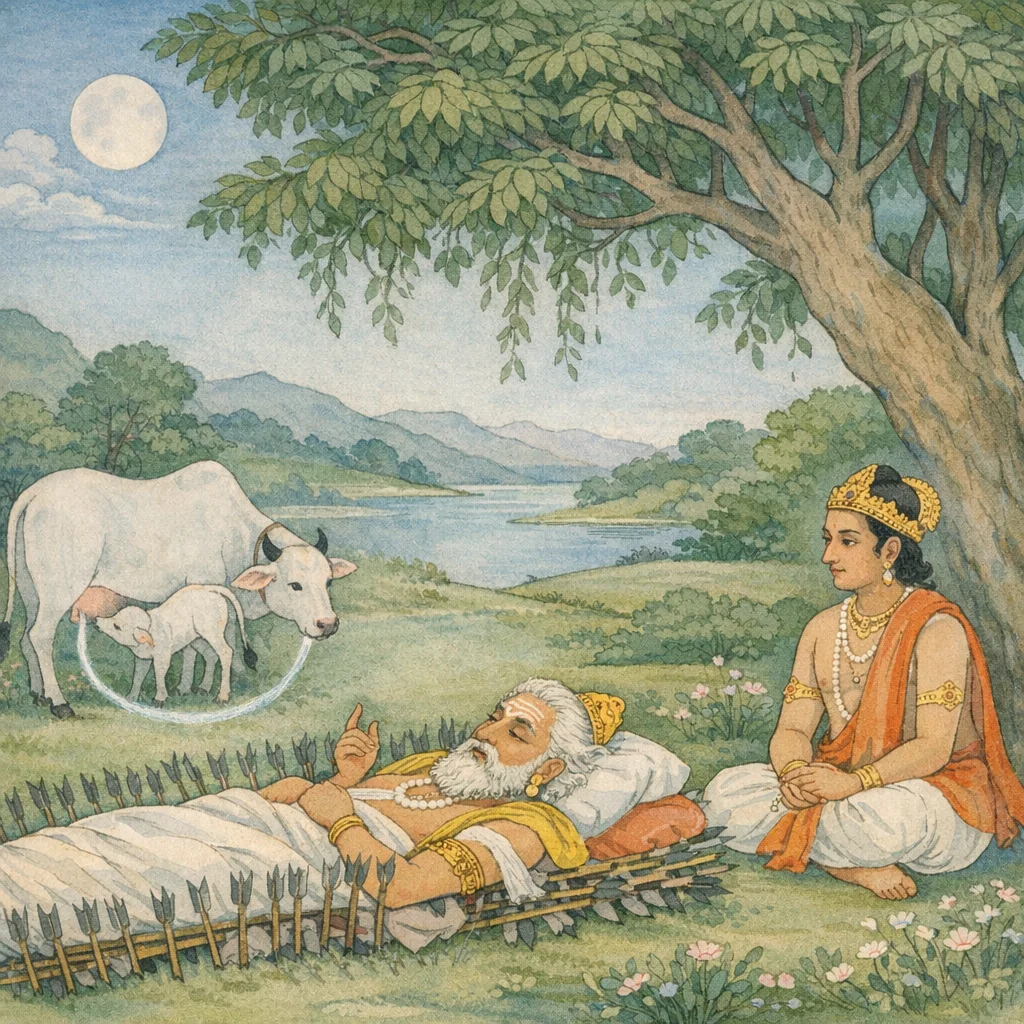
Yudhiṣṭhira asks Bhīṣma to identify what is supremely purifying among purifiers. Bhīṣma asserts the exceptional sanctity and salvific value of cows, describing them as sustaining beings through milk and sacrificial utility, and states that gifting cows leads to exalted realms, citing exemplary kings. He then introduces an ancient account: Śuka approaches Vyāsa after daily rites and asks a cluster of systematic questions—what is the foremost sacrifice, what act yields highest heaven, what purifier sustains the gods, and what is the best gift. Vyāsa replies by positioning cows as the foundation and refuge of beings, narrating a cosmogonic motif where Brahmā grants cows horns according to their intent, rendering them auspicious providers of offerings. The chapter elaborates the “world of cows” with ornate heavenly imagery as the merit-result of go-dāna. It prescribes reverence and non-malice toward cows, mentions a daily japa formula, and elevates ghṛta (ghee) as “pavitrāṇāṃ pavitram,” outlining its ritual uses (offerings, auspicious recitations, gifting, consumption). A structured purification regimen involving pañcagavya-related elements is described as expiatory. The chapter closes by affirming cows as yajñiya and wish-fulfilling, urging consistent worship by example of Śuka.
Chapter Arc: युधिष्ठिर, गोदान के अमृत-तुल्य गुणों को सुनकर भी तृप्त नहीं होते और भीष्म (शान्तनव) से पुनः विस्तारपूर्वक पूछते हैं कि गौ-दान का महात्म्य क्या है और गौओं की उत्पत्ति व प्रतिष्ठा कैसे हुई। → भीष्म क्रमशः सृष्टि-क्रम और श्रेष्ठता-क्रम बताते हैं—स्थावर से जंगम, जंगम में मनुष्य, मनुष्य में ब्राह्मण; और ब्राह्मणों में यज्ञ की प्रतिष्ठा। फिर यज्ञ, सोम और गौ—इन तीनों की परस्पर-आश्रयता दिखाकर यह प्रश्न तीखा होता जाता है कि गौ को ‘अमृत’ क्यों कहा गया और उसका ‘उच्छिष्ट’ क्यों नहीं माना जाता। → गौओं की ‘अमृत-सम्भव’ महिमा का निर्णायक प्रतिपादन होता है—जैसे सोम/अमृत का प्रवाह और देवोपभोग उच्छिष्ट नहीं कहलाता, वैसे ही बछड़े के पीने पर भी गौ का दूध जूठा नहीं होता; गौओं में सोम-तत्त्व प्रतिष्ठित है, इसलिए वे यज्ञ, देव, प्रजा और वृत्ति—सबकी आधार-शिला हैं। → भीष्म गो-दान को केवल दान नहीं, सृष्टि-पालन की धुरी बताते हैं—प्राणी जन्म लेते ही वृत्ति की पुकार करते हैं और गौ ‘माता-पिता’ की भाँति वृत्ति देने वाली है; अतः गो-दान से देवता प्रसन्न, यज्ञ पुष्ट, ब्राह्मण-धर्म स्थिर और लोक-कल्याण सुनिश्चित होता है। → गो-दान के फल-विशेष और विविध विधानों/उपदानों (किसे, कब, कैसे) का आगे और सूक्ष्म विस्तार संकेतित रहता है।
Shlokas
Verse 1
अपन क्ाा बछ। 2 सप्तसप्ततितमो< ध्याय: कपिला गौओंकी उत्पत्ति और महिमाका वर्णन वैशम्पायन उवाच ततो युधिष्ठटिरो राजा भूय: शान्तनवं नृपम् | गोदानविस्तरं धर्मान् पप्रच्छ विनयान्वितः,वैशम्पायनजी कहते हैं--जनमेजय! तदनन्तर राजा युधिष्ठिरने पुनः शान्तनुनन्दन भीष्मसे गोदानकी विस्तृत विधि तथा तत्सम्बन्धी धर्मोके विषयमें विनयपूर्वक जिज्ञासा की
Vaiśampāyana said: Thereafter King Yudhiṣṭhira, with humility, again questioned the royal son of Śantanu (Bhīṣma) about the detailed procedure of gifting cows and the dharmic principles connected with that act—seeking clarity on its proper performance and ethical significance.
Verse 2
युधिछिर उवाच गोप्रदानगुणान् सम्यक् पुनर्मे ब्रूहि भारत । न हि तृप्याम्यहं वीर शृण्वानो$मृतमीदृशम्,युधिष्ठिर बोले--भारत! आप गोदानके उत्तम गुणोंका भलीभाँति पुनः मुझसे वर्णन कीजिये। वीर! ऐसा अमृतमय उपदेश सुनकर मैं तृप्त नहीं हो रहा हूँ
Yudhiṣṭhira said: “O Bhārata, tell me once again—clearly and in full—the virtues and merits of gifting cows. For, O hero, as I listen to such nectar-like instruction, I do not feel satisfied; my desire to hear it only grows.”
Verse 3
वैशम्पायन उवाच इत्युक्तो धर्मराजेन तदा शान्तनवो नृप: । सम्यगाह गुणांस्तस्मै गोप्रदानस्य केवलान्,वैशम्पायनजी कहते हैं--राजन! धर्मराज युधिष्ठिरके ऐसा कहनेपर उस समय शान्तनुनन्दन भीष्म केवल गोदान-सम्बन्धी गुणोंका भलीभाँति (विधिवत) वर्णन करने लगे
Vaiśampāyana said: Thus addressed by Dharmarāja (Yudhiṣṭhira), the king Śāntanava (Bhīṣma) then proceeded to describe, in a proper and orderly manner, the virtues and merits that pertain specifically to the gift of cows—setting forth its ethical value as a dharmic act of generosity.
Verse 4
भीष्म उवाच वत्सलां गुणसम्पन्नां तरुणीं वस्त्रसंयुताम् । दत्त्वेदृशीं गां विप्राय सर्वपापै: प्रमुच्यते,भीष्मजीने कहा--बेटा! वात्सल्यभावसे युक्त, गुणवती और जवान गायको वस्त्र ओढ़ाकर उसका दान करे। ब्राह्मणको ऐसी गायका दान करके मनुष्य सब पापोंसे मुक्त हो जाता है
Bhīṣma said: “My child, one who donates to a brāhmaṇa a young cow—affectionate in nature and endowed with good qualities—after clothing her with garments, is freed from all sins.”
Verse 5
असुर्या नाम ते लोका गां दत्त्वा तानू न गच्छति । पीतोदकां जग्धतृणां नष्टक्षीरां निरिन्द्रियाम्,असुर्य नामके जो अन्धकारमय लोक (नरक) हैं, उनमें गोदान करनेवाले पुरुषको नहीं जाना पड़ता। जिसका घास खाना और पानी पीना प्राय: समाप्त हो चुका हो, जिसका दूध नष्ट हो गया है, जिसकी इन्द्रियाँ काम न दे सकती हों, जो बुढ़ापा और रोगसे आक्रान्त होनेके कारण शरीरसे जीर्ण-शीर्ण हो बिना पानीकी बावड़ीके समान व्यर्थ हो गयी हो, ऐसी गौका दान करके मनुष्य ब्राह्मणको व्यर्थ कष्टमें डालता है और स्वयं भी घोर नरकमें पड़ता है
Bhīṣma said: ‘There are worlds called “Asurya” (sunless, dark realms). A man who gives a cow in proper condition does not have to go to those realms. But if one donates a cow left without water and fodder, whose milk has been ruined, and whose senses and strength have failed—old and afflicted—then such a “gift” only inflicts pointless suffering on the recipient brāhmaṇa, and the giver himself falls into a dreadful hell.’
Verse 6
जरारोगोपसम्पन्नां जीर्णा वापीमिवाजलाम् | दत्त्वा तम: प्रविशति द्विजं क्लेशेन योजयेत्,असुर्य नामके जो अन्धकारमय लोक (नरक) हैं, उनमें गोदान करनेवाले पुरुषको नहीं जाना पड़ता। जिसका घास खाना और पानी पीना प्राय: समाप्त हो चुका हो, जिसका दूध नष्ट हो गया है, जिसकी इन्द्रियाँ काम न दे सकती हों, जो बुढ़ापा और रोगसे आक्रान्त होनेके कारण शरीरसे जीर्ण-शीर्ण हो बिना पानीकी बावड़ीके समान व्यर्थ हो गयी हो, ऐसी गौका दान करके मनुष्य ब्राह्मणको व्यर्थ कष्टमें डालता है और स्वयं भी घोर नरकमें पड़ता है
Bhīṣma said: “If one gives away a cow afflicted with old age and disease—worn out like a ruined well without water—one falls into darkness (a grievous hell). Such a gift only burdens the brāhmaṇa recipient with hardship. Therefore charity must be fit and beneficial; giving what is useless or debilitating is not true merit but a cause of sin.”
Verse 7
रुष्टा दुष्टा व्याधिता दुर्बला वा नो दातव्या याश्र मूल्यैरदत्तै: । क्लेशैविंप्रं योडफलै: संयुनक्ति तस्यावीर्याश्षवाफलाश्वैव लोका:,जो क्रोध करनेवाली, दुष्ट, रोगिणी और दुबली-पतली हो तथा जिसका दाम न चुकाया गया हो, ऐसी गौका दान करना कदापि उचित नहीं है। जो इस तरहकी गाय देकर ब्राह्मणको व्यर्थ कष्टमें डालता है, उसे निर्बल और निष्फल लोक ही प्राप्त होते हैं
Bhishma said: A cow that is angry, ill-natured, diseased, or weak should not be given in charity—nor one whose price has not been duly paid. Whoever, by giving such a fruitless gift, merely burdens a Brahmin with hardship, attains worlds that are likewise powerless and without reward.
Verse 8
बलान्विता: शीलवयोपपन्ना: सर्वे प्रशंसन्ति सुगन्धवत्य: । यथा हि गंगा सरितां वरिष्ठा तथार्जुनीनां कपिला वरिष्ठा
Bhishma said: “Endowed with strength, and possessed of good conduct and youthful vigor, all people praise the fragrant ones. Just as the Ganga is the foremost among rivers, so Kapilā is the foremost among Arjunī cows.”
Verse 9
हृष्ट-पुष्ट, सुलक्षणा, जवान तथा उत्तम गन्धवाली गायकी सभी लोग प्रशंसा करते हैं। जैसे नदियोंमें गंगा श्रेष्ठ हैं, वैसे ही गौओंमें कपिला गौ उत्तम मानी गयी है ।। युधिछिर उवाच कस्मात् समाने बहुलाप्रदाने सद्धिः प्रशस्तं कपिलाप्रदानम् । विशेषमिच्छामि महाप्रभावं श्रोतुं समर्थो5स्मि भवान् प्रवक्तुम्,युधिष्ठिरने पूछा--पितामह! किसी भी रंगकी गायका दान किया जाय, गोदान तो एक-सा ही होगा? फिर सत्पुरुषोंने कपिला गौकी ही अधिक प्रशंसा क्यों की है? मैं कपिलाके महान् प्रभावको विशेषरूपसे सुनना चाहता हूँ। मैं सुननेमें समर्थ हूँ और आप कहनेमें
Yudhiṣṭhira said: “Grandfather, if the gift of a cow is essentially the same regardless of its color and yields abundant merit, why have the virtuous especially praised the gifting of a tawny (kapilā) cow? I wish to hear, in particular, the great and exceptional power of that gift. I am capable of listening, and you are capable of explaining.”
Verse 10
भीष्म उवाच वृद्धानां ब्रुवतां तात श्रुतं मे यत् पुरातनम् । वक्ष्यामि तदशेषेण रोहिण्यो निर्मिता यथा,भीष्मजीने कहा--बेटा! मैंने बड़े-बूढ़ोंके मुँहसे रोहिणी (कपिला) की उत्पत्तिका जो प्राचीन वृत्तान्त सुना है, वह सब तुम्हें बता रहा हूँ
Bhishma said: “Dear child, I have heard from the words of the elders an ancient account. I shall recount it to you in full—how Rohiṇī (the tawny cow, Kapilā) came to be created.”
Verse 11
प्रजा: सृजेति चादिष्ट: पूर्व दक्ष: स्वयम्भुवा । असृजद् वृत्तिमेवाग्रे प्रजानां हितकाम्यया,सृष्टिके प्रारम्भमें स्वयम्भू ब्रह्माजीने प्रजापति दक्षको यह आज्ञा दी कि “तुम प्रजाकी सृष्टि करो," किंतु प्रजापति दक्षने प्रजाके हितकी इच्छासे सर्वप्रथम उनकी आजीविकाका ही निर्माण किया
Bhīṣma said: In the beginning, Dakṣa was commanded by Svayambhū, the Self-born Creator: “Create the creatures.” Yet, seeking the welfare of all beings, Dakṣa first established their means of livelihood, and only then proceeded to the creation of progeny—showing that rule and creation must begin by securing sustenance and well-being.
Verse 12
यथा हाामृतमाश्रित्य वर्तयन्ति दिवौकस: । तथा वृत्तिं समाश्रित्य वर्तयन्ति प्रजा विभो,प्रभो! जैसे देवता अमृतका आश्रय लेकर जीवन-निर्वाह करते हैं, उसी प्रकार समस्त प्रजा आजीविकाके सहारे जीवन धारण करती है
Bhīṣma said: “O mighty one, just as the gods sustain their existence by relying on amṛta, the nectar of immortality, so do all people sustain their lives by relying on vṛtti—their means of livelihood. Livelihood is the support by which society endures.”
Verse 13
अचरेभ्यश्व भूतेभ्यश्वरा: श्रेष्ठा: सदा नरा: । ब्राह्मणाश्व तत: श्रेष्ठास्तेषु यज्ञा: प्रतिष्ठिता:,स्थावर प्राणियोंसे जंगम प्राणी सदा श्रेष्ठ हैं। उनमें भी मनुष्य और मनुष्योंमें भी ब्राह्मण श्रेष्ठ हैं; क्योंकि उन्हींमें यज्ञ प्रतिष्ठित हैं
Bhīṣma said: “Among beings, those that move are always superior to those that are immobile. Among the moving, human beings are superior; and among humans, Brāhmaṇas are foremost—because in them the sacrificial order (yajña) is established.”
Verse 14
यज्जैरवाप्यते सोम: स च गोषु प्रतिष्ठित: । ततो देवा: प्रमोदन्ते पूर्व वृत्तिस्तत: प्रजा:,यज्ञसे सोमकी प्राप्ति होती है और वह यज्ञ गौओंमें प्रतिष्ठित है, जिससे देवता आनन्दित होते हैं; अत: पहले आजीविका है फिर प्रजा
Bhīṣma said: “Soma is obtained through sacrifices, and sacrifice itself is founded upon cattle. From that, the gods rejoice. Therefore, livelihood and sustenance come first; only thereafter does the flourishing of people follow.”
Verse 15
प्रजातान्येव भूतानि प्राक्रोशन् वृत्तिकांक्षया । वृत्तिदं चान्वपद्यन्त तृषिता: पितृमातृवत्,समस्त प्राणी उत्पन्न होते ही जीविकाके लिये कोलाहल करने लगे। जैसे भूखे-प्यासे बालक अपने माँ-बापके पास जाते हैं, उसी प्रकार समस्त जीव जीविकादाता दक्षके पास गये
Bhīṣma said: “No sooner were beings born than they cried out, longing for livelihood. And as hungry, thirsty children run to their father and mother, so did all creatures go to Dakṣa, the giver of sustenance.”
Verse 16
इतीदं मनसा गत्वा प्रजासर्गार्थमात्मन: । प्रजापतिस्तु भगवानमृतं प्रापिबत् तदा,प्रजाजनोंकी इस स्थितिपर मन-ही-मन विचार करके भगवान् प्रजापतिने प्रजावर्गकी आजीविकाके लिये उस समय अमृतका पान किया
Bhīṣma said: “Having thus reflected within his mind for the sake of bringing forth and sustaining living beings, the blessed Lord Prajāpati then drank the nectar. The act is presented as a deliberate, welfare-oriented resolve—undertaken to secure the means of livelihood and continuance of the created subjects.”
Verse 17
स गतस्तस्य तृप्तिं तु गन्धं सुरभिमुद्विरन् । ददर्शोद्वारसंवृत्तां सुरभिं मुखजां सुताम्,अमृत पीकर जब वे पूर्ण तृप्त हो गये, तब उनके मुखसे सुरभि (मनोहर) गन्ध निकलने लगी। सुरभि गन्धके निकलनेके साथ ही “सुरभि” नामक गौ प्रकट हो गयी, जिसे प्रजापतिने अपने मुखसे प्रकट हुई पुत्रीके रूपमें देखा
Bhīṣma said: When he had drunk the nectar and become fully satisfied, a sweet, fragrant scent began to issue forth from his mouth. Along with that delightful fragrance, the cow named Surabhī manifested—seen by Prajāpati as a daughter born from his own mouth.
Verse 18
सासृजत् सौरभेयीस्तु सुरभिलोकमातृका: । सुवर्णवर्णा: कपिला: प्रजानां वृत्तिधेनव:,उस सुरभिने बहुत-सी 'सौरभेयी” नामवाली गौओंको उत्पन्न किया, जो सम्पूर्ण जगतके लिये माताके समान थीं। उन सबका रंग सुवर्णके समान उद्दीप्त हो रहा था। वे कपिला गौएँ प्रजाजनोंके लिये आजीविकारूप दूध देनेवाली थीं
Bhishma said: Surabhi brought forth many cows known as Saurabheyīs—like mothers to the world—radiant with a golden hue, tawny in color, and serving as sustaining milch-cows that provide livelihood and nourishment to living beings.
Verse 19
तासाममृतवर्णानां क्षरन्तीनां समन्ततः । बभूवामृतज: फेन: स्रवन्तीनामिवोर्मिज:,जैसे नदियोंकी लहरोंसे फेन उत्पन्न होता है, उसी प्रकार चारों ओर दूधकी धारा बहाती हुई अमृत (सुवर्ण) के समान वर्णवाली उन गौओंके दूधसे फेन उठने लगा
Bhishma said: “From those cows, whose hue was like nectar (golden and radiant), milk was flowing on every side. From that streaming milk, foam arose—just as foam is born from the waves of rivers.”
Verse 20
स वत्समुखविश्रष्टो भवस्य भुवि तिष्ठत: । शिरस्यवाप तत् क्रुद्ध: स तदैक्षत च प्रभु:
Then, as Bhava (Śiva) stood upon the earth, that—having slipped from the calf’s mouth—fell upon Bhava’s head. Enraged at this, the Lord (Bhava) at once looked upon it, intent on responding.
Verse 21
तत्तेजस्तु ततो रौद्रं कपिलास्ता विशाम्पते
Bhīṣma said: “Then that radiance turned fierce; and those beings became tawny, O lord of the people.”
Verse 22
यास्तु तस्मादपक्रम्य सोममेवाभिसंश्रिता:,परंतु जो गौएँ वहाँसे भागकर चन्द्रमाकी ही शरणमें चली गयीं, वे जैसे उत्पन्न हुई थीं वैसे ही रह गयीं। उनका रंग नहीं बदला। उस समय क्रोधमें भरे हुए महादेवजीसे दक्षप्रजापतिने कहा--
Bhīṣma said: “But those cows who, fleeing from there, took refuge solely in Soma (the Moon) remained just as they had been born; their color did not change. Then Daksha Prajapati, addressing Mahadeva who was filled with anger at that time, spoke as follows—”
Verse 23
यथोत्पन्ना: स्ववर्णास्थास्ता होता नान्यवर्णगा: । अथ कुद्ध॑ महादेवं प्रजापतिरभाषत,परंतु जो गौएँ वहाँसे भागकर चन्द्रमाकी ही शरणमें चली गयीं, वे जैसे उत्पन्न हुई थीं वैसे ही रह गयीं। उनका रंग नहीं बदला। उस समय क्रोधमें भरे हुए महादेवजीसे दक्षप्रजापतिने कहा--
“Those cows remained in their own color, as they had been born; they did not take on any other hue. Then Prajāpati (Daksha) spoke to the angered Mahādeva—”
Verse 24
अमृतेनावसिक्तस्त्वं नोच्छिष्टं विद्यते गवाम् । यथा हामृतमादाय सोमो विस्यन्दते पुन:
Bhīṣma said: “You have been sprinkled with immortality; therefore, in the case of cows there is no ‘leftover’ (no impurity of remnants). Just as Soma, having taken in ambrosia, flows forth again.”
Verse 25
न दुष्यत्यनिलो नाग्निर्न सुवर्ण न चोदथधि:,आसामैश्वर्यमिच्छन्ति सर्वेडमृतमयं शुभम् | 'जैसे वायु, अग्नि, सुवर्ण, समुद्र और देवताओंका पीया हुआ अमृत--े वस्तुएँ उच्छिष्ट नहीं होतीं, उसी प्रकार बछड़ोंके पीनेपर उन बछड़ोंके प्रति स्नेह रखनेवाली गौ भी दूषित या उच्छिष्ट नहीं होती। (तात्पर्य यह कि दूध पीते समय बछड़ेके मुँहसे गिरा हुआ झाग अशुद्ध नहीं माना जाता।) ये गौएँ अपने दूध और घीसे इस सम्पूर्ण जगत्का पालन करेंगी। सब लोग चाहते हैं कि इन गौओंके पास मंगलकारी अमृतमय दुग्धकी सम्पत्ति बनी रहे”
Bhīṣma said: “The wind is not tainted, nor is fire; gold is not tainted, nor is the ocean. In the same way, these cows are not rendered impure by what is left after their calves drink. All people desire that these cows may possess auspicious, nectar-like abundance—so that by their milk and ghee they may sustain the whole world.”
Verse 26
नामृतेनामृतं पीतं वत्सपीता न वत्सला | इमॉल्लोकान् भरिष्यन्ति हविषा प्रस्नरवेण च
Bhīṣma said: “Without the true ‘nectar’ of right conduct, what is drunk is no nectar at all; and a cow that lets her milk be taken by the calf is not therefore truly affectionate. It is by sacrificial oblations (havis) and by the proper sacred utterance—the ritual call and chant—that these worlds are sustained.”
Verse 27
वृषभं च ददौ तस्मै सह गोभि: प्रजापति:
Bhīṣma said: “Prajāpati also bestowed upon him a bull, along with cows. The gift underscores the dharmic ideal of supporting livelihood, sacrifice, and social welfare through generous donation of cattle—symbols of prosperity and righteous sustenance.”
Verse 28
प्रीतश्चापि महादेवश्चकार वृषभं तदा
Bhīṣma said: “Pleased by that devotion and conduct, Mahādeva then fashioned a bull—signifying divine approval and the bestowal of a sacred emblem and support.”
Verse 29
ध्वजं च वाहनं चैव तस्मात् स वृषभध्वज: । महादेवजी प्रसन्न हुए। उन्होंने वृषभको अपना वाहन बनाया और उसीकी आकृतिसे अपनी ध्वजाको चिह्नित किया, इसीलिये वे “वृषभध्वज” कहलाये ।। ततो देवैर्महादेवस्तदा पशुपति: कृत: । ईश्वर: स गवां मध्ये वृषभाड्क: प्रकीर्तित:,तदनन्तर देवताओंने महादेवजीको पशुओंका अधिपति बना दिया और गौओंके बीचमें उन महेश्वरका नाम “वृषभांक” रख दिया
Bhishma said: “Therefore, he came to be known as ‘Vṛṣabhadhvaja’—the Lord whose banner bears the bull—for he adopted the bull both as his vehicle and as the emblem upon his standard. Thereafter the gods appointed Mahādeva as Paśupati, the Lord of creatures; and among the cattle that same Supreme Lord was celebrated by the name ‘Vṛṣabhāṅka’, ‘he who bears the mark of the bull.’”
Verse 30
एवमव्यग्रवर्णानां कपिलानां महौजसाम् । प्रदाने प्रथम: कल्प: सर्वासामेव कीर्तित:,इस प्रकार कपिला गौएँ अत्यन्त तेजस्विनी और शान्त वर्णवाली हैं। इसीसे दानमें उन्हें सब गौओंसे प्रथम स्थान दिया गया है
Bhīṣma said: “Thus, the tawny (kapilā) cows—serene in complexion and possessed of great radiance—are declared foremost among all cows for the purpose of gifting. Therefore, in acts of charity, they are assigned the first rank.”
Verse 31
लोकमज्येष्ठा लोकवृत्तिप्रवृत्ता रुद्रोपेता: सोमविष्यन्दभूता: । सौम्या: पुण्या: कामदा: प्राणदाश्न गा वै दत्त्वा सर्वकामप्रद: स्थात्,गौएँ संसारकी सर्वश्रेष्ठ वस्तु हैं। ये जगत्को जीवन देनेके कार्यमें प्रवृत्त हुई हैं। भगवान् शंकर सदा उनके साथ रहते हैं। वे चन्द्रमासे निकले हुए अमृतसे उत्पन्न हुई हैं तथा शान्त, पवित्र, समस्त कामनाओंको पूर्ण करनेवाली और जगत्को प्राणदान देनेवाली हैं; अतः गोदान करनेवाला मनुष्य सम्पूर्ण कामनाओंका दाता माना गया है
Bhishma said: “Cows are the foremost wealth of the world, engaged in sustaining the life and livelihood of all beings. Lord Rudra abides with them. Born of the nectar that flows from Soma, they are gentle and pure—granting desired blessings and even sustaining life itself. Therefore, one who gives cows in charity is regarded as a giver of all wishes.”
Verse 32
इदं गवां प्रभवविधानमुत्तमं पठन् सदाशुचिरपि मंगलप्रिय: । विमुच्यते कलिकलुषेण मानव: श्रियं सुतान् धनपशुमाप्तुयात् सदा,गौओंकी उत्पत्तिसे सम्बन्ध रखनेवाली इस उत्तम कथाका सदा पाठ करनेवाला मनुष्य अपवित्र हो तो भी मंगलप्रिय हो जाता है और कलियुगके सारे दोषोंसे छूट जाता है। इतना ही नहीं, उसे पुत्र, लक्ष्मी, धन तथा पशु आदिकी सदा प्राप्ति होती है
Bhishma said: Whoever regularly recites this excellent account describing the origin and proper understanding of cattle becomes a lover of auspiciousness even if he is not ritually pure. Such a person is released from the defilements associated with the Kali age, and continually attains prosperity—children, fortune, wealth, and livestock.
Verse 33
हव्यं कव्यं तर्पणं शान्तिकर्म यान॑ वासो वृद्धबालस्यथ तुष्टि: । एतान् सर्वान् गोप्रदाने गुणान् वै दाता राजज्नाप्तुयाद् वै सदैव,राजन! गोदान करनेवालेको हव्य, कव्य, तर्पण और शान्तिकर्मका फल तथा वाहन, वस्त्र एवं बालकों और वृद्धोंको संतोष प्राप्त होता है। इस प्रकार ये सब गोदानके गुण हैं। दाता इन सबको सदा पाता ही है
Bhishma said: By the gift of a cow, a giver continually attains the merits associated with offerings to the gods (havya), rites for the ancestors (kavya), acts of satisfaction such as libations (tarpaṇa), and pacificatory rites (śānti-karman). He also gains the benefits of conveyance and clothing, and the contentment of the aged and of children. These, O king, are all declared to be the virtues and fruits inherent in cow-giving, and the donor truly obtains them again and again.
Verse 34
वैशम्पायन उवाच पितामहस्याथ निशम्य वाक्य राजा सह भ्रातृभिराजमीढ: । सुवर्णवर्णानडुहस्तथा गा: पार्थो ददौ ब्राह्मणसत्तमेभ्य:,वैशम्पायनजी कहते हैं--राजन्! पितामह भीष्मकी ये बातें सुनकर अजमीढवंशी राजा युधिष्ठिर और उनके भाइयोंने श्रेष्ठ ब्राह्मणोंको सोनेके समान रंगवाले बैलों और उत्तम गौओंका दान किया
Vaiśampāyana said: Having heard the words of the grandsire Bhīṣma, King Yudhiṣṭhira of the Ājamīḍha line—together with his brothers—made a righteous gift to the foremost Brāhmaṇas: bulls of golden hue and excellent cows.
Verse 35
तथैव तेभ्योडपि ददौ द्विजेभ्यो गवां सहस्राणि शतानि चैव । यज्ञान् समुद्दिश्य च दक्षिणार्थे लोकान् विजेतुं परमां च कीर्तिम्,इसी प्रकार यज्ञोंकी दक्षिणाके लिये, पुण्यलोकोंपर विजय पानेके लिये तथा संसारमें अपनी उत्तम कीर्तिका विस्तार करनेके लिये राजाने उन्हीं ब्राह्मणोंको सैकड़ों और हजारों गौएँ दान की
Vaiśampāyana said: In the same manner, the king also bestowed upon those Brahmin twice-borns hundreds and thousands of cows, intending them as sacrificial fees. By such gifts he sought to secure merit in the worlds beyond, to ‘conquer’ auspicious realms through dharma, and to spread his highest fame in this world.
Verse 76
इस प्रकार श्रीमह्या भारत अनुशासनपर्वके अन्तर्गत दानधर्मपर्वमें गोदानकथनविषयक छिह्वत्तरवाँ अध्याय पूरा हुआ
Thus, in the sacred Mahābhārata, within the Anuśāsana Parva, in the section on the dharma of giving (Dāna-dharma Parva), the seventy-sixth chapter—dealing with the narration concerning the gift of cows—comes to an end.
Verse 77
इति श्रीमहाभारते अनुशासनपर्वणि दानधर्मपर्वणि गोप्रभवकथने सप्तसप्ततितमो<ध्याय:
Thus, in the Śrī Mahābhārata, within the Anuśāsana Parva, in the section on the dharma of gifts, in the narration concerning the origin of cows, ends the seventy-seventh chapter.
Verse 206
ललाटप्रभवेणाक्ष्णा रोहिणीं प्रदहन्निव । एक दिन भगवान् शंकर पृथ्वीपर खड़े थे। उसी समय सुरभिके एक बछड़ेके मुँहसे फेन निकलकर उनके मस्तकपर गिर पड़ा। इससे वे कुपित हो उठे और अपने ललाटजनित नेत्रसे, मानो रोहिणीको भस्म कर डालेंगे, इस तरह उसकी ओर देखने लगे
Bhīṣma said: “With the eye that arises from his forehead, as though he would burn Rohiṇī to ashes, the Blessed Lord Śaṅkara once stood upon the earth. At that very time, foam issued from the mouth of Surabhi’s calf and fell upon his head. Enraged by this, he fixed his gaze upon her with his forehead-born eye, as if to consume her in fire.”
Verse 213
नानावर्णत्वमनयन्मेघानिव दिवाकर: । प्रजानाथ! रुद्रका वह भयंकर तेज जिन-जिन कपिलाओंपर पड़ा, उनके रंग नाना प्रकारके हो गये। जैसे सूर्य बादलोंको अपनी किरणोंसे बहुरंगा बना देते हैं, उसी प्रकार उस तेजने उन सबको नाना वर्णवाली कर दिया
Bhīṣma said: “O lord of creatures, that dreadful, Rudra-born energy made them assume many different colours, just as the sun, by its rays, makes the clouds appear variegated. In the same way, wherever that fierce radiance fell upon the tawny ones, their hues became manifold.”
Verse 246
तथा क्षीरं क्षरन्त्येता रोहिण्यो5मृतसम्भवम् । प्रभो! आपके ऊपर अमृतका छींटा पड़ा है। गौओंका दूध बछड़ोंके पीनेसे जूठा नहीं होता। जैसे चन्द्रमा अमृतका संग्रह करके फिर उसे बरसा देता है, उसी प्रकार ये रोहिणी गौएँ अमृतसे उत्पन्न दूध देती हैं
Bhīṣma said: “In the same way, these Rohiṇī cows yield milk that has arisen from nectar. Their milk is not rendered impure by calves drinking it; rather, like the moon that gathers the essence of nectar and then showers it forth, these cows produce milk of nectarean origin.”
Verse 263
आसामैश्वर्यमिच्छन्ति सर्वेडमृतमयं शुभम् | 'जैसे वायु, अग्नि, सुवर्ण, समुद्र और देवताओंका पीया हुआ अमृत--े वस्तुएँ उच्छिष्ट नहीं होतीं, उसी प्रकार बछड़ोंके पीनेपर उन बछड़ोंके प्रति स्नेह रखनेवाली गौ भी दूषित या उच्छिष्ट नहीं होती। (तात्पर्य यह कि दूध पीते समय बछड़ेके मुँहसे गिरा हुआ झाग अशुद्ध नहीं माना जाता।) ये गौएँ अपने दूध और घीसे इस सम्पूर्ण जगत्का पालन करेंगी। सब लोग चाहते हैं कि इन गौओंके पास मंगलकारी अमृतमय दुग्धकी सम्पत्ति बनी रहे”
Bhishma explains that everyone desires for these cows an auspicious, nectar-like prosperity. Just as wind, fire, gold, the ocean, and even the nectar drunk by the gods are not considered “defiled” or “leftover,” so too a cow that lovingly nourishes her calves is not rendered impure when the calves drink. Therefore, the foam that falls from a calf’s mouth while drinking is not treated as unclean. Such cows, through their milk and ghee, sustain the whole world; hence people wish that the blessed, amṛta-like wealth of their milk may remain ever abundant.
Verse 2736
प्रसादयामास मनस्तेन रुद्रस्य भारत । भरतनन्दन! ऐसा कहकर प्रजापतिने महादेवजीको बहुत-सी गौएँ और एक बैल भेंट किये तथा इसी उपायके द्वारा उनके मनको प्रसन्न किया
Bhishma said: “O Bharata, by that means Prajapati soothed the mind of Rudra. O joy of the Bharatas! Having spoken thus, Prajapati presented Mahadeva with many cows and a bull, and by this very method he brought about the Lord’s satisfaction.”
Frequently Asked Questions
The question asks what is the greatest purifier; the answer privileges cows (go) as uniquely purifying and socially sustaining, and further identifies ghṛta (ghee) as the supreme purifier among purifiers in ritual practice.
The chapter recommends disciplined reverence: avoid malice toward cows, honor them with respectful conduct, and treat go-dāna and ghṛta-centered rites as structured means of purification and merit-making within regulated ethical behavior.
Yes. It repeatedly asserts result-claims: go-dāna leads to attainment of exalted realms (the “world of cows”), while ghṛta use in offering, gifting, and sanctioned consumption is framed as yielding auspicious purification and welfare outcomes.