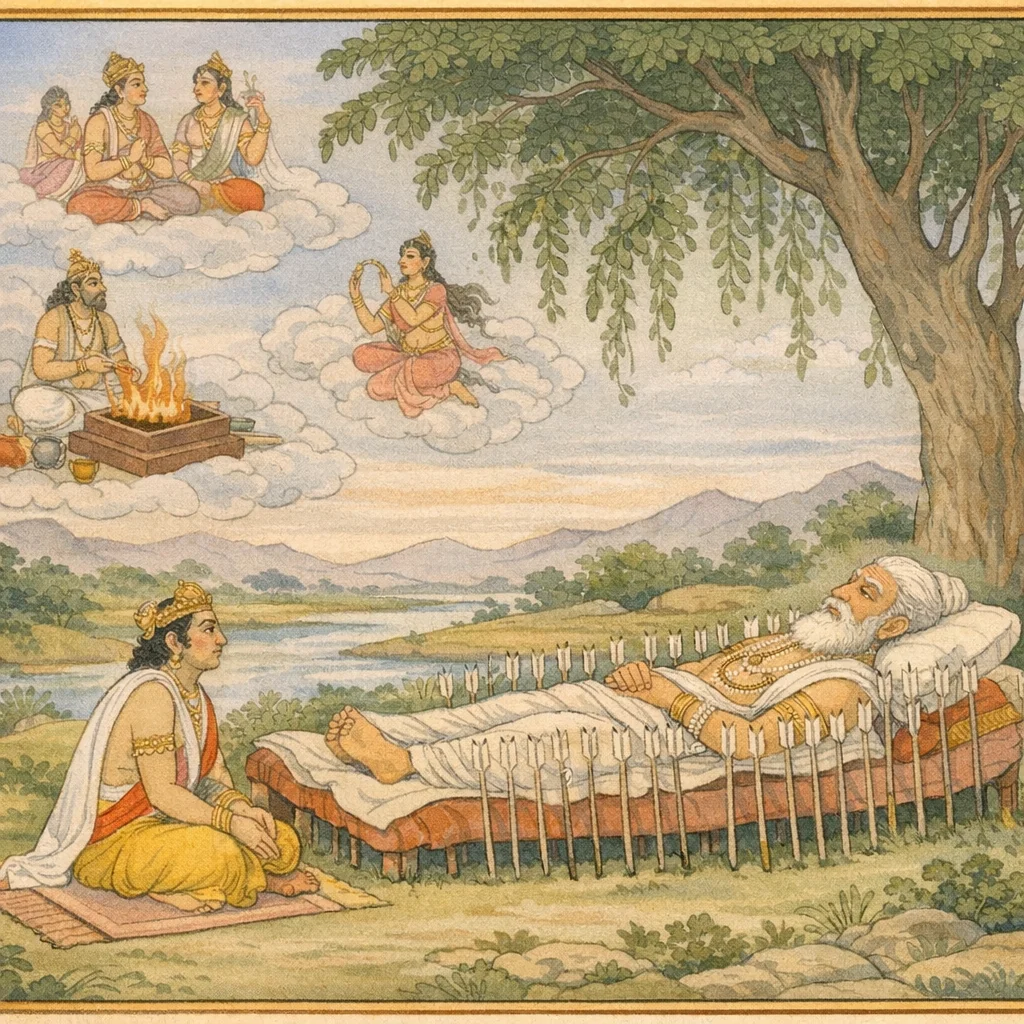
Adhyaya 37
पात्रलक्षण-परिक्षा (Pātra-Lakṣaṇa Parīkṣā) — Criteria for a Worthy Recipient
Upa-parva: Dāna-Dharma and Pātra-Parīkṣā (Recipient-Assessment) Discourse
Yudhiṣṭhira asks Bhīṣma to define what makes a person a proper recipient (pātra), including whether novelty (apūrva), long absence (ciroṣita), or distant arrival (dūrād-abhyāgata) confer worthiness. Bhīṣma responds by distinguishing superficial markers from ethical substance: certain practices may appear meritorious (including vows performed quietly), but coercing or burdening one’s dependents undermines the self. He affirms that newcomers, long-absent persons, and those arriving from afar can be considered worthy, yet the decisive criterion is the presence of stable virtues—non-anger, truthfulness, non-harm, self-control, straightforwardness, non-malice, humility, modesty, endurance, austerity, and tranquility—without contrary misconduct. He warns against anti-scriptural postures (disparaging Veda and śāstra), inconsistent behavior, and performative disputation: a self-styled learned critic who indulges in sterile logic, harsh speech, and antagonism toward brāhmaṇas is socially corrosive and should not be treated as a recipient of honor. The chapter concludes by recommending association with genuinely learned, tradition-grounded scholars (versed in śruti, smṛti, itihāsa, purāṇa, and related disciplines) and by outlining the householder’s sequential discharge of obligations—debts to gods, sages, ancestors, learned persons, and guests—through purified action, thereby preserving dharma.
Chapter Arc: शरशय्या पर लेटे भीष्म युधिष्ठिर से कहते हैं—राजधर्म की जड़ ब्राह्मण-सत्कार है; जो समाज ब्राह्मण को निरादर करता है, वह अपने ही पुण्य-स्तम्भ को काट देता है। → भीष्म ब्राह्मणों की अनिवार्य पूज्यता का विधान करते हैं: भोग, अलंकार, और अन्य इच्छित वस्तुओं से उन्हें संतुष्ट करो; उन्हें पिता के समान रक्ष्य मानो। फिर वे यज्ञ-तत्त्व जोड़ते हैं—ब्राह्मण को दिया हुआ हवि देवता ग्रहण करते हैं; ब्राह्मण-तृप्ति से पितर और देवता स्वतः तृप्त होते हैं। पृथ्वी स्वयं वाणी बनकर कहती है कि ब्राह्मण-सेवा से रज (पाप-धूल) नष्ट होती है और कीर्ति-बुद्धि-समृद्धि जन्म लेती है। → निर्णायक प्रतिज्ञा-सा निष्कर्ष उभरता है: 'तथैव देवता राजन्—नात्र कार्या विचारणा'—हे राजन्, इसमें संशय नहीं; ब्राह्मण संतुष्ट हों तो देवता-पितर सदा प्रसन्न। और जो ब्राह्मणों का अनुसरण करते हैं वे न पराभव को प्राप्त होते हैं, न प्रेत्य विनश्यन्ति—मरणोत्तर भी उनकी गति ऊँची होती है। → भीष्म कर्म-फल की सरल कुंजी देते हैं: मनुष्य जिस-जिस हविष्य से ब्राह्मणों को तृप्त करता है, उसी-उसी से देवता और पितर तृप्त होते हैं; अतः राजाओं और गृहस्थों के लिए ब्राह्मण-पूजा, दान, नमस्कार और संरक्षण—ये ही स्थिर कल्याण के साधन हैं। → युधिष्ठिर के मन में यह प्रश्न जागता है कि ब्राह्मण-पूजा का आचरण किन सीमाओं और किन पात्रताओं के साथ किया जाए—अगले उपदेश में उसी का विस्तार संकेतित है।
Shlokas
Verse 1
(दाक्षिणात्य अधिक पाठक $ “लोक मिलाकर २७३ श्लोक हैं) नफमशा+ (0) आज अन+- चतुस्त्रिंशो 5 ध्याय: श्रेष्ठ ब्राह्मणोंकी प्रशंसा भीष्म उवाच ब्राह्मणानेव सततं भृशं सम्परिपूजयेत् । एते हि सोमराजान ईश्वरा: सुखदुःखयो:,भीष्मजी कहते हैं--युधिष्ठिर! ब्राह्मणोंका सदा ही भलीभाँति पूजन करना चाहिये। चन्द्रमा इनके राजा हैं। ये मनुष्यको सुख और दु:ख देनेमें समर्थ हैं
Bhishma said: “O Yudhishthira, one should always and earnestly honor the Brahmanas. For they are, as it were, sovereign powers over happiness and sorrow; Soma (the Moon) is spoken of as their king.”
Verse 2
एते भोगैरलड्कारैरन्यैश्वैव किमिच्छकै: । सदा पूज्या नमस्कारै रक्ष्याश्व॒ पितृवन्नूपै:
Bhīṣma said: “What need have they of enjoyments, ornaments, or any other desired possessions? They should always be honored with salutations and protected by kings as one would protect one’s own father.”
Verse 3
जायतां ब्रह्मवर्चस्वी राष्ट्रे वै ब्राह्मण: शुचि:
Bhīṣma said: “May there be born in the kingdom a pure Brāhmaṇa, radiant with brahmanical splendor (spiritual learning and disciplined conduct).”
Verse 4
ब्राह्मणं जातिसम्पन्नं धर्मज्ञ संशितव्रतम्
Bhīṣma said: “A brāhmaṇa—well-born, knowledgeable in dharma, and steadfast in disciplined vows—”
Verse 5
ब्राह्मणेभ्यो हविर्दत्तं प्रतिगृह्लन्ति देवता:
Bhīṣma said: “The gods accept the sacrificial offering when it is given to Brahmins.”
Verse 6
आदित्यश्रन्द्रमा वायुरापो भूरम्बरं दिश:
Bhīṣma said: “The Sun, the Moon, the Wind, the Waters, the Earth, the Sky, and the Directions—these cosmic powers stand ever-present as witnesses and supports of the order of dharma.”
Verse 7
न तस्याश्रन्ति पितरो यस्य विप्रा न भुज्जते
Bhīṣma said: “The ancestors find no satisfaction in the case of that man in whose house the brāhmaṇas are not fed.”
Verse 8
ब्राह्मणेषु तु तुष्टेषु प्रीयन्ते पितर: सदा
Bhīṣma said: “When the brāhmaṇas are satisfied, the ancestors are always pleased.”
Verse 9
तथैव ते>पि प्रीयन्ते येषां भवति तद्धवि:
Bhīṣma said: “In the same way, those too are pleased for whom that very offering becomes their share.”
Verse 10
येन येनैव हविषा ब्राह्म॒णांस्तर्पयेन्नर:
Bhīṣma said: “Whatever oblation a man offers, if by that very offering he satisfies the Brāhmaṇas, he acts in accordance with dharma.”
Verse 11
ब्राह्मणादेव तद् भूतं प्रभवन्ति यत: प्रजा:,जिससे समस्त प्रजा उत्पन्न होती है, वह यज्ञ आदि कर्म ब्राह्मणोंसे ही सम्पन्न होता है। जीव जहाँसे उत्पन्न होता है और मृत्युके पश्चात् जहाँ जाता है, उस तत्त्वको, स्वर्ग और नरकके मार्गको तथा भूत, वर्तमान और भविष्यको ब्राह्मण ही जानता है। ब्राह्मण मनुष्योंमें सबसे श्रेष्ठ है। भरतश्रेष्ठ) जो अपने धर्मको जानता है और उसका पालन करता है, वही सच्चा ब्राह्मण है
Bhishma said: From the Brahmin arises that principle by which living beings come forth; and the sacrificial and other sacred rites through which society is sustained are accomplished by Brahmins. The Brahmin knows the truth from which life is born and to which it goes after death; he knows the paths that lead to heaven and hell, and he understands past, present, and future. Therefore the Brahmin is held to be the foremost among men. Yet, O best of the Bharatas, only the one who truly knows his dharma and lives in accordance with it is a genuine Brahmin.
Verse 12
यतक्षायं प्रभवति प्रेत्य यत्र च गच्छति । वेदैष मार्ग स्वर्गस्य तथैव नरकस्य च,जिससे समस्त प्रजा उत्पन्न होती है, वह यज्ञ आदि कर्म ब्राह्मणोंसे ही सम्पन्न होता है। जीव जहाँसे उत्पन्न होता है और मृत्युके पश्चात् जहाँ जाता है, उस तत्त्वको, स्वर्ग और नरकके मार्गको तथा भूत, वर्तमान और भविष्यको ब्राह्मण ही जानता है। ब्राह्मण मनुष्योंमें सबसे श्रेष्ठ है। भरतश्रेष्ठ) जो अपने धर्मको जानता है और उसका पालन करता है, वही सच्चा ब्राह्मण है
Bhīṣma said: “That principle from which a being arises, and to which it goes after death—along with the Vedic path that leads to heaven and likewise the path that leads to hell—this is to be known through the Veda. In this teaching, Bhīṣma underscores that true excellence lies in knowing dharma and living by it, for such knowledge guides one’s origin, conduct, and final destination.”
Verse 13
आगतानागते चोभे ब्राह्मणो द्विपदं वर: । ब्राह्मणो भरतश्रेष्ठ स्वरधर्म चैव वेद यः:,जिससे समस्त प्रजा उत्पन्न होती है, वह यज्ञ आदि कर्म ब्राह्मणोंसे ही सम्पन्न होता है। जीव जहाँसे उत्पन्न होता है और मृत्युके पश्चात् जहाँ जाता है, उस तत्त्वको, स्वर्ग और नरकके मार्गको तथा भूत, वर्तमान और भविष्यको ब्राह्मण ही जानता है। ब्राह्मण मनुष्योंमें सबसे श्रेष्ठ है। भरतश्रेष्ठ) जो अपने धर्मको जानता है और उसका पालन करता है, वही सच्चा ब्राह्मण है
Bhīṣma said: “The Brāhmaṇa is the foremost among bipeds, for he knows both what has come to pass and what is yet to come. O best of the Bharatas, that person is truly a Brāhmaṇa who understands his own dharma and lives by it.”
Verse 14
ये चैनमनुवर्तन्ते ते न यान्ति पराभवम् | नते प्रेत्य विनश्यन्ति गच्छन्ति न पराभवम्,जो लोग ब्राह्मणोंका अनुसरण करते हैं उनकी कभी पराजय नहीं होती तथा मृत्युके पश्चात् उनका पतन नहीं होता। वे अपमानको भी नहीं प्राप्त होते हैं
Bhishma said: Those who follow and serve the Brahmins do not fall into defeat. Even after death they do not perish or decline; they do not come to dishonour, but proceed without downfall—protected by the merit born of reverence for dharma and its custodians.
Verse 15
यद् ब्राह्मणमुखात् प्राप्तं प्रतिगृह्लन्ति वै वच: । भूतात्मानो महात्मानस्ते न यान्ति पराभवम्
Bhishma said: Those great-souled men, whose inner being is aligned with all creatures, accept as authoritative the counsel that comes from the mouth of a brāhmaṇa. Such men do not fall into defeat or ruin—because they choose guidance grounded in dharma rather than impulse or pride.
Verse 16
ब्राह्मणके मुखसे जो वाणी निकलती है, उसे जो शिरोधार्य करते हैं, वे सम्पूर्ण भूतोंको आत्मभावसे देखनेवाले महात्मा कभी पराभवको नहीं प्राप्त होते हैं ।। क्षत्रियाणां प्रतपतां तेजसा च बलेन च | ब्राह्मणेष्वेव शाम्पन्ति तेजांसि च बलानि च
Bhishma said: Those who take to heart the words that issue from the mouth of a Brahmin—holding them as worthy to be borne upon the head—become great-souled, beholding all beings with the vision of the Self, and they do not fall into defeat. For even the blazing might of Kshatriyas—their splendor and their strength—finds quieting and restraint in Brahmins; there their fiery power and force are pacified.
Verse 17
अपने तेज और बलसे तपते हुए क्षत्रियोंके तेज और बल ब्राह्मणोंके सामने आनेपर ही शान्त होते हैं ।। भृूगवस्तालजंघांश्व नीपानाजड्िरसो5जयन् । भरद्वाजो वैहतव्यानैलांश्व भरतर्षभ,भरतश्रेष्ठ! भृगुवंशी ब्राह्मणोंने तालजंघोंको, अंगिराकी संतानोंने नीपवंशी राजाओंको तथा भरद्वाजने हैहयोंको और इलाके पुत्रोंको पराजित किया था
Bhishma said: When Kshatriyas blaze with their own might and martial splendor, that very power is quelled the moment they come face to face with Brahmins. For in former times the Bhargava Brahmins subdued the Talajanghas; the descendants of Angiras overcame the Naipa kings; and Bharadvaja defeated the Haihayas and the sons of Ila.
Verse 18
चित्रायुधांश्षाप्पजयन्नेते कृष्णाजिनध्वजा: । प्रक्षिप्पाथ च कुम्भान् वै पारगामिनमारभेत्,क्षत्रियोंक पास अनेक प्रकारके विचित्र आयुध थे तो भी कृष्णमृगचर्म धारण करनेवाले इन ब्राह्मणोंने उन्हें हरा दिया। क्षत्रियको चाहिये कि ब्राह्मणोंको जलपूर्ण कलश दान करके पारलौकिक कार्य आरम्भ करे
Bhīṣma said: Though those warriors bore many kinds of splendid weapons, these Brahmins—marked by the black antelope-skin as their emblem—overcame them. Therefore a kṣatriya should begin rites aimed at the hereafter by offering water-filled jars (kumbhas) in gift to Brahmins.
Verse 19
यत् किंचित् कथ्यते लोके श्रूयते पठ्यतेडपि वा । सर्व तद् ब्राह्मणेष्वेव गूढो ग्निरिव दारुषु,संसारमें जो कुछ कहा-सुना या पढ़ा जाता है वह सब काठमें छिपी हुई आगकी तरह ब्राह्मणोंमें ही स्थित है
Bhīṣma said: Whatever is spoken of in the world—whatever is heard or even read—has its ultimate seat in the Brāhmaṇas, just as fire lies hidden within wood.
Verse 20
अत्राप्युदाहरन्तीममितिहासं पुरातनम् । संवाद वासुदेवस्य पृथ्व्याश्व भरतर्षभ,भरतश्रेष्ठ] इस विषयमें जानकार लोग भगवान् श्रीकृष्ण और पृथ्वीके संवादरूप इस प्राचीन इतिहासका उदाहरण दिया करते हैं
Here too, O bull among the Bharatas, the learned cite an ancient precedent: the old narrative in the form of a dialogue between Vāsudeva (Śrī Kṛṣṇa) and the Earth.
Verse 21
वायुदेव उवाच मातरं सर्वभूतानां पृच्छे त्वां संशयं शुभे । केनस्वित् कर्मणा पाप॑ व्यपोहति नरो गृही,श्रीकृष्णने पूछा--शुभे! तुम सम्पूर्ण भूतोंकी माता हो, इसलिये मैं तुमसे एक संदेह पूछ रहा हूँ। गृहस्थ मनुष्य किस कर्मके अनुष्ठानसे अपने पापका नाश कर सकता है?
Vāyu-deva said: “O auspicious one, mother of all beings, I ask you to resolve a doubt: by what act can a householder, through proper observance, remove his sin?”
Verse 22
पृथिव्युवाच ब्राह्मणानेव सेवेत पवित्र होतदुत्तमम् । ब्राह्मणान् सेवमानस्य रज: सर्व प्रणश्यति । अतो भूतिरत: कीर्तिरितो बुद्धि: प्रजायते,पृथ्वीने कहा--भगवन्! इसके लिये मनुष्यको ब्राह्मणोंकी ही सेवा करनी चाहिये। यही सबसे पवित्र और उत्तम कार्य है। ब्राह्मणोंकी सेवा करनेवाले पुरुषका समस्त रजोगुण नष्ट हो जाता है। इसीसे ऐश्वर्य, इसीसे कीर्ति और इसीसे उत्तम बुद्धि भी प्राप्त होती है
The Earth said: “O venerable one, for this a person should serve the brāhmaṇas alone; this is the purest and highest course. For one who serves the brāhmaṇas, all rajas—passionate agitation—is destroyed. From this arises prosperity; from this, fame; and from this, superior understanding is born.”
Verse 23
महारथश्न राजन्य एष्टव्य: शत्रुतापन: । इति मां नारद: प्राह सततं सर्वभूतये,पृथ्वी और श्रीकृष्णका संवाद सदा सब प्रकारकी समृद्धिके लिये नारदजीने मुझसे कहा कि शत्रुओंको संताप देनेवाले महारथी क्षत्रियके उत्पन्न होनेकी कामना करनी चाहिये
Vāyu-deva said: “O king, one should pray for the birth of a great chariot-warrior Kṣatriya—a maharatha who scorches the enemies. Nārada told me this again and again, as counsel meant for the welfare and prosperity of all beings.”
Verse 24
ब्राह्मणं जातिसम्पन्नं धर्मज्ञं संशितं शुचिम् । अपरेषां परेषां च परेभ्यश्रैव येडपरे,उत्तम जातिसे सम्पन्न, धर्मज्ञ, दृढ़तापूर्वक व्रतका पालन करनेवाले तथा पवित्र ब्राह्मणके उत्पन्न होनेकी भी इच्छा रखनी चाहिये। छोटे-बड़े सब लोगोंसे जो बड़े हैं, उनसे भी ब्राह्मण बड़े माने गये हैं। ऐसे ब्राह्मण जिसकी प्रशंसा करते हैं उस मनुष्यकी वृद्धि होती है और जो ब्राह्मणोंकी निन्दा करता है वह शीघ्र ही पराभवको प्राप्त होता है
Vāyu said: “One should desire the birth and presence of a brāhmaṇa who is well-born, knowledgeable of dharma, disciplined, and pure. Among those deemed ‘lower’ and those deemed ‘higher’—and even among those higher still—the brāhmaṇas are regarded as higher. The person whom such brāhmaṇas praise prospers, while one who censures brāhmaṇas quickly meets with defeat.”
Verse 25
ब्राह्मणा यं प्रशंसन्ति स मनुष्य: प्रवर्धते । अथ यो ब्राह्मणान् क्रुष्ट: पराभवति सो5चिरात्,उत्तम जातिसे सम्पन्न, धर्मज्ञ, दृढ़तापूर्वक व्रतका पालन करनेवाले तथा पवित्र ब्राह्मणके उत्पन्न होनेकी भी इच्छा रखनी चाहिये। छोटे-बड़े सब लोगोंसे जो बड़े हैं, उनसे भी ब्राह्मण बड़े माने गये हैं। ऐसे ब्राह्मण जिसकी प्रशंसा करते हैं उस मनुष्यकी वृद्धि होती है और जो ब्राह्मणोंकी निन्दा करता है वह शीघ्र ही पराभवको प्राप्त होता है
Vāyu said: “The person whom the brāhmaṇas commend prospers and grows. But one who reviles the brāhmaṇas quickly meets with defeat.”
Verse 26
ततो राष्ट्रस्य शान्तिर्हि भूतानामिव वासवात् । राजाओंको चाहिये कि वे उत्तम भोग, आभूषण तथा पूछकर प्रस्तुत किये गये दूसरे मनोवांछित पदार्थ देकर नमस्कार आदिके द्वारा सदा ब्राह्मणोंकी पूजा करें और पिताके समान उनके पालन-पोषणका ध्यान रखें। तभी इन ब्राह्मणोंसे राष्ट्रमें शान्ति रह सकती है। ठीक उसी तरह, जैसे इन्द्रसे वृष्टि प्राप्त होनेपर समस्त प्राणियोंको सुख-शान्ति मिलती है,यथा महार्णवे क्षिप्त आमलोष्टो विनश्यति । तथा दुश्चरितं सर्व पराभावाय कल्पते जैसे महासागरमें फेंका हुआ कच्ची मिट्टीका ढेला तुरंत गल जाता है, उसी प्रकार ब्राह्मणोंका संग प्राप्त होते ही सारा दुष्कर्म नष्ट हो जाता है
Bhīṣma said: “From this arises peace in the kingdom—just as all creatures find welfare through Vāsava (Indra) when he grants rain. Therefore kings should continually honor Brāhmaṇas with reverence: offering excellent enjoyments, ornaments, and other desired gifts that are respectfully requested and duly presented, and caring for their maintenance as one would for a father. Only through such Brāhmaṇas can peace endure in the realm. Just as a lump of raw clay thrown into the great ocean quickly dissolves, so too, upon gaining the company of Brāhmaṇas, all misconduct is brought to ruin and leads to its own downfall.”
Verse 27
पश्य चन्द्रे कृतं लक्ष्म समुद्रो लवणोदकः: । तथा भगसहस््रेण महेन्द्र: परिचिल्वित:,माधव! देखिये, ब्राह्मणोंका कैसा प्रभाव है, उन्होंने चन्द्रमामें कलंक लगा दिया, समुद्रका पानी खारा बना दिया तथा देवराज इन्द्रके शरीरमें एक हजार भगके चिह्न उत्पन्न कर दिये और फिर उन्हींके प्रभावसे वे भग नेत्रके रूपमें परिणत हो गये; जिनके कारण शतक्रतु इन्द्र 'सहस्राक्ष' नामसे प्रसिद्ध हुए
Vāyu said: “Look—by the power of the Brāhmaṇas a blemish was set upon the Moon; the ocean’s waters were made salty; and Mahendra (Indra) was marked with a thousand ‘bhaga’-signs. Later, by that same influence, those marks became ‘eyes’, and thus Śatakratu Indra came to be renowned as ‘Sahasrākṣa’ (the thousand-eyed).”
Verse 28
तेषामेव प्रभावेण सहस्ननयनो हासौ । शतक्रतु: समभवत् पश्य माधव यादृशम्,माधव! देखिये, ब्राह्मणोंका कैसा प्रभाव है, उन्होंने चन्द्रमामें कलंक लगा दिया, समुद्रका पानी खारा बना दिया तथा देवराज इन्द्रके शरीरमें एक हजार भगके चिह्न उत्पन्न कर दिये और फिर उन्हींके प्रभावसे वे भग नेत्रके रूपमें परिणत हो गये; जिनके कारण शतक्रतु इन्द्र 'सहस्राक्ष' नामसे प्रसिद्ध हुए
“By the sheer power of those brāhmaṇas, this Indra became ‘the thousand-eyed.’ Behold, O Mādhava, what their potency can accomplish: from the marks that arose upon his body through their influence, he came to be known as Sahasrākṣa (the Thousand-eyed) and Śatakratu (the performer of a hundred sacrifices).”
Verse 29
इच्छन् कीर्ति च भूतिं च लोकांश्व मधुसूदन । ब्राह्मणानुमते तिछेत् पुरुष: शुचिरात्मवान्,मधुसूदन! जो कीर्ति, ऐश्वर्य और उत्तम लोकोंको प्राप्त करना चाहता हो, वह मनको वशमें रखनेवाला पवित्र पुरुष ब्राह्मणोंकी आज्ञाके अधीन रहे
Vāyu said: “O Madhusūdana, a man who seeks fame, prosperity, and attainment of higher worlds should remain under the guidance and sanction of the Brāhmaṇas—being pure in conduct and self-controlled.”
Verse 30
भीष्म उवाच इत्येतद् वचन श्रुत्वा मेदिन्या मधुसूदन: । साधु साध्विति कौरव्य मेदिनीं प्रत्यपूजयत्,भीष्मजी कहते हैं--कुरुनन्दन! पृथ्वीके ये वचन सुनकर भगवान् मधुसूदनने कहा --4वाह-वाह, तुमने बहुत अच्छी बात बतायी।” ऐसा कहकर उन्होंने भूदेवीकी भूरि-भूरि प्रशंसा की
Bhīṣma said: “O Kauravya, having heard these words of Bhūdevī, the Lord Madhusūdana exclaimed, ‘Well said! Well said!’ and then praised the Earth-goddess greatly.”
Verse 31
एतां श्रुत्वोपमां पार्थ प्रयतो ब्राह्मणर्षभान् । सतत पूजयेथास्त्वं तत: श्रेयोडभिपत्स्यसे,कुन्तीनन्दन! इस दृष्टान्त एवं ब्राह्मण-माहात्म्यको सुनकर तुम सदा पवित्रभावसे श्रेष्ठ ब्राह्मणोंका पूजन करते रहो। इससे तुम कल्याणके भागी होओगे
Bhishma said: “O Partha, having heard this illustrative teaching, you should, with disciplined purity of intent, continually honor the foremost of Brahmins. By doing so, O son of Kunti, you will attain what is truly auspicious and beneficial.”
Verse 33
इस प्रकार श्रीमह्याभारत अनुशासनपर्वके अन्तर्गत दानधर्मपर्वमें ब्राह्मणकी प्रशंसा नामक तैतीसवाँ अध्याय पूरा हुआ
Thus ends the thirty-third chapter, titled “Praise of the Brāhmaṇa,” within the Dāna-dharma section of the Anuśāsana Parva of the sacred Mahābhārata. This closing colophon signals the completion of a discourse that upholds the ethical and social ideal of honoring the Brāhmaṇa as a bearer of learning, restraint, and dharma, especially in the context of gifts and righteous conduct.
Verse 34
इति श्रीमहाभारते अनुशासनपर्वणि दानधर्मपर्वणि पृथ्वीवासुदेवसंवादे चतुस्त्रिंशो 5ध्याय:
Thus, in the Śrī Mahābhārata, within the Anuśāsana Parva—specifically in the section on the dharma of giving—ends the thirty-fourth chapter, presented as the dialogue between the Earth (Pṛthvī) and Vāsudeva. This colophon marks the close of the teaching context in which ethical principles of charity are framed through a sacred conversation.
Verse 36
महारथश्न राजन्य एष्टव्य: शत्रुतापन: । सबको यह इच्छा करनी चाहिये कि राष्ट्रमें ब्रह्मतेजसे सम्पन्न पवित्र ब्राह्मण उत्पन्न हो और शत्रुओंको संताप देनेवाले महारथी क्षत्रियकी उत्पत्ति हो
Bhīṣma said: “O king, one should strive for the rise of a great chariot-warrior, a Kṣatriya who can scorch the enemies. Indeed, everyone ought to desire this: that within the realm there be born a pure Brāhmaṇa endowed with the radiance of sacred knowledge, and that there also be born a mighty Kṣatriya—an expert warrior—who can bring suffering to hostile forces.”
Verse 46
वासयेत गृहे राजन् न तस्मात् परमस्ति वै । राजन! विशुद्ध जातिसे युक्त तथा तीक्ष्ण व्रतका पालन करनेवाले धर्मज्ञ ब्राह्मणको अपने घरमें ठहराना चाहिये। इससे बढ़कर दूसरा कोई पुण्यकर्म नहीं है
Bhishma said: “O King, one should give lodging in one’s own house; truly, there is no merit higher than that.” In ethical context, the verse upholds atithi-sevā—honouring and supporting worthy guests (especially learned, disciplined Brahmins) as a supreme act of dharma and social responsibility.
Verse 53
पितर: सर्वभूतानां नैतेभ्यो विद्यते परम् ब्राह्मणोंको जो हविष्य अर्पित किया जाता है उसे देवता ग्रहण करते हैं; क्योंकि ब्राह्मण समस्त प्राणियोंके पिता हैं। इनसे बढ़कर दूसरा कोई प्राणी नहीं है
Bhishma said: “Brahmins are the fathers of all living beings; there is none higher than they. The oblation offered to Brahmins is accepted by the gods, for Brahmins stand as the universal fathers of creatures. Beyond them, no superior being is found.”
Verse 66
सर्वे ब्राह्मणमाविश्य सदान्नमुप भुठ्जते । सूर्य, चन्द्रमा, वायु, जल, पृथ्वी, आकाश और दिशा--इन सबके अधिष्ठाता देवता सदा ब्राह्मणके शरीरमें प्रवेश करके अन्न भोजन करते हैं
Bhīṣma said: “All these divine powers—those presiding over the sun, the moon, wind, water, earth, space, and the directions—continually enter into the body of a brāhmaṇa and partake of food. Thus, honoring and sustaining a brāhmaṇa through rightful giving and hospitality is not merely social courtesy but a dharmic act that reaches the cosmic order itself, for the deities are understood to be present within him as their living seat.”
Verse 76
देवाक्षाप्यस्य नाश्नन्ति पापस्य ब्राह्मुणद्विष: । ब्राह्मण जिसका अन्न नहीं खाते उसके अन्नको पितर भी नहीं स्वीकार करते। उस ब्राह्मणद्रोही पापात्माका अन्न देवता भी नहीं ग्रहण करते हैं
Bhīṣma said: “Even the gods do not accept the expiatory offerings of a sinful man who bears hatred toward brāhmaṇas. One who is hostile to brāhmaṇas becomes unfit for sacred participation: his food and offerings are rejected in the religious order, signaling that enmity toward the custodians of Vedic dharma destroys the merit of rites and severs support from the divine sphere.”
Verse 86
तथैव देवता राजन् नात्र कार्या विचारणा | राजन! यदि ब्राह्मण संतुष्ट हो जायँ तो पितर तथा देवता भी सदा प्रसन्न रहते हैं। इसमें कोई अन्यथा विचार नहीं करना चाहिये
Bhīṣma said: “So too, O King—there is no need for doubt or further deliberation here. If the brāhmaṇas are satisfied, then the ancestors (pitṛs) and the gods also remain ever pleased. On this point, you should not entertain any contrary thought.”
Verse 96
नच प्रेत्य विनश्यन्ति गच्छन्ति च परां गतिम् इसी प्रकार वे यजमान भी प्रसन्न होते हैं जिनकी दी हुई हवि ब्राह्मणोंके उपयोगमें आती है। वे मरनेके बाद नष्ट नहीं होते हैं, उत्तम गतिको प्राप्त हो जाते हैं
Bhīṣma said: “Those whose offered oblations come into the use of Brāhmaṇas do not perish after death; rather, they attain the highest course of destiny. Thus, the sacrificer too becomes inwardly satisfied, for his gift is fulfilled through righteous use and supports the sacred order.”
Verse 106
तेन तेनैव प्रीयन्ते पितरो देवतास्तथा । मनुष्य जिस-जिस हविष्यसे ब्राह्मणोंको तृप्त करता है, उसी-उसीसे देवता और पितर भी तृप्त होते हैं
Bhīṣma said: By that very offering through which a person satisfies the Brāhmaṇas, the gods and the ancestral spirits are likewise pleased.
Frequently Asked Questions
Whether worthiness can be inferred from circumstantial factors (newness, long absence, distant arrival) versus verified moral qualities; the chapter resolves this by prioritizing stable virtues and non-harmful conduct over merely external markers.
Continuously examine character: a worthy recipient is marked by truthfulness, non-violence, self-control, humility, endurance, and tranquility, while inconsistent conduct, cruelty toward dependents, and anti-scriptural posturing negate eligibility for honor.
Not as an explicit phalaśruti formula; instead it provides a normative payoff: right association with genuinely learned persons and the purified, sequential discharge of household obligations ensures one does not fall away from dharma and sustains long-term social and spiritual stability.