Adhyaya 33
Ādi-parva Adhyāya 33: Vāsuki’s Council on Averting the Sarpa-satra
Upa-parva: Āstīka Upākhyāna (Sarpa-śāpa and Sarpa-satra Context)
Sauti narrates that Vāsuki, having heard from his mother of a decisive curse upon the serpents, experiences acute anxiety and convenes counsel with his brothers and dharma-inclined Nāgas (e.g., Airāvata). Vāsuki articulates the severity of a maternal curse, treating it as uniquely difficult to counter, and urges the assembly to seek a means of collective protection before time overtakes them. The council then generates a spectrum of proposals aimed at preventing or undermining Janamejaya’s snake-sacrifice: some advocate assuming Brahmin form to petition the king; others propose entering the royal advisory circle to dissuade the rite; others suggest neutralizing the officiating ritual specialist(s) or the ṛtvij priests; some argue for dharma-based restraint, warning against brahma-hatyā and the wider disorder of adharmic escalation. Additional tactics include extinguishing the sacrificial fire through storm-cloud transformation, stealing implements, inducing fear by biting attendees, contaminating food supplies, bribery-like manipulation via serving as priests, abducting the king, or directly assassinating him. After hearing these, Vāsuki rejects the most extreme options as not acceptable to him, indicating a search for an alternative resolution that preserves both survival and ethical legitimacy—preparing the narrative ground for later mediation rather than mere sabotage.
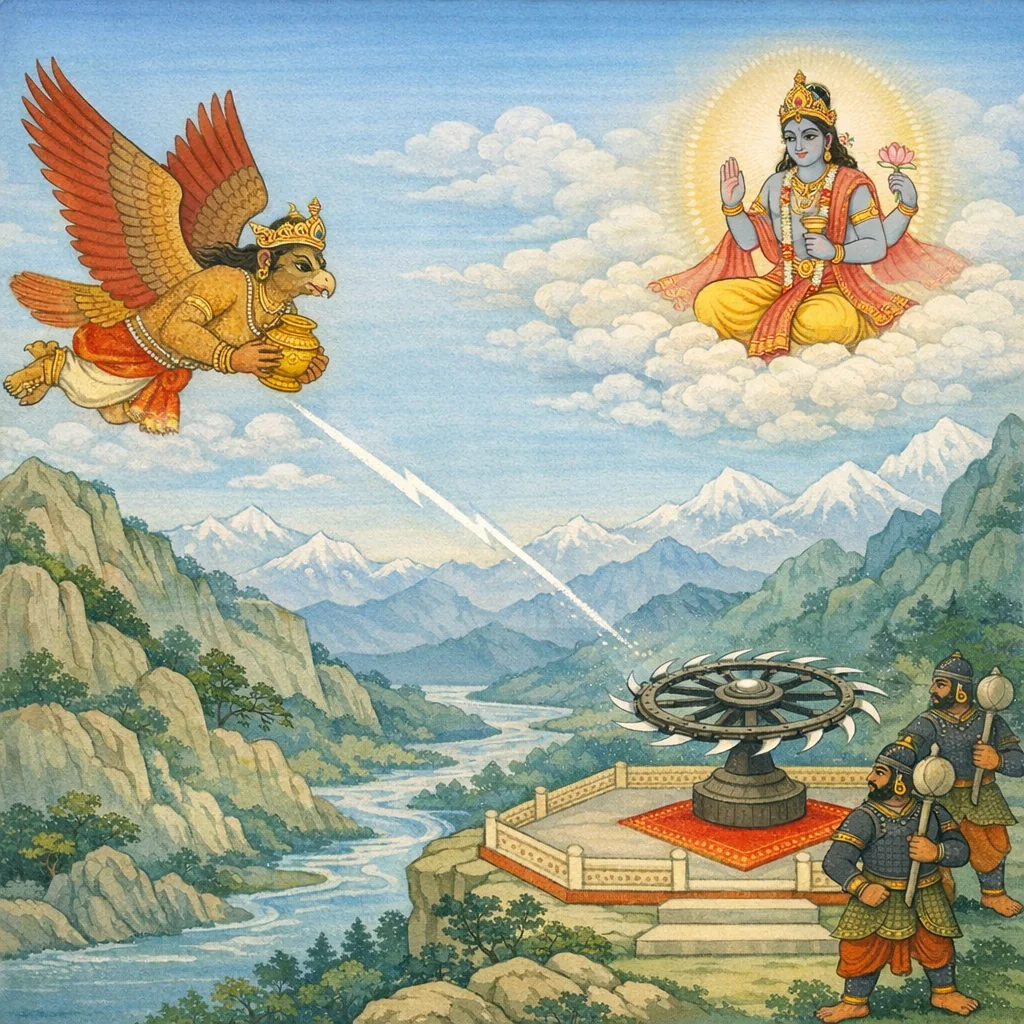
Chapter Arc: Sauti narrates how Garuda, having resolved to win amrita to ransom his mother Vinata from Kadru’s bondage, reaches the guarded precinct of the nectar—where divine contrivances whirl like doom itself. → Near the amrita he beholds a ceaselessly revolving iron chakra ringed with razor-blades, blazing like fire and sun—an engineered terror set by the gods. Beyond it stand two ever-wakeful, wrath-eyed guardians whose unblinking gaze can reduce any intruder to ash. Garuda must outwit not merely strength, but divine surveillance and celestial machinery. → As Garuda bears away the amrita, the imperishable Vishnu appears in the sky and offers him a boon. Garuda, in turn, seeks a boon of his own—thus the theft becomes a covenant: power meets dharma, and the act of taking is transformed by divine recognition. → Vishnu grants Garuda’s wish and makes him his own dhvaja—placing the king of birds above himself as the emblem on his banner. Indra strikes Garuda with the vajra, yet Garuda declares the thunderbolt causes him no pain; he releases a single feather, demonstrating invincibility without descending into needless slaughter. The chapter closes with Garuda continuing his return with the amrita, now marked by Vishnu’s favor. → Garuda still must deliver the amrita to the Nagas to secure Vinata’s freedom—yet the gods’ designs and Indra’s intent to recover the nectar remain poised to unfold.
Shlokas
Verse 1
अफ्-४#-राल जा त्रयस्त्रिंशो5 ध्याय: गरुडका अमृत लेकर लौटना, मार्गमें भगवान् विष्णुसे वर पाना एवं उनपर इन्द्रके द्वारा वज्न-प्रहार सौतिरुवाच जाम्बूनदमयो भूत्वा मरीचिनिकरोज्ज्वलः । प्रविवेश बलात् पक्षी वारिवेग इवार्णवम्,उग्रश्रवाजी कहते हैं--तदनन्तर जैसे जलका वेग समुद्रमें प्रवेश करता है, उसी प्रकार पक्षिराज गरुड सूर्यकी किरणोंके समान प्रकाशमान सुवर्णमय स्वरूप धारण करके बलपूर्वक जहाँ अमृत था, उस स्थानमें घुस गये
Sauti said: Thereafter Garuḍa, the mighty bird, assumed a form of radiant gold, blazing like a mass of sunbeams, and forced his way into the place where the nectar of immortality was kept—just as a rushing torrent plunges into the ocean.
Verse 2
सचक्र क्षुरपर्यन्तमपश्यदमृतान्तिके । परिभ्रमन्तमनिशं तीक्ष्णधारमयस्मयम्,उन्होंने देखा, अमृतके निकट एक लोहेका चक्र घूम रहा है। उसके चारों ओर छुरे लगे हुए हैं। वह निरन्तर चलता रहता है और उसकी धार बड़ी तीखी है
Near the nectar he saw an iron wheel, its rim set all around with razor-blades. It kept revolving without pause, and its edge was exceedingly sharp.
Verse 3
ज्वलनार्कप्रभं घोरं छेदन॑ं सोमहारिणाम् | घोररूपं तदत्यर्थ यन्त्र देवैः सुनिर्मितम्,वह घोर चक्र अग्नि और सूर्यके समान जाज्वल्यमान था। देवताओंने उस अत्यन्त भयंकर यन्त्रका निर्माण इसलिये किया था कि वह अमृत चुरानेके लिये आये हुए चोरोंके टुकड़े-टुकड़े कर डाले
That dreadful wheel blazed like fire and like the sun. The gods had fashioned that most terrible device so that it would cut to pieces any thieves who came to steal the amṛta.
Verse 4
तस्यान्तरं स दृष्टवैव पर्यवर्तत खेचर: । अरान्तरेणाभ्यपतत संक्षिप्याडुं क्षणेन ह,पक्षी गरुड उसके भीतरका छिद्र--उसमें घुसनेका मार्ग देखते हुए खड़े रहे। फिर एक क्षणमें ही वे अपने शरीरको संकुचित करके उस चक्रके अरोंके बीचसे होकर भीतर घुस गये
Śaunaka said: Having spotted the opening within it, the sky-ranging Garuḍa paused and circled, judging the passage. Then, in a single instant, he compressed his body and darted through the narrow space between the spokes of the whirling wheel, entering within.
Verse 5
अधक्षक्रस्य चैवात्र दीप्तानलसमद्युती । विद्युज्जिल्नौ महावीर्यों दीप्तास्यां दीप्तलोचनौ,वहाँ चक्रके नीचे अमृतकी रक्षाके लिये ही दो श्रेष्ठ सर्प नियुक्त किये गये थे। उनकी कान्ति प्रज्वलित अग्निके समान जान पड़ती थी। बिजलीके समान उनकी लपलपाती हुई जीभें, देदीप्यमान मुख और चमकती हुई आँखें थीं। वे दोनों सर्प बड़े पराक्रमी थे। उनके नेत्रोमें ही विष भरा था। वे बड़े भयंकर, नित्य क्रोधी और अत्यन्त वेगशाली थे। गरुडने उन दोनोंको देखा
Śaunaka said: “Here, beneath Indra’s wheel, two excellent serpents had been stationed to guard the nectar. Their radiance was like blazing fire; their tongues flickered like lightning. With flaming mouths and shining eyes, they were mighty in prowess—terrible, ever-angry, and exceedingly swift. Garuḍa saw those two guardians.”
Verse 6
चक्षुविषौ महाघोरौ नित्यं क्रुद्धीं तरस्विनौ । रक्षार्थमेवामृतस्य ददर्श भुजगोत्तमौ,वहाँ चक्रके नीचे अमृतकी रक्षाके लिये ही दो श्रेष्ठ सर्प नियुक्त किये गये थे। उनकी कान्ति प्रज्वलित अग्निके समान जान पड़ती थी। बिजलीके समान उनकी लपलपाती हुई जीभें, देदीप्यमान मुख और चमकती हुई आँखें थीं। वे दोनों सर्प बड़े पराक्रमी थे। उनके नेत्रोमें ही विष भरा था। वे बड़े भयंकर, नित्य क्रोधी और अत्यन्त वेगशाली थे। गरुडने उन दोनोंको देखा
Śaunaka said: Garuḍa beheld two foremost serpents stationed solely to guard the nectar of immortality. Their very eyes were venomous; they were exceedingly dreadful, ever wrathful, and swift with overpowering force—set there as vigilant protectors of amṛta, a treasure whose custody demanded relentless watchfulness.
Verse 7
सदा संरब्धनयनौ सदा चानिमिषेक्षणौ । तयोरेको<पि यं पश्येत् स तूर्ण भस्मसाद् भवेत्,उनके नेत्रोंमें सदा क्रोध भरा रहता था। वे निरन्तर एकटक दृष्टिसे देखा करते थे (उनकी आँखें कभी बंद नहीं होती थीं)। उनमेंसे एक भी जिसे देख ले, वह तत्काल भस्म हो सकता था
Their eyes were ever inflamed with wrath, and their gaze was unblinking. Whomever even one of the two should look upon would at once be reduced to ashes.
Verse 8
तयोश्चक्षूंषि रजसा सुपर्ण: सहसावृणोत् । ताभ्यामदृष्टरूपो सौ सर्वतः समताडयत्,सुंदर पंखवाले गरुडजीने सहसा धूल झोंककर उनकी आँखें बंद कर दीं और उनसे अदृश्य रहकर ही वे सब ओरसे उन्हें मारने और कुचलने लगे
Then Suparṇa (Garuḍa) suddenly blinded their eyes by flinging dust. Remaining unseen to them, he struck at them from every side, crushing and beating them down.
Verse 9
तयोरज्जे समाक्रम्य वैनतेयोन्तरिक्षग: । आच्छिनत् तरसा मध्ये सोममभ्यद्रवत् ततः,आकाशकमें विचरनेवाले महापराक्रमी विनता-कुमारने वेगपूर्वक आक्रमण करके उन दोनों सर्पोके शरीरको बीचसे काट डाला; फिर वे अमृतकी ओर झपटे और चक्रको तोड़- फोड़कर अमृतके पात्रको उठाकर बड़ी तेजीके साथ वहाँसे उड़ चले
Śaunaka said: Garuḍa, the son of Vinatā, coursing through the sky, rushed upon those two serpents and, by sheer speed, cut their bodies in the middle. Then he darted toward the Soma (amṛta); shattering the guarding wheel, he seized the vessel of nectar and flew swiftly away from that place.
Verse 10
समुत्पाट्यामृतं तत्र वैनतेयस्ततो बली । उत्पपात जवेनैव यन्त्रमुन्मथ्य वीर्यवान्,आकाशकमें विचरनेवाले महापराक्रमी विनता-कुमारने वेगपूर्वक आक्रमण करके उन दोनों सर्पोके शरीरको बीचसे काट डाला; फिर वे अमृतकी ओर झपटे और चक्रको तोड़- फोड़कर अमृतके पात्रको उठाकर बड़ी तेजीके साथ वहाँसे उड़ चले
Śaunaka said: Then the mighty Vainateya (Garuḍa), having seized the nectar there, sprang up with great speed. With his strength he shattered the guarding mechanism and, taking up the vessel of amṛta, flew away swiftly through the sky.
Verse 11
अपीत्वैवामृतं पक्षी परिगृह्माशु निःसृतः । आगच्छदपरिश्रान्त आवार्यार्कप्रभां ततः,उन्होंने स्वयं अमृतको नहीं पीया, केवल उसे लेकर शीघ्रतापूर्वक वहाँसे निकल गये और सूर्यकी प्रभाका तिरस्कार करते हुए बिना थकावटके चले आये
Without drinking the nectar at all, the winged one seized it and swiftly departed. Then, undaunted and unwearied, he came back as though eclipsing the radiance of the sun—his resolve marked by restraint and purpose rather than indulgence.
Verse 12
विष्णुना च तदाकाशे वैनतेय: समेयिवान् । तस्य नारायणस्तुष्टस्तेनालौल्येन कर्मणा,उस समय आकाशमें विनतानन्दन गरुड़की भगवान् विष्णुसे भेंट हो गयी। भगवान् नारायण गरुडके लोलुपतारहित पराक्रमसे बहुत संतुष्ट हुए थे
In that very sky, Vainateya (Garuḍa) encountered Viṣṇu. Nārāyaṇa was greatly pleased with him, for his deed was marked by fearless prowess free from greed.
Verse 13
तमुवाचाव्ययो देवो वरदो5स्मीति खेचरम् । स वत्रे तव तिछेयमुपरीत्यन्तरिक्षग:,अतः उन अविनाशी भगवान् विष्णुने आकाशचारी गरुडसे कहा--मैं तुम्हें वर देना चाहता हूँ।' अन्तरिक्षमें विचरनेवाले गरुडने यह वर माँगा--'प्रभो! मैं आपके ऊपर (थ्वजमें) स्थित होऊँ"
Śaunaka said: The imperishable divine Lord addressed the sky-roaming Garuḍa, saying, “I am a giver of boons.” Garuḍa, who moves through the mid-air, chose this boon: “Lord, let me remain above you—stationed upon you as your emblem.”
Verse 14
उवाच चैनं भूयो5पि नारायणमिदं वच: । अजरश्नामरश्न स्थाममृतेन विनाप्यहम्,इतना कहकर वे भगवान् नारायणसे फिर यों बोले--“भगवन्! मैं अमृत पीये बिना ही अजर-अमर हो जाऊँ'
Śaunaka spoke once more to Nārāyaṇa: “O Lord, grant that I may become ageless and deathless, even without drinking the amṛta, the nectar of immortality.”
Verse 15
एवमस्त्विति तं विष्णुरुवाच विनतासुतम् । प्रतिगृह्य वरो तौ च गरुडो विष्णुमब्रवीत्,तब भगवान् विष्णुने विनतानन्दन गरुडसे कहा--'एवमस्तु/--ऐसा ही हो। वे दोनों वर ग्रहण करके गरुडने भगवान् विष्णुसे कहा--
Viṣṇu said to Garuḍa, the son of Vinatā, “So be it.” Having accepted those two boons, Garuḍa then spoke to Lord Viṣṇu.
Verse 16
भवते<पि वरं दद्यां वृणोतु भगवानपि | त॑ं वव्रे वाहनं विष्णुर्गरुत्मन्तं महाबलम्,“देव! मैं भी आपको वर देना चाहता हूँ। भगवान् भी कोई वर माँगें।” तब श्रीहरिने महाबली गरुत्मानसे अपना वाहन होनेका वर माँगा
Garuḍa said: “I too wish to grant you a boon; let the Blessed Lord choose one as well.” Thereupon Viṣṇu chose as his boon the mighty Garutmān himself—to become his vehicle.
Verse 17
ध्वजं च चक्रे भगवानुपरि स्थास्यसीति तम् | एवमस्त्विति तं देवमुक्त्वा नारायणं खग:,हरन्तममृतं रोषाद् गरुडं पक्षिणां वरम् | भगवान् विष्णुने गरुडको अपना ध्वज बना लिया--उन्हें ध्वजके ऊपर स्थान दिया और कहा--'इस प्रकार तुम मेरे ऊपर रहोगे।' तदनन्तर उन भगवान् नारायणसे “एवमस्तु' कहकर पक्षी गरुड वहाँसे वेग-पूर्वक चले गये। महान् वेगशाली गरुड उस समय वायुसे होड़ लगाते चल रहे थे। पक्षियोंके सरदार उन खगश्रेष्ठ गरडको अमृतका अपहरण करके लिये जाते देख इन्द्रने रोषमें भरकर उनके ऊपर वज़से आघात किया
The Blessed Lord Nārāyaṇa made him His banner and declared, “You shall abide above Me.” Garuḍa replied to that deity, “So be it,” and departed swiftly. As Garuḍa—the foremost of birds—was carrying away the amṛta, Indra, inflamed with anger, struck at him with the thunderbolt.
Verse 18
वव्राज तरसा वेगाद् वायुं स्पर्थनू महाजव: । तं व्रजन्तं खगश्रेष्ठं वज्रेणेन्द्रो5भ्यताडयत्
With tremendous speed and force, the great swift one flew forth, seeming to brush the very wind. As that best of birds sped on, Indra struck him with his thunderbolt.
Verse 19
तमुवाचेन्द्रमाक्रन्दे गरूड: पततां वर:,विहंगप्रवर गरुडने उस युद्धमें वज्जाहत होकर भी हँसते हुए मधुर वाणीमें इन्द्रसे कहा --'देवराज! जिनकी हड्डीसे यह वज्र बना है, उन महर्षिका सम्मान मैं अवश्य करूँगा। शतक्रतो! ऋषिके साथ-साथ तुम्हारा और तुम्हारे वज़का भी आदर करूँगा; इसीलिये मैं अपनी एक पाँख, जिसका तुम कहीं अन्त नहीं पा सकोगे, त्याग देता हूँ
Garuda, foremost among birds, cried out to Indra and—though struck by the thunderbolt in that battle—smiled and spoke in a gentle voice: “O king of the gods! I will certainly honor the great sages from whose bones this vajra was fashioned. O Shatakratu, along with the sage I will also respect you and your weapon; therefore I relinquish one of my wings—one whose end you will never be able to find.”
Verse 20
प्रहसउश्लक्षणया वाचा तथा वज़्समाहत: । ऋषेर्मान करिष्यामि वज् यस्यास्थिसम्भवम्,विहंगप्रवर गरुडने उस युद्धमें वज्जाहत होकर भी हँसते हुए मधुर वाणीमें इन्द्रसे कहा --'देवराज! जिनकी हड्डीसे यह वज्र बना है, उन महर्षिका सम्मान मैं अवश्य करूँगा। शतक्रतो! ऋषिके साथ-साथ तुम्हारा और तुम्हारे वज़का भी आदर करूँगा; इसीलिये मैं अपनी एक पाँख, जिसका तुम कहीं अन्त नहीं पा सकोगे, त्याग देता हूँ
Though struck by Indra’s thunderbolt, Garuḍa laughed and spoke in a gentle, gracious tone: “I will certainly honor the great seer from whose bones this thunderbolt was fashioned.” The ethical point is clear: even amid conflict, reverence for sanctity and gratitude toward the source of sacred power must not be abandoned; respect for ṛṣi-tejas stands above personal injury and victory.
Verse 21
वज्ञस्थ च करिष्यामि तवैव च शतक्रतो । एतत् पत्र त्यजाम्येकं॑ यस्यान्तं नोपलप्स्यसे,विहंगप्रवर गरुडने उस युद्धमें वज्जाहत होकर भी हँसते हुए मधुर वाणीमें इन्द्रसे कहा --'देवराज! जिनकी हड्डीसे यह वज्र बना है, उन महर्षिका सम्मान मैं अवश्य करूँगा। शतक्रतो! ऋषिके साथ-साथ तुम्हारा और तुम्हारे वज़का भी आदर करूँगा; इसीलिये मैं अपनी एक पाँख, जिसका तुम कहीं अन्त नहीं पा सकोगे, त्याग देता हूँ
Though struck by Indra’s thunderbolt, Garuḍa smiled and spoke gently: “O Śatakratu (Indra), I will certainly honor the great sage whose bones became this vajra. And I will honor you as well—together with your weapon. Therefore I relinquish a single feather, the end of which you will not be able to find.” The moment underscores reverence for sanctity behind power: even in conflict, one should respect the holy source of a weapon and restrain pride through courteous conduct.
Verse 22
न च वज्ननिपातेन रुजा मे5स्तीह काचन । एवमुक्क्त्वा ततः पत्रमुत्ससर्ज स पक्षिराट्,“तुम्हारे वज्ञके प्रहारसे मेरे शरीरमें कुछ भी पीड़ा नहीं हुई है।" ऐसा कहकर पक्षिराजने अपना एक पंख गिरा दिया
Śaunaka said: “And by the strike of the thunderbolt, no pain at all has arisen in me here.” Having spoken thus, the king of birds then let fall a single feather—demonstrating his invulnerability and the futility of Indra’s assault, while underscoring the moral that true strength is not merely destructive power but steadfastness grounded in one’s earned merit and purpose.
Verse 23
तदुत्सृष्टमभिप्रेक्ष्य तस्य पर्णमनुत्तमम् । हृष्टानि सर्वभूतानि नाम चक्रुर्गरुत्मत:,उस गिरे हुए परम उत्तम पंखको देखकर सब प्राणियोंको बड़ा हर्ष हुआ और उसीके आधारपर उन्होंने गरुडका नामकरण किया
Seeing that supremely excellent feather of his that had been cast off, all beings were filled with joy; and taking that very feat as the basis, they bestowed upon him the name “Garuḍmān” (the winged one).
Verse 24
सुरूप॑ पत्रमालक्ष्य सुपर्णोडयं भवत्विति । तद् दृष्टवा महदाश्चर्य सहस्राक्ष: पुरन्दर: । खगो महदिदं भूतमिति मत्वाभ्यभाषत,वह सुन्दर पाँख देखकर लोगोंने कहा--'जिसका यह सुन्दर पर्ण (पंख) है, वह पक्षी सुपर्ण नामसे विख्यात हो।' (गरुडपर वज्र भी निष्फल हो गया) यह महान् आश्वर्यकी बात देखकर सहसू नेत्रोंवाले इन्द्रने मन-ही-मन विचार किया--अहो! यह पक्षीरूपमें कोई महान् प्राणी है, ऐसा सोचकर उन्होंने कहा
Seeing the bird’s beautifully formed wings, the onlookers exclaimed, “Let this one be called Suparṇa.” Witnessing this great marvel, Indra—thousand-eyed Purandara—reflected to himself, “This is no ordinary bird; it is a mighty being in avian form,” and then spoke.
Verse 25
शक्र उवाच बल॑ विज्ञातुमिच्छामि यत् ते परमनुत्तमम् | सख्यं चानन्तमिच्छामि त्वया सह खगोत्तम,इन्द्रने कहा--विहंगप्रवर! मैं तुम्हारे सर्वोत्तम उत्कृष्ट बलको जानना चाहता हूँ और तुम्हारे साथ ऐसी मैत्री स्थापित करना चाहता हूँ, जिसका कभी अन्त न हो
Śakra said: “O best of birds, I wish to know that supreme, unsurpassed strength of yours. And I also desire to form with you an unending friendship—one that will never come to an end.”
Verse 32
इस प्रकार श्रीमह्ोा भारत आदिपव॑के अन्तर्गत आस्तीकपवरमें गरुडचरित्रविषयक बत्तीसवाँ अध्याय पूरा हुआ
Thus ends the thirty-second chapter of the Āstīka section within the Ādi Parva of the revered Mahābhārata, dealing with the narrative of Garuḍa. (This is a colophon marking the completion of the chapter.)
Verse 33
इति श्रीमहाभारते आदिपर्वणि आस्तीकपर्वणि सौपर्णे त्रयस्त्रिंशो5ध्याय:
Thus ends the thirty-third chapter of the Sauparṇa section within the Āstīka sub-parva of the Ādi Parva of the Śrī Mahābhārata. This is a colophon marking the close of a narrative unit.
Verse 183
हरन्तममृतं रोषाद् गरुडं पक्षिणां वरम् | भगवान् विष्णुने गरुडको अपना ध्वज बना लिया--उन्हें ध्वजके ऊपर स्थान दिया और कहा--'इस प्रकार तुम मेरे ऊपर रहोगे।' तदनन्तर उन भगवान् नारायणसे “एवमस्तु' कहकर पक्षी गरुड वहाँसे वेग-पूर्वक चले गये। महान् वेगशाली गरुड उस समय वायुसे होड़ लगाते चल रहे थे। पक्षियोंके सरदार उन खगश्रेष्ठ गरडको अमृतका अपहरण करके लिये जाते देख इन्द्रने रोषमें भरकर उनके ऊपर वज़से आघात किया
Śaunaka said: When Garuḍa—the foremost of birds—was carrying off the amṛta, Indra, inflamed with anger, struck at him with the vajra, the thunderbolt. Earlier, the Blessed Nārāyaṇa (Viṣṇu) had accepted Garuḍa as His own banner, granting him a place above His standard and declaring, “Thus you shall abide above Me.” Garuḍa assented, saying, “So be it,” and then departed at great speed, racing as though in rivalry with the wind. Seeing that best of birds fleeing with the amṛta, Indra, lord of the gods, attacked him in wrath.
Frequently Asked Questions
The Nāgas must choose between expedient disruption of a hostile royal ritual (including coercive or lethal tactics) and dharma-aligned restraint, balancing collective preservation against actions that would intensify moral and social disorder.
Even under existential threat, counsel must weigh means as well as ends: policies that secure short-term advantage through adharmic escalation (e.g., brahma-hatyā or indiscriminate harm) risk compounding suffering and undermining legitimacy.
No explicit phalaśruti appears in this passage; the chapter functions as narrative-ethical scaffolding that clarifies why later resolution must occur through lawful intervention and persuasive speech rather than purely force-based prevention.