Adhyaya 23
Garuḍa Learns the Cause of Vinatā’s Bondage and the Nāgas Demand Amṛta (Ādi Parva, Adhyāya 23)
Upa-parva: Āstīka Parva (Garuḍa–Nāga episode context)
Sūta describes the serpents being swiftly carried by Suparṇa (Garuḍa) to an island region encircled by ocean waters and resonant with bird-calls. The landscape is rendered in high descriptive density: forests laden with diverse fruits and blossoms, pleasing dwellings, lotus-filled ponds, clear lakes, and fragrant winds; sandal-like trees appear to scent the air, and wind-driven blossoms fall like showers, producing an atmosphere enjoyed by gandharvas and apsarases. Having arrived, the nāgas sport there and address Garuḍa, requesting conveyance to yet another beautiful island—implicitly acknowledging his aerial range and mobility. Garuḍa then turns to his mother Vinatā to ask what obligation compels him to follow the serpents’ directives. Vinatā explains that she has become a servant to her sister Kadru because of a wager made false through the serpents’ deceit. Hearing this, Garuḍa, distressed, confronts the serpents and asks what act or object will secure Vinatā’s release. The serpents respond with a precise condition: bring amṛta by force, and Garuḍa will obtain freedom from the imposed servitude. The chapter thus links scenic travel, disclosure of wrongful subjugation, and a conditional bargain that propels the subsequent quest motif.
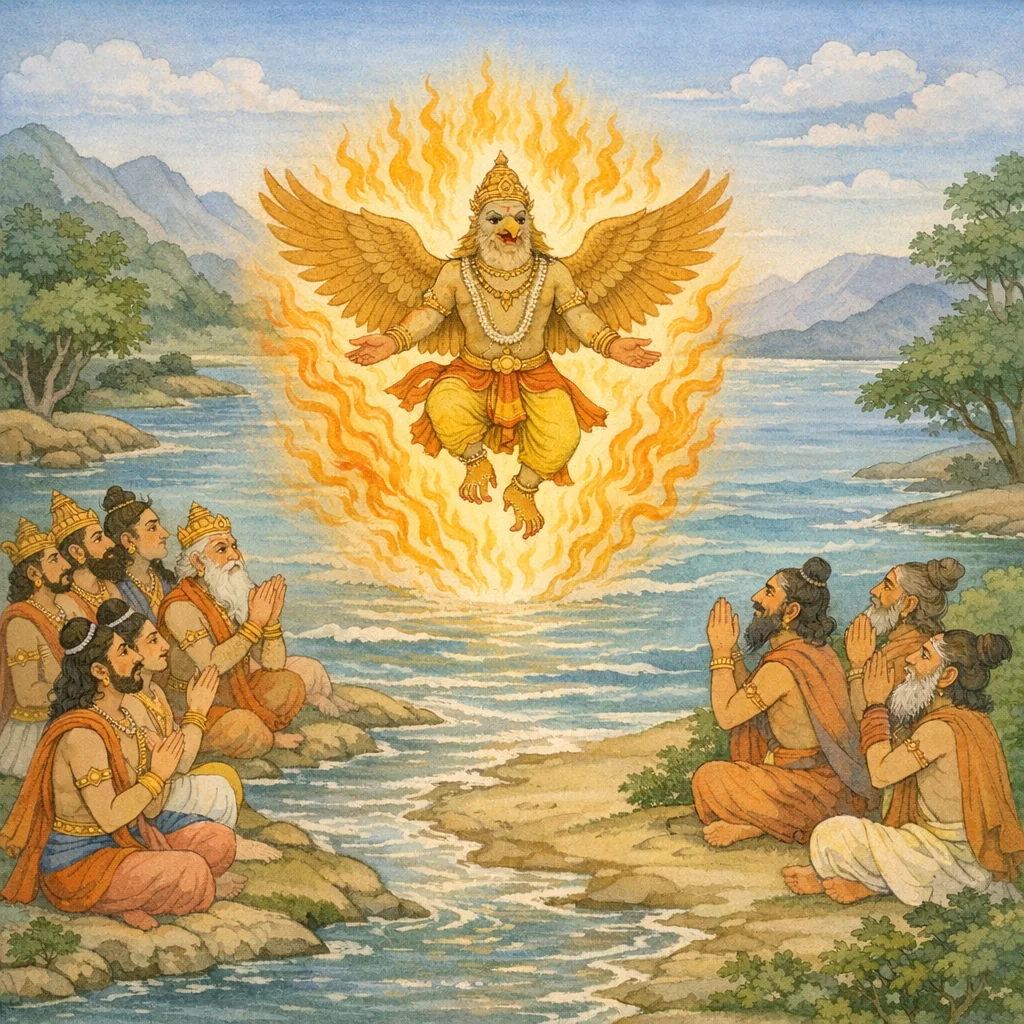
Chapter Arc: Sauti recounts how Kadru and Vinata cross toward the ocean to behold the wondrous horse Uccaiḥśravas—yet the wager’s shadow already hangs over Vinata’s fate. → Kadru’s serpent-sons, at their mother’s behest, cling to the horse’s tail and darken it with their clustered bodies, making the tail appear black; Vinata, seeing the ‘proof’ against her, sinks into despair as the deceit tightens like a noose. → Vinata is declared defeated and bound to servitude under Kadru—an unjust victory sealed by guile—setting in motion the chain of necessity that will demand a deliverer. → From Vinata’s humiliation arises Garuḍa: his birth and blazing presence shake the worlds; the gods and ṛṣis, terrified by his fire-like radiance, hymn him as cosmic power itself, and Garuḍa, thus praised, withdraws and restrains his splendor. → Even as the gods approach and seek audience without fear, the narrative leans forward toward the bargain that will be demanded for Vinata’s freedom and the great quest it will unleash.
Shlokas
Verse 1
2: छा अकाल त्रयोविशो<् ध्याय: पराजित विनताका कढद्रूकी दासी होना, गरुडकी उत्पत्ति तथा देवताओंद्वारा उनकी स्तुति सौतिरुवाच त॑ समुद्रमतिक्रम्य कद्रू्विनतया सह । न्यपतत् तुरगाभ्याशे नचिरादिव शीघ्रगा,उग्रश्रवाजी कहते हैं-शौनक! तदनन्तर शीघ्रगामिनी कद्ू विनताके साथ उस समुद्रको लाँधकर तुरंत ही उच्चै:श्रवा घोड़ेके पास पहुँच गयीं। उस समय चन्द्रमाकी किरणोंके समान श्वेत वर्णवाले उस महान् वेगशाली श्रेष्ठ अश्वको उन दोनोंने काली पूँछवाला देखा
Sauti said: Having crossed over the ocean together with Kadru and Vinata, the swift-moving one soon descended near the horse. There, that foremost steed—great in speed and radiant white like the moon’s rays—was seen by the two, appearing to have a dark tail. The episode frames a moral contest driven by envy and rivalry, where perception and assertion become instruments of bondage and consequence.
Verse 2
ततस्ते तं॑ हयश्रेष्ठ ददूशाते महाजवम् । शशाड्ककिरणप्रख्यं कालवालमुभे तदा,उग्रश्रवाजी कहते हैं-शौनक! तदनन्तर शीघ्रगामिनी कद्ू विनताके साथ उस समुद्रको लाँधकर तुरंत ही उच्चै:श्रवा घोड़ेके पास पहुँच गयीं। उस समय चन्द्रमाकी किरणोंके समान श्वेत वर्णवाले उस महान् वेगशाली श्रेष्ठ अश्वको उन दोनोंने काली पूँछवाला देखा
Then those two—Kadru and Vinatā—beheld that foremost of horses, of tremendous speed. At that moment they saw him shining white like the rays of the moon, yet with a black tail. The scene advances the moral tension of the episode: a small visible feature (the tail’s color) becomes the basis for a high-stakes wager, revealing how attachment to winning can distort judgment and lead toward deceit.
Verse 3
निशम्य च बहून् बालान् कृष्णान् पुच्छसमाश्रितान् | विषण्णरूपां विनतां कद्रूर्दास्थे ्ययोजयत्,पूँछके घनीभूत बालोंको काले रंगका देखकर विनता विषादकी मूर्ति बन गयी और कद्गूने उसे अपनी दासीके काममें लगा दिया
Seeing many young ones clustered about the tail, dark in color, Vinatā became the very image of despair. Taking advantage of her dejection, Kadrū compelled Vinatā into the condition of servitude—an episode that underscores how deceit and opportunism can turn a moment of misperception into lasting bondage.
Verse 4
ततः सा विनता तस्मिन् पणितेन पराजिता । अभवद् दुःखसंतप्ता दासीभावं समास्थिता,पहलेकी लगायी हुई बाजी हारकर विनता उस स्थानपर दुःखसे संतप्त हो उठी और उसने दासीभाव स्वीकार कर लिया
Then Vinatā, having been defeated in that wager, was consumed by grief and anguish; she accepted the condition of servitude. The episode underscores the ethical peril of rash gambling and binding oneself by ill-considered vows, where a moment’s loss can lead to lasting humiliation and dependence.
Verse 5
एतस्मिन्नन्तरे चापि गरुड: काल आगते । विना मात्रा महातेजा विदार्याण्डमजायत,इसी बीचमें समय पूरा होनेपर महातेजस्वी गरुड माताकी सहायताके बिना ही अण्डा फोड़कर बाहर निकल आये
Śaunaka said: Meanwhile, when the destined time had arrived, the mighty and radiant Garuḍa—without any assistance from his mother—burst open the egg and was born. The episode underscores the force of fate and inner strength: when the proper time comes, latent power manifests, and one may be compelled to act independently even without parental support.
Verse 6
महासत्त्वबलोपेत: सर्वा विद्योतयन् दिश: । कामरूप: कामगम: कामवीर्यों विहंगम:,वे महान् साहस और पराक्रमसे सम्पन्न थे। अपने तेजसे सम्पूर्ण दिशाओंको प्रकाशित कर रहे थे। उनमें इच्छानुसार रूप धारण करनेकी शक्ति थी। वे जहाँ जितनी जल्दी जाना चाहें जा सकते थे और अपनी रुचिके अनुसार पराक्रम दिखला सकते थे। उनका प्राकट्य आकाशबचारी पक्षीके रूपमें हुआ था
Śaunaka describes the wondrous being as endowed with immense courage and strength, radiating such brilliance that all directions seemed illuminated. It could assume any form at will, travel wherever it wished with effortless speed, and display prowess according to its own desire. Its manifestation was that of a sky-ranging bird—an extraordinary presence marked by power, freedom of movement, and dazzling splendor.
Verse 7
अग्निराशिरिवोद्भासन् समिद्धो $तिभयंकर: । विद्युद्धिस्पष्टपिज्ञक्षो युगान्ताग्निसमप्र भ:,वे प्रजजलित अग्नि-पुंजके समान उद्धासित होकर अत्यन्त भयंकर जान पढ़ते थे। उनकी आँखें बिजलीके समान चमकनेवाली और पिंगलवर्णकी थीं। वे प्रलयकालकी अग्निके समान प्रज्वलित एवं प्रकाशित हो रहे थे
Śaunaka said: “Blazing like a heap of fire, fully kindled and exceedingly terrifying, with lightning-like gaze and clearly tawny eyes, he shone forth like the fire at the end of an age—radiant and fiercely aflame.”
Verse 8
प्रवृद्ध;/ सहसा पक्षी महाकायो नभोगत: । घोरो घोरस्वनो रौद्रो वह्निरौर्व इवापर:,उनका शरीर थोड़ी ही देरमें बढ़कर विशाल हो गया। पक्षी गरुड आकाशमें उड़ चले। वे स्वयं तो भयंकर थे ही, उनकी आवाज भी बड़ी भयानक थी। वे दूसरे बड़वानलकी भाँति बड़े भीषण जान पड़ते थे
Śaunaka said: In an instant the bird grew to an immense size and took to the sky. Terrible in form and terrifying in cry, he appeared like another Aurva-fire—an all-consuming blaze—portending irresistible power and danger in the unfolding tale.
Verse 9
तं॑ दृष्टवा शरणं जम्मुर्देवा: सर्वे विभावसुम् । प्रणिपत्याब्रुवंश्चैनमासीनं विश्वरूपिणम्,उन्हें देखकर सब देवता विश्वरूपधारी अग्निदेवकी शरणमें गये और उन्हें प्रणाम करके बैठे हुए उन अग्निदेवसे इस प्रकार बोले--
Seeing him, all the gods sought refuge in Vibhāvasu (Agni). Bowing down, they addressed that seated Fire-god, the one of universal form, speaking to him in this manner.
Verse 10
अग्ने मा त्वं प्रवर्धिष्ठा: कच्चिन्नो न दिधक्षसि । असौ हि राशि: सुमहान् समिद्धस्तव सर्पति,'“अग्ने! आप इस प्रकार न बढ़ें। आप हमलोगोंको जलाकर भस्म तो नहीं कर डालना चाहते हैं? देखिये, वह आपका महान, प्रज्वलित तेज:पुंज इधर ही फैलता आ रहा है"
Śaunaka addresses the fire with anxious restraint: “O Agni, do not blaze up further. Surely you do not intend to burn us to ashes? Look—your vast, fully kindled mass of flame is already spreading toward us.”
Verse 11
अग्निर्वाच नैतदेवं यथा यूय॑ मन्यध्वमसुरार्दना: । गरुडो बलवानेष मम तुल्यश्न तेजसा,अग्निदेवने कहा--असुरविनाशक देवताओ! तुम जैसा समझ रहे हो, वैसी बात नहीं है। ये महाबली गरुड हैं, जो तेजमें मेरे ही तुल्य हैं
Agni said, “It is not as you imagine, O destroyers of the Asuras. This is Garuḍa, mighty in strength, and in splendor he is equal to me.”
Verse 12
जात: परमतेजस्वी विनतानन्दवर्धन:। तेजोराशिमिमं दृष्टवा युष्मान् मोह: समाविशत्,विनताका आनन्द बढ़ानेवाले ये परम तेजस्वी गरुड इसी रूपमें उत्पन्न हुए हैं। तेजके पुंजरूप इन गरुडको देखकर ही तुमलोगोंपर मोह छा गया है
Śaunaka said: “That supremely radiant Garuḍa—who increases Vinatā’s joy—was born in this very form. Seeing this embodiment of blazing splendor, delusion overcame you all.”
Verse 13
नागक्षयकरश्चलैव काश्यपेयो महाबल: । देवानां च हिते युक्तस्त्वहितो दैत्यरक्षसाम्,कश्यपनन्दन महाबली गरुड नागोंके विनाशक, देवताओंके हितैषी और दैत्यों तथा राक्षसोंके शत्रु हैं
Śaunaka said: “That mighty son of Kaśyapa—Garuḍa—is indeed the destroyer of serpents. He is devoted to the welfare of the gods, and stands as an adversary to the Dānavas (Daityas) and the Rākṣasas.”
Verse 14
न भी: कार्या कथं चात्र पश्यध्वं सहिता मम । एवमुक्तास्तदा गत्वा गरुडं वाग्भिरस्तुवन्
Śaunaka said: “Do not be afraid. How could there be any cause for fear here? Stay united with me and see for yourselves.” Thus addressed, they then went forth and praised Garuḍa with words of eulogy.
Verse 15
देवा ऊचु: त्वमृषिस्त्वं महाभागस्त्वं देव: पतगेश्वर:,देवता बोले--प्रभो! आप मन्त्रद्रष्टा ऋषि हैं; आप ही महाभाग देवता तथा आप ही पतगेश्वर (पक्षियों तथा जीवोंके स्वामी) हैं
The gods said: “You are a seer, a greatly fortunate one; you are divine, the lord of birds.”
Verse 16
त्वं प्रभुस्तपन: सूर्य: परमेष्ठी प्रजापति: । त्वमिन्द्रस्त्वं हयमुखस्त्वं शर्वस्त्वं जगत्पति:,आप ही प्रभु, तपन, सूर्य, परमेष्ठी तथा प्रजापति हैं। आप ही इन्द्र हैं, आप ही हयग्रीव हैं, आप ही शिव हैं तथा आप ही जगत के स्वामी हैं
You are the sovereign Lord—Tapana, the Sun; you are Parameṣṭhin and Prajāpati. You are Indra; you are Hayamukha (Hayagrīva); you are Śarva (Śiva); you are the Lord of the world.
Verse 17
त्वं मुखं पद्मजो विप्रस्त्वमग्नि: पवनस्तथा । त्वं हि धाता विधाता च त्वं विष्णु: सुरसत्तम:,आप ही भगवानके मुखस्वरूप ब्राह्मण, पद्मयोनि ब्रह्मा और विज्ञानवान् विप्र हैं, आप ही अग्नि तथा वायु हैं, आप ही धाता, विधाता और देवश्रेष्ठ विष्णु हैं
You are the Lord’s “mouth”—the Brahmin; you are Padmaja, Brahmā born of the lotus. You are Agni, fire, and Pavana, wind. Truly you are Dhātā and Vidhātā; you are Viṣṇu, the foremost among the gods.
Verse 18
त्वं महानभिभू: शश्वदमृतं त्वं महद् यश: । त्वं प्रभास्त्वमभिप्रेतं त्वं नस्त्राणमनुत्तमम्,आप ही महत्तत््व और अहंकार हैं। आप ही सनातन, अमृत और महान् यश हैं। आप ही प्रभा और आप ही अभीष्ट पदार्थ हैं। आप ही हमलोगोंके सर्वोत्तम रक्षक हैं
You are the great Overpowering Lord; you are everlasting and deathless; you are vast renown itself. You are radiance; you are the cherished goal. You are our unsurpassed refuge and protector.
Verse 19
बलोरमिमान् साधुरदीनसत्त्व: समृद्धिमान् दुर्विषहस्त्वमेव । त्वत्तः सृतं सर्वमहीनकीरते हानागतं चोपगतं च सर्वम्,आप बलके सागर और साधु पुरुष हैं। आपमें उदार सत्त्वगुण विराजमान है। आप महान् ऐश्वर्यशाली हैं। युद्धमें आपके वेगको सह लेना सभीके लिये सर्वथा कठिन है। पुण्यश्लोक! यह सम्पूर्ण जगत् आपसे ही प्रकट हुआ है। भूत, भविष्य और वर्तमान सब कुछ आप ही हैं
O Bala, you are an ocean—vast and unfathomable—and you are a true saint, steadfast and undaunted in spirit. You are endowed with prosperity and power; in battle your force is almost impossible for others to endure. O one of stainless fame, from you this entire world has issued forth; and you yourself are all that has passed, all that is yet to come, and all that is present.
Verse 20
त्वमुत्तम: सर्वमिदं चराचरं गभस्तिभिर्भानुरिवावभाससे । समाक्षिपन् भानुमतः प्रभां मुहु- स्त्वमन्तकः सर्वमिदं ध्रुवाध्रुवम्,आप उत्तम हैं। जैसे सूर्य अपनी किरणोंसे सबको प्रकाशित करता है, उसी प्रकार आप इस सम्पूर्ण जगत्को प्रकाशित करते हैं। आप ही सबका अन्त करनेवाले काल हैं और बारम्बार सूर्यकी प्रभाका उपसंहार करते हुए इस समस्त क्षर और अक्षररूप जगत्का संहार करते हैं
You are the Supreme. As the sun, by its rays, illuminates all that moves and all that is still, so do you illumine this entire universe. You are also Time, the ender of all; repeatedly drawing back even the sun’s own radiance, you bring about the dissolution of this whole world—both the perishable and the imperishable.
Verse 21
दिवाकर: परिकुपितो यथा दहेत् प्रजास्तथा दहसि हुताशनप्रभ । भयंकर: प्रलय इवाग्निरुत्थितो विनाशयन् युगपरिवर्तनान्तकृत्,अग्निके समान प्रकाशित होनेवाले देव! जैसे सूर्य क़ुद्ध होनेपर सबको जला सकते हैं, उसी प्रकार आप भी कुपित होनेपर सम्पूर्ण प्रजाको दग्ध कर डालते हैं। आप युगान्तकारी कालके भी काल हैं और प्रलयकालमें सबका विनाश करनेके लिये भयंकर संवर्तकाग्निके रूपमें प्रकट होते हैं
Śaunaka said: “O radiant one, blazing like fire: just as the sun, when fiercely angered, could burn all creatures, so too, when you are wrathful, you can scorch the entire world of beings. Terrible as the fire of dissolution, you rise up to destroy—an end-maker at the turning of the ages, the very ‘death’ even of Time at the world’s end.”
Verse 22
इस प्रकार श्रीमहाभारत आदिपव॑के अन्तर्गत आस्तीकपर्वमें गरुडचरितके प्रसंगमें समुद्रदर्शन नामक बाईसवाँ अध्याय पूरा हुआ,खगेश्वरं शरणमुपागता वयं महौजसं ज्वलनसमानवर्चसम् | तडित्प्रभं वितिमिरमभ्रगोचरं महाबलं गरुडमुपेत्य खेचरम् आप सम्पूर्ण पक्षियों एवं जीवोंके अधीश्वर हैं। आपका ओज महान् है। आप अग्निके समान तेजस्वी हैं। आप बिजलीके समान प्रकाशित होते हैं। आपके द्वारा अज्ञानपुंजका निवारण होता है। आप आकाशकमें मेघोंकी भाँति विचरनेवाले महापराक्रमी गरुड हैं। हम यहाँ आकर आपके शरणागत हो रहे हैं
We have come seeking refuge in the lord of birds—Garuḍa—whose energy is immense and whose radiance is like fire. Shining like lightning, he dispels darkness (ignorance). Moving through the sky like a cloud, he is mighty in strength and valor. Approaching that great sky-roamer, we surrender ourselves to him.
Verse 23
परावरं वरदमजय्यविक्रमं तवौजसा सर्वमिदं प्रतापितम् जगत्प्रभो तप्तसुवर्णवर्चसा त्वं पाहि सर्वाश्व सुरान् महात्मन:,आप ही कार्य और कारणरूप हैं। आपसे ही सबको वर मिलता है। आपका पराक्रम अजेय है। आपके तेजसे यह सम्पूर्ण जगत् संतप्त हो उठा है। जगदीश्वर! आप तपाये हुए सुवर्णके समान अपने दिव्य तेजसे सम्पूर्ण देवताओं और महात्मा पुरुषोंकी रक्षा करें इति श्रीमहाभारते आदिपर्वणि आस्तीकपर्वणि सौपर्णे त्रयोविंशो 5ध्याय:
Śaunaka said: “You are both the highest and the lowest—source and end—bestower of boons, whose valor cannot be overcome. By your might this entire world is made to blaze with power. O Lord of the universe, radiant like refined gold, O great-souled one, protect all the gods.”
Verse 24
भयान्विता नभसि विमानगामिनो विमानिता विपथगतिं प्रयान्ति ते । ऋषे: सुतस्त्वमसि दयावत: प्रभो महात्मन: खगवर कश्यपस्य ह,पक्षिराज! प्रभो! विमानपर चलनेवाले देवता आपके तेजसे तिरस्कृत एवं भयभीत हो आकाशकमें पथ भ्रष्ट हो जाते हैं। आप दयालु महात्मा महर्षि कश्यपके पुत्र हैं
O king of birds, O Lord! The gods who travel in vimānas (celestial chariots) are humbled and terrified by your splendor, and they stray from their course in the sky. You are the compassionate, great-souled son of the great sage Kaśyapa.
Verse 25
स मा क्रुध: कुरु जगतो दयां परां त्वमीश्वर: प्रशममुपैहि पाहि नः । महाशनिस्फुरितसमस्वनेन ते दिशो«म्बरं त्रिदिवमियं च मेदिनी,प्रभो! आप कुपित न हों, सम्पूर्ण जगतपर उत्तम दयाका विस्तार करें। आप ईश्वर हैं, अतः शान्ति धारण करें और हम सबकी रक्षा करें। महान् वज्रकी गड़गड़ाहटके समान आपकी गर्जनासे सम्पूर्ण दिशाएँ, आकाश, स्वर्ग तथा यह पृथ्वी सब-के-सब विचलित हो उठे हैं और हमारा हृदय भी निरन्तर काँपता रहता है। अत: खगगश्रेष्ठ) आप अग्निके समान तेजस्वी अपने इस भयंकर रूपको शान्त कीजिये। क्रोधमें भरे हुए यमराजके समान आपकी उग्र कान्ति देखकर हमारा मन अस्थिर एवं चंचल हो जाता है। आप हम याचकोंपर प्रसन्न होइये। भगवन्! आप हमारे लिये कल्याणस्वरूप और सुखदायक हो जाइये
Śaunaka said: “Do not be wrathful. Extend supreme compassion to the whole world. You are the Lord—enter into calm and protect us. By your roar, like the crack and thunder of a great thunderbolt, the directions, the sky, heaven, and this earth are all shaken, and our hearts tremble without cease. Therefore, O Master, pacify this terrifying form—blazing like fire. Seeing your fierce radiance like that of Death enraged, our minds become unsteady and restless. Be gracious to us who beg; become for us auspicious and a giver of peace.”
Verse 26
चलन्ति न: खग हृदयानि चानिशं निगृहातां वपुरिदमग्निसंनिभम् | तव द्युतिं कुपितकृतान्तसंनिभां निशम्य नश्नलति मनो<व्यवस्थितम् । प्रसीद न: पतगपते प्रयाचतां शिवश्व नो भव भगवन् सुखावह:,प्रभो! आप कुपित न हों, सम्पूर्ण जगतपर उत्तम दयाका विस्तार करें। आप ईश्वर हैं, अतः शान्ति धारण करें और हम सबकी रक्षा करें। महान् वज्रकी गड़गड़ाहटके समान आपकी गर्जनासे सम्पूर्ण दिशाएँ, आकाश, स्वर्ग तथा यह पृथ्वी सब-के-सब विचलित हो उठे हैं और हमारा हृदय भी निरन्तर काँपता रहता है। अत: खगगश्रेष्ठ) आप अग्निके समान तेजस्वी अपने इस भयंकर रूपको शान्त कीजिये। क्रोधमें भरे हुए यमराजके समान आपकी उग्र कान्ति देखकर हमारा मन अस्थिर एवं चंचल हो जाता है। आप हम याचकोंपर प्रसन्न होइये। भगवन्! आप हमारे लिये कल्याणस्वरूप और सुखदायक हो जाइये
Śaunaka said: “O bird-lord, our hearts keep trembling without cease. Restrain this body-form of yours that blazes like fire. Hearing and beholding your radiance—fierce like enraged Death (Yama)—our minds cannot remain steady and become unsettled. Be gracious to us who beg you; O Blessed Lord, become auspicious and a bringer of peace and well-being for us.”
Verse 27
एवं स्तुतः सुपर्णस्तु देवै: सर्षिगणैस्तदा । तेजस: प्रतिसंहारमात्मन: स चकार ह,ऋषियोंसहित देवताओंके इस प्रकार स्तुति करनेपर उत्तम पंखोंवाले गरुडने उस समय अपने तेजको समेट लिया
Thus praised at that time by the gods together with the companies of seers, Suparṇa (Garuḍa) drew back and restrained his own blazing energy—showing self-control in response to reverent acclaim and the presence of the righteous.
Verse 143
ते दूसदभ्युपेत्यैनं देवा: सर्षिगणास्तदा । इनसे किसी प्रकारका भय नहीं करना चाहिये। तुम मेरे साथ चलकर इनका दर्शन करो। अग्निदेवके ऐसा कहनेपर उस समय देवताओं तथा ऋषियोंने गरुडके पास जाकर अपनी वाणीद्वारा उनका इस प्रकार स्तवन किया (यहाँ परमात्माके रूपमें गरुडकी स्तुति की गयी है)
Then the gods, together with the company of seers, approached him. “You should not fear them in any way. Come with me and behold them.” When Agni spoke thus, the gods and the sages went to Garuḍa and praised him with their words—here Garuḍa is extolled as a manifestation of the Supreme, and the scene frames reverence and fearlessness before divine power.
Frequently Asked Questions
Garuḍa faces a dharma-sankat between compliance under coercion (serving the serpents’ demands) and the ethical imperative to free his mother from an unjust servitude created through deception.
The chapter teaches that liberation from wrongdoing often requires clear diagnosis of causes, direct questioning of oppressors, and ethically bounded negotiation—while also warning that deceit in social contracts (wagers) produces enduring harm.
No explicit phalaśruti appears in this passage; its meta-function is structural, establishing the causal condition (amṛta retrieval) that drives the next narrative sequence and frames later reflections on bondage, duty, and restitution.