Adhyaya 223
Śārṅgaka-stuti to Agni during the Khāṇḍava Conflagration (शार्ङ्गक-स्तुतिः / अग्नि-स्तुतिः)
Upa-parva: Khāṇḍava-dāha Upākhyāna (Episode of the Khāṇḍava Forest Conflagration and the Śārṅgaka Birds)
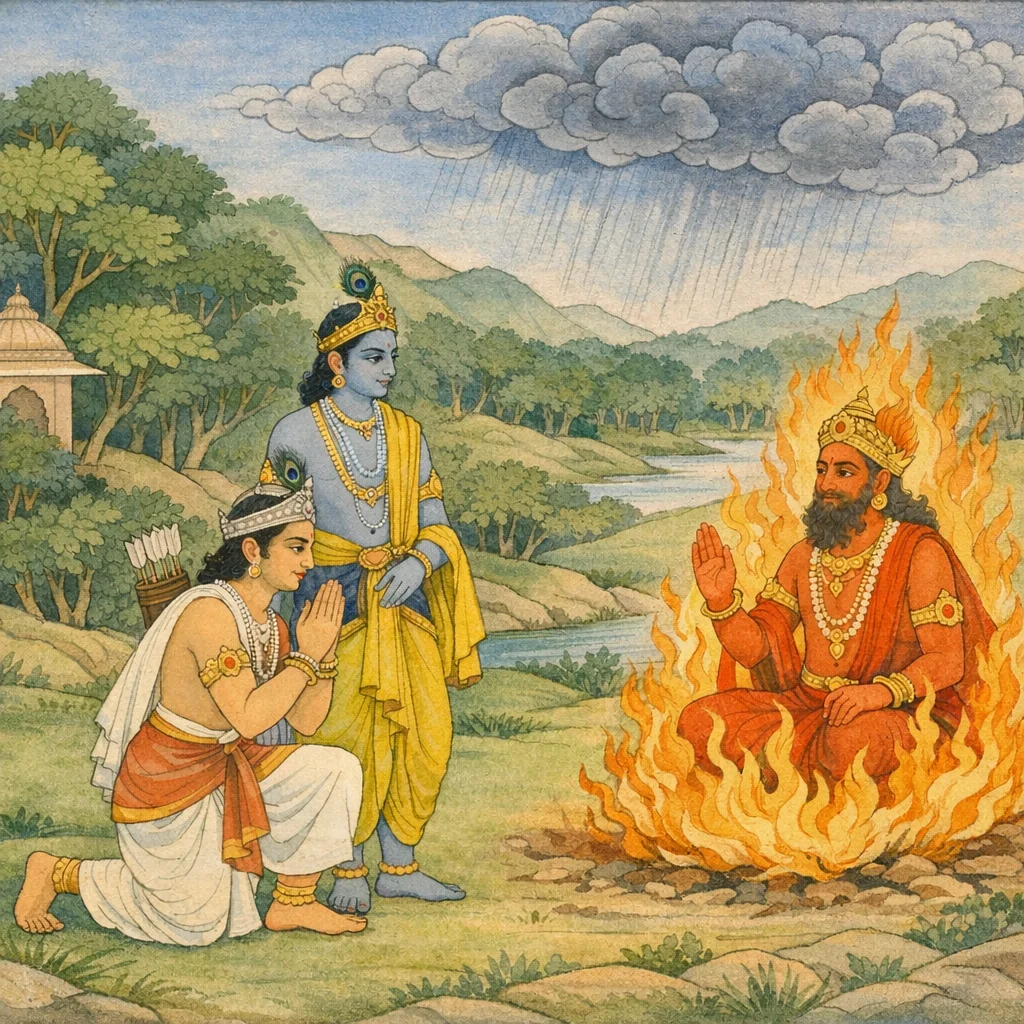
This chapter stages a tightly structured crisis dialogue among the Śārṅgaka birds and Agni. Jarītāri opens with a maxim on foresight: the intelligent remain awake before adversity and do not succumb to distress when hardship arrives; the unmindful, surprised by crisis, becomes confused. The brothers affirm Jarītāri’s courage and wisdom, while also articulating jyeṣṭha-dharma—the eldest must protect; if the elder lacks discernment, the younger cannot compensate. As the fire approaches (depicted with vivid epithets: seven-tongued, emaciated, licking flames), Vaiśaṃpāyana frames Jarītāri’s response: he offers stuti with folded hands. The hymns identify Agni as cosmic mediator—wind’s essence, water’s womb, sun-like rays, sustainer of beings, consumer and transformer of offerings, and cyclical agent of creation and reconstitution. The birds explicitly seek refuge, claiming no protector other than Agni. Agni responds that Droṇa’s words are brahman-like and recalls Mandapāla’s prior notification to spare the young; he invites a request. Droṇa petitions that predatory cats be placed into Agni’s jaws, removing the immediate threat. Agni assents, spares the birds, and continues to burn Khāṇḍava, fulfilling the broader narrative trajectory while honoring the negotiated protection.
Chapter Arc: खाण्डववन-दाह की योजना में अग्नि अपने पूर्व-पराभव का वृत्तान्त और बाधा का संकेत देता है—इन्द्र की वर्षा से वह बार-बार रोका गया है; अब उसे ऐसे सहायक चाहिए जो देव-वर्षा को भी निष्फल कर दें। → अग्नि ब्रह्मा के पास जाकर ‘यथान्याय’ सब निवेदन करता है; ब्रह्मा विचार कर उपाय बताता है कि उचित काल-क्षण और समर्थ मानव-वीर के सहारे ही खाण्डव दहेगा। उधर अर्जुन अपनी व्यावहारिक कठिनाइयाँ रखता है—उसके बाहुबल के अनुरूप धनुष नहीं, अक्षय बाणों का भार साधारण रथ नहीं ढो सकता, और कृष्ण के पराक्रम के तुल्य आयुध भी चाहिए। → अर्जुन सीधे लक्ष्य पर आता है: ‘भगवन्, ऐसा उपाय बताइये जिससे मैं इन्द्र की वर्षा को रोक सकूँ’—यानी देव-शक्ति के प्रतिरोध का संकल्प, और साथ ही दिव्य अस्त्र-शस्त्र/रथ/अश्व की माँग, ताकि अग्नि का कार्य सिद्ध हो। → अग्नि अर्जुन-कृष्ण की शर्तों और आवश्यकताओं को स्वीकारते हुए उन्हें ‘करणानि समर्थानि’ देने की दिशा में संवाद को स्थिर करता है—पुरुषार्थ वे करेंगे, साधन वह उपलब्ध कराएगा; इस प्रकार खाण्डव-दाह की तैयारी निर्णायक रूप से आगे बढ़ती है। → दिव्य साधनों का वास्तविक दान और इन्द्र-वर्षा के विरुद्ध प्रत्यक्ष प्रतिरोध अगले प्रसंग में फूटने को है—क्या मनुष्य-वीर देव-राज की वर्षा को रोक पाएँगे?
Shlokas
Verse 1
इस प्रकार श्रीमहाभारत आदिपव॑के अन्तर्गत खाण्डवदाहपर्वमें अग्निपराभवविषयक दो सौ बाईसवाँ अध्याय पूरा हुआ ॥/ २२२ ॥। ऑपनआक्राा बछ। अर: 2 त्रयोविशर्त्याधेकद्विशततमो< ध्याय: अर्जुनका अग्निकी प्रार्थना स्वीकार करके उनसे दिव्य धनुष एवं रथ आदि माँगना वैशम्पायन उवाच स तु नैराश्यमापन्न: सदा ग्लानिसमन्वित: । पितामहमुपागच्छत् संक्रुद्धो हव्यवाहन:,वैशम्पायनजी कहते हैं--जनमेजय! अपनी असफलतासे अग्निदेवको बड़ी निराशा हुई। वे सदा ग्लानिमें डूबे रहने लगे और कुपित हो पितामह ब्रह्माजीके पास गये
Vaiśampāyana said: Agni, having met with failure, fell into deep despondency and remained continually weighed down by exhaustion. Angered, the Fire-god approached the Grandsire Brahmā, seeking a way out of his thwarted purpose.
Verse 2
तच्च सर्व यथान्यायं ब्रह्मुणे संन्यवेदयत् । उवाच चैनं भगवान् मुहूर्त स विचिन्त्य तु,वहाँ उन्होंने ब्रह्माजीसे सब बातें यथोचित रीतिसे कह सुनायीं। तब भगवान् ब्रह्माजी दो घड़ीतक विचार करके उनसे बोले--
He reported everything to Brahmā in the proper and fitting manner. Then the Blessed Lord Brahmā, after reflecting for a while, addressed him—signaling that the matter required careful judgment before a response could be given.
Verse 3
उपाय: परिदृष्टो मे यथा त्वं धक्ष्यसेडनघ । कालं च कंचित् क्षमतां ततस्त्वं धक्ष्यसेडनल,“अनघ! तुम जिस प्रकार खाण्डववनको जलाओगे, वह उपाय तो मुझे सूझ गया है; किंतु उसके लिये तुम्हें कुछ समयतक प्रतीक्षा करनी पड़ेगी। अनल! इसके बाद तुम खाण्डववनको जला सकोगे
Vaiśampāyana said: “O blameless one, I have discerned the means by which you will be able to burn the Khāṇḍava forest. But you must endure and wait for some time; then, O Anala, you will be able to set Khāṇḍava ablaze.”
Verse 4
भविष्यत: सहायौ ते नरनारायणौ तदा । ताभ्यां त्वं सहितो दावं धक्ष्यसे हव्यवाहन,“हव्यवाहन! उस समय नर और नारायण तुम्हारे सहायक होंगे। उन दोनोंके साथ रहकर तुम उस वनको जला सकोगे”
Vaiśaṃpāyana said: “In the time to come, Nara and Nārāyaṇa will be your allies. United with those two, O Havyavāhana (Fire), you will be able to burn that forest.”
Verse 5
एवमस्त्विति त॑ वल्निब्रह्याणं प्रत्यभाषत । सम्भूतौ तौ विदित्वा तु नरनारायणावृषी,तब अगनि्निने ब्रह्माजीसे कहा--'“अच्छा, ऐसा ही सही।” तदनन्तर दीर्घकालके पश्चात् नर-नारायण ऋषियोंके अवतीर्ण होनेकी बात जानकर अग्निदेवको ब्रह्माजीकी बातका स्मरण हुआ। राजन! तब वे पुनः ब्रह्माजीके पास गये
Vaiśampāyana said: “So be it,” he replied to Brahmā and Agni. After a long time, when Agni learned that the sages Nara and Nārāyaṇa had been born (incarnated), he remembered Brahmā’s earlier words; and then, O King, he went again to Brahmā.
Verse 6
कालस्य महतो राजंस्तस्य वाक्यं स्वयम्भुव: । अनुस्मृत्य जगामाथ पुनरेव पितामहम्,तब अगनि्निने ब्रह्माजीसे कहा--'“अच्छा, ऐसा ही सही।” तदनन्तर दीर्घकालके पश्चात् नर-नारायण ऋषियोंके अवतीर्ण होनेकी बात जानकर अग्निदेवको ब्रह्माजीकी बातका स्मरण हुआ। राजन! तब वे पुनः ब्रह्माजीके पास गये
Vaiśampāyana said: “O king, after a long time had passed, recalling the words of the Self-born Creator (Brahmā), he went once again to Pitāmaha (Brahmā).” The sense is that a prior divine instruction was remembered at the appropriate moment, and action was taken in accordance with it.
Verse 7
अब्रवीच्च तदा ब्रह्मा यथा त्वं धक्ष्यसेडनल । खाण्डवं दावमद्यैव मिषतो5स्य शचीपते:,उस समय ब्रह्माजीने कहा--'अनल! अब जिस प्रकार तुम इन्द्रके देखते-देखते अभी खाण्डववन जला सकोगे, वह उपाय सुनो
Then Brahmā spoke: “O Anala (Fire), listen to the means by which you will be able to burn the Khāṇḍava forest—this very day—while Śacīpati (Indra) looks on.”
Verse 8
नरनारायणोौ यौ तौ पूर्वदेवी विभावसो । सम्प्राप्ती मानुषे लोके कार्यार्थ हि दिवौकसाम्,“विभावसो! आदिदेव नर और नारायण मुनि इस समय देवताओंका कार्य सिद्ध करनेके लिये मनुष्यलोकमें अवतीर्ण हुए हैं
Vaiśampāyana said: “O Vibhāvasu (Agni)! Those two primeval divine sages, Nara and Nārāyaṇa, have now arrived in the human world in order to accomplish the task of the gods.”
Verse 9
अर्जुन वासुदेवं च यौ तौ लोको5भिमन्यते । तावेतौ सहितावेहि खाण्डवस्य समीपत:,“वहाँके लोग उन्हें अर्जुन और वासुदेवके नामसे जानते हैं। वे दोनों इस समय खाण्डववनके पास ही एक साथ बैठे हैं
Vaiśampāyana said: “Those two whom the people recognize by the names Arjuna and Vāsudeva—know that they are together at this very moment, seated near the Khāṇḍava forest.”
Verse 10
तौ त्वं याचस्व साहाय्ये दाहार्थ खाण्डवस्य च । ततो थक्ष्यसि त॑ दावं रक्षितं त्रिदशैरपि,“उन दोनोंसे तुम खाण्डववन जलानेके कार्यमें सहायताकी याचना करो। तब तुम इन्द्रादि देवताओंसे रक्षित होनेपर भी उस वनको जला सकोगे
Vaiśampāyana said: “Beseech those two for aid in the work of burning the Khāṇḍava forest. Then you will be able to consume that woodland with fire, even though it is guarded by the Thirty gods, led by Indra.”
Verse 11
तौ तु सत्त्वानि सर्वाणि यत्नतो वारयिष्यत: । देवराजं च सहितौ तत्र मे नास्ति संशय:,“वे दोनों वीर एक साथ होनेपर यत्नपूर्वक वनके सारे जीवोंको भी रोकेंगे और देवराज इन्द्रका भी सामना करेंगे, मुझे इसमें कोई संशय नहीं है”
Vaiśampāyana said: “Those two heroes, acting together, will with determined effort restrain every living creature of the forest; and they will even stand up to Indra, the king of the gods. Of this I have no doubt.”
Verse 12
एतच्छुत्वा तु वचन त्वरितो हव्यवाहनः । कृष्णपार्थावुपागम्य यमर्थ त्वभ्यभाषत,नृपश्रेष्ठ॒ यह सुनकर हव्यवाहनने तुरंत श्रीकृष्ण और अर्जुनके पास आकर जो कार्य निवेदन किया, वह मैं तुम्हें पहले ही बता चुका हूँ। जनमेजय! अग्निका वह कथन सुनकर अर्जुनने इन्द्रकी इच्छाके विरुद्ध खाण्डववन जलानेकी अभिलाषा रखनेवाले जातवेदा अग्निसे उस समयके अनुकूल यह बात कही
Hearing these words, Havyavāhana (Agni) hastened at once. Approaching Kṛṣṇa and Pārtha (Arjuna), he stated the purpose for which he had come.
Verse 13
त॑ ते कथितवानस्मि पूर्वमेव नृपोत्तम | तच्छुत्वा वचन त्वग्नेर्बीभत्सुर्जातवेदसम्,नृपश्रेष्ठ॒ यह सुनकर हव्यवाहनने तुरंत श्रीकृष्ण और अर्जुनके पास आकर जो कार्य निवेदन किया, वह मैं तुम्हें पहले ही बता चुका हूँ। जनमेजय! अग्निका वह कथन सुनकर अर्जुनने इन्द्रकी इच्छाके विरुद्ध खाण्डववन जलानेकी अभिलाषा रखनेवाले जातवेदा अग्निसे उस समयके अनुकूल यह बात कही
Vaiśampāyana said: “O best of kings, I have already told you this earlier. Having heard the words of Agni, Bībhatsu (Arjuna) then addressed Jātavedas (the Fire-god) in a manner suited to that moment.”
Verse 14
अब्रवीन्नपशार्दूल तत्कालसदृशं वच: । दिधक्षुं खाण्डवं दावमकामस्य शतक्रतो:,नृपश्रेष्ठ॒ यह सुनकर हव्यवाहनने तुरंत श्रीकृष्ण और अर्जुनके पास आकर जो कार्य निवेदन किया, वह मैं तुम्हें पहले ही बता चुका हूँ। जनमेजय! अग्निका वह कथन सुनकर अर्जुनने इन्द्रकी इच्छाके विरुद्ध खाण्डववन जलानेकी अभिलाषा रखनेवाले जातवेदा अग्निसे उस समयके अनुकूल यह बात कही
Vaiśampāyana said: “O tiger among men, he spoke words suited to that moment—words concerning the intent to burn the Khāṇḍava forest with wildfire, even though Śatakratu (Indra) was unwilling.”
Verse 15
अजुन उवाच उत्तमास्त्राणि मे सन्ति दिव्यानि च बहूनि च । यैरहं शक्नुयां योद्धुमपि वज्धरान् बहून्,अर्जुन बोले--भगवन्! मेरे पास बहुत-से दिव्य एवं उत्तम अस्त्र तो हैं, जिनके द्वारा मैं एक क्या, अनेक वज्धारियोंसे युद्ध कर सकता हूँ
Arjuna said: “O revered one, I possess many excellent and divine weapons. With them I could fight—even against many wielders of the thunderbolt.”
Verse 16
धनुर्मे नास्ति भगवन् बाहुवीर्येण सम्मितम् । कुर्वतः समरे यत्नं वेगं यद् विषहेन्मम,परंतु मेरे पास मेरे बाहुबलके अनुरूप धनुष नहीं है, जो समरभूमिमें युद्धके लिये प्रयत्न करते समय मेरा वेग सह सके
Arjuna said: “O revered one, I do not have a bow proportionate to the strength of my arms—one that could endure the force of my speed when I exert myself in battle.”
Verse 17
शरैश्व मे<र्थों बहुभिरक्षयै: क्षिप्रमस्यत: । न हि वोढुं रथ: शक्त: शरान् मम यथेप्सितान्,इसके सिवा शीघ्रतापूर्वक बाण चलाते रहनेके लिये मुझे इतने अधिक बाणोंकी आवश्यकता होगी, जो कभी समाप्त न हों तथा मेरी इच्छाके अनुरूप बाणोंको ढोनेके लिये शक्तिशाली रथ भी मेरे पास नहीं है
“Moreover, to keep loosing arrows swiftly without pause, I would need many arrows that never run out. And I do not have a chariot strong enough to carry the arrows in the measure I desire.”
Verse 18
अश्वांश्व दिव्यानिच्छेयं पाण्डुरान् वातरंहस: । रथं च मेघनिर्घोष॑ सूर्यप्रतिमतेजसम्,मैं वायुके समान वेगवान् श्वेत वर्णके दिव्य अश्व तथा मेघके समान गम्भीर घोष करनेवाला एवं सूर्यके समान तेजस्वी रथ चाहता हूँ। इसी प्रकार इन भगवान् श्रीकृष्णके बल-पराक्रमके अनुसार कोई आयुध इनके पास भी नहीं है, जिससे ये नागों और पिशाचोंको युद्धमें मार सकें
Arjuna said: “I desire divine horses—white in color and swift as the wind—and a chariot whose roar is like thunderclouds and whose splendor is comparable to the sun.”
Verse 19
तथा कृष्णस्य वीर्येण नायुधं विद्यते समम् । येन नागान् पिशाचांश्व निहन्यान्माधवो रणे,मैं वायुके समान वेगवान् श्वेत वर्णके दिव्य अश्व तथा मेघके समान गम्भीर घोष करनेवाला एवं सूर्यके समान तेजस्वी रथ चाहता हूँ। इसी प्रकार इन भगवान् श्रीकृष्णके बल-पराक्रमके अनुसार कोई आयुध इनके पास भी नहीं है, जिससे ये नागों और पिशाचोंको युद्धमें मार सकें
“Likewise, no weapon exists equal to Krishna’s prowess—no armament by which Madhava might strike down the Nagas and the Pisachas in battle.”
Verse 20
उपायं कर्मसिद्धौ च भगवन् वक्तुमहसि । निवारयेयं येनेन्द्रं वर्षमाणं महावने,भगवन्! इस कार्यकी सिद्धिके लिये जो उपाय सम्भव हो, वह मुझे बताइये, जिससे मैं इस महान् वनमें जल बरसाते हुए इन्द्रको रोक सकूँ
Arjuna said: “O Blessed Lord, tell me the means by which this task may be accomplished—by what method might I restrain Indra as he pours down rain upon this great forest?”
Verse 21
पौरुषेण तु यत् कार्य तत् कर्तारौ स्व पावक । करणानि समर्थानि भगवन् दातुमहसि,भगवन् अग्निदेव! पुरुषार्थसे जो कार्य हो सकता है, उसे हमलोग करनेके लिये तैयार हैं; किंतु इसके लिये सुदृढ़ साधन जुटा देनेकी कृपा आपको करनी चाहिये
Arjuna said: “O Agni, our purifier, whatever can be accomplished through human effort—we two are ready to do it. Yet, O Blessed Lord, O Fire-god, grant us the capable means and equipment required for that undertaking.”
Verse 223
इति श्रीमहाभारते आदिपर्वणि खाण्डवदाहपर्वणि अर्जुनाग्निसंवादे त्रयोविंशत्यधिकद्धिशततमो<5 ध्याय:,इस प्रकार श्रीमहाभारत आदिपव॑के अन्तर्गत खाण्डवदाहपर्वमें अर्जुन-अग्निसंवादाविषयक दो सौ तेईसवाँ अध्याय पूरा हुआ
Thus ends the two-hundred-and-twenty-third chapter of the Ādi Parva of the Śrī Mahābhārata, within the Khāṇḍava-dāha section, describing the dialogue between Arjuna and Agni.
Frequently Asked Questions
The dilemma is how to respond ethically and effectively to unavoidable crisis: whether to panic and lose discernment or to exercise foresight, assume protective responsibility (especially as the eldest), and seek refuge through appropriate, truthful, and purposeful speech.
The chapter teaches apramāda (non-negligence): preparedness and wakeful intelligence reduce suffering during adversity. It also affirms that leadership is protective service, and that calibrated speech (stuti/petition) can mediate outcomes even when facing overwhelming forces.
No explicit phalaśruti is stated. The meta-commentary is implicit in the frame: Vaiśaṃpāyana’s narration positions the episode as an instructive exemplar of dharma under pressure—how prior commitments, right praise, and clear requests shape a constrained but meaningful resolution.