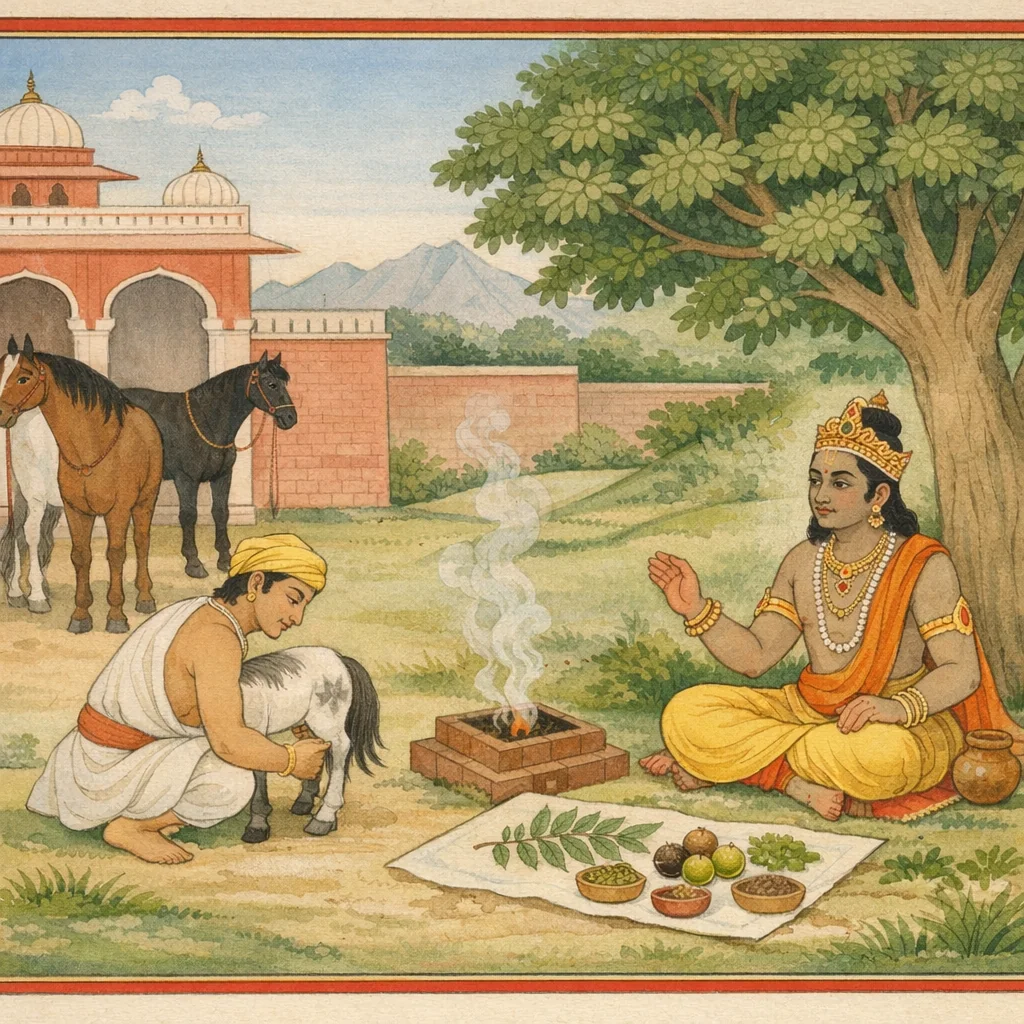
Adhyaya 201
Aśva–Gaja Āyurveda: Marks, Defects, Wounds, Doṣa-Therapy, and Protective Rites
Continuing the Purāṇic teaching of applied dharma and health-science, Dhanvantari turns from general Ayurvedic principles to veterinary care for royal conveyances—first horses, then elephants. He lists ominous and defective equine marks (including fearsome “Yama-forms”) that require rejection, and briefly notes breed and size gradations. The teaching then moves to protection—Revanta worship, homa, gifts to Brahmins—and to amulets and fumigants using sarṣapa, nimba, guggulu, and ghṛta. A clinical frame follows: wounds are external (āgantuja) or internal (doṣa-jantu), each doṣa having its own ripening and symptoms. Cleansing and healing recipes are given—castor root, haridrā, citraka, garlic-salt preparations, neem boluses, and compound powders—along with guidance for kuṣṭha and ulcers, nasya with mātuluṅga/māṃsī, rules for dose escalation, and seasonal contraindications. Dietetics and doṣa-wise feeding for digestion and systemic disorders are specified, including guggulu regimens and triphalā/cow-urine preparations. The chapter closes by extending the same integrated model to elephants: higher (fourfold) dosing, anti-epidemic propitiations, deity worship, and a concise elephant pharmacopeia (Triphala, Pañcakola, Daśamūla, Viḍaṅga, Guḍūcī, Nimba, etc.), preparing for further remedial traditions.
Shlokas
Verse 1
धन्वन्तरिरुवाच / हयायुर्वेदमाख्यास्ये हयं सर्वार्थलक्षणम् / काकतुण्डः कृष्णजिह्वो वृक्षास्यश्चोष्णतालुकः
Dhanvantari said: “Now I shall expound the Ayurveda of horses—the horse whose marks indicate complete excellence in every respect: a muzzle like a crow’s beak, a black tongue, a mouth broad and firm like a tree, and a warm palate.”
Verse 2
करालो हीनदन्तश्च शृङ्गी विरलदन्तकः / एकाण्डश्चैव जाताण्डः कञ्चुकी द्विखुरी स्तनी
He is frightful-looking, with missing teeth; horned, with teeth set far apart; having a single testicle and born with swollen testicles; wearing a cuirass-like covering; cloven-hoofed, and possessing udders.
Verse 3
मार्जारपादो व्याघ्राभः कुष्ठविद्रधिसन्निभः / यमजो वामनश्चैव मार्जारः कपिलोचनः
‘Cat-footed’, ‘tiger-like’, ‘resembling leprosy and boils’, ‘born of Yama’, ‘the dwarf’, ‘cat-like’, and ‘yellow-eyed’—these are the dreadful forms described.
Verse 4
एतद्दोषी हयस्त्याज्य उत्तमो ऽश्वस्तुरुष्कजः / मध्यमः पञ्चहस्तश्च कनीयांश्च त्रिहस्तकः
A horse possessing this defect should be rejected. The best type is the Turushka-bred horse; the middling type is five hands, and the inferior is three hands.
Verse 5
असंहता ये च वाहा ह्रस्वकर्णास्तथैव च / शबलाभाः प्रभावेषु न दीनाश्चिरजीविनः
Those conveyances that are well-knit and sound, with short ears, and of variegated hue—such beings are powerful in their own sphere, not wretched, and long-lived.
Verse 6
रेवन्तपूजनाद्धोमाद्रक्ष्याश्च द्विजभाजेनात् / सरलं निम्बपत्राणि गुग्गुलं सर्षपान्घृतम्?
By worship of Revanta, by performing a protective fire-offering, and by receiving what is given by a Brahmin, one gains protection; likewise pine resin, neem leaves, guggulu, mustard seeds, and ghee are used.
Verse 7
तिलञ्चैव वचां हिगुं बध्नीयाद्वाजिनो गले / आगन्तुजं दोषजन्तु व्रणं द्विविधमीरितम्
Tie sesame, vacā (sweet-flag), and hiṅgu (asafoetida) around the horse’s neck. The treatise declares that wounds are of two kinds: those arising from external causes (āgantuja) and those produced by inner faults and organisms (doṣa-jantu).
Verse 8
चिरपाकं वातजन्तु श्लेष्मजं क्षिप्रपाककम्? / कण्ठदाहात्मकं पित्ताच्छोणितान्मन्दवेदनम्
A boil arising from vāta ripens slowly; one born of śleṣman (kapha) ripens quickly. That due to pitta is marked by burning in the throat, while that arising from blood (śoṇita) brings only mild pain.
Verse 9
आगन्तुजन्तु शस्त्राद्यैर्दुष्टव्रणविशोधनम् / एरण्डमूलं द्विनिशं चित्रकं विश्वभेषजम्
To cleanse and purify foul, infected wounds caused by external agents—such as organisms and weapon-injuries—use the root of eraṇḍa (castor), turmeric, citraka (plumbago), and viśvabheṣaja, the “universal medicine.”
Verse 10
रसोनं सैन्धवं वापि तक्रकाञ्जिकपोषितम् / तिलसक्तुकपिण्डिका दधियुक्ता ससैन्धवा / निम्बपत्रयुतं पिण्डं व्रणशोधनरोपणम्
Garlic with rock salt (saindhava), prepared with buttermilk and sour gruel; a bolus of sesame and roasted barley-flour mixed with curd and rock salt; and a paste-bolus combined with neem leaves—these cleanse wounds and promote their healing.
Verse 11
पटोलं निम्बपत्रञ्च वचा चित्रकमेव च / पिप्पलीशृङ्गवेरञ्च चूर्णमेकत्र कारयेत्
Prepare a single powdered blend by combining patola, neem leaves, vacā, citraka, pippalī, and śṛṅgavera (dry ginger).
Verse 12
एतत्पानात्क्रिमिश्लेष्ममन्दानिलविनाशनम् / निम्बपत्रं पटो लञ्च त्रिफला खदिरं तथा
By drinking this, intestinal worms, excess phlegm, and the sluggishness of vāta (the bodily wind) are destroyed. It is prepared with neem leaves, paṭola, triphalā, and also khadira.
Verse 13
क्वाथयित्वा ततो वाहं सृतरक्तं विचक्षणः / त्र्यहमेव प्रिदातव्यं हयकुष्ठोपशान्तये
Then, having boiled it, the wise person should give that decoction mixed with expressed blood for three days alone, for the pacification of a horse’s skin-disease (kuṣṭha).
Verse 14
सव्रणेषु च कुष्ठेषु तैलं सर्षपजं हितम् / लशुनादिकषायश्च पानभुक्त्युपशान्तये
For ulcerated wounds and for kuṣṭha (skin disorders), mustard oil is beneficial; and a decoction prepared with garlic and similar herbs helps to pacify disturbances arising from drink and food.
Verse 15
मातुलुङ्गरसोपेतं मांसीनां रसकेन वा / सद्यो दद्यात्तत्र नस्यमन्यैर्वातैः सुसंयुतैः
Mixed with mātuluṅga (citron) juice—or else with the expressed juice of māṃsī (spikenard)—one should administer nasya (nasal therapy) there immediately, suitably combined with other vāta-pacifying ingredients.
Verse 16
पलद्वयं प्रथमे ऽह्नि एकैकपलवृद्धितः / यावद्दिनानि पूर्णानि पलान्यष्टादशोत्तमे
On the first day it is two palas; then it increases by one pala each day, until the full number of days is completed—reaching eighteen palas at the end.
Verse 17
अधमे ऽष्टपलानि स्युर्मध्यमे स्युश्चतुर्दश / शरन्निदाघयोर्नैवदेयं नैव तु दापयेत्
In the lowest grade it should be eight palas; in the middle grade, fourteen. But in autumn and in the fierce heat of summer, it should not be given—nor should one cause it to be given.
Verse 18
तैलेन वातिके रोगे शर्कराज्यपयोन्वितैः / कटुतैलैः कफे व्योषैः पित्ते चत्रिफलाम्बुभिः
In disorders caused by vāta, one should treat with oil combined with sugar, ghee, and milk. In kapha disorders, pungent oils together with vyoṣa (the three spices) are prescribed; and in pitta disorders, water infused with triphalā is to be used.
Verse 19
शालिषष्टिकदुग्धाशी हयो हिन जुगुप्सितः / पक्वजम्बूनिभो हेमवर्णो ऽश्वो न जुगुप्सितः
A horse that feeds on śāli rice, ṣaṣṭika (sixty-day) rice, and milk is deemed inferior and to be avoided. But a horse whose hue is like a ripe jambu fruit, golden in color, is not regarded as blameworthy.
Verse 20
अर्धप्रहरणे धुर्ये गुग्गुलुं प्राशयेद्धयम् / भोजयेत्पायसं दुग्धं सत्वरं सुस्थिरो हयः
At the half-watch, when the horse is in harness, one should make it consume guggulu. Then one should promptly feed it milk-rice (pāyasa) and milk; thus the horse quickly becomes steady and well-composed.
Verse 21
विकारे भोजने दुग्धं शाल्यन्नं वातले ददेत् / कर्षमांसरसैः पित्ते मधुमुद्गरसाज्यकैः
When digestion is disturbed, one should give milk and rice as food; in vāta-type disorders, such suitable fare should be provided. In pitta-type conditions, food should be given along with broth of lean meat, and with honey, mung-bean soup (mudga-rasa), and ghee.
Verse 22
कफे मुद्गान्कुलत्थान्वा कटुतिक्तान्कफे हये / बाधिर्ये व्याधिते ग्रासे त्रिदोषादौ तु गुग्गुलुः
In disorders where kapha predominates, one should take mung beans and horse‑gram, and foods that are pungent and bitter. For deafness and for throat disease with difficulty in swallowing, and in conditions involving all three doṣas (tridoṣa), guggulu is prescribed.
Verse 23
घासैर्दूर्वा सर्वरोगे प्रथमे ऽह्नि पलं ददेत् / विवर्धयेत्ततः कर्षमेकाह्नि पलपञ्चकम्
Using fresh grass together with dūrvā (Bermuda grass), for the cure of all diseases one should administer one pala on the first day; thereafter the dose should be increased gradually—from one karṣa up to five palas in a single day.
Verse 24
पाने च भोजने चैव अशीतिपलकं परम् / मध्ये षष्टिश्चाधमेषु चत्वारिंशच्च भोगिषु
In offerings of drink and of food, the highest measure is eighty palas; the middling is sixty; and for the lower class of enjoyers it is forty palas.
Verse 25
व्रणे कुष्ठेषु खञ्जेषु त्रिफलाक्वाथसंयुतम् / मन्दाग्नौ शोथरोगे च गवां मूत्रेण योजितम्
For wounds, leprosy/skin diseases, and lameness, it is to be administered combined with a decoction of Triphalā; and for weak digestive fire (agni) and for oedematous swelling as well, it should be prepared by mixing with cow’s urine.
Verse 26
वातपित्ते व्रणे व्याधौ गोक्षीरं घृतसंयुतम् / देयं कृशानां पुष्ट्यर्थं मांसैर्युक्तं च भोजनम्
In ailments involving vāta and pitta, and in wounds or diseases, cow’s milk mixed with ghee should be given. For those who are emaciated, nourishing food—also prepared with meat—should be provided for strengthening.
Verse 27
सुपिष्टायाः प्रदातव्यं गुडूच्याः पलपञ्चकम् / प्रभाते घृतसंयुक्तं शरद्गीष्मे च वाजिनाम्
Five palas of well-pounded guḍūcī should be given; taken at dawn mixed with ghee, it is prescribed for horses, especially in the autumn and summer seasons.
Verse 28
रोगघ्नं पुष्टिदं चापि बलतेजोविवर्धनम् / तदेवाश्वायदातव्यं क्षीरयुक्तमथापि वा
That preparation destroys disease, bestows nourishment, and increases strength and vital radiance; it should be given to the horse—either by itself or mixed with milk.
Verse 29
गुडूचीकल्पयोगेन शतावर्यश्वगन्धयोः / चत्वारि त्रीणि मध्यस्य जघन्यस्य पलानि हि
Prepared according to the proper medicinal formulation with guḍūcī, the prescribed dose of śatāvarī and aśvagandhā is four palas for one of medium strength, and three palas for the weakest indeed.
Verse 30
अकस्माद्यत्र वाहानामेकरूपं यदा भवेत् / म्रियते च यदा क्षिप्रमुपसर्गं तमादिशेत्
When, all of a sudden, the conveyances or mounts appear in one identical form, and death follows swiftly, one should understand it as an ominous upasarga—a fatal portent—and declare it as such.
Verse 31
होमाद्यै रक्षया विप्रभोजनैर्बलिकर्मणा / शान्त्योपसर्गशान्तिः स्याद्धरीतक्यादिकल्पतः
Through rites such as homa (fire-offerings), protective observances, feeding of Brahmins, and the performance of bali offerings, the pacification of afflictive disturbances is accomplished—according to the prescribed procedures beginning with harītakī and related remedies.
Verse 32
हरीतकी गवां मूत्रैस्तैलेन लवणान्विता / आदौ पञ्च ततः पञ्च वृद्ध्या पूर्णशतावधि / उत्तमा च शतं मात्रास्त्वशीतिः षष्टिरेव वा
Harītakī (chebulic myrobalan) should be administered mixed with cow’s urine, oil, and salt. One should begin with five measures, then increase by five each time, continuing up to a full hundred. The finest dose is a hundred measures, though eighty or sixty may also be used.
Verse 33
गजायुर्वेदमाख्यास्ये उक्ताः कल्पा गजे हिताः / गजे चतुर्गुणा मात्रास्ताभिर्गजरुगर्दनः
I shall now expound the Ayurvedic science for elephants—the remedies taught as beneficial to the elephant. For elephants, the doses are fourfold; by those measures the ailments of elephants are alleviated.
Verse 34
गजो पसर्गव्याधीनां शमनं शान्तिकर्म च / पूजयित्वा सुरान्विप्रान्रत्नैर्गां कपिलां ददेत्
For the pacification of afflictions and epidemic diseases, and as a śānti rite of propitiatory appeasement, one should worship the Devas and the Brahmin sages; then one should donate a tawny kapilā cow together with jewels.
Verse 35
दन्तिदन्तद्वये मालां निबन्धीयादुपोषितः / मन्त्रेण मन्त्रितान्वैद्यैर्वचासिद्धार्थकांस्तथा
Having fasted, one should bind a garland upon the pair of tusks; and likewise one should use vācā and siddhārthaka (mustard) that have been empowered with a mantra by physicians.
Verse 36
सूर्यादिशिवदुर्गाश्रीविष्ण्वर्चा रक्षयेद्गजम् / बलिं दद्याच्च भूतेभ्यः स्नापयेच्च चतुर्घटैः
By worshipping Sūrya and the others—Śiva, Durgā, Śrī (Lakṣmī), and Viṣṇu—one should protect the elephant; one should also offer bali (propitiatory offerings) to the bhūtas, and bathe it with water poured from four pots.
Verse 37
भोजनं मन्त्रितं दद्याद्भस्मनोद्धूनयेद्गजमम् / भूतरक्षा शुभा मेध्या वारणं रक्षयेत्सदा
One should offer food sanctified by mantras, and then dust the elephant with ash. This is an auspicious, purifying safeguard against spirits, keeping the elephant ever protected.
Verse 38
त्रिफलापञ्चकोले च दशमूलं विडङ्गकम् / शतावरीगुडूची च निम्बवासककिंशुकाः
One should employ Triphalā and Pañcakola, Daśamūla and Viḍaṅga, together with Śatāvarī and Guḍūcī, and also Nimba, Vāsaka, and Kiṃśuka.
Verse 39
गजरोगविनाशाय हितो रूक्षः कषायकः / आयुर्वेदद्वयोक्तानामुक्तं संक्षेपसारतः
To remove the diseases of elephants, a decoction that is drying and astringent is beneficial. Here the essence is stated concisely, as taught in the two Ayurvedic traditions.
Frequently Asked Questions
The chapter classifies wounds as āgantuja (external—injury, weapons, organisms) and doṣa-jantu (internal—arising from doṣic faults and living agents). This matters because therapy differs: external wounds emphasize cleansing/purification and topical measures, while internal-origin disorders require doṣa-pacifying medicines, diet regulation, and systemic management.
It links doṣas to observable courses and sensations: vāta-type boils ripen slowly, kapha-type ripen quickly, pitta shows burning features, and blood-related conditions show comparatively mild pain. Treatment is then aligned—unctuous/oil-based measures for vāta, pungent/spice-forward oils for kapha, and triphalā-infused cooling water for pitta.
Guggulu appears both as a protective substance and as a therapeutic, including timed administration when the horse is in harness and as a prescription for conditions like tridoṣa involvement, throat-related difficulty, and deafness. It is also paired with triphalā decoction for wounds/skin disease and with cow’s urine for swelling and weak digestion.
The text warns against administering certain escalating-dose regimens during autumn and the heat of summer, reflecting an Ayurvedic sensitivity to seasonal doṣa fluctuation and heat burden. This indicates that even effective medicines can become harmful when ṛtu (season) amplifies the same qualities (e.g., heat/dryness).
For elephants, the chapter prescribes appeasement and protection through worship of devas and Brahmin sages, donation of a tawny cow with jewels, mantra-empowered vācā and mustard, worship of Sūrya, Śiva, Durgā, Śrī, and Viṣṇu, bali offerings to spirits, bathing with water from four pots, feeding mantra-sanctified food, and dusting with ash as a purificatory safeguard.