Adhyaya 152
Rajayakshma Nidana: Causes, Pathogenesis, Symptoms, and Prognosis
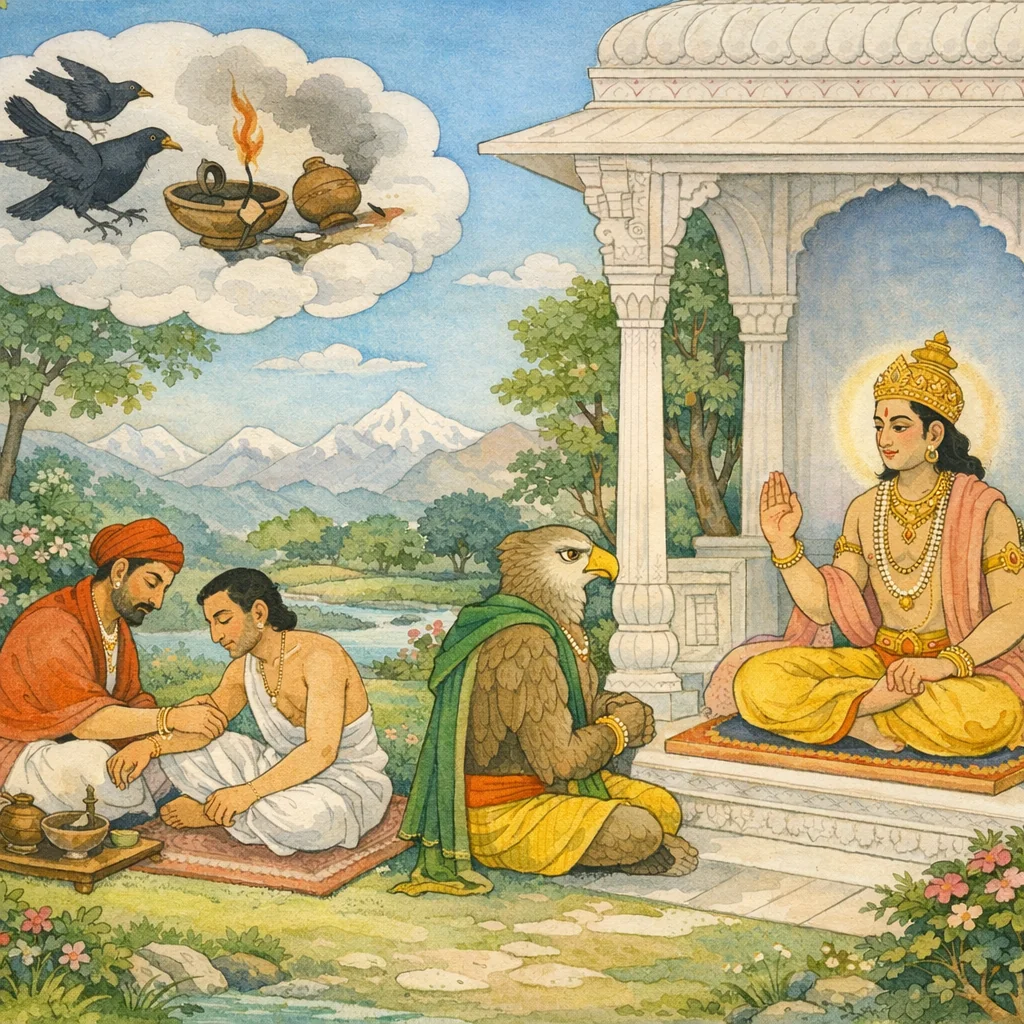
Continuing the Garuda Purana’s Brahma Khanda focus on applied dharma through bodily health, Dhanvantari turns from general medical teaching to a concentrated nidāna of rājayakṣmā (yakṣmā/kṣaya/śoṣa). He defines the disease as a “sovereign” affliction of wide reach, then traces its rise to the drying of the dhātu beginning with rasa, driven by rash exertion, suppression of natural urges, and depletion of semen/ojas and unctuousness. He describes tridoṣa disturbance—vāta initiating systemic disorder, channel obstruction or excessive discharge, followed by cardio-thoracic pain, coryza, fever, anorexia, nausea, vomiting, pallor, and progressive weakness. Ominous dreams and strange perceptions are given as prognostic signs of decline. Symptom clusters are distinguished by vāta, pitta, and kapha dominance (burning, diarrhoea, haematemesis, catarrh, heaviness, weak agni), ending with a practical rule: when extreme wasting and loss of faculties appear, avoid treatment; otherwise, treat. Thus the chapter sets diagnostic thresholds and doṣa-based presentations for the therapies that follow.
Shlokas
Verse 1
ऽध्यायः धन्वन्तरिरुवाच / अथातो यक्ष्मरोगस्य निदानं प्रवदाम्यहम् / अनेकरोगानुगतो बहुरोगपुरोगमः
Dhanvantari said: Now, therefore, I shall explain the nidāna—the causes and diagnostic basis—of the disease called yakṣmā (consumption). It is accompanied by many other ailments and is preceded by numerous disorders.
Verse 2
राजयक्ष्मा क्षयः शोषो रोगराडिति कथ्यते / नक्षत्राणां द्विजानाञ्च राज्ञो ऽभूद्यदयं पुरा
This ailment is called rājayakṣmā—also known as kṣaya (consumption) and śoṣa (wasting)—the ‘king of diseases’. In ancient times, it arose as a curse/affliction upon the king, and it also came to affect the nakṣatras and the dvijas (the twice-born).
Verse 3
यच्च राजा च यक्ष्मा च राजयक्ष्मा ततो मतः / देहौषधक्षयकृतेः क्षयस्तत्सम्भवाच्च सः
Because it is both ‘rājā’ (a sovereign affliction) and ‘yakṣmā’ (consumption), it is therefore known as rājayakṣmā. It is called kṣaya (‘wasting’) because it depletes the body and even the efficacy of medicines, and it arises from that very wasting.
Verse 4
रसादिशोषणाच्छोषो रोगराडिति राजवत् / साहसं वेगसंरोधः शुक्रौजः स्नेहसंक्षयः
From the drying up of the bodily fluids beginning with rasa arises śoṣa—the wasting disease—which rules over ailments like a king. It is brought on by rash exertion, suppression of natural urges, depletion of śukra and ojas (vital essence), and the loss of bodily unctuousness.
Verse 5
अन्नपानविधित्यागश्चत्वारस्तस्यहेतवः / तैरुदीर्णो ऽनिलः पित्तं व्यर्थं चोदीर्य सर्वतः
Neglect of the proper ordinances of eating and drinking has four causes. By these the bodily wind (vāta) is provoked; it then stirs up bile (pitta) and spreads vain, disorderly agitation throughout the whole system.
Verse 6
शरिरसन्धिमाविश्य ताः शिराः प्रतिपीडयन् / मुखानि स्रोतसां रुद्ध्वा तथैवातिविसृज्य वा
Entering the body’s joints, it presses hard upon the nāḍīs; and by obstructing the mouths of the channels (srotas)—or else by driving them to excessive discharge—it brings about intense distress.
Verse 7
मध्यमूर्ध्वमधस्तिर्यगव्यथां सञ्जनयेद्धृदः / रूपं भविष्यतस्तस्य प्रतिश्यायो भृशं ज्वरः
From the heart there arises pain in the middle, above, below, and even to the sides. Such is the form of what is to come for him: severe coryza and an intense fever.
Verse 8
प्रसेको मुखमाधुर्यं मार्दवं वह्निदे हयोः / लौल्यभावो ऽन्नपानादौ शुचावशुचिवीक्षणम्
In one afflicted by the inner fire (agni) there arise drooling, a sweetness in the mouth, and a softening of the body. Restlessness concerning food and drink appears, and he begins to perceive in what he sees both purity and impurity.
Verse 9
मक्षिकातृणकेशादिपातः प्रायो ऽन्नपानयोः / हृल्लासश्छर्दिररुचिरस्नाते ऽपि बलक्षयः
Often flies, blades of grass, hairs, and the like fall into one’s food and drink. There is nausea, vomiting, and loss of appetite; and—even without bathing—strength wastes away.
Verse 10
पाण्योरुवक्षः पादास्यकुक्ष्यक्ष्णोरतिशुक्लता / बाह्वोः प्रतोदो जिह्वायाः काये बैभत्स्यदर्शनम्
Excessive pallor appears in the hands, thighs and chest, and likewise in the feet, mouth, belly, and eyes. There is stabbing pain in the arms, affliction of the tongue, and the body takes on a repulsive, grotesque appearance.
Verse 11
स्त्रीमद्यमांसप्रियता घृणिता मूर्धगुण्ठनम् / नखकेशास्थिवृद्धिश्च स्वप्ने चाभिभवो भवेत्
Fondness for women, liquor, and meat; a repulsive disposition; covering or veiling of the head; excessive growth of nails, hair, and bones—and defeat or oppression in dreams—these signs are said to occur.
Verse 12
पतनं कृकलासाहिकपिश्वापदपक्षिभिः / केशास्थितुषभस्मादितरौ समधिरोहणम्
He is made to fall among lizards, serpents, flesh‑eating creatures, and birds; and then, upon the rest—hair, bones, husks/chaff, ash and the like—he is forced to mount.
Verse 13
शून्यानां ग्रामदेशानां दर्शनं शुष्यतो ऽम्भसः / ज्योतिर्दिवि दवाग्नीनां ज्वलतां च महीरुहाम्
Seeing villages and regions as deserted, perceiving water as dried up, and beholding in the sky the fiery glow of forest-conflagrations and of trees blazing—these are ominous perceptions.
Verse 14
पीनसश्वासकासं च स्वरमूर्धरुजो ऽरुचिः / ऊर्ध्वनिः श्वाससंशोषावधश्छर्दिश्च कोष्ठगे
When the disorder is seated in the abdomen, it produces nasal congestion, laboured breathing and cough, hoarseness of voice, headache and loss of appetite; there is upward, obstructed breathing with dryness, and also vomiting downward.
Verse 15
स्थिते पार्श्वे च रुग्बोधे सन्धिस्थे भवति ज्वरः / रूपाण्यैकादशैतानि जायन्ते राजयक्ष्मणः
When the affliction settles in the side, pain arises; when it becomes established in the joints, fever is born. These are the eleven characteristic manifestations that appear in rājayakṣmā (consumption).
Verse 16
तेषामुपद्रवान्विद्यात्कण्ठध्वंसकरी रुजाः / जृम्भाङ्गमर्दनिष्ठीववह्निमान्द्यास्यपूतिता
These should be known as its attendant afflictions: pains as though tearing the throat apart, together with yawning, aching of the limbs, excessive spitting, a weakening of the digestive fire, and foulness of the mouth.
Verse 17
तत्र वाताच्छिरः पार्श्वशूलनं सांगमर्दनम् / कण्ठरोधः स्वरभ्रंशः पित्तात्पादांसपाणिषु
There, due to the derangement of vāta, one suffers pain in the head and sides and a crushing ache throughout the limbs; there is also choking in the throat and loss of voice. Due to the derangement of pitta, burning afflictions arise in the feet, shoulders, and hands.
Verse 18
दाहो ऽतिसारो ऽसृक् छर्दिर्मुखगन्धो ज्वरो मदः / कफादरोचकच्छर्दिकासा अर्ध्वां गगौरवम्
Burning sensation, diarrhoea, vomiting of blood, foul odour from the mouth, fever, and delirium; and from kapha arise loss of appetite, vomiting, cough, an upward disturbance (of the breath/energy), and heaviness of the limbs.
Verse 19
प्रसेकः पीनसः श्वासः स्वरभेदो ऽल्पवह्निता / दोषैर्मन्दानलत्वेन शोथलेपकफोल्बणैः
Excess salivation, nasal catarrh, breathlessness, hoarseness of voice, and weak digestive fire arise when the doṣa are aggravated—when the digestive fire becomes manda (sluggish), with swelling, a mucous coating, and an excess of kapha.
Verse 20
स्रोतोमुखेषु रुद्धेषु धातुषु स्वल्पकेषु च / विदाहो मनसः स्थाने भवन्त्यन्ये ह्युपद्रवाः
When the mouths of the bodily channels (srotas) are obstructed and the dhātus, the vital constituents, become scant, a burning arises in the region of the heart-mind, and other afflictions also manifest.
Verse 21
पच्यते कोष्ठ एवान्नमम्लयुक्तै रसैर्युतम् / प्रायो ऽस्य क्षयभागानां नैवान्नं चाङ्गपुष्टये
Food is digested only within the gut, mingled with sour digestive juices; yet for one destined for kṣaya—wasting and decline—that food generally does not nourish the limbs at all.
Verse 22
रसो ह्यस्य न रक्ताय मांसाय कुरुते तु तत् / उपष्टब्धः समन्ताच्च केवलं वर्तते क्षयी
For him, the rasa—the nourishing essence—does not become blood or flesh; though supported on every side, it merely persists, only to waste away.
Verse 23
लिङ्गेष्वल्पेष्वतिक्षीणं व्याधौ षट्करणक्षयम् / वर्जयेत्साधयेदेव सर्वेष्वपि ततो ऽन्यथा
When the signs are few and the patient is exceedingly wasted, or when a disease brings decline of the six faculties (ṣaṭ-karaṇa), one should refrain from undertaking treatment. Otherwise—when these are absent—one should indeed treat in all cases.
Verse 24
दोषैर्व्यस्तैः समस्तैश्च क्षयात्सर्वस्य मेदसः / स्वरभेदो भवेत्तस्य क्षामो रूक्षश्चलः स्वरः
When the doṣas—acting separately or all together—deplete the body’s medas, the fat tissue, a disturbance of the voice arises: the voice becomes thin, dry, and unsteady.
Verse 25
शुकवर्णाभकण्ठत्वं स्निग्धोष्णोपशमो ऽनिलात् / पित्तात्तालुगले दाहः शोषो भवति सन्ततम्
From derangement of vāta (wind) arise a pale, whitish hue and dryness of the throat, and it is relieved by unctuous and warming measures. From derangement of pitta arise burning in the palate and throat, and a constant drying up.
Verse 26
लिम्पन्निव कफैः कण्ठं मुखं घुरघुरायते / स्वयं विरुद्धैः सर्वैस्तु सर्वालिङ्गैः क्षयो भवेत्
As if smeared over with kapha (phlegm), the throat becomes clogged and the mouth rattles with a gurgling sound. When all bodily signs appear in mutually conflicting ways, it indicates that kṣaya (consumption, wasting) will occur.
Verse 27
धूमायतीव चात्यर्थमुदेति श्लेष्मलक्षणम् / कृच्छ्रसाध्याः क्षयाश्चात्र सर्वैरल्पञ्च वर्जयेत्
When the kapha condition manifests excessively—rising as though it were smoking—then kṣaya (wasting disorders) becomes difficult to cure. In such a state, everyone should avoid even small amounts of harmful foods or habits.
Frequently Asked Questions
It arises from drying of bodily fluids starting with rasa and from behaviors that destabilize doṣas—rash exertion, suppression of natural urges, neglect of proper eating-drinking rules, depletion of semen and ojas, and loss of bodily unctuousness—leading to srotas/nāḍī dysfunction and dhātu-kṣaya.
The text states that provoked vāta, triggered by regimen errors, agitates pitta and disrupts the system through channel obstruction or excessive discharge, producing distress and a cascade of multi-system symptoms (pain, fever, respiratory and digestive impairment).
Prognostic red flags include extreme wasting with few manifest signs, decline of the six faculties, mutually conflicting bodily signs, and excessive kapha presentation described as rising ‘like smoke’; these indicate advanced consumption and poor curability, prompting avoidance of treatment.