Chapter 9: Adhyaya 9 — Ethical Restraint, Social Caution, and Practical Discernment
अध्याय ९
Practical Wisdom for Navigating Adversity
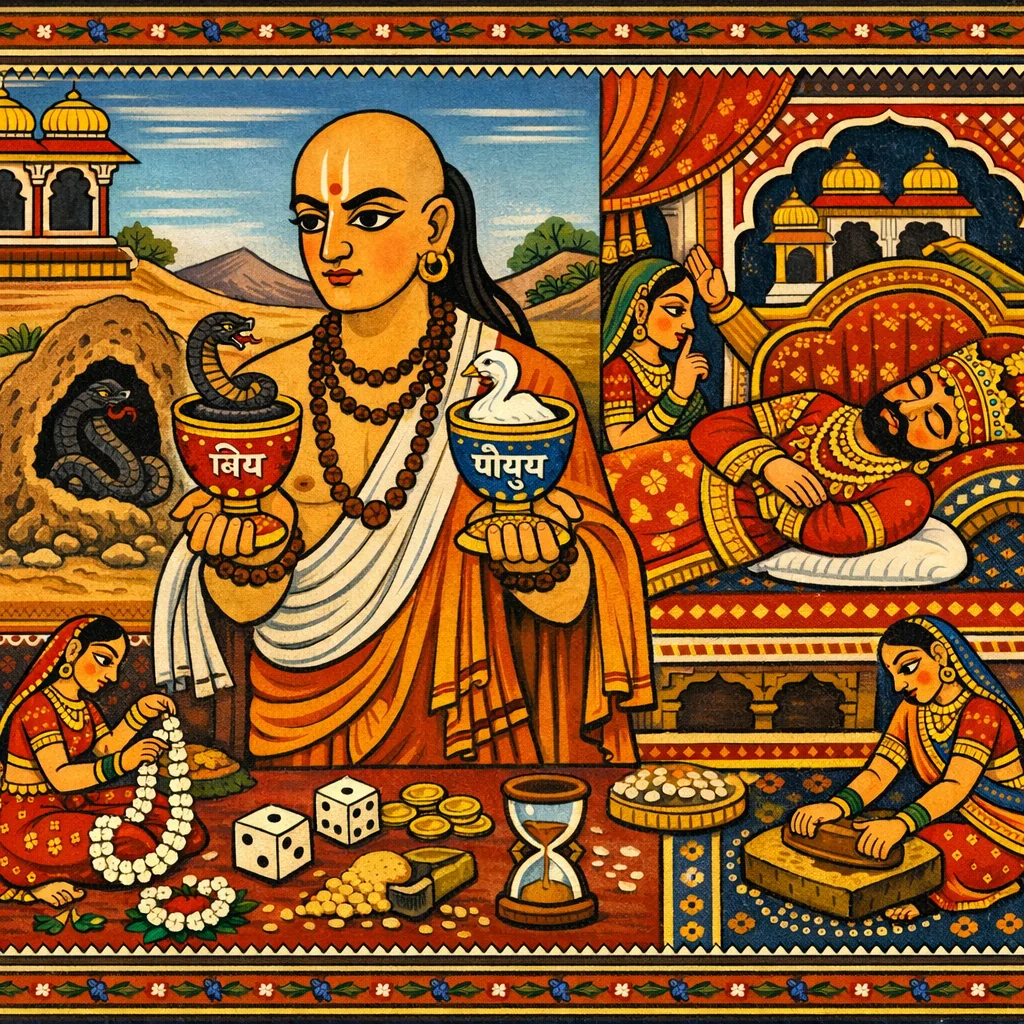
Adhyaya 9 presents a clustered set of subhāṣita-style maxims framed as historical ethical and strategic observations. The verses juxtapose renunciatory language (treating sensory pursuits as “poison” and virtues such as forbearance, sincerity, and compassion as “nectar”) with pragmatic warnings about social speech, reputation, and risk. Several aphorisms describe the dangers of malicious disclosure and backbiting, using zoological metaphors to depict self-destruction through harmful talk. The chapter also catalogs hierarchical “primacies” (e.g., head among limbs, eyes among senses, food among comforts), reflecting classical Indian didactic taxonomies. Courtly intelligence and learned expertise are indicated through astronomical knowledge, while a practical list identifies categories of persons traditionally considered appropriate—or inappropriate—to awaken, reflecting social etiquette and power asymmetry. Further verses treat intimidation as performance (the hood of a non-venomous snake), critique time lost to gambling, sexual preoccupation, and theft-related entanglements, and present embodied labor (handmade garlands, sandal paste, written hymns) as culturally valorized. Archaic social observations about caste and gender appear as historical data points within the genre’s worldview.
Key Concepts
Key Principles
Strategic Themes
Shlokas in Chapter 9
Verse 1
मुक्तिमिच्छसि चेत्तात विषयान्विषवत्त्यज । क्षमार्जवदयाशौचं सत्यं पीयूषवत्पिब ॥
If you seek liberation, child, abandon sense-objects as poison; drink forbearance, straightforwardness, compassion, purity, and truth as nectar.
Verse 2
परस्परस्य मर्माणि ये भाषन्ते नराधमाः । त एव विलयं यान्ति वल्मीकोदरसर्पवत् ॥
The lowest men, who speak of one another’s vulnerable points, come to ruin themselves—like a snake within the belly of an anthill.
Verse 3
गन्धः सुवर्णे फलमिक्षुदण्डे नाकरि पुष्पं खलु चन्दनस्य । विद्वान्धनाढ्यश्च नृपश्चिरायुः धातुः पुरा कोऽपि न बुद्धिदोऽभूत् ॥
Fragrance is not in gold, nor fruit in a sugarcane stalk, nor does sandalwood bear a flower. Neither the learned, nor the wealthy, nor a king, nor the long-lived—by mere bodily constitution—becomes a giver of intellect.
Verse 4
सर्वौषधीनाममृता प्रधाना सर्वेषु सौख्येष्वशनं प्रधानम् । सर्वेन्द्रियाणां नयनं प्रधानं सर्वेषु गात्रेषु शिरः प्रधानम् ॥
Among medicines, amṛtā is foremost; among comforts, food is foremost. Among the senses, the eye is foremost; among the limbs, the head is foremost.
Verse 5
दूतो न सञ्चरति खे न चलेच्च वार्ता पूर्वं न जल्पितमिदं न च सङ्गमोऽस्ति । व्योम्नि स्थितं रविशाशिग्रहणं प्रशस्तं जानाति यो द्विजवरः स कथं न विद्वान् ॥
No messenger travels in the sky, no report moves there; nothing was spoken beforehand, and no meeting occurred. Yet the learned brāhmaṇa knows from the heavens the auspicious sign of a solar and lunar eclipse—how could one who knows thus not be a wise man?
Verse 6
विद्यार्थी सेवकः पान्थः क्षुधार्तो भयकातरः । भाण्डारी प्रतिहारी च सप्त सुप्तान्प्रबोधयेत् ॥
A student, a servant, a traveler, one tormented by hunger, one distressed by fear, a storekeeper/treasurer, and a doorkeeper—these seven may awaken those who sleep.
Verse 7
अहिं नृपं च शार्दूलं वृद्धं च बालकं तथा । परश्वानं च मूर्खं च सप्त सुप्तान्न बोधयेत् ॥
A serpent, a king, a tiger, an old man, a child, another man’s dog, and a fool—these seven sleepers should not be awakened.
Verse 8
अर्धाधीताश्च यैर्वेदास्तथा शूद्रान्नभोजनाः । ते द्विजाः किं करिष्यन्ति निर्विषा इव पन्नगाः ॥
Those who have studied the Vedas only halfway and merely cling to the rule “do not eat a Śūdra’s food” are twice-born in name alone—like serpents without venom.
Verse 9
यस्मिन्रुष्टे भयं नास्ति तुष्टे नैव धनागमः । निग्रहोऽनुग्रहो नास्ति स रुष्टः किं करिष्यति ॥
One whose anger inspires no fear and whose pleasure brings no gain; who neither punishes nor grants favor—if such a person is angered, what can he accomplish?
Verse 10
निर्विषेणापि सर्पेण कर्तव्या महती फणा । विषमस्तु न चाप्यस्तु घटाटोपो भयङ्करः ॥
Even a venomless snake should raise a great hood. Venom or no venom, the very display is fearsome.
Verse 11
प्रातर्द्यूतप्रसङ्गेन मध्याह्ने स्त्रीप्रसङ्गतः । रात्रौ चौरप्रसङ्गेन कालो गच्छन्ति धीमताम् ॥
Morning is spent on gambling, midday on women, and night on thieves—thus time is consumed even for the intelligent.
Verse 12
स्वहस्तग्रथिता माला स्वहस्तघृष्टचन्दनम् । स्वहस्तलिखितं स्तोत्रं शक्रस्यापि श्रियं हरेत् ॥
A garland strung by one’s own hand, sandalwood rubbed by one’s own hand, and a hymn written by one’s own hand—such merit is said to dim even the splendor of Śakra (Indra).
Verse 13
इक्षुदण्डास्तिलाः शूद्राः कान्ता हेम च मेदिनी । चन्दनं दधि ताम्बूलं मर्दनं गुणवर्धनम् ॥
Sugarcane stalks, sesame, the Śūdra, a beloved woman, gold, and the earth—along with sandalwood, curd, and betel—are said to have their qualities enhanced by rubbing, pounding, or churning.
Verse 14
दह्यमानाः सुतीव्रेण नीचाः परयशोऽग्निना अशक्तास्तत्पदं गन्तुं ततो निन्दां प्रकुर्वते । दरिद्रता धीरतया विराजतेकुवस्त्रता शुभ्रतया विराजते कदन्नता चोष्णतया विराजते कुरूपता शीलतया विराजते ॥
The low-minded are fiercely scorched by the “fire” of another’s fame; unable to reach that station, they turn to disparagement. Poverty shines with fortitude; poor clothing with cleanliness; plain food with warmth; ugliness with good conduct.
Frequently Asked Questions
The text foregrounds a historical niti principle of restraint and discernment: sensory indulgence is described through a poison metaphor, while virtues (forbearance, straightforwardness, compassion, purity, truth) are framed as life-sustaining goods. This ethical axis is paired with pragmatic vigilance about speech, time-use, and social risk.
Interpersonal conduct is addressed through types rather than formal relationship categories: malicious speakers who expose others’ vulnerabilities; persons socially deemed suitable to awaken (e.g., student, servant, traveler, hungry, fearful, storekeeper, doorkeeper) versus those deemed unsuitable (e.g., king, tiger, elder, child, dog, fool). These groupings function as etiquette and risk-management typologies in the chapter’s historical social register.
Like broader niti corpora (including the Arthashastra’s pragmatic orientation and the Panchatantra’s moralized social tactics), this chapter compiles compact heuristics for managing danger, reputation, and attention. Its metaphors and lists reflect a didactic method common to Sanskrit wisdom literature: compressing political psychology, courtly caution, and social hierarchy into memorable verses for transmission and citation.