Adhyaya 44
ललितोपाख्याने जप-न्यास-योगप्रकरणम् (Lalitopākhyāna: Procedure of Japa, Nyāsa, and Yogic Installation)
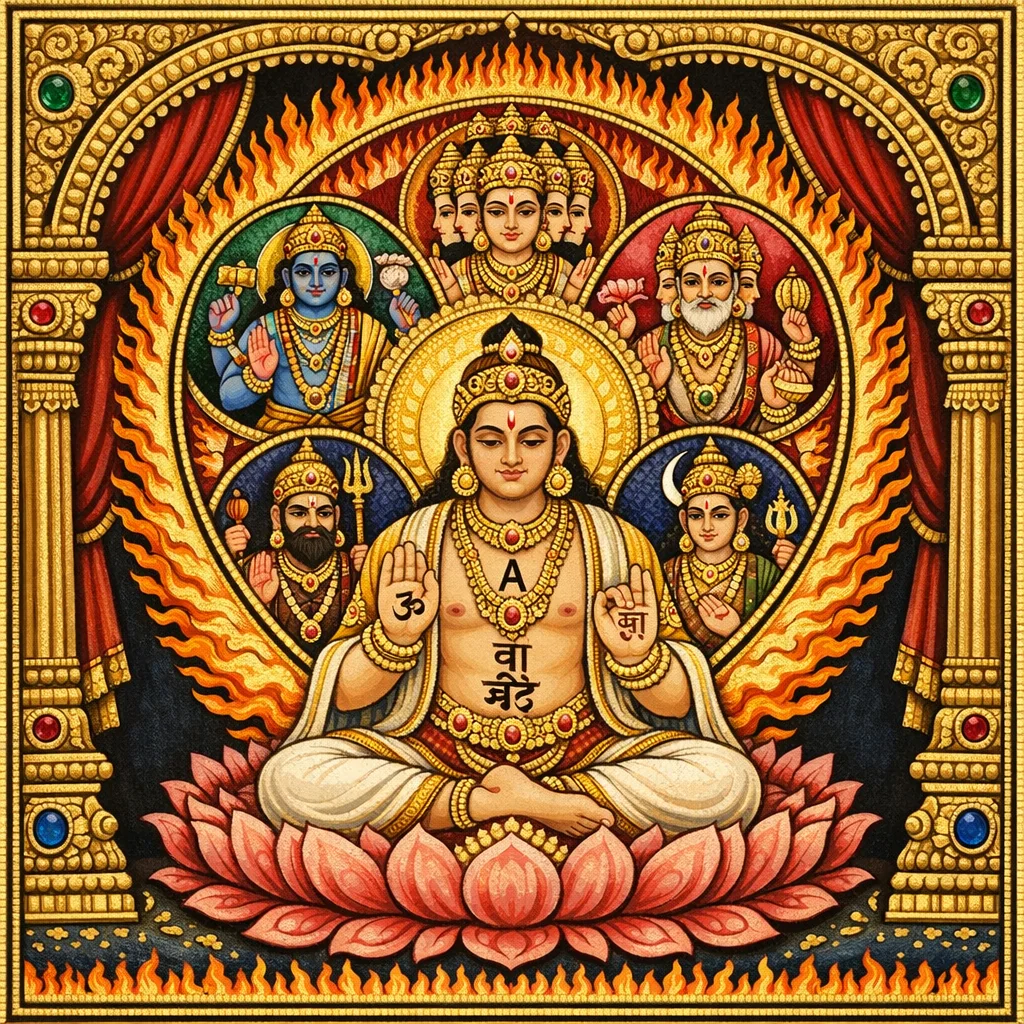
This adhyāya (in the Uttara-bhāga, Lalitopākhyāna) is a technical ritual manual on japa and nyāsa rather than a dynastic narrative. Hayagrīva teaches disciplined entry into the japa-sthāna, correct posture and orientation (e.g., facing east in padmāsana), and mantra-governed purifications and installations. It stresses preparing the seat and, through dhyāna, identifying oneself with the devatā-mūrti; placing bīja-mantras and mātṛkā systematically on fingers, palms, and bodily centers (navel, heart, brow, etc.); forming a protective enclosure up to the ‘agni-prākāra’ boundary by one’s astramantra; visualizing subtle and gross bodies through phonemic (kāra) articulation; mapping nine āsanas/deity-stations (including Brahmā, Viṣṇu, Rudra, Īśvara, Sadāśiva) in a heart-centered display; awakening kuṇḍalinī by mudrā and prāṇa with huṃ repetitions, raising it to the dvādaśānta and reinstalling it; and concluding with refined nyāsa (including kuṅkuma-nyāsa) to stabilize mantra-śakti for subsequent worship or recitation, presenting ritual as an inner cosmology mirroring the Purāṇic macrocosm.
Shlokas
Verse 1
इति श्रीब्रह्माण्डमहापुराणे उत्तरभागे ललितोपाख्याने त्रिचत्वारिंशो ऽध्यायः हयग्रीव उवाच प्रविश्य तु जपस्थानमानीय निजमासनम् / अभ्युक्ष्य विधिवन्मन्त्रैर्गुरूक्तक्रमयोगतः
Thus, in the Śrī Brahmāṇḍa Mahāpurāṇa, in the latter section, in the Lalitā narrative, the forty-third chapter. Hayagrīva said: “Entering the place of japa, bringing his own seat, he duly sprinkled it with mantras, in the yogic sequence taught by the Guru…”
Verse 2
स्वात्मानं देवतामूर्तिं ध्यायंस्तत्राविशेषतः / प्राङ्मुखो दृढमाबध्य पद्मासनमनन्यधीः
There, meditating on his own self as the very form of the Deity, without any sense of difference, facing east he firmly assumed padmāsana, his mind unwavering and one-pointed.
Verse 3
त्रिखण्डामनुबध्नीयाद्गुर्वादीनभिवन्द्य च / द्विरुक्तबालबीजानि मध्याद्यङ्गुलिषु क्रमात्
Then he bound the trikhaṇḍā, and after bowing to the Guru and the revered elders, he placed in sequence upon the fingers—beginning with the middle finger—the bāla-bīja, each uttered twice.
Verse 4
तलयोरपि विन्यस्य करशुद्धिपुरःसरम् / अग्निप्राकारपर्यन्तं कुर्यात्स्वास्त्रेण मन्त्रवित्
Placing it also upon both palms, with hand-purification performed first, the knower of mantras should, by his own svāstra (weapon-mantra), fashion a protective enclosure of fire up to the outer boundary.
Verse 5
प्रतिलोमेन पादाद्यमनुलोमेन कादिकम् / व्याप कन्यासमारोप्य व्यापयन्वाग्भवादिभिः
In reverse order begin from the syllable “pā”, and in forward order from “ka”. Having raised it and set it in the rite of kanyā-samāropya, let him cause it to pervade by mantras such as “Vāgbhava” and the rest.
Verse 6
व्यक्तैः कारमसूक्ष्मस्थूलशरीराणि कल्पयेत् / नाभौ हृदि भ्रुवोर्मध्ये बालाबीजान्यथ न्यसेत्
With the manifest letters, let him fashion—according to the kāra—the subtle body and the gross body. Then let him place the “Bālā” seed-syllables at the navel, the heart, and the space between the brows.
Verse 7
मातृकां मूलपुटितां न्यसेन्नाभ्यादिषु क्रमात् / बालाबीजानि तान्येव द्विरावृत्त्याथ विन्यसेत्
Let him place the Mātṛkā, enclosed in the root (mūla-puṭita), at the navel and the other stations in due order. Those very “Bālā” seed-syllables he should then arrange again, repeating them twice.
Verse 8
मध्यादिकरशाखासु तलयोरपि नान्यथा / नाभ्यादावथ विन्यस्य न्यसेदथ पदद्वये
Upon the branches of the arms beginning from the middle, and likewise upon both palms, let it be placed in the same way and not otherwise. Having arranged it from the navel onward, let him then place it upon both feet.
Verse 9
जानूरुस्फिग्गुह्यमूलनाभि हृन्मूर्धसु क्रमात् / नवासनानि ब्रह्माणं विष्णुं रुद्रं तथेश्वरम्
In due order—at the knees, the thighs, the hips, the secret place, the root (mūla), the navel, the heart, and the crown of the head—are set the nine āsanas for Brahmā, Viṣṇu, Rudra, and also Īśvara.
Verse 10
सदाशिवं च पूषाणं तूलिकां च प्रकाशकम् / विद्यासनं च विन्यस्य हृदये दर्शयेत्ततः
Then, placing Sadāśiva and Pūṣan, along with Tūlikā and the Illuminator, and establishing the Seat of Knowledge (Vidyāsana), let him thereafter reveal it within the heart.
Verse 11
पद्मत्रिखण्डयोन्याख्यां मुद्रामोष्ठपुटेन च / वायुमापूर्य हुं हुं हुं त्विति प्राबीध्य कुण्डलीम्
With the mudrā called the “three-part lotus-yoni,” and with the lips sealed, let him fill the breath; then uttering “Hūṃ, Hūṃ, Hūṃ,” let him pierce and rouse the Kuṇḍalinī.
Verse 12
मन्त्रशक्त्या समुन्नीय द्वादशान्ते शिवैकताम् / भावयित्वा पुनस्तं च स्वस्थाने विनिवेश्य च
Raising it by the power of mantra to the dvādaśānta, let him contemplate oneness with Śiva; then again, let him place it back in its own proper seat.
Verse 13
वाग्भवादीनि बीजानि मूलहृद्बाहुषु न्यसेत् / समस्तमूर्ध्नि दोर्मूलमध्याग्रेषु यथाक्रमम्
Let him place the seed-syllables (bīja) such as Vāgbhava and the rest at the root, the heart, and the arms; then, in due order, upon the crown of the head and at the base, middle, and tip of the arms.
Verse 14
हस्तौ विन्यस्य चाङ्गेषु ह्यङ्गुष्ठादितलावधि / हृदयादौ च विन्यस्य कुङ्कुमं न्यासमाचरेत्
Placing both hands upon the limbs, from the thumb down to the palm, and placing them also beginning at the heart and onward, let him perform the nyāsa with kuṅkuma.
Verse 15
शुद्धा तृतीयबीजेन पुटितां मातृकां पुनः / आद्यबीजद्वयं न्यस्य ह्यन्त्यबीजं न्यसेदिति
Having purified it, again enclose the Mātṛkā with the third bīja; first place the two primal bījas, and then set down the final bīja—so it is taught.
Verse 16
पुनर्भूतलविन्यासमाचरेन्नातिविस्तरम् / वर्गाष्टकं न्यसेन्मूले नाभौ हृदयकण्ठयोः
Then perform again the placement upon the ground, without undue elaboration; set the eightfold classes of letters at the base, at the navel, and at the heart and throat.
Verse 17
प्रागाधायैषु शषसान्मूलहृन्मूर्द्धसु न्यसेत् / कक्षकट्यंसवामांसकटिहृत्सु च विन्यसेत्
Having first set them, place these «śa ṣa sa» at the base, the heart, and the crown of the head; and arrange them also at the armpit, the waist, the shoulder, the flesh of the left side, the hip, and the heart.
Verse 18
प्रभूताधः षडङ्गानि दादिवर्गैस्तु विन्यसेत् / ऋषिस्तु शब्दब्रह्मस्याच्छन्दो भूतलिपिर्मता
Below, fully place the six limbs (ṣaḍaṅga) by means of the «dādi» groups; the Ṛṣi is of the Śabda-Brahman, and the chandas is held to be Bhūta-lipi, the script of the elements.
Verse 19
श्रीमूलप्रकृतिस्त्वस्य देवता कथिता मनोः / अक्षस्रक्पुस्तके चोर्ध्वे पुष्पसायककार्मुके
The deity of this mantra is declared to be Śrī-Mūla-Prakṛti; above are the garland of letters and the sacred book, and also the flower-arrows and the flower-bow.
Verse 20
वराभीतिकराब्जैश्च धारयन्तीमनूपमाम् / रक्षणाक्षमयीं मानां वहन्ती कण्ठदेशतः
With lotus-like hands she bears the boon-bestowing mudrā (varadāna) and the fear-dispelling mudrā (abhaya), peerless; and at her throat she wears a mālā formed of protective syllables.
Verse 21
हारकेयूरकटकच्छन्नवीरविभूषणाम् / दिव्याङ्गरागसंभिन्नमणिकुण्डलमण्डिताम्
She is adorned with necklace, armlets (keyūra), and bracelets (kaṭaka), the ornaments of heroic splendor; and she is graced with gem-studded earrings, gleaming with the divine unguent (divyāṅgarāga).
Verse 22
लिपिकल्पद्रुमस्याधो रूपिपङ्कजवासिनीम् / साक्षाल्लिपिमयीं ध्यायेद्भैरवीं भक्तवत्सलाम्
Beneath the wish-fulfilling tree of letters she dwells upon the lotus of form; one should meditate on Bhairavī—herself the very embodiment of script—tender to her devotees.
Verse 23
अनेककोटिदूतीभिः समन्तात्समलङ्कृताम् / एवं ध्यात्वा न्यसेद्भूयो भूतलेप्यक्षरान्क्रमात्
She is adorned on every side by countless crores of dūtīs; having thus meditated, one should again perform nyāsa, placing the syllables in due sequence—even upon the ground.
Verse 24
मूलाद्याज्ञावसानेषु वर्गाष्टकमथो न्यसेत् / शषसान्मूर्ध्नि संन्यस्य स्वरानेष्वेव विन्यसेत्
From the mūlādhāra up to the culmination at the ājñā, one should place the eight consonant-classes (varga-aṣṭaka); then set «śa ṣa sa» upon the crown of the head, and arrange the vowels in their proper order.
Verse 25
हादिरूर्ध्वादिपञ्चास्येष्वग्रे मूले च मध्यमे / अङ्गुलीमूलमणिबन्धयोर्देष्णोश्च पादयोः
For the five-faced syllables such as “hā”, “ḍi”, and the rest, place them at the tip, at the root, and in the middle; likewise at the bases of the fingers, at the wrist-joints, at the ankles, and upon both feet.
Verse 26
जठरे पार्श्वयोर्दक्षवामयोर्नाभिपृष्ठयोः / शषसान्मूलहृन्मूर्धस्वेतान्वा लादिकान्न्य सेत्
In the belly, on the right and left sides, at the navel and the back—or else at the root, the heart, and the crown of the head—set in due order the white syllables beginning with “lā”.
Verse 27
ह्रस्वाः पञ्चाथ सन्ध्यर्णाश्चत्वारो हयरा वलौ / अकौ खगेनगश्चादौ क्रमोयं शिष्टवर्गके
The short vowels are five; the sandhi-letters are four; “haya-ra” is contained within “va-la”; and “a” and “ka” stand at the beginning along with “kha-ga-e-na-ga”—such is the sequence in the class laid down by the learned.
Verse 28
शषसा इति विख्याता द्विचत्वारिंशदक्षराः / आद्यः पञ्चाक्षरो वर्गो द्वितीयश्चतुरक्षरः
These are famed as “śaṣasā”, consisting of forty-two letters. The first group is of five letters; the second is of four.
Verse 29
पञ्चाक्षरी तु षड्वर्गी त्रिवर्णो नवमो मतः / ब्रह्मा विष्णुश्च रुद्रश्च धनेशेन्द्रयमाः क्रमात्
The five-letter group forms six vargas, while the ninth is held to be of three letters. In order they are: Brahmā, Viṣṇu, Rudra, Dhaneśa (Kubera), Indra, and Yama.
Verse 30
वरुणश्चैव सोमश्च शक्तित्रयमिमे नव / वर्णानामीश्वराः प्रोक्ताः क्रमो भूतलिपेरयम्
Varuṇa and Soma, together with these three Śaktis, make nine; they are declared the Lords of the letters—this is the order of the Bhūta-lipi.
Verse 31
एवं सृष्टौ पाठो विपरीतः संहृतावमुन्येव / स्थानानि योजनीयौ विसर्गबिन्दू च वर्णान्तौ
Thus, in creation the recitation proceeds in reverse order; in reabsorption (saṃhāra) it is as stated here. The places are to be properly joined, and visarga and bindu are set at the end of the letter.
Verse 32
ध्यानपूर्वं ततः प्राज्ञो रत्यादिन्यासमाचरेत् / जपाकुसुमसंकाशाः कुङ्कुमारुणविग्रहाः
Then the wise one, first establishing meditation (dhyāna), should perform the nyāsa beginning with Rati and the rest; their forms shine like the japā blossom, their bodies red as kuṅkuma.
Verse 33
कामवामाधिरूढाङ्का ध्येयाः शरधनुर्धराः / रतिप्रीतियुतः कामः कामिन्याः कान्तैष्यते
One should meditate on those who bear Kāma and Vāmā as emblems upon the thigh, holding arrows and bow. Kāma, joined with Rati and Prīti, goes to the longing woman to seek her beloved.
Verse 34
कान्तिमान्मोहिनीयुक्तकामाङ्गः कलहप्रियाम् / अन्वेति कामचारैस्तु विलासिन्या समन्वितः
Kāma, radiant, whose body of desire is joined with Mohinī, follows the woman fond of quarrel; and by the courses of passion he moves, accompanied by the playful Vilāsinī.
Verse 35
कामः कल्पलता युक्तः कामुकः श्यामवर्णया / शुचिस्मितान्वितः कामो बन्धको विस्मृतायुतः
Kāma, joined with the wish-fulfilling creeper (kalpalatā), the lustful one with a dark-hued consort; Kāma, endowed with a pure smile, is the binder, attended by countless forgettings.
Verse 36
रमणो विस्मिताक्ष्या च रामो ऽयं लेलिहानया / रमण्या रतिनाथोपि दिग्वस्त्राढ्यो रतिप्रियः
Ramaṇa, the delighter, with the wide-eyed, astonished one; this Rāma is with Lelihānā, the licker. With the lovely Ramaṇī he is also the Lord of Rati; clad in the quarters as his garment, he is dear to Rati.
Verse 37
वामया कुब्जया युक्तो रतिनाथो धरायुतः / रमाकान्तो रमोपास्यो रममाणो निशाचरः
Joined with Vāmā, the hunchback (Kubjā), the Lord of Rati is with Dharā, the Earth. Beloved of Ramā and worship-worthy to Ramā, sporting in delight, he is the night-roamer (niśācara).
Verse 38
कल्याणो मोहिनीनाथो नन्दकश्चोत्तमान्वितः / नन्दी सुरोत्तमाढ्यो नन्दनो नन्दयिता पुनः
Kalyāṇa, the auspicious one, is the Lord of Mohinī; and Nandaka is endowed with the highest excellence. Nandī is enriched with the noblest devas; Nandana again is the giver of joy.
Verse 39
सुलावण्यान्वितः पञ्चबाणो बालनिधीश्वरः / कलहप्रियया युक्तस्तथा रतिसखः पुनः
Endowed with radiant beauty, Pañcabāṇa, the wielder of five arrows, is the Lord of the treasure of youth. Joined with Kalahapriyā, she who loves quarrel, he is again the friend of Rati.
Verse 40
एकाक्ष्या पुष्पधन्वापि सुमुखेशो महाधनुः / नीली जडिल्यो भ्रमणः क्रमशः पालिनीपतिः
With Ekākṣyā he is called Puṣpadhanvā, and also Sumukheśa, wielder of the great bow; and Nīlī, Jaḍilyā, and Bhramaṇa, in due order, are revered as Pālinīpati, lord of Pālinī.
Verse 41
भ्रममाणः शिवाकान्तो भ्रमो भ्रान्तश्च मुग्धया / भ्रामको रमया प्राप्तो भ्रामितो भृङ्ग इष्यते
Śivākānta, as he whirls about, is called Bhrama and Bhrānta through Mugdhā; Bhrāmaka comes to Ramā, and Bhrāmita is held to be Bhṛṅga.
Verse 42
भ्रान्ताचारो लोचनया दीर्घजिह्विकया पुनः / भ्रमावहं समन्वेति मोहनस्तु रतिप्रियाम्
Bhrāntācāra is with Locanā, and again with Dīrghajihvikā; Bhramāvaha follows along (samanveti), while Mohana goes to Ratipriyā, beloved of Rati.
Verse 43
मोहकस्तु पलाशाक्ष्या गृहिण्यां मोह इष्यते / विकटेशो मोहधरो वर्धनोयं धरायुतः
Mohaka, with Palāśākṣyā, is called Moha in the presence of the housewife (Gṛhiṇī); Vikaṭeśa is Mohadhara, and this Vardhana is joined with Dharā.
Verse 44
मदनाथो ऽनूपमस्तु मन्मथो मलयान्वितः / मादकोह्लादिनीयुक्तः समिच्छन्विश्वतोमुखी
Madanātha is the peerless one; Manmatha is joined with Malayā; attended by Mādakohlādinī, he longs for Viśvatomukhī, whose face is turned to every quarter.
Verse 45
नायको भृङ्गपूर्वस्तु गायको नन्दिनीयुतः / गणको ऽनामया ज्ञेयः काल्या नर्तक इष्यते
The leader is Bhṛṅga set in the fore; the singer is joined with Nandinī. The reckoner is to be known as Anāmayā; and Kālyā is held to be the dancer.
Verse 46
क्ष्वेल्लकः कालकर्ण्यढ्यः कन्दर्पो मत्त इष्यते / नर्तकः श्यामलाकान्तो विलासी झषयान्वितः
Kṣvellaka is adorned with Kālakarṇyā; Kandarpa is said to be intoxicated. The dancer is Śyāmalākānta, sportive and pleasure-loving, attended by Jhaṣayā.
Verse 47
उन्मत्तामुपसंगम्य मोदते कामवर्धनः / ध्यानपूर्वं ततः श्रीकण्ठादिविन्यासमाचरेत्
Kāmavardhana, drawing near to the frenzied woman, rejoices. Then, having first established meditation, one should perform the sacred nyāsa (ritual placement), beginning with Śrīkaṇṭha and the rest.
Verse 48
सिंदूरकाञ्चनसमोभयभागमर्धनारीश्वरं गिरिसुताहरभूपचिह्नम् / पाशद्वयाक्षवलयेष्टदहस्तमेव स्मृत्वा न्यसेल्लिपिपदेषु समीहितार्थम्
Remember Ardhanārīśvara, whose two halves shine alike as vermilion sindūra and gold, bearing the emblems of Hara and the Mountain-Daughter. Recalling the beloved hand that holds two nooses (pāśa) and the rosary-ring (akṣavalaya), place the nyāsa upon the stations of the letters to attain the desired aim.
Verse 49
श्रीकण्ठानन्तसूक्ष्मौ च त्रिमूर्तिरमरेश्वरः / उर्वीशोभारभूतिश्चातिथीशः स्थाणुको हरः
Śrīkaṇṭha, Ananta, and Sūkṣma; also Trimūrti, Lord of the Immortals; Urvīśa and Obhārabhūti; Ātithīśa; Sthāṇuka; Hara—these are the sacred names.
Verse 50
चण्डीशो भौतिकः सद्योजातश्चानुग्रहेश्वरः / अक्रूरश्च महासेनः स्युरेते वरमूर्त्तयः
Caṇḍīśa, Bhautika, Sadyojāta, and Anugraheśvara; and also Akrūra and Mahāsena—these are the most excellent, blessed forms.
Verse 51
ततः क्रोधीशचण्डीशौ पञ्चान्तकशिवोत्तमौ / तथैकरुद्रकूर्मैकनेत्राः सचतुरातनाः
Then come Krodhīśa and Caṇḍīśa, the supreme Śiva as Pañcāntaka; and likewise Ekarudra, Kūrma, and Ekanetra, together with Caturātana.
Verse 52
अजेशः शर्वसोमेशौ हरो लागलिदारुकौ / अर्धनारीश्वरश्चोमाकान्तश्चापाढ्यदण्डिनौ
Ajeśa, Śarva-Someśa, Hara, Lāgali, and Dāruka; and also Ardhanārīśvara, Umākānta, Apāḍhya, and Daṇḍin.
Verse 53
अत्रिर्मीनश्च मेषश्च लोहितश्च शिखी तथा / खड्गदण्डद्विदण्डौ च सुमहाकालव्या लिनौ
Atri, Mīna, Meṣa, Lohita, and Śikhī; and also Khaḍgadaṇḍa, Dvidaṇḍa, and Sumahākāla-vyālin.
Verse 54
भुजङ्गेशः पिनाकी च खड्गेशश्च बकस्तथा / श्वेतो ह्यभ्रश्च लकुलीशिवः संवर्त्तकस्तथा
Bhujaṅgeśa, Pinākī, Khaḍgeśa, and Baka; and also Śveta, Abhra, Lakulīśiva, and Saṃvarttaka.
Verse 55
पूर्णोदरी च विरजा तृतीया शाल्म तथा / लोलाक्षी वर्तुलाक्षी च दीर्घङ्घोणा तथैव च
Pūrṇodarī and Virajā; the third is Śālmā as well. Also Lolākṣī, Vartulākṣī, and likewise Dīrghaṅghoṇā.
Verse 56
सुदीर्घमुखिगो मुख्यौ नवमी दीर्घजिह्विका / कुञ्जरी चौर्ध्वकेशा च द्विमुखी विकृतानना
Sudīrghamukhī and Mukhyā; the ninth is Dīrghajihvikā. Also Kuñjarī and Ūrdhvakeśā; Dvimukhī and Vikṛtānanā.
Verse 57
सत्यलीलाकलाविद्यामुख्याः स्युः स्वरशक्तयः / महाकाली सरस्वत्यौ सर्वसिद्धिसमन्विते
The Svara-Śaktis—foremost in Truth, Divine Play, Sacred Arts, and Knowledge. Mahākālī and Sarasvatī, both endowed with every siddhi.
Verse 58
गौरी त्रैलोक्यविद्या च तथा मन्त्रात्मशक्तिका / लंबोदरी भूतमता द्राविणी नागरी तथा
Gaurī and Trailokyavidyā, and likewise Mantrātmaśaktikā. Lambodarī, Bhūtamatā, Drāviṇī, and Nāgarī as well.
Verse 59
खेचरी मञ्जरी चैव रूपिणी वीरिणी तथा / कोटरा पूतना भद्रा काली योगिन्य एव च
Khecarī and Mañjarī, and also Rūpiṇī and Vīriṇī. Koṭarā, Pūtanā, Bhadrā, Kālī, and the Yoginīs as well.
Verse 60
शङ्खिनीगर्जिनीकालरात्रिकूर्दिन्य एव च / कपर्दिनी तथा वज्रा जया च सुमुखेश्वरी
These are the Devīs: Śaṅkhinī, Garjinī, Kālarātrī, and Kūrdinyā; Kapardinī and Vajrā; Jayā and Sumukheśvarī.
Verse 61
रेवती माधवी चैव वारुणी वायवी तथा / रक्षावधारिणी चान्या तथा च सहजाह्वया
Also (there are) the Devīs: Revatī, Mādhavī, Vāruṇī, and Vāyavī; another, Rakṣāvadhāriṇī; and she who is called Sahajā.
Verse 62
लक्ष्मीश्च व्यापिनीमाये संख्याता वर्णशक्तयः / द्विरुक्तवालाया वर्णै रङ्गं कृत्वाथ केवलैः
Lakṣmī and Vyāpinī-Māyā are reckoned as the śaktis of color (varṇa-śakti). Then, with the hues of the vālā uttered twice, one fashions the raṅga, using only pure colors.
Verse 63
षोढा न्यासं प्रकुर्वीत देवतात्मत्वसिद्धये / विघ्नेशादींस्तु तत्रादौ विन्यसेद्ध्यानपूर्वकम्
To attain the realization of oneness with the very Self of the Deity, one should perform the sixteenfold nyāsa (ṣoḍhā-nyāsa). There, first of all, one should install Vighneśa and the others, preceded by meditation (dhyāna).
Verse 64
तरुणारुणसंकाशान्गजवक्त्रांस्त्रिलोचनान् / पाशाङ्कुशवराभीतिहस्ताञ्छक्तिसमन्वितान्
Meditate upon them as radiant like the fresh crimson of youth, elephant-faced and three-eyed; with hands bearing the noose (pāśa) and goad (aṅkuśa), granting boon (vara) and fearlessness (abhaya), endowed with śakti.
Verse 65
विघ्नेशो विघ्नराजश्च विनायकशिवोत्तमौ / विघ्नकृद्विघ्नहन्ता च विघ्नराढ्गणनायकः
Vighneśa, the King of obstacles, and Vināyaka, supreme like Śiva; both the maker of hindrances and the destroyer of hindrances, the sovereign of obstacles and the leader of the Gaṇas.
Verse 66
एकदन्तो द्विदन्तश्च गजवक्त्रो निरञ्जनः / कपर्दवान्दीर्घमुखः शङ्कुकर्णो वृषध्वजः
Ekadanta and Dvidanta, elephant-faced and stainless; with matted hair in a knot, long-faced, sharp-eared, bearing the banner of the bull.
Verse 67
गणनाथो गजेन्द्रास्यः शूर्पकर्णस्त्रिलोचनः / लम्बोदरो महानादश्चतुर्मूर्तिः सदाशिवः
Gaṇanātha, elephant-king-faced, fan-eared, three-eyed; pot-bellied, of mighty resonance, four-formed—ever-abiding Sadāśiva.
Verse 68
आमोदो दुर्मदश्चैव सुमुखश्च प्रमोदकः / एकपादो द्विपादश्च शूरो वीरश्च षण्मुखः
Āmoda, Durmada, Sumukha, and Pramodaka; one-footed and two-footed, the brave and the heroic, the six-faced Lord.
Verse 69
वरदो नाम देवश्च वक्रतुण्डो द्विदन्तकः / सेनानीर्ग्रामणीर्मत्तो मत्तमूषकवाहनः
Varada, the God who grants boons, with a curved trunk and two tusks; commander of hosts and leader of the people, mighty in ardor, with the mouse as his vāhana (mount).
Verse 70
जटी मुण्डी तथा खड्गी वरेण्यो वृषकेतनः / भङ्यप्रियो गणेशश्च मेघनादो गणेश्वरः
The matted-haired (Jaṭī), the shaven-headed (Muṇḍī), and the sword-bearer; the most venerable Vṛṣaketana; the lover of breaking obstacles—Gaṇeśa, and Megha-nāda, the Lord of the Gaṇas (Gaṇeśvara).
Verse 71
एते गणेशा वर्णानामेकपञ्चाशतः क्रमात् / श्रीश्च ह्रीश्चैव पुष्टिश्च शान्तिस्तुष्टिः सरस्वती
These are the fifty-one Gaṇeśas, set forth in sequence according to the letters; and also Śrī, Hrī, Puṣṭi, Śānti, Tuṣṭi, and Sarasvatī.
Verse 72
रतिर्मेधा तथा कान्तिः कामिनी मोहिनी तथा / तीव्रा च ज्वालिनी नन्दा सुयशाः कामरूपिणी
Rati, Medhā, and Kānti; Kāminī and Mohinī as well; and Tīvrā, Jvālinī, Nandā, Suyashā, and Kāmarūpiṇī, she who assumes forms at will.
Verse 73
उग्रा तेजोवती सत्या विघ्नेशानी स्वरूपिणी / कामार्त्ता मदजिह्वा च विकटा घूर्णितानना
Ugrā, Tejovatī, Satyā, and Vighneśānī, abiding in her own true form; Kāmārttā, Madajihvā, Vikaṭā, and Ghūrṇitānanā, she of the whirling face.
Verse 74
भूतिर्भूमिर्द्विरम्या चामारूपा मकरध्वजा / विकर्णभ्रुकुटी लज्जा दीर्घघोणा धनुर्धरी
Bhūti, Bhūmi, Dviramyā, and Amārūpā; Makaradhvajā; Vikarṇabhrukuṭī, Lajjā, Dīrghaghoṇā, and Dhanurdharī, the bearer of the bow.
Verse 75
तथैव यामिनी रात्रिश्चन्द्रकान्ता शशिप्रभा / लोलाक्षी चपला ऋज्वी दुर्भगा सुभगा शिवा
So too is Yamini, the Night—moon-beloved, radiant with lunar splendor; with wavering eyes, swift yet upright; at times ill-fated, at times fortunate—she is Śivā, the auspicious one.
Verse 76
दुर्गा गुहप्रिया काली कालजिह्वा च शक्तयः / ग्रहन्यासं ततः कुर्याद्ध्यानपूर्वं समाहितः
These are the Śaktis: Durgā, lover of the hidden; Kālī, and Kālajihvā. Then, with mind well-composed, one should perform the graha-nyāsa, preceded by meditation (dhyāna).
Verse 77
वरदाभयहस्ताढ्याञ्छक्त्यालिङ्गितविग्रहान् / कुङ्कुमक्षीररुधिरकुन्दकाञ्चनकंबुभिः
Let one recall the forms embraced by Śakti, endowed with the boon-giving hand (varada) and the fear-dispelling hand (abhaya); and worship with kunkuma, milk, blood, kunda blossoms, gold, and the conch (śaṅkha).
Verse 78
अम्भोदधूमतिमिरैः सूर्यादीन्सदृशान्स्मरेत् / हृदयाधो रविं न्यस्य शीर्ष्णि सोमं दृशोः कुजम्
With cloud, smoke, and darkness as their semblances, let one remember the Sun and the others accordingly. Place Ravi (the Sun) below the heart, Soma (the Moon) upon the crown of the head, and Kuja (Mars) in the two eyes.
Verse 79
हृदि शुक्रं च हृन्मध्ये बुधं कण्ठे बृहस्पतिम् / नाभौ शनैश्चरं वक्त्रे राहुं केतुं पदद्वये
Place Śukra (Venus) in the heart; Budha (Mercury) in the heart’s center; Bṛhaspati (Jupiter) in the throat. Set Śanaiścara (Saturn) in the navel, Rāhu in the mouth, and Ketu in both feet.
Verse 80
ज्वलत्कालानलप्रख्या वरदाभयपाणयः / तारा न्यसेत्ततो ध्यायन्सर्वाभरणभूषिताः
Tārā blazes like the fire of Time, her hands bearing the gestures of boon-giving and fearlessness. Then, meditating, one should place the nyāsa of Tārā, contemplating her adorned with every ornament.
Verse 81
भाले नयनयोः कर्णद्वये नासापुडद्वये / कण्ठे स्कन्धद्वये पश्चात्कूर्पयोर्मणिबन्धयोः
On the forehead, in the two eyes, in the two ears, in the two nostrils; on the throat, on the two shoulders; and thereafter on the two elbows and the two wrists, one should place it in order.
Verse 82
स्तनयोर्नाभिकट्यूरुजानुजङ्घापदद्वये / योगिनीन्यासमादध्या द्विशुद्धो हृदये तथा
On the two breasts, the navel, the waist, the thighs, the knees, the shanks, and the two feet, one should establish the yoginī-nyāsa; and likewise in the heart, the twofold purification as well.
Verse 83
नाभौ स्वाधिष्ठिते मूले भ्रूमध्ये मूर्धनि क्रमात् / पद्मेन्दुकर्णिकामध्ये वर्णशक्तीर्दलेष्वथ
In the navel, in Svādhiṣṭhāna, in the root (Mūla), between the brows, and on the crown in due order; then, in the center of the moon-lotus’s pericarp, place the powers of the letters upon its petals.
Verse 84
दलाग्रेषु तु पद्मस्य मूर्ध्नि सर्वाश्च विन्यसेत् / अमृता नन्दिनीन्द्राणी त्वीशानी चात्युमा तथा
On the tips of the lotus petals, and on the crown of the head, one should place them all; likewise Amṛtā, Nandinī, Indrāṇī, Tvīśānī, and Atyumā as well.
Verse 85
ऊर्ध्वकेशी ऋद्विदुषी ऌकारिका तथैव च / एकपादात्मिकैश्वर्यकारिणी चौषधात्मिका
She whose hair is uplifted, wise in ṛddhi, and likewise the very letter “ḷ”; she who, as Eka-pāda, bestows aiśvarya (divine sovereignty) and whose essence is that of sacred healing herbs.
Verse 86
ततोंबिकाथो रक्षात्मिकेति षोडश शक्तयः / कालिका खेचरी गायत्री घण्टाधारिणी तथा
Then come Ambikā and Rakṣātmikā—thus the sixteen Śaktis; also Kālikā, Khecarī, Gāyatrī, and likewise Ghaṇṭādhāriṇī, the Bearer of the Bell.
Verse 87
नादात्मिका च चामुण्टा छत्रिका च जया तथा / झङ्कारिणी च संज्ञा च टङ्कहस्ता ततः परम्
And Nādātmikā and Cāmuṇḍā; Chatrikā and Jayā as well; Jhaṅkāriṇī and Saṃjñā; and thereafter Ṭaṅkahastā, She who holds the sacred hammer.
Verse 88
टङ्कारिणी च विज्ञेयाः शक्तयो द्वादश क्रमात् / डङ्कारी टङ्कारिणी च णामिनी तामसी तथा
And Ṭaṅkāriṇī is to be known among the Śaktis—twelve in due sequence: Ḍaṅkārī, Ṭaṅkāriṇī, Ṇāminī, and likewise Tāmasī.
Verse 89
थङ्कारिणी दया धात्री नादिनी पार्वती तथा / फट्कारिणी च विज्ञेयाः शक्तयो द्वयपन्नगाः
Thaṅkāriṇī, Dayā, Dhātrī, Nādīnī, and likewise Pārvatī; and Phaṭkāriṇī too is to be known—those Śaktis associated with the pair of Nāgas.
Verse 90
वर्धिनी च तथा भद्रा मज्जा चैव यशस्विनी / रमा च लामिनी चेति षडेताः शक्तयः क्रमात्
Vardhinī and Bhadrā, Majjā and Yaśasvinī; Ramā and Lāminī—these are the six Śakti, in due order.
Verse 91
नारदा श्रीस्तथा षण्ढाशश्वत्यपि च शक्तयः / चतस्रो ऽपि तथैव द्वे हाकिनी च क्षमा तथा
Nārada and Śrī; likewise Ṣaṇḍhā and Aśvatī are also Śakti. There are four more, and likewise two—Hākinī and Kṣamā as well.
Verse 92
ततः पादे च लिङ्गे च कुक्षौ हृद्दोःशिरस्मु च / दक्षा दिवामपादान्तं राशीन्मेषादिकान्न्यसेत्
Then, in the foot, in the liṅga, in the belly, in the heart, in the arms and in the head, one should place the rāśi beginning with Meṣa and the rest, in order, from the right side down to the end of the foot.
Verse 93
ततः पीठानि पञ्चाशदेकं चक्रं मनो न्यसेत् / वाराणसी कामरूपं नेपालं पौण्ड्रवर्धनम्
Then let the mind place the fifty Pīṭha and the single Cakra: Vārāṇasī, Kāmarūpa, Nepāla, and Pauṇḍravardhana.
Verse 94
वरस्थिरं कान्यकुब्जं पूर्णशैलं तथार्बुदम् / आम्रातकेश्वरैकाम्रं त्रिस्रोतः कामकोष्ठकम्
Varasthira, Kānyakubja, Pūrṇaśaila, and Arbuda; Āmrātakeśvara–Ekāmra, Trisrotaḥ, and Kāmakōṣṭhaka.
Verse 95
कैलासं भृगुनगरं केदारं चन्द्रपुष्करम् / श्रीपीठं चैकवीरां च जालन्ध्रं मालवं तथा
Kailāsa, Bhṛgunagara, Kedāra, and Candrapuṣkara; also Śrīpīṭha, Ekavīrā, Jālandhra, and Mālava.
Verse 96
कुलान्नं देविकोटं च गोकर्णं मारुतेश्वरम् / अट्टहासं च विरजं राजवेश्म महापथम्
Kulānna, Devikoṭa, Gokarṇa, and Māruteśvara; also Aṭṭahāsa, Viraja, Rājaveśma, and Mahāpatha.
Verse 97
कोलापुरकैलापुरकालेश्वरजयन्तिकाः / उज्ज्यिन्यपि चित्रा च क्षीरकं हस्तिनापुरम्
Kolāpura, Kailāpura, Kāleśvara, and Jayantikā; also Ujjayinī, Citrā, Kṣīraka, and Hastināpura.
Verse 98
उडीरां च प्रयागं च षष्टिमायापुरं तथा / गौरीशं सलयं चैव श्रीशैलं मरुमेव च
Uḍīrā and Prayāga; likewise Ṣaṣṭimāyāpura; Gaurīśa, Salaya, Śrīśaila, and Marumeva as well.
Verse 99
पुनर्गिरिवरं पश्चान्महेन्द्रं वामनं गिरिम् / स्याद्धिरण्यपुरं पश्चान्महालक्ष्मीपुरं तथा
Thereafter comes Girivara; then Mahendra and Mount Vāmana; then Hiraṇyapura; and likewise Mahālakṣmīpura.
Verse 100
पुरोद्यानं तथा छायाक्षेत्रमाहुर्मनीषिणः / लिपिक्रमसमायुक्तांल्लिपिस्थानेषु विन्यसेत्
The sages declare it to be the fore-garden and the field of shade. Let the sequence of letters (lipikrama) be arranged and placed in the stations of the letters.
Verse 101
अन्यान्यथीक्तस्थानेषु संयुक्तांल्लिपिसङ्कमात् / षोढा न्यासो मयाख्यातः साक्षादीश्वरभाषितः
In the other places as prescribed, let them be joined according to the movement of the letters (lipisaṅkama). This sixteenfold nyāsa I have proclaimed, spoken directly by the Lord Himself.
Verse 102
एवं विन्यस्तदेहस्तु देवताविग्रहो भवेत् / ततः षोढा पुरः कृत्वा श्रीचक्रन्यासमाचरेत्
When the body is thus established by nyāsa, it becomes the very icon of the deity. Then, having first performed the sixteenfold nyāsa, one should undertake the nyāsa of the Śrīcakra.
Verse 103
अंशाद्यानन्द्यमूर्त्यन्तं मन्त्रैस्तु व्यापकं चरेत् / चक्रेश्वरीं चक्रसमर्पणमन्त्रान्हृदि न्यसेत्
From “aṃśa” up to “ānandyamūrti”, one should perform the all-pervading rite (vyāpaka) with mantras. And one should place Cakreśvarī and the mantras of offering the cakra within the heart.
Verse 104
अन्यान्यथोक्तस्थानेषु गणपत्यादिकान्न्यसेत् / दक्षिणोरुसमं वामं सर्वांश्च क्रमशो न्यसेत्
In the other places as stated, one should install Gaṇapati and the rest. Let the left correspond to the right thigh, and place all parts in due sequence.
Verse 105
गणेशं क्षेत्रपालं च योगिनीं बटुकं तथा / आदाविन्द्रादयो न्यस्याः पदाङ्गुष्ठद्वयाग्रके
First, perform nyāsa by placing Gaṇeśa and Kṣetrapāla, and likewise the Yoginī and Baṭuka; then place Indra and the other deities upon the tips of the two great toes.
Verse 106
जानुपार्श्वंसमूर्धास्यपार्श्वजानुषु मूर्धनि / मूलाधारे ऽणिमादीनां सिद्धीनां दशकं ततः
Upon the knees, the sides, and the crown of the head; upon the sides of the face and the sides of the knees, and again upon the head—then, in the mūlādhāra, place the ten siddhis beginning with aṇimā.
Verse 107
न्यस्तव्यमंसदोः पृष्ठवक्षस्सु प्रपदोः स्फिजि / दोर्देशपृष्ठयोर्मूर्धपादद्वितययोः क्रमात्
Let it be placed by nyāsa upon the shoulders and arms, upon the back and chest, upon the insteps and the hips; upon the arm-regions and the back; and in due order upon the head and upon both feet.
Verse 108
अणिमा चैव लघिमा तृतीया महिमा तथा / ईशित्वं च वशित्वं च प्राकाम्यं प्राप्तिरेव च / इच्छासिद्धी रससिद्धिर्मोक्षसिद्धिरिति स्मृताः
Aṇimā and Laghimā, the third being Mahimā; Īśitva and Vaśitva; Prākāmya and Prāpti; Icchā-siddhi, Rasa-siddhi, and Mokṣa-siddhi—thus are they remembered.
Verse 109
ततो विप्र न्यसेद्धीमान्मातृणामष्टकं क्रमात् / पादाङ्गुष्ठयुगे दक्षपार्श्वे मूर्द्धनि वामतः
Then, O brāhmaṇa, let the wise one place in nyāsa, in due order, the eight Mātṛkās: upon the pair of great toes, on the right side, upon the crown of the head, and on the left side.
Verse 110
वामजनौ दक्षजानौ दक्षवामांसयोस्तथा
Those born from the left and those born from the right—so too upon the right shoulder and the left shoulder.
Verse 111
ब्राह्मी माहेश्वरी चैव कौमारी वैष्णवी तथा / वाराही च तथेन्द्राणी चामुण्डा चैव सप्तमी
Brāhmī, Māheśvarī, Kaumārī, and Vaiṣṇavī; likewise Vārāhī, Indrāṇī, and Cāmuṇḍā—these are the seven Divine Mothers.
Verse 112
महालक्ष्मीश्च विज्ञेया मातरो वै क्रमाद् बुधैः / मुद्रादेवीर्न्यसेदष्टावेष्वेव द्वे च ते पुनः
Mahālakṣmī too is to be known as a Mother, in the sequence taught by the wise; one should install the eight Mudrā-goddesses, and again add two more of them.
Verse 113
मूर्द्धार्न्ध्योरपि मुद्रास्तु सर्वसंक्षोभिणी तथा / सर्वविद्राविणी पश्चात्सर्वार्थाकर्षणी तथा
The mudrā at the crown of the head and also between the brows is Sarvasaṃkṣobhiṇī; thereafter Sarvavidrāviṇī, and likewise Sarvārthākarṣaṇī.
Verse 114
सर्वाद्या वशकरिणी सर्वाद्या प्रियकारिणी / महाङ्कुशी च सर्वाद्या सर्वाद्या खेचरी तथा
Sarvādyā is Vaśakariṇī; Sarvādyā is Priyakāriṇī; Sarvādyā is Mahāṅkuśī; and Sarvādyā is likewise Khecarī.
Verse 115
त्रिखण्डा सर्वबीजा च मूद्रा सर्वप्रपीरिका / योनिमुद्रेति विज्ञेयास्तत्र चक्रेश्वरीं न्यसेत्
Know this as the “Yoni Mudrā”: threefold, the seed of all seeds, the mudrā that brings all to fullness; there, within that cakra, one should place Cakreśvarī, the Lady of the Wheel.
Verse 116
त्रैलोक्य मोहनं चक्रं समर्प्य व्याप्य वर्ष्मणि / ततः कलानां नित्यानां क्रमात्षोडशकं न्यसेत्
Having offered the cakra that enchants the three worlds and pervaded the body with it, then, in due order, one should place the sixteen eternal kalā.
Verse 117
कामाकर्षणरूपा च शब्दाकर्षणरूपिणी / अहङ्काराकर्षिणी च शब्दाकर्षणरूपिणी
She is the form that draws in kāma (desire), and the form that draws in śabda (sound); she draws in ahaṅkāra (egoity), and again is the form that draws in śabda.
Verse 118
स्पर्शाकर्षणरूपा च रूपाकर्षणरूपिणी / रसाकर्षणरूपा च गन्धाकर्षणरूपिणी
She is the form that draws in sparśa (touch) and the form that draws in rūpa (form); the form that draws in rasa (taste) and the form that draws in gandha (fragrance).
Verse 119
चित्ताकर्षणरूपा च धैर्याकर्षणरूपिणी / स्मृत्याकर्षणरूपा च हृदाकर्षणरूपिणी
She is the form that draws in citta (mind) and the form that draws in dhairya (steadfastness); the form that draws in smṛti (memory) and the form that draws in hṛdaya (the heart).
Verse 120
श्रद्धाकर्षणरूपा च ह्यात्माकर्षणरूपिणी / अमृताकर्षिणी प्रोक्ता शरीराकर्षणी तथा
She is of the form that draws forth śraddhā (sacred faith), and indeed of the form that draws the ātman (inner Self). She is declared to draw amṛta (the nectar of immortality), and likewise to draw the body.
Verse 121
स्थानानि दक्षिणं श्रोत्रं पृष्ठमंसश्च कूर्परः / दक्षहस्त तलस्याथ पृष्ठं तत्स्फिक्च जानुनी
The places are: the right ear, the flesh of the back, and the elbow; then the palm of the right hand and its back; also the buttocks and the two knees.
Verse 122
तज्जङ्घाप्रपदे वामप्रपदादिविलोमतः / चक्रेशीं न्यस्य चक्रं च समर्च्य व्याप्य वर्ष्मणि
On that shin and on the sole of the foot, and then from the left sole in reverse order: install the Lady Cakreśī and also the cakra, worshipping duly, and let it pervade the whole body.
Verse 123
न्यसेदनङ्गकुसुमदेव्यादीनामथाष्टकम् / शङ्खजत्रूरुजङ्घासु वामे तु प्रतिलोमतः
Then one should install the aṣṭaka—the eight goddesses beginning with Anaṅgakusumā-devī and the rest—upon the temples, the neck, the thighs, and the shins; on the left side, however, in reverse order.
Verse 124
अनङ्गकुसुमा पश्चाद्द्वितीयानङ्ग मेखला / अनङ्गमदना पश्चादनङ्गमदनातुरा
First is Anaṅgakusumā; then the second, Anaṅga-mekhalā. Next is Anaṅga-madanā, and thereafter Anaṅga-madanāturā.
Verse 125
अनङ्गरेखा तत्पश्चाद्वेगाख्यानङ्गपूर्विका / ततो ऽनङ्गाङ्कुशा पश्चादनङ्गाधारमालिनी
Thereafter comes Anaṅgarekhā; then Vegākhyā Anaṅgapūrvikā; next Anaṅgāṅkuśā; and after that Anaṅgādhāramālinī.
Verse 126
चक्रेशीं न्यस्य चक्रं च समर्प्य व्याप्य वर्ष्मणि / शक्तिदेवीर्न्यसेत्सर्वसंक्षोभिण्यादिका अथ
Having placed (nyāsa) Cakreśī, offer the cakra and let it pervade the whole body; then install the Śakti-goddesses, beginning with Sarvasaṃkṣobhiṇī and the rest.
Verse 127
ललाटगण्डयोरं से पादमूले च जानुनि / उपर्यधश्च जङ्घायां तथा वामे विलोमतः
On the forehead and the two cheeks; at the root of the foot and at the knee; above and below upon the calf; and on the left side, in reverse order.
Verse 128
सर्वसंक्षोभिणी शक्तिः सर्वविद्राविणी तथा / सर्वाद्याकर्षणी शक्तिः सर्वप्रह्लादिनी तथा
The Śakti Sarvasaṃkṣobhiṇī, and likewise Sarvavidrāviṇī; the Śakti Sarvādyākarṣaṇī, and also Sarvaprahlādinī.
Verse 129
सर्वसंमोहिनी शक्तिः सर्वाद्या स्तंभिनी तथा / सर्वाद्या जृंभिणी शक्तिः सर्वाद्या वशकारिणी
The Śakti Sarvasaṃmohinī, and Sarvādyā-staṃbhinī; the Śakti Sarvādyā-jṛṃbhiṇī, and Sarvādyā-vaśakāriṇī.
Verse 130
सर्वाद्या रञ्जिनी शक्तिः सर्वाद्योन्मादिनी तथा / सर्वार्थसाधिनी शक्तिस्सर्वाशापूरिणी तथा
She is the primordial Śakti of all, the Delighter; she is also the primordial Śakti who stirs the mind to rapture. She is the Śakti who accomplishes every aim and fulfills every desire.
Verse 131
सर्वमन्त्रमयी शक्तिः सर्वद्वन्द्वक्षयङ्करा / चक्रेशीं न्यस्य चक्रं च समर्प्य व्याप्य वर्ष्मणि
The Śakti formed of all mantras, the one who brings the end of every duality. Having installed Cakreśī and offered the cakra, let her power pervade and fill the body.
Verse 132
सर्वसिद्धिप्रदादीनां दशकं चाथ विन्यसेत् / दक्षनासापुटे दन्तमूले दक्षस्तने तथा
Then one should place the set of ten Śakti who bestow all siddhis. Set them at the right nostril, at the root of the teeth, and likewise at the right breast.
Verse 133
कूर्परे मणिबन्धे च न्यस्येद्वामे विलोमतः / सर्वसिद्धिप्रदा नित्यं सर्वसंपत्प्रदा तथा
At the elbow and the wrist, place them on the left in reverse order. She is ever the Bestower of all siddhis, and likewise the Giver of all prosperity.
Verse 134
सर्वप्रियङ्करा देवी सर्वमङ्गलकारिणी / सर्वाघमोचिनी शक्तिः सर्वदुःखविमोचिनी
The Goddess who makes herself beloved to all, the Maker of all auspiciousness. The Śakti who removes every sin and releases from every sorrow.
Verse 135
सर्व मृत्युप्रशमिनी सर्वविघ्नविनाशिनी / सर्वाङ्गसुन्दरी चैव सर्वसौभाग्यदायिनी
She who pacifies all fear of death, who destroys every obstacle; the Goddess beautiful in every limb, bestower of all auspicious fortune.
Verse 136
चक्रेशीं न्यस्य चक्रं च समर्प्य व्याप्य वर्ष्मणि / सर्वज्ञाद्यान्न्यसेद्वक्षस्यपि दन्तस्थलेष्वथ
Having installed Cakreśī, the Lady of the Cakra, and offered the discus, let it pervade the whole body; then place the names beginning with “Sarvajñā” upon the chest and also at the places of the teeth.
Verse 137
सर्वज्ञा सर्वशक्तिश्च सर्वज्ञानप्रदा तथा / सर्वज्ञानमयी देवी सर्वव्याधिविनाशिनी
“Sarvajñā” is all-knowing and all-powerful, the giver of every kind of knowledge; the Goddess made of wisdom itself, destroyer of all diseases.
Verse 138
सर्वाधारस्वरूपा च सर्वपापहरा तथा / सर्वानन्दमयी देवी सर्वरक्षास्वरूपिणी / विज्ञेया दशमी चैव सर्वेप्सितफलप्रदा
She is the very form of all support, and the remover of every sin; the Goddess filled with bliss, the embodiment of all protection. Know her as Daśamī, bestower of every desired fruit.
Verse 139
चक्रेशीं न्यस्य चक्रं च समर्प्य व्याप्य वर्ष्मणि / प्राग्वामाद्याश्च विन्यस्य पक्षिण्याद्यास्ततः सुधीः
Having installed Cakreśī and offered the Cakra so that it pervades the body, the wise one should arrange the placements beginning with “Prāgvāmā”, and thereafter those beginning with “Pakṣiṇī”.
Verse 140
दक्षे तु चिबुके कण्ठे स्तने नाभौ च पार्श्वयोः / वामा विनोदिनी विद्या वशिता कामिकी मता
On the right—at the chin, throat, breast, navel, and both flanks—Vāmā is the Vidyā called Vinodinī; and Vaśitā is regarded as Kāmikī.
Verse 141
कामेश्वरी परा ज्ञेया मोहिनी विमला तथा / अरुणा जयिनी पश्चात्तथा सर्वेश्वरी मता / कौलिनीति समुक्तानि तासां नामानि सूरिभिः
Kāmeśvarī is to be known as the Supreme (Parā); likewise Mohinī and Vimalā; then Aruṇā and Jayinī; and so too is Sarveśvarī held. These names, the sages declare, are called Kaulinī.
Verse 142
चक्रेश्वरीं न्यसेच्चक्रं समर्प्य व्याप्य वर्ष्मणि / हृदि त्रिकोणं संभाव्य दिक्षु प्रागादितः क्रमात्
Let one install Cakreśvarī and set the cakra in place, offering it and causing it to pervade the whole body. In the heart, contemplate the triangle (trikoṇa), and in the directions proceed in order, beginning from the east.
Verse 143
तद्बहिर्विन्न्यसेद्धीमानायुधानां चतुष्टयम् / न्यसेदग्न्यादिकोणेषु मध्ये पीठचतुष्टयम्
Outside that, the wise one should place the set of four weapons. And he should install the four pīṭhas in the corners—beginning with the fire-corner—and in the center.
Verse 144
मध्यवृत्तंन्यसित्वा च नित्याषोडशकं न्यसेत् / कामेश्वरी तथा नित्या नित्या च भगमालिनी
Having placed the central circle, one should install the sixteen Nityās. Kāmeśvarī is also a Nityā, and Bhagamālinī too is a Nityā.
Verse 145
नित्यक्लिन्ना तथा नित्या नित्या भेरुण्डिनी मता / वह्निवासिनिका नित्या महावज्रेश्वरी तथा
She is Nityaklinnā and Nityā; Nityā is revered as Bheruṇḍinī. Nityā is also Vahnivāsinikā, and likewise Mahāvajreśvarī.
Verse 146
नित्या च दूती नित्या च त्वरिता तु ततः परम् / कुलसुन्दरिका नित्या कुल्या नित्या ततः परम्
Nityā is Dūtī; and thereafter Nityā is Tvaritā. Nityā is Kulasundarikā; and thereafter Nityā is Kulyā.
Verse 147
नित्या नीलपताका च नित्या तु विजया परा / ततस्तु मङ्गला चैव नित्यपूर्वा प्रचक्ष्यते
Nityā is Nīlapatākā; Nityā is the supreme Vijayā. Thereafter comes Maṅgalā, and Nityapūrvā is declared.
Verse 148
प्रभामालिनिका नित्या चित्रा नित्या तथैव च / एतास्त्रिकोणान्तरेण पादतो हृदि विन्यसेत्
Nityā is Prabhāmālinikā; and Nityā is likewise Citrā. These should be placed within the interval of the triangle, from the feet up to the heart.
Verse 149
नित्या प्रमोदिनी चैव नित्या त्रिपुरसुन्दरी / तन्मध्ये विन्यसेद्देवीमखण्डजगदात्मिकाम्
Nityā is Pramodinī; Nityā is Tripurasundarī. In their midst one should place the Goddess, the indivisible Self of the entire universe.
Verse 150
चक्रेश्वरीं हृदि न्यस्य कृत्वा चक्रं समुद्धृतम् / प्रदर्श्य मुद्रां योन्याख्यां सर्वानन्दमनुं जपेत्
Placing Cakreśvarī within the heart and lifting up the cakra, let one display the mudrā called “Yoni” and, in japa, recite the mantra “Sarvānanda” with devotion.
Verse 151
इत्यात्मनस्तु चक्रस्य चक्रदेवी भविष्यति
Thus Cakrādevī shall become the Goddess of one’s own cakra, as the very nature of the Self.
Frequently Asked Questions
None is foregrounded in the sampled material; the chapter’s focus is ritual technology (japa, nyāsa, kuṇḍalinī procedure) within the Lalitopākhyāna rather than solar/lunar or ṛṣi genealogies.
No bhuvana-kośa measurements are central here; instead, the text uses an internalized cosmography—mapping mantra-phonemes and deity-seats onto bodily loci (nābhi, hṛdaya, bhrūmadhya, mūrdhan, etc.).
The significance lies in Śākta praxis: bīja–mātṛkā nyāsa and kuṇḍalinī elevation operationalize “deity as mantra” and “body as shrine,” enabling the sādhaka to stabilize mantra-śakti before worship/japa; this is a hallmark of Śrīvidyā-style internal ritualization within Purāṇic narrative frames.