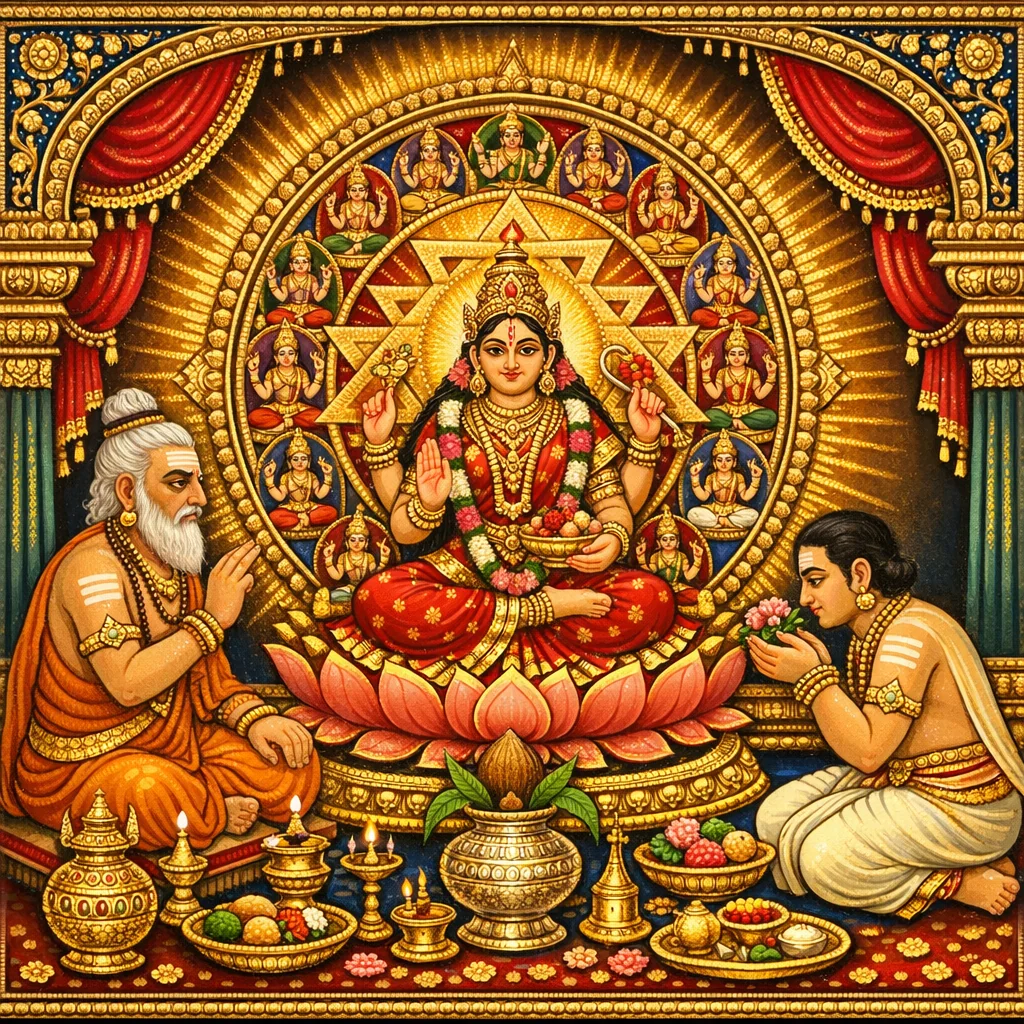
Adhyaya 43
Dīkṣā-bhedaḥ (Types of Initiation) — Lalitopākhyāna: Hayagrīva–Agastya Dialogue
This Adhyāya in the Lalitopākhyāna presents a technical, guru-centered teaching framed by Agastya’s question and Hayagrīva’s orderly reply. Agastya asks what kind of dīkṣā is required for Śrī Devī-darśana (the vision/realization of the Goddess). Hayagrīva classifies initiations and stresses purification and the immediacy of knowledge through the guru’s power: sparśa-dīkṣā (by touch), dṛg-dīkṣā (by sight), śāmbhavī-dīkṣā (a mere glance/word/touch giving instant jñāna), and mānasī-dīkṣā (mental initiation through silent resolve after long service). The chapter then lays out the procedure for kriyā-dīkṣā: choosing auspicious time (śukla-pakṣa, śubha-dina), preparing bodily and verbal purity, observing sandhyā, seclusion, regulated diet and silence, and performing formal pūjā with standard upacāras. The rite culminates in offering puṣpāñjali with the sahasrākṣarī-vidyā (a long mantra to Tripurasundarī and the deities of the Śrīcakra), declaring that omission makes worship fruitless, thus uniting mantra, authority, and ritual efficacy in Purāṇic fashion.
Shlokas
Verse 1
इति श्रीब्रह्माण्डमहापुराणे उत्तरभागे ललितोपाख्याने हयग्रीवागस्त्यसम्वादे द्वाचत्वारिंशो ऽध्यायः अगस्त्य उवाच अश्वानन महाप्राज्ञ करुणामृतवारिधे / श्रीदेवीदर्शने दीक्षा यादृशी तां निवेदय
Thus, in the Śrī Brahmāṇḍa Mahāpurāṇa, in the latter section, in the Lalitā-upākhyāna, in the dialogue of Hayagrīva and Agastya, the forty-second chapter. Agastya spoke: “O Aśvānana, great sage, ocean of compassion’s amṛta, declare to me what manner of dīkṣā leads to the darśana of Śrī Devī.”
Verse 2
हयग्रीव उवाच यदि ते देवताभावो यया कल्मषकर्दमाः / क्षाल्यन्ते च तथा पुसां दीक्षामाचक्ष्महे ऽत्र ताम्
Hayagrīva said: If you seek the state of the Devas, by which the mire of sinful taint is washed away from men, then here we shall declare that dīkṣā, the sacred initiation.
Verse 3
हस्ते शिवपुरन्ध्यात्वा जपेन्मूलाङ्गमालिनीम् / गुरुः स्पृशेच्छिष्यतनुं स्पर्शदीक्षेयमीरिता
Holding the hand and meditating on Śiva as the Divine Consort, one should repeat in japa the Mūlāṅgamālinī; the guru then touches the disciple’s body—this is declared to be sparśa-dīkṣā, initiation by touch.
Verse 4
निमील्य नयने ध्यात्वा श्रीकामाक्षीं प्रसन्नधीः / सम्यक्पश्येद्गुरुः शिष्यं दृग्दीक्षा सेयमुच्यते
Closing the eyes and meditating on Śrī Kāmākṣī with a tranquil mind, the guru then beholds the disciple rightly and fully—this is called dṛg-dīkṣā, initiation by the gaze.
Verse 5
गुरोरालोकमात्रेण भाषणात्स्पर्शनादपि / सद्यः सञ्जायते ज्ञानं सा दीक्षा शाम्भवी मता
By the guru’s mere glance, by his word, or even by his touch, knowledge (jñāna) arises at once; that initiation is held to be Śāmbhavī-dīkṣā.
Verse 6
देव्या देहो यथा प्रोक्तो गुरुदेहस्तथैव च / तत्प्रसादेन शिष्यो ऽपि तद्रूपः सम्प्रकाशते
As has been declared, such as is the body of the Devī, so indeed is the body of the guru; by her grace the disciple too shines forth, manifesting that very form.
Verse 7
चिरं शुश्रूषया सम्यक्तोषितो देशिकेश्वरः / तूष्णीं संकल्पयेच्छिष्यं सा दीक्षा मानसी मता
When, through long and faithful service, the Lord among teachers is rightly pleased, he silently resolves within to accept the disciple; that is held to be the mental initiation (mānasī dīkṣā).
Verse 8
दीक्षाणामपि सर्वासामियमेवोत्तमोत्तमा / आदौ कुर्यात्क्रियादीक्षां तत्प्रकारः प्रवक्ष्यते
Among all initiations, this alone is the highest of the high. Yet first one should perform the ritual initiation (kriyā-dīkṣā); its procedure will be explained.
Verse 9
शुक्लपक्षे शुभदिने विधाय शुचिमानसम् / जिह्वास्यमलशुद्धिं च कृत्वा स्नात्वा यथाविधि
In the bright fortnight (śukla-pakṣa), on an auspicious day, make the mind pure; cleanse the impurities of tongue and mouth, and bathe according to the prescribed rule.
Verse 10
संध्याकर्म समाप्याथ गुरुदेहं परं स्मरन् / एकान्ते निवसञ्छ्रीमान्मौनी च नियताशनः
Having completed the sandhyā rite, remembering the supreme form of the Guru, let him dwell in solitude—silent, disciplined in food, and endowed with serene dignity.
Verse 11
गुरुश्च तादृशोभूत्वा पूजामन्दिरमाविशेत् / देवीसूक्तेन संयुक्तं विद्यान्यासं समातृकम्
The Guru too, being thus prepared, should enter the hall of worship; then he performs the placement of sacred knowledge-mantras (vidyā-nyāsa), joined with the Devī-sūkta and accompanied by the mātṛkās.
Verse 12
कृत्वा पुरुषसूक्तेन षोडशैरुपचारकैः / आवाहना सने पाद्यमर्ध्यमाचमनं तथा
Having performed the rite with the Puruṣa Sūkta, one should offer the sixteen services of worship: invocation, offering of a seat, water for washing the feet, arghya, and also water for rinsing the mouth.
Verse 13
स्नानं वस्त्रं च भूषा च गन्धः पुष्पं तथैव च / धूपदीपौ च नैवेद्यं ताम्बूलं च प्रदक्षिणा
Then offer the bath, garments and ornaments, fragrance and flowers; and also incense and lamp, naivedya (food offering), tāmbūla (betel), and pradakṣiṇā (circumambulation).
Verse 14
प्रणामश्चेति विख्यातैः प्रीणयेत्त्रिपुरांबिकाम् / अथ पुष्पाञ्जलिं दद्यात्सहस्राक्षरविद्यया
By the well-known acts such as praṇāma (reverent prostration) and the rest, one should gladden Tripurāmbikā; then one should offer a handful of flowers with the Sahasrākṣarī-vidyā (the thousand-syllabled mantra).
Verse 15
ॐ ऐं ह्रीं श्रीं ऐं क्लीं सौः ॐ नमस्त्रिपुरसुन्दरि हृदये देवि शिरोदेवि शिखादेवि कवचदेवि नेत्रदेवि आस्यदेवि कामेश्वरि भगमालिनि नित्यक्लिन्नें भैरुण्डे वह्निवासिनि महावज्रेश्वरि विद्येश्वरि परशिवदूति त्वरिते कुलसुंदरि नित्ये नीलपताके विजये सर्वमङ्गले ज्वालामालिनि चित्रे महानित्ये परमेश्वरि मन्त्रेशमयि षष्ठीशमय्युद्यानमयि लोपामुद्रामय्यगस्त्यमयि कालतापनमयि धर्माचारमयि मुक्तके शीश्वरमयि दीपकलानाथमयि विष्णुदेवमयि प्रभाकरदेवमयि तेजोदेवमयि मनोजदेवमयि अणिमसिद्धे महिमसिद्धे गरिम सिद्धे लघिमसिद्धे ईशित्वसिद्धे वशित्वसिद्धे प्राप्तिसिद्धे प्राकाम्यसिद्धे रससिद्धे मोक्षसिद्धे ब्राह्मि माहेश्वरी कौमारि वैष्णवि वाराहि इन्द्राणि चामुण्डे महालक्ष्मि सर्वसंक्षोभिणि सर्वविद्राविणि सर्वाकर्षिणि सर्ववशङ्करि सर्वोन्मादिनि सर्वमहाङ्कुशे सर्वखेचरि सर्वबीजे सर्वयोने सर्वास्त्रखण्डिनि त्रैलोक्यमोहिनि चक्रस्वामिनि प्राटयोगिनि बौद्धदर्शनाङ्गि कामाकर्षिणि बुद्ध्याकर्षिणि अहङ्काराकर्षिणि शब्दाकर्षिणि स्पर्शाकर्षिणि रूपाकर्षिणि रसाकर्षिणि गन्धाकर्षिणि चित्ताकर्षिणि धैर्याकर्षिणि स्मृत्याकर्षिणि नामाकर्षिणि बीजाकर्षिणात्माकिर्षिणि अमृताकर्षिणि शरीराकर्षिणि गुप्तयोगिनि सर्वाशापरिपूरकचक्रस्वामिनि अनङ्गकुसुमे अनङ्गमेखले अनङ्गमादिनि अनङ्गमदनातुरे ऽनङ्गरेखे ऽनङ्गवेगिन्यनङ्गाङ्कुशे ऽनङ्गमालिनि गुप्ततरयोगिनि वैदिकदर्शनाङ्गि सर्वसंक्षोभकारक चक्रस्वामिनि पूर्वाम्नायाधिदेवते सृष्टिरूपे सर्वसंक्षोभिणि सर्वविद्राविणि सर्वाकर्षिणि सर्वाह्लादिनि सर्वसंमोहिनि सर्वस्तंभिणि सर्वजृंभिणि सर्ववशङ्करि सर्वरञ्जिनि सर्वोन्मादिनि सर्वार्थसाधिके सर्वसंपत्प्रपूरिणि सर्वमन्त्रमयि सर्वद्वन्द्वक्षयकरि सम्प्रदाययोगिनि सौरदर्शनाङ्गि सर्वसौभाग्यदायकचक्रे सर्वसिद्धिप्रदे सर्वसम्पत्प्रदे सर्वप्रियङ्करि सर्वमङ्गलकारिणि सर्वकामप्रदे सर्वदुःखविमोचिनि सर्वमृत्युप्रशमिनि सर्वविघ्ननिवारिणि सर्वाङ्गसुन्दरि सर्वसौभाग्यदायिनि कुलोत्तीर्णयोगिनि सर्वार्थसाधकचक्रेशि सर्वज्ञे सर्वशक्ते सर्वैश्वर्यफलप्रदे सर्वज्ञानमयि सर्वव्याधिनिवारिणि सर्वाधारस्वरूपे सर्वपापहरे सर्वानन्दमयि सर्वरक्षास्वरूपिणि सर्वेप्सित फलप्रदे नियोगिनि वैष्णवदर्शनाङ्गि सर्वरक्षाकरचक्रस्थे दक्षिणाम्नायेशि स्थितिरूपे वशिनि कामेशि मोदिनि विमले अरुणे जयिनि सर्वेश्वरि कौलिनि रहस्ययोगिनि रहस्यभोगिनि रहस्यगोपिनि शाक्तदर्शनाङ्गि सर्वरोगहरचक्रेशि पश्चिमाम्नाये धनुर्बाणपाशाङ्कुशदेवते कामेशि वज्रेशि फगमालिनि अतिरहस्ययोगिनि शैवदर्शनाङ्गि सर्वसिद्धिप्रदचक्रगे उत्तराम्नायेशि संहाररूपे शुद्धपरे विन्दुपीठगते महारात्रिपुरसुन्दरि परापरातिरहस्ययोगिनि शांभवदर्शनाङ्गि सर्वानन्दमयचक्रेशि त्रिपुरसुंदरि त्रिपुरवासिनि त्रिपुरश्रीः त्रिपुरमालिनि त्रिपुरसिद्धे त्रिपुरांब सर्वचक्रस्थे अनुत्तराम्नायाख्यस्वरूपे महात्रिपुरभैरवि चतुर्विधगुणरूपे कुले अकुले कुलाकुले महाकौलिनि सर्वोत्तरे सर्वदर्शनाङ्गि नवासनस्थिते नवाक्षरि नवमिथुनाकृते महेशमाधवविधातृमन्मथस्कन्दनन्दीन्द्रमनुचन्द्रकुबेरागस्त्यदुर्वासःक्रोधभट्टारकविद्यात्मिके कल्याणतत्त्वत्रयरूपे शिवशिवात्मिके पूर्मब्रह्मशक्ते महापरमेश्वरि महात्रिपुरसुन्दरि तव श्रीपादुकां पूजयामि नमः / क एं ईल ह्रीं हस कहल ह्रीं ऐं क्लीं सौः सौः क्लीं ऐं श्रीं / देव्याः पुष्पाञ्जलिं दद्यात्सहस्राक्षरविद्याया / नोचेत्तत्पूजनं व्यर्थमित्याहुर्वेदवादिनः
With the great mantra beginning “Oṃ aiṃ hrīṃ śrīṃ aiṃ klīṃ sauḥ…”, one should worship Śrī Tripurasundarī by Her many divine names; then offer a handful of flowers according to the Sahasrākṣarī-vidyā. Otherwise, say the expounders of the Veda, that worship is in vain.
Verse 16
ततो गोमयसंलिप्ते भूतले द्रोणशालिभिः / तावद्भिस्तण्डुलैः शुद्धैः शस्तार्णैस्तत्र नूतनम्
Then, upon the ground smeared with cow-dung, one should place rice in the measure of a droṇa; and with an equal amount of pure, well-chosen grains, prepare there what is new.
Verse 17
द्रोणोदपूरितं कुंभं पञ्चरत्नैर्नवैर्युतम् / न्यग्रोधाश्वत्थमाकन्दजंबूदुम्बरशाखिनाम्
Fill the sacred kumbha with water to the measure of a droṇa, and place within it the five jewels with fresh offerings; adorn it with branches of nyagrodha, aśvattha, ākanda, jambu, and udumbara.
Verse 18
त्वग्भिश्च पल्लवैश्चैव प्रक्षिप्तैरधिवासिनम् / कुम्भाग्रे निक्षिपेत्पक्वं नारिकेलफलं शुभम्
With bark and tender shoots cast in for adhi-vāsana (ritual sanctifying and perfuming), place upon the mouth of the kumbha a ripe, auspicious coconut.
Verse 19
अभ्यर्च्य गन्धपुष्पाद्यैर्धूपदीपादि दर्शयेत् / श्रीचिन्तामणिमन्त्रं तु हृदि मातृकमाजपेत्
Having worshiped with fragrance, flowers, and other offerings, present incense and the sacred lamp; then, within the heart, softly perform japa of the Śrī Cintāmaṇi mantra together with the Mātṛkā.
Verse 20
कुम्भ स्पृशञ्छ्रीकामाप्तिरूपीकृतकलेवरम् / अष्टोत्तरशते जाते पुनर्दीपं प्रदर्शयेत्
By touching the kumbha, the body is fashioned into the form of Śrī—prosperity—and the fulfillment of desire; when the one hundred and eight recitations are complete, show the lamp once more.
Verse 21
शिष्यमाहूय रहसि वाससा बद्धलोचनम् / कारयित्वा प्रणामानां साष्टाङ्गानां त्रयं गुरुः
The guru summons the disciple in secrecy and binds his eyes with a cloth; then he has him perform three sāṣṭāṅga praṇāmas—full prostrations of eight limbs.
Verse 22
पुष्पाणि तत्करे दत्त्वा कारये त्कुसुमाञ्जलिम् / श्रीनाथकरुणाराशे परञ्ज्योतिर्मयेश्वरि
Placing the flowers into His hand, let one offer a floral anjali; O Śrīnātha, ocean of compassion, O Īśvarī, formed of the Supreme Light.
Verse 23
प्रसूनाञ्जलिरेषा ते निक्षिप्ता चरणांबुजे / परं धाम परं ब्रह्म मम त्वं परदेवता
This anjali of flowers I have laid upon the lotus of Your feet; You are the Supreme Abode, the Supreme Brahman—You are my highest Deity.
Verse 24
अद्यप्रभृति मे पुत्रान्रक्ष मां शारणागतम् / इत्युक्त्वा गुरुपादाव्जे शिष्यो मूर्ध्नि विधारयेत्
From this day forth, protect me and my sons; I have come seeking refuge. Having said so, the disciple should place upon his head the lotus-feet of the Guru.
Verse 25
जन्मान्तर सुकृतत्वं स्यान्न्यस्ते शिरसि पादुके / गुरुणा कमलासनमुरशासनपुरशासनसेवया लब्धे
When the Guru’s pādukā, set upon one’s head, it is the merit of former births. Such merit was gained by the Guru through devoted service to Brahmā upon the lotus-seat and to Viṣṇu, Lord of cities and palaces.
Verse 26
इत्युक्त्वा भक्तिभरितः पुनरुत्थाय शान्तिमान् / वामपार्श्वे गुरोस्तिष्ठेदमानी विनयान्वितः
Having spoken thus, filled with devotion, he rose again, serene; and stood at the Guru’s left side, free of pride, endowed with humility and discipline.
Verse 27
ततस्तुंबीजलैः प्रोक्ष्य वामभागे निवेदयेत् / विमुच्य नेत्रबन्धं तु दर्शयेदर्चनक्रमम्
Then, sprinkling with the water of the tumbi fruit for purification, let him offer the naivedya on the left side; thereafter, loosening the band over the eyes, let him reveal the proper order of worship (arcana).
Verse 28
सितामध्वाज्यकदलीफलपायसरूपकम् / महात्रिपुरसुन्दर्या नैवेद्यमिति चादिशेत्
Let there be prepared white sugar, honey, ghee, banana fruit, and payasa (milk-rice), along with the proper delicacies; and let it be declared: “This is the naivedya for Mahātripurasundarī.”
Verse 29
षोडशर्णमनुं तस्य वदेद्वामश्रुतौ शनैः / ततो बहिर्विनिर्गत्य स्थाप्य दार्वासने शुचिम्
Let him softly speak her sixteen-syllabled mantra into the left ear; then, going outside, let him seat the purified disciple upon a wooden āsana.
Verse 30
निवेश्य प्राङ्मुखं तत्र पट्टवस्त्रसमास्तृते / शिष्यं श्रीकुम्भसलिलैरभिषिञ्चेत्समन्त्रकम्
Seating the disciple there facing east upon the spread silk cloth, let him perform the abhiṣeka with the water of the auspicious śrīkumbha, together with mantras.
Verse 31
पुनः शुद्धोदकैः स्नात्वा वाससी परिगृह्य च / अष्टोत्तरशतं मन्त्रं जप्त्वा निद्रामथाविशेत्
Then, bathing again with pure water and donning his garments, having recited the mantra one hundred and eight times, let him thereafter enter into sleep.
Verse 32
शुभे दृष्टे सति स्वप्ने पुण्यं योज्यं तदोत्तमम् / दुःस्वप्ने तु जपं कुर्यादष्टोत्तरसहस्रकम्
If an auspicious vision is seen in a dream, one should add to one’s merit; that is the highest good. But if a bad dream occurs, one should perform japa one thousand and eight times.
Verse 33
कारयेत्त्रिपुरांबायाः सपर्यां मुक्तमार्गतः / यदा न दृष्टः स्वप्नो ऽपि तदा सिद्धिश्चिराद्भवेत्
Let the worshipful service (saparyā) of Mother Tripurāmbā be performed in accord with the path of liberation. When not even a dream is seen, then accomplishment (siddhi) arises only after a long time.
Verse 34
स्वीकुर्यात्परया भक्त्या देवी शेष कलाधिकम् / सद्य एव स शिष्यः स्यात्पङ्क्तिपावनपावनः
The Goddess, through supreme devotion, accepts what remains beyond the allotted portion. At once that disciple becomes pure—purifier of the line, purifier even of the purifiers.
Verse 35
शरीरमर्थं प्राणं च तस्मै श्रीगुरवे दिशेत् / तदधीनश्च रेन्नित्यं तद्वाक्यं नैव लघयेत्
Offer to that Śrī Guru one’s body, wealth, and very life-breath. Ever dependent on him each day, one should never make light of his word.
Verse 36
यः प्रसन्नः क्षणार्धेन मोक्षलक्ष्मीं प्रयच्छति / दुर्लभं तं विजानीयाद्गुरुं संसारतारकम्
He who, pleased in but half a moment, bestows the Lakṣmī of liberation—know that guru to be rare indeed, the one who ferries beings across saṃsāra.
Verse 37
गुकारस्यान्धकारोर्ऽथो रुकारस्तन्निरोधकः / अन्धकारनिरोधित्वाद्गुरुरित्यभिधीयते
The syllable “gu” signifies darkness; the syllable “ru” is that which restrains it. Because he dispels darkness (ignorance), he is called “Guru”.
Verse 38
बोधरूपं गुरुं प्राप्य न गुर्वन्तरमादिशेत् / गुरुक्तं परुषं वाक्यमाशिषं परिचिन्तयेत्
Having attained the Guru, who is the very form of awakening, one should not point to another teacher. Even the Guru’s harsh words should be contemplated as a blessing.
Verse 39
लौकिकं वैदिकं वापि तथाध्यात्मिकमेव च / आददीत ततो ज्ञानं पूर्वं तमभिवादयेत्
Whether worldly, Vedic, or truly spiritual, one should receive knowledge from him. And before taking that knowledge, one should first bow and pay reverence to the Guru.
Verse 40
एवं दीक्षात्रयं कृत्वा विधेयं बौधयेत्पुनः / गुरुभक्तिस्सदाचारस्तद्द्रोहस्तत्र पातकम्
Thus, having performed the threefold initiation (dīkṣā), one should again be instructed in what must be done. Devotion to the Guru and right conduct are ever to be upheld; betrayal of him is a grave sin.
Verse 41
तत्पदस्मरणं मुक्तिर्यावद्देहमयं क्रमः / यत्पापं समवाप्नोति गुर्वग्रे ऽनृतभाषणत्
Remembrance of his sacred feet is liberation, step by step, for as long as one dwells in this embodied course. And the sin one incurs is to speak falsehood in the Guru’s presence.
Verse 42
गोब्राह्मणावधं कृत्वा न तत्पापं समाश्रयेत् / ब्रह्मादिस्तंब पर्यतं यस्य मे गुरुसंततिः
Even if one has slain a cow and a Brahmin, that sin does not cling to him who bears my lineage of Gurus, extending from Brahmā down to the very blade of grass.
Verse 43
तस्य मे सर्वपूज्यस्य को न पूज्यो महीतले / इति सर्वानुकूलो यः स शिष्यः परिकीर्तितः
For one who worships me, the one worthy of all worship, who on this earth would not be worthy of reverence? He who is thus harmonious and favorable to all is called a disciple.
Verse 44
शीलादिविमलानेकगुणसंपन्नभावनः / गुरुशासनवर्तित्वाच्छिष्य इत्यभिधीयते
He whose nature is endowed with many stainless virtues—good conduct and the like—and who abides by the Guru’s injunctions is called a disciple.
Verse 45
जपाच्छ्रान्तः पुनर्ध्यायेद्ध्यानाच्छ्रान्तः पुनर्जपेत् / जपध्यानादियुक्तस्य क्षिप्रं मन्त्रः प्रसिध्यति
Wearied by japa, one should meditate again; wearied by meditation, one should take up japa again. For one joined to japa and dhyāna, the mantra swiftly attains accomplishment.
Verse 46
यथा ध्यानस्य सामर्थ्यात्कीटो ऽपि भ्रमरायते / तथा समाधिसा मर्थ्याद्ब्रह्मीभूतो भवेन्नरः
Just as by the power of dhyāna even a worm becomes as a bee, so by the power of samādhi a man becomes brahmī-bhūta—transformed into oneness with Brahman.
Verse 47
यथा निलीयते काले प्रपञ्चो नैव दृश्यते / तथैव मीलयेन्नेत्रे एतद्ध्यानस्य लक्षणम्
As when, in time’s concealment, the manifold world is no longer seen, so too one should close the eyes—this is the mark of dhyāna.
Verse 48
विदिते तु परे तत्त्वे वर्णातीते ह्यविक्रिये / किङ्करत्वं च गच्छन्ति मन्त्रा मन्त्राधिपैः सह
When the supreme Tattva is known—beyond letters and varṇa, and unchanging—then the mantras, together with the lords of mantra, enter the state of service.
Verse 49
आत्मैक्यभावनिष्ठस्य या चेष्टा सा तु दर्शनम् / योगस्तपः स तन्मन्त्रस्तद्धनं यन्निरीक्षणम्
For one steadfast in the contemplation of the Self’s oneness, whatever activity arises is darśana; that is yoga, that is tapas, that is his mantra; his wealth is that very seeing.
Verse 50
देहाभिमाने गलिते विज्ञाते परमात्मनि / यत्रयत्र मनो याति तत्रतत्र समाधयः
When identification with the body has fallen away and the Paramātman is known, wherever the mind goes, there and there is samādhi.
Verse 51
यः पश्येत्सर्वगं शांमानन्दात्मानमद्वयम् / न तस्य किञ्चिदाप्तव्यं ज्ञातव्यं वावशिष्यते
One who beholds the all-pervading, tranquil Ātman—bliss itself, non-dual—has nothing left to attain, and nothing remains to be known.
Verse 52
पूजाकोटिसमं स्तोत्रं स्तोत्रकोटिसमोजपः / जपकोटिसमं ध्यानं ध्यानकोटिसमो लयः
A million acts of worship equal one sacred hymn; a million hymns equal one japa, the mantra’s repetition. A million japas equal one dhyāna, meditation; a million meditations equal laya, dissolution into the Divine.
Verse 53
देहो देवालयः प्रोक्तो जीव एव महेश्वरः / त्यजेदज्ञाननिर्माल्यं सोहंभावेन योजयेत्
The body is declared to be a devālaya, a temple of the Devas; the jīva itself is Maheśvara. Cast away the garland of ignorance and unite through the feeling “so’ham”—“I am He”.
Verse 54
तुषेण बद्धो व्रीहिः स्यात्तुषाभावे तु तण्डुलः / पाशबद्धः स्मृतो जीवः पाशमुक्तो महेश्वरः
Rice bound by its husk is called vrīhi; when the husk is absent, it is taṇḍula, pure grain. The jīva is remembered as bound by the pāśa, the noose; freed from the pāśa, it is Maheśvara.
Verse 55
आकाशे पक्षिजातीनां जलेषु जलचारिणाम् / यथा गतिर्न दृश्येत महावृत्तं महात्मनाम्
As the course of birds in the sky and of water-creatures in the waters leaves no visible track, so the great conduct (mahāvṛtta) of the great-souled is not easily seen.
Verse 56
नित्यार्चनं दिवा कुर्याद्रात्रौ नैमित्तिकार्चनम् / उभयोः काम्यकर्मा स्यादिति शास्त्रस्य निश्चयः
By day one should perform nityārcana, the daily worship; by night, naimittikārcana, worship done on special occasions. If one does both with desire for reward, it becomes kāmya-karma; such is the śāstra’s settled conclusion.
Verse 57
कोटिकोटिमहादानात्कोटिकोटिमहाव्रतात् / कोटिकोटिमहायज्ञात्परा श्रीपादुका स्मृतिः
Higher than countless great gifts, countless great vows, and countless great sacrifices is the supreme remembrance of the Śrīpādukā—the holy sandals of the Lord’s feet.
Verse 58
ज्ञानतो ऽज्ञानतो वापि यावद्देहस्य धारणम् / तावद्वर्णाश्रमाचारः कर्तव्यः कर्ममुक्तये
Whether knowingly or unknowingly, so long as one bears this body, one should observe the duties of varṇa and āśrama, for release from karma.
Verse 59
निर्गतं यद्गुरोर्वक्त्रात्सर्वं शास्त्रं तदुच्यते / निषिद्धमपि तत्कुर्याद्गुर्वाज्ञां नैव लङ्घयेत्
Whatever issues from the Guru’s mouth is called the whole of Śāstra. Even if it be something forbidden, one should do it; one must never transgress the Guru’s command.
Verse 60
जातिविद्याधनाढ्यो वा दूरे दृष्ट्वा गुरुं मुदा / दण्डप्रमाणं कृत्वैकं त्रिः प्रदक्षिणामाचरेत्
Whether noble by birth, learned, or wealthy, on joyfully seeing the Guru from afar, one should stand straight like a staff and perform pradakṣiṇā three times.
Verse 61
गुरुबुद्ध्या नमेत्सर्वं दैवतं तृणमेव वा / प्रणमेद्देवबुद्ध्या तु प्रतिमां लोहमृन्मयीम्
With the understanding of the Guru, one should bow to all—be it a deity or even a blade of grass. But with the understanding of Deva, one should bow to an image (pratimā) made of metal or clay.
Verse 62
गुरुं हुङ्कृत्य तुङ्कृत्य विप्रं वादैर्विजित्य च / विकास्य गुह्यशास्त्राणि भवन्ति ब्रह्मराक्षसाः
He who cries “huṃ” and “tuṃ” at the Guru, defeats a brāhmaṇa by disputation, and lays open the secret śāstras—such a one becomes a Brahma-rākṣasa.
Verse 63
अद्वैतं भाव येन्नित्यं नाद्वैतं गुरुणा सह / न निन्देदन्यसमयान्वेदशास्त्रागमादिकान्
Let one ever abide in the contemplation of Advaita; yet one should not assume “non-duality” in one’s conduct toward the Guru. Nor should one revile other paths, or the Vedas, Śāstras, Āgamas, and the like.
Verse 64
एकग्रामस्थितः शिष्यस्त्रिसंध्यं प्रणमेद्गुरुम् / क्रोश मात्रस्थितो भक्त्या गुरुं प्रतिदिनं नमेत्
A disciple dwelling in the same village should bow to the Guru at the three sandhyā times. One who lives but a krośa away should, with devotion, salute the Guru each day.
Verse 65
अर्थयोजनगः शिष्यः प्रणमेत्पञ्चपर्वसु / एकयोजनमारभ्य योजनद्वादशावधि
A disciple at a distance of half a yojana should bow to the Guru on the five parva days—this rule applying for distances from one yojana up to twelve yojanas.
Verse 66
तत्तद्योजनसंख्यातमासेषु प्रणमेद्गुरुम् / अतिदूरस्थितः शिष्यो यदेच्छा स्यात्तदा व्रजेत्
According to the number of yojanas, in the corresponding months one should bow to the Guru. A disciple who is exceedingly far away should go to him whenever the wish to do so arises.
Verse 67
रिक्तपाणिस्तु नोपेयाद्राजानं देवतां गुरुम् / फलपुष्पांबरादीनि यथाशक्ति समर्पयेत्
One should not approach a king, a deity, or a guru with empty hands; according to one’s ability, one should offer fruits, flowers, garments, and the like.
Verse 68
मनुष्यचर्मणा बद्धः साक्षात्परशिवः स्वयम् / सच्छिष्यानुग्रहार्थाय गूढं पर्यटति क्षितौ
Paraśiva himself, as though bound in human skin, wanders the earth in secret, for the sake of bestowing grace upon worthy disciples.
Verse 70
सद्भक्तरक्षणायैव निराकारो ऽपि साकृतिः / शिवः कृपानिधिर्लोके संसारीव हि चेष्टते // ब्न्द्प्३,४३।६९ / अत्रिनेत्रः शिवः साक्षादचतुर्बाहुरच्युतः / अचतुर्वदनो ब्रह्मा श्रीगुरुः परिकीर्तितः
To protect true devotees, though formless, Śiva assumes a form; Śiva, a treasury of compassion, moves in this world as though a being bound to saṃsāra. The three-eyed one is Śiva; Acyuta is not four-armed; Brahmā is not four-faced—thus is the venerable Śrī Guru proclaimed.
Verse 71
श्रीगुरुं परतत्त्वाख्यं तिष्ठन्तं चक्षुरग्रतः / भाग्यहीना न पश्यन्ति सूर्यमन्धा इवोदितम्
Śrī Guru, known as the Supreme Reality, stands before one’s very eyes; yet the fortune-less do not behold him, like the blind who cannot see the risen sun.
Verse 72
उत्तमा तत्त्वचिन्ता स्याज्जपचिन्ता तु मध्यमा / अधमा शास्त्रचिन्ता स्याल्लोकचिन्ताधमाधमा
Supreme is contemplation upon tattva (the true principle); middling is contemplation upon japa (sacred repetition); inferior is preoccupation with śāstra alone; and lowest of the low is anxiety over worldly matters.
Verse 73
नास्थि गुर्वधिकं तत्त्वं नास्ति ज्ञानाधिकं सुखम् / नास्ति भक्त्यधिका पूजा न हि मोक्षाधिकं फलम्
There is no truth higher than the Guru; no joy higher than knowledge. There is no worship greater than bhakti; nor any fruit higher than moksha, liberation.
Verse 74
सर्ववेदेषु शास्त्रेषु ब्रह्मविष्णुशिवादिषु / तत्र तत्रोच्यते शब्दैः श्रीकामाक्षी परात्परा
In all the Vedas and śāstras, in Brahmā, Viṣṇu, Śiva and the rest, it is spoken of again and again in words: Śrī Kāmākṣī is the Supreme beyond the supreme.
Verse 75
शचीन्द्रौ स्वाहाग्नी च प्रभारवी / लक्ष्मीनारायणौ वाणीधातारौ गिरिजाशिवौ
Śacī and Indra; Svāhā and Agni; Prabhā and Ravi; Lakṣmī and Nārāyaṇa; Vāṇī and Dhātā; Girijā and Śiva.
Verse 76
अग्नीषोमौ बिन्दुनादौ तथा प्रकृतिपूरुषौ / आधाराधेयनामानौ भोगमोक्षौ तथैव च
Agni and Soma; Bindu and Nāda; Prakṛti and Puruṣa; named Ādhāra and Ādheya; and likewise Bhoga, enjoyment, and Mokṣa, liberation.
Verse 77
प्राणापनौ च शब्दार्थौं तथा विधिनिषेधकौ / सुखदुःखादि यद्द्वन्द्वं दृश्यते श्रूयते ऽपि वा
Prāṇa and Apāna; word and meaning; ordinance and prohibition; and every pair of opposites such as joy and sorrow and the rest—whether seen or even heard.
Verse 78
सर्वलोकेषु तत्सर्वं परं ब्रह्म न संशयः / उत्तीर्ममपरं ज्योतिः कामाक्षीनामकं विदुः
In all the worlds, all this indeed is the Supreme Brahman (Para Brahman), without doubt; that unsurpassed, transcendent Light is known by the name Kāmākṣī.
Verse 79
यदेव नित्यं ध्यायन्ति ब्रह्मविष्णुशिवादयः / इत्थं हि शक्तिमार्गे ऽस्मिन्यः पुमानिह वर्तते
That very Reality which Brahmā, Viṣṇu, Śiva and the other gods ever meditate upon—thus indeed is the person who, here, abides on this path of Śakti.
Verse 80
प्रसादभूमिः श्रीदेव्या भुक्तिमुक्त्योः स भाजनम् / अमन्त्रं वा समत्रं वा कामाक्षीमर्चयन्ति ये
Śrī Devī is the ground of grace; such a one becomes a vessel of both bhukti (worldly fulfillment) and mukti (liberation). Those who worship Kāmākṣī, with or without mantra, attain this.
Verse 81
स्त्रियो वैश्याश्च शूद्राश्च ते यान्ति परमां गतिम् / किं पुनः क्षत्त्रिया विप्रा मन्त्रपूर्वं यजन्ति ये
Women, Vaiśyas, and Śūdras too attain the supreme goal; how much more, then, Kṣatriyas and Vipras who worship with mantras duly preceding.
Verse 82
संसारिणो ऽपि ते नूनं विमुक्ता नात्र संशयः / सितामध्वाज्यकदलीफलपायसरूपकम्
Even those who still wander in saṃsāra are surely set free—of this there is no doubt; with offerings of sugar, honey, ghee, bananas, fruits, and payasa (sacred milk-rice).
Verse 83
पञ्चपर्वसु नैवेद्यं सर्वदैव निवेदयेत् / योनार्चयति शक्तो ऽपि स देवीशापमाप्नुयात्
At the five sacred observances, one should ever offer naivedya (food-offering) to all the gods; whoever worships the yoni, though able, shall incur the Goddess’s curse.
Verse 84
अशक्तौ भावनाद्रव्यैरर्चयेन्नित्यमंबिकाम् / गृहस्थस्तु महादेवीं मङ्गलाचारसंयुतः
When one lacks the means, let one worship Ambikā daily with offerings born of devout contemplation; and let the householder revere the Mahādevī, endowed with auspicious conduct.
Verse 85
अर्चयेत महालक्ष्मीमनुकूलाङ्गनासखः / गुरुस्त्रिवारमाचारं कथयेत्कलशोद्भव
Let one worship Mahālakṣmī with a kindly, harmonious heart, as a friend to a virtuous wife; and, O Kalaśodbhava (Born of the Pot), let the guru declare the proper conduct three times.
Verse 86
शिष्यो यदि न गृह्णीया च्छिष्ये पापं गुरोर्न हि / लक्ष्मीनारायणौ वाणीधातारौ गिरिजाशिवौ
If the disciple does not accept (the teaching), the sin rests with the disciple, not with the guru; remember the divine pairs: Lakṣmī and Nārāyaṇa, Vāṇī and Dhātā, Girijā and Śiva.
Verse 87
श्रीगुरुं गुरुपत्नीं च पितरौ चिन्तयेद्धिया / इति सर्वं मया प्रोक्तं समासेन घटोद्भव
With the mind, one should contemplate the venerable guru, the guru’s wife, and one’s parents; thus have I spoken all this in brief, O Ghaṭodbhava (Born of the Pot).
Verse 88
एतावदवधानेन सर्वज्ञो मतिमान्भवेत्
By only this much attentive focus, the wise-minded one becomes as though all-knowing.
Frequently Asked Questions
It differentiates sparśa-dīkṣā (guru’s touch with mantra-japa), dṛg-dīkṣā (guru’s sanctified gaze after meditation), śāmbhavī-dīkṣā (instant knowledge via glance/speech/touch), and mānasī-dīkṣā (silent mental conferment after sustained service), then outlines kriyā-dīkṣā as a formal ritual procedure.
Auspicious timing in śukla-pakṣa, purification of mind and speech, prescribed bathing and sandhyā, seclusion with regulated diet/silence, guru-led entry into the worship space, nyāsa with Vedic sūktas, ṣoḍaśopacāra pūjā, and puṣpāñjali offered with the sahasrākṣarī-vidyā.
It functions as a comprehensive Śākta liturgical address to Tripurasundarī and her cakra-deities, serving both as consecratory speech and as a doctrinal map of Śrīvidyā; the text explicitly stresses that puṣpāñjali without this vidyā makes the worship ineffective.