Adhyaya 28
Gaṇanātha-Parākrama (Episode of Gaṇeśa’s Martial Exploit) — Lalitopākhyāna Battle Continuation
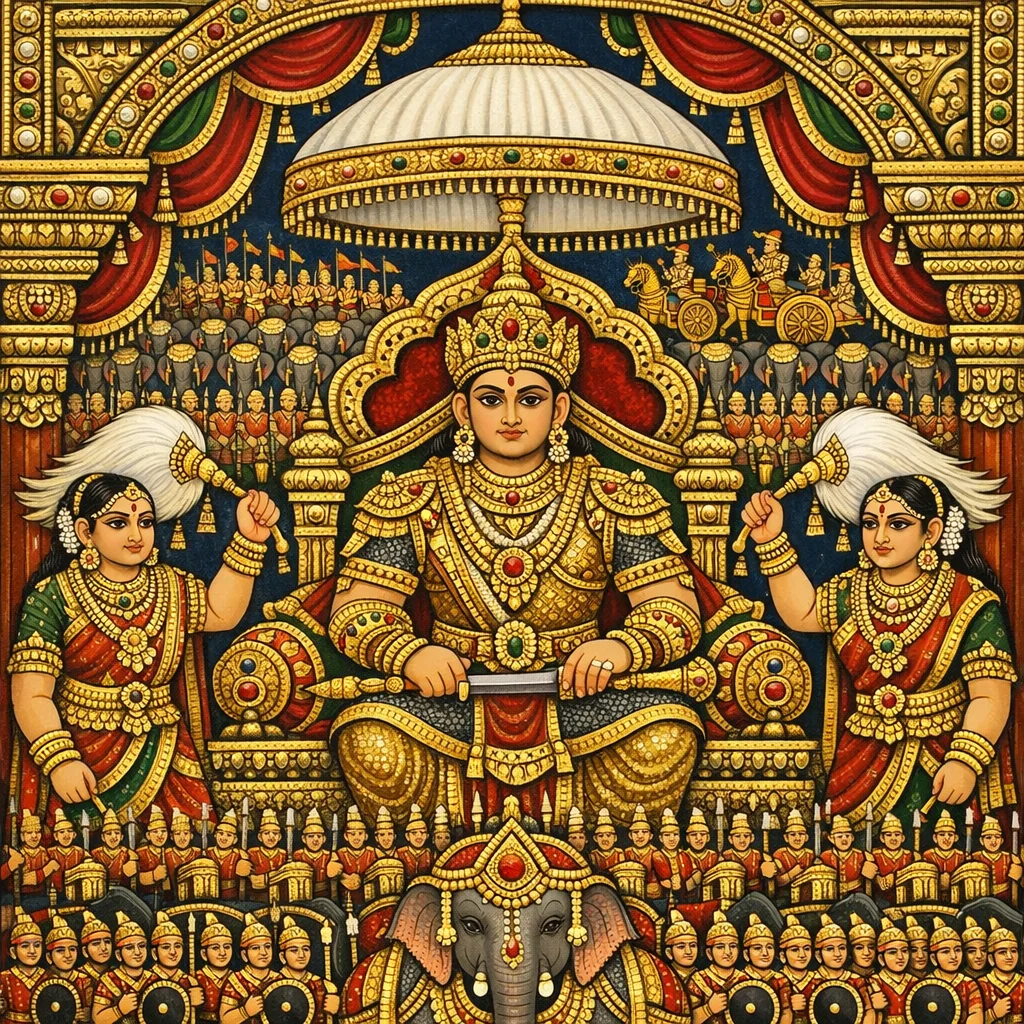
Set within the Lalitopākhyāna frame (the Hayagrīva–Agastya dialogue), this chapter turns to battlefield logistics and the command order on Bhaṇḍāsura’s side. Hearing of reverses and the shattering of a major daitya host, Bhaṇḍa and his brothers/allies mobilize fresh commanders. Two chief antagonists, Viṣaṅga and Viśukra, are sent into action; Viśukra is portrayed as the yuvarāja (crown prince), bearing royal insignia (umbrella, chowries) and surrounded by vast akṣauhiṇī formations. The narrative highlights martial spectacle—war-cries, bow-sounds, lion-roars—as psychological intimidation, and the mustering of allied kin-groups, notably the sons/relatives of the sister Dhūminī, trained in weapons by their maternal uncle Bhaṇḍa. Its purpose is to intensify the conflict and prepare the next encounter, where Devī’s forces (including Gaṇanātha/Gaṇeśa in this cycle) counter these egoic asuric embodiments, upholding the Śākta vision of ordered power overcoming chaotic pride.
Shlokas
Verse 1
इति श्रीब्रह्माण्डपुराणे उत्तरभागे हयग्रीवागस्त्यसंवादे ललितोपाख्याने गणनाथपराक्रमो नाम सप्तविंशो ऽध्यायः रणेभग्नं महादैत्यं भण्डदैत्यः सहोदरम् / सेनानां कदनं श्रुत्वा सन्तप्तो बहुचिन्तया
Thus, in the Śrī Brahmāṇḍa Purāṇa, in the latter section, in the dialogue of Hayagrīva and Agastya, in the sacred tale of Lalitā, is the twenty-seventh chapter called “The Valor of Gaṇanātha.” Hearing that his brother, the mighty Daitya, had been broken in battle, and that the armies had been slaughtered, Bhaṇḍa Daitya burned with anguish, beset by many thoughts.
Verse 2
उभावपि समेतौ तौ युक्तौ सर्वैश्चसैनिकैः / प्रेषयामास युद्धाय भण्डदैत्यः सहोदरौ
Both of them assembled together, joined by all their troops; and Bhaṇḍa Daitya dispatched those two brothers to wage war.
Verse 3
तावुभौ परमक्रुद्धौ भण्डदैत्येन देशितौ / विषङ्गश्च विशुक्रश्च महोद्यम मवापनुः
Both, inflamed with utmost wrath and dispatched by the asura Bhaṇḍa, Viṣaṅga and Viśukra entered upon a mighty and exalted endeavor.
Verse 4
कनिष्ठसहितं तत्र युवराजं महाबलम् / विशुक्रमनुवव्राज सेना त्रैलोक्यकम्पिनी
There the mighty crown prince, together with his youngest brother, was followed by an army that made the three worlds tremble, marching after Viśukra.
Verse 5
अक्षौहिणीचतुःशत्या सेनानामावृतश्च सः / युवराजः प्रववृधे प्रतापेन महीयसा
He was encompassed by four hundred akṣauhiṇī divisions of troops; and that crown prince waxed ever greater through his vast splendor and might.
Verse 6
उलूकजित्प्रभृतयो भागिनेया दशोद्धताः / भण्डस्य च भगिन्यान्तु धूमिन्यां जातयोनयः
Ulūkajit and the rest—ten arrogant nephews—were born of Dhūminī, Bhaṇḍa’s sister, all sprung from the same lineage.
Verse 7
कृतास्त्रशिक्षा भण्डेन मातुलेन महीयसा / विक्रमेण वलन्तस्ते सेनानाथाः प्रतस्थिरे
Trained in the lore of weapons by Bhaṇḍa, their great maternal uncle, those commanders of the host set forth, surging with valor and prowess.
Verse 8
प्रोद्गतैश्चापनिर्घोषैर्घोषयन्तो दिशो दश / द्वयोर्मातुलयोः प्रीतिं भागिनेया वितेनिरे
With rising, thunderous weapon-cries they made the ten directions resound; and the sister’s sons increased the joy of both maternal uncles (mātula).
Verse 9
आरूढयानाः प्रत्येकगाढाहङ्कारशालिनः / आकृष्टगुरुधन्वानो विशुक्रमनुवव्रजुः
Mounting their vehicles, each possessed of stubborn pride, they drew their heavy bows and followed after Viśukra.
Verse 10
यौवराज्यप्रभाचिह्नच्छत्रचामरशोभितः / आरूढवारणः प्राप विशुक्रो युद्धमेदिनीम्
Viśukra, adorned with the royal parasol and chāmara as emblems of the yuvarāja’s splendor, mounted an elephant and reached the battlefield.
Verse 11
ततः कलकलारावकारिण्या सेनया वृतः / विशुक्रः पटु दध्वान सिंहनादं भयङ्करम्
Then, surrounded by an army raising a tumultuous din, Viśukra uttered a sharp and fearsome siṃhanāda—the lion’s roar.
Verse 12
तत्क्षोभात्क्षुभितस्वान्ताः शक्तयः संभ्रमोद्धताः / अग्निप्राकारवलयान्निर्जगमुर्बद्धपङ्कयः
From that upheaval the hearts of the śakti-bearers were shaken, driven up by confusion; and they burst forth from the ring of fiery ramparts like lotuses with tightly closed petals.
Verse 13
तडिन्मयमिवाकाशं कुर्वन्त्यः स्वस्वरोचिषा / रक्ताम्वुजावृतमिव व्योमचक्रं रणोन्मुखाः
By their own radiance they made the sky seem as if wrought of lightning; and the wheel of heaven appeared as though veiled in red lotuses, as they turned toward battle.
Verse 14
अथ भण्डकनीयांसावागतौ युद्धदुर्मदौ / निशम्य युगपद्योद्धं मन्त्रिणीदण्डनायके
Then the two Bhaṇḍakanīyāṃsās arrived, maddened by the arrogance of war; and hearing that Mantriṇī and Daṇḍanāyaka would fight together at once, they stirred for combat.
Verse 15
किरिचकं ज्ञेयचक्रमारूढे रथशेखरम् / धृतातपत्रवलये चामराभ्यां च वीजिते
Upon the chariot’s summit, mounted on the wheel known as Kiricaka, stood the peerless car like a crown; encircled by the royal parasol’s ring and fanned on both sides with two chāmaras.
Verse 16
अप्सरोभिः प्रनृत्ताभिर्गीयमानमहोदये / निर्जगमतू रणं कर्तुमुभाभ्यां ललिताज्ञया
As apsarases danced and the Mahodaya was sung in praise, the two set forth to wage war, by the command of Lalitā.
Verse 17
श्रीचक्ररथराजस्य रक्षणार्थं निवेशिते / शताक्षौहिणिकां सेनां वर्जयित्वास्त्रभीषणम्
For the protection of the king of chariots, the Śrīcakra chariot-lord, an army of a hundred akṣauhiṇīs was stationed—setting aside the dread power of the astras, the divine weapons.
Verse 18
अन्यत्सर्वं चमुजालं निर्जगाम रणोन्मुखी / पुरतः प्राचलद्दण्डनाथा रथनिषेदुषी
All the other hosts likewise marched forth, facing the battle; in the van advanced Daṇḍanāthā, seated upon her chariot.
Verse 19
एकयैव कराङ्गुल्या घूर्णयन्ती हलायुधम् / मुसलं चान्यहस्तेन भ्रामयन्ती मुहुर्मुहुः
With but a single finger of one hand she whirled the Halāyudha; with the other hand she spun the mace again and again.
Verse 20
तरलेन्दुकलाचूडास्फुरत्पोत्रमुखाम्बुजा / पुरः प्रहर्त्री समरे सर्वदा विक्रमोद्धता / अस्या अनुप्रचलिता गेयचक्ररथस्थिता
With a trembling crescent-moon upon her crown and a lotus-face shining bright, she was ever the foremost striker in battle, always uplifted in valor. In her wake her followers moved, stationed upon the chariot with the singing wheels, the geyacakra.
Verse 21
धनुषो ध्वनिना विश्वं पूरयन्ती महोद्धता / वेणीकृतकचन्यस्तविलसच्चन्द्रपल्लवा
With the thunder of her bow she filled the whole world, in mighty ardor. Her hair was braided and bound, adorned with a shining sprig of moonlight.
Verse 22
स्फुरत्त्रितयनेत्रेण सिन्दूरतिलकत्विषा / पाणिना पद्मरम्येण मणिकङ्कणचारुणा
With her radiant third eye and the red splendor of the sindūra tilaka; with a lotus-lovely hand, made fair by a jeweled bracelet.
Verse 23
तूणीरमुखतः कृष्टं भ्रामयन्ती शिलीमुखम् / जय वर्धस्ववर्धस्वेत्यतिहर्षसमाकुले
She drew the arrow from the mouth of the quiver and whirled the sharp shaft about; overwhelmed with rapture she cried, “Victory! Flourish, flourish!”
Verse 24
नृत्यद्भिर्दिव्यमुनिभिर्वर्द्धिताशीर्वचो ऽमृतैः / गेयचक्ररथेन्द्रस्य चक्रनेमिविघट्टनैः
Divine sages danced, swelling the blessings with words sweet as amṛta; and amid the songs rang the clatter of the wheel-rims of the lord of the chakra-chariot striking the spokes.
Verse 25
दारयन्ती क्षितितलं दैत्यानां हृदयैः सह / लोकातिशायिता विश्वमनोमोहनकारिणा / गीतिबन्धेनामरीभिर्बह्वीभिर्गीतवैभवा
She rent the earth’s surface, along with the very hearts of the Daityas; surpassing the worlds by a woven bond of song that bewitched the mind of the universe. Many Amarīs sang in linked strains, displaying the splendor of melody.
Verse 26
अक्षौहिणीसहस्राणामष्टकं समरोद्धतम् / कर्षती कल्पविश्लेषनिर्मर्यादाब्धिसंनिभम्
She dragged along eight thousand akṣauhiṇī hosts, raging in battle—like the boundless ocean when a kalpa breaks apart.
Verse 27
तस्याः शक्तिचमूचक्रे काश्चित्कनकरोचिषः / काश्चिद्दाडिमसंकाशाः काश्चिज्जीमूतरोचिषः
Within the wheel of her Śakti-host, some shone with the radiance of gold; some were red like pomegranate; and some gleamed with the hue of storm-clouds.
Verse 28
अन्याः सिंदूररुचयः पराः पाटलपाटलाः / काचाद्रिकाम्बराः काश्चित्पराः श्यामलकोमलाः
Some shone with the vermilion hue of sindūra; others were rosy, like the pāṭala blossom. Some wore garments like Mount Kācādri; others were dark-greenish, gentle and tender.
Verse 29
अन्यास्तु हीरकप्रख्याः परा गारुत्मतोपमाः / विरुद्धैः पञ्चभिर्बाणैर्मिश्रितैः शतकोटिभिः
Others gleamed like diamonds; others were like gārutmata, the emerald. With five kinds of mutually opposed arrows, they were mingled in hundreds of koṭis beyond count.
Verse 30
व्यञ्जयन्त्यो देहरुचं कतिचिद्विविधायुधाः / असंख्याः शक्तयश्चेलुर्दण्डिन्यास्सैनिके तथा
Some revealed the radiance of their bodies, bearing weapons of many kinds. In that host moved countless śaktis—spears—and likewise daṇḍinīs, soldiers who wielded staves.
Verse 31
तथैव सैन्यसन्नाहो मन्त्रिण्याः कुम्भसम्भव / यथा भूषणवेषादि यथा प्रभावलक्षणम्
O Kumbhasambhava (Agastya), so too was the martial array of the Mantriṇī: as were her ornaments and attire, so were the marks and signs of her radiant power.
Verse 32
यथा सद्गुणशालित्वं यथा चाश्रितलक्षणम् / यथा दैत्यौघसंहारो यथा सर्वैश्च पूजिता
So too was she endowed with noble virtues (sadguṇas) and bore the signs of a refuge for those who seek shelter. So too did she destroy the hosts of the Daityas, and was worshipped by all.
Verse 33
यथा शक्तिर्महाराज्ञ्या देडिन्यश्च तथाखिलम् / विशेषस्तु परं तस्याः साचिव्ये तत्करे स्थितम् / महाराज्ञीवितीर्णं तदाज्ञामुद्राङ्गुलीयकम्
As is the power of the Great Queen, so too was Deḍinī, and so were all things. Yet her highest distinction was the authority of royal counsel resting in her hand—the signet ring of command, the seal of the Queen’s decree bestowed upon her.
Verse 34
इत्थं प्रचलिते सैन्ये मन्त्रिणीदण्डनाथयोः / तद्भारभङ्गुरा भूमिर्देलालीलामलंबत
Thus, when the army surged forth under the authority of the minister-queen and the Daṇḍanātha, the earth—fragile beneath their burden—seemed to sway in a līlā, as though in a play that made it tremble.
Verse 35
ततः प्रववृते युद्धं तुमुलं रोमहर्षणम् / उद्धूतधूलिजंबालीभूतसप्तार्णवीजलम्
Then the battle began—tumultuous and hair-raising. The dust flung up made the waters of the seven oceans seem as though turned to muddy mire.
Verse 36
हयस्थैर्हयसादिन्यो रथस्थै रथसंस्थिताः / आधोरणैर्हस्तिपकाः खड्गैः पद्गाश्च सङ्गताः
Horsemen met horsewomen in combat; chariot-fighters clashed with those upon chariots. Elephant-riders, wielding the ādhoraṇa goad, pressed into the fray, and foot-soldiers joined with swords.
Verse 37
दण्डनाथाविषङ्गेण समयुध्यन्त सङ्गरे / विशुक्रेण समं श्यामा विकृष्टमणिकार्मुका
In the thick of battle the Daṇḍanātha fought in close engagement. Śyāmā, drawing taut her jewel-adorned bow, contended as an equal with Viśukra.
Verse 38
अश्वरूढा चकारोच्चैः सहोलूकजिता रणम् / सम्पदीशाच जग्राह पुरुषेण युयुत्सया
The Goddess, mounted on a horse, raised a fierce battle against Ulūkajitā; then Sampadīśā, eager to fight, seized a man.
Verse 39
विषेण नकुली देवी समाह्वास्त युयुत्सया / कुन्तिषेणेन समरं महामाया तदाकरोत्
The Goddess Nakulī, with the power of poison, issued her challenge in a will to fight; then Mahāmāyā waged battle with Kuntiseṇa.
Verse 40
मलदेन समं चक्रे युद्धमुन्मत्तभैरवी / लघुश्यामा चकारोच्चैः कुशूरेण समं रणम्
Unmattabhairavī fought Malada on equal terms; and Laghuśyāmā raised a fierce battle against Kuśūra.
Verse 41
स्वप्नेशी मङ्गलाख्येन दैत्येन्द्रेण रणंव्यधात् / वाग्वादिनी तु जघटे द्रुघणेन समं रणे
Svapneśī waged war against the Daitya lord named Maṅgala; and Vāgvādinī clashed with Drughaṇa upon the battlefield.
Verse 42
कोलाटेन च दुष्टेन चण्डकाल्यकरोद्रणम् / अक्षौहिणीभिर्दैत्यानां शताक्षौहिणिकास्तथा / महान्तं समरे चक्रुरन्योन्यं क्रोधमूर्छिताः
Caṇḍakālī fought a battle with the wicked Kolāṭa; and the Daityas’ akṣauhiṇī armies—amounting to a hundred akṣauhiṇīs—made the war vast, maddened by wrath as they crashed against one another.
Verse 43
प्रवर्तमाने समरे विशुक्रो दुष्टदानवः / वर्धमानां शक्तिचमूं हीयमानां निजां चमूम्
As the battle raged on, Viśukra, the wicked Dānava, beheld Śakti’s host ever increasing, while his own army waned.
Verse 44
अवलोक्य रुषाविष्टः स कृष्टगुरुकार्मुकः / शक्तिसैन्ये समस्ते ऽपि तृषास्त्रं प्रमुमोच ह
Seeing this, seized by wrath, he drew his heavy, mighty bow; and even against Śakti’s entire army he loosed the Tṛṣāstra, the weapon of thirst.
Verse 45
तेन दावानलज्वालादीप्तेन मथितं बलम् / तृतीये युद्धदिवसे याममात्रं गते रवौ / विशुक्रमुक्ततर्षास्त्रव्याकुलाः शक्तयो ऽवन्
By that weapon, blazing like the flames of a forest fire, the host was churned and shattered. On the third day of battle, when the sun had gone but a single yāma, Śakti’s forces were thrown into turmoil by the thirst-weapon loosed by Viśukra.
Verse 46
क्षोभयन्निन्द्रियग्रामं तालुमूलं विशोषयन् / रूक्षयन्कर्णकुहरमङ्गदौर्वल्यमाहवन्
It agitated the whole array of the senses, dried up the root of the palate, made the ear-cavities harsh and parched, and brought weakness to the limbs in battle.
Verse 47
पातयन्पृथिवीपृष्ठे देहं विस्रंसितायुधम् / आविर्बभूव शक्तीनामतितीव्रस्तृषाज्वरः
It cast their bodies down upon the earth, their weapons slipping from their hands; and among Śakti’s ranks there arose an exceedingly fierce fever of thirst.
Verse 48
युद्धेष्वनुद्यमकृता सर्वोत्साहविरोधिना / तर्षेण तेन क्वथितं शक्तिसैन्यं विलोक्यसा / मन्त्रिणी सह पोत्रिण्या भृशं चिन्तामवाप ह
In the battle she was rendered unable to strive, for the weapon “Tarṣā,” hostile to all ardor, opposed every surge of courage. Seeing the host of Śakti seethed and scorched by that thirst, she, with the woman-minister and the Potriṇī, fell into grievous anxiety.
Verse 49
उवाच तां दण्डनाथामत्याहितविशङ्किनीम् / रथस्थिता रथगता तत्प्रती कारकर्मणे / सखि पोत्रिणि दुष्टस्य तर्षास्त्रमिदमागतम्
Daṇḍanāthā, standing upon the chariot to undertake the work of countering it, spoke to the woman-minister, anxious and suspicious: “Friend Potriṇī, this is the wicked one’s weapon—Tarṣā—now come upon us.”
Verse 50
शिथिलीकुरुते सैन्यमस्माकं हा विधेः क्रमः / विशुष्कतालुमूलानां विभ्रष्टायुधतेजसाम् / शक्तीनां मण्डलेनात्र समरे समुपेक्षितम्
“Alas—such is the sequence of fate! It slackens our army: their palates are parched to the root, and the splendor of their weapons has fallen away. Here in battle, the Śaktis are neglected, hemmed in by that encircling ring.”
Verse 51
न कापि कुरुते युद्धं न धारयति चायुधम् / विशुष्कतालुमूलत्वा द्वक्तुमप्यालि न क्षमाः
“None can wage war, nor can any even bear a weapon. With their palates dried to the root, friend, they are not able even to speak.”
Verse 52
ईदृशीन्नो गतिं श्रुत्वा किं वक्ष्यति महेश्वरी / कृता चापकृतिर्दैत्यैरुपायः प्रविचिन्त्यताम्
“When Maheśvarī hears that we have come to such a plight, what will the Great Goddess say? The Daityas have already wrought their misdeed—let a means be carefully devised.”
Verse 53
सर्वत्र द्व्यष्टसाहस्राक्षौहिण्यमत्र पोत्रिणि / एकापि शक्तिर्नैवास्ति या तर्षेण न पीडिता
Everywhere here are thousands of Akṣauhiṇī armies; yet there is not a single śakti that is not oppressed by thirst.
Verse 54
अत्रैवावसरे दृष्ट्वा मुक्तशस्त्रां पताकिनीम् / रन्ध्रप्रहारिणो हन्त बाणैर्निघ्नन्ति दानवाः
Just then, seeing the banner-bearer who had cast away her weapons, the Dānavas—skilled at striking through gaps—cried out and felled her with arrows.
Verse 55
अत्रोपायस्त्वया कार्यो मया च समरोद्यमे / त्वदीयरथपर्वस्थो यो ऽस्ति शीतमहार्णवः
Here you must devise a means, and I as well as we set the battle in motion; upon a part of your chariot there lies a vast, cold ocean.
Verse 56
तमादिश समस्तानां शक्तीनां तर्षनुत्तये / नाल्पैः पानीयपानाद्यैरेतासां तर्षसंक्षयः
Command that to be brought to relieve the thirst of all the śaktis; by a little drinking water and the like, their thirst will not be exhausted.
Verse 57
स एव मदिरासिंधुः शक्त्यौघं तर्पयिष्यति / तमादिश महात्मानं समरोत्साहकारिणम् / सर्वतर्षप्रशमनं महाबलविवर्धनम्
That very ocean of madirā will satisfy the entire host of śaktis. Command that Mahātman, who kindles the ardor of battle—who quenches every thirst and increases great strength.
Verse 58
इत्युक्ते दण्डनाथा सा सदुपायेन हर्षिता / आजुहाव सुधासिंधुमाज्ञां चक्रेश्वरी रणे
Thus addressed, that Daṇḍanāthā rejoiced in the noble means; and on the battlefield Cakreśvarī summoned the Ocean of Amṛta and issued her sacred command.
Verse 59
स मदालसरक्ताक्षो हेमाभः स्रग्विभूषितः
Drunk with martial ardor, his eyes were reddened; he shone like gold and was adorned with garlands.
Verse 60
प्रणम्य दण्डनाथां तां तदाज्ञापरिपारकः
Bowing to that Daṇḍanāthā, he became the one who perfectly carried out her command.
Verse 61
आत्मानं बहुधा कृत्वा तरुणादित्यपाटलम् / क्वचित्तापिच्छवच्छ्यामं क्वचिच्च धवलद्युतिम्
Making himself manifold, he became at times ruddy like the young sun, at times dark as a crow’s plume, and at times radiant with white splendor.
Verse 62
कोटिशो मधुराधारा करिहस्तसमाकृतीः / ववर्ष सिंधुराजो ऽयं वायुना बहुलीकृतः
This king of oceans, made abundant by the wind, rained down by millions sweet streams, shaped like the trunks of elephants.
Verse 63
पुष्कलावर्तकाद्यैस्तु कलपक्षयबलाहकैः / निषिच्यमानो मध्ये ऽब्धिः शक्तिसैन्ये पपात ह
By mighty clouds such as Puṣkalāvartaka and the rain-clouds of the kalpa’s end, the downpour was poured forth; the ocean in the midst, drenched, fell upon the host of Śakti.
Verse 64
यद्गन्धाघ्राममात्रेण मृत उत्तिष्ठते स्फुटम् / दुर्बलः प्रबलश्च स्यात्तद्ववर्ष सुरांबुधिः
By merely breathing in its fragrance once, the dead rise up plainly; the weak become strong—thus did the ocean of surā rain it down.
Verse 65
परार्द्धसंख्यातीतास्ता मधुधारापरंपराः / प्रपिबन्त्यः पिपासार्तैर्मुखैः शक्तय उत्थिताः
In unbroken succession flowed streams of honey, beyond the count of a parārdha; the Śakti rose and drank them in with mouths tormented by thirst.
Verse 66
यथा सा मदिरासिंधुवृष्टिर्दैत्येषु नो पतेत् / तथा सैन्यस्य परितो महाप्राकारमण्डलम्
So that the rain from that ocean of liquor might not fall upon the Daityas, a vast ring of mighty ramparts was formed around the army.
Verse 67
लघुहस्ततया मुक्तैः शरजातैः सहस्रशः / चकार विस्मयकरी कदंबवनवासिनी
The dweller in the kadamba grove, with swift and light-handed skill, loosed arrows by the thousand, performing a deed that filled all with wonder.
Verse 68
कर्मणा तेन सर्वे ऽपि विस्मिता मरुतो ऽभवन् / अथ ताः शक्तयो भूरि पिबन्ति स्म रणान्तरे
By that deed all the Maruts were filled with wonder. Then those Śakti-spears drank deeply and in abundance amid the battlefield.
Verse 69
विविधा मदिराधारा बलोत्साहविवर्धनीः / यस्या यस्या मनःप्रीती रुचिः स्वादो यथायथा
Many were the streams of madirā, increasing strength and martial ardor. For each one, delight of mind, taste, and sweetness arose exactly as desired.
Verse 70
तृतीये युद्धदिवसे प्रहरद्वितयावधि / संततं मध्यधाराभिः प्रववर्ष सुरांबुधिः
On the third day of battle, for the span of two praharas, the ocean of surā poured forth unceasingly in continuous central streams.
Verse 71
गौडी पैष्टी च माध्वी च वरा कादंबरी तथा / हैताली लाङ्गलेया च तालजातास्तथा सुराः
There were many kinds of surā: Gauḍī, Paiṣṭī, Mādhvī, and the excellent Kādaṃbarī; also Haitālī, Lāṅgaleyā, and surā born of the tāla fruit.
Verse 72
कल्पवृक्षोद्भवा दिव्या नानादेशसमुद्भवाः / सुस्वादुसौरभाद्याश्च शुभगन्धसुखप्रदाः
Born of the divine Kalpavṛkṣa and arising from many lands, they were exquisitely sweet and fragrant, bestowing delight through their auspicious perfume.
Verse 73
बकुलप्रसवामोदा ध्वनन्त्यो बुद्बुदोज्ज्वलाः / कटुकाश्च कषायाश्च मधुरास्तिक्ततास्पृशः
Fragrant with the scent of bakula blossoms, they resounded, bright with shining bubbles; some were pungent and astringent, some sweet, and some touched with a hint of bitterness.
Verse 74
बहुवर्मसमाविष्टाश्छेदिनीः पिच्छलास्तथा / ईषदम्लाश्च कट्वम्ला मधुराम्लास्तथा पराः
Some were wrapped in many layers; some were cutting and sharp, and some were slick and viscous; some were mildly sour, some pungently sour, and others supremely sweet-and-sour.
Verse 75
शस्त्रक्षतरुगाहन्त्री चास्थिसंधानदायिनी / रणभ्रमहरा शीता लघ्व्यस्तद्वत्कवोष्ठकाः
Some dispelled the pain of weapon-wounds and healed deep gashes; some bestowed the joining of bones and joints; some removed the dizziness of battle—cool and light, like the lips of the kavoṣṭhakā.
Verse 76
संतापहारिणीश्चैव वारुणीस्ता जयप्रदाः / नानाविधाः सुराधारा ववर्ष मदिरार्णवः
And there were those that removed the burning of affliction—those vāruṇīs bestowed victory; the ocean of madirā rained down many kinds of surā-streams.
Verse 77
अविच्छिन्नं याममात्रमेकैका तत्र योगिनी / ऐरावतकर प्रख्यां सुराधारां मुदा पपौ
There each yoginī drank joyfully, without pause, for the span of one yāma; and with delight she drank the surā-stream famed as being like the trunk of Airāvata.
Verse 78
उत्तानं वदनं कृत्वा विलोलरसनाश्चलम् / शक्तयः प्रपपुः सीधु मुदा मीलितलोचनाः
The Śaktis, lifting up their faces and opening their mouths wide, their tongues quivering, drank the sīdhu in joy, their eyes gently closed.
Verse 79
इत्थं बहुविधं माध्वीधारापातैः सुधांबुधिः / आगतस्तर्पयित्वा तु दिव्यरूपं समास्थितः
Thus, as manifold streams of mādhvī poured down, the ocean of sudhā arrived; having satisfied them, it then abided in a divine form.
Verse 80
पुनर्गत्वा दण्डनाथां प्रणम्य स सुरांबुधिः / स्निग्धगंभीरघोषेण वाक्यं चेदमुवाच ताम्
Then the ocean of surā returned, bowed to Daṇḍanāthā, and in a gentle, deep voice spoke these words to her.
Verse 81
देवि पश्य महाराज्ञि दण्डमण्डलनायिके / मया संतर्पिता मुग्धरूपा शक्तिवरूथिनी
O Goddess, great queen, mistress of the Daṇḍa-maṇḍala, behold: the host of Śaktis, lovely in form, has been satisfied by me.
Verse 82
काश्चिन्नृत्यन्ति गायन्त्यो कलक्वणितमेखलाः / नृत्यन्तीनां पुरः काश्चित्करतालं वितन्वते
Some danced and sang, their girdles chiming with sweet notes; before the dancers, others spread the rhythm with clapping hands.
Verse 83
काश्चिद्धसंति व्यावल्गद्वल्गुवक्षोजमण्डलाः / पतन्त्यन्योन्यमङ्गेषु काश्चिदानन्दमन्थराः
Some laughed in delight, their lovely rounded breasts quivering; others, slowed by bliss, fell upon one another’s limbs, entwining body with body.
Verse 84
काश्चिद्वल्गन्ति च श्रोणिविगलन्मेखलांबराः / काश्चिदुत्थाय संनद्धा घूर्णयन्ति निरायुधाः
Some leapt and danced, their hip-girdles slipping and garments loosening; others sprang up, braced themselves as if for battle, and whirled about though unarmed.
Verse 85
इत्थं निर्दिश्यमानास्ताः शक्ती मैरेय सिंधुनां / अवलोक्य भृशं तुष्टा दण्डिनी तमुवाच ह
Seeing thus displayed those powers born of Maireya and the ocean of liquor, Dandinī was greatly pleased and spoke to him.
Verse 86
परितुष्टास्मि मद्याब्धे त्वया साह्यमनुष्ठितम् / देवकार्यमिद किञ्च निर्विघ्नितमिदं कृतम्
O ocean of drink, I am well pleased that you have rendered aid; this work of the Devas has been accomplished without hindrance.
Verse 87
अतः परं मत्प्रसादाद्द्वापरे याज्ञिकैर्मखे / सोमपानवदत्यन्तमुपयोज्यो भविष्यसि
Henceforth, by my grace, in the Dvāpara age, in the makha rites performed by the yajña-priests, you shall be employed abundantly, even as Soma is drunk.
Verse 88
मन्त्रेण पूतं त्वां यागे पास्यन्त्यखिलदेवताः / यागेषु मन्त्रपूतेन पीतेन भवता जनाः
Purified by mantra, you shall be drunk in the yajña by all the deities; and in the sacrifices, by drinking you—cleansed by mantra—people shall be blessed.
Verse 89
सिद्धिमृद्धिं बलं स्वर्गमपवर्गं च बिभ्रतु / महेश्वरी महादेवो बलदेवश्च भार्गवः / दत्तात्रेयो विधिर्विष्णुस्त्वां पास्यन्ति महाजनाः
May siddhi, prosperity, strength, heaven, and liberation be upheld. Maheshvarī, Mahādeva, Baladeva and Bhārgava; Dattātreya, Vidhi (Brahmā) and Viṣṇu—the great ones shall drink you in the yajña.
Verse 90
यागे समर्चितस्त्वं तु सर्वसिद्धिं प्रदास्यसि
When you are duly worshiped in the yajña, you will bestow all siddhis, every attainment.
Verse 91
इत्थं वरप्रदानेन तोषयित्वा सुरांबुधिम्
Thus, by granting boons, she pleased Surāmbudhi, the ocean of the devas.
Verse 92
मन्त्रिणीं त्वरयामास पुनर्युद्धाय दण्डिनी / पुनः प्रववृते युद्धं शक्तीनां दानवैः सह
Daṇḍinī urged Mantriṇī to hasten back to battle once more; and again the war broke out between the Śaktis and the Dānavas.
Verse 93
मुदाट्टहासनिर्भिन्नदिगष्टकधरा धरम् / प्रत्यग्रमदिरामत्ताः पाटलीकृतलोचनाः / शक्तयो दैत्यचक्रेषु न्यपतन्नेकहेलया
With laughter lifted in joy, as though rending the eight directions and shaking the earth, the Śaktis—intoxicated with fresh liquor, their eyes reddened like the pātalī blossom—fell upon the Daitya battle-circles with effortless ease in a single rush.
Verse 94
द्वयेन द्वयमारेजे शक्तीनां समदश्रियाम् / मदरागेण चक्षूंषि दैत्यरक्तेन शस्त्रिका
The Śaktis, equal in their intoxication, shone forth arranged two by two, pair set against pair. Their eyes were reddened by the hue of rapture and wine, and their weapons were stained with Daitya blood.
Verse 95
तथा बभूव तुमुलं युद्धं शक्तिसुरद्विषाम् / यथा मृत्युरवित्रस्तः प्रजाः संहरते स्वयम्
Thus arose a tumultuous war between the Śaktis and the haters of the Devas, like Death himself who, unafraid, gathers up beings with his own hand.
Verse 96
संस्खलत्पदविन्यासा मदेनारक्तदृष्टयः / स्खलदक्षरसंदर्भवीरभाषा रणोद्धताः
Their footfalls slipped and staggered as they advanced, their gaze reddened by intoxication; their warrior-speeches on the battlefield stumbled over syllables, yet they remained fierce and exultant in the fray.
Verse 97
कदंबगोलकाकारा दृष्टसर्वाङ्गदृष्टयः / युवराजस्य सैन्यानि शक्त्यः समानाशयन्
The Śaktis, round as kadamba globes and with eyes that seemed to scan every limb, devoured and destroyed the armies of the Yuvarāja, consuming them all alike.
Verse 98
अक्षौहिणीशतं तत्र दण्डिनी सा व्यदारयत् / अक्षौहिणीसार्द्धशत नाशयामास मन्त्रिणी
There, Daṇḍinī tore apart a hundred akṣauhiṇī armies; and Mantriṇī brought to ruin a hundred and fifty akṣauhiṇī.
Verse 99
अश्वारूढाप्रभृतयो मदारुणविलोचनाः / अक्षौहिणीसार्धशतं नित्युरन्तकमन्दिरम्
Horsemen and the rest, their eyes fierce and crimson with the intoxication of battle, sent a hundred and fifty akṣauhiṇī to Antaka’s abode, the house of Death.
Verse 100
अङ्कुशेनातितीक्ष्णेन तुरगा रोहिणी रणे / उलूकजितमुन्मथ्य परलोकातिथिं व्यधात्
In battle, Rohiṇī, mounted upon her steed, wielded an aṅkuśa of surpassing sharpness; crushing Ulūkajit, she made him a guest of the world beyond.
Verse 101
सम्पत्करीप्रभृतयः शक्तिदण्डाधिनायिकाः / परुषेण मुखान्यन्यान्यवरुद्धाव्यदारयन्
Sampatkarī and the rest, commanders bearing śakti-spears and daṇḍa-staves, with harsh force split open the faces of other foes, once they were checked and hemmed in.
Verse 102
अस्तं गते सवितरि ध्वस्तसर्वबलं ततः / विशुक्रं योधयामास श्यामला कोपशालिनी
When the Sun had set and all their might was shattered, then Śyāmalā, filled with wrath, joined battle with Viśukra.
Verse 103
अस्त्रप्रत्य स्त्रमोक्षेण भीषणेन दिवौकसाम् / महता रणकृत्येन योधयामास मन्त्रिणी
The lady minister made war upon the celestials, hurling weapon against weapon in dreadful volleys, and performing a mighty work of battle.
Verse 104
आयुधानि सुतीक्ष्णानि विशुक्रस्य महौजसः / क्रमशः खण्डयन्ती सा केतनं रथसारथिम्
She shattered, one by one, the keen-edged weapons of the mighty Viśukra, and struck down his banner and his charioteer as well.
Verse 105
धनुर्गुणं धनुर्दण्डं खण्डयन्ती शिलीमुखैः / अस्त्रेण ब्रह्मशिरसा ज्वलत्पावकरोचिषा
With Śilīmukha arrows she severed the bowstring and the bowstaff, and then unleashed the Brahmaśiras astra, blazing with the radiance of living fire.
Verse 106
विशुक्रं मर्दयामास सो ऽपतच्छूर्णविग्रहः / विषङ्गं च महादैत्यं दण्डनाथा मदोद्धता
Daṇḍanāthā, swollen with martial pride, crushed Viśukra so that he fell with his body shattered to dust; and she subdued the great Daitya Viṣaṅga as well.
Verse 107
योधयामास चण्डन मुसलेन विनिघ्नती / सचापि दुष्टो दनुजः कालदण्डनिभां गदाम् / उद्यम्य बाहुना युद्धं चकाराशेषभीषणम्
She fought Caṇḍana, striking him down with a musala club; yet that wicked Danuja too, raising with his arm a mace like Kāla’s rod of doom, waged a battle dreadful in every way.
Verse 108
अन्योन्यमङ्गं मृद्नन्तौ गदायुद्धप्रवर्तिनौ / चण्डाट्टहासमुखरौ परिभ्रमणकारिणौ
The two crushed one another’s limbs and set in motion a battle of maces (gadā). With fierce, resounding laughter, they whirled and circled about each other.
Verse 109
कुर्वाणौ विविधांश्चारान्घूर्णन्तौ तूर्मवेष्टिनौ / अन्योन्यदण्डहननैर्मोहयन्तौ मुहुर्मुहुः
They performed many kinds of maneuvers, spinning like a whirlwind and entwining with one another. By striking each other’s staffs, they bewildered one another again and again.
Verse 110
अन्योन्यप्रहृतौ रन्ध्रमीक्षमाणौ महोद्धतौ / महामुसलदण्डाग्रघट्टनक्षोभितांबरौ / अयुध्येतां दुराधर्षौं दण्डिनीदैत्यशेखरौ
They struck each other, watching for a gap in the other, in towering arrogance. The very sky was shaken by the clash of the tips of their great musala-staffs. Thus they fought on—hard to subdue—those two staff-bearing Daitya chieftains.
Verse 111
अथार्द्धरात्रिसमयपर्यन्तं कृतसंगरा / संक्रुद्धा हन्तुमारेभे विषङ्गं दण्डनायिका
Then, after the battle had raged until the hour of midnight, Dandanāyikā, inflamed with wrath, began to move to slay Viṣaṅga.
Verse 112
तं मूर्धनि निमग्नेन हलेनाकृष्य वैरिणम् / कठोरं ताडनं चक्रे मुसलेनाथ पोत्रिणी
She dragged the foe by the hala (plough) sunk into the crown of his head; then Potriṇī dealt a hard blow with the musala, the heavy club.
Verse 113
ततो मुसलघातेन त्यक्तप्राणो महासुरः / चूर्णितेन शताङ्गेन समं भूतलमाश्रयत्
Then, struck by the Musala (pestle), the great Asura gave up his life and fell to the ground along with his shattered chariot.
Verse 114
इति कृत्वा महत्कर्म मन्त्रिणीदण्डनायिके / तत्रैव तं निशा शेषं निन्यतुः शिबिरं प्रति
Having performed this great deed, Mantrini and Dandanayika spent the rest of the night right there in the camp.
Frequently Asked Questions
Bhaṇḍāsura responds to battlefield losses by ordering fresh commanders—especially Viṣaṅga and the yuvarāja Viśukra—into combat, with detailed descriptions of army scale (akṣauhiṇī), insignia, and war-sounds that escalate the conflict.
The frame is the Hayagrīva–Agastya dialogue; this matters because it fixes the transmission context (who narrates to whom), enabling consistent indexing of sub-episodes (like Gaṇanātha-parākrama) inside the larger Brahmāṇḍa Purāṇa.
The royal insignia and massive escort symbolize concentrated asuric authority and pride; narratively, it sets up a theologically charged reversal where Devī’s order (often through Gaṇas/Gaṇanātha) subdues the inflated ego-power embodied by Bhaṇḍa’s commanders.