Adhyaya 23
दुर्मद-कुरण्ड-वधः (The Slaying of Durmada and Kuraṇḍa) — Lalitopākhyāna Battle Continuation
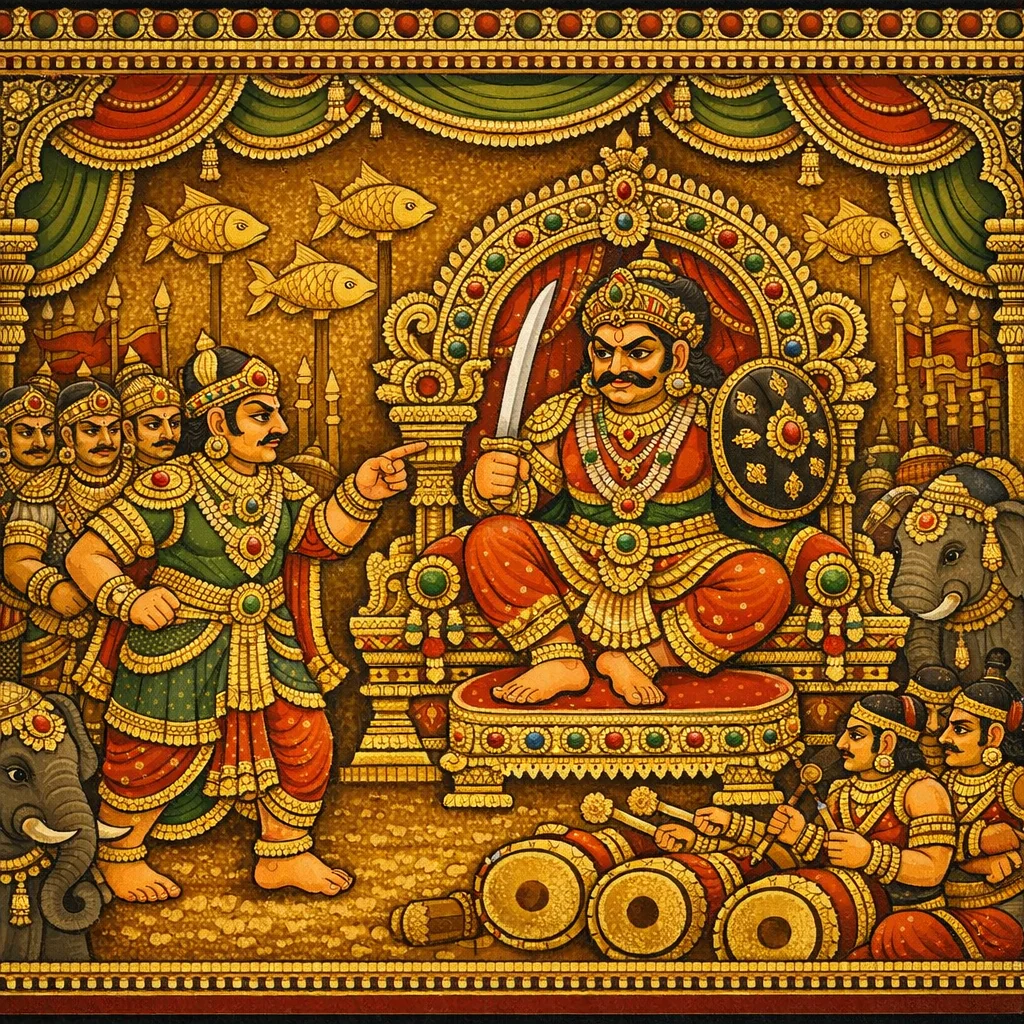
This chapter continues the Lalitopākhyāna war narrative within the Hayagrīva–Agastya dialogue. After Kuraṇḍa is violently driven back by a mounted assault, stunning the Daitya camp, Bhaṇḍa responds with disbelief and escalates his plans: he laments an unprecedented peril, attributes the setback to the extraordinary māyā and power of the “māyāvinī” Lalitā/Śakti, and orders further commanders—beginning with Karaṅka and other leaders—deployed with a vast force described in akṣauhiṇī measure. Kuṭilākṣa, Bhaṇḍa’s agent, summons the chiefs; they march out in wrath, as if entering fire. The mobilization is rendered through battlefield phenomenology and cosmic scale: dust veils the world-disc, banners move like fish in an ocean of dust, and war-sounds shake the quarters and even the diggajas. The chapter thus conveys a universe-spanning conflict while affirming that Śakti’s agency overturns Daitya expectations.
Shlokas
Verse 1
इति श्रीब्रह्माण्डमहापुराणे उत्तरभागे हयग्रीवागस्त्यसंवादे ललितोपाख्याने दुर्मदकुरण्डवधो नाम द्वाविंशो ऽध्यायः अथाश्वरूढया क्षिप्ते कुरण्डे भण्डदानवः / कुटिलाक्षमिदं प्रोचे पुनरेव युयुत्सया
Thus, in the Śrī Brahmāṇḍa Mahāpurāṇa, in the Uttara section, in the dialogue of Hayagrīva and Agastya, within the Lalitā narrative, is the twenty-second chapter called “The Slaying of Durmada and Kuraṇḍa.” Then, when Kuraṇḍa was hurled down by the Goddess mounted on a horse, Bhaṇḍa the dānava spoke these words again to Kuṭilākṣa, eager to fight once more.
Verse 2
स्वप्ने ऽपि यन्न संभाव्यं यन्न श्रुतमितः पुरा / यच्च नो शङ्कितं चित्ते तदेतत्कष्टमागतम्
What was unimaginable even in a dream, what had never been heard of before, and what our hearts never even suspected—this calamity has now come upon us.
Verse 3
कुरण्डदुर्मदौ सत्त्वशालिनौ भ्रातरौ हितौ / दुष्टदास्याः प्रभावो ऽयं मायाविन्या महत्तरः
Kuraṇḍa and Durmada were two brothers, stout of heart and fit to aid one another; yet this might is the still greater influence of the wicked handmaid Māyāvinī, mistress of illusion.
Verse 4
इतः परं करङ्कादीन्पञ्चसेनाधिनायकान् / शतमक्षौहिणीनां च प्रस्थापय रणाङ्गणे
Henceforth, dispatch Karaṅka and the commanders of the five armies to the field of battle, and send forth a hundred akṣauhiṇī divisions to the war-ground.
Verse 5
ते युद्धदुर्मदाः शूराः संग्रामेषु तनुत्यजः / सर्वथैव विजेष्यन्ते दुर्विदग्धविलासिनीम्
Those heroes, maddened by war, who in battles cast away their very bodies, shall surely, in every way, conquer that playful enchantress, unskilled in subtle arts.
Verse 6
इति भण्डवचः श्रुत्वा भृशं चत्वरयान्वितः / कुटिलाक्षः करङ्कादीनाजुहाव चमूपतीन्
Hearing those mocking words, and filled with fierce wrath, Kuṭilākṣa of the crooked gaze summoned the commanders of the host—Karaṅka and the rest.
Verse 7
ते स्वामिनं नमस्कृत्य कुटिलाक्षेण देशिताः / अग्नौ प्रविष्णव इव क्रोधान्धा निर्ययुः पुरात्
Bowing to their lord, and directed by Kuṭilākṣa, they rushed forth from the city, blinded by wrath, like men entering a blazing fire.
Verse 8
तेषां प्रयाणनिःसाणरणितं भृशदुःसहम् / आकर्ण्य दिग्गजास्तूर्णं शीर्णकर्णा जुघूर्णिरे
The clamor and rumbling of their march was so fierce as to be scarcely bearable; hearing it, the Diggajas—the elephants guarding the quarters—at once reeled and whirled, as though their ears were torn.
Verse 9
शतमक्षौहिणीनां च प्राचलत्केतुमालकम् / उत्तरङ्गतुरङ्गादि बभौ मत्तमतङ्गजम्
The victory-banners of a hundred akṣauhiṇīs surged forth, a moving sea of standards; and the maddened great elephant appeared, as though in the north rose waves of horses and other hosts.
Verse 10
ह्रेषमाणहयाकीर्णं क्रन्दद्भटकुलोद्भवम् / बृंहमाणगजं गर्जद्रथयक्रं चचाल तत्
Then all that host shook and surged—thick with neighing horses and the wailing cries of warrior bands; with elephants trumpeting and the roaring wheels of war-chariots, the whole field was set in motion.
Verse 11
चक्रनेमिहतक्षोणीरेणुक्षपितरोचिषा / बभूवे तुहिनासारच्छन्नेनेव विवस्वता
The dust of the earth, struck up by the rims of the wheels, dimmed the radiance; and the Sun—Vivasvat—seemed as though veiled beneath a curtain of snowy spray.
Verse 12
धूलीमयमिवाशेषमभवद्विश्वमण्डलम् / क्वचिच्छब्दमयं चैव निःसाणकठिनस्वनैः
The whole circle of the world seemed wholly made of dust; and in places it became as though made only of sound, from the harsh, hard-blaring notes of the war-conches.
Verse 13
उद्भूतैर्धूलिकाजालैराक्रान्ता दैत्यसैनिकाः / इयत्तयातः सेनायाः संख्यापि परिभाविता
Overrun by the rising nets of dust, the armies of the Daityas were engulfed and pressed down; and by that vastness even the very count of the host was thrown into obscurity.
Verse 14
ध्वजा बहुविधाकारा मीनव्यालादिचित्रिताः / प्रचेलुर्धूलिकाजाले मत्स्या इव महोदधौ
Banners of many shapes, emblazoned with fish, sea-serpents, and varied emblems, streamed through the net of dust like fishes moving in the mighty ocean.
Verse 15
तानापतत आलोक्य ललितासैनिकं प्रति / वित्रेसुरमराः सर्वे शक्तीनां भङ्गशङ्कया
Seeing Lalitā’s host swooping down against them, all the Devas trembled in fear, suspecting that their Śaktis would be shattered.
Verse 16
ते करङ्कमुखाः पञ्च सेनापतय उद्धताः / सर्पिणीं नाम समरे मायां चक्रुर्महीयसीम्
Those five haughty commanders, skull-faced, wrought upon the battlefield a mighty māyā called “Sarpiṇī”.
Verse 17
तैः समुत्पतिता दुष्टा सर्पिणी रमशांबरी / धूम्रवर्णा च धूम्रोष्ठी धूम्रवर्मपयोधरा
From that māyā sprang forth the wicked Sarpiṇī, clad in graceful raiment—smoke-hued, smoke-lipped, and full-breasted as though armored in smoke.
Verse 18
महोदधिरिवात्यन्तं गंभीरकुहरोदरी / पुरश्चचाल शक्तीनान्त्रासयन्ती मनो रणे
With a belly like a cavern of unfathomable depth, deep as the mighty ocean, she surged forward in battle, striking terror into the hearts of the Śaktis.
Verse 19
कद्रूरिवापरा दुष्टा बहुसर्पविभूषणा / सर्पाणामुद्भवस्थानं मायामयशरीरिणाम्
She was another wicked one, like Kadru, adorned with many serpents—the very source from which serpents arise, whose bodies are fashioned of māyā.
Verse 20
सेनापतीनां नासीरे वेल्लयन्तीमहीतले / वेल्लितं बहुधा चक्रे घोरारावविराविणी
Before the army’s commanders she rolled upon the earth, shaking the battlefield again and again, her dreadful roar resounding.
Verse 21
तथैव मायया पूर्वं ते ऽसुरेद्रा व्यजीजयन् / करङ्काद्या दुरात्मानः पञ्चपञ्चत्त्वकामुकाः
So too, in former times, by the power of māyā those Asura-lords won their victories; Karanka and the rest, wicked of heart, lusted after the five tattvas.
Verse 22
अथ प्रववृते युद्धं शक्तीनाममरद्रुहाम् / अन्योन्यवीरभाषाभिः प्रोत्साहितघनक्रुधाम्
Then the battle began among the bearers of śakti-spears, foes of the Amaras; they spurred one another on with heroic cries, their wrath thick as storm-clouds.
Verse 23
अत्यन्तसंकुलतया न विज्ञातपरस्पराः / शक्तयो दानवश्चैव प्रजहुः शस्त्रपाणयः
In the crush of utter confusion they could not discern one another; the śakti-bearers and the Dānavas, weapons in hand, fell upon each other.
Verse 24
अन्योन्यशस्त्रसंघट्टसमुत्थितहुताशने / प्रवृत्तविशिखस्रोतःप्रच्छन्नहरिदन्तरे
Amid the blaze born of weapon striking weapon, streams of arrows poured forth, veiling the green-hued reaches of the sky.
Verse 25
बहुरक्तनदीपूरह्रियमाणमतङ्गजे / मांसकर्दमनिर्मग्ननिष्पन्दरथमण्डले
The great elephant was swept away by the flood of a river red with blood; and the wheel-rim of the chariot, sunk in flesh-mire, lay motionless.
Verse 26
विकीर्णकेशशैवालविलसद्रक्तनिर्झरे / अतिनिष्ठुरविध्वंसि सिंहनादभयङ्करे
In the blood-cascade that gleamed, where weed lay strewn like dishevelled hair, the ruin was most ruthless—terrifying with a lion-like roar.
Verse 27
रजो ऽन्धकारतु मुले राक्षसीतृप्तिदायिनि / शस्त्रीशरणिविच्छिन्नदैत्यकण्ठोत्थितासृजि
At the very base, dust and darkness fed the rākṣasīs to satiety; and blood surged up from the daityas’ throats, severed by ranks of weapons.
Verse 28
प्रवृत्ते घोरसंग्रामे शक्तीनां च सुरद्विषाम् / अथस्वबलमादाय पञ्चभिः प्रेरिता सती / सर्पिणी बहुधा सर्पान्विससर्ज शरीरतः
When the dreadful battle began between the Śaktis and the foes of the devas, the holy Satī gathered her own power; urged on by the five, Sarpiṇī released from her body serpents in many ways and in great number.
Verse 29
तक्षकर्केटकसमा वासुकिप्रमुखत्विषः / नानाविधवपुर्वर्णा नानादृष्टिभयङ्कराः
Those serpents shone like Takṣaka and Karkeṭaka, with Vāsuki foremost; of many forms and hues, and with many kinds of gaze, all fearsome.
Verse 30
नानाविधविषज्वालानिर्दग्धभुवनत्रयाः / दारदं वत्सनाभं च कालकूटमथापरम्
Many kinds of poison, blazing like venomous fire, scorched the three worlds—Dārada, Vatsanābha, Kālakūṭa, and other poisons besides.
Verse 31
सौराष्ट्रं च विषं घोरं ब्रह्मपुत्रमथापरम् / प्रतिपन्नं शौक्लिकेयमन्यान्यपि विषाणि च
There was the dreadful poison called Saurāṣṭra, and also Brahmaputra; then arose Śauklikeya, and other poisons as well.
Verse 32
व्यालैः स्वकीयवदनैर्विलोलरसनाद्वयैः / विकिरन्तः शक्तिसैन्ये विसम्रुः सर्पिणीतनोः
The great serpents, with their own mouths and their wavering forked tongues, scattered venom upon the armed host; the poison spread forth from the body of Sarpiṇī.
Verse 33
धूम्रवर्णा द्विवदना सर्पा अतिभयङ्कराः / सर्पिण्या नयनद्वन्द्वा दुत्थिताः क्रोधदीपिताः
Smoke-hued serpents with two faces, exceedingly dreadful, rose up—bearing paired eyes like Sarpiṇī’s, kindled by wrath.
Verse 34
पीतवर्णास्त्रिफणका दंष्ट्राभिर्विकटाननाः / सर्पिण्याः कर्णकुहरादुत्थिताः सर्पकोटयः
Yellow serpents with triple hoods, their mouths made monstrous by fangs—serpents by countless koṭis—sprang forth from the ear-caverns of Sarpiṇī.
Verse 35
अग्रेपुच्छे च वदनं धारयन्तः फणान्वितम् / आस्यादा नीलवपुषः सर्पिण्याः फणिनो ऽभवन्
At the fore and at the tip of the tail they bore a face adorned with hoods (phaṇa); from the mouth of the blue-bodied serpentess arose the hooded Nāgas.
Verse 36
अन्यैश्च बलवर्णाश्च चतुर्वक्त्राश्चतुष्पदाः / नासिकाविवरात्तस्या उद्गता उग्ररोचिषः
Others too emerged—mighty and radiant in hue, four-faced and four-footed; from the openings of her nostrils they burst forth, blazing with fierce splendor.
Verse 37
लंबमानमहाचर्मावृत्तस्थूलपयोधरात् / नाभिकुण्डाच्च बहवो रक्तवर्णा भयानकाः
From her massive, thick breasts, wrapped in great hanging hide, and from the hollow of her navel as well, there arose many—red-hued and dreadful.
Verse 38
हलाहलं वहन्तश्च प्रोत्थिताः पन्नगाधिपाः / विदशन्तः शक्तिसेनां दहन्तो विषवह्निभिः
The lords of serpents rose up bearing Hālāhala, the dread poison; they bit into Śakti’s host and scorched it with fires of venom.
Verse 39
बध्नन्तो भोगपाशैश्च निघ्नन्तः फणमण्डलैः / अत्यन्तमाकुलां चक्रुर्ललितेशीचमूममी
They bound them with nooses of coiled bodies (bhoga-pāśa) and struck them down with circles of hoods (phaṇa-maṇḍala); thus they threw this host of Laliteśī into utter turmoil.
Verse 40
खण्ड्यमाना अपि मुहुः शक्तीनां शस्त्रकोटिभिः
Though again and again they were hewn asunder by crores of weapons of the hosts of Śakti, yet they endured without cease.
Verse 41
उपर्युपरि वर्धन्ते सपिण्डप्रविसर्पिणः / नश्यन्ति बहवः सर्पा जायन्ते चापरे पुनः
They swelled higher and higher, writhing like serpents that creep into the mass; many serpents perished, and yet others were born again.
Verse 42
एकस्य नाशसमये बहवो ऽन्ये समुत्थिताः / मूलभूता यतो दुष्टा सर्पिणी न विनश्यति
At the very time one was destroyed, many others arose; for the wicked mother-serpent, the primal root, does not perish.
Verse 43
अतस्तत्कृतसर्पाणां नाशे सर्पान्तरोद्भवः / ततश्चशक्तिसैन्यानां शरीराणि विषानलैः
Therefore, when the serpents wrought by her were destroyed, other serpents sprang forth; and then the bodies of Śakti’s armies were scorched by the fire of venom.
Verse 44
दह्यमानानि दुःखेन विप्लुतान्यभवन्रणे / किङ्कर्तव्यविमूढेषु शक्तिचक्रेषु भोगिभिः
Burning in anguish, they were overwhelmed upon the battlefield; and as Śakti’s wheel-like ranks stood bewildered, not knowing what to do, the great serpents pressed upon them.
Verse 45
पराक्रमं बहुविधं चक्रुस्ते पञ्च दानवाः / करीन्द्री गर्दभशतैर्युक्तं स्यन्दनमास्थितः
The five Dānavas wrought valor in many forms; one mounted a war-chariot (syandana) yoked with a queenly she-elephant and a hundred asses.
Verse 46
चक्रेण तीक्ष्णधारेण शक्तिसेनाममर्दयत् / वज्रदन्ताभिधश्चान्यो भण्डदैत्यचमूपतिः
With a razor-edged cakra he crushed the host of Śakti; and another, named Vajradanta, was the commander of Bhaṇḍa’s Daitya army.
Verse 47
वज्रबाणाभिघातेन होष्ट्रतो हि रणं व्यधात् / अथ वज्रमुखश्चैव चक्रिवन्तं महत्तरम्
By the smiting of vajra-arrows he stirred the battle fiercely at the fore; then Vajramukha too advanced against the mighty wielder of the cakra.
Verse 48
आरुह्य कुन्तधाराभिः शक्तिचक्रममर्दयत् / वज्रदन्ताभिधानो ऽन्यश्चमूनामधिपो बली
Charging in with keen-pointed kuntā spears, he crushed the forces of Śakti and the cakra-host; and another, named Vajradanta, was the mighty lord of the armies.
Verse 49
गृध्रयुग्मरथारूढः प्रजहार शिलीमुखैः / तैः सेनापतिभिर्दुष्टैः प्रोत्साहितमथाहवे
Mounted on a chariot drawn by a pair of vultures, he smote with śilīmukha arrows; and in the fray he was spurred on and inflamed by those wicked commanders.
Verse 50
शतमक्षौहिणीनां च निपपातैकहेलया / सर्पिणी च दुराचारा बहुमायापरिग्रहा
With a single, playful stroke she brought down a hundred akṣauhiṇī hosts. That serpent-woman was of wicked conduct, possessed of many māyā—arts of illusion.
Verse 51
क्षणेक्षणे कोटिसंख्यान्विससर्ज फणाधरान् / तथा विकलितं सैन्यमवलोक्य रुषाकुला
Moment after moment she unleashed, in koṭi upon koṭi, the hooded serpents, the phaṇādhara. Seeing the army shattered and reeling, she was consumed with wrath.
Verse 52
नकुली गरुडारूढा सा पपात रणाजिरे / प्रतप्तकनकप्रख्या ललितातालुसम्भवा
Nakulī, mounted upon Garuḍa, descended into the midst of the battlefield. She shone like heated gold, born from a tender, graceful palate.
Verse 53
समस्तवाङ्मयाकारा दन्तैर्वज्रमयैर्युता / सर्पिण्यभिमुखं तत्र विससर्ज निजं बलम्
She was the very embodiment of all sacred speech, furnished with teeth hard as vajra. There, facing the serpent-woman, she unleashed her own power.
Verse 54
तयाधिष्ठिततुङ्गांसः पक्षविक्षिप्तभूधरः / गरुडः प्राचलद्युद्धे सुमेरुरिव जङ्गमः
With her enthroned upon his lofty shoulders, Garuḍa surged into the battle, scattering mountains with the sweep of his wings. He moved like Sumeru itself, made living and mobile.
Verse 55
सर्पिणीमायया जातान्सर्पान्दृष्ट्वा भयानकान् / क्रोधरक्तेक्षणं व्यात्तं नकुली विदधे मुखम्
Seeing the dreadful serpents born of Sarpiṇī’s māyā, Nakulī opened her mouth wide, her eyes reddened with wrath.
Verse 56
अथ श्रीनकुलीदेव्या द्वात्रिंशद्दन्तकोटयः / द्वात्रिंशत्कोटयो जाता नकुलाः कनकप्रभाः
Then, from the blessed goddess Nakulī appeared thirty-two koṭis of teeth; and thirty-two koṭis of nakulas were born, shining with golden splendor.
Verse 57
इतस्ततः खण्डयन्तः सर्पिणीसर्पमण्डलम् / निजदंष्ट्राविमर्देन नाशयन्तश्च तद्विषम् / व्यभ्रमन्समरे घोरे विषघ्नाः स्वर्णबभ्रवः
Ranging here and there, they tore apart Sarpiṇī’s ring of serpents; by grinding their own fangs they destroyed that venom. In the dreadful battle, those golden-brown poison-slayers surged and wheeled through the fray.
Verse 58
उत्कर्णाः क्रोध सम्पर्काद्धूनिताशेषलोमकाः / उत्फुल्ला नकुला व्यात्तवदना व्यदशन्नहीन्
Touched by fury, the nakulas pricked up their ears and shook all their fur; swelling up, mouths gaping wide, they bit into the serpents.
Verse 59
एकैकमायासर्पस्य बभ्रुरेकैक उद्गतः / तीक्ष्णदन्तनिपातेन खण्डयामास विग्रहम्
For each illusory serpent, a babhru sprang forth; with the strike of sharp teeth, it tore that body into pieces.
Verse 60
भोगिभोगसृतै रक्तैः सृक्किणी शोणतां गते / लिहन्तो नकुला जिह्वापल्लवैः पुप्लुवुर्मृधे
With blood streaming from the serpents’ bites, their mouth-corners turned crimson; upon the battlefield the nakulas (mongooses) licked it with tongue-tips like tender leaf-buds.
Verse 61
नकुलैर्दश्यमानानामत्यन्तचटुलं वपुः / मुहुः कुण्डलितैर्भोगैः पन्नगानां व्यचेष्टत
The serpents, being bitten by the nakulas, grew wildly restless in body; again and again they writhed, coiling their rings, and struggled in convulsion.
Verse 62
नकुलावलिदष्टानां नष्टासूनां फणाभृताम् / फणाभरसमुत्कीर्णा मणयो व्यरुचन्रणे
Of the hood-bearing serpents, bitten by the host of nakulas and bereft of life, the jewels, flung out by the weight of their hoods, shone upon the battlefield.
Verse 63
नकुलाघातसंशीर्णफणाचक्रैर्विनिर्गतैः / फणयस्तन्महाद्रोहवह्विज्वाला इवाबभुः
The hoods, shattered by the nakulas’ blows and flung out in broken rings, appeared like tongues of flame from a mighty blaze—fire born of fierce enmity.
Verse 64
एवंप्रकारतो बभ्रुमण्डलैरवखण्डिते / मायामये सर्पजाले सर्पिणी कोपमादधे
Thus, when the māyā-wrought net of serpents was shattered by the circles of babhrus (nakulas), Nāginī, the serpent-female, was seized by wrath.
Verse 65
तया सह महद्युद्धं कृत्वा सा नकुलेश्वरी / गारुडास्त्रमतिक्रूरं समाधत्त शिलीमुखे
Having waged a mighty battle with her, Nakuleśvarī set the exceedingly fierce Garuḍāstra upon the Śilīmukha arrow.
Verse 66
तद्गारुडास्त्रमुद्दामज्वालादीपितदिङ्मुखम् / प्रविश्य सर्पिणीदेहं सर्पमायां व्यशोषयत्
That Garuḍāstra, blazing with unbridled flames that lit up every quarter, entered the serpent-woman’s body and dried up her serpentine māyā.
Verse 67
मायाशक्तोर्विनाशेन सर्पिणी विलयं गता / क्रोधं च तद्विनाशेन प्राप्ताः पञ्च चमूवराः
With the destruction of her māyā-power, the serpent-woman passed into dissolution; and at that ruin, the five foremost commanders were seized by wrath.
Verse 68
यद्बलेन सुरान्सर्वान्सेनान्यस्ते ऽवमेनिरे / सा सर्पिणी कथाशेषं नीता नकुलवीर्यतः
By the very strength with which she had scorned all the Devas and other commanders, that serpent-woman was now brought to the tale’s end by Nakula’s prowess.
Verse 69
अतःस्वबलनाशेन भृशं क्रुद्धाश्चमूचराः / एकोद्यमेन शस्त्रौघैर्नकुलीं तामवाकिरन्
Then, by the loss of their own strength, the commanders burned with fierce anger; and with one concerted effort, they showered that Nakulī with torrents of weapons.
Verse 70
एकैव सा तार्क्ष्यरथा पञ्चभिः पृतनेश्वरी / लघुहस्ततया युद्धे चक्रे वै शस्त्रवर्षिणी
She alone, the sovereign lady of the host, mounted on the Tārkṣya chariot; in battle, by the swiftness of her hands, she truly poured down a rain of weapons.
Verse 71
पट्टिशैर्मुसलैश्चैव भिन्दिपालैः सहस्रशः / वज्रसारमयैर्दन्तैर्व्यदशन्मर्म सीमसु
With paṭṭiśas, musalas, and bhindipālas by the thousand, and with fangs hard as vajra, she bit and tore the vital points along the body’s bounds.
Verse 72
ततो हाहारुतं घोरं कुर्वाणा दैत्यकिङ्कराः / उदग्रदंशनकुलैर्नकुलैराकुलीकृताः
Then the Daitya servants, raising a dreadful “hā hā” cry, were thrown into turmoil, harried by bands of sharp-fanged nakulas.
Verse 73
उत्पत्य गगनात्केचिद्घोरचीत्कार कारिणः / देशन्तस्तद्द्विषां सैन्य सकुलाः प्रज्वलक्रुधः
Some sprang down from the sky, uttering fearsome shrieks; with wrath blazing, they fell upon the enemy host to bite and rend, together with all their kind.
Verse 74
कर्णेषु दष्ट्वा नासायामन्ये दष्टाः शिरस्तटे / पृष्ठतो प्यदशन्केचिदा गत्य व्याकृतक्रियाः
Some bit the ears, others bit the nose; others were bitten upon the crown of the head. Some, coming from behind, bit as well, their movements swift and uncanny.
Verse 75
विकलाश्छिन्नवर्माणो भयविस्रस्तशस्त्रिकाः / नकुलैरभिभूतास्ते न्यपतन्नमरद्रुहः
The Asuras, foes of the Devas, were overpowered by the nakulas (mongooses); their armor was torn, their weapons slipped away in fear, and they fell down to the ground.
Verse 76
केचित्प्रविश्यनकुला व्यात्तान्यास्यानि वैरिणाम् / भोगिभोगानि वाकृष्य व्यदशन्रसनातलम्
Some nakulas entered the enemies’ gaping mouths; dragging out the coiled bodies of the serpents (nagas), they bit down to the very root of the tongue at the floor of the mouth.
Verse 77
अन्ये कर्णेषु नकुलाः प्राविशन्देववैरिणाम् / सूक्ष्मरूपा विशन्तिस्म नानारन्ध्राणि बभ्रवः
Other nakulas entered the ears of the Devas’ enemies; taking on subtle, minute forms, those brown ones slipped into many kinds of openings and crevices.
Verse 78
इति तैरभिभूतानि नकुलैरवलोकयन् / निजसैन्यानि दीनानि करङ्कः कोपमास्थितः
Seeing his own troops overwhelmed by the nakulas and sunk into wretchedness, Karaṅka was seized by wrath.
Verse 79
अन्ये ऽपि च चमूनाथा लघुहस्ता महाबलाः
There were other commanders of the host as well—swift-handed and of mighty strength.
Verse 80
प्रतिबभ्रु शरस्तोमान्ववृषुर्वारिदा इव / दैत्यसैन्यपतिप्रौढ कोदडोत्थाः शिलीमुखाः / बभ्रूणां दन्तकोटीषु कठोरघट्टनं व्यधुः
Like rain from the clouds, volleys of arrows poured down; the Śilīmukha shafts, loosed from the mighty bow of the Daitya army’s seasoned commander, struck with harsh grinding force upon the tips of the Babhrūs’ fangs.
Verse 81
चमूपतिशख्यूहैराहतेभ्यः परःशतैः / बभ्रूणां वज्रदतेभ्यो निश्चक्राम हुताशनः / पञ्चापि ते चमूनाथविसृष्टैरेकहेलया
Smitten by the allied battle-formations of the army-lord and by hundreds of shafts, from the Babhrūs’ vajra-hard teeth burst forth Hutāśana, the Fire; and those five were sent forth by the commander with effortless, almost playful ease.
Verse 82
स्फुरत्फलैः शरकुलैर्बभ्रुसेनां व्यमर्दयत् / इतस्ततश्चमूनाथविक्षिप्तशरकोटिभिः / विशीर्णगात्रा नकुला नकुलीं पर्यवारयन्
With clusters of arrows whose tips flashed, he crushed the Babhrū host; and as the army-lord scattered countless arrows in every direction, the Nakulas—their bodies torn and shattered—closed in and encircled Nakulī.
Verse 83
अथ सा नकुली वाणी वाङ्मयस्यैकनायिका / नकुलानां परावृत्त्या महान्तं रोषमाश्रिता
Then Nakulī—Vāṇī, the sole sovereign lady of speech and sacred utterance—seeing the Nakulas turn back, was seized by a mighty wrath.
Verse 84
अक्षीणनकुलं नाम महास्त्रं सर्वतोमुखम् / वह्निज्वालापरीताग्रं संदधे शार्ङ्गधन्वनि
She then invoked the great Astra called “Akṣīṇa-nakula”, facing all directions; its tip wreathed in tongues of fire, she set it upon the bow of Śārṅgadhanvan, the bearer of Śārṅga.
Verse 85
तदस्त्रतो विनिष्ठ्यूता नकुलाः कोटिसंख्याकाः / वज्राङ्गा वज्रलोमानो वज्रदंष्ट्रा महाजवा
From that weapon there burst forth mongooses, numbering in koṭis—bodies of vajra, fur of vajra, fangs of vajra, and of tremendous speed.
Verse 86
वज्रसाराश्च निबिडा वज्रजाल भयङ्करा / वज्राकारैर्नशैस्तूर्ण दारयन्तो महीतलम्
Hard as the very essence of vajra, dense and compact, they became a fearsome net of vajra; with vajra-shaped claws they swiftly tore open the earth’s surface.
Verse 87
वज्ररत्नप्रकाशेन लोचनेनापि शोभिताः / वज्रसंपातसदृशा नासाचीत्कार कारिणः
Their eyes were adorned with the radiance of vajra-gems and shone splendidly; like a crashing fall of vajra, they made sharp snorting sounds through their nostrils.
Verse 88
मर्दयन्ति सुरारातिसैन्यं दशनकोटिभिः / पराक्रमं बहुविधं तेनिरे ते निरेनसः
With koṭis of fangs they crushed the army of the gods’ foe; manifold forms of valor they displayed, unsullied by sin.
Verse 89
एवं नकुलकोटीभिर् वज्रघोरैर्महाबलैः / विनष्टाः प्रत्यवयवं विनेशुर्दानवाधमाः
Thus, by koṭis of mongooses—terrible as vajra and of immense might—the wretched Dānavas were destroyed limb by limb and utterly perished.
Verse 90
एवं वज्रमयैर्बभुमण्डलैः शण्डिते बले
Thus the host was shattered by earth-circles hard as vajra, and its might was cleft apart.
Verse 91
शताक्षौहिणिके संख्ये ते स्वमात्रावशेषिताः / अतित्रासेन रोषेण गृहीताश्च चमूवराः / संग्राममधिकं तेनुः समाकृष्टशरासनाः
Of a hundred akṣauhiṇīs in number, they were reduced to a mere remnant; seized by extreme terror and wrath, the foremost commanders took up their weapons, drew their bows to the full, and waged the battle with redoubled fury.
Verse 92
तैः समं बहुधा युद्धं तन्वाना नकुलेश्वरी / पट्टिशेन करङ्कस्य चिच्छेद कठिनं शिरः
Nakuleśvarī fought them in many ways; then, with the paṭṭiśa blade, she severed Karaṅka’s hard head.
Verse 93
काकवाशितसुख्यानां चतुर्णामपि वैरिणाम् / उत्पत्योत्पत्य तार्क्ष्येण व्यलुनादसिना शिरः
And the four foes, whose names were like the cry of crows—leaping again and again like Tārkṣya (Garuda), she cut off their heads with her sword.
Verse 94
तादृशं लाघवं दृष्ट्वा नकुल्या श्यामलांबिका
Seeing such wondrous lightness and speed in Nakulī, Śyāmalāmbikā was filled with amazement.
Verse 95
बहु मेने महासत्त्वां दुष्टासुरविनाशिनीम् / निजाङ्गदेवतत्त्वं च तस्यै श्यामांबिका ददौ
She fully recognized her as a Mahāsattvā, the destroyer of wicked Asuras; and Śyāmāmbikā, the sacred Mother, bestowed upon her the divine essence born of her own limbs.
Verse 96
लोकोत्तरे गुणे दृष्टे कस्य न प्रीतिसंभवः / हतशिष्टा भीतभीता नकुलीशरणं गताः
On beholding virtue beyond the world, who would not be filled with love and delight? The survivors of the slaughter, trembling with fear, went for refuge to Nakulī.
Verse 97
सापि तान्वीक्ष्य कृपया मा भैष्टेति विहस्य च / भवद्राज्ञे रणोदन्तमशेषं च निबोधत
She, seeing them with compassion, smiled and said, “Do not fear.” Then she instructed, “Report to your king the entire account of the battle, leaving nothing out.”
Verse 98
तयैवं प्रेषिताः शीघ्रं तदालोक्य रणक्षितिम् / मुदितास्ते पुनर्भीत्या शून्यकायां पलायिताः
Thus dispatched by her, they quickly went to look upon the battlefield; at first they rejoiced, but then fear returned, and they fled to a desolate place as though their bodies were emptied of strength.
Verse 99
तदुदन्तं ततः श्रुत्वा भण्डश्चण्डो रुषाभवत्
Hearing that report, Bhaṇḍa and Caṇḍa were inflamed with wrath.
Frequently Asked Questions
It narrates the reversal and downfall context of Durmada–Kuraṇḍa’s side and immediately shifts to Bhaṇḍāsura’s response: a large-scale escalation in which new commanders are dispatched and a vast army is mobilized against Lalitā’s forces.
Karaṅka and other senānāyakas are named, and the force is described as “śatam akṣauhiṇī” (hundreds of akṣauhiṇīs). This scaling signals an itihāsa-like quantification that frames the battle as world-impacting and not merely local combat.
Bhaṇḍa’s disbelief and attribution to an exceptional māyāvinī power implies Śakti’s transcendence over Daitya strength: the narrative teaches that egoic or demonic might collapses when confronted by the cosmic sovereignty of Lalitā/Śakti.