Adhyaya 28
Amāvasyā-Pitṛtarpaṇa: Purūravas and the Soma-Based Ancestral Offering (अमावस्या-पितृतर्पण / सोमतर्पण-विधि)
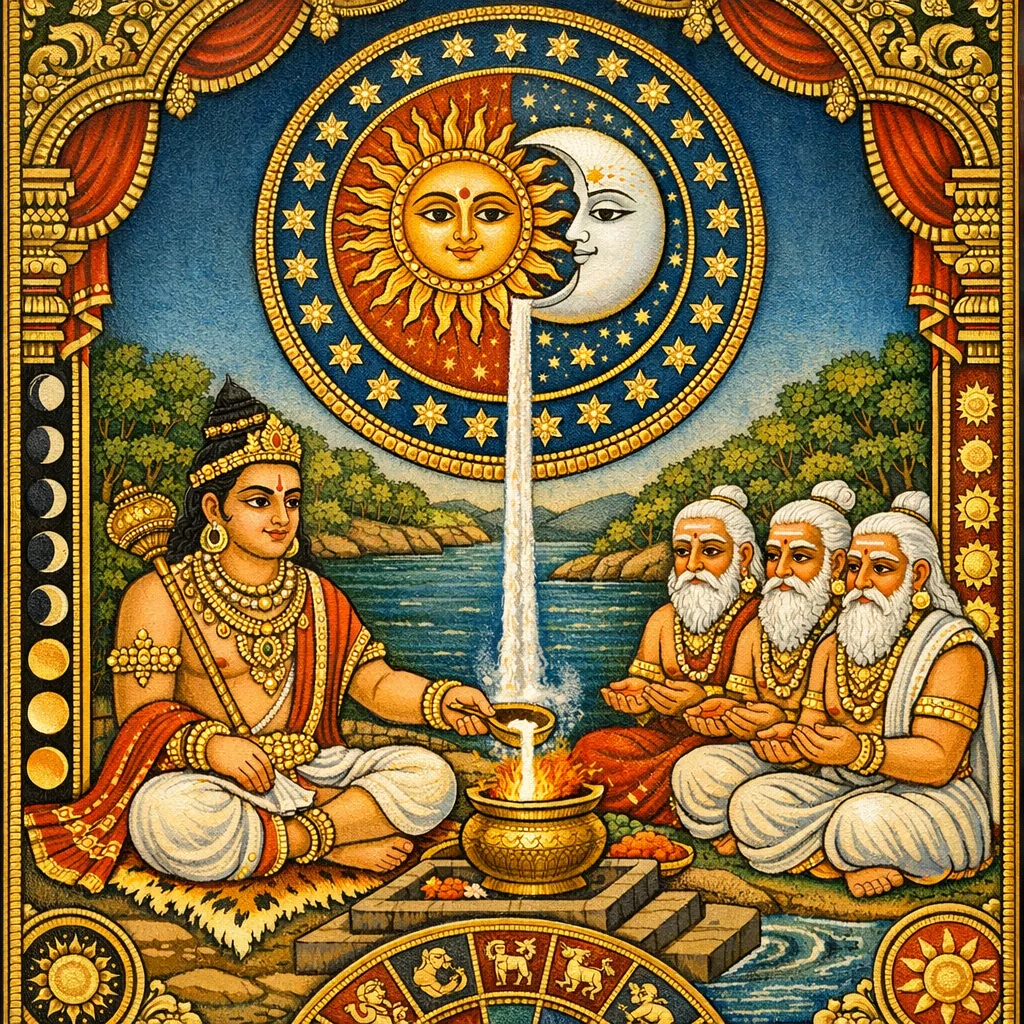
This chapter begins in dialogue: a Ṛṣi asks how King Purūravas (Aila) is said to “go to heaven month after month” on amāvasyā, and by what means he satisfies the Pitṛs. Sūta answers that he will explain the prabhāva (efficacy) arising from Aila’s connection with Āditya and Soma, shifting from narrative to a technical cosmology of lunar phases. It describes the Moon’s inner essence and how the waxing and waning halves (śukla/kṛṣṇa pakṣa) signify increase and decrease, linking Soma’s dripping sudhā-amṛta to the nourishment and contentment of ancestral beings. Amāvasyā is presented as the crucial conjunction when Sun and Moon share the same nakṣatra and abide as a single sphere for a night, creating a special access-point for ancestral rites. Purūravas is shown approaching Soma for monthly śrāddha, observing liminal lunar measures (Kuhū, Sinīvālī), and performing tarpaṇa with Soma-derived amṛta according to pitṛ-vidhi. The chapter also classifies Pitṛ groups (Barhiṣad, Kāvyā, Agniṣvātta, Saumyā) and frames the rite within a wider theology of time (ṛta/agni as the year), presenting ritual practice as an extension of cosmic mechanics.
Shlokas
Verse 1
इति श्रीब्रह्माण्डे महापुराणे वायुप्रोक्ते पूर्वभागे द्वितीये ऽनुषङ्गपाद दारुवनप्रवेशभस्मस्नानविधिर्नाम सप्तविंशतितमो ऽध्यायः ऋषिरुवाच अगात्कथममावस्यां मासि मासि दिवं नृपः / ऐलः पुरूरवाः सूत कथं वातर्पयत्पितॄन्
Thus, in the Śrī Brahmāṇḍa Mahāpurāṇa, in the earlier section spoken by Vāyu, in the second part, is the twenty-seventh chapter called “Anuṣaṅgapāda: the entry into the Dāru forest and the rite of bathing with sacred ash.” The ṛṣi said: “O king, how did he go to heaven month after month on the new-moon day (amāvasyā)? O Sūta, how did Aila Purūravas satisfy the Pitṛs with tarpaṇa?”
Verse 2
सूत उवाच तस्य ते ऽहं प्रवक्ष्यामि प्रभावं शांशपायने / ऐलस्यादित्यसंयोगं सोमस्य च महात्मनः
Sūta said: “O Śāṃśapāyana, I shall tell you of its power—the connection of Aila with Āditya, and also that of Soma, the great-souled one.”
Verse 3
अन्तःसारमयस्येन्दोः पक्षयोः शुक्लकृष्णयोः / ह्रासवृद्धी पिदृमतः पित्र्यस्य च विनिर्णयम्
It sets forth the waning and waxing of the Moon, whose nature is inner essence, in the bright and dark fortnights, and determines the doctrine of the Pitṛ-world and the pitrya rites.
Verse 4
सोमाच्चैवामृतप्राप्तिं पितॄणां तर्वणं तथा / काव्याग्निष्वात्तमौम्यानां पितॄणाञ्चैव दर्शनम्
From Soma, too, comes the Pitṛs’ attainment of ambrosia; likewise their tarpaṇa offering, and the vision of the Pitṛs known as Kāvya, Agniṣvātta, and Saumya.
Verse 5
यथा पुरूरवाश्चैव तर्पयामास वै पितॄन् / एतत्सर्वं प्रवक्ष्यामि पर्वाणि च यथाक्रमम्
Just as Purūravas indeed satisfied the Pitṛs with tarpaṇa, so shall I declare all this, and also the parvas in their proper order.
Verse 6
यदा तु चन्द्रसूर्यौं वै नक्षत्रेण समागतौ / अमावस्यां निवसत एकरात्रैकमण्डलौ
When the Moon and the Sun come together with the nakṣatra, then on Amāvasyā they dwell for a single night within one and the same sphere.
Verse 7
स गच्छति तदा द्रष्टुं दिवाकरनिशाकरौ / अमावस्याममावास्यां मातामहपितामहौ
Then, on that very Amāvasyā, he goes to behold Divākara (the Sun) and Niśākara (the Moon); on that Amāvasyā the maternal grandsire and the paternal grandsire, the two Pitṛs, are present.
Verse 8
अभिवाद्य स तौ तत्र कालापेक्षः प्रतीक्षते / प्रस्यन्दमानात्सोमात्तु पित्रर्थं तु परिश्रवान्
Having reverently saluted them both there, he waited, mindful of the proper time. From the Soma that was flowing forth arose the sacred pariśrava stream, meant for the rite to the Pitṛs.
Verse 9
ऐलः पुरूरवा विद्वान्मासश्राद्धचिकीर्षया / उपास्ते पितृमन्तं तं सोमं दिवि समास्थितः
Aila Purūrava, the wise, desiring to perform the monthly śrāddha, worships that Soma endowed with the presence of the Pitṛs, established in heaven.
Verse 10
द्विलवां कुहूमात्रां च ते उभे तु विचार्य सः / सिनीवालीप्रमाणेभ्यः सिनीवालीमुपास्य सः
He reflected on both dvilavā and the measure of Kuhū; then, by the standards of Sinīvālī, he worshiped Sinīvālī.
Verse 11
कुहूमात्रः कलां चैव ज्ञात्वोपास्ते कुहूं तथा / स तदा तामुपासीनः कालापेक्षः प्रपश्यति
Knowing the measure of Kuhū and the kalā as well, he worshiped Kuhū accordingly. Then, seated in devotion, he watched on, waiting for the proper time.
Verse 12
सुधामृतं तु तत्सोमात्स्रवद्वै मासतृप्तये / दशभिः पञ्चभिश्चैव सुधामृतपरिस्रवैः
From that Soma flows sudhā-amṛta, to bring monthly satisfaction, in streams of nectar—ten and five alike—pure outpourings of ambrosia.
Verse 13
कृष्णपक्षे भुजां प्रीत्या दह्यमानां तथांशुभिः / सद्यः प्रक्षरता तेन सौम्येन मधुना तु सः
In the dark fortnight, his arms were scorched by the rays; then, with that gentle honey, he at once caused sweet streams to flow.
Verse 14
निर्वातेष्त्रथ पक्षेषु पित्र्येण विधिना दिवि / सुधामृतेन राजैन्द्रस्तर्प यामास वै पितॄन्
In the windless fortnights, in heaven and by the ancestral rite, the lordly king satisfied the Pitṛs with sudhā—nectar of immortality.
Verse 15
सौम्यान्बर्हिषदः काव्यानग्निष्वात्तांस्तथैव च / ऋतमग्निस्तु यः प्रोक्तः स तु संवत्सरो मतः
Saumyas, Barhiṣads, Kavyas, and Agniṣvāttas—these are the orders of the Pitṛs; and he who is called Ṛtam-agni is regarded as Saṃvatsara, the Year.
Verse 16
जज्ञिरे ह्यृतवस्तस्माद्ध्यृतुभ्यश्चार्त्तवास्तथा / आर्तवा ह्यर्द्धमासाख्याः पितरो ह्यृतुसूनवः
From him the seasons (ṛtus) were born, and from the seasons the ārtavas as well. The ārtavas are called the half-months, and those Pitṛs are the sons of the seasons.
Verse 17
ऋतवः पितामहा मासा अयनाह्यब्दसूनवः / प्रपितामहास्तु वै देवाः पञ्चाब्दा ब्रह्मणः सुताः
The seasons are the pitāmahas (grandfathers); the months and the ayanas are sons of the year; and the gods as prapitāmahas (great-grandfathers) are called Pañcābda, sons of Brahmā.
Verse 18
सौम्यास्तु सोमजा ज्ञेयाः काव्या ज्ञेयाः कवेः सुताः / उपहूताः स्मृता देवाः सोमजाः सोमपाः स्मृताः
Those called Saumya are to be known as the Somaja Pitṛs; the Kāvya Pitṛs are known as the sons of Kavi. The gods are remembered as Upahūta; and the Somajas are also remembered as Somapā, drinkers of the sacred Soma.
Verse 19
आज्यपास्तु स्मृताः काव्यास्तिस्रस्ताः पितृजातयः / काव्या बर्हिषद श्चैव अग्निष्वात्ताश्च तास्त्रिधा
The Kāvya Pitṛs are remembered as Ājyapā; and the Pitṛ lineages are threefold—Kāvya, Barhiṣad, and Agniṣvātta—thus they are of three kinds.
Verse 20
गृहस्था ये च यज्वान ऋतुर्बर्हिषदो ध्रुवम् / गृहस्थाश्चाप्ययज्वान अग्निष्वात्तास्तथार्त्तवाः
Householders who perform yajña are indeed called Ṛtu and Barhiṣad. Householders who do not perform yajña are called Agniṣvātta and Ārttava.
Verse 21
अष्टकापतयः काव्याः पञ्चाब्दास्तान्निबोधत / तेषां संवत्सरो ह्यग्निः सूयस्तु परिवत्सरः
The Kāvya Pitṛs are the lords of the Aṣṭakās; know that they are five “abda”. Among them, Saṃvatsara is Agni, and Parivatsara is Sūrya.
Verse 22
सोम इड्वत्सरः प्रोक्तो वायुश्चैवानुवत्सरः / रुद्रस्तु वत्सरस्तेषां पञ्चाब्दास्ते युगात्मकाः
Soma is declared to be Iḍvatsara, and Vāyu to be Anuvatsara. For them, Rudra is Vatsara; these five “abda” are yuga in their very essence.
Verse 23
काव्याश्चैवोष्मपाश्चैव दिवाकीर्त्याश्च ते स्मृताः / ये ते पिबन्त्यमावस्यां मासिमासि सुधां दिवि
Kāvya, Uṣmapa, and Divākīrtya are thus remembered—those who, in heaven, month after month, drink the sacred sudhā on the new-moon night (amāvasyā).
Verse 24
तांस्तेन तर्पयामास यावदासीत्पुरूरवाः / यस्मात्प्रस्रवते सोमान्मासि मासि धिनोति च
So long as Purūrava remained, he satisfied them with that; for from that Soma, month after month, the nectar streams forth and is renewed.
Verse 25
तस्मात्सुधामृतं तद्वै पितॄणां सोमपायिनाम् / एवं तदमृतं सौम्यं सुधा च मदु चैव ह
Therefore that sudhā-amṛta truly belongs to the Pitṛs who drink Soma; thus that gentle amṛta is called both sudhā and madhu.
Verse 26
कृष्णपक्षे यथा वेन्दोः कलाः पञ्चदश क्रमात् / पिबन्त्यंबुमयं देवास्त्रयस्त्रिंशत्तु छन्दनाः
As, in the dark fortnight, the moon’s fifteen portions wane in due order, so do the thirty-three Devas called Chandanā drink the watery share.
Verse 27
पीत्वार्द्धमासं गच्छन्ति चतुर्दश्यां सुधामृतम् / इत्येवं पीयमानैस्तु देवैः सर्वैर्निशाकरः
Having drunk the sudhā-amṛta on the fourteenth day (caturdaśī), they pass on through half the month; thus, as all the Devas drink, Niśākara—the Moon—wanes.
Verse 28
समागच्छत्यमावस्यां भागे पञ्चदशे स्थितः / सुषुम्णाप्यायितं चैव ह्यमावस्यां यथा क्रमम्
At amāvasyā, abiding in the fifteenth portion, Soma comes together; and through the Suṣumṇā nāḍī he is nourished at the new moon, in due order.
Verse 29
पिबन्ति द्विलवं कालं पितरस्ते सुधामृतम् / पीतक्षयं ततः सोमं सूर्यो ऽसावेकरश्मिना
The Pitṛs drink that nectar of sudhā-amṛta for the span of two lavas; then the Sun, with a single ray, takes back Soma after it has been drained by their drinking.
Verse 30
आप्याययत्सुषुम्णातः पुनस्तान्सोमपायिनः / निः शेषायां कलायां तु सोममाप्याययत्पुनः
From Suṣumṇā he again nourishes those who drink Soma; and when the kalā is exhausted without remainder, he replenishes Soma once more.
Verse 31
सुषुम्णाप्यायमानस्य भागं भागमहः क्रमात् / कलाः क्षीयन्ति ताः कृष्णाः शुक्ला चाप्याययन्ति तम्
As he is nourished through Suṣumṇā, the kalās wane portion by portion in the course of the days—those are the dark (kṛṣṇa) phases; and the bright (śukla) phases replenish him.
Verse 32
एवं सूर्यस्य वीर्येण चन्द्रस्याप्यायिता तनुः / दृश्यते पौर्णमास्यां वै शुक्लः संपूर्णमण्डलः
Thus, by the Sun’s potency, the Moon’s body is replenished; and on the full-moon night he is seen radiant and white, a perfectly complete orb.
Verse 33
संसिद्धिरेवं सोमस्य पक्षयोः शुक्लकृष्णयोः / इत्येवं पितृमान्सोमः स्मृत इड्वत्सरात्मकः
Thus is Soma fulfilled in the bright and dark fortnights; Soma, joined with the Pitṛs, is remembered as having the nature of Idvatsara.
Verse 34
क्रान्तः पञ्चदशैः सार्द्धं सुधामृतपरिस्रवैः / अतः पर्वाणि वक्ष्यामि वर्वणां संधयश्च ये
Soma moves on with the fifteen kalās, accompanied by streams of sudhā and amṛta; therefore I shall declare the parvas and the junctions (saṃdhis) that belong to them.
Verse 35
ग्रन्थिमन्ति यथा पर्वाणीक्षुवे ण्वोर्भवन्त्युत / तथार्द्धमासि पर्वाणि शुक्लकृष्णानि चैव हि
As sugarcane has joints called parvas, so too the parvas of a half-month are indeed the bright and the dark fortnights.
Verse 36
पूर्णामावस्ययोर्भेदौ ग्रन्थयः संधयश्च वै / अर्द्धमासं तु पर्वाणि द्वितीयाप्रभृतीनि तु
The distinction between full moon and new moon is truly the knot and the junction; and the parvas of a half-month are the tithis beginning with the second day (Dvitīyā).
Verse 37
अन्वाधानक्रिया यस्मात्क्रियते पर्वसंधिषु / तस्मात्तु पर्वणामादौ प्रतिपत्सर्वसंधिषु
Since the rite of anvādhāna is performed at the junctions of the parvas, therefore at every junction the beginning of a parva is marked by Pratipadā (the first lunar day).
Verse 38
सायाह्ने ऽह्यनुमत्यादौ कालो द्विलव उच्यते / लवौ द्वावेव राकायां कालो ज्ञेयो ऽपराह्णकः
At evening, at the beginning of Anumatī and the like, the time is said to be two lava. And on Rākā (the full moon), those two lava are to be known as the aparāhṇa time.
Verse 39
प्रतिपत्कृष्णपक्षस्य काले ऽतीते ऽपराह्णके / सायाह्ने प्रतिपन्ने च स कालः पौर्णमासिकः
On the pratipadā of the dark fortnight, when the aparāhṇa has passed and evening has set in, that very time is called the paurṇamāsika time.
Verse 40
व्यतीपाते स्थिते सूर्ये लेखार्द्धे तु युगान्तरे / युगान्तरोदिते चैव लेशार्द्धे शशिनः क्रमात्
In vyatīpāta, when the Sun stands at the ‘half‑line’ (lekhārdha), the yuga‑interval is spoken of; and when that interval arises, in due order the Moon too is at the ‘half‑portion’ (leśārdha).
Verse 41
पौर्णमासी व्यतीपाते यदीक्षेतां परस्परम् / यस्मिन्काले समौ स्यातां तौ व्यतीपात एव सः
In vyatīpāta, if on the full‑moon day the Sun and Moon behold one another, then the moment when the two are equal—this indeed is vyatīpāta.
Verse 42
तं कालं सूर्यनिर्द्देश्यं दृष्ट्वा संख्यां तु सर्पति / स वै वषटाक्रियाकालः सद्यः कालं विधीयते
Beholding that moment as indicated by the Sun, the reckoning moves onward. That indeed is the time for the vaṣaṭ rite; at once, according to rule, the time is duly fixed.
Verse 43
पूर्णन्दोः पूर्णपक्षे तु रात्रिसंधिश्च पूर्णिमा / ततो विरज्यते नक्तं पौर्णमास्यां निशाकरः
In the bright fortnight, the very junction of the night is called Pūrṇimā; on that Paurṇamāsī night, Niśākara—the Moon—shines with special splendor.
Verse 44
यदीक्षेते व्यतीपाते दिवा पूर्णे परस्परम् / चन्द्रार्कावपराह्णे तु पूर्णात्मानौ तु पूर्णिमा
When, at Vyatīpāta, in the fullness of day, Moon and Sun behold one another face to face, and in the afternoon both stand in their fullness—that is Pūrṇimā.
Verse 45
यस्मात्तामनुमन्यन्ते पितरो दैवतैः सह / तस्मादनुमतिर्नाम पूर्णिमा प्रथमा स्मृता
Because the Pitṛs, together with the deities, give their assent to that tithi, it is called Anumatī; among the Pūrṇimās it is remembered as the first.
Verse 46
अत्यर्थं भ्राजते यस्माद्व्योम्न्यस्यां वै निशाकरः / रञ्जनाच्चैव चन्द्रस्य राकेति कवयो ऽब्रुवन्
For on this tithi Niśākara—the Moon—shines exceedingly in the sky; and because of Candra’s enchanting radiance, the poets called it Rākā.
Verse 47
अमावसेतामृक्षे तु यदा चन्द्रदिवाकरौ / राका पञ्चदशी रात्रिरमावास्या ततः स्मृता
In the Amāvasyā nakṣatra, when Candra and Divākara—the Moon and the Sun—come together, then after the fifteenth night called Rākā, that tithi is remembered as Amāvasyā.
Verse 48
व्युच्छिद्य तममावस्यां पश्यतस्तौ समागतौ / अन्योन्यं चन्द्रसूर्यौं तौ यदा तद्वर्श उच्यते
Cleaving the dense darkness of the amāvasyā night, before the very eyes they came together; when Moon and Sun unite with one another, that is called “varṣa”.
Verse 49
द्वौ द्वौ लवावमावास्या स कालः पर्वसंधिषु / द्व्यक्षर कुहुमात्रश्च पर्वकालास्त्रयः स्मृताः
On the amāvasyā, at the junctions of the parva there is a span of two-and-two lava; “dvyakṣara” and the mere “kuhū-mātra” are remembered as the three sacred parva-times.
Verse 50
नष्टचन्द्रा त्वमावस्या या मध्याङ्नात्प्रवर्त्तते / दिवसार्द्धेन रात्र्या च सूर्यं प्राप्य तु चन्द्रमाः
That amāvasyā in which the Moon is lost begins from midday; after passing through half the day and a portion of the night, the Moon comes to the Sun’s proximity.
Verse 51
सूर्येण सह सामुद्रं गत्वा प्रातस्तनात्स वै / द्वौ कालौ संगमं चैव मध्याह्ने नियतं रविः
He (the Moon), together with the Sun, goes to the oceanic region and remains there from the morning; there too is the confluence of two times, and at midday Ravi abides in his fixed course.
Verse 52
प्रतिपच्छुक्लपक्षस्य चन्द्रमाः सूर्य मण्डलात् / विमुच्यमानयोर्मध्ये तयोर्मण्डलयोस्तु वै
On the pratipadā of the bright fortnight, the Moon begins to be released from the Sun’s orb; and as the two orbs separate, the space between their circles becomes manifest.
Verse 53
स तदा ह्याहुतेः कालो दर्शस्य तु वषट्क्रिया / एतदृतुमुखं ज्ञेयममा वास्यास्य पर्वणः
Then is the proper time for the oblation (āhuti); in the Darśa sacrifice the rite of “vaṣaṭ” is performed. Know this as the gateway of the season—the parvan of Amāvāsyā.
Verse 54
दिवापर्व ह्यमावास्या क्षीणेन्दौ बहुले तु वै / तस्माद्दिवा ह्यमावास्यां गृह्यते ऽसौ दिवाकरः
In the dark fortnight, when the moon is waning, Amāvāsyā is called the “day-parvan.” Therefore on Amāvāsyā the Divākara (Sun) is reckoned in the daytime.
Verse 55
गृह्यते तु दिवा तस्मादमावास्यां दिवि क्षयाम् / कलानामपि चैतासां वृद्धिहान्या जलात्मनः
Therefore Amāvāsyā is reckoned in the daytime, considering the waning in the heavens. And in these portions (kalā) too there is increase and decrease in the Moon, whose nature is of water (jalātmā).
Verse 56
तिथीनां नामधेयानि विद्वद्भिः संज्ञितानि वै / दर्शयेतामथात्मानं सूर्याचन्द्रमसावुभौ
The names of the tithis have indeed been assigned by the learned. Then the Sun and the Moon—both—reveal their own nature.
Verse 57
निष्क्रामत्यथ तेनैव क्रमशः सूर्यमण्डलात् / द्विलवोनमहोरात्रं भास्करं स्पृशते शशी
Then, in that very order, the Moon gradually moves out from the Sun’s orb. In one day and night, lacking two lava, Śaśī (the Moon) touches Bhāskara (the Sun).
Verse 58
स तदा ह्याहुतेः कालोदर्शस्य तु वषट्क्रिया / कुहेति कोकिलेनोक्तो यः स कालः समाप्यते
Then, at the time of the oblation (āhuti), in the Darśa rite the sacred ‘vaṣaṭ’ act is performed; the time marked by the kokila’s call “kuhe” is the time that comes to its close.
Verse 59
तत्कालसंमिता यस्मादमावास्या कुहूः स्मृता / सिनीवालीप्रमाणस्तु क्षीणशेषो निशाकरः
Because it accords with that very measure of time, the new-moon night (amāvāsyā) is remembered as ‘Kuhū’; then the Moon, lord of the night, is left as a waning remnant, in the measure of Sinīvālī.
Verse 60
आमावस्यां विशत्यर्कस्सिनी वालीततः स्मृता / अनुमत्याश्चराकायाः सिनीवाल्याः कुहूंविना
At amāvāsyā, when the Sun is said to enter (that juncture), it is remembered as Sinīvālī; and the wondrous-formed goddess Anumatī is spoken of in relation to Sinīvālī, yet apart from Kuhū.
Verse 61
एतासां द्विलवः कालः कुहूमात्रङ्कुहूःस्मृताः / चन्द्रसूर्यव्यतीपाते संगते पूर्णिमान्तरे
The span of two lavas of these is remembered as the ‘measure of Kuhū’; and when, in the vyatīpāta—Moon and Sun in special conjunction—it occurs within the interval between full moons, that is called Kuhū.
Verse 62
प्रतिपत्प्रतिपद्येत पर्वकालो द्विमात्रकः / कालः कहूसिनीवाल्योः सामुद्रस्य तु मध्यतः
From pratipadā to pratipadā, the parva-time measures two mātrās; and the time of Kuhū and Sinīvālī is said to lie in the very middle of the sāmudra (oceanic) reckoning.
Verse 63
अर्काग्नि मण्डले सोमे पर्वकालः कलासमः / एवं स शुक्लपक्षे वै रजन्यां पर्वसंधिषु
Within the sun’s fiery sphere, for Soma the parva-time is reckoned as equal to a single kalā; thus too, in the bright fortnight, it is so at night, at the junctions of the parvas.
Verse 64
संपूर्ममण्डलः श्रीमांश्चन्द्रमा उपरज्यते / यस्मादा दाप्यायते सोमः पञ्चदश्यां तु पूर्णिमा
The glorious moon shines forth with its disk made whole; for on the fifteenth tithi Soma is nourished into fullness—therefore that day is Pūrṇimā, the full moon.
Verse 65
दशभिः पञ्चभिश्चैव कलाभिर्दिवसक्रमात् / तस्मात्कलाः पञ्चदश सोमेनास्य तु षोडशी
In the succession of days, (the moon) waxes by ten and by five kalās; therefore Soma’s kalās are fifteen, and yet there is also his sixteenth, called Ṣoḍaśī—the mark of completeness.
Verse 66
तस्मात्सोमस्य भवति पञ्चदश्याप्रपां क्षयः / इत्येते पितरो देवाः सोमपाः सोमवर्द्धनाः
Therefore, on the fifteenth tithi Soma comes to diminution. Such are these Pitṛs, divine in nature—drinkers of Soma and increasers of Soma.
Verse 67
आर्तवा ऋतवो ह्यृद्धा देवास्तान्भावयन्ति वै / अतः पितॄन्प्रवक्ष्यामि मासश्राद्धभुजस्तु ये
In accord with the cycle of seasons, these ṛtus are abundant; the gods indeed cause them to flourish. Therefore I shall now speak of those Pitṛs who partake of the monthly śrāddha offerings.
Verse 68
तेषां गतिं सतत्त्वां च प्राप्तिं श्राद्धस्य चैव हि / न मृतानां गतिः शक्या ज्ञातुं न पुनरागतिः
Their course, their true nature, and the attainment of the fruit of śrāddha are not truly knowable with certainty; the path of the departed cannot be known, nor is there any return again.
Verse 69
तपसापि प्रसिद्धेन किंपुनर्मासचक्षुषा / अनुदेवपितॄनेते पितरो लौकिकाः स्मृताः
Even one renowned for austerity cannot know it—how much less with the eye of flesh. These Pitṛs, who follow the Deva-Pitṛs, are remembered as the ‘laukika’, the worldly Fathers.
Verse 70
देवाः सौम्याश्च काव्याश्च अयज्वानो ह्यचोनिजाः / देवास्ते पितरः सर्वे देवास्तान्वादयन्त्युत
The Devas called Saumya and Kāvya—non-sacrificers and not born of the sacrificial fire—are all Pitṛs of divine nature; and the Devas, too, sing their praise.
Verse 71
मनुष्यपितरश्चैव तेभ्यो ऽन्ये लौकिकाः स्मृताः / पिता पितामहश्चापि तथा यः प्रपितामहः
There are also human Pitṛs; and distinct from them are others remembered as ‘laukika’, the worldly Fathers—one’s father, grandfather, and great-grandfather.
Verse 72
यज्वानो ये तु सामेन सोमवन्तस्तु ते स्मृताः / ये यज्वानो हविर्यज्ञे ते वै बर्हिषदः स्मृताः
Those sacrificers who perform the rite with the Sāman chants are remembered as ‘Somavant’; and those sacrificers who perform the havis-offering sacrifice are remembered as the ‘Barhiṣad’.
Verse 73
अग्निष्वात्ताः स्मृतास्तेषां होमिनो ऽयाज्ययाजिनः / तेषां तु धर्मसाधर्म्यात्स्मृताः सायुज्यगा द्विजैः
They are remembered as the Pitṛs called Agniṣvāttas—performers of homa, even offering sacrifice for those unfit to be worshipped. By kinship in dharma, the dvijas declare them to be bound for sāyujya, divine union.
Verse 74
ये चाप्याश्रमधर्माणां प्रस्थानेषु व्यवस्थिताः / अन्ते तु नावसीदन्ति श्रद्धायुक्तास्तु कर्मसु
Those who are established on the paths of āśrama-dharma do not falter at the end; in their rites and deeds they remain endowed with śraddhā, sacred faith.
Verse 75
तपसा ब्रह्मचर्येण यज्ञेन प्रजया च वै / श्राद्धेन विद्यया चैव प्रदानेन च सप्तधा
In seven ways: through tapas (austerity), brahmacarya, yajña, progeny, śrāddha rites, sacred learning (vidyā), and charitable giving (pradāna).
Verse 76
कर्मस्वेतेषु ये युक्ता भवन्त्यादेहपातनात् / दैवैस्तैः पितृभिः सार्द्धं सूक्ष्मजैः सोमयाजनैः
Those who remain devoted to these observances until the body falls away come to dwell with those divine Pitṛs—subtle-bodied beings, performers of Soma-sacrifice.
Verse 77
स्वर्गता दिवि मोदन्ते पितृवत्त उपासते / तेषां निवापे दत्ते तु तत्कुलीनैश्च बन्धुभिः
Having reached heaven, they rejoice in the celestial realm and are worshipped like the Pitṛs. And when kinsmen of their own lineage offer them the nivāpa—piṇḍa offerings for the departed.
Verse 78
मासश्राद्धभुजस्तृप्तिं लभन्ते सोमलौकिकाः / एते मनुष्यपितरो मासश्राद्धभुजस्तु ये
Those in Somaloka who partake of the monthly śrāddha attain contentment. They who receive the monthly śrāddha are known as the human Pitṛs.
Verse 79
तेभ्यो ऽपरे तु ये ऽप्यन्ये संकीर्णाः कर्मयोनिषु / भ्रष्टाश्चाश्रमधर्मेभ्यः स्वधास्वाहाविवर्जिताः
Yet others, mingled among births shaped by karma, have fallen away from the dharmas of the āśramas and are bereft of the offerings of “svadhā” and “svāhā”.
Verse 80
भिन्नदेहा दुरात्मानः प्रेतभूता यमक्षये / स्वकर्माण्य नुशोचन्तो यातनास्थानमागताः
Those wicked souls, severed from the body, become pretas in Yama’s realm; lamenting their own deeds, they arrive at the place of torment.
Verse 81
दीर्घायुषो ऽतिशुष्काश्च श्मश्रुलाश्च विवाससः / क्षुत्पिपासापरीताश्च विद्रवन्तस्ततस्ततः
Long-lived yet utterly parched, bearded and unclad, beset by hunger and thirst, they run about from place to place.
Verse 82
सरित्सरस्तडागानि वापीश्चाप्युपलिप्सवः / परान्नानि च लिप्संतः काल्यमानास्ततस्ततः
They yearn for rivers, lakes, ponds, and wells; craving others’ food, they are driven off and wander from place to place.
Verse 83
स्थानेषु पात्यमानाश्च यातनाश्च पुनः पुनः / शाल्मले वैतरण्यां च कुंभीपाके तथैव च
They are cast down in various places again and again, enduring repeated torments—also in the hells of Śālmali, Vaitaraṇī, and Kuṃbhīpāka.
Verse 84
करंभवालुकायां च असिपत्रवने तथा / शिला संपेषणे चैव पात्यमानाः स्वकर्मभिः
In Karaṃbha-vālukā, in the sword-leaf forest Asipatravana, and in the crushing of stones Śilā-saṃpeṣaṇa, they are cast down by their own deeds.
Verse 85
तत्रस्थानां हि तेषां वै दुः खितानामनाशिनाम् / तेषां लोकान्तरस्थानां बान्धवैर्नाम गोत्रतः
Those who abide there, though sorrowing, do not perish; those dwelling in another realm are remembered by their kin by name and lineage (gotra).
Verse 86
भूमावसव्यं दर्भेषु दत्ताः पिण्डास्त्रयस्तु वै / यान्ति तास्तर्पयन्ते च प्रेतस्थानेष्वधिष्ठितान्
The three piṇḍas offered on darbha grass upon the earth, in the apasavya rite, reach those abiding in the preta-stations and bring them satisfaction (tarpana).
Verse 87
अप्राप्ता यातनास्थानं प्रभ्रष्टा य च पञ्चधा / पश्चाद्ये स्थावरान्ते वै जाता नीचैः स्वकर्मभिः
Those who do not even reach the place of torment fall in fivefold ways; thereafter, by their base deeds, they are born even into the state of the immobile (sthāvara).
Verse 88
नानारूपासु जायन्ते तिर्यग्योनिष्वयोनिषु / यदाहारा भवन्त्येते तासु तास्विह योनिषु
They are born in many forms, in the wombs of animals and in other kinds of birth. In each and every yoni, according to the food found there, they become partakers of that very food.
Verse 89
तस्मिंस्तस्मिंस्तदाहारे श्राद्धं दत्तं प्रतिष्ठते / काले न्यायागतं पात्रे विधिना प्रतिपादितम्
The śrāddha offered becomes firmly established as that very nourishment, when it is duly presented—at the proper time, to a rightful recipient, and according to prescribed rite.
Verse 90
प्राप्नोत्यन्नं यथादत्तं जन्तुर्यत्रावतिष्ठते / यथा गोषु प्रनष्टामु वत्सो विन्दति मातरम्
Wherever a being abides, there it receives the food exactly as it was offered—just as a calf, though lost among many cows, finds its own mother.
Verse 91
तथा श्राद्धेषु दत्तान्नं मन्त्रः प्रापयते पितॄन् / एवं ह्यविफलं श्राद्धं श्रद्धादत्तं तु मन्त्रतः
So too, the food offered in śrāddha is conveyed by mantra to the Pitṛs. Thus śrāddha given with faith, and through mantra, is never fruitless.
Verse 92
तत्तत्कुमारः प्रोवाच पश्यन्दिव्येन चक्षुषा / गतागतज्ञः प्रेतानां प्राप्तिं श्राद्धस्य तैः सह
That kumāra spoke while beholding with divine sight; he knew the comings and goings of the pretas, and with them, the manner in which śrāddha reaches its recipients.
Verse 93
बाह्लीकाश्चोष्मपाश्चैव दिवाकीर्त्याश्च ते स्मृताः / कृष्णपक्षस्त्वहस्तेषां शुक्लः स्वप्नाय शर्वरी
They are remembered as the Bāhlīkas, the Uṣmapas, and the Divākīrtyas. For them, the day is the dark fortnight (Kṛṣṇapakṣa), and the night the bright fortnight (Śuklapakṣa), ordained for dreaming.
Verse 94
इत्येते पितरो देवा देवाश्च पितरश्च वै / ऋत्वर्तवार्द्धमासास्तु अन्योन्यं पितरः स्मृताः
Thus the Pitṛs are gods, and the gods too are truly Pitṛs. The seasons (ṛtu), the seasonal cycles (artava), and the half-months (arddhamāsa) are remembered as Pitṛs to one another.
Verse 95
इत्येत पितरो देवा मनुष्यपितरश्च ये / प्रीतेषु तेषु प्रीयन्ते श्राद्धयुक्तेषु कर्मसु
Thus the Pitṛs who are gods, and the Pitṛs of humankind: when they are pleased, they delight in rites performed in union with Śrāddha.
Verse 96
इत्येष विचयः प्रोक्तः पितॄणां सोमपायिनाम् / एवं पितृसतत्त्वं हि पुराणे निश्चयं गतम्
This is the stated discernment concerning the Soma-drinking Pitṛs. Thus the true principle of the Pitṛs stands firmly determined in the Purāṇa.
Verse 97
इत्यर्कपितृसोमानामैलस्य च समागमः / सुधामृतस्य च प्राप्तिः पितॄणां चैव तर्प्पणम्
Thus is told the meeting of Arka, the Pitṛs, and Soma, and also the coming together of Aila (Purūravas); the gaining of the nectar Sudhā-amṛta, and the tarpaṇa—oblations of satisfaction—offered to the Pitṛs.
Verse 98
पूर्णा मावास्ययोः कालो यातनास्थानमेव च / समासात्कीर्तितस्तुभ्यमेष सर्गः मनातनः
The time of the full-moon and the new-moon, and also the place of torment—these I have declared to you in brief. This sarga is ancient, without beginning.
Verse 99
वैश्वरूप्यं तु सर्गस्य कथितं ह्येकदैशिकम् / न शक्यं परिसंख्यातुं श्रद्धेयं भूतिमिच्छता
The cosmic, all-formed nature of the sarga has been told only in part. It cannot be fully reckoned; one who seeks blessed prosperity should receive it with faith.
Verse 100
स्वायंभुवस्य हि ह्येष सर्गः क्रान्तो मया तु वै / विस्तरेणानुपूर्व्या च भूयः किं वर्णयाम्यहम्
This sarga of Svayambhuva Manu has indeed been covered by me. If I were to describe it again in full and in due sequence, what more could I say?
Frequently Asked Questions
He is identified as Aila (of the Ilā lineage), signaling a dynastic anchor (vaṃśa-marker) while the chapter uses his practice as an exemplar for monthly ancestral rites rather than narrating a full genealogy.
Amāvasyā is described as the Sun and Moon meeting in the same nakṣatra and residing as a single sphere for one night; this junction is treated as the optimal temporal gateway for pitṛ-oriented offerings and tarpaṇa.
No. Its focus is śrāddha/pitṛ-tarpaṇa theology grounded in lunar cosmology—Soma’s amṛta, pakṣa dynamics, and Pitṛ classifications—rather than Śākta vidyā/yantra narratives of Lalitopākhyāna.