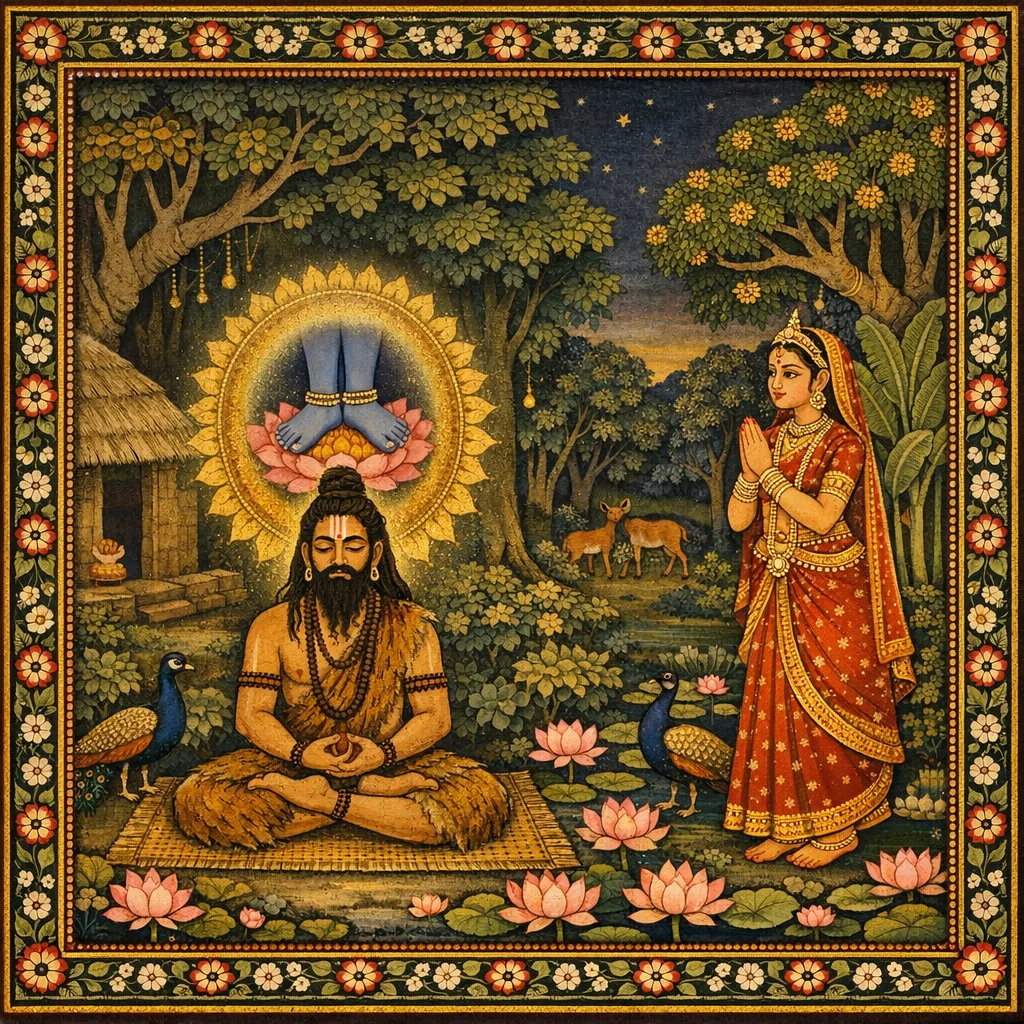
Adhyaya 23
Pṛthu Mahārāja’s Renunciation, Austerities, Departure, and the Glory of Hearing His History
As Pṛthu Mahārāja’s story nears its end, the king, seeing old age, hands rule to his heirs and distributes his accumulated opulence among all beings, establishing orderly support according to dharma and entrusting his descendants to the Earth (personified as his daughter). Leaving behind grieving citizens, he enters the forest with Queen Arci and strictly follows vānaprastha disciplines. His tapas progresses from severe diet to breath-control, not to display mystic power but solely to please Kṛṣṇa, culminating in unwavering bhakti, realization of the Paramātmā, and the abandonment of subsidiary yoga/jñāna aims. At death, Pṛthu fixes his mind on Kṛṣṇa’s lotus feet and performs a yogic withdrawal, reabsorbing the elements and relinquishing all designations—portraying a Bhāgavata “return” grounded in devotion. Arci, embodying pativratā-dharma, performs the final rites and enters the funeral fire, praised by celestial women. The chapter ends with Maitreya’s phala-śruti: hearing, reciting, and teaching Pṛthu’s character grants spiritual elevation and strengthens devotion, transitioning to later dynastic and instructive narrations after his departure.
Shlokas
Verse 1
मैत्रेय उवाच दृष्ट्वात्मानं प्रवयसमेकदा वैन्य आत्मवान् । आत्मना वर्धिताशेषस्वानुसर्ग: प्रजापति: ॥ १ ॥ जगतस्तस्थुषश्चापि वृत्तिदो धर्मभृत्सताम् । निष्पादितेश्वरादेशो यदर्थमिह जज्ञिवान् ॥ २ ॥ आत्मजेष्वात्मजां न्यस्य विरहाद्रुदतीमिव । प्रजासु विमन:स्वेक: सदारोऽगात्तपोवनम् ॥ ३ ॥
Maitreya said: In the final stage of his life, when Vainya Pṛthu saw that he had grown old, that great soul—the prajāpati who maintained all beings, moving and unmoving, and who upheld dharma for the saintly—fulfilled the Supreme Lord’s orders in complete harmony with Him. Then, according to religious principles, he distributed all the opulence he had amassed among all living entities, and entrusted the earth, regarded as his daughter, to his sons. As the citizens nearly wept in separation from their king, he left them and, with his wife, went alone to the forest of austerity to perform tapasya.
Verse 2
मैत्रेय उवाच दृष्ट्वात्मानं प्रवयसमेकदा वैन्य आत्मवान् । आत्मना वर्धिताशेषस्वानुसर्ग: प्रजापति: ॥ १ ॥ जगतस्तस्थुषश्चापि वृत्तिदो धर्मभृत्सताम् । निष्पादितेश्वरादेशो यदर्थमिह जज्ञिवान् ॥ २ ॥ आत्मजेष्वात्मजां न्यस्य विरहाद्रुदतीमिव । प्रजासु विमन:स्वेक: सदारोऽगात्तपोवनम् ॥ ३ ॥
Maitreya said: When, at life’s final stage, Mahārāja Pṛthu (son of Vena) saw himself growing old, that great soul—the ruler of the world—distributed, in accord with dharma, all the opulence he had amassed among all beings, moving and unmoving, and arranged proper maintenance for everyone. Having executed the orders of the Supreme Personality of Godhead in full harmony with Him, he entrusted the Earth—regarded as his daughter—to his sons. Then, leaving his citizens who wept in separation, he went with his wife, alone, to the forest of austerity to perform tapasya.
Verse 3
मैत्रेय उवाच दृष्ट्वात्मानं प्रवयसमेकदा वैन्य आत्मवान् । आत्मना वर्धिताशेषस्वानुसर्ग: प्रजापति: ॥ १ ॥ जगतस्तस्थुषश्चापि वृत्तिदो धर्मभृत्सताम् । निष्पादितेश्वरादेशो यदर्थमिह जज्ञिवान् ॥ २ ॥ आत्मजेष्वात्मजां न्यस्य विरहाद्रुदतीमिव । प्रजासु विमन:स्वेक: सदारोऽगात्तपोवनम् ॥ ३ ॥
Maitreya said: When, at life’s final stage, Mahārāja Pṛthu (son of Vena) saw himself growing old, that great soul—the ruler of the world—distributed, in accord with dharma, all the opulence he had amassed among all beings, moving and unmoving, and arranged proper maintenance for everyone. Having executed the orders of the Supreme Personality of Godhead in full harmony with Him, he entrusted the Earth—regarded as his daughter—to his sons. Then, leaving his citizens who wept in separation, he went with his wife, alone, to the forest of austerity to perform tapasya.
Verse 4
तत्राप्यदाभ्यनियमो वैखानससुसम्मते । आरब्ध उग्रतपसि यथा स्वविजये पुरा ॥ ४ ॥
There, Mahārāja Pṛthu unwaveringly followed the Vaikhānasa-approved disciplines of vānaprastha life and undertook severe austerities in the forest. He pursued them with the same gravity with which he had formerly governed and conquered.
Verse 5
कन्दमूलफलाहार: शुष्कपर्णाशन: क्वचित् । अब्भक्ष: कतिचित्पक्षान् वायुभक्षस्तत: परम् ॥ ५ ॥
In the forest of austerity, Mahārāja Pṛthu would sometimes eat tubers and roots, sometimes fruits and dry leaves. For some weeks he drank only water, and at last he lived simply by subsisting on air alone.
Verse 6
ग्रीष्मे पञ्चतपा वीरो वर्षास्वासारषाण्मुनि: । आकण्ठमग्न: शिशिरे उदके स्थण्डिलेशय: ॥ ६ ॥
Following the disciplines of forest life and the path of the great sages, Pṛthu Mahārāja practiced pañca-tapā in summer, endured torrents of rain in the rainy season, and in winter stood in water up to his neck. For sleep he would simply lie down on the bare ground.
Verse 7
तितिक्षुर्यतवाग्दान्त ऊर्ध्वरेता जितानिल: । आरिराधयिषु: कृष्णमचरत्तप उत्तमम् ॥ ७ ॥
Mahārāja Pṛthu performed the highest, severe austerities to master his speech and senses, to remain celibate, and to conquer the life air within his body. He did all this solely to please Śrī Kṛṣṇa, with no other aim.
Verse 8
तेन क्रमानुसिद्धेन ध्वस्तकर्ममलाशय: । प्राणायामै: सन्निरुद्धषड्वर्गश्छिन्नबन्धन: ॥ ८ ॥
By such austerity, perfected step by step, Mahārāja Pṛthu destroyed the impurity of desire for karmic results. Through prāṇāyāma he restrained the sixfold forces of mind and senses, cut the bonds, and became wholly free from fruitive longing.
Verse 9
सनत्कुमारो भगवान् यदाहाध्यात्मिकं परम् । योगं तेनैव पुरुषमभजत्पुरुषर्षभ: ॥ ९ ॥
Thus Mahārāja Pṛthu, the best of men, followed the supreme spiritual path taught by Bhagavān Sanat-kumāra—namely, he worshiped the Supreme Personality of Godhead, Śrī Kṛṣṇa.
Verse 10
भगवद्धर्मिण: साधो: श्रद्धया यतत: सदा । भक्तिर्भगवति ब्रह्मण्यनन्यविषयाभवत् ॥ १० ॥
Mahārāja Pṛthu, a saintly follower of the Lord’s dharma, strove always with faith. Thus his exclusive bhakti to Bhagavān Śrī Kṛṣṇa, protector of the brāhmaṇas, grew firm—steady and unflinching.
Verse 11
तस्यानया भगवत: परिकर्मशुद्ध सत्त्वात्मनस्तदनुसंस्मरणानुपूर्त्या । ज्ञानं विरक्तिमदभून्निशितेन येन चिच्छेद संशयपदं निजजीवकोशम् ॥ ११ ॥
By steadily performing devotional service, Mahārāja Pṛthu’s mind became purified in sattva, and he could constantly remember the Lord’s lotus feet. From this arose perfect knowledge and detachment; with that keen wisdom he cut away the root of doubt and was freed from false ego and the material conception of life.
Verse 12
छिन्नान्यधीरधिगतात्मगतिर्निरीह- स्तत्तत्यजेऽच्छिनदिदं वयुनेन येन । तावन्न योगगतिभिर्यतिरप्रमत्तो यावद्गदाग्रजकथासु रतिं न कुर्यात् ॥ १२ ॥
When he became wholly free from bodily identification, Mahārāja Pṛthu realized Śrī Kṛṣṇa as the Paramātmā seated within everyone’s heart. Receiving all instruction from Him within, he abandoned other disciplines of yoga and jñāna, caring nothing even for their perfections. He understood with certainty that bhakti to Kṛṣṇa is life’s supreme goal, and that until yogīs and jñānīs are drawn to kṛṣṇa-kathā, their delusion about existence can never be dispelled.
Verse 13
एवं स वीरप्रवर: संयोज्यात्मानमात्मनि । ब्रह्मभूतो दृढं काले तत्याज स्वं कलेवरम् ॥ १३ ॥
Thus the foremost hero, Mahārāja Pṛthu, joined the self to the Self and fixed his mind firmly on the lotus feet of Śrī Kṛṣṇa. Then, fully established on the brahma-bhūta platform, he relinquished his material body in due course of time.
Verse 14
सम्पीड्य पायुं पार्ष्णिभ्यां वायुमुत्सारयञ्छनै: । नाभ्यां कोष्ठेष्ववस्थाप्य हृदुर:कण्ठशीर्षणि ॥ १४ ॥
In a particular yogic sitting posture, Mahārāja Pṛthu blocked the anus with his ankles, pressed his right and left calves, and gradually raised the prāṇa-vāyu upward. He placed it at the navel circle, carried it to the heart and throat, and finally pushed it to the central point between the eyebrows.
Verse 15
उत्सर्पयंस्तु तं मूर्ध्नि क्रमेणावेश्य नि:स्पृह: । वायुं वायौ क्षितौ कायं तेजस्तेजस्ययूयुजत् ॥ १५ ॥
In this way Mahārāja Pṛthu gradually raised the prāṇa-vāyu to the opening at the crown of his skull and became free from all desire for material existence. Then, step by step, he merged his life air into the totality of air, his body into the totality of earth, and the fire within his body into the totality of fire.
Verse 16
खान्याकाशे द्रवं तोये यथास्थानं विभागश: । क्षितिमम्भसि तत्तेजस्यदो वायौ नभस्यमुम् ॥ १६ ॥
Thus, according to the respective positions of the body’s parts, Mahārāja Pṛthu merged the sense openings into ākāśa (ether) and the bodily liquids—blood and other secretions—into the totality of water, each in its proper place. Then he merged earth into water, water into fire, fire into air, and air into ether, and so on, in due order.
Verse 17
इन्द्रियेषु मनस्तानि तन्मात्रेषु यथोद्भवम् । भूतादिनामून्युत्कृष्य महत्यात्मनि सन्दधे ॥ १७ ॥
He merged the mind into the senses, the senses into their subtle objects (tan-mātras) according to their proper order, and he raised the material ego to unite it with the mahat-tattva, the total material energy.
Verse 18
तं सर्वगुणविन्यासं जीवे मायामये न्यधात् । तं चानुशयमात्मस्थमसावनुशयी पुमान् । ज्ञानवैराग्यवीर्येण स्वरूपस्थोऽजहात्प्रभु: ॥ १८ ॥
Pṛthu Mahārāja offered to the supreme controller of māyā the entire arrangement of qualities and all false designations upon the jīva. Freed by knowledge, renunciation, and the spiritual power of bhakti, he became established in his original nature—Kṛṣṇa consciousness—and, as a prabhu, master of the senses, he gave up his body.
Verse 19
अर्चिर्नाम महाराज्ञी तत्पत्न्यनुगता वनम् । सुकुमार्यतदर्हा च यत्पद्भ्यां स्पर्शनं भुव: ॥ १९ ॥
Queen Arci, the wife of Pṛthu Mahārāja, followed her husband into the forest. Though her queenly body was delicate and unfit for such a life, she willingly set her lotus feet upon the earth.
Verse 20
अतीव भर्तुर्व्रतधर्मनिष्ठया शुश्रूषया चार्षदेहयात्रया । नाविन्दतार्तिं परिकर्शितापि सा प्रेयस्करस्पर्शनमाननिर्वृति: ॥ २० ॥
Though unaccustomed to such hardship, Queen Arci faithfully followed her husband’s vows, living in the forest like the great sages. She slept on the ground and ate only fruits, flowers, and leaves, growing frail and thin; yet the joy of serving her beloved husband made her feel no distress.
Verse 21
देहं विपन्नाखिलचेतनादिकं पत्यु: पृथिव्या दयितस्य चात्मन: । आलक्ष्य किञ्चिच्च विलप्य सा सती चितामथारोपयदद्रिसानुनि ॥ २१ ॥
When Queen Arci saw that her husband—so merciful to her, to the earth, and to his people—no longer showed any sign of life, she lamented briefly. Then, upon a hilltop, she built a funeral pyre and placed his body upon it.
Verse 22
विधाय कृत्यं ह्रदिनीजलाप्लुता दत्त्वोदकं भर्तुरुदारकर्मण: । नत्वा दिविस्थांस्त्रिदशांस्त्रि: परीत्य विवेश वह्निं ध्यायती भर्तृपादौ ॥ २२ ॥
Then the Queen performed the required funeral rites and, after bathing in the river, offered the water oblation for her husband of noble deeds. Bowing to the devas in the heavens and circumambulating the fire three times, she entered the flames while meditating on her husband’s lotus feet.
Verse 23
विलोक्यानुगतां साध्वीं पृथुं वीरवरं पतिम् । तुष्टुवुर्वरदा देवैर्देवपत्न्य: सहस्रश: ॥ २३ ॥
Seeing the chaste Arci follow her husband Pṛthu, the foremost of heroes, thousands of the wives of the devas, together with their husbands, became greatly pleased and offered prayers in praise of the Queen.
Verse 24
कुर्वत्य: कुसुमासारं तस्मिन्मन्दरसानुनि । नदत्स्वमरतूर्येषु गृणन्ति स्म परस्परम् ॥ २४ ॥
At that time the devas stood upon the summit of Mandara Hill, and celestial instruments resounded. Their wives showered the funeral pyre with flowers and spoke among themselves as follows.
Verse 25
देव्य ऊचु: अहो इयं वधूर्धन्या या चैवं भूभुजां पतिम् । सर्वात्मना पतिं भेजे यज्ञेशं श्रीर्वधूरिव ॥ २५ ॥
The wives of the devas said: “How blessed is this bride! She has served her husband—the sovereign of the kings of the earth—with mind, speech, and body, just as Śrī, the goddess of fortune, serves Yajñeśa, Lord Viṣṇu.”
Verse 26
सैषा नूनं व्रजत्यूर्ध्वमनु वैन्यं पतिं सती । पश्यतास्मानतीत्यार्चिर्दुर्विभाव्येन कर्मणा ॥ २६ ॥
The wives of the devas continued: “Just see! By the power of her inconceivable pious deeds, the chaste Arci is still following her husband, Vainya Pṛthu, upward—passing even beyond the reach of our sight.”
Verse 27
तेषां दुरापं किं त्वन्यन्मर्त्यानां भगवत्पदम् । भुवि लोलायुषो ये वै नैष्कर्म्यं साधयन्त्युत ॥ २७ ॥
In this mortal world, human life is brief and unsteady; yet those engaged in devotional service to the Bhagavān attain His lotus feet, the Bhagavat-pada. For such devotees, nothing remains unattainable.
Verse 28
स वञ्चितो बतात्मध्रुक् कृच्छ्रेण महता भुवि । लब्ध्वापवर्ग्यं मानुष्यं विषयेषु विषज्जते ॥ २८ ॥
One who gains the human form—meant for liberation—yet toils greatly in fruit-seeking works and clings to sense pleasures is truly cheated and hostile to his own self, an offender against the soul.
Verse 29
मैत्रेय उवाच स्तुवतीष्वमरस्त्रीषु पतिलोकं गता वधू: । यं वा आत्मविदां धुर्यो वैन्य: प्रापाच्युताश्रय: ॥ २९ ॥
Maitreya said: O Vidura, as the wives of the heavenly denizens were thus praising one another, Queen Arci reached the realm of her husband—the realm attained by Vainya Prthu, foremost among the self-realized, who had taken shelter of Acyuta.
Verse 30
इत्थम्भूतानुभावोऽसौ पृथु: स भगवत्तम: । कीर्तितं तस्य चरितमुद्दामचरितस्य ते ॥ ३० ॥
Maitreya continued: Thus Mahārāja Prthu, greatest among devotees, was supremely powerful, and his character was broad, splendid, and magnanimous. As far as I am able, I have described his noble life to you.
Verse 31
य इदं सुमहत्पुण्यं श्रद्धयावहित: पठेत् । श्रावयेच्छृणुयाद्वापि स पृथो: पदवीमियात् ॥ ३१ ॥
Anyone who, with faith and steady attention, reads, hears, or enables others to hear this greatly meritorious account of King Prthu will surely attain the same realm he attained—returning to the Vaikuntha worlds, back to Godhead.
Verse 32
ब्राह्मणो ब्रह्मवर्चस्वी राजन्यो जगतीपति: । वैश्य: पठन् विट्पति: स्याच्छूद्र: सत्तमतामियात् ॥ ३२ ॥
Whoever hears the qualities of Mahārāja Pṛthu: if a brāhmaṇa, he becomes fully endowed with brahminical potency; if a kṣatriya, he becomes a king, lord of the world; if a vaiśya, he becomes a leader among vaiśyas and rich in cattle; and if a śūdra, he becomes the foremost bhakta.
Verse 33
त्रि: कृत्व इदमाकर्ण्य नरो नार्यथवादृता । अप्रज: सुप्रजतमो निर्धनो धनवत्तम: ॥ ३३ ॥
Whether man or woman, anyone who respectfully hears this narration of Mahārāja Pṛthu three times—if childless becomes blessed with many children, and if poor becomes exceedingly wealthy.
Verse 34
अस्पष्टकीर्ति: सुयशा मूर्खो भवति पण्डित: । इदं स्वस्त्ययनं पुंसाममङ्गल्यनिवारणम् ॥ ३४ ॥
Even one unknown in society becomes renowned, and even the unlearned becomes a great scholar. Hearing the narrations of Mahārāja Pṛthu is supremely auspicious for all people, driving away every inauspiciousness.
Verse 35
धन्यं यशस्यमायुष्यं स्वर्ग्यं कलिमलापहम् । धर्मार्थकाममोक्षाणां सम्यक्सिद्धिमभीप्सुभि: । श्रद्धयैतदनुश्राव्यं चतुर्णां कारणं परम् ॥ ३५ ॥
Hearing the narration of Mahārāja Pṛthu is blessed: it grants honor and fame, increases one’s lifespan, leads to the heavenly realms, and removes the impurities of Kali-yuga. Those who seek the true fulfillment of dharma, artha, kāma, and mokṣa should hear it with śraddhā, for it is the supreme cause of all four.
Verse 36
विजयाभिमुखो राजा श्रुत्वैतदभियाति यान् । बलिं तस्मै हरन्त्यग्रे राजान: पृथवे यथा ॥ ३६ ॥
If a king seeking victory and sovereign power recites the narration of Mahārāja Pṛthu three times before setting out on his chariot, the subordinate kings will automatically bring him every kind of tax and tribute—just as they did for Pṛthu—simply by his command.
Verse 37
मुक्तान्यसङ्गो भगवत्यमलां भक्तिमुद्वहन् । वैन्यस्य चरितं पुण्यं शृणुयाच्छ्रावयेत्पठेत् ॥ ३७ ॥
Even one who is liberated and unattached, bearing spotless bhakti to Bhagavān, should hear, read, and cause others to hear the sacred life and character of Vainya, Mahārāja Pṛthu.
Verse 38
वैचित्रवीर्याभिहितं महन्माहात्म्यसूचकम् । अस्मिन् कृतमतिमर्त्यं पार्थवीं गतिमाप्नुयात् ॥ ३८ ॥
This narration, spoken by Vaicitravīrya, proclaims great glory. Whoever fixes the mind upon it, though mortal, attains the supreme destination like Mahārāja Pṛthu.
Verse 39
अनुदिनमिदमादरेण शृण्वन् पृथुचरितं प्रथयन् विमुक्तसङ्ग: । भगवति भवसिन्धुपोतपादे स च निपुणां लभते रतिं मनुष्य: ॥ ३९ ॥
Whoever, day by day with reverence, hears, chants, and proclaims Pṛthu’s history becomes free from attachment and gains steady, mature love for the Lord’s lotus feet—the boat that carries one across the ocean of ignorance.
Frequently Asked Questions
Pṛthu’s distribution reflects rājadharma purified by devotion: kingship is stewardship, not ownership. By arranging sustenance and pensions according to religious principles, he demonstrates non-exploitative governance and detachment, ensuring social stability while he transitions to vānaprastha. The Bhāgavata frames this as completion of the Lord’s mandate—prosperity administered as service, then relinquished without possessiveness.
The text explicitly states his purpose: control of speech and senses, celibacy, and prāṇa regulation were undertaken “for the satisfaction of Kṛṣṇa,” not for siddhis, fame, or heavenly promotion. As devotion becomes fixed, he abandons separate pursuits of yoga and jñāna because he realizes bhakti to Kṛṣṇa is the ultimate goal and that without attraction to kṛṣṇa-kathā, illusion cannot be fully dispelled.
Anta-kāla-smaraṇa is presented as the culmination of a life of regulated devotion: remembrance is not accidental but the fruit of steady service. Pṛthu’s brahma-bhūta steadiness and absorption in the Lord’s lotus feet illustrate the Bhāgavata conclusion that liberation is secured through devotion, with yogic procedures functioning as supportive rather than independent means.
The narrative describes a yogic withdrawal where bodily constituents are returned to their cosmic totals (earth to earth, water to water, etc.), alongside the relinquishing of sense-identities and false ego (ahaṅkāra) into mahat-tattva. In Bhāgavata theology, this is not impersonal annihilation but freedom from upādhis (material labels) so the self can abide in its constitutional service identity, strengthened by bhakti.
Arci is Pṛthu’s chaste queen who voluntarily accepts forest hardship to serve her husband and, after his passing, performs the rites and enters the funeral fire while meditating on his lotus feet. The deva-patnīs praise her as paralleling Śrī (Lakṣmī) in service to Viṣṇu—highlighting loyalty, selflessness, and devotion-centered marital dharma as spiritually luminous when aligned with the Lord’s purpose.
Phala-śruti functions pedagogically: it motivates śravaṇa and kīrtana by declaring tangible and spiritual results, while ultimately steering the listener toward bhakti. The chapter states that faithful recitation and assisting others to hear leads to attaining Pṛthu’s destination (Vaikuṇṭha) and increases unflinching faith—asserting that contact with saintly character narratives purifies Kali-yuga contamination and awakens devotion.