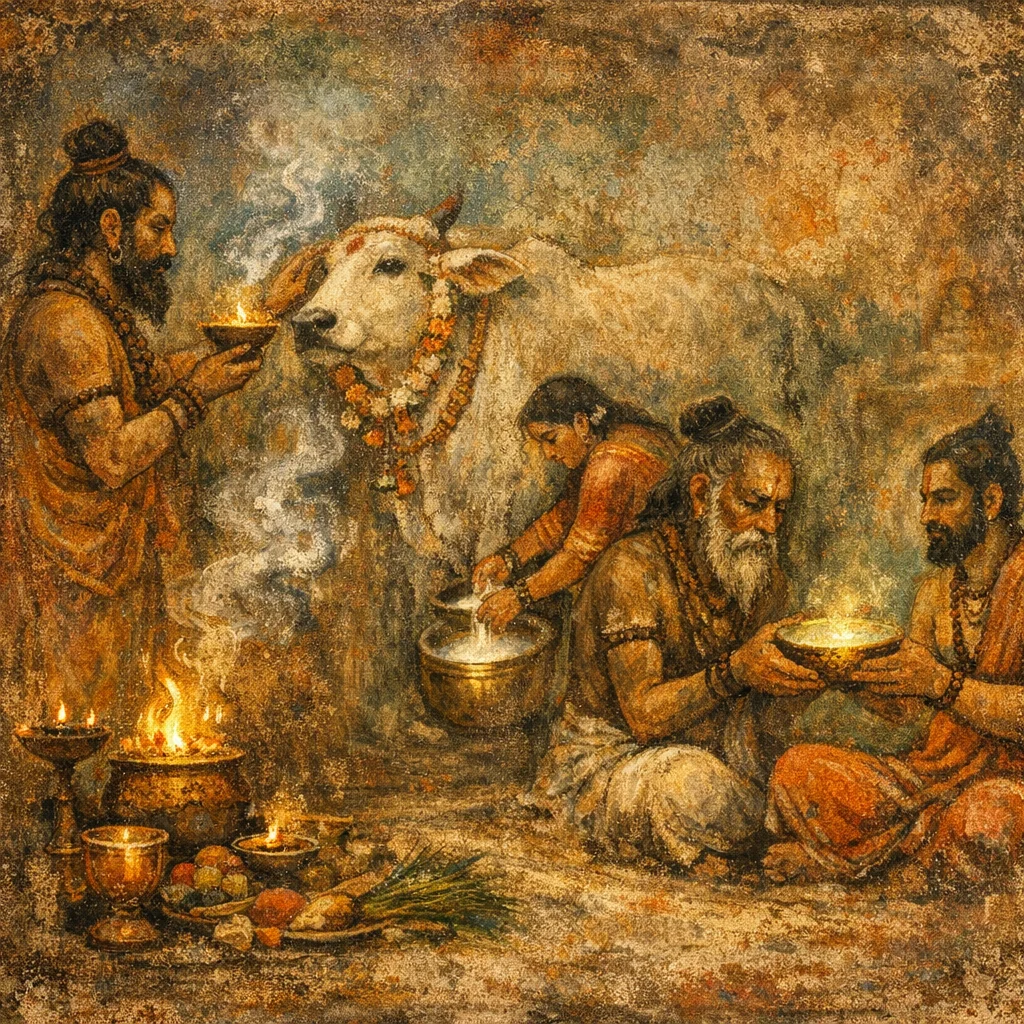
Sukta 10
Rishi: Atharvanic tradition (sūkta attributed within AV ritual corpus; specific ṛṣi assignment requires pada-anukramaṇī consultation).
Devata: Yajña (Sacrifice personified) / Vaśā as ritually empowered object
Chandas: Anuṣṭubh (predominant; to be confirmed by syllable count in critical edition)
Mantras
Mantra 1
वशा गौः। २३ बृहती, २४ उपरिष्टाद् बृहती, २६ आस्तारपङ्क्तिः, २७ शंकुमती, नमस्ते जायमानायै जाताया उत ते नमः । बालेभ्यः शफेभ्यो रूपायाघ्न्ये ते नमः
The Vāśā Cow. Homage to thee, in thy being born, and homage to thee when born. Homage, O inviolable one, to thy young, to thy hoofs, and to thy form.
Mantra 2
यो विद्यात् सप्त प्रवतः सप्त विद्यात् परावतः । शिरो यज्ञस्य यो विद्यात् स वशां प्रति गृह्णीयात्
Whoso should know the seven forward slopes, should know the seven far-remote regions; whoso should know the head of the Sacrifice, he may, in due claim, take to him the Vaśā-cow.
Mantra 3
वेदाहं सप्त प्रवतः सप्त वेद परावतः । शिरो यज्ञस्याहं वेद सोमं चास्यां विचक्षणम्
I know the seven forward slopes; the seven far-remote regions I know. The head of the Sacrifice I know; and Soma too, the manifest discerning power within this (Vaśā).
Mantra 4
यया द्यौर्यया पृथिवी ययापो गुपिता इमाः। वशां सहस्रधारां ब्रह्मणाच्छावदामसि
By that whereby Heaven, whereby Earth, whereby these Waters are guarded—unto the thousand-streaming Vaśā we speak, with brahman (sacred power).
Mantra 5
शतं कंसाः शतं दोग्धारः शतं गोप्तारो अधि पृष्ठे अस्याः । ये देवास्तस्यां प्राणन्ति ते वशां विदुरेकधा
A hundred vessels, a hundred milkers, a hundred guards are upon her back. The gods that breathe within her—those know the Vaśā in one accord, as one.
Mantra 6
यज्ञपदीराक्षीरा स्वधाप्राणा महीलुका । वशा पर्जन्यपत्नी देवाँ अप्येति ब्रह्मणा
With sacrifice for her footing, unmilkless, with svadhā for breath, of mighty fostering—Vaśā, the spouse of Parjanya, by brahman goes unto the gods.
Mantra 7
अनु त्वाग्निः प्राविशदनु सोमो वशे त्वा । ऊधस्ते भद्रे पर्जन्यो विद्युतस्ते स्तना वशे
After thee entered Agni; after thee Soma entered—bringing thee under mastery. Thy udder, O auspicious one, is Parjanya; thy teats are the lightnings—under mastery.
Mantra 8
अपस्त्वं धुक्षे प्रथमा उर्वरा अपरा वशे । तृतीयं राष्ट्रं धुक्षेऽन्नं क्षीरं वशे त्वम्
The Waters thou milkest forth—first; the fertile field next—under mastery. Thirdly thou milkest forth the realm: food, milk—under mastery art thou.
Mantra 9
यदादित्यैर्हूयमानोपातिष्ठ ऋतवरि । इन्द्रः सहस्रं पात्रान्त्सोमं त्वापाययद् वशे
When, invoked with the Ādityas, thou didst take thy station, O ṛta-rich one: Indra made thee drink the Soma in a thousand vessels—bringing thee under mastery.
Mantra 10
यदनूचीन्द्रमैरात् त्व ऋषभोऽह्वयत्। तस्मात् ते वृत्रहा पयः क्षीरं क्रुद्धोऽहरद् वशे
When Anūcī, from Āirāt, called the Bull unto thee, then the Vṛtra-slayer, in wrath, carried off thy milk—thy kṣīra—bringing it under mastery.
Mantra 11
यत् ते क्रुद्धो धनपतिरा क्षीरमहरद् वशे । इदं तदद्य नाकस्त्रिषु पात्रेषु रक्षति
When, angered, the Lord of Wealth carried off thy milk into mastery—this selfsame act to-day does Nāka guard within three vessels.
Mantra 12
त्रिषु पात्रेषु तं सोममा देव्यऽहरद् वशा। अथर्वा यत्र दीक्षितो बर्हिष्यास्त हिरण्यये
In threefold vessels that Soma did the Goddess bring hither—Vāśā. Where Atharvan, consecrated, sate him down upon the Barhis, on the golden seat.
Mantra 13
सं हि सोमेनागत समु सर्वेण पद्वता । वशा समुद्रमध्यष्ठाद् गन्धर्वैः कलिभिः सह
Yea, with Soma came she, in full accord, with all that is footed. Vāśā bestrode the Ocean, together with the Gandharvas, with the Kalis beside her.
Mantra 14
सं हि वातेनागत समु सर्वैः पतत्रिभिः । वशा समुद्रे प्रानृत्यदृचः सामानि बिभ्रती
Yea, with the Wind came she, in full accord, with all the winged. In the Ocean Vāśā danced forth, bearing the Ṛcs and bearing the Sāmans.
Mantra 15
सं हि सूर्येणागत समु सर्वेण चक्षुषा । वशा समुद्रमत्यख्यद् भद्रा ज्योतींषि बिभ्रती
Yea, with the Sun came she, in full accord, with all-seeing vision. Vāśā looked over the Ocean, gracious, bearing lights of blessing.
Mantra 16
अभीवृता हिरण्येन यदतिष्ठ ऋतावरि । अश्वः समुद्रो भूत्वाध्यस्कन्दद् वशे त्वा
Encompassed round with gold, when thou didst take thy stand, O keeper of Order: becoming the Ocean, a Horse leapt over—O Vāśā—unto thee.
Mantra 17
तद् भद्राः समगच्छन्त वशा देष्ट्र्यथो स्वधा। अथर्वा यत्र दीक्षितो बर्हिष्यास्त हिरण्यये
Then came the Auspicious Ones together—Vasā, the Deṣṭrī, and Svadhā besides—where Atharvan, consecrated, sat upon the barhis, on the golden (seat).
Mantra 18
वशा माता राजन्यऽस्य वशा माता स्वधे तव । वशाया यज्ञ आयुधं ततश्चित्तमजायत
Vasā is mother of the royal man; Vasā is mother of thee, O Svadhā. From Vasā the sacrifice is a weapon; from her, moreover, thought (and purpose) was born.
Mantra 19
ऊर्ध्वो बिन्दुरुदचरद् ब्रह्मणः ककुदादधि । ततस्त्वं जज्ञिषे वशे ततो होताजायत
Upward the seed-drop moved forth from upon the summit of brahman. Thence wast thou born, O Vasā; thence thereafter the Hotṛ was born.
Mantra 20
आस्नस्ते गाथा अभवन्नुष्णिहाभ्यो बलं वशे । पाजस्याऽज्जज्ञे यज्ञ स्तनेभ्यो रश्मयस्तव
From thy mouth the songs came into being; from the Uṣṇihs, O Vasā, strength. From fiery vigor the sacrifice was born; from thy breasts, thy rays (of power) issued.
Mantra 21
ईर्माभ्यामयनं जातं सक्थिभ्यां च वशे तव । आन्त्रेभ्यो जज्ञिरे अत्रा उदरादधि वीरुधः
From thy paired supports the course was born, and from thy thighs likewise, O Vasā. From the intestines here were the plants brought forth; from the belly, from within, the herbs arose.
Mantra 22
यदुदरं वरुणस्यानुप्राविशथा वशे । ततस्त्वा ब्रह्मोदह्वयत् स हि नेत्रमवेत् तव
When thou, O Vaśā, didst enter after and within the belly of Varuṇa, then did the Brahman invoke thee forth; for he, in truth, knew thy guiding rein.
Mantra 23
सर्वे गर्भादवेपन्त जायमानादसूस्वः । ससूव हि तामाहुवशेति ब्रह्मभिः क्लृप्तः स ह्यऽस्या बन्धुः
All trembled at her birth from the womb, O vital Breaths. For she was brought forth; and men call her ‘Vaśā’: by the brahmans is he made ready—he is, in sooth, her kinsman-link.
Mantra 24
युध एकः सं सृजति यो अस्या एक इद् वशी। तरांसि यज्ञा अभवन् तरसां चक्षुरभवद् वशा
In battle one sends her forth in full—he who alone is her master. Victorious crossings became the sacrifices; and Vaśā became the eye of those strong overcomings.
Mantra 25
वशा यज्ञं प्रत्यगृह्णाद् वशा सूर्यमधारयत्। वशायामन्तरविशदोदनो ब्रह्मणा सह
Vaśā took hold upon the sacrifice; Vaśā upheld the Sun. Within Vaśā entered the rice-mess, together with the sacred spell.
Mantra 26
वशामेवामृतमाहुर्वशां मृत्युमुपासते । वशेदं सर्वमभवद् देवा मनुष्या३ असुराः पितर ऋषयः
Vaśā—her indeed they call Immortality; Vaśā—Death do they wait upon. Vaśā became this All: gods and men, Asuras, Fathers, and seers.
Mantra 27
य एवं विद्यात् स वशां प्रति गृह्णीयात्। तथा हि यज्ञः सर्वपाद् दुहे दात्रेऽनपस्फुरन्
Whoso should know it thus, he may accept the Vaśā in return; for so, from every side, the Sacrifice is milked for the giver, unfaltering, slipping not away.
Mantra 28
तिस्रो जिह्वा वरुणस्यान्तर्दीद्यत्यासनि । तासां या मध्ये राजति सा वशा दुष्प्रतिग्रहा
Three are the tongues of Varuṇa, shining inwardly; of them, that which in the midst is resplendent—she is the Vaśā, hard to be accepted.
Mantra 29
चतुर्धा रेतो अभवद् वशायाः । आपस्तुरीयममृतं तुरीयं यज्ञस्तुरीयं पशवस्तुरीयम्
Fourfold became the seed of the Vaśā: the Waters are one fourth, Immortality one fourth, the Sacrifice one fourth, the Beasts one fourth.
Mantra 30
वशा द्यौर्वशा पृथिवी वशा विष्णुः प्रजापतिः । वशाया दुग्धमपिबन्त्साध्या वसवश्च ये
Vaśā is Heaven, Vaśā is Earth; Vaśā is Viṣṇu, (and) Prajāpati. The milk of Vaśā the Sādhyas drank, and the Vasus who are.
Mantra 31
वशाया दुग्धं पीत्वा साध्या वसवश्च ये । ते वै ब्रध्नस्य विष्टपि पयो अस्या उपासते
Having drunk the milk of Vaśā, the Sādhyas and the Vasus who are—these verily, in Bradhna’s station, attend upon her milk as nourishment.
Mantra 32
सोममेनामेके दुह्रे घृतमेक उपासते । य एवं विदुषे वशां ददुस्ते गतास्त्रिदिवं दिवः
Some milk her for Soma; some, again, attend her with ghee. They who, thus, have given the Vashā to the man of knowledge—those have gone unto the threefold heaven of the sky.
Mantra 33
ब्राह्मणेभ्यो वशां दत्त्वा सर्वांल्लोकान्त्समश्नुते । ऋतं ह्यऽस्यामार्पितमपि ब्रह्माथो तपः
Having given the Vashā unto the Brahmans, he wins, in full, all worlds. For in her are deposited Ṛta—yea, Brahman also—and moreover Tapas.
Mantra 34
वशां देवा उप जीवन्ति वशां मनुष्याऽउत। वशेदं सर्वमभवद् यावत् सूर्यो विपश्यति
On the Vashā live the Gods; on the Vashā men likewise. The Vashā became this All—so far as the Sun surveys with his far-seeing gaze.
Frequently Asked Questions
Vaśā is a ritually empowered cow treated as a sanctioned source of prosperity; her milk is elevated to Soma-like nourishment supported by divine precedent.
Because the hymn makes ritual knowledge itself the authorization: one who knows Yajña’s cosmic structure is entitled to take/receive Vaśā without blame or dispute.
Primarily wealth and stability (paustika): it aims to secure lawful acquisition, social legitimacy, and sustained nourishment through the sacral power of Vaśā’s milk.