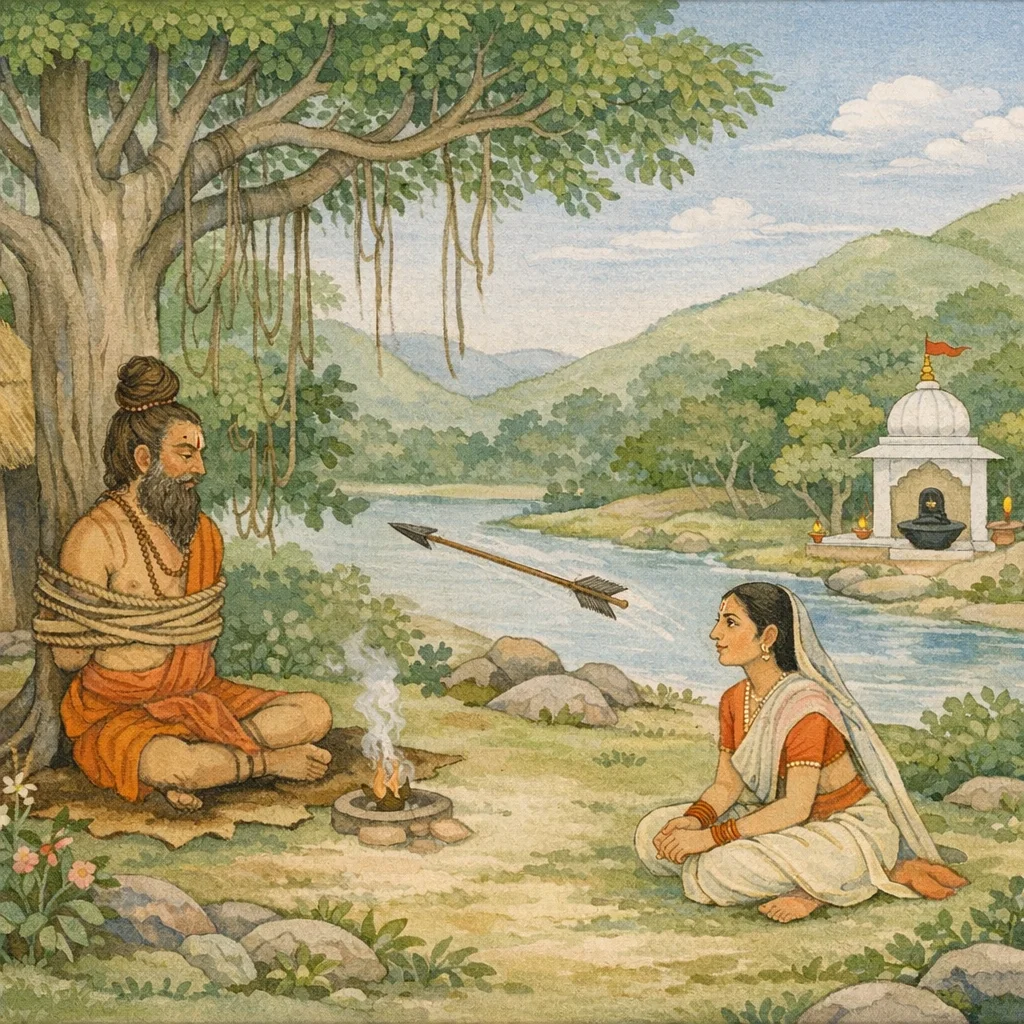
Adhyaya 37: Jabali Bound on the Banyan Tree and Nandayanti’s Appeal at Sri-Kantha on the Yamuna
जाबालिबन्धन-नन्दयन्ती-श्रीकण्ठयमुनातट-प्रसङ्गः (Jābāli-bandhana–Nandayantī–Śrīkaṇṭha-Yamunā-taṭa-prasaṅgaḥ)
Nandayanti's Appeal
Within the Pulastya–Nārada narrative frame of the Vāmana Purāṇa, this adhyāya unfolds a tightly woven etiological tale that sacralizes a Śaiva landscape on the Yamunā while retaining the Purāṇa’s characteristic syncretic theology. Viśvakarmā, cursed into a vānarā-form, becomes the agent of a chain of events involving the daitya Kandara and his daughter Devavatī. A dramatic pursuit leads to Śrīkaṇṭha (Śiva) on the Yamunā bank and to an abandoned āśrama, where Devavatī’s fate turns tragic and the vānarā is swept away by the river’s divine force. Parallelly, Nandayantī—yakṣa-born and marked by prophecy to become a king’s chief queen—wanders through forest and riverine zones, encounters the bound child-sage Jābāli, and is directed to Śrīkaṇṭha’s tīrtha. The episode culminates in Ṛtadhvaja’s appeal to the Ikṣvāku king and the martial rescue by Śakuni, blending ascetic power, royal dharma, and topographical sanctification around Yamunā-associated sacred sites.
Divine Beings
Sacred Geography
Mortal & Asura Figures
Key Content Points
- Viśvakarmā’s curse into vānaratā triggers a pursuit narrative: the daitya Kandara’s daughter Devavatī is seized, leading to flight toward Himālaya and the Yamunā-bank presence of Śrīkaṇṭha (Śiva).
- Nandayantī’s forest-exile and river-transport culminate in her discovery of the child Jābāli bound by his own jaṭā to a vaṭa (banyan), with a detailed time-scale of life-stages and suffering—an ascetic-chronological motif.
- Tīrtha-oriented resolution: Jābāli directs Nandayantī to Śrīkaṇṭha at Yamunātaṭa; Ṛtadhvaja reads her inscribed prophecy, approaches the Ikṣvāku ruler at Ayodhyā, and Śakuni’s archery cuts the latā-pāśa ‘yantra’ to free Jābāli.
Shlokas in Adhyaya 37
Verse 1
इति श्रीवामनपुराणे षट्त्रिशोध्यायः नाराद उवाच गतो ऽन्धकस्तु पाताले किमचेष्टत दानवः शङ्करो मन्दरस्थो ऽपि यच्चाकार तदुच्यताम्
“(Thus ends) the thirty-sixth chapter in the Śrī Vāmana Purāṇa. Nārada said: ‘When Andhaka went to Pātāla, what did that Dānava do? And what did Śaṅkara do while dwelling on Mandara? Please tell (me) that.’”
Verse 2
पुलास्त्य उवाच पातालस्थो ऽन्धको ब्रह्मन् बाध्यते मदनाग्निना संत्पतविग्रहः सर्वान् दानवानिदमब्रवीत्
“Pulastya said: ‘O Brahmin, Andhaka, while staying in Pātāla, was tormented by the fire of desire (lust). His body scorched with distress, he spoke these words to all the Dānavas.’”
Verse 3
स मे सुहृत्स मे बन्धुः स भ्रात स पिता मम यस्तामद्रिसुतां शीघ्नं ममान्ति कमुपानयेत्
“He is my well-wisher, he is my kinsman; he is my brother, he is my father—whoever would quickly bring that daughter of the mountain to me, to satisfy my desire.”
Verse 4
एवं ब्रुवति दैत्येन्दे अन्धके मदनान्धके मेघगम्भीरनिर्घोषं प्रहलादो वाक्यमब्रवीत्
“While the lord of the Daityas, Andhaka—blinded by the intoxication of passion—was speaking thus, Prahlāda spoke words resonant and deep like the rumbling of clouds.”
Verse 5
येयं गिरिसुता वीर सा माता धर्मतस्तव पिता त्रिनयनो देवः श्रूयतामत्र कारणम्
“O hero, this very Girisutā is, by dharma, your mother; and the three-eyed god is your father. Hear now the reason for this.”
Verse 6
तव पित्रा ह्यपुत्रेम धर्मनित्येन दानव आराधितो महादेवः पुत्रार्थाय पुरा किल
O Dānava, formerly your father—being without a son and steadfast in dharma—propitiated Mahādeva in order to obtain a son.
Verse 7
तस्मै त्रिलोचननासीद् दत्तो ऽन्धो ऽप्येव दानव पुत्रकः पुत्रकामास्य प्रोक्त्वेत्यं वचनं विभो
Then, by Trilocana (the Three-eyed One), a son was granted to him—though blind, O Dānava—after he (Śiva) spoke these words to that son-seeking (father), O Lord.
Verse 8
नेत्रत्रयं हिरण्याक्ष नर्मार्थमुमया मम पिहितं योगसंस्थस्य ततो ऽन्धमभवत्तमः
O Hiraṇyākṣa, for sport Umā covered my three eyes while I was established in yoga; from that, darkness came to be—(and thus) he became blind.
Verse 9
तस्माच्च तमसो जातो भूतो नीलघनस्वनः तदितं गृह्यतां दैत्य तवोपयिकमात्मजम्
“And from that Darkness (Tamas) there was born a being whose sound was like a dark thundercloud. ‘O Daitya, accept this son—one who will be useful to you.’”
Verse 10
यदा तु लोकविद्विष्टं दुष्टं कर्म करिष्यति त्रैलोक्यजननीं चापि अभीवाञ्छिष्यते ऽधमः
“But when he commits wicked deeds hated by the world, and when that vile one even lusts after the Mother of the three worlds…”
Verse 11
घातयिष्यति वा विप्रं यदा प्रक्षिप्त चासुरान् तदास्य स्वयमेवाहं करिष्ये कायशोधनम्
“Or when he kills a brāhmaṇa, and when he harasses/assails the asuras (or: when he is incited among the asuras), then I myself shall perform the ‘purification of his body’ (i.e., I will personally punish and destroy him).”
Verse 12
एवमुक्त्वा गतः शंभुं स्वस्थानं मन्दराचलम् त्वत्पितापि समभ्यागात् त्वामादाय रसातलम्
“Having spoken thus, Śambhu departed to his own abode, Mount Mandara. Then your father also came, and taking you with him, went down to Rasātala.”
Verse 13
एतेन कारणेनाम्बा शैलेयी भविता तव सर्वस्यापीह जगतो गुरुः शंभुः पिता ध्रुवम्
“For this reason, dear one, your mother will be Śaileyī; and indeed Śambhu—teacher of this entire world—is certainly your father.”
Verse 14
भवानपि तपोयुक्तः शास्त्रवेत्ता गुणाप्लुतः नेदृशे पापसंकल्पे मतिं कुर्याद् भवद्विधः
“You too are endowed with austerity, a knower of the scriptures, and filled with virtues; one like you should not set one’s mind upon such a sinful intention.”
Verse 15
त्रैलोक्यप्रभुरव्यक्तो भवः सर्वैर्नमस्कृतः अजेयस्तस्य भार्येयं न त्वमर्हे ऽमरार्दन
“Bhava (Śiva) is the unmanifest lord of the three worlds, revered by all; he is unconquerable. This woman is his wife—O subduer of the gods—she is not fit to be sought by you.”
Verse 16
न चापि शक्तः प्राप्तुं तां भवाञ्शैलनृपात्मजाम् अजित्वा सगणं रुद्रं स च कामो ऽद्य दुर्लभः
“Nor are you capable of obtaining her—Bhavā’s (consort), the daughter of the mountain-king—unless you first conquer Rudra together with his hosts; and that desire (kāma) is, today, hard to attain (i.e., impossible to fulfill).”
Verse 17
यस्तरेत् सागरं दोर्भ्या पातयेद् भुवि भास्करम् मेरुमुत्पाटयेद् वापि स जयेच्छूलपाणिनम्
“He who could cross the ocean with his arms, who could bring the Sun down to the earth, or who could uproot Mount Meru—only such a one could conquer the Spear/Trident-bearer (Śiva).”
Verse 18
उताहोस्विदिमाः शक्याः क्रियाः कर्तुं नरेर्बलात् न च शक्यो हरो जेतुं सत्यं सत्यं मयोदितम्
“Or else, are these deeds truly possible to be accomplished by the strength of a mere man? And Hara cannot be conquered—this is truth, truth, as I have declared.”
Verse 19
किं त्वया न श्रुतं दैत्य यथा दण्डो महीपलिः परस्त्रीकामवान् मूढः सराष्ट्रो नाशमाप्तवान्
“Have you not heard, O Daitya, how Daṇḍa, a lord of the earth—foolish and consumed by desire for another man’s wife—met destruction along with his entire kingdom?”
Verse 20
आसीद् दण्डो नाम नृपः प्रभूतबलवाहनः स च वव्रे महातेजाः पौरोहित्याय भार्गवम्
“There was a king named Daṇḍa, possessed of abundant strength and forces. That mighty one chose a Bhārgava as his royal priest (purohita).”
Verse 21
ईजे च विविधैर्यज्ञैर्नृपतिः शुक्रपावलितः सुक्रस्यासीच्च दुहिता अरजा नाम नामतः
The king, guided by Śukra, performed various sacrifices. And Śukra had a daughter, whose name by appellation was Arajā.
Verse 22
शुक्रः कदाचिदगमद् वृषुपर्वाणमासुरम् तेनार्चितश्चिरं तत्र तस्थौ भार्गवसत्त्मः
On one occasion Śukra went to the Asura Vṛṣaparvan. Honored by him, the excellent Bhārgava stayed there for a long time.
Verse 23
अरजा स्वगृहे वह्निं शुश्रुषन्ती महासुर अतिष्ठत सुचार्वङ्गी ततो ऽब्यागान्नराधिपः
Arajā, in her own house, stood attending upon the sacred fire. She, of beautiful limbs, remained there; then the king arrived.
Verse 24
स पप्रच्छ क्व शुक्रोति तमूचुः परिचारिकाः गतः स भगवान् शुक्रो याजनाय दनोः सुतम्
He asked, “Where is Śukra?” The attendants replied to him: “That venerable Śukra has gone to officiate as priest for the son of Danu, in order to conduct his sacrifice.”
Verse 25
पप्रच्छ नृपतिः का तु तिष्ठते भार्गवाश्रमे तास्तमूचुर्गुरोः पुत्री संतिष्ठत्यरजा नृप
The king asked, “Who is it that remains in the Bhārgava hermitage?” They replied to him: “O king, the guru’s daughter, Arājā, stays here.”
Verse 26
तामाश्रमे शुक्रसुतां द्रष्टुमिक्ष्वाकुनन्दनः प्रविवेश महाबाहुर्ददर्शारजसं ततः
Wishing to see Śukra’s daughter in the hermitage, the descendant of Ikṣvāku—mighty-armed—entered, and there he beheld Arājā.
Verse 27
तां तृष्ट्वा कामसंतप्तस्तत्क्षणादेव पार्थिवः संजातो ऽन्धक दण्डस्तु कृतान्तबलचोदितः
Seeing her, the king was instantly scorched by desire; at that very moment the ‘rod of Andhaka’ came into being, impelled by the force of Kṛtānta (Death).
Verse 28
ततो विसर्जयामास भृत्यान् भ्रातृन् सुहृत्तमान् शुक्रशिष्यानपि बली एकाकी नृप आव्रजत्
Then Bali dismissed his attendants, his brothers, and his dearest friends—along with even the disciples of Śukra—and the king returned alone.
Verse 29
तमागतं शुक्रसुता प्रत्युत्थाय यशस्विनी पूजयामास संहृष्टा भ्रातृभावेन दानव
When he arrived, Śukra’s daughter—illustrious—rose to greet him and, delighted, honored the Dānava with the affection due to a brother.
Verse 30
ततस्तामाह नृपतिर्बाले कामाग्निवारिणा मां समाह्लादयस्वाद्य स्वपरिष्वङ्गवारिणा
Then the king said to her: “O young girl, with the water that quenches the fire of desire, refresh me—by the water of your own embrace.”
Verse 31
सापि प्राह नृपश्रेष्ठ मा विनीनस आतुरः पिता मम महाक्रोधात् त्रिदशानपि निर्दहेत्
She too said: “O best of kings, do not be reckless in your agitation. My father, through great wrath, could burn even the thirty gods (the Devas).”
Verse 32
मूढबुद्धे भवान् भ्राता ममासि त्वनयाप्लुतः भगिनी धर्मतस्ते ऽहं भवाञ्शिष्यः पितुर्मम
“O foolish-minded one, you are my brother—by this (relationship) you are encompassed. By dharma I am your sister; and you are the disciple of my father.”
Verse 33
सो ऽब्रोवीद् भीरु मां शुक्रः कालेन परिधक्ष्यति कामाग्निर्निर्दहति मामद्यैव तनुमध्यमे
He said: “O timid one, Śukra will, in due course, burn me all around; the fire of desire is consuming me—today itself—within the middle of my body.”
Verse 34
सा प्राह दण्डं नृपातिं मुहूर्त परिपालय तमेव याचस्व गुरुं स ते दास्यत्यसंशयम्
She said to Daṇḍa, the lord of men: “Wait for a moment; entreat that very guru—he will grant it to you without doubt.”
Verse 35
दण्डो ऽब्रवीत् सुतन्वङ्गि कालक्षेपो न मे क्षमः च्युतावसरकर्तृत्वे विघ्नो जायेत सुन्दरि
Daṇḍa said: “O slender-limbed one, I cannot tolerate delay of time. If one acts after the proper opportunity has slipped, an obstacle will arise, O fair one.”
Verse 36
ततो ऽब्रवीच्च विरजा नाहं त्वां पार्थिवात्मज दातुं शक्ता स्वमात्मानं स्वतन्त्रा न हि योषितः
Then Virajā spoke: “O son of a king, I am not able to give myself to you. For a woman is not independent (to dispose of herself at will).”
Verse 37
किं वा ते बहुनोक्तेन मा त्वं नाशं नराधिप गच्छस्व शुक्रशापेन सभृत्यज्ञातिबान्धवः
“But what is the use of saying much? O lord of men, do not go to destruction—(lest) by Śukra’s curse you become bereft of attendants, kinsmen, and friends.”
Verse 38
ततो ऽऽब्रवीन्नरपतिः सुतनु शृणु चेष्टितम् चित्राङ्गदाया यद् वृत्तं पुरा देवयुगे शुभे
Then the king said: “O fair-bodied one, listen to the conduct (and) what happened long ago to Citrāṅgadā in the divine age, O auspicious lady.”
Verse 39
विश्वकर्णसुता साध्वी नाम्ना चित्राङ्गदाभवत् रूपयौवनसंपन्ना पद्महीनेव पद्मिनी
Viśvakarṇa’s daughter, a virtuous woman named Citrāṅgadā, was endowed with beauty and youth—like a lotus-pond bereft of lotuses.
Verse 40
सा कदाचिन्महारण्यं सखीभिः परिवारिता जगाम नेमिषं नाम स्नातुं कमललोचना
Once, that lotus-eyed lady—surrounded by her companions—went to the great forest called Nemiṣa, in order to bathe.
Verse 41
सा स्नातुमवतीर्णा च अथाभ्यागान्नरेश्वरः सुदेवतनयो धीमान् सुरथो नाम नामतः तां ददर्श च तन्वङ्गीं शुभाङ्गो मदनातुरः
And as she had descended to bathe, then a king arrived—wise Suratha by name, the son of Sudevatā. He saw that slender-limbed woman; though of handsome form, he became afflicted by desire.
Verse 42
तं दृष्ट्वा सा सखीराह वचनं सत्यसंयुतम् असौ नराधिपसुतो मदनेन सदर्थ्यते
Seeing him, she spoke to her friends words joined with truth: “That prince, the son of a king, is being afflicted—indeed tormented—by Kāma (love/desire).”
Verse 43
मदर्थे च क्षमं मे ऽस्य स्वप्रदानं सुरूपिणः सख्यस्तामब्रुवन् बाला न प्रगल्भऽसि सुन्दरि
“And for my sake, let the self-giving (offering oneself in marriage) to that handsome man be permitted.” Her friends said to the girl: “Fair one, you are not yet bold/independent (enough) [to decide this on your own].”
Verse 44
अस्वातन्त्र्यं तवास्तीह प्रदाने स्वत्मनो ऽनघे पिता तवास्ति धर्मिष्ठः सर्वशिल्पविशारदः
“Blameless one, in this matter of giving yourself (in marriage) you do not have independence here. Your father is present—most righteous, and skilled in every art (i.e., competent in all matters).”
Verse 45
न ते युक्तमिहात्मानं दातुं नरपतेः स्वयम् एतस्मिन्नन्तरे राजा सुरथः सत्यवात् सुधी
“It is not proper for you, here, to give yourself (in marriage/sexual surrender) of your own accord to a king. Meanwhile, King Suratha—truthful in speech and wise—(arrived/was present).”
Verse 46
समभ्येत्याब्रबीदेनां कन्दर्पशरपीडितः त्वं मुग्धे मोहयसि मां दृष्ट्यैव मदिरेक्षणे
“Approaching her, he spoke—tormented by the arrows of Kandarpa: ‘O naïve one, you bewilder me merely by your glance, O you whose eyes are intoxicating.’”
Verse 47
त्वद्दृष्टिरपातेन स्मरेणाभ्येत्य ताडितः तन्मां कुचतले तल्पे अभिशायितुमर्हसि
“Struck by Smara as he came upon me through the descent/fall of your glance, therefore you ought to let me lie down upon the bed at the slope/level of your breasts.”
Verse 48
नोचेत् प्रधक्ष्यते कामो भूयो भूयो ऽतिदर्शनात् ततः सा चारुसर्वाङ्गी राज्ञो राजीवलोचना
“Otherwise, desire will blaze up again and again from repeated seeing. Therefore that lotus-eyed woman of lovely limbs (kept herself from further encounter) with the king.”
Verse 49
वार्यमाणा सखीभिस्तु प्रादादात्मानमात्मना एवं पुरा तया तैन्व्या परित्रातः स भूपतिः
“Though being restrained by her girlfriends, she gave herself of her own accord. Thus formerly, by that slender-waisted woman, that king was saved/protected.”
Verse 50
तस्मान्मामपि सुश्रोणि त्वं परित्रातुमर्हसि अरजस्काब्रवीद् दण्डं तस्या यद् वृत्तमुत्तरम्
“Therefore you too, O fair-hipped one, ought to protect me. Arajaskā spoke to Daṇḍa (and related) what further happened in her case.”
Verse 51
किं त्वया न पिरज्ञातं तस्मात् ते कथयाम्यहम् तदा तया तु तन्वङ्ग्या सुरथस्य महीपतेः
“What is it that you have not understood? Therefore I shall explain it to you. At that time, however, that slender-limbed maiden (tanvaṅgī), in connection with King Suratha…”
Verse 52
आत्मा प्रदत्तः स्वातन्त्र्यात् ततस्तामशपत् पिता यस्माद् धर्मं परित्यज्य स्त्रीभावान् मन्दचेतसे
“Out of her own independence (svātantrya), she had given herself (in love). Then her father cursed her: ‘Because, O dull-minded one, you have abandoned dharma and taken to the condition/role of a woman (strī-bhāva)…’”
Verse 53
आत्मा प्रदत्तस्तस्माद्धि न विवाहो भविष्यति विवाहरहिता नैव सुखं लप्स्यसि भर्तृतः
“Since you have given yourself, therefore indeed there will be no marriage (for you). Without marriage, you will not obtain happiness from a husband (i.e., the joys/security of conjugal life).”
Verse 54
न च पुत्रफलं नैव पतिना योगमेष्यसि उत्सृष्टमात्रे शापे तु ह्यपोवाह त्रयोदश अपकृष्टे नपरपतौ सापि मोहमुपागता
“You shall obtain no fruit in the form of a son, nor shall you attain union with your husband. But as soon as the curse was uttered, the king was carried away—thirteen yojanas—by the current of water; and when the lord of men had been drawn away, she too fell into delusion.”
Verse 55
अकृतार्थं नरपतिं योजनानि त्रयोदश अपकृष्टे नपरपतौ सापि मोहमुपागता
“The king, his purpose unfulfilled, was dragged away for thirteen yojanas; when the lord of men had been drawn off, she too became overcome by delusion.”
Verse 56
ततस्तां सिषिचुः सख्यः सरस्वत्या जलेन हि सा सिच्यमाना सुतरां शिशिरेणाप्यथाम्भसा
“Then her female companions sprinkled her indeed with the water of the Sarasvatī. As she was being sprinkled—especially with that cool water—(she began to recover/was soothed).”
Verse 57
मृतकल्पा महाबाहो विश्वकर्मसुताभवत् तां मृतामिति विज्ञाय जग्मुः सख्यस्त्वरान्विताः
O mighty-armed one, Viśvakarmā’s daughter became as though dead. Realizing, “She is dead,” her female companions hurried away in haste.
Verse 58
काष्ठान्याहर्तुमपरा वह्निमानेतुमाकुलाः सा च तास्वपि सर्वासु गतासु वनमुत्तमम्
Some went to fetch firewood; others, in agitation, went to bring fire. And she, when all of them had gone, went to an excellent forest.
Verse 59
संज्ञां लेभे सुचार्वङ्गी दिशश्चाप्यवलोकयत् अपश्यन्ती नापतिं तथा स्निग्धं सखीजनम्
The fair-limbed woman regained consciousness and looked about in all directions; yet she did not see her husband, nor her affectionate circle of companions.
Verse 60
निपपात सरस्वत्याः पयसि स्फुरितेक्षणा तां वेगात् काञ्चनाक्षी तु महानद्यां नरेश्वर
O king, the golden-eyed (woman), her eyes flashing, plunged into the waters of the Sarasvatī; and, borne along by the force of the current, she was carried into the great river.
Verse 61
गोमत्यां परिचिक्षेप तरङ्कुटिले जले तयापि तस्यास्तद्भाव्यं विदित्वाथ विशां पते
O lord of the people, she was cast into the Gomati, into water made crooked by waves; and that (river) too, having understood what was destined for her, then (acted accordingly).
Verse 62
महावने परिक्षिप्ता सिंहव्याघ्रभयाकुले एवं तस्याः स्वतन्त्राया एषावस्था श्रुता मया
Cast into the Great Forest (Mahāvana), a place filled with fear from lions and tigers—such, I have heard, was the condition of that independent (woman).
Verse 63
तां प्राह पुत्रि कस्यासि सुता सुरसुतोपमा किमर्थमागतासीह निर्मनुष्यमृगे वने
He said to her: “Daughter, whose child are you—one who resembles the daughter of a god? For what purpose have you come here, into this forest, devoid of people and filled with wild beasts?”
Verse 64
ततः सा प्राह तमृषिं यथातथ्यं कृशोदरी श्रुत्वार्षिः कोपमगमदशपच्छिल्पिनां वपम्
Then the slender-waisted woman told that sage the matter exactly as it had happened. Having heard it, the sage was seized by anger—[directed] at the sinful artisan(s) (or: at the ‘ten artisans’)—[and at] that wretched deed/condition.
Verse 65
यस्मात् स्वतनुजातेयं परदेयापि पापिना योजिता नैव पतिना तस्माच्छाखामृगो ऽस्तु सः
“Because this girl—one’s own offspring—though fit to be given [in marriage] to another, was not properly joined to a husband by that sinful man, therefore let him become a ‘śākhā-mṛga’ (a branch-dwelling animal/monkey).”
Verse 66
इत्युक्त्वा स महायोगी भूयः स्नात्वा विधानतः उपास्य पश्विमां सन्ध्यां पूजयामास शङ्करम्
Having spoken thus, that great yogin again bathed according to the prescribed rule; then, having performed the evening twilight worship, he proceeded to worship Śaṅkara.
Verse 67
संपूज्य देवदेवेशं यथोक्तविधिना हरम् उवाचागम्यतां सुभ्रूं सुदतीं पतिलालसाम्
Having fully worshipped Hara—the Lord of the lords of gods—according to the stated procedure, he said: ‘Let that fair-browed, beautiful-toothed woman, longing for her husband, be brought (here).’
Verse 68
गच्छस्व सुभगे देशं सप्तगोदावरं शुभम् तत्रोपास्य महेशानं महान्तं हाटकेश्वरम्
‘Go, O fortunate one, to the auspicious region called Saptagodāvara; there, worship Maheśāna—the great Hāṭakeśvara.’
Verse 69
तत्र स्थिताया रम्भोरु ख्याता देववती शुभा आगमिष्यति दैत्यस्य पुत्री कन्दरमालिनः
“When you remain stationed there, O one with beautiful thighs (Rambhoru), the auspicious and renowned Devavatī will come—she who is the daughter of the Daitya Kandaramālin.”
Verse 70
तथान्या सुह्यकसुता नन्दयन्तीति विश्रुता अञ्जनस्यैव तत्रापि समेष्यति तपस्विनी तथापरा वेदवती पर्जन्यदुहिता शुभा
“Likewise another—Nandayantī, famed as the daughter of Suhyaka—will also come there; and the ascetic woman Añjanā will come there as well. And another, the auspicious Vedavatī, the daughter of Parjanya, (will come).”
Verse 71
यदा तिस्रः समेष्यन्ति सप्तगोदावरे जले हाटकाख्ये महादेव तदा संयोगमेष्यसि
“When the three (women) assemble in the waters of Saptagodāvarī, at the place called Hāṭaka, O Mahādeva—then you will attain the destined conjunction (meeting/union).”
Verse 72
इत्येवमुक्ता मुनिना बाला चित्राङ्गदा तदा सप्तगोदावरं तीर्थमगमत् त्वरिता ततः
Thus instructed by the sage, the young woman Citrāṅgadā then hurriedly went from there to the sacred ford known as Sapta-Godāvara.
Verse 73
संप्राप्य तत्र देवेशं पूजयन्ती त्रिलोचनम् समध्यास्ते शुचिपरा फलमूलाशनाभवत्
Having arrived there, she worshipped the Lord of the gods—Trilocana (the Three-Eyed One)—and remained there, devoted to purity, living on fruits and roots.
Verse 74
स चर्षिर्ज्ञानसंपन्नः श्रीकण्ठायतने ऽलिखत् श्लोकमेकं महाख्यानं तस्याश्च प्रियकाम्यया
And that sage, endowed with knowledge, in the sanctuary of Śrīkaṇṭha, composed (wrote) a single verse—a great sacred narrative—out of a wish to do what was dear to her (to fulfill her cherished desire).
Verse 75
न सो ऽस्ति कश्चित् त्रिदशो ऽसुरो वा यक्षो ऽथ मर्त्यो रजनीचरो वा इदं हि दुःखं मृगशावनेत्र्या निर्मार्जयेद् यः स्वपराक्रमेण
There exists no one—whether a god, an asura, a yakṣa, a mortal, or a night‑ranging being—who by his own prowess could wipe away this sorrow of the doe‑eyed lady.
Verse 76
इत्येवमुक्त्वा स मुनिर्जगाम द्रष्टुं विभुं पुष्करनाथमीड्यम् नदीं पयोष्णीं मुनिवृन्दवन्द्यां संचिन्तयन्नेव विशालनेत्राम्
Having spoken thus, that sage departed to behold the all‑powerful Lord—Puṣkaranātha, worthy of praise—and (to reach) the river Payōṣṇī, venerated by hosts of sages, while continually thinking of the large‑eyed lady.
Frequently Asked Questions
Although the immediate plot is Śaiva-leaning—centering on Śrīkaṇṭha (Śiva) at the Yamunā bank—the chapter’s theology remains characteristically Purāṇic and integrative: divine agency operates through both ascetic tapas (ṛṣi-power) and a sanctified deity-presence at a tīrtha, while royal dharma (Ikṣvāku lineage intervention) becomes the worldly instrument of restoration. This layered causality—deity, river-goddess, tapas, and kingship—reflects the Vāmana Purāṇa’s broader syncretic method rather than a sectarian exclusivism.
The adhyāya repeatedly anchors turning-points at the Yamunā/कालिन्दी and specifically at Śrīkaṇṭha on the Yamunātaṭa, presenting the site as a ritually potent locus where worship, inscription, and recognition occur. Nandayantī is explicitly instructed to go to Śrīkaṇṭha at midday when Ṛtadhvaja arrives to worship Śarva, and the narrative treats the river’s force (Kālindī’s ‘vega’) as a divine conveyor of fate—thereby sacralizing both the river corridor and the Śiva-sthāna as pilgrimage-relevant geography.
This adhyāya does not directly advance the Bali–Vāmana conflict; instead it foregrounds asura-dharma and royal dharma in a rescue-plot: a daitya household (Kandara–Devavatī) intersects with ascetic discipline (Jābāli’s survival ‘tapaso balāt’) and culminates in kṣātra skill (Śakuni’s archery) deployed in service of a sage’s request. The moral emphasis shifts to the efficacy of tapas, the legitimacy of righteous royal intervention, and the sanctifying authority of tīrtha-space.