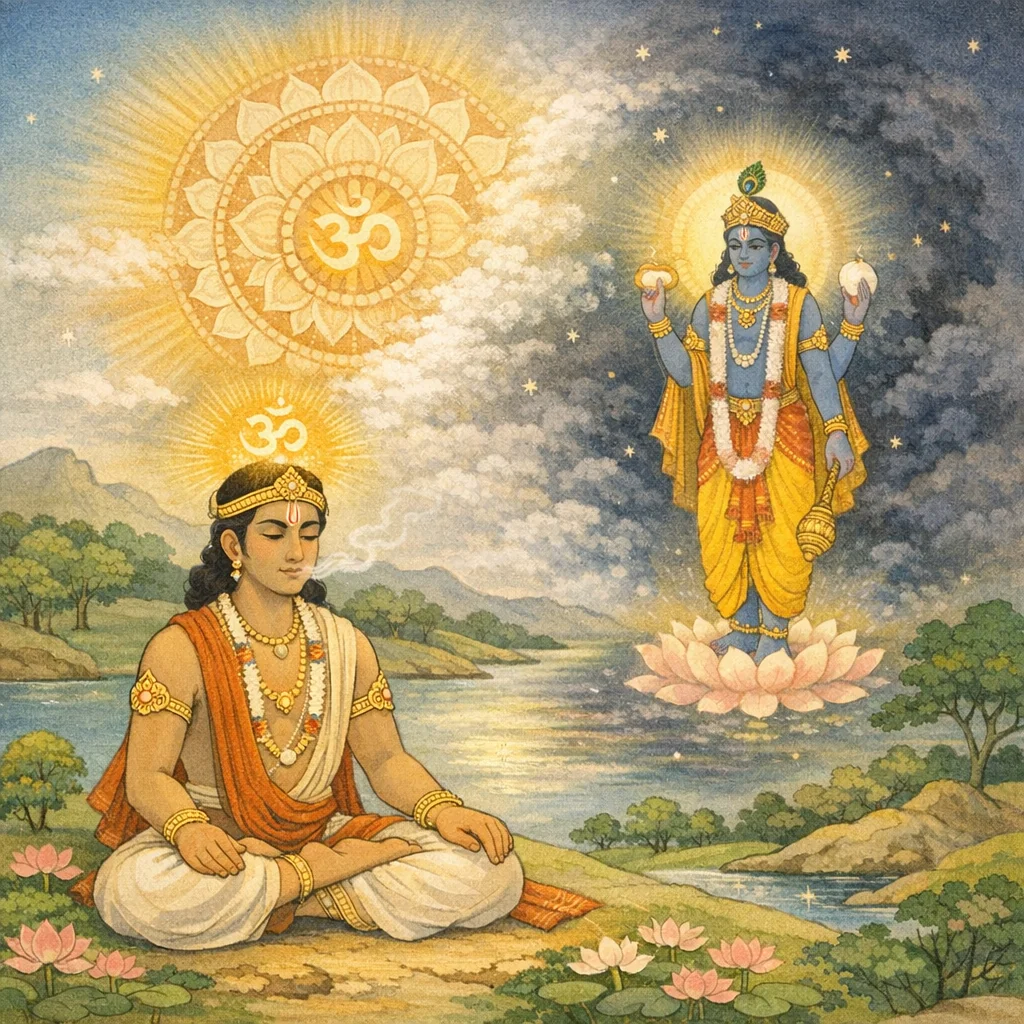
Chapter 8: Akshara Brahma Yoga
अक्षरब्रह्मयोग
The Yoga of the Imperishable Brahman
Chapter 8 advances a tightly structured metaphysical inquiry framed by Arjuna’s request for definitional clarity and practical guidance at the moment of transition. He asks Krishna to distinguish Brahman, adhyatma (the inner Self-domain), karma (creative causality), adhibhuta (the perishable field), adhidaiva (the cosmic intelligence), and adhiyajna (the sacrificial principle), and to explain how the disciplined practitioner can know the Divine at the time of departure. Krishna answers by mapping reality into interlocking layers—imperishable Brahman, embodied nature, and action as the generative offering—then pivots to a soteriological principle: the final remembered orientation shapes the next state. The chapter introduces a disciplined remembrance-yoga (smarana supported by abhyasa and bhakti), including pranayama-like concentration and the mantra “Om” as a unifying symbol. It also presents a cosmological arc of cycles (day/night of Brahma) and two “paths” (light/dark) to clarify non-return and return, concluding that steady yogic integration surpasses ritual merit and stabilizes liberation-oriented focus.
Speakers
Key Concepts
Philosophical Constructs
Shlokas in Chapter 8
Verse 1
अर्जुन उवाच । किं तद्ब्रह्म किमध्यात्मं किं कर्म पुरुषोत्तम । अधिभूतं च किं प्रोक्तमधिदैवं किमुच्यते ॥ ८.१ ॥
Arjuna said: O Supreme Person, what is that Brahman? What is adhyātma? What is karma? What is called adhibhūta, and what is termed adhidaiva?
Verse 2
अधियज्ञः कथं कोऽत्र देहेऽस्मिन्मधुसूदन । प्रयाणकाले च कथं ज्ञेयोऽसि नियतात्मभिः ॥ ८.२ ॥
Who is Adhiyajña here in this body, O Madhusūdana? And how are You to be known at the time of departure by the self-controlled?
Verse 3
श्रीभगवानुवाच । अक्षरं ब्रह्म परमं स्वभावोऽध्यात्ममुच्यते । भूतभावोद्भवकरो विसर्गः कर्मसंज्ञितः ॥ ८.३ ॥
The Blessed Lord said: The Supreme Imperishable is Brahman; one’s own nature is called adhyātma; and the creative outflow that brings forth the existence of beings is called karma.
Verse 4
अधिभूतं क्षरो भावः पुरुषश्चाधिदैवतम् । अधियज्ञोऽहमेवात्र देहे देहभृतां वर ॥ ८.४ ॥
The perishable mode of existence is called adhibhūta; the cosmic Person is called adhidaiva; and I alone am Adhiyajña here in this body, O best of embodied beings.
Verse 5
अन्तकाले च मामेव स्मरन्मुक्त्वा कलेवरम् । यः प्रयाति स मद्भावं याति नास्त्यत्र संशयः ॥ ८.५ ॥
And at the final moment, remembering Me alone, one who departs, leaving the body, attains My state—of this there is no doubt.
Verse 6
यं यं वापि स्मरन्भावं त्यजत्यन्ते कलेवरम् । तं तमेवैति कौन्तेय सदा तद्भावभावितः ॥ ८.६ ॥
Whatever state one remembers while leaving the body at the end, that very state one attains, O son of Kuntī, being ever formed by that state.
Verse 7
तस्मात्सर्वेषु कालेषु मामनुस्मर युध्य च । मय्यर्पितमनोबुद्धिर्मामेवैष्यस्यसंशयम् ॥ ८.७ ॥
Therefore, at all times remember Me, and also fight (do your ordained duty). With mind and intellect offered to Me, you shall surely come to Me—without doubt.
Verse 8
अभ्यासयोगयुक्तेन चेतसा नान्यगामिना । परमं पुरुषं दिव्यं याति पार्थानुचिन्तयन् ॥ ८.८ ॥
With a mind disciplined by the yoga of practice, not wandering elsewhere, meditating upon Him, one attains the supreme, divine Person, O Pārtha.
Verse 9
कविं पुराणमनुशासितारमणोरणीयांसमनुस्मरेद्यः । सर्वस्य धातारमचिन्त्यरूपमादित्यवर्णं तमसः परस्तात् ॥ ८.९ ॥
Whoever remembers the Seer, the Ancient, the Ruler; subtler than the subtlest; the Sustainer of all; of inconceivable form; radiant like the sun; beyond darkness—
Verse 10
प्रयाणकाले मनसाचलेन भक्त्या युक्तो योगबलेन चैव । भ्रुवोर्मध्ये प्राणमावेश्य सम्यक् स तं परं पुरुषं उपैति दिव्यम् ॥ ८.१० ॥
At the time of departure, with an unwavering mind, endowed with devotion and with the power of yoga, fixing the life-breath well between the eyebrows, one attains that supreme, divine Person.
Verse 11
यदक्षरं वेदविदो वदन्ति विशन्ति यद्यतयो वीतरागाः । यदिच्छन्तो ब्रह्मचर्यं चरन्ति तत्ते पदं संग्रहेण प्रवक्ष्ये ॥ ८.११ ॥
That Imperishable (Akṣara) which the knowers of the Vedas declare; into which enter the ascetics free from attachment; desiring which they practise brahmacarya—of that state I shall tell you briefly.
Verse 12
सर्वद्वाराणि संयम्य मनो हृदि निरुध्य च । मूर्ध्न्याधायात्मनः प्राणमास्थितो योगधारणाम् ॥ ८.१२ ॥
Having restrained all the gates of the senses, having confined the mind within the heart, and having placed one’s prāṇa upon the crown of the head, abiding in yogic concentration (dhāraṇā)…
Verse 13
ओमित्येकाक्षरं ब्रह्म व्याहरन्मामनुस्मरन् । यः प्रयाति त्यजन्देहं स याति परमां गतिम् ॥ ८.१३ ॥
Uttering the one-syllabled Brahman, ‘Om’, and remembering Me, whoever departs, abandoning the body, he attains the supreme Goal.
Verse 14
अनन्यचेताः सततं यो मां स्मरति नित्यशः । तस्याहं सुलभः पार्थ नित्ययुक्तस्य योगिनः ॥ ८.१४ ॥
O Pārtha, for that ever-united yogin who, with undivided mind, constantly remembers Me always, I am easy to attain.
Verse 15
मामुपेत्य पुनर्जन्म दुःखालयमशाश्वतम् । नाप्नुवन्ति महात्मानः संसिद्धिं परमां गताः ॥ ८.१५ ॥
Having attained Me, the great-souled ones who have reached the supreme perfection do not attain rebirth, this impermanent abode of sorrow.
Verse 16
आब्रह्मभुवनाल्लोकाः पुनरावर्तिनोऽर्जुन । मामुपेत्य तु कौन्तेय पुनर्जन्म न विद्यते ॥ ८.१६ ॥
O Arjuna, all worlds up to the realm of Brahmā are subject to return; but, O son of Kuntī, having attained Me, there is no rebirth.
Verse 17
सहस्रयुगपर्यन्तमहर्यद्ब्रह्मणो विदुः । रात्रिं युगसहस्रान्तां तेऽहोरात्रविदो जनाः ॥ ८.१७ ॥
Those who know that Brahmā’s day lasts for a thousand yugas, and that his night too ends after a thousand yugas—such people truly know the principle of day and night.
Verse 18
अव्यक्ताद्व्यक्तयः सर्वाः प्रभवन्त्यहरागमे । रात्र्यागमे प्रलीयन्ते तत्रैवाव्यक्तसंज्ञके ॥ ८.१८ ॥
At the coming of Brahmā’s day, all beings arise from the Unmanifest into manifestation; and at the coming of night, they dissolve back into that very state called the Unmanifest.
Verse 19
भूतग्रामः स एवायं भूत्वा भूत्वा प्रलीयते । रात्र्यागमेऽवशः पार्थ प्रभवत्यहरागमे ॥ ८.१९ ॥
O Pārtha, this very multitude of beings comes forth again and again and dissolves again and again; at the coming of night it dissolves helplessly, and at the coming of day it arises once more.
Verse 20
परस्तस्मात्तु भावोऽन्योऽव्यक्तोऽव्यक्तात्सनातनः । यः स सर्वेषु भूतेषु नश्यत्सु न विनश्यति ॥ ८.२० ॥
But beyond that Unmanifest there is another Reality—Unmanifest and eternal—which does not perish even when all beings perish.
Verse 21
अव्यक्तोऽक्षर इत्युक्तस्तमाहुः परमां गतिम् । यं प्राप्य न निवर्तन्ते तद्धाम परमं मम ॥ ८.२१ ॥
That is called the Unmanifest and the Imperishable; they declare it to be the highest goal. Having reached it, they do not return—this is My supreme abode.
Verse 22
पुरुषः स परः पार्थ भक्त्या लभ्यस्त्वनन्यया । यस्यान्तःस्थानि भूतानि येन सर्वमिदं ततम् ॥ ८.२२ ॥
That Supreme Person, O Pārtha, is attainable by exclusive, undivided devotion—He within whom all beings abide, and by whom all this is pervaded.
Verse 23
यत्र काले त्वनावृत्तिमावृत्तिं चैव योगिनः । प्रयाता यान्ति तं कालं वक्ष्यामि भरतर्षभ ॥ ८.२३ ॥
Now I shall declare to you, O best of the Bharatas, the times in which yogins who depart attain non-return, and also those in which they return.
Verse 24
अग्निर्ज्योतिरहः शुक्लः षण्मासा उत्तरायणम् । तत्र प्रयाता गच्छन्ति ब्रह्म ब्रह्मविदो जनाः ॥ ८.२४ ॥
Fire, light, day, the bright fortnight, and the six months of the sun’s northern course—departing then, the knowers of Brahman go to Brahman.
Verse 25
धूमो रात्रिस्तथा कृष्णः षण्मासा दक्षिणायनम् । तत्र चान्द्रमसं ज्योतिर्योगी प्राप्य निवर्तते ॥ ८.२५ ॥
Smoke, night, the dark fortnight, and the six months of the sun’s southern course—departing then, the yogin reaches the lunar light and returns.
Verse 26
शुक्लकृष्णे गती ह्येते जगतः शाश्वते मते । एकया यात्यनावृत्तिमन्ययावर्तते पुनः ॥ ८.२६ ॥
These two paths—bright and dark—are indeed regarded as the eternal paths of the world. By one, one goes to non-return; by the other, one returns again.
Verse 27
नैते सृती पार्थ जानन्योगी मुह्यति कश्चन । तस्मात्सर्वेषु कालेषु योगयुक्तो भवार्जुन ॥ ८.२७ ॥
Knowing these two paths, O Pārtha, no yogin is ever deluded. Therefore, at all times be steadfastly united in yoga, O Arjuna.
Verse 28
वेदेषु यज्ञेषु तपःसु चैव दानेषु यत् पुण्यफलं प्रदिष्टम् । अत्येति तत्सर्वमिदं विदित्वा योगी परं स्थानमुपैति चाद्यम् ॥ ८.२८ ॥
Whatever fruit of merit is declared in the Vedas, in sacrifices, in austerities, and in gifts—knowing all this, the yogin transcends it all and attains the supreme, primordial abode.
Frequently Asked Questions
Chapter 8 treats attention as destiny-forming: repeated practice (abhyasa) and value-aligned devotion (bhakti) train the mind so that, even under the pressure of transition, it naturally returns to the chosen highest ideal. The practical takeaway is that stable focus is built long before crises, through daily recollection, disciplined habits, and reducing mental scattering.
The chapter distinguishes the imperishable Absolute (akshara-brahman) from the perishable field (adhibhuta) and presents the Supreme Person as the all-pervading ground in whom beings abide. It also identifies a timeless unmanifest (sanatana avyakta) beyond cyclical manifestation, described as the supreme abode from which there is no return.
Arjuna’s dilemma is resolved by converting abstract metaphysics into a navigable map and a concrete method: know the categories (Brahman, adhyatma, karma, etc.), then cultivate unwavering remembrance. The chapter links liberation not to mere information, but to trained orientation—what one consistently contemplates becomes one’s realized trajectory.
Use Chapter 8 as a focus-and-resilience protocol: (1) define your highest principle (values/meaning) as your ‘north star,’ (2) practice daily single-task attention (abhyasa) and emotion-regulation through devotion/commitment (bhakti), (3) add brief breath-centered pauses to reduce cognitive noise, and (4) rehearse end-of-day reflection so your default mental habit becomes clarity rather than rumination—supporting better decisions, leadership composure, and stress management.