
Bhagavad Gita — Akshara Brahma Yoga, Shloka 12
Akshara Brahma Yoga
सर्वद्वाराणि संयम्य मनो हृदि निरुध्य च । मूर्ध्न्याधायात्मनः प्राणमास्थितो योगधारणाम् ॥ ८.१२ ॥
sarva-dvārāṇi saṁyamya mano hṛdi nirudhya ca | mūrdhny ādhāyātmanaḥ prāṇam āsthito yoga-dhāraṇām || 8.12 ||

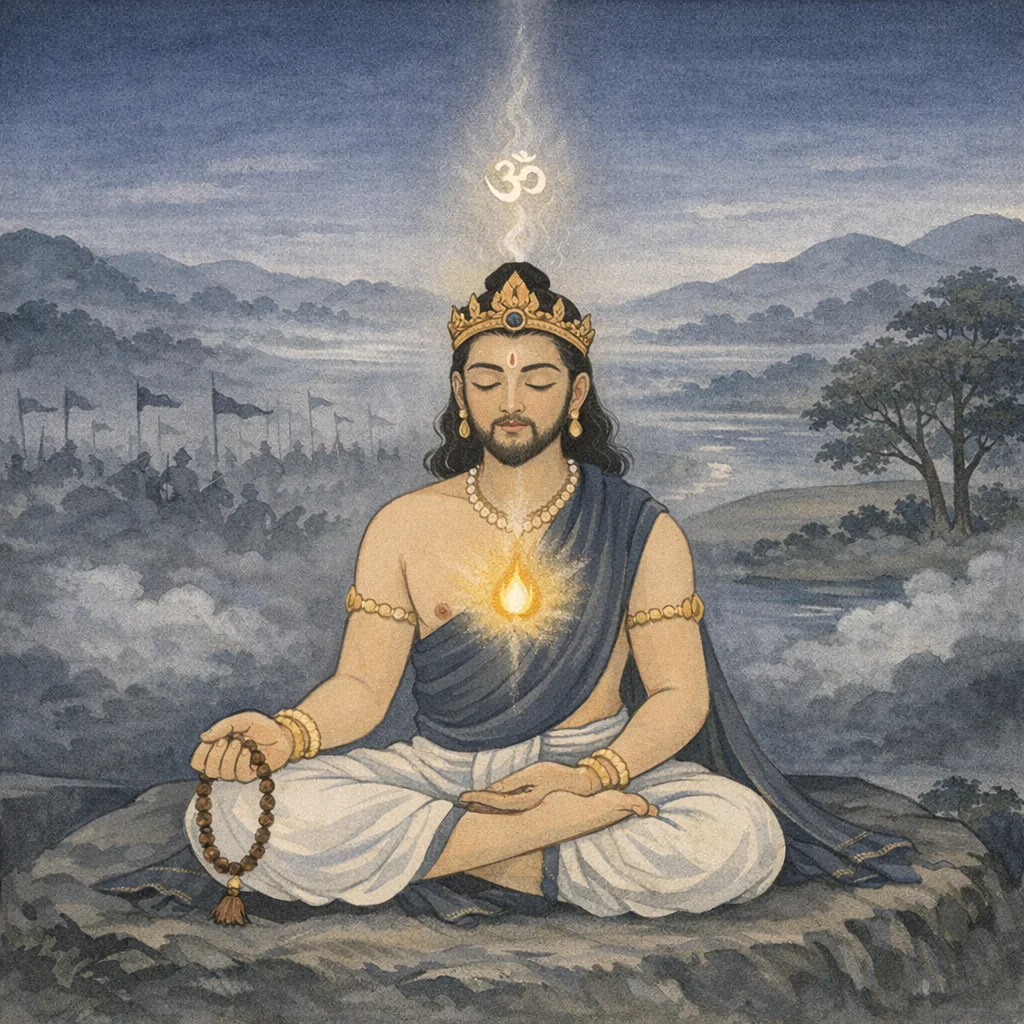
Having restrained all the gates of the senses, having confined the mind within the heart, and having placed one’s prāṇa upon the crown of the head, abiding in yogic concentration (dhāraṇā)…
सब इन्द्रियों के द्वारों को रोककर, मन को हृदय में स्थिर करके और प्राण को मस्तक में स्थापित करके योग-धारणा में स्थित (योगी)...
Restraining all the gates (of the senses), confining the mind in the heart, and placing one’s breath at the crown of the head, established in yogic concentration—
‘सर्वद्वाराणि’ को सामान्यतः इन्द्रिय-विषयों से ‘द्वार’ (sense-gates) माना जाता है; ‘मूर्ध्नि प्राणम्’ को कुछ परंपराएँ कुंडलिनी/सुषुम्ना-मार्ग के संकेत के रूप में, जबकि अन्य इसे प्रतीकात्मक रूप से ‘उर्ध्वगामी ध्यान’ (higher focus) के रूप में पढ़ती हैं।
FAQs
Describes a structured withdrawal from distractions and a unification of attention—useful as a model for deep focus and emotion regulation.
Presents yogic concentration as a means to align individual consciousness with the highest reality at a critical transitional moment.
Begins the procedural description of how one should meditate and remember the divine while departing the body.
Can be adapted as contemplative practice: reduce sensory input, steady attention in the chest region, and practice calm breathing with focused intention.