
Bhagavad Gita — Akshara Brahma Yoga, Shloka 26
Akshara Brahma Yoga
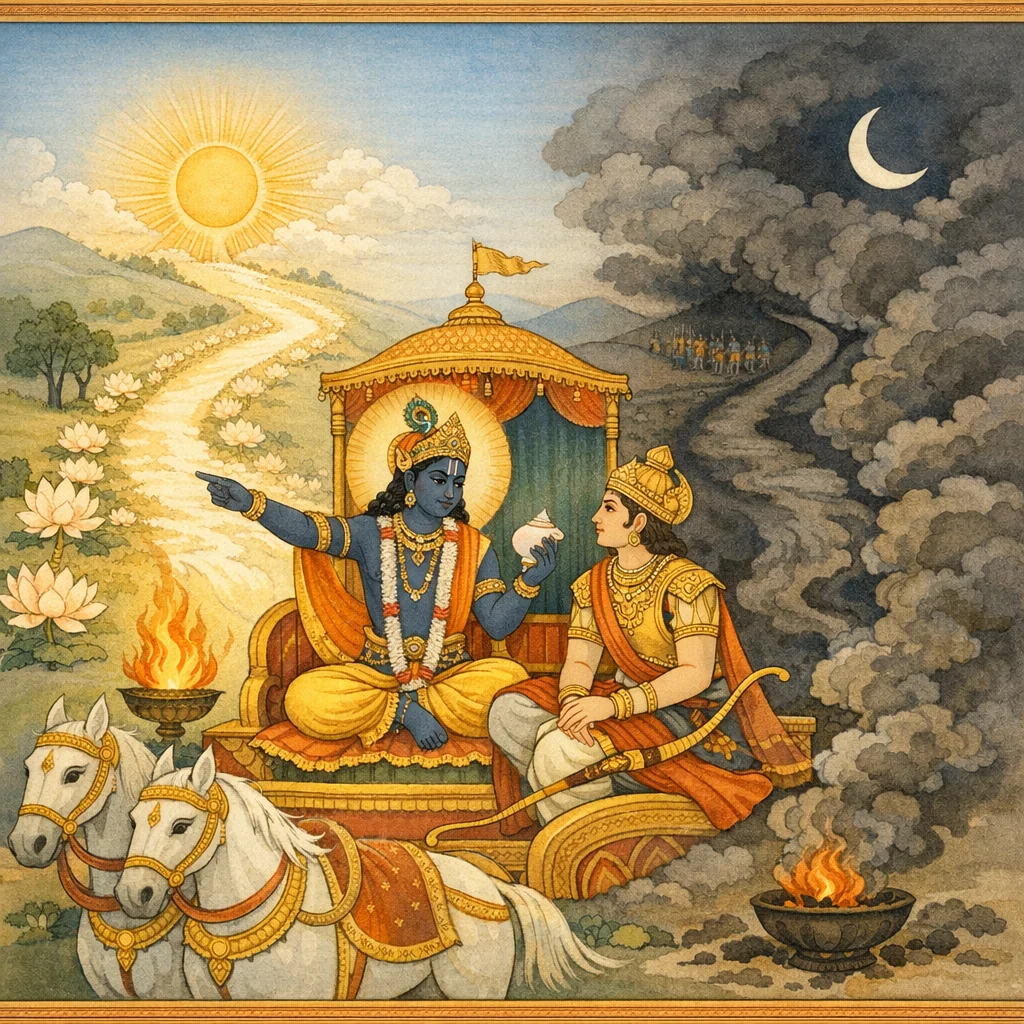
शुक्लकृष्णे गती ह्येते जगतः शाश्वते मते । एकया यात्यनावृत्तिमन्ययावर्तते पुनः ॥ ८.२६ ॥
śuklakṛṣṇe gatī hy ete jagataḥ śāśvate mate | ekayā yāty anāvṛttim anyayāvartate punaḥ || 8.26 ||

These two paths—bright and dark—are indeed regarded as the eternal paths of the world. By one, one goes to non-return; by the other, one returns again.
These two paths—bright and dark—are deemed the eternal paths of the world. By one, one goes to non-return; by the other, one returns again.
These two courses, bright and dark, are held to be the enduring courses of the world; by one one goes to non-return, by the other one returns again.
‘Śāśvate mate’ is often taken as ‘according to the ancient/established view.’ Some commentators emphasize cosmology; others stress that knowledge/devotion, not mere calendrical factors, is decisive.
FAQs
The ‘two paths’ can be read as two orientations: toward clarity and release, or toward obscuration and repetition—useful for reflecting on choices that either deepen freedom or reinforce cycles.
It generalizes the prior two verses into a stable doctrine: one trajectory culminates in liberation, the other in continued cyclic existence.
It summarizes the preceding teaching and prepares for the practical exhortation that follows (8.27).
It encourages evaluating life-paths by long-term outcomes—whether they cultivate enduring well-being and insight or perpetuate recurring dissatisfaction.