
Bhagavad Gita — Akshara Brahma Yoga, Shloka 1
Akshara Brahma Yoga
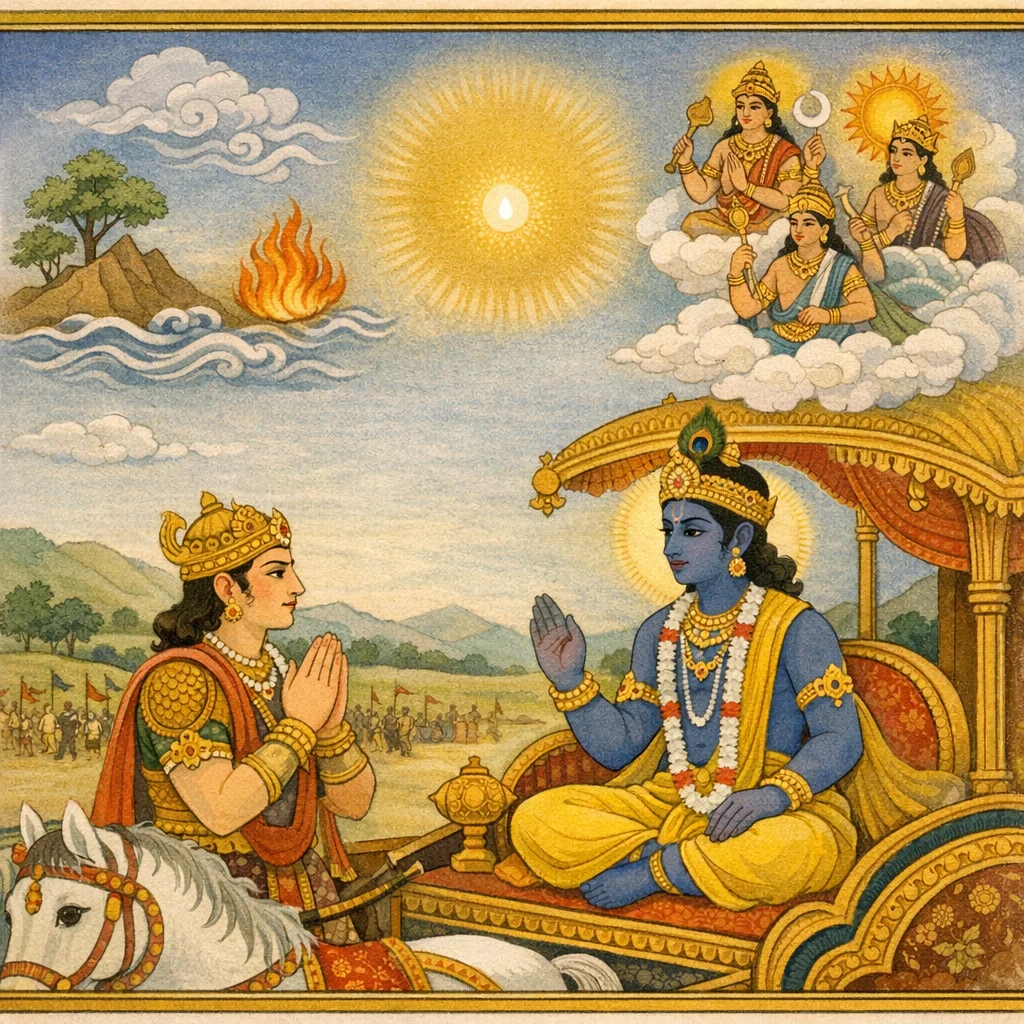
अर्जुन उवाच । किं तद्ब्रह्म किमध्यात्मं किं कर्म पुरुषोत्तम । अधिभूतं च किं प्रोक्तमधिदैवं किमुच्यते ॥ ८.१ ॥
arjuna uvāca | kiṁ tad brahma kim adhyātmaṁ kiṁ karma puruṣottama | adhibhūtaṁ ca kiṁ proktam adhidaivaṁ kim ucyate || 8.1 ||

Arjuna said: O Supreme Person, what is that Brahman? What is adhyātma? What is karma? What is called adhibhūta, and what is termed adhidaiva?
Arjuna said: O Supreme Person, what is that Brahman? What is the Self (adhyātma)? What is action (karma)? What is called the perishable (adhibhūta), and what is said to be the divine (adhidaiva)?
Arjuna asks Kṛṣṇa to define key technical categories: Brahman (the imperishable absolute), adhyātma (the inner self-nature), karma (productive action/causation), adhibhūta (the domain of perishable beings), and adhidaiva (the domain of the presiding divine principle).
Most recensions agree on the sequence of terms. Interpretive differences mainly concern whether 'adhyātma' is the individual self (jīva/ātman) or 'svabhāva' (one’s intrinsic nature), clarified in 8.3.
FAQs
The verse frames a cognitive need for clear categories: Arjuna seeks conceptual precision to stabilize understanding and guide attention, especially relevant to disciplined contemplation.
It introduces a structured ontology—absolute (Brahman), inner principle (adhyātma), causal efficacy (karma), perishable field (adhibhūta), and divine governance (adhidaiva)—preparing for a doctrine of liberation through right understanding and remembrance.
At the start of Chapter 8, Arjuna requests definitions that connect the prior teaching on devotion and disciplined mind to a more technical account of reality and liberation.
As a study method, it encourages asking for operational definitions of key terms before applying a philosophy to ethics, meditation, or daily decision-making.