
Bhagavad Gita — Akshara Brahma Yoga, Shloka 9
Akshara Brahma Yoga
कविं पुराणमनुशासितारमणोरणीयांसमनुस्मरेद्यः । सर्वस्य धातारमचिन्त्यरूपमादित्यवर्णं तमसः परस्तात् ॥ ८.९ ॥
kaviṁ purāṇam anuśāsitāram aṇor aṇīyāṁsam anusmared yaḥ | sarvasya dhātāram acintyarūpam ādityavarṇaṁ tamasaḥ parastāt || 8.9 ||

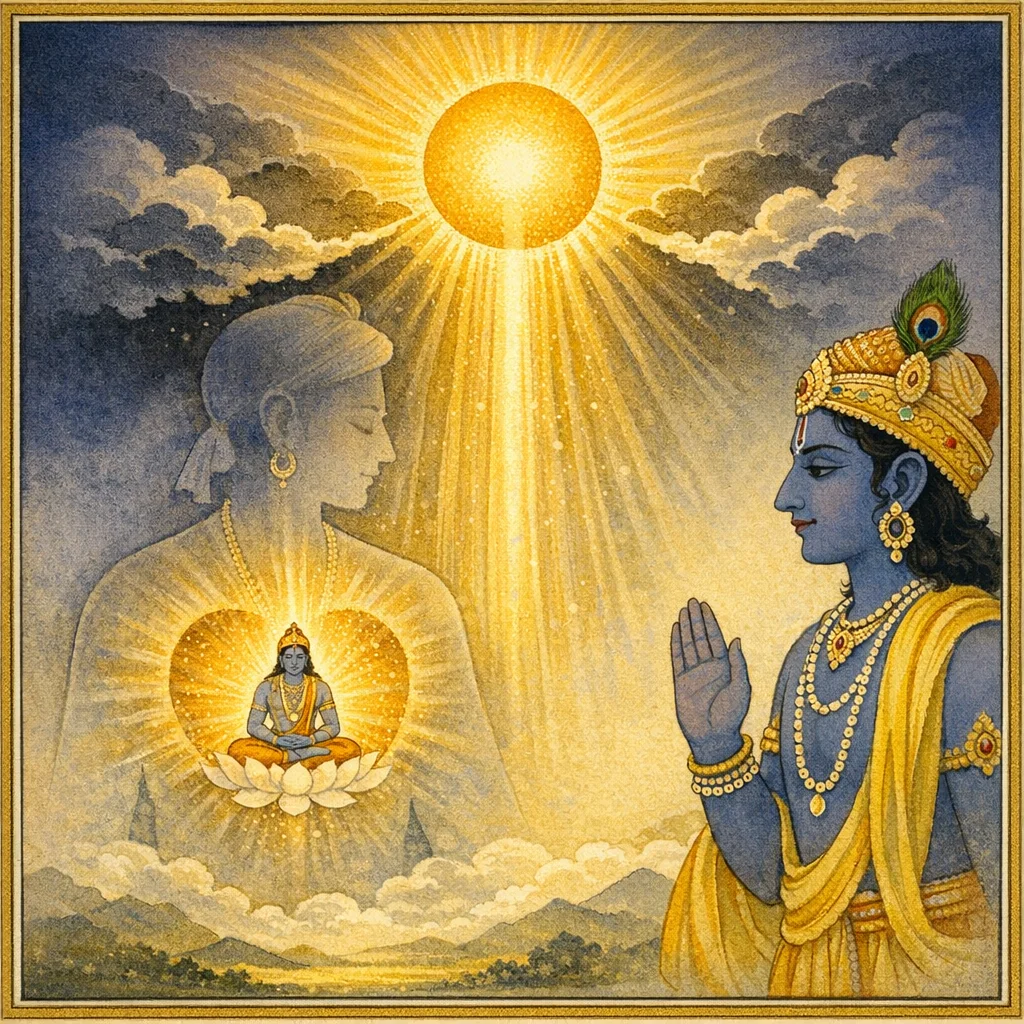
Whoever remembers the Seer, the Ancient, the Ruler; subtler than the subtlest; the Sustainer of all; of inconceivable form; radiant like the sun; beyond darkness—
Whoever remembers the Seer, the ancient, the ruler, subtler than the subtle, the sustainer of all, of inconceivable form, radiant like the sun, beyond darkness—
The verse describes the object of remembrance: an ancient, insightful principle (kavi/purāṇa), the cosmic regulator (anuśāsitṛ), subtler than the subtlest, the universal ground/support (dhātṛ), of inconceivable form, luminous (sun-like), transcending darkness (ignorance).
Terms like 'kavi' can mean 'seer' or 'wise/poet', and 'tamasaḥ parastāt' is often read as beyond ignorance rather than a physical darkness. The imagery is largely stable; interpretive variation concerns whether the referent is a personal deity, the cosmic self, or Brahman described theistically.
FAQs
The verse supplies contemplative imagery—wisdom, subtlety, luminosity—that can serve as cognitive scaffolding for sustained attention and meaning.
It portrays the ultimate as both governing and subtle, immanent as sustainer yet transcendent of ignorance—combining personal and impersonal philosophical registers.
It elaborates what it means to 'remember' the divine: not a vague thought, but a structured contemplation of defining attributes.
Can be used as a reflective template: contemplate wisdom, ethical order, subtle presence, and clarity (light) as guiding ideals.