
Bhagavad Gita — Akshara Brahma Yoga, Shloka 8
Akshara Brahma Yoga
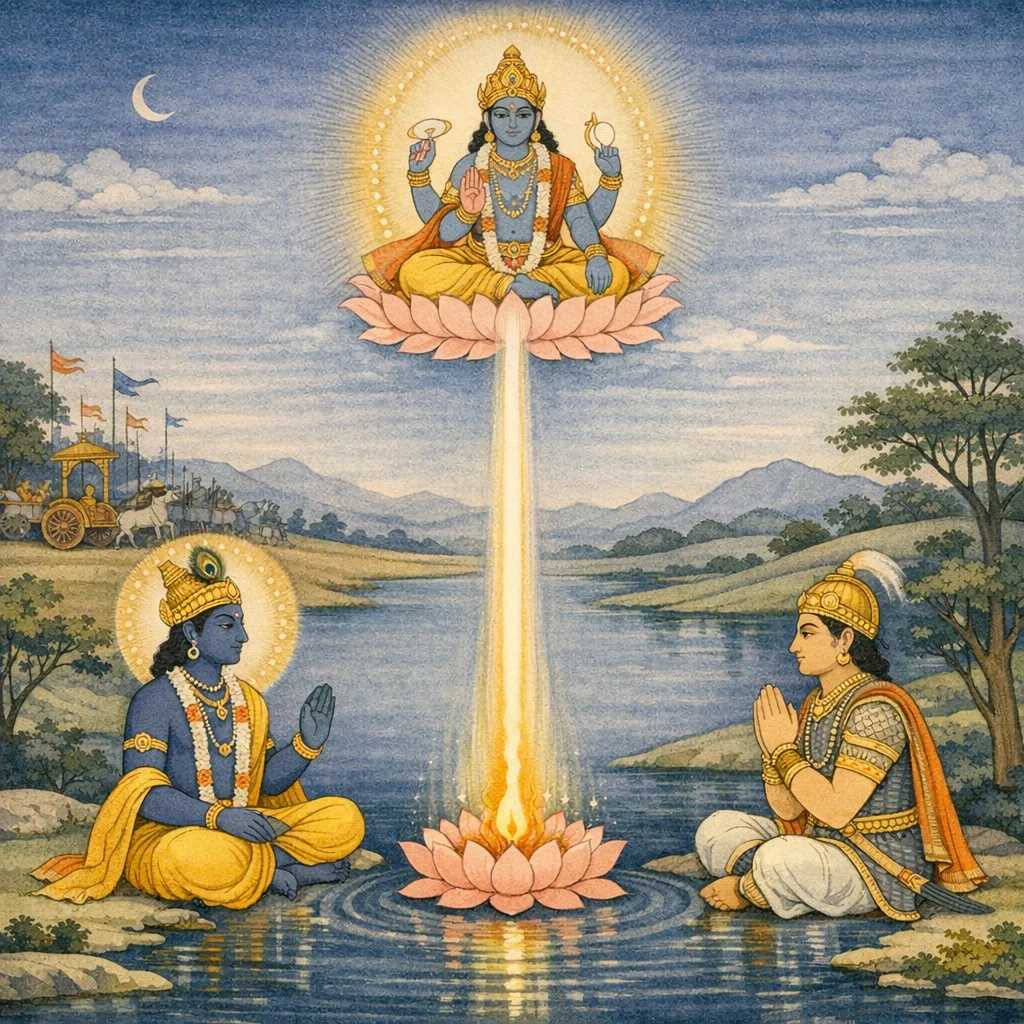
अभ्यासयोगयुक्तेन चेतसा नान्यगामिना । परमं पुरुषं दिव्यं याति पार्थानुचिन्तयन् ॥ ८.८ ॥
abhyāsayogayuktena cetasā nānyagāminā | paramaṁ puruṣaṁ divyaṁ yāti pārthānucintayan || 8.8 ||

With a mind disciplined by the yoga of practice, not wandering elsewhere, meditating upon Him, one attains the supreme, divine Person, O Pārtha.
With a mind disciplined by the yoga of practice and not wandering elsewhere, contemplating Him, one reaches the supreme divine Person, O Pārtha.
Through sustained practice (abhyāsa) that yokes the mind in yoga and prevents distraction, continuous contemplation leads to realization/attainment of the supreme divine Puruṣa.
The verse emphasizes method (abhyāsa) rather than sudden insight. Traditions differ on whether 'attainment' is understood as reaching a divine abode, experiential union, or non-dual realization expressed in devotional language.
FAQs
It offers a practical model: repeated training reduces distractibility and builds a stable attentional habit, making contemplation more continuous and less effortful.
The verse links a disciplined cognitive process to an ultimate object (the supreme Puruṣa), implying that the mind can be shaped to apprehend transcendent reality.
It supports the chapter’s claim that the last remembrance is shaped by lifelong practice, explaining how such steadiness becomes possible.
Aligns with structured practice: short daily sessions of focused attention, reflection, or prayer that gradually reduce mental scattering.