
Bhagavad Gita — Akshara Brahma Yoga, Shloka 7
Akshara Brahma Yoga
तस्मात्सर्वेषु कालेषु मामनुस्मर युध्य च । मय्यर्पितमनोबुद्धिर्मामेवैष्यस्यसंशयम् ॥ ८.७ ॥
tasmāt sarveṣu kāleṣu mām anusmara yudhya ca | mayy arpitamanobuddhir mām evaiṣyasy asaṁśayam || 8.7 ||

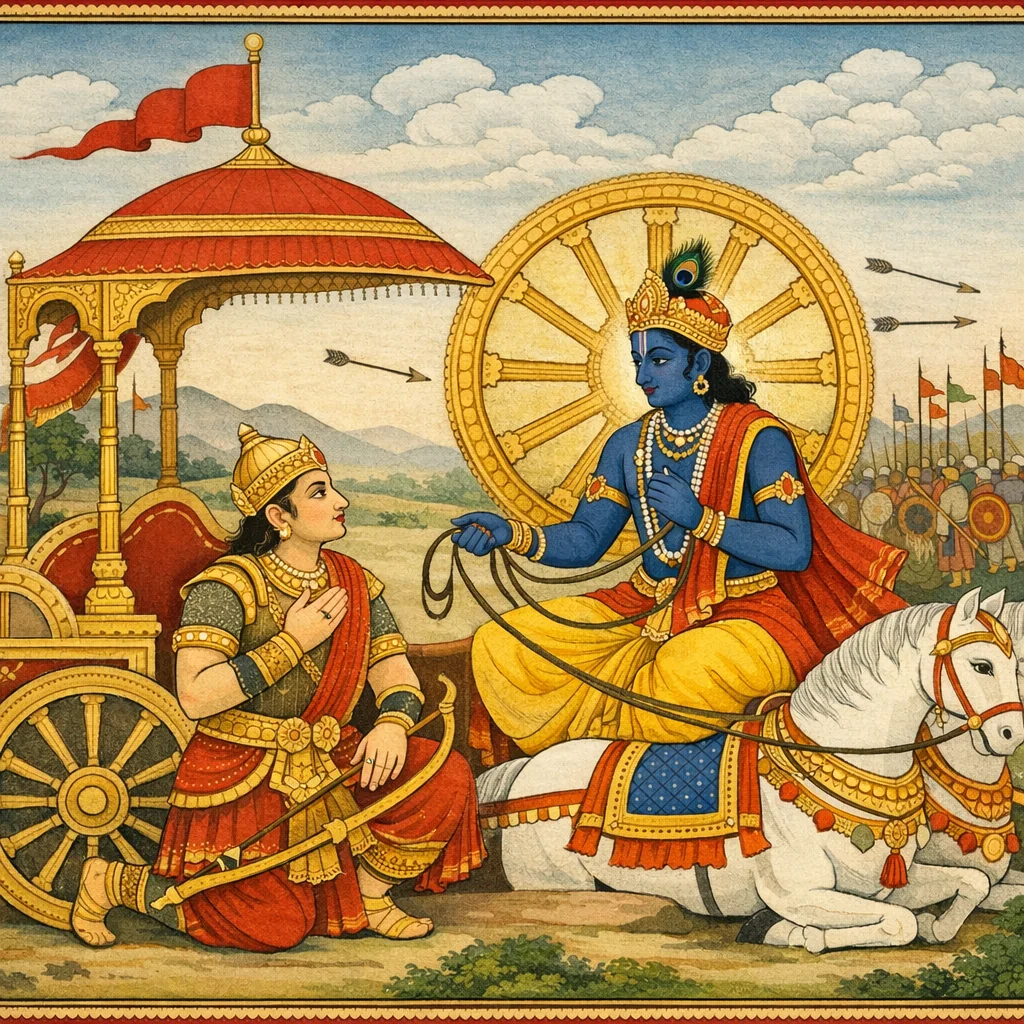
Therefore, at all times remember Me, and also fight (do your ordained duty). With mind and intellect offered to Me, you shall surely come to Me—without doubt.
Therefore, at all times remember Me and also do your duty; with mind and intellect offered to Me, you shall surely come to Me.
Kṛṣṇa prescribes a synthesis of contemplation and action: continuous recollection of Kṛṣṇa alongside fulfilling one’s role (here, Arjuna’s warrior-duty), with mental and intellectual faculties dedicated to the divine, leads to attainment of Kṛṣṇa.
The imperative 'yudhya' is commonly read within the epic’s historical setting (a warrior’s obligation) and, more broadly, as steadfast engagement in one’s responsibilities. Non-literal readings treat it as commitment to an inner discipline amid life’s challenges.
FAQs
It recommends attentional anchoring: sustaining a central commitment while engaging in demanding tasks, reducing fragmentation between inner life and external roles.
The verse presents devotion as a unifying orientation that aligns cognition (buddhi) and affective attention (manas) with the divine, shaping one’s ultimate end.
Within the narrative, Arjuna is urged to remain engaged in his social duty while maintaining spiritual recollection—resolving the tension between renunciation and responsibility.
Can be applied as mindful engagement: perform responsibilities conscientiously while keeping a guiding value or contemplative focus present.