
Bhagavad Gita — Akshara Brahma Yoga, Shloka 18
Akshara Brahma Yoga
अव्यक्ताद्व्यक्तयः सर्वाः प्रभवन्त्यहरागमे । रात्र्यागमे प्रलीयन्ते तत्रैवाव्यक्तसंज्ञके ॥ ८.१८ ॥
avyaktād vyaktayaḥ sarvāḥ prabhavanty ahar-āgame | rātry-āgame pralīyante tatraivāvyakta-saṁjñake || 8.18 ||

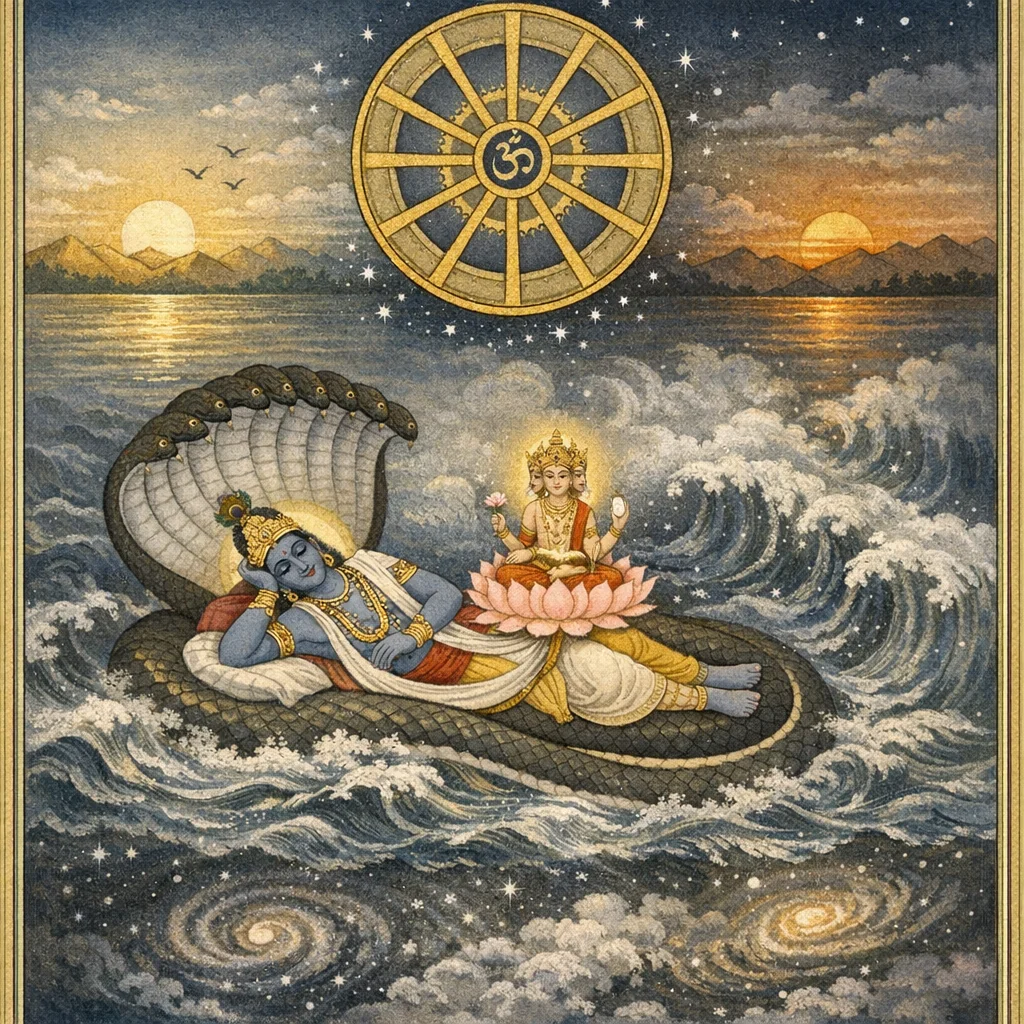
At the coming of Brahmā’s day, all beings arise from the Unmanifest into manifestation; and at the coming of night, they dissolve back into that very state called the Unmanifest.
ब्रह्मा के दिन के आरम्भ में सब प्राणी अव्यक्त से व्यक्त होते हैं और रात के आने पर उसी अव्यक्त नामक (अवस्था) में लीन हो जाते हैं।
From the unmanifest all manifestations arise at the coming of day; at the coming of night they dissolve into that very state called the unmanifest.
‘अव्यक्त’ को सांख्य में प्रधाने/प्रकृति के रूप में, और वेदान्त में कारणावस्था/माया-आश्रित अव्यक्त के रूप में पढ़ा जा सकता है; अनुवाद-भेद इसी दार्शनिक पृष्ठभूमि के अनुसार होता है।
FAQs
Can be read as a metaphor for how thoughts and identities arise from a latent background and return to it in deep rest or stillness.
Describes periodic manifestation from an unmanifest causal state and dissolution back into it.
Extends the teaching on cosmic time (v.17) into a doctrine of recurring creation and dissolution.
Encourages seeing change as patterned and cyclical, reducing attachment to transient forms.