
Bhagavad Gita — Akshara Brahma Yoga, Shloka 5
Akshara Brahma Yoga
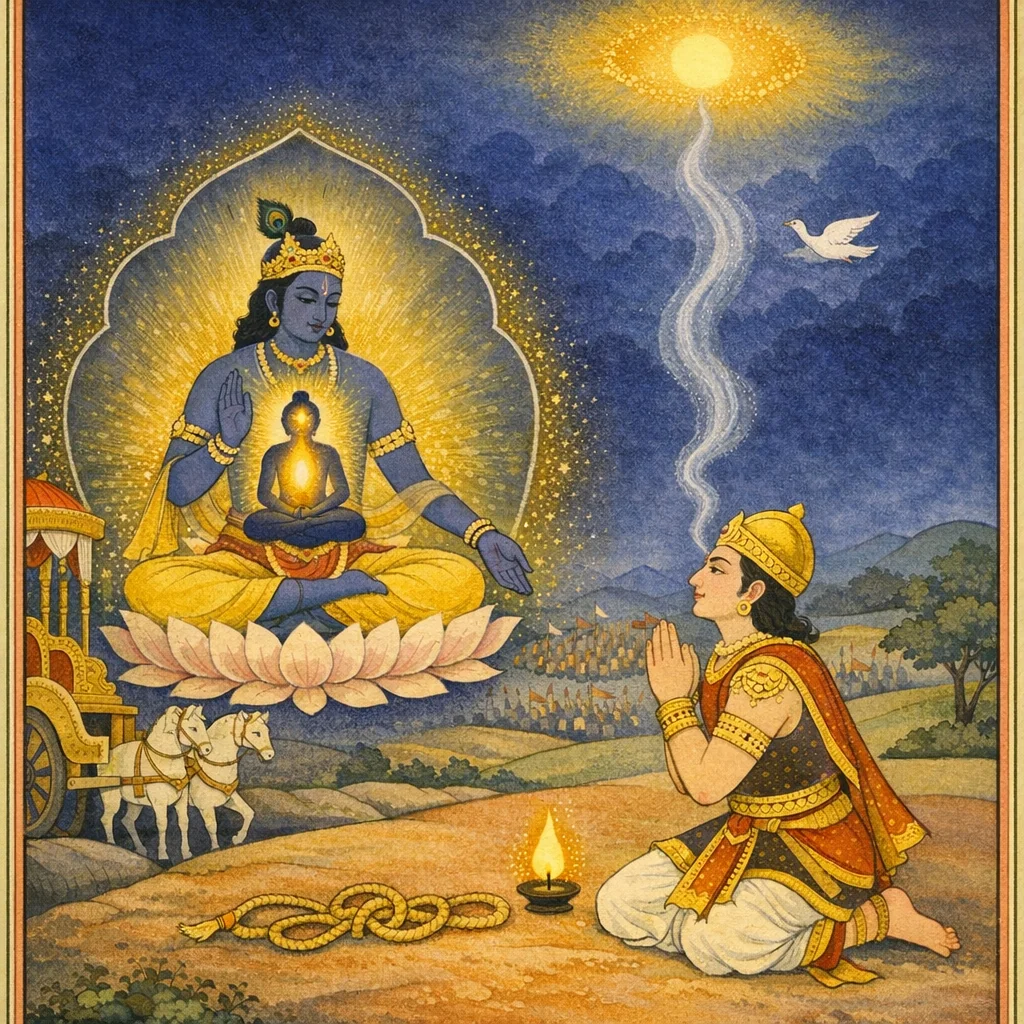
अन्तकाले च मामेव स्मरन्मुक्त्वा कलेवरम् । यः प्रयाति स मद्भावं याति नास्त्यत्र संशयः ॥ ८.५ ॥
antakāle ca mām eva smaran muktvā kalevaram | yaḥ prayāti sa madbhāvaṁ yāti nāsty atra saṁśayaḥ || 8.5 ||

And at the final moment, remembering Me alone, one who departs, leaving the body, attains My state—of this there is no doubt.
And at the final time, remembering Me alone, one who departs leaving the body attains My state; of this there is no doubt.
Kṛṣṇa states a soteriological principle: the person who, at death, maintains exclusive recollection of Kṛṣṇa and then leaves the body attains 'madbhāva'—a mode/state of being aligned with Kṛṣṇa.
'Madbhāva' is interpreted variously: as reaching the Lord’s realm (theistic), as attaining likeness/participation in divine nature, or as realization of the imperishable through devotion. The verse’s emphasis is on the determinative role of final, concentrated remembrance.
FAQs
It underscores how deeply trained attention and dominant life-orientations can shape cognition in extreme moments, suggesting that long-term practice influences end-of-life mental states.
The verse proposes a link between consciousness at death and post-mortem destiny, with devotional recollection functioning as the decisive connector to the divine state.
This begins the chapter’s practical teaching: after defining terms, Kṛṣṇa explains how remembrance relates to liberation.
Encourages cultivating a stable, life-defining focus (ethical or spiritual) so that one’s priorities remain accessible during crises and major transitions.