Adhyaya 54
Uttanka’s Viśvarūpa Request and the ‘Uttanka Clouds’ Boon (उत्तङ्क-विष्वरूप-दर्शनम्)
Upa-parva: Uttanka–Krishna Darśana Episode (Āśvamedhika Parva)
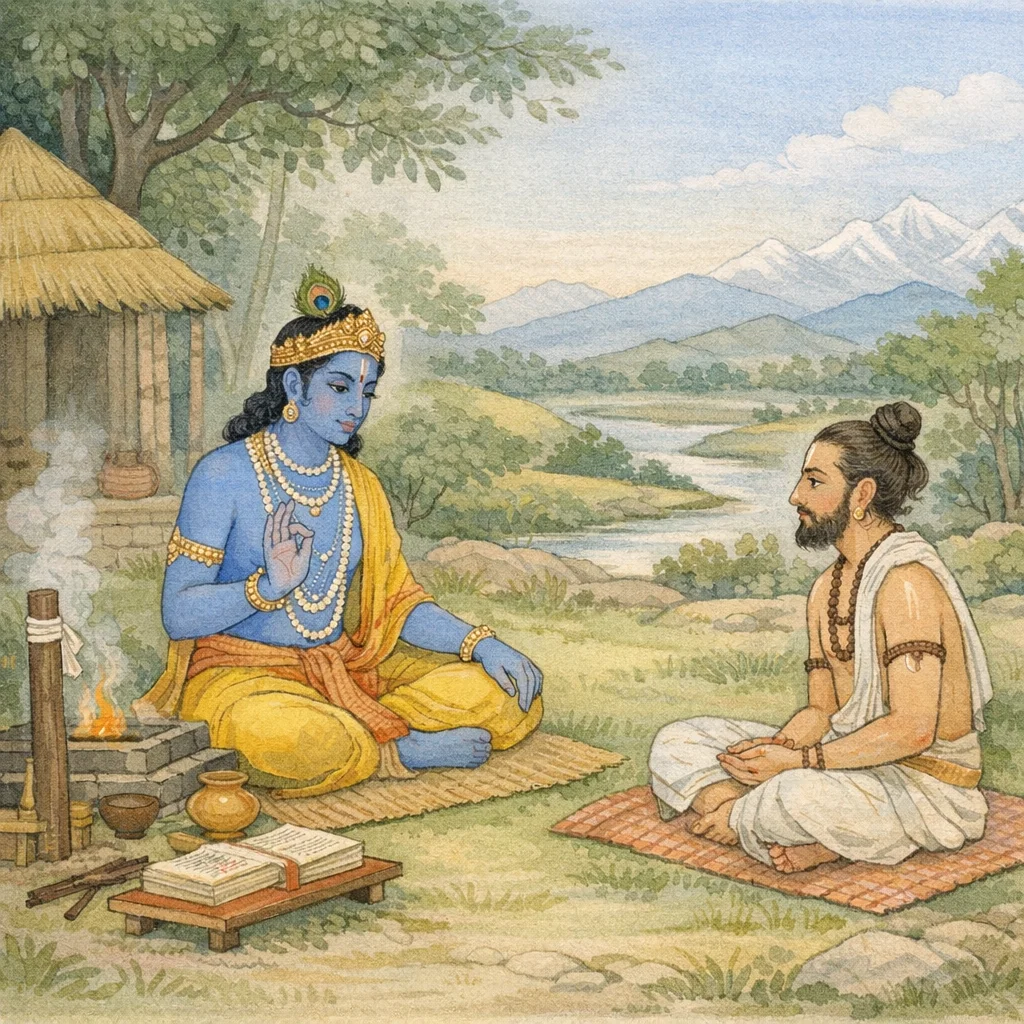
Uttanka addresses Kṛṣṇa (Janārdana/Acyuta) acknowledging him as the creator and attributing his own pacified mind and cessation of anger to divine grace. He requests a direct vision of Kṛṣṇa’s aiśvara (sovereign) form; Kṛṣṇa grants a Vaiṣṇava theophany described as expansive and world-encompassing, producing astonishment. Uttanka then asks Kṛṣṇa to withdraw the cosmic form and reappear in the familiar eternal form. Kṛṣṇa offers a boon; Uttanka initially claims the vision itself suffices, but Kṛṣṇa insists on granting something effective. Uttanka requests water in the desert, noting its scarcity. Later, while thirsty, Uttanka encounters a frightening digvāsas figure with dogs (a mātaṅga/caṇḍāla-like guise) offering abundant water; Uttanka refuses and speaks harshly. The figure disappears; Uttanka feels deceived and confronts Kṛṣṇa. Kṛṣṇa explains that Indra (Vajrapāṇi) was instructed to offer amṛta in the form of water, but Indra refused to grant immortality to a mortal and thus appeared as a mātaṅga; Uttanka’s rejection becomes a serious transgression of discernment. Kṛṣṇa then promises that whenever Uttanka desires water, rain-bearing clouds will fill the desert—these become known as “Uttanka-meghāḥ,” said to rain there even now.
Chapter Arc: उत्तंक, केशव-जनार्दन से आग्रह करता है कि वे ‘उत्तम अध्यात्मतत्त्व’ का यथार्थ वर्णन करें—और संकेत देता है कि सुनकर वह आशीर्वाद भी दे सकता है, शाप भी। → कृष्ण उत्तर देते हैं ऐसे वाक्यों में जो साधारण उपदेश नहीं, विराट्-स्वरूप का उद्घोष है: ‘सम्पूर्ण भूत मुझमें हैं और मैं सम्पूर्ण भूतों में स्थित हूँ’; वे वेद, यज्ञ, ओंकार, यूप, सोम, होम—सबको अपने ही रूप में प्रतिष्ठित करते हैं। उत्तंक के सामने प्रश्न तीखा हो उठता है: यदि सब कुछ ईश्वर में ही है, तो कर्म, धर्म और विनाश का कारण कहाँ ठहरता है? → कृष्ण का निर्णायक आत्मघोष: वे ही सृष्टि-स्थिति-प्रलय के कारण, वही विष्णु-ब्रह्मा-इन्द्र; और अवतार-योनियों में प्रकट होने पर वे उसी लोक-धर्म के अनुरूप आचार करते हैं। इसी के साथ वे कौरव-विनाश का नैतिक कारण भी स्पष्ट करते हैं—दुर्योधन के अपराध और अधर्म ने कालधर्म के साथ मिलकर उन्हें धर्मयुद्ध में निहत किया; धर्म से संयुक्त होकर वे स्वर्ग को गए। → उपदेश का निष्कर्ष यह बनता है कि ईश्वर सर्वव्यापक होकर भी धर्म-व्यवस्था को निरस्त नहीं करता; जो पाप-कर्मों से निवृत्त होकर धर्म में प्रवृत्त होते हैं, उनके साथ भगवान् का नित्य निवास है। उत्तंक के लिए यह ज्ञान-समाधान है: आशीर्वाद/शाप की धमकी ज्ञान के प्रकाश में शान्त हो जाती है।
Shlokas
Verse 1
#फ्जला+ (0) आज अत+- चतुष्पठ्चाशत्तमोडध्याय: भगवान् श्रीकृष्णका उत्तंकसे अध्यात्मतत्त्वका वर्णन करना तथा दुर्योधनके अपराधको कौरवोंके विनाशका कारण बतलाना उत्तद्क उवाच ब्रूहि केशव तत्त्वेन त्वमध्यात्ममनिन्दितम् । श्रुत्वा श्रेयोडभिधास्यामि शापं वा ते जनार्दन
Verse 2
उत्तंकने कहा--केशव! जनार्दन! तुम यथार्थरूपसे उत्तम अध्यात्मतत्त्वका वर्णन करो। उसे सुनकर मैं तुम्हारे कल्याणके लिये आशीर्वाद दूँगा अथवा शाप प्रदान करूँगा ।। वायुदेव उवाच तमो रजश्न सत्त्वं च विद्धि भावान् मदाश्रयान् । तथा रुद्रान् वसून् वापि विद्धि मत्प्रभवान् द्विज,श्रीकृष्णने कहा--ब्रह्मर्ष!] आपको यह विदित होना चाहिये कि तमोगुण, रजोगुण और सत्त्वगगुण--ये सभी भाव मेरे ही आश्रित हैं। रुद्“रों और वसुओंको भी आप मुझसे ही उत्पन्न जानिये
Vāyu said: “Know that tamas, rajas, and sattva—the fundamental dispositions that shape embodied experience—rest upon Me. Likewise, O twice-born one, understand that the Rudras and the Vasus also arise from Me.”
Verse 3
मयि सर्वाणि भूतानि सर्वभूतेषु चाप्यहम् । स्थित इत्यभिजानीहि मा ते5भूदत्र संशय:,सम्पूर्ण भूत मुझमें हैं और सम्पूर्ण भूतोंमें मैं स्थित हूँ। इस बातको आप अच्छी तरह समझ लें। इसमें आपको संशय नहीं होना चाहिये
Vāyu said: “Know this clearly: all beings abide in me, and I too abide within all beings. Understand it firmly, and let there be no doubt in you about this.”
Verse 4
तथा दैत्यगणान् सर्वान् यक्षगन्धर्वराक्षसान् | नागानप्सरसश्वैव विद्धि मत्प्रभवान् द्विज,विप्रवर! सम्पूर्ण दैत्यगण, यक्ष, गन्धर्व, राक्षस, नाग और अप्सराओंको मुझसे ही उत्पन्न जानिये
Vāyu said: “Know, O twice-born brāhmaṇa, that all the hosts of Dānavas (Daityas), as well as the Yakṣas, Gandharvas, Rākṣasas, Nāgas, and Apsarases, have arisen from me.” In the ethical frame of the discourse, this asserts a single cosmic source behind diverse beings—some feared, some revered—inviting the listener to see creation as ordered and interconnected rather than merely divided into ‘good’ and ‘evil’ kinds.
Verse 5
सदसच्चैव यत् प्राहुरव्यक्तं व्यक्तमेव च । अक्षरं च क्षरं चैव सर्वमेतन्न्मदात्मकम्,विद्वान लोग जिसे सत-असत, व्यक्त-अव्यक्त और क्षर-अक्षर कहते हैं, यह सब मेरा ही स्वरूप है
Vāyu said: “Whatever the wise describe as being and non-being, as the unmanifest and the manifest, and as the imperishable and the perishable—know that all of it is of my very nature. I pervade these seeming opposites, and their distinctions are only ways of speaking about the one reality.”
Verse 6
ये चाश्रमेषु वै धर्माश्चतुर्धा विदिता मुने । वैदिकानि च सर्वाणि विद्धि सर्व मदात्मकम्,मुने! चारों आश्रमोंमें जो चार प्रकारके धर्म प्रसिद्ध हैं तथा जो सम्पूर्ण वेदोक्त कर्म हैं, उन सबको मेरा स्वरूप ही समझिये
Vāyu said: “O sage, the fourfold duties known in the four āśramas, and all the rites enjoined by the Vedas—know all of them to be of my very nature. In truth, the whole discipline of Vedic life and conduct is pervaded by me.”
Verse 7
असच्च सदसच्चैव यद् विश्व सदसत् परम् । मत्त: परतरं नास्ति देवदेवात् सनातनात्,असत्ू, सदसत् तथा उससे भी परे जो अव्यक्त जगत् है, वह भी मुझ सनातन देवाधिदेवसे पृथक् नहीं है
Vāyu said: “Whatever in this universe is unreal, and whatever is real—indeed, even that which is beyond both the real and the unreal (the supreme, unmanifest principle)—none of it stands apart from me, the eternal God of gods. There is nothing higher than me.”
Verse 8
ओड्कारप्रमुखान् वेदान् विद्धि मां त्वं भगूद्वह । यूपं सोम॑ चरुं होम॑ त्रिदशाप्यायनं मखे
Vāyu said: “Know me, O best of the blessed, as the very Vedas whose foremost sound is the sacred syllable. In the sacrifice I am the sacrificial post, the Soma, the cooked oblation (caru), the act of offering into the fire, and the nourishment and strengthening of the gods.”
Verse 9
होतारमपि हव्यं च विद्धि मां भूगुनन्दन । अध्वर्यु: कल्पकश्नापि हवि: परमसंस्कृतम्
Vāyu said: “Know me also, O delight of the Bhṛgus, to be the Hotṛ and the very oblation worthy of offering. I am likewise the Adhvaryu and the arranger of the rite; and the havis (sacrificial offering) is made supremely refined through proper consecration.”
Verse 10
भुगुश्रेष्ट! >>कारसे आरम्भ होनेवाले चारों वेद मुझे ही समझिये। यज्ञमें यूप, सोम, चरु, देवताओंको तृप्त करनेवाला होम, होता और हवन-सामग्री भी मुझे ही जानिये। भृगुनन्दन! अध्वर्यु, कल्पक और अच्छी प्रकार संस्कार किया हुआ हविष्य--ये सब मेरे ही स्वरूप हैं ।। उदगाता चापि मां स्तौति गीताघोषैर्महा ध्वरे । प्रायक्षित्तेषु मां ब्रह्मन् शान्तिमड्रलवाचका:
Vāyu said: “O best of the Bhṛgus, understand the four Vedas—those that begin with the sacred syllable ‘oṃ’—to be none other than me. In the sacrifice, know the sacrificial post, the Soma, the cooked oblation (caru), the oblation that satisfies the gods, the Hotṛ priest, and the offering materials as my very form. O descendant of Bhṛgu, the Adhvaryu, the ritual arranger (kalpaka), and the properly consecrated oblation (haviṣ) are also my own embodiment. In the great rite the Udgātṛ too praises me with sung chants; and in rites of expiation, O brāhmaṇa, I am the utterer of words of peace and auspiciousness.”
Verse 11
स्तुवन्ति विश्वकर्माणं सततं द्विजसत्तम । मम विद्धि सुतं धर्ममग्रजं द्विजसत्तम
Vāyu said: “O best of the twice-born, the sages continually praise Viśvakarmā. Know that Dharma is my son—indeed my firstborn, O best of brāhmaṇas.”
Verse 12
मानसं दयितं विप्र सर्वभूतदयात्मकम् । बड़े-बड़े यज्ञोंमें उदगाता उच्च स्वरसे सामगान करके मेरी ही स्तुति करते हैं। ब्रह्मन! प्रायश्चित्त-कर्ममें शान्तिपाठ तथा मंगलपाठ करनेवाले ब्राह्मण सदा मुझ विश्वकर्माका ही स्तवन करते हैं। द्विजश्रेष्ठ! तुम्हें मालूम होना चाहिये कि सम्पूर्ण प्राणियोंपर दया करना-रूप जो धर्म है, वह मेरा परमप्रिय ज्येष्ठ पुत्र है। मेरे मनसे उसका प्रादुर्भाव हुआ है ।। १०-११ ६ || तत्राहं वर्तमानैश्न निवृत्तैश्नैव मानवै:,तैस्तैवेंषैश्व रूपैश्व त्रिषु लोकेषु भार्गव । भार्गव! उस धर्ममें प्रवृत्त होकर जो पाप-कर्मोंसे निवृत्त हो गये हैं ऐसे मनुष्योंके साथ मैं सदा निवास करता हूँ। साधुशिरोमणे! मैं धर्मकी रक्षा और स्थापनाके लिये तीनों लोकोंमें बहुत-सी योनियोंमें अवतार धारण करके उन-उन रूपों और वेषोंद्वारा तदनुरूप बर्ताव करता हूँ
Vāyu said: “O brāhmaṇa, compassion for all beings is what is dearest to my heart. Wherever people live by that dharma—turning away from sinful acts and choosing restraint—I dwell with them. And, O Bhārgava, for the protection and re-establishment of dharma, I move through the three worlds, assuming many forms and outward guises, acting in ways suited to each role.”
Verse 13
बह्वी: संसरमाणो वै योनीर्वतामि सत्तम | धर्मसंरक्षणार्थाय धर्मसंस्थापनाय च
O best of the virtuous, I have indeed wandered through many wombs (many births), moving through saṁsāra, for the sake of protecting dharma and for the re-establishment of dharma as well.
Verse 14
अहं विष्णुरहं ब्रह्मा शक्रो5थ प्रभवाप्यय:
Vāyu said: “I am Viṣṇu; I am Brahmā; I am also Śakra (Indra); and I am the very source and dissolution of all.” In this declaration, the speaker asserts a single, all-pervading divine agency behind multiple revered forms, urging the listener to look beyond sectarian labels and recognize the one power that upholds, originates, and withdraws the world—an ethical call toward humility, unity of vision, and reverence for the cosmic order.
Verse 15
भूतग्रामस्य सर्वस्य सत्रष्टा संहार एव च। मैं ही विष्णु, मैं ही ब्रह्मा और मैं ही इन्द्र हूँ। सम्पूर्ण भूतोंकी उत्पत्ति और प्रलयका कारण भी मैं ही हूँ। समस्त प्राणिसमुदायकी सृष्टि और संहार भी मेरे ही द्वारा होते हैं ।। १४ * अधर्मे वर्तमानानां सर्वेषामहमच्युत:,अधर्ममें लगे हुए सभी मनुष्योंको दण्ड देनेवाला और अपनी मर्यादासे कभी च्युत न होनेवाला ईश्वर मैं ही हूँ। जब-जब युगका परिवर्तन होता है, तब-तब मैं प्रजाकी भलाईके लिये भिन्न-भिन्न योनियोंमें प्रविष्ट होकर धर्ममर्यादाकी स्थापना करता हूँ
Vāyu-deva declares: “I am the creator of the entire host of beings, and I am also their dissolution. I am Vishnu; I am Brahmā; I am Indra. The arising and the passing away of all creatures proceed from me alone; the creation and destruction of the whole community of living beings occur through me. For all who persist in unrighteousness, I am the unfailing Lord who administers punishment without ever deviating from rightful order. Whenever an age turns, I enter diverse wombs for the welfare of beings and re-establish the boundaries and authority of dharma.”
Verse 16
धर्मस्य सेतुं बध्नामि चलिते चलिते युगे । तास्ता योनी: प्रविश्याहं प्रजानां हितकाम्यया,अधर्ममें लगे हुए सभी मनुष्योंको दण्ड देनेवाला और अपनी मर्यादासे कभी च्युत न होनेवाला ईश्वर मैं ही हूँ। जब-जब युगका परिवर्तन होता है, तब-तब मैं प्रजाकी भलाईके लिये भिन्न-भिन्न योनियोंमें प्रविष्ट होकर धर्ममर्यादाकी स्थापना करता हूँ
I bind fast the bridge of Dharma whenever an age is shaken and passes into change. For the welfare of beings, I enter again and again into diverse wombs and forms, so that the boundaries of righteousness are restored and living creatures are protected from the drift into lawlessness.
Verse 17
यदा त्वहं देवयोनौ वर्तामि भूगुनन्दन । तदाहं देववत् सर्वमाचरामि न संशय:,भृगुनन्दन! जब मैं देवयोनिमें अवतार लेता हूँ, तब देवताओंकी ही भाँति सारे आचार- विचारका पालन करता हूँ, इसमें संशय नहीं है
O delight of the Bhṛgus, whenever I take my course in a divine birth, I then conduct myself in every respect like the gods themselves—of this there is no doubt. The statement underscores that one’s mode of life and standards of conduct should accord with the nature and duties of the station one inhabits.
Verse 18
यदा गन्धर्वयोनौ वा वर्तामि भगुनन्दन । तदा गन्धर्ववत् सर्वमाचरामि न संशय:
Vāyu-deva said: “Whenever I take my course in the womb of the Gandharvas, O delight of Bhagu’s line, then I conduct myself in every way like a Gandharva—of this there is no doubt.”
Verse 19
भूगुकुलको आनन्द प्रदान करनेवाले महर्षे! जब मैं गन्धर्व-योनिमें प्रकट होता हूँ, तब मेरे सारे आचार-विचार गन्धर्वोके ही समान होते हैं, इसमें संदेह नहीं है ।। नागयोनौ यदा चैव तदा वर्तामि नागवत् | यक्षराक्षसयोन्योस्तु यथावद् विचराम्यहम्,जब मैं नागयोनिमें जन्म ग्रहण करता हूँ, तब नागोंकी तरह बर्ताव करता हूँ। यक्षों और राक्षसोंकी योनियोंमें प्रकट होनेपर उनन््हींके आचार-विचारका यथावत् रूपसे पालन करता हूँ
O great sage who brings joy to the line of Bhṛgu! Whenever I manifest in the womb and condition of the Gandharvas, my conduct and ways of thinking become just like those of the Gandharvas—there is no doubt of it. And when I take birth among the Nāgas, I behave as a Nāga. Likewise, when I appear among Yakṣas or Rākṣasas, I move and act in full accordance with the customs and dispositions of those very beings.
Verse 20
मानुष्ये वर्तमाने तु कृपणं याचिता मया । न च ते जातसम्मोहा वचो<गृह्नन्त मे हितम्,इस समय मैं मनुष्ययोनिमें अवतीर्ण हुआ हूँ, इसलिये कौरवोंपर अपनी ईश्वरीय शक्तिका प्रयोग न करके पहले मैंने दीनतापूर्वक ही संधिके लिये प्रार्थना की थी; परंतु उन्होंने मोहग्रस्त होनेके कारण मेरी हितकर बात नहीं मानी
“Since I am presently moving about in the human condition, I did not employ my divine power against the Kauravas; instead, I first begged humbly for a settlement. But they, having fallen into delusion, did not accept my words spoken for their welfare.”
Verse 21
उत्तड़कमुनिकी श्रीकृष्णसे विश्वरूप दिखानेके लिये प्रार्थना भयं च महदुद्दिश्य त्रासिता: कुरवो मया । क्रुद्धेन भूत्वा तु पुनर्यथावदनुदर्शिता:,इसके बाद क्रोधमें भरकर मैंने कौरवोंको बड़े-बड़े भय दिखाये और उन्हें बहुत डराया- धमकाया तथा यथार्थरूपसे युद्धका भावी परिणाम भी उन्हें दिखाया; परंतु वे तो अधर्मसे युक्त एवं कालसे ग्रस्त थे। अतः मेरी बात माननेको राजी न हुए। फिर क्षत्रिय-धर्मके अनुसार युद्धमें मारे गये। इसमें संदेह नहीं कि वे सब-के-सब स्वर्गलोकमें गये हैं
Vāyu said: “When the sage Uttadaka prayed to Śrī Kṛṣṇa to reveal the universal form, I, intending a great fear, terrified the Kurus. Then, becoming wrathful, I showed them—exactly as it would be—the true outcome that the war would bring. Yet they were bound to adharma and seized by Time; therefore they would not accept my counsel. Afterwards, in accordance with kṣatriya-dharma, they were slain in battle. There is no doubt: all of them went to heaven.”
Verse 22
ते<धर्मेणेह संयुक्ता: परीता: कालधर्मणा । धर्मेण निहता युद्धे गता: स्वर्ग न संशय:,इसके बाद क्रोधमें भरकर मैंने कौरवोंको बड़े-बड़े भय दिखाये और उन्हें बहुत डराया- धमकाया तथा यथार्थरूपसे युद्धका भावी परिणाम भी उन्हें दिखाया; परंतु वे तो अधर्मसे युक्त एवं कालसे ग्रस्त थे। अतः मेरी बात माननेको राजी न हुए। फिर क्षत्रिय-धर्मके अनुसार युद्धमें मारे गये। इसमें संदेह नहीं कि वे सब-के-सब स्वर्गलोकमें गये हैं
Vāyu said: “Here, they were bound to their (appointed) dharma, yet were also encompassed by the law of Time. Slain in battle in accordance with dharma, they have gone to heaven—of this there is no doubt.”
Verse 23
लोकेषु पाण्डवाश्वैव गता: ख्यातिं द्विजोत्तम | एतत् ते सर्वमाख्यातं यन्मां त्वं परिपृच्छसि,द्विजश्रेष्ठ! पाण्डव अपने धर्माचरणके कारण समस्त लोकोंमें विख्यात हुए हैं। आपने जो कुछ पूछा था, उसके अनुसार मैंने यह सारा प्रसड़ कह सुनाया
Verse 53
इस प्रकार श्रीमह्ाभारत आश्वमेधिकपववके अन्तर्गत अनुगीतापर्वनें उत्तकुकके उपाख्यानमें श्रीकृष्ण और उत्तकुकका समागमविषयक तिरपनवाँ अध्याय पूरा हुआ
Thus ends the fifty-third chapter, concerning the meeting of Śrī Kṛṣṇa and Uttakuka, within the Uttakuka episode of the Anugītā section, which is included in the Aśvamedhika Parva of the Śrī Mahābhārata. The closing formula signals the completion of a narrative unit and frames the episode as part of the larger ethical and reflective discourse that follows the war, where encounters and recollections serve to reaffirm dharma and right understanding.
Verse 54
इति श्रीमहाभारते आश्वमेधिके पर्वणि अनुगीतापर्वणि उत्तड़कोपाख्याने कृष्णवाक्ये चतुष्पञ्चाशत्तमो<ध्याय:
Thus, in the Śrī Mahābhārata, within the Aśvamedhika Parva—specifically in the Anugītā section—this concludes the fifty-fourth chapter, set in the episode known as the Upākhyāna of Uttaḍaka and presented as the discourse of Kṛṣṇa. The line functions as a formal colophon, marking the end of the chapter and situating its teaching within the broader ethical instruction of the Anugītā.
Verse 136
तैस्तैवेंषैश्व रूपैश्व त्रिषु लोकेषु भार्गव । भार्गव! उस धर्ममें प्रवृत्त होकर जो पाप-कर्मोंसे निवृत्त हो गये हैं ऐसे मनुष्योंके साथ मैं सदा निवास करता हूँ। साधुशिरोमणे! मैं धर्मकी रक्षा और स्थापनाके लिये तीनों लोकोंमें बहुत-सी योनियोंमें अवतार धारण करके उन-उन रूपों और वेषोंद्वारा तदनुरूप बर्ताव करता हूँ
Vāyu said: “O Bhārgava, in the three worlds I move about in many such forms and disguises. I ever dwell with those people who, having entered upon this dharma, have turned away from sinful deeds. O foremost among the virtuous, for the protection and re-establishment of dharma I assume births in many kinds of existences across the three worlds, and through those very forms and guises I act in ways suited to each.”
Frequently Asked Questions
Uttanka must choose whether to accept life-sustaining water offered through a socially stigmatized guise; his refusal foregrounds the tension between purity conventions and discernment of beneficial intent.
Divine assistance may arrive in non-preferred forms; the chapter teaches that ethical judgment should evaluate substance and purpose rather than be governed solely by external markers of status or appearance.
Yes: the narrative ends with an etiological claim that “Uttanka-meghāḥ” still rain in the desert, functioning as a continuing-world marker that memorializes the boon and the lesson about perception.