Adhyaya 32
जनक–ब्राह्मणसंवादः (Viṣaya, Mamatva, and Self-Mastery)
Upa-parva: Anuśāsana on Non-Possessiveness (Janaka–Brāhmaṇa Saṃvāda Episode)
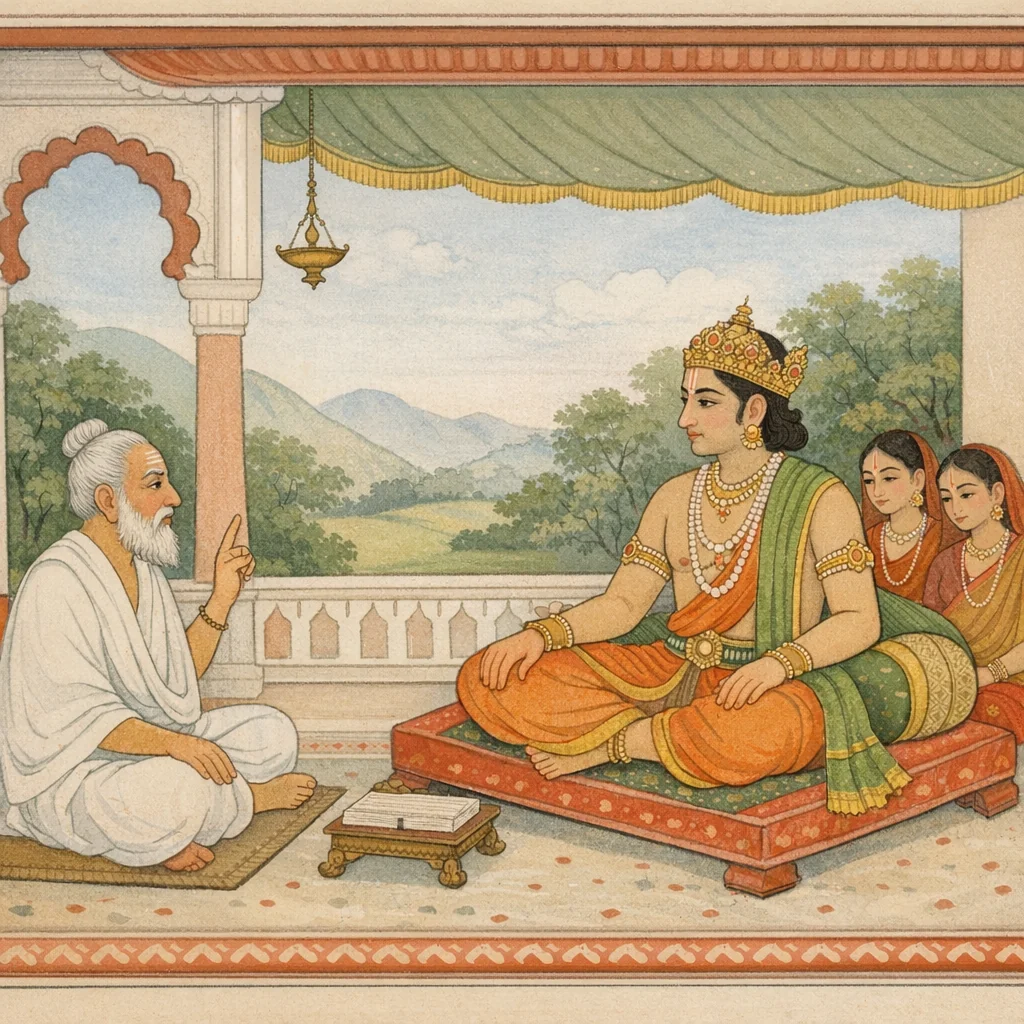
A brāhmaṇa introduces an ancient itihāsa: a dialogue with King Janaka. The king, encountering the brāhmaṇa, remarks—apparently as a test of propriety—that the brāhmaṇa should not dwell in his ‘viṣaya’ (domain). The brāhmaṇa replies with deliberate compliance, stating he wishes to live in another king’s territory, thereby prompting Janaka’s reflective silence and momentary distress (kaśmala). Recovering composure, Janaka explains that despite searching he cannot locate any exclusive ‘domain’ that can truly be called his: neither Mithilā, nor its people, nor the earth itself yields a stable basis for “this is mine.” He articulates the doctrinal pivot: by discerning the finitude of undertakings and by reflecting on ownership-questions (“kasyedam?” “kasya svam?”), he abandons mamatva. Janaka then frames conquest as sensory and mental restraint—he does not seek objects for the self (smell, taste, form/light, touch, sound, and the mind’s movements), therefore the elements and faculties are described as ‘conquered’ and under control. Actions, he concludes, are undertaken for gods, ancestors, beings, and guests—i.e., duty and relational obligation rather than private appropriation. The brāhmaṇa closes by identifying the exchange as a dharma-oriented inquiry, praising Janaka’s role in sustaining an ordered moral ‘wheel’ of disciplined intelligence.
Chapter Arc: A king famed for wisdom—Janaka—confronts a Brahmin seized for an alleged offense, declaring that the Brahmin must not dwell in his realm, as though sovereignty itself were a moral boundary. → The Brahmin challenges the very notion of ‘your realm’: define, O king, the extent of what lies under your control. Janaka’s confidence in possession and jurisdiction is pressed by the Brahmin’s relentless inquiry into what truly belongs to anyone—land, body, pleasures, even the self. → With delusion dispelled, the insight breaks forth: ‘Now I deem no single place my kingdom—or else all is my kingdom; even this self is not mine—or else the whole earth is mine.’ The paradox reveals the collapse of possessiveness and the birth of non-ownership. → The teaching turns inward: mastery is not conquest of provinces but conquest of craving—tastes in the mouth are not to be enjoyed for ‘my’ satisfaction; the elements and impulses stand subdued when the ego’s claim is withdrawn. Janaka is shown the path where rule becomes restraint and authority becomes renunciation.
Shlokas
Verse 1
ऑपन--+र< बक। है २ द्वात्रिशोड्थ्याय: ब्राह्मणरूपधारी धर्म और जनकका ममत्वत्यागविषयक संवाद ब्राह्मण उवाच अत्राप्युदाहरन्तीममितिहासं पुरातनम् । ब्राह्मणस्य च संवादं जनकस्य च भाविनि,ब्राह्मणने कहा--भामिनि! इसी प्रसंगमें एक ब्राह्मण और राजा जनकके संवादरूप प्राचीन इतिहासका उदाहरण दिया जाता है
The Brāhmaṇa said: “Beloved lady, in this very connection they also cite an ancient precedent—an old historical example—namely, a dialogue between a Brāhmaṇa and King Janaka.”
Verse 2
ब्राह्मणं जनको राजा सन्न॑ कस्मिंक्षिदागसि । विषये मे न वस्तव्यमिति शिष्ट्यर्थमब्रवीत्,एक समय राजा जनकने किसी अपराधमें पकड़े हुए ब्राह्मणको दण्ड देते हुए कहा --“ब्रह्मन! आप मेरे देशसे बाहर चले जाइये'
The Brahmin said: King Janaka, having found a Brahmin implicated in some offence, spoke to him by way of discipline and instruction: “Brahmin, you must not remain within my realm; leave my country.”
Verse 3
इत्युक्त: प्रत्युवाचाथ ब्राह्मणो राजसत्तमम् | आचक्ष्व विषयं राजन् यावांस्तव वशे स्थित:,; बन्-+ ना ० ऑन ि-ण >जा 9 32% /५ 2) 28 ८ यह सुनकर ब्राह्मणने उस श्रेष्ठ राजाको उत्तर दिया--“महाराज! आपके अधिकारमें जितना देश है, उसकी सीमा बताइये
Thus addressed, the brāhmaṇa replied to the best of kings: “O King, declare the extent of your realm—how much territory lies under your control.”
Verse 4
सोअन्यस्य विषये राज्ञो वस्तुमिच्छाम्यहं विभो | वचस्ते कर्तुमिच्छामि यथाशास्त्रं महीपते,'सामर्थ्यशाली नरेश! इस बातको जानकर मैं दूसरे राजाके राज्यमें निवास करना चाहता हूँ और शास्त्रके अनुसार आपकी आज्ञाका पालन करना चाहता हूँ
The brāhmaṇa said: “O mighty lord, having understood this, I wish to dwell in the realm of another king. Yet, O protector of the earth, I also wish to carry out your command in accordance with the śāstras.”
Verse 5
इत्युक्तस्तु तदा राजा ब्राह्मणेन यशस्विना । मुहुरुष्णं विनि:श्वस्य न किंचित् प्रत्यभाषत,उस यशस्वी ब्राह्मणके ऐसा कहनेपर राजा जनक बार-बार गरम उच्छवास लेने लगे, कुछ जवाब न दे सके
Thus addressed by the illustrious brāhmaṇa, King Janaka repeatedly let out hot, heavy breaths; overcome and reflective, he could not offer any reply. The moment underscores how truthful admonition can silence even a powerful ruler, compelling inward reckoning rather than immediate speech.
Verse 6
तमासीनं ध्यायमानं राजानममितौजसम् | कश्मलं सहसागच्छद् भानुमन्तमिव ग्रह:,वे अमित तेजस्वी राजा जनक बैठे हुए विचार कर रहे थे, उस समय उनको उसी प्रकार मोहने सहसा घेर लिया जैसे राहु ग्रह सूर्यको घेर लेता है
The Brahmin said: As that mighty king sat absorbed in contemplation, a sudden bewilderment seized him—like a planet (Rāhu) eclipsing the radiant sun. The verse underscores how even a powerful ruler, when faced with inner conflict, can be overtaken by delusion, and hints at the ethical need for clarity and steadiness of mind in kingship.
Verse 7
समाश्चास्य ततो राजा विगते कश्मले तदा । ततो मुहूर्तादिव त॑ ब्राह्मणं वाक्यमब्रवीत्,जब राजा जनक विश्राम कर चुके और उनके मोहका नाश हो गया, तब थोड़ी देर चुप रहनेके बाद वे ब्राह्मणसे बोले
When the king had regained composure and his delusion had passed away, after a brief pause he addressed the brāhmaṇa with words—signaling a return to clarity, restraint, and readiness to hear and act in accordance with dharma.
Verse 8
जनक उवाच पितृपैतामहे राज्ये वश्ये जनपदे सति । विषयं नाधिगच्छामि विचिन्वन् पृथिवीमहम्,जनकने कहा--ब्रह्मन! यद्यपि बाप-दादोंके समयसे ही मिथिला-प्रान्तके राज्यपर मेरा अधिकार है, तथापि जब मैं विचारदृष्टिसे देखता हूँ तो सारी पृथ्वीमें खोजनेपर भी कहीं मुझे अपना देश नहीं दिखायी देता
Janaka said: “O Brāhmaṇa, although I hold rightful authority over this kingdom and its obedient realm, inherited from my father and forefathers, yet when I examine matters with discerning reflection and search across the whole earth, I do not truly find any ‘country’ that I can call mine.”
Verse 9
नाधिगच्छं यदा पृथ्व्यां मिथिला मार्गिता मया । नाध्यगच्छं यदा तस्यां स्वप्रजा मार्गिता मया
Janaka said: “When I searched the earth for Mithilā, I could not find her; and when I searched within that very Mithilā for my own people, I could not find them.”
Verse 10
ततो मे कश्मलस्यान्ते मति: पुनरुपस्थिता,फिर विचारके द्वारा उस मोहका नाश होनेपर मैं इस नतीजेपर पहुँचा हूँ कि कहीं भी मेरा राज्य नहीं है अथवा सर्वत्र मेरा ही राज्य है। एक दृष्टिसे यह शरीर भी मेरा नहीं है और दूसरी दृष्टिसे यह सारी पृथ्वी ही मेरी है
Janaka said: “When my inner confusion came to an end, clarity returned to my mind. With reflection, once delusion was dispelled, I arrived at this conclusion: either I have no kingdom anywhere, or else the whole world is my kingdom. From one standpoint, even this body is not ‘mine’; from another standpoint, the entire earth is indeed mine.”
Verse 11
तदा न विषयं मन्ये सर्वो वा विषयो मम | आत्मापि चायं न मम सर्वा वा पृथिवी मम,फिर विचारके द्वारा उस मोहका नाश होनेपर मैं इस नतीजेपर पहुँचा हूँ कि कहीं भी मेरा राज्य नहीं है अथवा सर्वत्र मेरा ही राज्य है। एक दृष्टिसे यह शरीर भी मेरा नहीं है और दूसरी दृष्टिसे यह सारी पृथ्वी ही मेरी है
Janaka said: “Then I no longer regard anything as ‘my domain’—either nothing at all is mine, or else everything is mine. From one standpoint even this embodied self is not mine; from another standpoint, the whole earth is mine.”
Verse 12
यथा मम तथान्येषामिति मन्ये द्विजोत्तम । उष्यतां यावदुत्साहो भुज्यतां यावदुष्यते,यह जिस तरह मेरी है, उसी तरह दूसरोंकी भी है--ऐसा मैं मानता हूँ। इसलिये द्विजोत्तर! अब आपकी जहाँ इच्छा हो, रहिये एवं जहाँ रहें, उसी स्थानका उपभोग कीजिये
Janaka said: “I hold this to be true, O best of Brahmins: as it is for me, so it is for others as well. Therefore, remain wherever you wish for as long as your strength and zeal endure, and enjoy the rightful use of whatever is available in the place where you stay.”
Verse 13
ब्राह्मण उवाच पितृपैतामहे राज्ये वश्ये जनपदे सति । ब्रूहि कां मतिमास्थाय ममत्वं वर्जित त्वया,ब्राह्मणने कहा--राजन्! जब बाप-दादोंके समयसे ही मिथिला-प्रान््कके राज्यपर आपका अधिकार है, तब बताइये, किस बुद्धिका आश्रय लेकर आपने इसके प्रति अपनी ममताको त्याग दिया है?
The Brahmin said: “O King, when this realm and its people have been under your rightful authority since the time of your father and grandfather, tell me—what understanding have you relied upon that you have renounced all sense of ‘mine-ness’ toward it?”
Verse 14
कां वै बुद्धि समाश्रित्य सर्वो वै विषयस्तव । नावैषि विषयं येन सर्वो वा विषयस्तव,किस बुद्धिका आश्रय लेकर आप सर्वत्र अपना ही राज्य मानते हैं और किस तरह कहीं भी अपना राज्य नहीं समझते एवं किस तरह सारी पृथ्वीको ही अपना देश समझते हैं?
The Brāhmaṇa said: “Relying on what kind of understanding do you regard every place as your own domain? And by what understanding do you not recognize any place as your domain—so that, in a deeper sense, the whole earth becomes your country?”
Verse 15
जनक उवाच अन्तवन्त इहावस्था विदिता: सर्वकर्मसु | नाध्यगच्छमहं तस्मान्ममेदमिति यद् भवेत्,जनकने कहा--ब्रह्मन! इस संसारमें कर्मोके अनुसार प्राप्त होनेवाली सभी अवस्थाएँ आदि-अन्तवाली हैं, यह बात मुझे अच्छी तरह मालूम है। इसलिये मुझे ऐसी कोई वस्तु नहीं प्रतीत होती जो मेरी हो सके
Janaka said: “O Brahmin, I clearly understand that in this world all conditions and attainments that arise in connection with actions are finite—having a beginning and an end. Therefore I do not arrive at the notion ‘this is mine’; nothing appears to me as something that can truly be possessed.”
Verse 16
कस्येदमिति कस्य स्वमिति वेदवचस्तथा । नाध्यगच्छमहं बुद्ध्या ममेदमिति यद् भवेत्,वेद भी कहता है--“यह वस्तु किसकी है? यह किसका धन है? (अर्थात् किसीका नहीं है)! इसलिये जब मैं अपनी बुद्धिसे विचार करता हूँ, तब कोई भी वस्तु ऐसी नहीं जान पड़ती, जिसे अपनी कह सकें
Janaka said: “The Vedic word itself asks, ‘Whose is this? Whose wealth is it?’—implying that, in truth, it belongs to none. Therefore, when I examine with my own understanding, I do not find any thing that can rightly be fixed as ‘mine.’”
Verse 17
एतां बुद्धिं समाश्रित्य ममत्व॑ वर्जितं मया । शृणु बुद्धि च यां ज्ञात्वा सर्वत्र विषयो मम,इसी बुद्धिका आश्रय लेकर मैंने मिथिलाके राज्यसे अपना ममत्व हटा लिया है। अब जिस बुद्धिका आश्रय लेकर मैं सर्वत्र अपना ही राज्य समझता हूँ, उसको सुनो
Janaka said: “Relying on this understanding, I have cast off the sense of ‘mine’ with regard to the kingdom of Mithilā. Now listen to that understanding by knowing which I regard every sphere of experience as within my own domain—free from possessiveness and grounded in inner sovereignty.”
Verse 18
नाहमात्मार्थमिच्छामि गन्धान् प्राणगतानपि । तस्मान्मे निर्जिता भूमिर्वशे तिष्ठति नित्यदा,मैं अपनी नासिकामें पहुँची हुई सुगन्न्धको भी अपने सुखके लिये नहीं ग्रहण करना चाहता। इसलिये मैंने पृथ्वीको जीत लिया है और वह सदा ही मेरे वशमें रहती है
Janaka said: “I do not desire even fragrances that have reached my very breath for my own pleasure. Therefore, having conquered the earth (through self-mastery), it remains ever under my control.”
Verse 19
नाहमात्मार्थमिच्छामि रसानास्ये5पि वर्ततः । आपो मे निर्जितास्तस्माद् वशे तिष्ठन्ति नित्यदा,मुखमें पड़े हुए रसोंका भी मैं अपनी तृप्तिके लिये नहीं आस्वादन करना चाहता, इसलिये जलतत्त्वपर भी मैं विजय पा चुका हूँ और वह सदा मेरे अधीन रहता है
Janaka said: “I do not seek tastes for my own gratification, even when flavors are present in my mouth. Therefore I have conquered the principle of water as well, and it remains forever under my control.”
Verse 20
नाहमात्मार्थमिच्छामि रूप॑ ज्योतिश्न चक्षुष: । तस्मान्मे निर्जितं ज्योतिर्वशे तिष्ठति नित्यदा,मैं नेत्रके विषयभूत रूप और ज्योतिका अपने सुखके लिये अनुभव नहीं करना चाहता, इसलिये मैंने तेजको जीत लिया है और वह सदा मेरे अधीन रहता है
Janaka said: “I do not wish to experience form and light—the objects of the eye—for my own gratification. Therefore I have conquered the radiance (of the senses), and it remains always under my control.”
Verse 21
नाहमात्मार्थमिच्छामि स्पर्शास्त्वचि गताश्न ये । तस्मान्मे निर्जितो वायुर्वशे तिष्ठति नित्यदा,तथा मैं त्वचाके संसर्गसे प्राप्त हुए स्पर्शजनित सुखोंको अपने लिये नहीं चाहता, अतः मेरे द्वारा जीता हुआ वायु सदा मेरे वशमें रहता है
Janaka said: “I do not seek for myself the pleasures born of touch that arise when contact reaches the skin. Therefore, having conquered the vital wind, I keep it always under my control.”
Verse 22
नाहमात्मार्थमिच्छामि शब्दान् श्रोत्रगतानपि । तस्मान्मे निर्जिता: शब्दा वशे तिष्ठन्ति नित्यदा,मैं कानोंमें पड़े हुए शब्दोंको भी अपने सुखके लिये नहीं ग्रहण करना चाहता, इसलिये वे मेरे द्वारा जीते हुए शब्द सदा मेरे अधीन रहते हैं
Janaka said: “I do not desire even the sounds that enter the ear for the sake of my own pleasure. Therefore, those sounds—conquered by me—remain always under my control.”
Verse 23
नाहमात्मार्थमिच्छामि मनो नित्यं मनो<न्तरे | मनो मे निर्जितं तस्माद् वशे तिष्ठति नित्यदा,मैं मनमें आये हुए मन्तव्य विषयोंका भी अपने सुखके लिये अनुभव करना नहीं चाहता, इसलिये मेरे द्वारा जीता हुआ मन सदा मेरे वशमें रहता है
Janaka said: “I do not desire, for my own pleasure, even the experiences and objects of thought that arise within the mind. Therefore my mind—having been conquered by me—remains always under my control.”
Verse 24
देवेभ्यश्न पितृभ्यश्न भूतेभ्योडतिथिभि: सह । इत्यर्थ सर्व एवेति समारम्भा भवन्ति वै,मेरे समस्त कार्योंका आरम्भ देवता, पितर, भूत और अतिथियोंके निमित्त होता है
Janaka said: “My undertakings begin with a sense of offering—directed to the gods and the ancestors, and also mindful of living beings and guests. In this way, every action I commence is meant for the welfare and honoring of all.”
Verse 25
ततः प्रहस्य जनकं ब्राह्मण: पुनरब्रवीत् । त्वज्जिज्ञासार्थमद्येह विद्धि मां धर्ममागतम्,जनककी ये बातें सुनकर वह ब्राह्मण हँसा और फिर कहने लगा--“महाराज! आपको मालूम होना चाहिये कि मैं धर्म हूँ और आपकी परीक्षा लेनेके लिये ब्राह्मणका रूप धारण करके यहाँ आया हूँ
Verse 26
त्वमस्य ब्रह्मुलाभस्य दुर्वारस्यानिवर्तिन: । सत्त्वनेमिनिरुद्धस्य चक्रस्यैक: प्रवर्तक:,“अब मुझे निश्चय हो गया कि संसारमें सत्त्वमुणरूप नेमिसे घिरे हुए और कभी पीछेकी ओर न लौवनेवाले इस ब्रह्मप्राप्तिरूप दुर्निवार चक्रका संचालन करनेवाले एकमात्र आप ही हैं!
Verse 31
इस प्रकार श्रीमह्याभारत आश्वमेधिकपर्वके अन्तर्गत अनुगीतापर्वमें ब्राह्मणगीताविषयक इकतीसवाँ अध्याय पूरा हुआ
Thus ends the thirty-first chapter on the theme of the Brāhmaṇa’s Song (Brāhmaṇa-gītā) within the Anugītā section of the Āśvamedhika Parva of the revered Mahābhārata. This closing colophon marks the completion of a didactic unit, signaling a transition from the Brahmin’s discourse to the next portion of the narrative and instruction.
Verse 32
इति श्रीमहाभारते आश्वमेधिकेपर्वणि अनुगीतापर्वणि ब्राह्णगीतासु द्वात्रिंशोड्थ्याय:,इस प्रकार श्रीमह्याभारत आश्वमेधिकपर्वके अन्तर्गत अनुगीतापर्वमें ब्राह्मणगीताविषयक बत्तीसवाँ अध्याय पूरा हुआ
Thus, in the Śrī Mahābhārata, within the Aśvamedhika Parva, in the Anugītā section, the thirty-second chapter concerning the Brāhmaṇa-gītā concludes. (This is a colophon marking the end of the chapter rather than a spoken doctrinal verse.)
Verse 93
नाध्यगच्छ तदा तस्यां तदा मे कश्मलो5भवत् | जब पृथ्वीपर अपने राज्यका पता न पा सका तो मैंने मिथिलामें खोज की। जब वहाँसे भी निराशा हुई तो अपनी प्रजापर अपने अधिकारका पता लगाया, किंतु उनपर भी अपने अधिकारका निश्चय न हुआ, तब मुझे मोह हो गया
Janaka said: “At that time I could not discover it there; then confusion and inner bewilderment arose in me.” In context, Janaka describes a crisis of certainty about sovereignty and rightful authority—when he could not clearly locate the basis of his rule (first in the land, then in Mithilā, then in relation to his subjects), his mind fell into delusion, prompting deeper inquiry into what truly constitutes legitimate kingship and dharma.
Frequently Asked Questions
The dilemma concerns the legitimacy of claiming a ‘domain’ as one’s own: the brāhmaṇa’s challenge forces Janaka to justify ownership and authority without falling into mamatva (appropriative ‘mine-ness’).
True sovereignty is internal: by relinquishing possessiveness and restraining sensory and mental craving, one can act for duty—toward gods, ancestors, beings, and guests—without being bound by ownership-claims.
Yes. The brāhmaṇa explicitly frames the passage as an ancient itihāsa and later clarifies that he has come for dharma-inquiry (jijñāsā), signaling that the episode is exemplary instruction rather than mere courtly exchange.